Curriculum
EST II Physics
1. Mechanics
0/19
2. Electricity and Magnetism
0/15
-
2. Electricity and Magnetism
 Preview
-
2.1 Electric Charge and Coulomb’s Law
Preview
-
2.1 Electric Charge and Coulomb’s Law - Check yourself
 Preview
-
2.2 Electric Fields and Electric Potential
Preview
-
2.2 Electric Fields and Electric Potential - Check yourself
Preview
-
2.3 Capacitance
Preview
-
2.3 Capacitance - Check yourself
Preview
-
2.4 Current, Resistance and DC Circuits
Preview
-
2.4 Current, Resistance and DC Circuits - Check yourself
Preview
-
2.5 Electrical Energy and Power
Preview
-
2.5 Electrical Energy and Power - Check yourself
Preview
-
2.6 Magnetic Fields and Magnetic Forces
Preview
-
2.6 Magnetic Fields and Magnetic Forces - Check yourself
Preview
-
2.7 Electromagnetic Induction
Preview
-
2.7 Electromagnetic Induction - Check yourself
Preview
3. Waves and Optics
0/13
4. Heat and Thermodynamics
0/7
5. Modern Physics
0/11
6. Measurement, Analysis and Contemporary Physics
0/5
Text lesson
2. Electricity and Magnetism
Unit 2 Electricity and Magnetism — EST II PHYSICS notes: You will be able to connect the seven topics of Unit 2 by explaining how electric charges create fields and potentials, how capacitors and circuits store and transfer energy, how moving charges create and feel magnetic forces, and how changing magnetic flux produces emf.
1Charges, fields and potentials2Charges, fields and potentials
1Storing charge and energy2Storing charge and energy3Storing charge and energy4Storing charge and energy
1Current, resistance and circuits2Current, resistance and circuits3Current, resistance and circuits
1Magnetic fields and forces2Magnetic fields and forces3Magnetic fields and forces
Magnetic fields and forces
Magnetic fields and forces
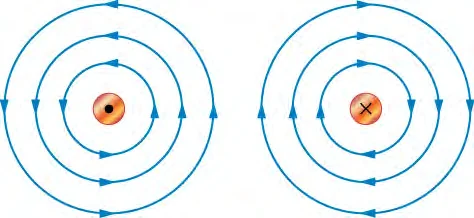
Currents produce magnetic fields.
1 / 3Next ▶
Magnetic fields and forces
1
A long straight wire, a loop and a solenoid each have a characteristic field formula in terms of
2
μ
3
0
4
(topic 2.6).
5
A moving charge or a current-carrying wire feels a force perpendicular to the field,
6
and the force between parallel wires depends on the currents and the separation.
◀ Previous2 / 3Next ▶
Magnetic fields of currents: Circular magnetic field lines around two straight wires, one with current out of the page and one into it.
Magnetic fields and forces
 ⤢ Enlarge
1
A charged particle moving perpendicular to a uniform field moves in a circle with a radius that depends on its speed,
2
and the period does not depend on the speed.
◀ Previous3 / 3
1Electromagnetic induction2Electromagnetic induction
1How the topics connect2How the topics connect
Key equations of Unit 2
| Topic | Equation | Quantities and SI units |
|---|---|---|
| 2.1 Charge and Coulomb’s law | q = ne; F = k|q1q2|/r2 | q in C, e = 1.60 × 10⁻¹⁹ C, F in N, r in m, k = 9.0 × 10⁹ N·m2/C2 |
| 2.2 Fields and potential | E = F/q; E = kQ/r2; E = ΔV/d; V = kQ/r; W = qΔV | E in N/C or V/m, V in V, d in m, W in J |
| 2.3 Capacitance | C = Q/ΔV; C = κε0A/d; U = (1⁄2)CΔV2; τ = RC | C in F, ε0 = 8.85 × 10⁻¹² F/m, A in m2, τ in s |
| 2.3 Series and parallel capacitors | 1/Ceq = Σ1/Ci (series); Ceq = ΣCi (parallel) | C in F |
| 2.3 Charging and discharging | q = Q0(1 − e−t/τ) (charging); q = Q0e−t/τ (discharging) | q in C, t in s |
| 2.4 Current and resistance | I = ΔQ/Δt; R = ΔV/I; R = ρL/A | I in A, R in Ω, ρ in Ω·m, L in m, A in m2 |
| 2.4 Networks and sources | Req = ΣRi (series); 1/Req = Σ1/Ri (parallel); I = ε/(R + r); V = ε − Ir | ε in V, r in Ω |
| 2.5 Power and energy | P = IΔV = I2R = ΔV2/R; E = Pt | P in W, E in J (1 kWh = 3.6 × 10⁶ J), t in s |
| 2.6 Magnetic fields of currents | B = μ0I/(2πr) (long wire); B = μ0I/(2R) (loop centre); B = μ0nI (solenoid) | B in T, μ0 = 4π × 10-7 T·m/A, n in turns/m |
| 2.6 Forces and motion | F = qvB sinθ; r = mv/(qB); T = 2πm/(qB); F = BIL sinθ; F/L = μ0I1I2/(2πd) | F in N, v in m/s, m in kg, L and d in m |
| 2.7 Flux and induction | Φ = BA cosθ; ε = −NΔΦ/Δt; ε = BLv; ε = NBAω sinωt | Φ in Wb (T·m2), ε in V, ω in rad/s |
| 2.7 Transformers | Vs/Vp = Ns/Np; VpIp = VsIs (ideal) | Voltages in V, currents in A |
Key terms
| Term | Meaning |
|---|---|
| Superposition | The principle that fields, forces and potentials from several sources are combined by adding them (as vectors for fields and forces, and as scalars for potentials). |
| Equipotential | A surface on which the electric potential is the same at every point, and which is always perpendicular to the field lines. |
| Time constant (τ) | The product RC, which sets how quickly a capacitor in an RC circuit charges or discharges. |
| Kirchhoff’s rules | The junction rule (conservation of charge) and the loop rule (conservation of energy) used to solve DC circuits. |
| Joule heating | The conversion of electrical energy to thermal energy in a resistor at a rate I2R. |
| Magnetic flux (Φ) | The product BA cosθ, measured in webers, which determines the induced emf. |
| Lenz’s law | The rule that an induced current opposes the change in flux that produces it. |
| Transformer | A pair of coils linked by a magnetic core that changes AC voltage in the ratio of the turns. |
1Avoid these mistakes2Avoid these mistakes3Avoid these mistakes