Curriculum
EST II Physics
1. Mechanics
0/19
2. Electricity and Magnetism
0/15
3. Waves and Optics
0/13
4. Heat and Thermodynamics
0/7
5. Modern Physics
0/11
-
5. Modern Physics
 Preview
-
5.1 Photons and the Photoelectric Effect
Preview
-
5.1 Photons and the Photoelectric Effect - Check yourself
 Preview
-
5.2 Atomic Models and Spectra
Preview
-
5.2 Atomic Models and Spectra - Check yourself
Preview
-
5.3 Nuclear Physics and Radioactivity
Preview
-
5.3 Nuclear Physics and Radioactivity - Check yourself
Preview
-
5.4 Fundamental Particles
Preview
-
5.4 Fundamental Particles - Check yourself
Preview
-
5.5 Special Relativity
Preview
-
5.5 Special Relativity - Check yourself
Preview
6. Measurement, Analysis and Contemporary Physics
0/5
Text lesson
5.4 Fundamental Particles
5.4 Fundamental Particles — EST II PHYSICS notes: You will be able to classify particles as leptons or hadrons, describe the quark makeup of protons, neutrons and pions and find their charges, state how antiparticles differ from particles, and name the four fundamental forces with their relative strengths.
Particle physicists sort the particles they know into families.
The two main families are leptons and hadrons.
Leptons are particles that do not feel the strong nuclear force.
The six leptons are the electron, the muon and the tau, each with a charge of −1 except for their neutrinos, and the three neutrinos, which are electrically neutral.
The electron is the only charged lepton found in ordinary matter.
Hadrons are particles that do feel the strong nuclear force, and they are made of quarks.
Hadrons are divided into baryons, which contain three quarks, and mesons, which contain one quark and one antiquark.
The proton and neutron are baryons, and the pion is a meson.
The strong force holds quarks together inside hadrons, and it also binds protons and neutrons together in the nucleus.
The name lepton comes from a Greek word meaning light or small, and it does not mean that leptons are always light.
The muon, for example, is about 207 times as massive as the electron, but it is still a lepton because it does not interact through the strong force.
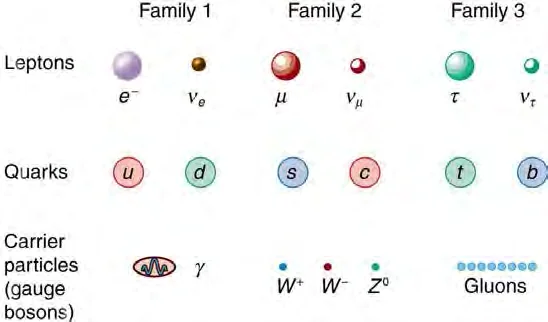
Quarks come in six flavours: up, down, strange, charm, bottom and top.
The up, charm and top quarks each have charge +2/3 of the elementary charge e, and the down, strange and bottom quarks each have charge −1/3 of e.
No quark has ever been observed alone, so quarks are only seen inside hadrons, and their charges are inferred from the charges of the hadrons they form.
A baryon is made of three quarks.
The proton has the quark combination uud, so its charge is (+2/3) + (+2/3) + (−1/3) = +1 e.
The neutron has the combination udd, so its charge is (+2/3) + (−1/3) + (−1/3) = 0.
Adding the charges of the quarks in any hadron always gives an integer multiple of e.
A meson is made of one quark and one antiquark.
The positive pion π+ is made of an up quark and an antidown quark (u d̄).
Its charge is (+2/3) + (+1/3) = +1 e, because the antidown quark has charge +1/3 e.
Every particle has an antiparticle with the same mass and the same spin, but with opposite values of charge and of the other additive quantum numbers.
The antiparticle of the electron is the positron, which has charge +e and the same mass as the electron.
The antiproton has charge −e, and the antineutron has zero charge but is made of antiquarks.
When a particle meets its antiparticle, the two annihilate and their mass energy appears as photons or other particles.
For an electron and a positron at rest, the total energy is 2 × 0.511 MeV = 1.02 MeV, which is released as two photons of 0.511 MeV each travelling in opposite directions.
Two photons are needed so that momentum and energy are both conserved.
The reverse process, pair production, needs a photon with energy at least 1.02 MeV, and a nucleus is usually present to conserve momentum.
Two conservation rules describe which reactions can occur.
Charge is always conserved.
Lepton number is conserved, counting +1 for each lepton and −1 for each antilepton; baryon number is conserved, counting +1 for each baryon and −1 for each antibaryon.
A reaction that breaks either rule does not happen.
All known interactions between particles come from four fundamental forces.
The strong nuclear force holds quarks together in hadrons and binds nucleons in nuclei.
It acts over a range of about 10−15 m, it is the strongest of the four, and it is carried by gluons.
The electromagnetic force acts between electric charges and is carried by photons.
It is about 1/137 as strong as the strong force, and it has an infinite range.
The weak nuclear force is responsible for beta decay and for many decays of particles.
It acts over a range of about 10−18 m, it is roughly a million times weaker than the strong force, and it is carried by the W+, W− and Z0 bosons.
The gravitational force acts between all masses.
It is by far the weakest of the four at the particle scale, about 10−39 of the strength of the strong force, and it has infinite range.
A graviton carrying gravity has been proposed but not observed.
In summary, the strong force is the strongest of the four, the weak force has the shorter range of the two nuclear forces, the electromagnetic force governs the structure of atoms and chemistry, the weak force governs some radioactive decays, and gravity dominates on large scales because it always attracts and has an infinite range.
Question
Show that a proton has charge +1 e using its quark content uud
1
Charges: up = +2/3, up = +2/3, down = −1/3.
2
Sum: 2/3 + 2/3 − 1/3 = 4/3 − 1/3 = 3/3 = +1
Answer
The proton has charge +1 e, as expected
Question
The negative pion π− has charge −1 e. Which quark and antiquark make it?
1
The pion is a meson with one quark and one antiquark.
2
A down quark has charge −1/3 and an anti-up quark has charge −2/3.
3
Their sum is −1/3 − 2/3 = −1.
4
The quark content is d ū
Answer
A down quark and an anti-up quark (d ū)
Question
An electron and a positron, each with rest energy 0.511 MeV, collide at rest and annihilate. Find the energy of each photon produced if two photons are emitted.
1
The total rest energy is 2 × 0.511 MeV = 1.022 MeV.
2
Two photons share this energy equally, because the particles were at rest and the photons travel in opposite directions with equal energy.
3
Each photon has energy 1.022 MeV/2 = 0.511 MeV.
Answer
Each photon has energy 0.511 MeV, and the total energy released is 1.02 MeV.
Thinking that quarks can be found on their own
Quarks are confined inside hadrons, and their charges are deduced from the hadrons they form.
Adding quark charges as whole numbers
Up quarks have +2/3 and down quarks have −1/3, so charges must be added as fractions.
Calling a muon or tau a hadron because it is heavy
Leptons do not feel the strong force, regardless of mass.
Giving an antiparticle the same charge as its particle
Antiparticles have the opposite charge. The antineutron is neutral like the neutron, but it is made of antiquarks, so it still differs from the neutron.
Stating that annihilation produces one photon
A single photon cannot conserve both energy and momentum when an electron and positron annihilate at rest, so two photons are produced.
Ranking the forces by range instead of strength
The strong force is the strongest, but gravity has the greatest range.