Curriculum
EST II Physics
1. Mechanics
0/19
2. Electricity and Magnetism
0/15
3. Waves and Optics
0/13
-
3. Waves and Optics
 Preview
-
3.1 General Wave Properties
Preview
-
3.1 General Wave Properties - Check yourself
 Preview
-
3.2 Sound and the Doppler Effect
Preview
-
3.2 Sound and the Doppler Effect - Check yourself
Preview
-
3.3 Superposition and Standing Waves
Preview
-
3.3 Superposition and Standing Waves - Check yourself
Preview
-
3.4 Reflection and Refraction
Preview
-
3.4 Reflection and Refraction - Check yourself
Preview
-
3.5 Mirrors, Lenses and Image Formation
Preview
-
3.5 Mirrors, Lenses and Image Formation - Check yourself
Preview
-
3.6 Physical Optics
Preview
-
3.6 Physical Optics - Check yourself
Preview
4. Heat and Thermodynamics
0/7
5. Modern Physics
0/11
6. Measurement, Analysis and Contemporary Physics
0/5
Text lesson
3.1 General Wave Properties
3.1 General Wave Properties — EST II PHYSICS notes: You will be able to classify waves as transverse or longitudinal, use v = fλ and T = 1/f, calculate the speed of a wave on a string, relate the energy of a wave to its amplitude, and order the regions of the electromagnetic spectrum.
1What a wave is2What a wave is
1Amplitude, wavelength, frequency and period2Amplitude, wavelength, frequency and period
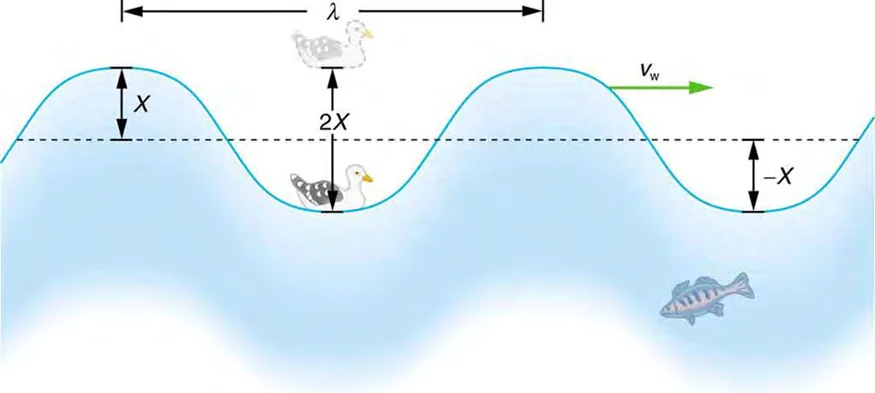
A water wave marked with amplitude, wavelength and wave speed. Image: OpenStax, College Physics for AP Courses, CC BY 4.0.
Amplitude, wavelength, frequency and period
 ⤢ Enlarge
Amplitude, wavelength, frequency and period
The amplitude A is the maximum displacement of a particle of the medium from its equilibrium position, measured in metres (m). For a transverse wave it is the height of a crest above the equilibrium line.
The wavelength λ is the distance from one point on a wave to the next point that is in the same state of motion, such as crest to crest or compression to compression. It is measured in metres (m).
The frequency f is the number of complete oscillations that pass a fixed point each second. It is measured in hertz (Hz)
where 1 Hz = 1 s−1. The period T is the time for one complete oscillation, measured in seconds (s). Period and frequency are reciprocals of each other:
T = 1/f
What the symbols mean:
T = period, the time for one complete wave (s) · f = frequency (Hz)
1 / 2Next ▶
Amplitude, wavelength, frequency and period
Amplitude, wavelength, frequency and period
where T is the period in seconds and f is the frequency in hertz. A frequency of 4 Hz therefore means a period of 0.25 s.
◀ Previous2 / 2
1Wave speed and the wave equation2Wave speed and the wave equation
Speed of a wave on a string
Speed of a wave on a string
The speed of a transverse wave on a string depends only on the tension in the string and on the mass of the string per unit length.
It does not depend on the amplitude or the frequency of the wave.
For a string with tension FT in newtons (N) and mass per unit length μ in kilograms per metre (kg/m):
v = √(FT/μ)
A tighter string carries waves faster, and a heavier string carries them more slowly. Doubling the tension multiplies the speed by √2
while quadrupling the tension doubles the speed. Once the speed is known, the frequency and wavelength of any wave on that string still satisfy v = fλ.
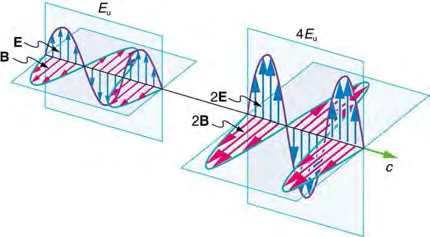
Doubling the electric and magnetic field amplitudes of a wave quadruples the energy it carries. Image: OpenStax, College Physics for AP Courses, CC BY 4.0.
Energy carried by a wave
 ⤢ Enlarge
1
A wave transfers energy from its source to the places it reaches. For a given wave, the energy carried is proportional to the square of the amplitude. Doubling the amplitude therefore makes the wave carry four times as much energy, and halving the amplitude leaves one quarter of the energy.
2
The rate at which a wave carries energy is its power P, measured in watts (W).
3
The power passing through unit area is the intensity I = P/A, measured in W/m2.
4
A point source sends waves out in all directions
so its energy spreads over a sphere of area 4πr2 at distance r.
5
The intensity therefore falls with the square of the distance from the source
which is why a light or a sound becomes much fainter far away.
The electromagnetic spectrum
The electromagnetic spectrum
Electromagnetic waves are transverse waves made of oscillating electric and magnetic fields.
The two fields are perpendicular to each other and to the direction of travel.
In a vacuum all electromagnetic waves travel at the speed of light, c = 3.0 × 10⁸ m/s
so for them c = fλ.
The waves differ only in their frequency and wavelength.
Listed from the longest wavelength to the shortest, with approximate ranges, the spectrum is: radio waves (longer than about 0.1 m), microwaves (about 1 mm to 0.1 m), infrared (about 700 nm to 1 mm), visible light (about 400 nm to 700 nm), ultraviolet (about 10 nm to 400 nm), X-rays (about 0.01 nm to 10 nm) and gamma rays (shorter than about 0.01 nm). Moving along the list from radio to gamma, the frequency increases and the energy of each photon increases with it.
Visible light is the small part of the spectrum that the human eye detects. Its colour depends on the frequency: red light has the lowest frequency in the visible band and violet has the highest.
1Example 1: Wavelength and period of a sound wave · Example 22Example 3: Frequency of green light
Key terms
| Term | Meaning |
|---|---|
| Wave | A disturbance that transfers energy from one place to another without transferring matter. |
| Transverse wave | A wave in which the oscillation is perpendicular to the direction of travel of the wave. |
| Longitudinal wave | A wave in which the oscillation is parallel to the direction of travel of the wave. |
| Amplitude (A) | The maximum displacement of a particle of the medium from its equilibrium position, in metres. |
| Wavelength (λ) | The distance between two successive points that are in the same state of motion, in metres. |
| Frequency (f) | The number of complete oscillations passing a point each second, in hertz. |
| Period (T) | The time for one complete oscillation, in seconds, equal to 1/f. |
| Wave speed (v) | The distance travelled by a wave per second, given by v = fλ, in metres per second. |
| Electromagnetic spectrum | The full range of electromagnetic waves, from radio waves to gamma rays, which differ only in frequency and wavelength. |
1Avoid these mistakes2Avoid these mistakes3Avoid these mistakes