Curriculum
EST II Physics
1. Mechanics
0/19
2. Electricity and Magnetism
0/15
3. Waves and Optics
0/13
4. Heat and Thermodynamics
0/7
-
4. Heat and Thermodynamics
 Preview
-
4.1 Temperature, Heat Transfer and Thermal Expansion
Preview
-
4.1 Temperature, Heat Transfer and Thermal Expansion - Check yourself
 Preview
-
4.2 Specific Heat and Latent Heat
Preview
-
4.2 Specific Heat and Latent Heat - Check yourself
Preview
-
4.3 Laws of Thermodynamics and Heat Engines
Preview
-
4.3 Laws of Thermodynamics and Heat Engines - Check yourself
Preview
5. Modern Physics
0/11
6. Measurement, Analysis and Contemporary Physics
0/5
Text lesson
4. Heat and Thermodynamics
Unit 4 Heat and Thermodynamics — EST II PHYSICS notes: You will be able to connect the three topics of Unit 4 by explaining how temperature and heat move energy between objects, how specific heat and latent heat account for the energy of heating and phase changes, and how the laws of thermodynamics limit the work that heat engines and refrigerators can do.
1What the unit covers2What the unit covers3What the unit covers4What the unit covers
Key equations of the unit
| Equation | Quantities and SI units | Topic |
|---|---|---|
| T (K) = T (°C) + 273 | Temperature in kelvins (K) or degrees Celsius (°C) | 4.1 |
| TF = (9⁄5)TC + 32 | Temperatures in degrees Fahrenheit and Celsius | 4.1 |
| P = kAΔT/L | P in W; k in W/(m·K); A in m2; ΔT in K; L in m | 4.1 |
| ΔL = αL0ΔT | ΔL and L0 in m; α in K−1; ΔT in K | 4.1 |
| ΔV = βV0ΔT, with β = 3α for solids | ΔV and V0 in m3; β in K−1 | 4.1 |
| Q = mcΔT | Q in J; m in kg; c in J/(kg·K); ΔT in K | 4.2 |
| Q = mL | Q in J; m in kg; L in J/kg | 4.2 |
| mhch(Th − Tf) = mccc(Tf − Tc) | Masses in kg; specific heats in J/(kg·K); temperatures in °C or K | 4.2 |
| PV = nRT = NkT | P in Pa; V in m3; n in mol; R = 8.31 J/(mol·K); N = number of particles; k = 1.38 × 10⁻²³ J/K; T in K | 4.3 |
| U = (3⁄2)nRT (monatomic ideal gas) | U in J; T in K | 4.3 |
| ΔU = Q − W | ΔU, Q, W in J; W is work done by the gas | 4.3 |
| W = PΔV | W in J; P in Pa; ΔV in m3 | 4.3 |
| ΔS = Q/T | ΔS in J/K; Q in J; T in K | 4.3 |
| e = W/QH = 1 − QC/QH; eC = 1 − TC/TH | Efficiency is dimensionless; temperatures in K | 4.3 |
| COP = QC/W; COPC = TC/(TH − TC) | Coefficient of performance is dimensionless; temperatures in K | 4.3 |
1How the three topics connect2How the three topics connect3How the three topics connect4How the three topics connect
1Example: Heating ice from a solid to warm water2Worked examples3Worked examples4Worked examples5Worked examples
Example: Heating ice from a solid to warm water
Example: Heating ice from a solid to warm water
A 0.20 kg block of ice at 0 °C is melted and the resulting water is warmed to 20 °C. Find the total energy needed. Take Lf = 3.3 × 10⁵ J/kg and cwater = 4.2 × 10³ J/(kg·K).
Working: Melting at 0 °C: Q1 = mLf = (0.20)(3.3 × 10⁵) = 6.6 × 10⁴ J.
1 / 5Next ▶
Worked examples
1
Warming the water:
2
Q
3
2
4
=
5
mc
6
Δ
◀ Previous2 / 5Next ▶
Worked examples
1
T
2
= (0.20)(4.2 × 10
3
3
4
)(20) = 1.68 × 10
5
4
6
J.
◀ Previous3 / 5Next ▶
Worked examples
Worked examples
The total is 6.6 × 10
J + 1.68 × 10
J = 8.28 × 10
Answer: 8.3 × 10⁴ J, to two significant figures. The melting step accounts for most of the energy.
◀ Previous4 / 5Next ▶
Key terms
| Term | Meaning |
|---|---|
| Thermal equilibrium | The state in which objects in contact have the same temperature and no net heat transfer between them. |
| Specific heat capacity | The energy needed to raise the temperature of one kilogram of a substance by one kelvin. |
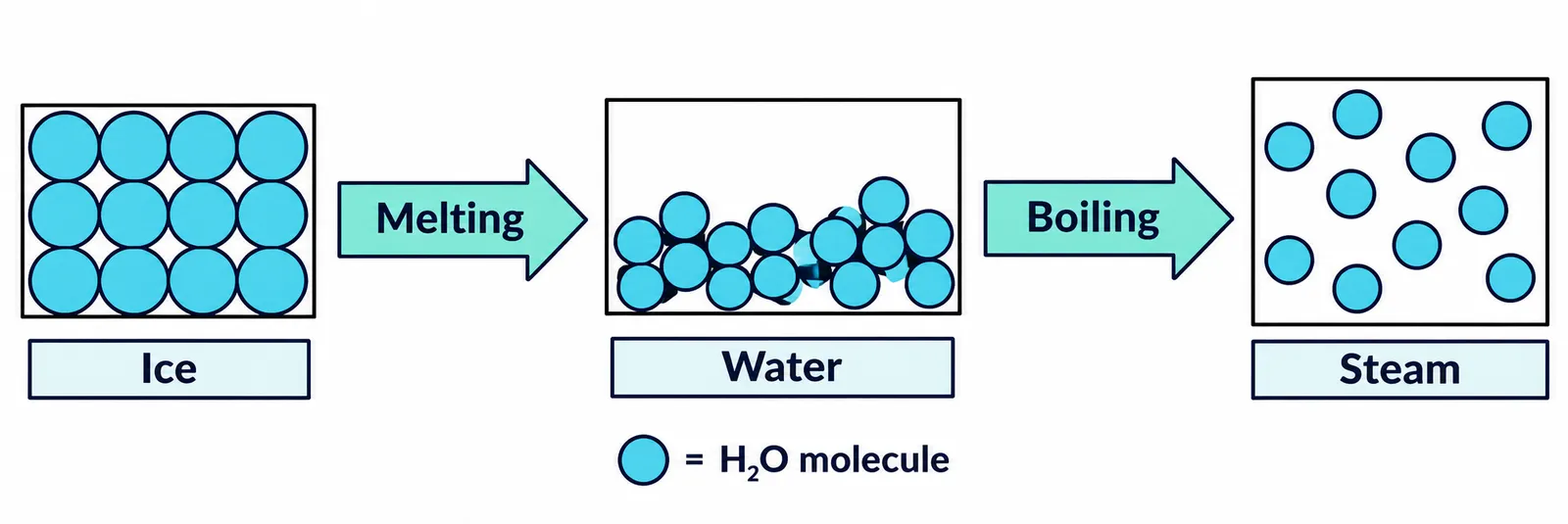
| Latent heat | The energy per kilogram needed to change the phase of a substance at constant temperature. |
| Internal energy | The sum of the random kinetic and potential energies of the particles in a system. |
| First law of thermodynamics | Conservation of energy for a system: the change in internal energy equals heat added minus work done by the system. |
| Entropy | A measure of how energy is spread among the possible arrangements of a system, measured in J/K. |
| Carnot efficiency | The maximum efficiency of a heat engine operating between two reservoirs, equal to 1 − TC/TH. |
| Coefficient of performance | For a refrigerator, the heat removed from the cold space divided by the work input. |
1Avoid these mistakes2Avoid these mistakes3Avoid these mistakes4Avoid these mistakes5Avoid these mistakes