Curriculum
EST II Physics
1. Mechanics
0/19
2. Electricity and Magnetism
0/15
3. Waves and Optics
0/13
4. Heat and Thermodynamics
0/7
5. Modern Physics
0/11
6. Measurement, Analysis and Contemporary Physics
0/5
-
6. Measurement, Analysis and Contemporary Physics
 Preview
-
6.1 Measurement, Units and Graphical Analysis
Preview
-
6.1 Measurement, Units and Graphical Analysis - Check yourself
 Preview
-
6.2 History of Physics and Contemporary Physics
Preview
-
6.2 History of Physics and Contemporary Physics - Check yourself
Preview
Text lesson
6. Measurement, Analysis and Contemporary Physics
Unit 6 Measurement, Analysis and Contemporary Physics — EST II PHYSICS notes: You will be able to check units and significant figures in any calculation, read and linearise graphs, and connect the experiments of physics history to the contemporary topics of the test.
1What the unit establishes2What the unit establishes3What the unit establishes
What the unit establishes
What the unit establishes
Unit 6 gives the tools that every other unit depends on.
1 / 3Next ▶
What the unit establishes
1
Topic 6.1 covers the SI system, prefixes, dimensional analysis, significant figures, uncertainty and the reading of graphs,
2
so that each answer in the test can be given in the right units and to the right precision.
3
Topic 6.2 places the physics you have studied in its history and shows how the same ideas reach into contemporary research.
4
The skills of the unit are used on every question. Before using any equation, check its units and dimensions. Before giving an answer, round it to the number of significant figures in the data. When a question shows a graph, identify the axes
then read a slope, an area or an intercept with the correct unit.
◀ Previous2 / 3Next ▶
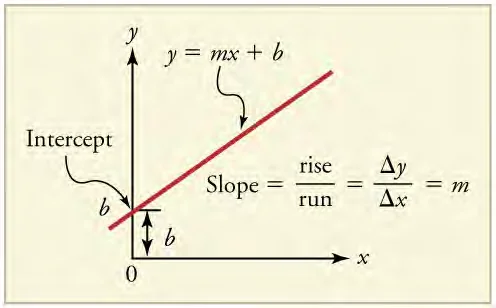
Reading graphs: slope, area and intercept: A straight-line graph with its slope and intercept marked.
What the unit establishes
◀ Previous3 / 3
Key equations of Unit 6
| Topic | Equation | Quantities and SI units |
|---|---|---|
| 6.1 | Percent uncertainty = (δx/x) × 100% | Absolute uncertainty δx and measured value x in the same unit; the result is a percentage |
| 6.1 | Slope = Δy/Δx | Unit of y divided by unit of x; on a v–t graph this is acceleration (m/s2) |
| 6.1 | Area under a graph | Unit of y multiplied by unit of x; on an F–x graph this is work (J), and on a v–t graph it is displacement (m) |
| 6.1 | Dimensions: [v] = [L][T]-1; [F] = [M][L][T]-2; [P] = [M][L]-1[T]-2 | Base dimensions of mass [M], length [L] and time [T]; both sides of an equation must match |
| 6.1 | d = ½at2, so a graph of d against t2 has slope ½a | Distance d (m), time t (s), acceleration a (m/s2) |
| 6.2 | F = Gm1m2/r2 | Force (N); masses (kg); separation (m); G is the gravitational constant |
| 6.2 | E = hf | Photon energy (J); frequency f (Hz); h = 6.63 × 10⁻³⁴ J·s |
| 6.2 | λ = h/p | De Broglie wavelength λ (m); momentum p (kg·m/s) |
| 6.2 | E = mc2 | Energy (J); mass (kg); speed of light c = 3.0 × 10⁸ m/s |
| 6.2 | v = H0d | Recession speed v (km/s); Hubble constant H0 (km/s per megaparsec); distance d (Mpc) |
How the two topics connect · How the two topics connect
How the two topics connect
Topic 6.1 provides the method and topic 6.2 provides the content. Dimensional analysis in 6.1 is the check used on the photon energy, the de Broglie wavelength and Hubble’s law in 6.2. The rules for significant figures from 6.1 decide how many digits an answer in 6.2 should have, and the graphical methods of 6.1 are the same ones used to find the constants in the experiments of history.
Topic 6.2 shows why the methods matter.
How the two topics connect
The Michelson–Morley null result, the Millikan measurement of quantized charge and the photoelectric effect each changed a model of nature,
and each was judged by careful measurement and by checking a prediction against data.
Contemporary physics applies the same approach to the expansion of the universe, to superconductors and to systems that show chaos.
Key terms
| Term | Meaning |
|---|---|
| Dimension | The combination of base quantities, [M], [L] and [T], that describes a physical quantity. |
| Significant figures | The digits of a value that are known with some confidence, including the first estimated digit. |
| Percent uncertainty | The absolute uncertainty divided by the measured value and multiplied by 100%. |
| Slope | The change in the vertical quantity divided by the change in the horizontal quantity on a straight-line graph. |
| Linearise | To choose new variables so that a relationship plots as a straight line from which a constant can be found. |
| Photon | A packet of electromagnetic energy with energy E = hf. |
| De Broglie wavelength | The wavelength λ = h/p associated with a particle of momentum p. |
| Hubble’s law | The relationship v = H0d between the recession speed of a galaxy and its distance. |
| Superconductor | A material with zero electrical resistance below a critical temperature, which expels magnetic fields from its interior. |
| Deterministic chaos | Behaviour that follows fixed rules but is so sensitive to initial conditions that long-term prediction is impractical. |
1Avoid these mistakes2Avoid these mistakes3Avoid these mistakes