Curriculum
EST II Physics
1. Mechanics
0/19
-
1. Mechanics
 Preview
-
1.1 Kinematics in One Dimension
Preview
-
1.1 Kinematics in One Dimension - Check yourself
 Preview
-
1.2 Projectile Motion and Motion in Two Dimensions
Preview
-
1.2 Projectile Motion and Motion in Two Dimensions - Check yourself
Preview
-
1.3 Forces and Newton’s Laws
Preview
-
1.3 Forces and Newton’s Laws - Check yourself
Preview
-
1.4 Statics and Friction
Preview
-
1.4 Statics and Friction - Check yourself
Preview
-
1.5 Work, Energy and Power
Preview
-
1.5 Work, Energy and Power - Check yourself
Preview
-
1.6 Impulse and Momentum
Preview
-
1.6 Impulse and Momentum - Check yourself
Preview
-
1.7 Circular Motion
Preview
-
1.7 Circular Motion - Check yourself
Preview
-
1.8 Simple Harmonic Motion
Preview
-
1.8 Simple Harmonic Motion - Check yourself
Preview
-
1.9 Gravitation, Orbits and Kepler’s Laws
Preview
-
1.9 Gravitation, Orbits and Kepler’s Laws - Check yourself
Preview
2. Electricity and Magnetism
0/15
3. Waves and Optics
0/13
4. Heat and Thermodynamics
0/7
5. Modern Physics
0/11
6. Measurement, Analysis and Contemporary Physics
0/5
Text lesson
1. Mechanics
Unit 1 Mechanics — EST II PHYSICS notes: You will be able to link the nine mechanics topics, choose the right principle for a problem, and use the key equations of the unit with correct SI units.
1How the nine topics connect2How the nine topics connect
How the nine topics connect
How the nine topics connect
Unit 1 describes motion and what causes it.
The topics form a chain.
Kinematics (1.1) and two-dimensional motion (1.2) describe how positions, velocities and accelerations change.
Newton’s laws (1.3) link those accelerations to forces,
and statics and friction (1.4) apply the same force rules to objects that are at rest or in equilibrium, together with the rules for torque and the centre of mass.
Work, energy and power (1.5) and impulse and momentum (1.6) give two different routes to the same results without finding every acceleration.
The work-energy theorem links force and displacement to speed,
and conservation of energy and momentum describe what happens in collisions and explosions.
1 / 2Next ▶
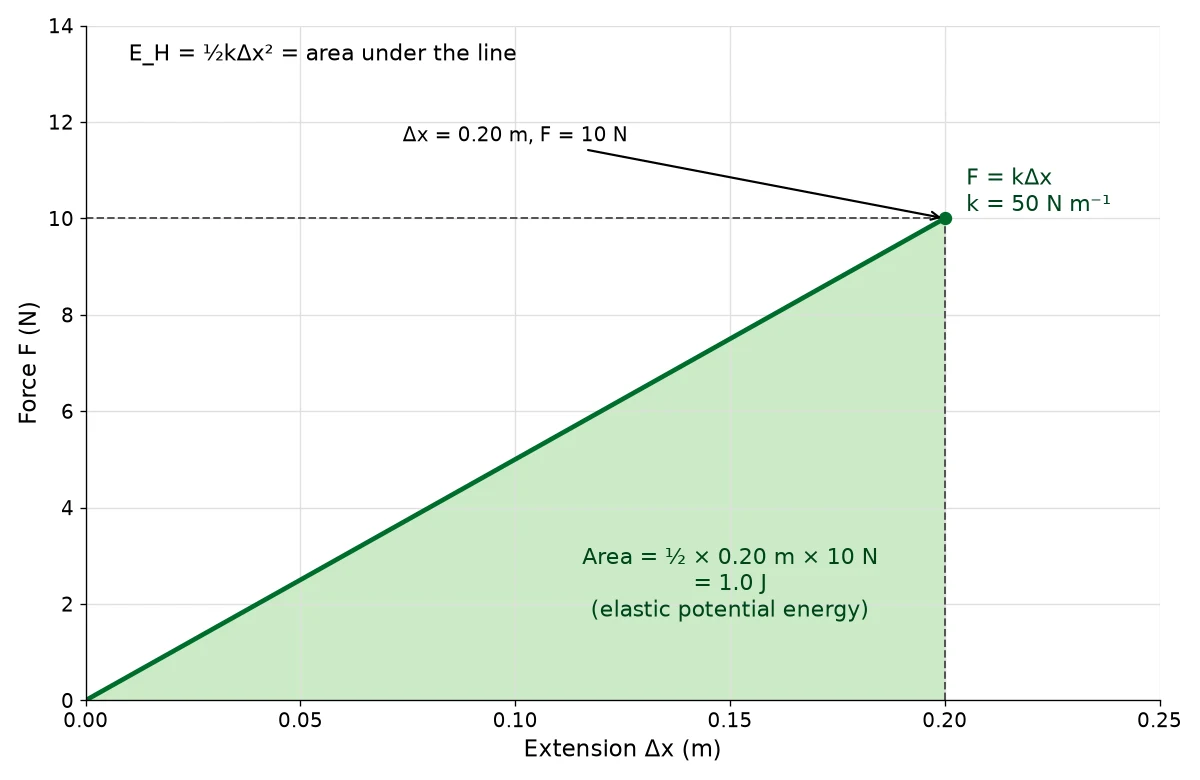
Force against extension graph for a spring obeying Hooke’s law with k = 50 N per m, showing the shaded triangle under the line up to 0.20 m
How the nine topics connect
 ⤢ Enlarge
1
Circular motion (1.7) applies Newton’s second law to an object whose velocity keeps turning,
and simple harmonic motion (1.8) applies it to a restoring force.
2
Gravitation, orbits and Kepler’s laws (1.9) apply Newton’s laws to the force between two masses and extend the same ideas to planets and satellites.
3
The common thread is that every problem starts with a free-body diagram or a sketch of the motion, a choice of axes and sign convention, and a choice of principle. Use Newton’s second law when the forces and the acceleration are needed, and use energy or momentum when the question asks for a speed after a change, a collision or a height without requiring the time or the acceleration.
◀ Previous2 / 2
Key equations of Unit 1
| Topic | Equation | Quantities and SI units |
|---|---|---|
| 1.1 | vavg = Δx/Δt; a = Δv/Δt | Velocity (m/s), displacement (m), acceleration (m/s2), time (s) |
| 1.1 | v = v0 + at; x − x0 = v0t + ½at2 | Constant acceleration only; g = 10 m/s2 in free fall |
| 1.1 | v2 = v02 + 2a(x − x0); x − x0 = ½(v0 + v)t | Each length in m; the first form needs no time |
| 1.2 | vx = v cos θ; vy = v sin θ | Components of velocity (m/s); θ measured from the horizontal |
| 1.2 | T = 2v sin θ/g; H = v2 sin2 θ/(2g); R = vxT | Time of flight (s), maximum height (m), range (m); level launch and landing |
| 1.2 | t = √(2h/g) for horizontal launch | Fall height h in m; t in s |
| 1.2 | vAC = vAB + vBC | Relative velocities (m/s), added as vectors |
| 1.3 | ΣF = ma; W = mg | Force and weight (N), mass (kg), acceleration (m/s2) |
| 1.3 | N = m(g + a) in a lift, a upward positive | Apparent weight (N); zero in free fall |
| 1.3 | a = (m2 − m1)g/(m1 + m2); T = 2m1m2g/(m1 + m2) | Two masses over a light frictionless pulley |
| 1.4 | fs ≤ μsN; fk = μkN | Friction (N); coefficients have no units |
| 1.4 | Incline: mg sin θ along the slope, N = mg cos θ | Weight components (N); θ the slope angle |
| 1.4 | τ = rF sin θ; ΣF = 0 and Στ = 0 | Torque (N·m), lever arm r (m) |
| 1.4 | xcm = (Σmx)/(Σm) | Centre of mass position (m) |
| 1.5 | W = Fd cos θ; Wnet = ΔK | Work (J), force (N), displacement (m) |
| 1.5 | K = ½mv2; Ug = mgh; Us = ½kx2 | Energies (J); k in N/m; x in m |
| 1.5 | ΔE = Wnc; work against friction = −fd | Mechanical energy conserved only without friction |
| 1.5 | P = W/t = Fv; efficiency = (useful output/input) × 100% | Power (W); efficiency has no unit |
| 1.6 | p = mv; J = FΔt = Δp | Momentum and impulse (kg·m/s or N·s) |
| 1.6 | Σpbefore = Σpafter; Favg = Δp/Δt | Isolated systems; average force (N) |
| 1.7 | f = 1/T; ω = 2π/T = 2πf; v = ωr | Frequency (Hz), angular speed (rad/s), radius (m) |
| 1.7 | ac = v2/r = ω2r; Fc = mv2/r | Directed towards the centre of the circle |
| 1.7 | vmin (top of vertical circle) = √(gr); vmax (flat curve) = √(μsgr); tan θ = v2/(gr) for a frictionless bank | Speeds in m/s; the mass cancels |
| 1.8 | F = −kx; a = −ω2x; ω = √(k/m) | Restoring force (N); angular frequency (rad/s) |
| 1.8 | T = 2π√(m/k); T = 2π√(L/g) | Spring and small-angle pendulum periods (s) |
| 1.8 | x = A cos(ωt); vmax = Aω; amax = Aω2; E = ½kA2 | Amplitude A (m); energy (J) |
| 1.9 | F = Gm1m2/r2; g = GM/r2 | G = 6.67 × 10⁻¹¹ N·m2/kg2; field in N/kg |
| 1.9 | v = √(GM/r); T = 2πr/v; T2 ∝ r3 | Orbital speed (m/s) and period (s); Kepler’s third law |
Choosing the right principle
Choosing the right principle
Most questions in this unit can be solved in more than one way, and the fastest method depends on what is asked.
Use Newton’s second law when a question gives forces and asks for an acceleration, or gives an acceleration and asks for a force.
Use kinematic equations when the acceleration is constant and time or distance is involved.
Use energy when a question asks for a speed at one height or position compared with another and no time is given.
Use momentum when two objects interact in a collision or explosion and the forces during the interaction are unknown.
For circular motion and oscillations, the force condition is always a net force directed to the centre or to equilibrium. For gravitation and orbits, the gravitational force is the centripetal force. For friction problems, check first whether an object is sliding or at rest
because this decides which friction law applies.
1Example 1: Using energy instead of Newton’s second law2Example 1: Using energy instead of Newton’s second law · Exa
Key terms
| Term | Meaning |
|---|---|
| Free-body diagram | A sketch showing one object and all the external forces acting on it, used as the first step in force problems. |
| Conservation of energy | The principle that the total energy of an isolated system remains constant, used with mechanical energy when no non-conservative forces act. |
| Conservation of momentum | The principle that the total momentum of an isolated system remains constant in collisions and explosions. |
| Centripetal force | The net force directed towards the centre of a circular path, which keeps an object moving in a circle. |
| Restoring force | A force directed towards equilibrium and proportional to displacement in simple harmonic motion. |
| Gravitational field strength | The gravitational force per unit mass at a point, measured in newtons per kilogram. |
1Avoid these mistakes2Avoid these mistakes3Avoid these mistakes