Curriculum
EST II Physics
1. Mechanics
0/19
2. Electricity and Magnetism
0/15
3. Waves and Optics
0/13
-
3. Waves and Optics
 Preview
-
3.1 General Wave Properties
Preview
-
3.1 General Wave Properties - Check yourself
 Preview
-
3.2 Sound and the Doppler Effect
Preview
-
3.2 Sound and the Doppler Effect - Check yourself
Preview
-
3.3 Superposition and Standing Waves
Preview
-
3.3 Superposition and Standing Waves - Check yourself
Preview
-
3.4 Reflection and Refraction
Preview
-
3.4 Reflection and Refraction - Check yourself
Preview
-
3.5 Mirrors, Lenses and Image Formation
Preview
-
3.5 Mirrors, Lenses and Image Formation - Check yourself
Preview
-
3.6 Physical Optics
Preview
-
3.6 Physical Optics - Check yourself
Preview
4. Heat and Thermodynamics
0/7
5. Modern Physics
0/11
6. Measurement, Analysis and Contemporary Physics
0/5
Text lesson
3.5 Mirrors, Lenses and Image Formation
3.5 Mirrors, Lenses and Image Formation — EST II PHYSICS notes: You will be able to describe images formed by pinhole cameras, plane mirrors, concave and convex mirrors, and converging and diverging lenses; draw ray diagrams; decide whether an image is real or virtual, upright or inverted; and use the mirror and lens equations and the magnification equation.
1
An image is a pattern of light that appears to come from the points of an object.
2
Each point of a luminous or lit object sends light in all directions, and an optical device collects some of that light and directs it to form an image.
Pinhole camera
A pinhole camera is a box with a small hole in one side.
1
Light from each point of the object passes through the hole in a straight line and lands on the opposite wall, so the image is inverted and reversed left to right.
2
The hole must be small so that light from one point reaches only one small spot on the screen; a larger hole blurs the image.
3
An image is real if light actually converges at its position, so it can be projected onto a screen.
4
An image is virtual if the light only appears to come from it, so it cannot be projected.
5
The pinhole image is real.
A plane mirror forms a virtual image that is upright, the same size as the object, and as far behind the mirror as the object is in front of it.
The object distance do and the image distance di are equal in magnitude, and a virtual image distance is given a negative sign in the equations of this topic.
The image is laterally inverted, so a right hand appears as a left hand.
Convex mirror, A convex mirror is curved outward and it diverges parallel light.
Focal point, The focal point F is the point where parallel rays meet, or appear to meet, after reflection.
Focal length, The focal length f is the distance from the mirror to the focal point, and for a spherical mirror it is half the radius of curvature R: f = R/2.
A ray diagram shows where an image forms.
Three rays are simple to draw for a mirror.
A ray parallel to the axis reflects through the focal point (or appears to come from it, for a convex mirror).
A ray that passes through the focal point reflects parallel to the axis.
A ray through the centre of curvature strikes the mirror along a normal and reflects straight back.
The point where the rays meet, or appear to meet, is the image.
A concave mirror gives a real, inverted image when the object is beyond the focal point, and a virtual, upright, enlarged image when the object is between the mirror and the focal point.
A convex mirror always gives a virtual, upright and smaller image.
1
where f is the focal length in metres (or centimetres), do is the object distance (positive for a real object in front of the mirror) and di is the image distance.
2
A positive di means a real image in front of the mirror; a negative di means a virtual image behind it.
3
A concave mirror has positive f and a convex mirror has negative f in this convention.
4
The magnification m compares the image height with the object height: m = hi/ho = −di/do, where ho and hi are the object and image heights, both in metres.
5
A negative m means the image is inverted; a positive m means it is upright.
6
An m with magnitude greater than 1 means the image is enlarged, and less than 1 means it is reduced.
Diverging lens
A diverging lens is thinner in the middle, and it spreads parallel rays out so that they appear to come from a focal point on the same side as the object.
For a converging lens, f is positive; for a diverging lens, f is negative.
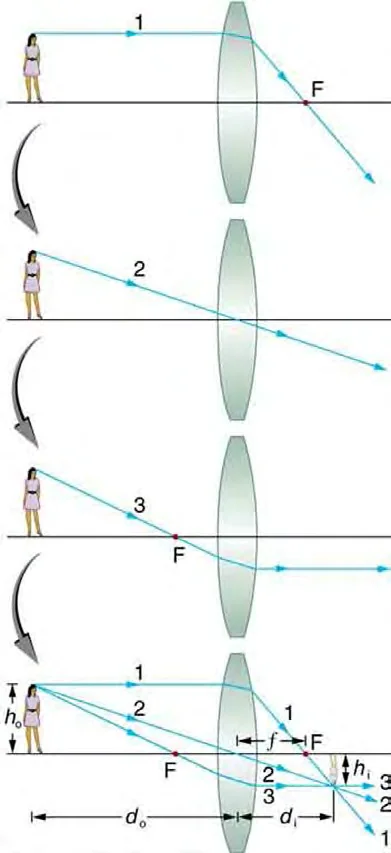
Ray diagrams for lenses also use three rays.
A ray through the centre of the lens goes straight through without bending.
The image is where the refracted rays meet or appear to meet.
A diverging lens always forms a virtual, upright and smaller image.
For lenses, a real image has di positive on the far side of the lens and a virtual image has di negative on the same side as the object.
A ray parallel to the axis is refracted through the far focal point of a converging lens.
A ray through the near focal point emerges parallel to the axis.
A converging lens forms a real, inverted image when the object lies beyond the focal length, and a virtual, upright and enlarged image when the object lies inside the focal length, which is how a magnifying glass works.
The lens equation has the same form as the mirror equation, 1/f = 1/do + 1/di, and the magnification equation m = −di/do also applies.
Example 1
Real image from a concave mirror
1
1/di = 1/f − 1/do = 1/10 − 1/30 = 3/30 − 1/30 = 2/30, so di = 15 cm.
2
Then m = −15 cm/30 cm = −0.5.
Answer
The image is real, 15 cm in front of the mirror, inverted and half the size of the object
Example 2
Virtual image from a convex mirror
1
1/di = 1/f − 1/do = −1/20 − 1/20 = −2/20, so di = −10 cm.
2
Then m = −(−10 cm)/20 cm = +0.5.
Answer
The image is virtual, 10 cm behind the mirror, upright and half the size of the object.
Example 3
Converging lens with the object at twice the focal length
1
1/di = 1/15 − 1/30 = 2/30 − 1/30 = 1/30, so di = 30 cm.
2
Then m = −30/30 = −1.
Answer
The image is real, 30 cm on the far side of the lens, inverted and the same size as the object.
Forgetting the sign of the focal length
A convex mirror and a diverging lens both have negative f in this course.
Reading a negative image distance as an error
A negative di means the image is virtual and on the same side as the object for a lens, or behind the mirror.
Calculating 1/di and then forgetting to invert it to find di
Always take the reciprocal at the end.
Assuming that all images are real
A plane mirror, a convex mirror and a diverging lens produce virtual images.
Giving the magnification a positive sign for a real image
A real image from a mirror or lens is inverted, so m is negative.