Curriculum
EST II Physics
1. Mechanics
0/19
2. Electricity and Magnetism
0/15
3. Waves and Optics
0/13
4. Heat and Thermodynamics
0/7
5. Modern Physics
0/11
-
5. Modern Physics
 Preview
-
5.1 Photons and the Photoelectric Effect
Preview
-
5.1 Photons and the Photoelectric Effect - Check yourself
 Preview
-
5.2 Atomic Models and Spectra
Preview
-
5.2 Atomic Models and Spectra - Check yourself
Preview
-
5.3 Nuclear Physics and Radioactivity
Preview
-
5.3 Nuclear Physics and Radioactivity - Check yourself
Preview
-
5.4 Fundamental Particles
Preview
-
5.4 Fundamental Particles - Check yourself
Preview
-
5.5 Special Relativity
Preview
-
5.5 Special Relativity - Check yourself
Preview
6. Measurement, Analysis and Contemporary Physics
0/5
Text lesson
5.3 Nuclear Physics and Radioactivity
5.3 Nuclear Physics and Radioactivity — EST II PHYSICS notes: You will be able to read nuclear notation, identify isotopes, balance alpha, beta and gamma decay equations, use half-life to find the amount of a sample remaining, calculate mass defect and binding energy, and compare nuclear fission with nuclear fusion.
The nucleus is made of protons and neutrons, which are collectively called nucleons.
A proton has positive charge and a neutron has no charge; both have a mass very close to 1 atomic mass unit (u), where 1 u = 1.66 × 10⁻²⁷ kg.
The number of protons in a nucleus is the atomic number Z, and the total number of nucleons is the mass number A.
The number of neutrons is N = A − Z.
A nuclide is written as AZX, where X is the chemical symbol of the element.
For example, 23892U is uranium with 92 protons and 146 neutrons.
Atoms with the same atomic number but different mass numbers are isotopes of the same element.
Isotopes have the same chemistry because they have the same number of electrons, but they can differ greatly in stability.
Some nuclei are unstable and emit radiation to become more stable.
This process is called radioactivity.
The emitted radiation is either an alpha particle, a beta particle or gamma-ray photons, and the nucleus that emerges is a different nuclide or a lower-energy form of the same nuclide.
In alpha decay, the nucleus emits an alpha particle, which is a helium nucleus 42He made of two protons and two neutrons.
The mass number falls by 4 and the atomic number falls by 2, so the product is a nuclide two places to the left in the periodic table.
Alpha particles are heavy and strongly ionising, but they have a short range in air.
In beta-minus decay, a neutron in the nucleus changes into a proton, an electron and an antineutrino.
The electron is emitted as the beta particle, written 0−1e, and the antineutrino carries away energy and momentum.
The mass number does not change, and the atomic number rises by 1.
Beta-plus decay, in which a proton changes into a neutron, a positron and a neutrino, lowers the atomic number by 1.
Beta particles are more penetrating than alpha particles but less ionising.
In gamma decay, the nucleus loses energy by emitting a high-energy photon, called a gamma ray.
Neither the mass number nor the atomic number changes.
Gamma decay usually follows alpha or beta decay, when the daughter nucleus is left in an excited state.
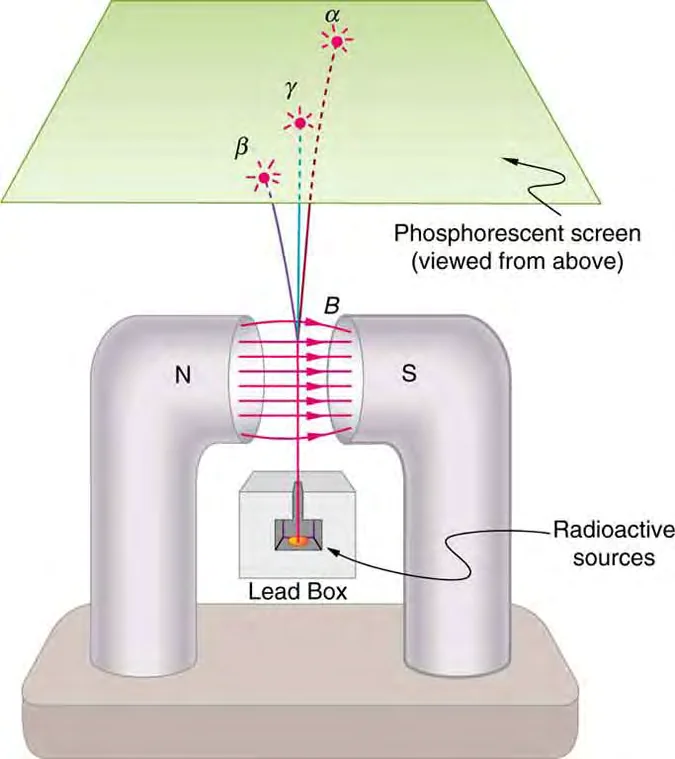
In every nuclear reaction the total mass number is conserved, and the total atomic number is conserved, so the sums of the superscripts and the sums of the subscripts must be equal on both sides of the equation.
Charge is also conserved, and an electron has atomic number −1 in this bookkeeping.
Balancing these sums identifies the missing particle.
For example, in the alpha decay of radium-226, 22688Ra → 22286Rn + 42He.
Here 226 = 222 + 4 and 88 = 86 + 2, so the equation balances.
A beta-minus decay of bismuth-214 is 21483Bi → 21484Po + 0−1e + antineutrino.
The mass numbers are equal, and 83 = 84 + (−1) gives the correct total.
Radioactive decay is random for each nucleus, but for a large sample the number of decays per second is predictable.
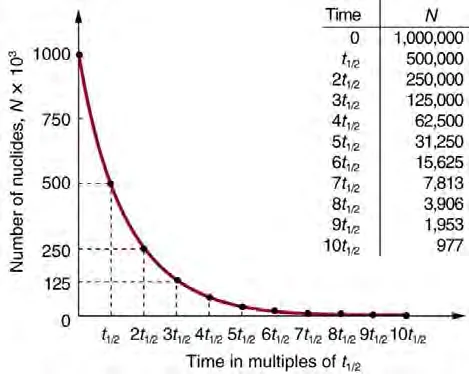
The half-life T1/2 is the time taken for half of the nuclei in a sample to decay.
It is measured in seconds, years or other time units, and it is a constant for each nuclide.
After each half-life, the number of undecayed nuclei is halved.
The number remaining after time t is N = N0(1/2)t/T1/2, where N0 is the number at the start.
The same formula applies to mass or to activity, which is the number of decays per second measured in becquerels (Bq).
A sample with a short half-life is more active than one with a long half-life of the same initial number of nuclei.
The number of half-lives that have passed is t/T1/2.
If this number is a whole number, the fraction remaining is simply 1/2 raised to that number, which makes many problems possible without a calculator.
The mass of a nucleus is less than the total mass of its separate protons and neutrons.
The difference is the mass defect Δm = (Z mp + N mn) − mnucleus, where mp and mn are the masses of a proton and a neutron.
Mass defect is measured in atomic mass units or kilograms.
The binding energy Eb is the energy that must be supplied to separate a nucleus into its nucleons, and it equals the energy released when the nucleons join together.
By Einstein’s relation, Eb = Δm c2.
A convenient conversion is 1 u = 931.5 MeV/c2, so an energy in MeV is 931.5 times the mass defect in atomic mass units.
The binding energy per nucleon, Eb/A, is largest for nuclei near iron-56, at about 8.8 MeV per nucleon, which is the most stable region.
Energy can be released from nuclei in two ways because of the shape of the binding energy per nucleon curve.
In nuclear fission, a heavy nucleus such as uranium-235 splits into two smaller nuclei, which have greater binding energy per nucleon than the original nucleus.
The extra binding energy is released as kinetic energy of the fragments and as radiation.
Fission also releases neutrons, which can trigger further fissions in a chain reaction.
In nuclear fusion, two light nuclei join to form a heavier nucleus, which again has greater binding energy per nucleon.
Fusion needs very high temperatures and pressures to overcome the electrostatic repulsion between positive nuclei, and it powers stars.
The fusion of hydrogen isotopes deuterium and tritium into helium-4 and a neutron releases about 17.6 MeV per reaction.
Question
Complete the equation for the beta-minus decay of carbon-14 146C → ? + 0−1e + antineutrino.
1
The mass number stays 14, and the atomic number rises by 1 from 6 to 7.
2
The product has A = 14 and Z = 7, which is nitrogen.
Answer
147N. Check: 14 = 14 + 0 and 6 = 7 + (−1).
Question
A sample has 80 g of a radioactive nuclide with half-life 2 days. How much remains after 6 days?
1
The number of half-lives is 6 days/2 days = 3.
2
The mass remaining is 80 g × (1/2)3 = 80 g × 1/8 = 10 g.
Answer
10 g. After 2 days 40 g remains, after 4 days 20 g, and after 6 days 10 g
Question
The atomic masses are, hydrogen-1 atom 1.00783 u, neutron 1.00866 u, and helium-4 atom 4.00260 u. Find the mass defect and binding energy of helium-4, which has two protons and two neutrons
1
The total mass of the separate parts is 2(1.00783 u) + 2(1.00866 u) = 4.03298 u.
2
The mass defect is Δm = 4.03298 u − 4.00260 u = 0.03038 u.
3
The binding energy is Eb = (0.03038 u)(931.5 MeV/u) = 28.3 MeV.
Answer
The mass defect is 0.0304 u and the binding energy is 28.3 MeV, or about 7.1 MeV per nucleon
Changing the mass number in beta decay
Beta-minus decay changes the atomic number by 1, and the mass number stays the same.
Calculating half-life problems as if the amount falls by a fixed amount each time
Each half-life halves the amount, so 80 g falls to 40 g, then 20 g.
Using the number of nucleons instead of the number of protons when identifying an element
The element is fixed by Z, not by A.
Dividing the mass defect by c2 when the answer is wanted in MeV
With 1 u = 931.5 MeV/c2, multiply the mass defect in atomic mass units by 931.5.
Saying that fusion releases energy because it breaks nuclei apart
Both fission and fusion release energy because the products have greater binding energy per nucleon.
Avoid
Forgetting that an electron has atomic number −1 when balancing equations, so the atomic numbers appear not to balance