Curriculum
EST II Physics
1. Mechanics
0/19
2. Electricity and Magnetism
0/15
3. Waves and Optics
0/13
-
3. Waves and Optics
 Preview
-
3.1 General Wave Properties
Preview
-
3.1 General Wave Properties - Check yourself
 Preview
-
3.2 Sound and the Doppler Effect
Preview
-
3.2 Sound and the Doppler Effect - Check yourself
Preview
-
3.3 Superposition and Standing Waves
Preview
-
3.3 Superposition and Standing Waves - Check yourself
Preview
-
3.4 Reflection and Refraction
Preview
-
3.4 Reflection and Refraction - Check yourself
Preview
-
3.5 Mirrors, Lenses and Image Formation
Preview
-
3.5 Mirrors, Lenses and Image Formation - Check yourself
Preview
-
3.6 Physical Optics
Preview
-
3.6 Physical Optics - Check yourself
Preview
4. Heat and Thermodynamics
0/7
5. Modern Physics
0/11
6. Measurement, Analysis and Contemporary Physics
0/5
Text lesson
3.4 Reflection and Refraction
3.4 Reflection and Refraction — EST II PHYSICS notes: You will be able to apply the law of reflection, calculate refractive index and wave speed in a medium, use Snell’s law to find refraction angles, determine how wavelength changes while frequency stays constant, find the critical angle for total internal reflection, and explain dispersion.
Angles are measured from the normal, which is the line perpendicular to the surface at the point where the wave strikes it.
The angle of incidence is the angle between the incoming ray and the normal, and the angle of reflection is the angle between the reflected ray and the normal.
The law of reflection states that the angle of reflection equals the angle of incidence, and that the incident ray, the reflected ray and the normal all lie in the same plane.
A ray that strikes a plane mirror at 30° to the normal leaves the mirror at 30° to the normal on the other side.
The refractive index n of a medium compares the speed of light in a vacuum with the speed of light in the medium: n = c/v, What the symbols mean n = refractive index (no unit) · c = speed of light in a vacuum (3.00 × 10⁸ m s−1) · v = speed of light in the material (m s−1), where n is dimensionless, c = 3.0 × 10⁸ m/s is the speed of light in a vacuum and v is the speed of light in the medium in m/s.
Since light is always slower in a material than in a vacuum, n is always 1 or greater.
Typical values are about 1.33 for water and 1.5 for ordinary glass.
Because the frequency is unchanged, the wavelength in a medium is related to the wavelength in a vacuum by:
The wave slows down in a medium with a higher refractive index, and its wavelength becomes shorter by the same factor.
When light slows on entering a denser medium, it bends toward the normal; when it speeds up on leaving, it bends away from the normal.
The angles of incidence and refraction are related by Snell’s law: n1 sin θ1 = n2 sin θ2, What the symbols mean n = refractive index (no unit) · i or θ1 = angle of incidence · r or θ2 = angle of refraction (both measured from the normal), where n1 and n2 are the refractive indices of the two media, θ1 is the angle of incidence and θ2 is the angle of refraction, both measured from the normal.
If the wave enters a medium with a larger refractive index, sin θ2 is smaller than sin θ1, so the ray bends toward the normal.
1
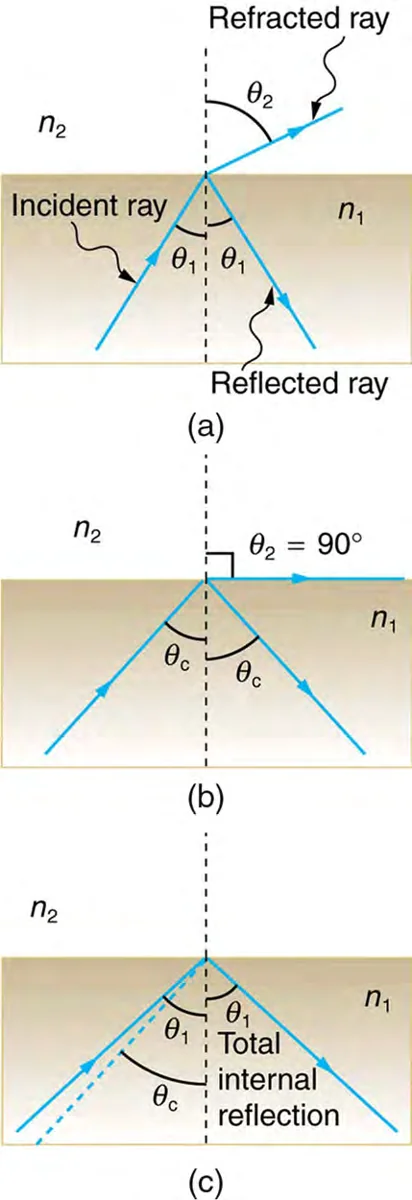
Total internal reflection can occur only when light travels from a medium of higher refractive index n1 into a medium of lower refractive index n2.
2
In this case the refracted angle is larger than the incident angle, and it reaches 90° when the incident angle reaches a particular value, the critical angle θc.
3
From Snell’s law with θ2 = 90°:
1
sin θc = n2/n1, For angles of incidence larger than θc, no light is refracted out of the medium, and all of the light is reflected back into it.
2
This is total internal reflection.
3
It is used in optical fibres, which carry signals along a glass core, and in the sparkle of cut diamonds, which have a high refractive index.
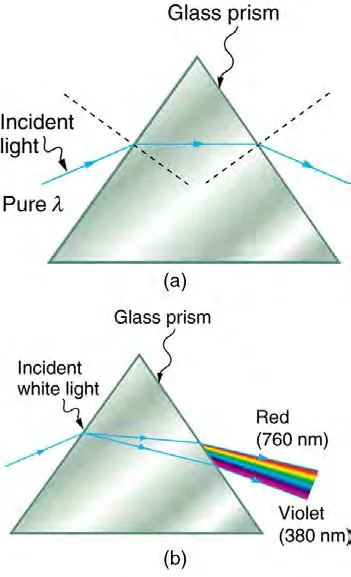
Violet light has a higher refractive index in glass than red light, so violet is refracted more strongly.
A prism spreads white light into a spectrum with red on one edge and violet on the other, and a rainbow forms because raindrops disperse sunlight and then reflect it internally.
This separation of colours by refraction is called dispersion.
Example 1
Speed and wavelength of light in glass
1
v = c/n = (3.0 × 10⁸ m/s) ÷ 1.5 = 2.0 × 10⁸ m/s.
2
The wavelength is λ = 600 nm ÷ 1.5 = 400 nm.
Answer
2.0 × 10⁸ m/s; 400 nm.
Example 2
Snell’s law with a known refraction angle
1
n1 sin θ1 = n2 sin θ2, so sin θ1 = (1.5 × 0.50)/1.0 = 0.75.
Answer
sin θ1 = 0.75, so θ1 ≈ 49°.
Example 3
Critical angle for glass and air
1
sin θc = n2/n1 = 1.0/1.5 = 0.67.
2
Since sin 42° ≈ 0.67, the critical angle is about 42°.
Answer
θc ≈ 42°. Light striking the glass–air boundary at more than 42° is totally internally reflected.
Believing that the frequency of light changes when it enters glass
Only the speed and the wavelength change; the frequency stays the same.
Bending the ray the wrong way
A ray entering a higher refractive index medium bends toward the normal, so the angle of refraction is smaller than the angle of incidence.
Using the refractive index of the less dense medium as n1 in the critical-angle formula
For total internal reflection, n1 is the larger, denser-medium index.
Thinking that a refractive index below 1 is possible
Light always travels slower in a material than in a vacuum, so n ≥ 1.
Avoid
Measuring angles from the surface instead of the normal in Snell’s law