Curriculum
Course: EST II Physics
Login

Curriculum

EST II Physics

Text lesson

5.5 Special Relativity

5.5 Special Relativity — EST II PHYSICS notes: You will be able to state the two postulates of special relativity, calculate time dilation and length contraction for objects moving at a constant speed, and use the mass-energy relation E = mc2 to find the energy equivalent of a mass.

1The postulates of special relativity2The postulates of special relativity3The postulates of special relativity4The postulates of special relativity
The postulates of special relativity
An inertial reference frame is a frame that moves at a constant velocity

so that Newton’s first law holds in it.
1 / 4Next ▶
The postulates of special relativity
1

Special relativity, proposed by Albert Einstein in 1905, applies to inertial frames and rests on two postulates.
2

The first postulate is that the laws of physics are the same in all inertial reference frames.
3

The second postulate is that the speed of light in vacuum,
4

c
5

= 3.00 × 10
6

8
◀ Previous2 / 4Next ▶
The postulates of special relativity
m/s, is the same for all observers, whatever the speed of the source or of the observer.
The second postulate is the surprising one.
If a person runs at 5 m/s towards a ball thrown at 20 m/s, the ball’s speed relative to the runner is 25 m/s.
For light, no such addition applies: an observer moving towards a light beam still measures the speed of the beam as
.
Nothing with mass can reach or exceed the speed of light, and this limit comes directly from the postulates.
◀ Previous3 / 4Next ▶
The postulates of special relativity
The two postulates imply that measurements of time and length depend on the relative motion of the observer and the events being measured. Two observers in relative motion can disagree about how much time has passed and about the lengths of objects, and both can be correct in their own frames.
◀ Previous4 / 4
1Time dilation2Time dilation3Time dilation4Time dilation
Time dilation
Time dilation
Time dilation is the result that a moving clock runs more slowly than a clock at rest, as judged by an observer at rest.
1 / 4Next ▶
Time dilation
1

The time measured by a clock that is at rest relative to the events is called the proper time Δ
2

t
3

0
4

.
5

An observer moving at speed
6

v
◀ Previous2 / 4Next ▶
Time dilation
Time dilation
relative to the events measures a longer time Δ
, given by Δ
= γΔ
Here γ is the Lorentz factor, γ = 1/√(1 − v2/c2).
The factor γ is always greater than or equal to 1, and it is equal to 1 only when
= 0.
◀ Previous3 / 4Next ▶
Graph of time dilation factor gamma rising and length contraction factor 1/gamma falling against v/c
Time dilation
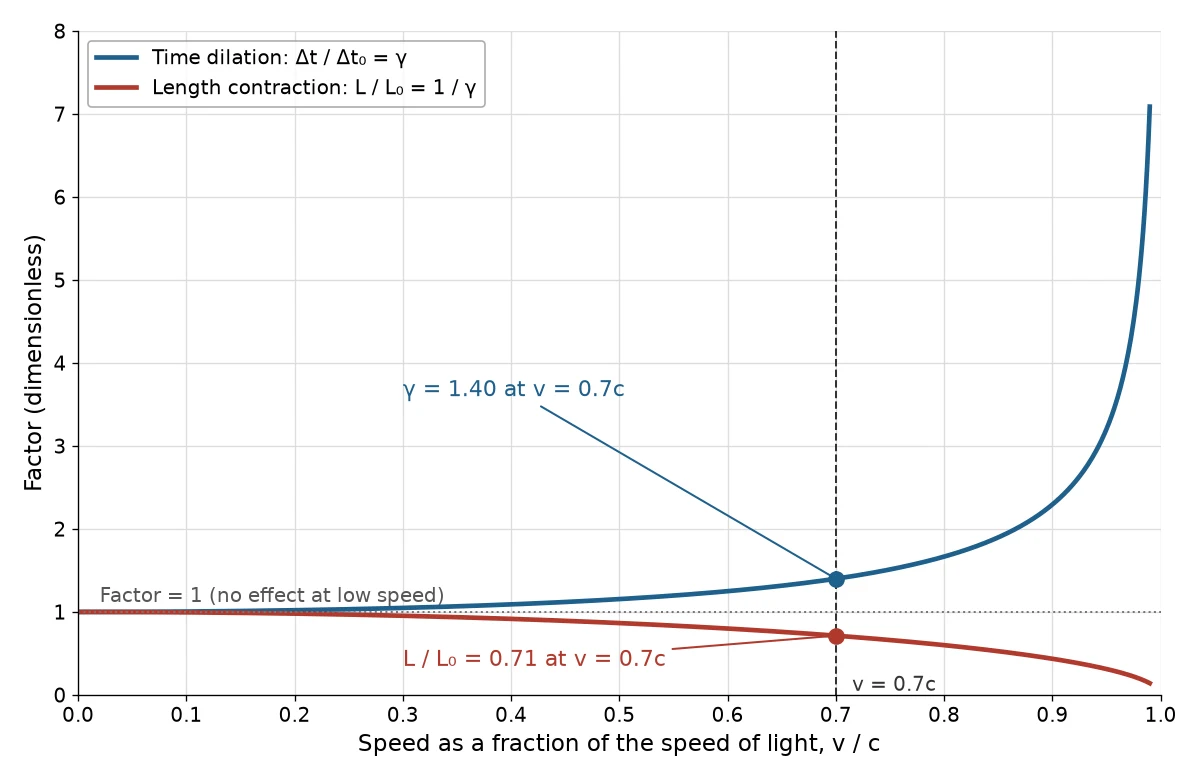
Graph of time dilation factor gamma rising and length contraction factor 1/gamma falling against v/c" loading= - Dr Khaled Dabour Academy⤢ Enlarge
1

For speeds much less than the speed of light, γ is very close to 1 and relativistic effects are negligible.
2

Time dilation has been confirmed by measurements of fast-moving unstable particles

which live longer when they move quickly.
3

The proper time is always the shorter of the two times. It is measured by a single clock present at both events, such as a clock that starts and stops a muon’s decay in the muon’s own frame. Other observers see a longer time, and the time dilation formula relates the two.
◀ Previous4 / 4
1Length contraction2Length contraction3Length contraction4Length contraction
Length contraction
Length contraction
Length contraction is the result that the length of an object moving relative to an observer is shorter than its length in its own rest frame.
1 / 4Next ▶
Length contraction
Length contraction
The proper length
L
0
is the length measured in the frame in which the object is at rest.
The length
measured by an observer moving at speed
◀ Previous2 / 4Next ▶
Length contraction
1

v
2

relative to the object is
3

=
4

/γ =
5

√(1 −
6

2
◀ Previous3 / 4Next ▶
Length contraction
1

/
2

c
3

).
4

Length contraction occurs only along the direction of motion. The width and height of an object moving sideways are unchanged. Like time dilation, it is significant only at speeds that are a large fraction of the speed of light.
5

Time dilation and length contraction are two aspects of the same relation between the frames. A fast-moving muon has a longer lifetime in the laboratory frame, and in its own frame the distance it travels to the ground is shortened. Both effects predict the same observed number of muons reaching the ground.
◀ Previous4 / 4
1Mass-energy equivalence2Mass-energy equivalence3Mass-energy equivalence4Mass-energy equivalence5Mass-energy equivalence6Mass-energy equivalence
Mass-energy equivalence
Einstein showed that mass and energy are equivalent.
1 / 6Next ▶
Mass-energy equivalence
1

The rest energy of an object of rest mass
2

m
3

is
4

E
5

0
6

=
◀ Previous2 / 6Next ▶
Mass-energy equivalence
mc
2
, where
is in joules (J),
is in kilograms (kg), and
c
◀ Previous3 / 6Next ▶
Mass-energy equivalence
is in metres per second.
A small mass corresponds to a very large energy, because
= 9.00 × 10
16
/s
is a very large number.
◀ Previous4 / 6Next ▶
Mass-energy equivalence
1

For a moving object, the total energy is E = γmc2, and its kinetic energy is the total energy minus the rest energy, K = (γ − 1)mc2.
2

At low speed, the kinetic energy reduces to the familiar
3

K
4

= ½
5

mv
6

.
◀ Previous5 / 6Next ▶
Mass-energy equivalence
1

Mass-energy equivalence explains nuclear energy: the mass defect of a nucleus, discussed in topic 5.3, is converted to binding energy through Δ
2

= Δ
◀ Previous6 / 6
1Example 1: Time dilation of a muon · Example 2: Length contr2Example 3: Energy equivalent of a mass
Example 1: Time dilation of a muon · Example 2: Length contraction of a rod
Example 1: Time dilation of a muon
A muon at rest has a lifetime of 2.2 μs. A muon moves at 0.80c relative to the laboratory. Find its lifetime measured in the laboratory.
Working: v/c = 0.80

so 1 − v2/c2 = 1 − 0.64 = 0.36 and √0.36 = 0.60. Then γ = 1⁄0.60 = 1.67. The laboratory lifetime is Δt = γΔt0 = (1.67)(2.2 μs) = 3.7 μs.
Answer: 3.7 μs. The laboratory observer sees the muon live longer than its rest lifetime.
Example 2: Length contraction of a rod
A rod has length 3.0 m when at rest and moves along its length at 0.60c. Find its length measured by a laboratory observer.
Working: 1 − 0.602 = 1 − 0.36 = 0.64, and √0.64 = 0.80

so γ = 1⁄0.80 = 1.25. The length is L = L0/γ = 3.0 m/1.25 = 2.4 m.
Answer: 2.4 m. The rod is shorter in the laboratory than at rest, and only its length along the direction of motion is affected.
1 / 2Next ▶
Example 3: Energy equivalent of a mass
1

Find the energy equivalent of a mass of 1.0 g.
2

Working: m = 1.0 × 10⁻³ kg. Then E0 = mc2 = (1.0 × 10⁻³ kg)(3.0 × 10⁸ m/s)2 = (1.0 × 10⁻³)(9.0 × 10¹⁶) J = 9.0 × 10¹³ J.
3

Answer: 9.0 × 10¹³ J. This is roughly 21 kilotons of TNT, since one kiloton of TNT releases about 4.2 × 10¹² J. A gram of matter contains an enormous amount of energy in this sense.
◀ Previous2 / 2
Key terms
Term Meaning
Inertial reference frame A frame of reference that moves at constant velocity, in which Newton’s first law holds.
Postulate of special relativity One of two basic assumptions: the laws of physics are the same in all inertial frames, and the speed of light in vacuum is the same for all observers.
Proper time (Δt0) The time interval between two events measured by a single clock present at both events.
Time dilation The longer time, Δt = γΔt0, measured by an observer who is moving relative to the events.
Lorentz factor (γ) The factor 1/√(1 − v2/c2), which is always at least 1.
Proper length (L0) The length of an object measured in the frame in which the object is at rest.
Length contraction The shortening of a length along the direction of relative motion, L = L0/γ.
Rest energy (E0) The energy equivalent of a mass at rest, E0 = mc2.
Mass-energy equivalence The principle that mass and energy are interchangeable, given by E = mc2.
1Avoid these mistakes2Avoid these mistakes3Avoid these mistakes4Avoid these mistakes5Avoid these mistakes
Avoid these mistakes
1Avoid this
Using γ as a multiplier for the proper time when the proper time is the shorter time. The moving observer measures the longer time, ΔAvoid this
tAvoid this
= γΔAvoid this
0Avoid this
.Avoid this
1 / 5Next ▶
Avoid these mistakes
2Avoid this
Dividing by γ for time dilation, or multiplying by γ for length contraction. Time is multiplied by γ and length is divided by γ.Avoid this
3Avoid this
Applying length contraction to the width or height of an object moving sideways. Contraction occurs only along the direction of motion.Avoid this
4Avoid this
Thinking that speeds add simply for light. An observer always measures light at speedAvoid this
◀ Previous2 / 5Next ▶
Avoid these mistakes
cAvoid this
, whatever the relative motion.Avoid this
5Avoid this
Forgetting to square the speed of light inAvoid this
EAvoid this
=Avoid this
◀ Previous3 / 5Next ▶
Avoid these mistakes
mcAvoid this
, or using grams instead of kilograms. Convert mass to kilograms before usingAvoid this
= 3.00 × 10Avoid this
8Avoid this
m/s.Avoid this
6Avoid this
◀ Previous4 / 5Next ▶
Avoid these mistakes
Assuming relativistic effects are large at everyday speeds. ForAvoid this
vAvoid this
much less thanAvoid this
, γ is very close to 1.Avoid this
◀ Previous5 / 5
Accepted payment methods