Curriculum
EST II Physics
1. Mechanics
0/19
2. Electricity and Magnetism
0/15
3. Waves and Optics
0/13
-
3. Waves and Optics
 Preview
-
3.1 General Wave Properties
Preview
-
3.1 General Wave Properties - Check yourself
 Preview
-
3.2 Sound and the Doppler Effect
Preview
-
3.2 Sound and the Doppler Effect - Check yourself
Preview
-
3.3 Superposition and Standing Waves
Preview
-
3.3 Superposition and Standing Waves - Check yourself
Preview
-
3.4 Reflection and Refraction
Preview
-
3.4 Reflection and Refraction - Check yourself
Preview
-
3.5 Mirrors, Lenses and Image Formation
Preview
-
3.5 Mirrors, Lenses and Image Formation - Check yourself
Preview
-
3.6 Physical Optics
Preview
-
3.6 Physical Optics - Check yourself
Preview
4. Heat and Thermodynamics
0/7
5. Modern Physics
0/11
6. Measurement, Analysis and Contemporary Physics
0/5
Text lesson
3.3 Superposition and Standing Waves
3.3 Superposition and Standing Waves — EST II PHYSICS notes: You will be able to apply the superposition principle to find the resultant of two waves, explain constructive and destructive interference, predict how pulses reflect at fixed and free ends, and find the nodes, antinodes and resonant frequencies of standing waves on strings and in open and closed pipes.
This is the principle of superposition.
After the waves pass through each other, each one continues with its original shape and amplitude.
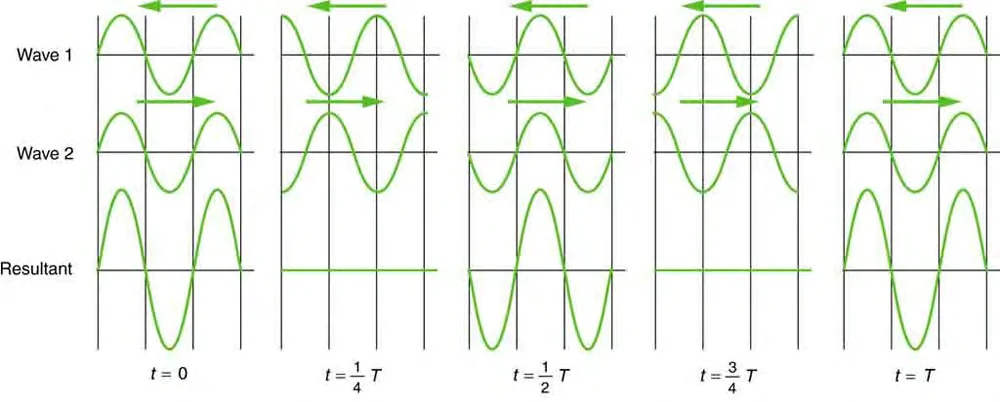
If two pulses of amplitude 2 cm and 3 cm, both upward, overlap exactly, the displacement at the overlap is 2 cm + 3 cm = 5 cm.
If one pulse is upward and the other is downward with the same size, the displacements cancel and the medium is flat at the moment of overlap.
1
Two waves travelling in opposite directions add to a resultant that changes with time.
2
Image: OpenStax, College Physics for AP Courses, CC BY 4.0.: The principle of superposition
For two identical sources in phase, the path difference Δd between the waves arriving at a point decides the outcome.
Constructive interference occurs when the path difference is a whole number of wavelengths, and destructive interference when it is a half-odd number of wavelengths: Constructive Δd = nλ, Destructive: Δd = (n + ½)λ, where n = 0, 1, 2, … and λ is the wavelength in metres.
A point where the path difference is 1.5 wavelengths, for example, has a minimum of displacement.
The reflection depends on how the end is held.
At a fixed end, the string cannot move, and the reflected pulse is inverted, which means it is turned upside down.
At a free end, the string can move freely, and the reflected pulse is upright.
The same rule applies when a pulse on a string meets a heavier string, which behaves like a fixed end, and a lighter string, which behaves like a free end.
The pattern does not move along the medium.
It has fixed points that never move, called nodes, and points of maximum displacement, called antinodes.
Adjacent nodes are separated by half a wavelength, and a node and the next antinode are separated by a quarter of a wavelength.
A string of length L fixed at both ends must have a node at each end.
The standing waves possible on it are those whose wavelengths fit a whole number of half-wavelengths into the string:
1
where L is the length of the string in metres, λn is the wavelength of the nth harmonic in metres, fn is its frequency in hertz and v is the wave speed on the string in m/s.
2
The lowest frequency, with n = 1, is the fundamental, and the higher values of n give the harmonics, which are whole-number multiples of the fundamental.
Sound waves in a pipe form standing waves as well.
The end that is closed has a node, because the air cannot move there.
The end of a pipe that is open to the air has an antinode, because the air there can move freely.
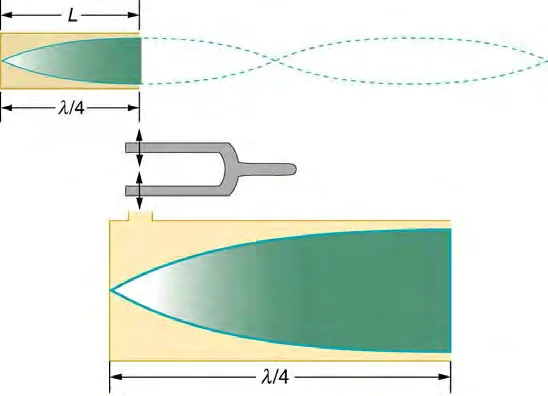
In a pipe that is open at both ends, there is an antinode at each end, and the harmonics are the same as for a string fixed at both ends: fn = n v/(2L), n = 1, 2, 3, …, In a pipe that is closed at one end and open at the other, there is a node at the closed end and an antinode at the open end.
A closed-end pipe of length L has the same fundamental as an open pipe of length 2L.
Only odd harmonics are possible: fn = n v/(4L), n = 1, 3, 5, …, Here L is the length of the pipe in metres and v is the speed of sound in the air in the pipe, in m/s.
Resonance occurs when an object is driven at one of its natural frequencies and the amplitude of its oscillation becomes large.
A standing wave is a resonance of the string or air column.
A singer who holds a note that matches the natural frequency of a glass can make it vibrate strongly, and a pipe sounds loudly when it is driven at one of its standing-wave frequencies.
Example 1
Harmonics of a string fixed at both ends
1
f1 = v/(2L) = 200 m/s ÷ (2 × 0.50 m) = 200 Hz.
2
The wavelength of the fundamental is λ1 = 2L = 1.0 m.
3
The third harmonic has f3 = 3 × 200 Hz = 600 Hz.
Answer
200 Hz; 1.0 m; 600 Hz.
Example 2
Open and closed pipes
1
Open pipe: f1 = v/(2L) = 340 m/s ÷ 1.0 m = 340 Hz.
Answer
The open pipe sounds 340 Hz, the closed pipe sounds 170 Hz and then 510 Hz
Example 3
Interference from two loudspeakers
1
The path difference is Δd = 0.60 m.
2
Dividing by the wavelength gives Δd/λ = 0.60/0.40 = 1.5.
3
Since 1.5 = (1 + ½), the path difference is a half-odd number of wavelengths.
Answer
Destructive interference, so the listener hears a minimum of loudness.
Adding the amplitudes of two waves when they are out of phase
Superposition is an algebraic sum, so opposite displacements subtract.
Using the length of a fixed-end string as one wavelength
In the fundamental, the wavelength is 2L, not L.
Applying the open-pipe formula to a closed pipe
A closed pipe at one end uses f = nv/(4L) with odd n only.
Forgetting that a reflection from a fixed end inverts the pulse, and that a free end does not
Adjacent nodes are half a wavelength apart, and a node lies at each fixed end.