Curriculum
EST II Physics
1. Mechanics
0/19
2. Electricity and Magnetism
0/15
3. Waves and Optics
0/13
-
3. Waves and Optics
 Preview
-
3.1 General Wave Properties
Preview
-
3.1 General Wave Properties - Check yourself
 Preview
-
3.2 Sound and the Doppler Effect
Preview
-
3.2 Sound and the Doppler Effect - Check yourself
Preview
-
3.3 Superposition and Standing Waves
Preview
-
3.3 Superposition and Standing Waves - Check yourself
Preview
-
3.4 Reflection and Refraction
Preview
-
3.4 Reflection and Refraction - Check yourself
Preview
-
3.5 Mirrors, Lenses and Image Formation
Preview
-
3.5 Mirrors, Lenses and Image Formation - Check yourself
Preview
-
3.6 Physical Optics
Preview
-
3.6 Physical Optics - Check yourself
Preview
4. Heat and Thermodynamics
0/7
5. Modern Physics
0/11
6. Measurement, Analysis and Contemporary Physics
0/5
Text lesson
3. Waves and Optics
U3 Waves and Optics — EST II PHYSICS notes: You will be able to bring together the wave, sound, interference, refraction, image-formation and physical optics ideas of Unit 3, choose the right equation for a wave or optical problem, and see how the six topics build on one another.
1Waves carry energy and are described by a few quantities2Waves carry energy and are described by a few quantities3Waves carry energy and are described by a few quantities4Waves carry energy and are described by a few quantities5Waves carry energy and are described by a few quantities
Waves carry energy and are described by a few quantities
Waves carry energy and are described by a few quantities
A wave transfers energy without transferring matter.
1
Transverse waves oscillate perpendicular to their direction of travel and longitudinal waves oscillate parallel to it.
2
Every wave is described by its amplitude, wavelength, frequency and period, and these are linked by
v
1 / 5Next ▶
Waves carry energy and are described by a few quantities
1
=
2
fλ
3
and
4
T
5
= 1/
6
f
◀ Previous2 / 5Next ▶
Waves carry energy and are described by a few quantities
Waves carry energy and are described by a few quantities
.
3
The energy carried by a wave depends on the square of its amplitude.
4
The speed of a wave on a string depends only on the tension and the mass per unit length.
5
◀ Previous3 / 5Next ▶
Waves carry energy and are described by a few quantities
Waves carry energy and are described by a few quantities
Electromagnetic waves, from radio to gamma rays, differ only in frequency and wavelength and all travel at
c
= 3.0 × 10
8
m/s in a vacuum.
◀ Previous4 / 5Next ▶
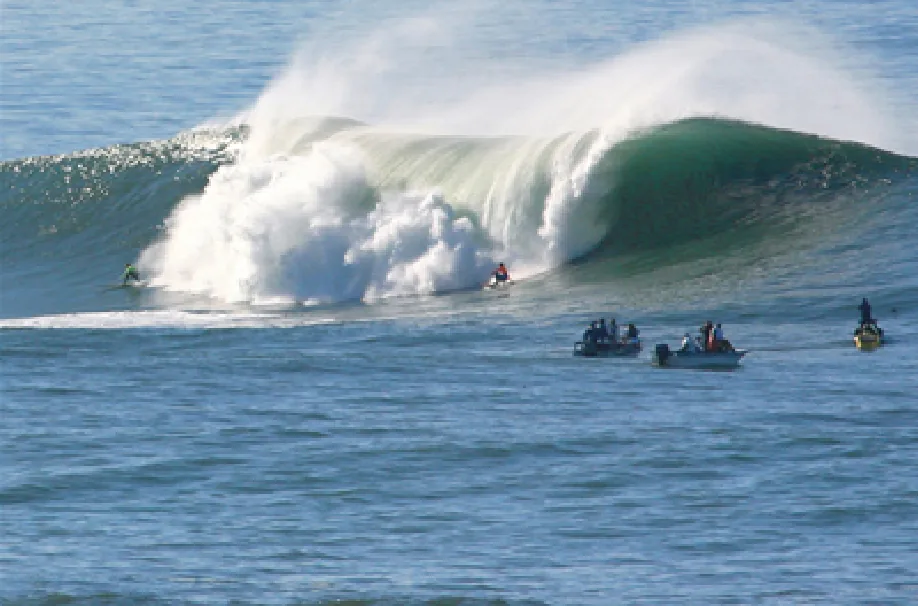
What a wave is: Large ocean waves breaking on a shoreline, a natural example of the same wave behaviour that governs all other types of waves.
Waves carry energy and are described by a few quantities
◀ Previous5 / 5
Sound, pitch and the Doppler effect
Sound, pitch and the Doppler effect
Sound is a longitudinal wave that travels at about 340 m/s in air. Pitch depends mainly on frequency and loudness on intensity, and sound levels are measured in decibels. When a source or an observer moves, the frequency heard changes, and two sources of nearly equal frequency produce beats at a frequency equal to their difference.
1Superposition, interference and standing waves2Superposition, interference and standing waves
1Reflection and refraction at boundaries2What the symbols mean:3What the symbols mean:4What the symbols mean:
1Forming images with mirrors and lenses2Forming images with mirrors and lenses3Forming images with mirrors and lenses4Forming images with mirrors and lenses
1Light as a wave: diffraction, interference and polarization2Light as a wave: diffraction, interference and polarization3Light as a wave: diffraction, interference and polarization4Light as a wave: diffraction, interference and polarization
Equations of Waves and Optics
| Equation | Topic | What it relates |
|---|---|---|
| v = fλ; T = 1/f | 3.1 | Wave speed, frequency, wavelength and period (m/s, Hz, m, s) |
| v = √(FT/μ) | 3.1 | Speed of a wave on a string (tension in N, μ in kg/m) |
| I = P/A; I ∝ A2 | 3.1, 3.2 | Intensity (W/m2) and its dependence on amplitude |
| β = 10 log10(I/I0) | 3.2 | Sound level in decibels; I0 = 1.0 × 10⁻¹² W/m2 |
| f′ = f (v + vo)/(v − vs) | 3.2 | Doppler effect for moving source and observer (m/s) |
| fbeat = |f1 − f2| | 3.2 | Beat frequency |
| Δd = nλ (constructive); (n + ½)λ (destructive) | 3.3 | Interference of two in-phase waves |
| fn = nv/(2L); fn = nv/(4L), odd n | 3.3 | Standing waves in strings and pipes (open–open or fixed–fixed; closed–open) |
| n = c/v; λmedium = λvacuum/n | 3.4 | Refractive index and wavelength in a medium |
| n1 sin θ1 = n2 sin θ2; sin θc = n2/n1 | 3.4 | Snell’s law and the critical angle |
| 1/f = 1/do + 1/di; m = −di/do | 3.5 | Mirror and lens equations; magnification |
| a sin θ = mλ (single-slit minima) | 3.6 | Single-slit diffraction |
| d sin θ = mλ; Δy = λL/d | 3.6 | Double slit, diffraction grating and fringe spacing |
| I = I0 cos2 θ | 3.6 | Malus’s law for polarizers |
1How the topics connect2How the topics connect3How the topics connect
1Example 1: Choosing the right wave equation · Example 2: Lin2Worked examples3Worked examples4Worked examples
Key terms
| Term | Meaning |
|---|---|
| Transverse wave | A wave whose oscillation is perpendicular to its direction of travel, such as a light wave. |
| Longitudinal wave | A wave whose oscillation is parallel to its direction of travel, such as sound in air. |
| Superposition | The algebraic addition of the displacements of two or more waves at the same point. |
| Standing wave | A pattern of fixed nodes and antinodes formed by two identical waves travelling in opposite directions. |
| Doppler effect | The change in observed frequency caused by the motion of a source or an observer. |
| Refractive index | The ratio of the speed of light in a vacuum to its speed in a medium. |
| Critical angle | The angle of incidence in the denser medium above which total internal reflection occurs. |
| Real image | An image formed where light converges, which can be projected onto a screen. |
| Diffraction grating | A device with many equally spaced slits that produces sharp maxima at angles given by d sin θ = mλ. |
| Polarization | The restriction of the oscillation of a transverse wave to a single plane. |
1Avoid these mistakes2Avoid these mistakes3Avoid these mistakes4Avoid these mistakes