Curriculum
EST II Physics
1. Mechanics
0/19
-
1. Mechanics
 Preview
-
1.1 Kinematics in One Dimension
Preview
-
1.1 Kinematics in One Dimension - Check yourself
 Preview
-
1.2 Projectile Motion and Motion in Two Dimensions
Preview
-
1.2 Projectile Motion and Motion in Two Dimensions - Check yourself
Preview
-
1.3 Forces and Newton’s Laws
Preview
-
1.3 Forces and Newton’s Laws - Check yourself
Preview
-
1.4 Statics and Friction
Preview
-
1.4 Statics and Friction - Check yourself
Preview
-
1.5 Work, Energy and Power
Preview
-
1.5 Work, Energy and Power - Check yourself
Preview
-
1.6 Impulse and Momentum
Preview
-
1.6 Impulse and Momentum - Check yourself
Preview
-
1.7 Circular Motion
Preview
-
1.7 Circular Motion - Check yourself
Preview
-
1.8 Simple Harmonic Motion
Preview
-
1.8 Simple Harmonic Motion - Check yourself
Preview
-
1.9 Gravitation, Orbits and Kepler’s Laws
Preview
-
1.9 Gravitation, Orbits and Kepler’s Laws - Check yourself
Preview
2. Electricity and Magnetism
0/15
3. Waves and Optics
0/13
4. Heat and Thermodynamics
0/7
5. Modern Physics
0/11
6. Measurement, Analysis and Contemporary Physics
0/5
Text lesson
1.5 Work, Energy and Power
1.5 Work, Energy and Power — EST II PHYSICS notes: You will be able to calculate the work done by a constant force, use kinetic and potential energy with the work-energy theorem and conservation of mechanical energy, include the energy lost to friction, and calculate power and efficiency.
For a constant force F that moves an object a distance d, with θ the angle between the force and the displacement, the work is W = Fd cos θ.
Force is in newtons (N), distance in metres (m), and work in joules (J), where 1 J = 1 N·m.
Work is a scalar.
It is positive when the force has a component in the direction of the displacement, which adds energy to the object, and negative when the force opposes the displacement, which removes energy.
A force perpendicular to the displacement, such as the normal force on a horizontally moving object, does no work.
Friction acting on a sliding object usually does negative work.
It is given by K = ½mv2, where m is the mass in kilograms (kg) and v is the speed in metres per second (m/s).
Kinetic energy is a scalar measured in joules (J), and it is never negative.
Doubling the speed of an object quadruples its kinetic energy.
The work-energy theorem states that the net work done on an object equals its change in kinetic energy, Wnet = ΔK = ½mvf2 − ½mvi2.
It is a powerful tool because it gives a speed without needing the acceleration or the time.
If the net work is negative, the object slows down.
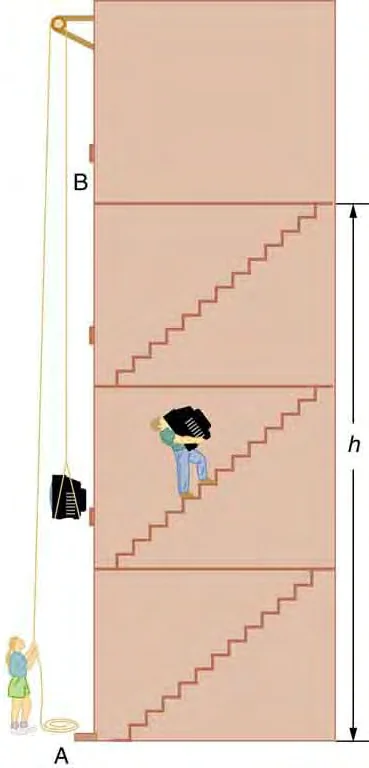
Near the surface of the Earth, the gravitational potential energy of an object of mass m at height h above a chosen reference level is Ug = mgh, in joules.
The reference level can be chosen freely, but the change in gravitational potential energy is the same for any choice.
Raising an object increases its potential energy, and gravity does negative work during the rise.
A spring that is stretched or compressed by a distance x from its natural length stores elastic potential energy Us = ½kx2.
Here k is the spring constant in newtons per metre (N/m), and x is in metres (m).
The energy depends on the square of the displacement, so compressing a spring twice as far stores four times the energy.
When only conservative forces, such as gravity and the spring force, do work, the total mechanical energy is constant, so Ki + Ui = Kf + Uf.
An object dropped from rest at height h without air resistance reaches speed v = √(2gh) at the bottom, because ½mv2 = mgh.
A non-conservative force, such as friction or air resistance, changes the mechanical energy.
Work done against kinetic friction of magnitude f over a distance d is Wf = −fd.
This energy is transferred to thermal energy in the surfaces, so the mechanical energy decreases by fd.
The general statement is that the change in mechanical energy equals the work done by non-conservative forces: ΔE = Wnc.
Its SI unit is the watt (W), where 1 W = 1 J/s.
When a constant force acts on an object moving at speed v in the direction of the force, the power is P = Fv, in watts.
No machine transfers all of its input energy into a useful output.
The efficiency of a device is the ratio of the useful power output to the total power input, written as a percentage: efficiency = (useful output power/input power) × 100%.
The energy that is not useful is usually transferred as thermal energy, so the efficiency is always less than 100%.
Example 1
A sliding block brought to rest by friction
1
The initial kinetic energy is ½ × 2.0 kg × (6.0 m/s)2 = 36 J.
2
The final kinetic energy is zero.
3
By the work-energy theorem, the work done by friction is −36 J.
4
The work done by friction is −fd = −9.0 N × d, so d = 36 J/9.0 N = 4.0 m.
Answer
The block slides 4.0 m before stopping.
Example 2
A ball dropped from a height
1
Mechanical energy is conserved, so ½mv2 = mgh.
2
Then v2 = 2 × 10 m/s2 × 20 m = 400 m2/s2, so v = 20 m/s.
3
The kinetic energy is ½ × 0.50 kg × (20 m/s)2 = 100 J, which is also mgh = 0.50 × 10 × 20 = 100 J.
4
20 m/s, with kinetic energy 100 J just before impact.
Example 3
Power and efficiency of a lifting motor
1
The work done against gravity is mgh = 60 kg × 10 m/s2 × 10 m = 6000 J.
2
The useful power is P = 6000 J/5.0 s = 1200 W.
3
The efficiency is 1200 W/2000 W × 100% = 60%.
Answer
1200 W useful power, and an efficiency of 60%.
Example 4
A spring launching a block
1
The elastic energy stored is ½ × 200 N/m × (0.10 m)2 = 1.0 J.
2
This becomes the kinetic energy of the block as the spring returns to its natural length, so ½ × 0.50 kg × v2 = 1.0 J, giving v2 = 4.0 m2/s2 and v = 2.0 m/s.
Answer
2.0 m/s.
Treating work as always positive
Friction and air resistance do negative work, and gravity does negative work when an object rises.
Using conservation of mechanical energy when friction is present
In that case the energy lost to friction must be subtracted, as fd.
Confusing power with energy
Power is the energy transferred per second, in watts, and two machines can do the same work at different powers.
Avoid
Forgetting the cosine in W = Fd cos θ, or using the force instead of its component along the displacement
Avoid
Using v instead of v2 in the kinetic energy, or x instead of x2 in the spring energy
Avoid
Calculating efficiency using the input energy as the numerator, or leaving it as a fraction instead of a percentage when a percentage is asked for