Curriculum
Biology for AP Courses
Unit 1: The Study of Life
0/6
-
Unit 1 overview: The Study of Life
 Text lessonPreview
-
1.1 The Science of Biology
Text lessonPreview
-
1.1 The Science of Biology - Check yourself
 6 questionsPreview
-
1.2 Themes and Concepts of Biology
Text lessonPreview
-
1.2 Themes and Concepts of Biology - Check yourself
6 questionsPreview
-
Unit 1 review quiz: The Study of Life
10 questionsPreview
Unit 2: The Chemical Foundation of Life
0/8
-
Unit 2 overview: The Chemical Foundation of Life
Text lessonPreview
-
2.1 Atoms, Isotopes, Ions, and Molecules: The Building Blocks
Text lessonPreview
-
2.1 Atoms, Isotopes, Ions, and Molecules: The Building Blocks - Check yourself
6 questionsPreview
-
2.2 Water
Text lessonPreview
-
2.2 Water - Check yourself
6 questionsPreview
-
2.3 Carbon
Text lessonPreview
-
2.3 Carbon - Check yourself
6 questionsPreview
-
Unit 2 review quiz: The Chemical Foundation of Life
10 questionsPreview
Unit 3: Biological Macromolecules
0/12
-
Unit 3 overview: Biological Macromolecules
Text lessonPreview
-
3.1 Synthesis of Biological Macromolecules
Text lessonPreview
-
3.1 Synthesis of Biological Macromolecules - Check yourself
6 questionsPreview
-
3.2 Carbohydrates
Text lessonPreview
-
3.2 Carbohydrates - Check yourself
6 questionsPreview
-
3.3 Lipids
Text lessonPreview
-
3.3 Lipids - Check yourself
6 questionsPreview
-
3.4 Proteins
Text lessonPreview
-
3.4 Proteins - Check yourself
6 questionsPreview
-
3.5 Nucleic Acids
Text lessonPreview
-
3.5 Nucleic Acids - Check yourself
6 questionsPreview
-
Unit 3 review quiz: Biological Macromolecules
10 questionsPreview
Unit 4: Cell Structure
0/14
-
Unit 4 overview: Cell Structure
Text lessonPreview
-
4.1 Studying Cells
Text lessonPreview
-
4.1 Studying Cells - Check yourself
6 questionsPreview
-
4.2 Prokaryotic Cells
Text lessonPreview
-
4.2 Prokaryotic Cells - Check yourself
6 questionsPreview
-
4.3 Eukaryotic Cells
Text lessonPreview
-
4.3 Eukaryotic Cells - Check yourself
6 questionsPreview
-
4.4 The Endomembrane System and Proteins
Text lessonPreview
-
4.4 The Endomembrane System and Proteins - Check yourself
6 questionsPreview
-
4.5 Cytoskeleton
Text lessonPreview
-
4.5 Cytoskeleton - Check yourself
6 questionsPreview
-
4.6 Connections between Cells and Cellular Activities
Text lessonPreview
-
4.6 Connections between Cells and Cellular Activities - Check yourself
6 questionsPreview
-
Unit 4 review quiz: Cell Structure
10 questionsPreview
Unit 5: Structure and Function of Plasma Membranes
0/10
-
Unit 5 overview: Structure and Function of Plasma Membranes
Text lessonPreview
-
5.1 Components and Structure
Text lessonPreview
-
5.1 Components and Structure - Check yourself
6 questionsPreview
-
5.2 Passive Transport
Text lessonPreview
-
5.2 Passive Transport - Check yourself
6 questionsPreview
-
5.3 Active Transport
Text lessonPreview
-
5.3 Active Transport - Check yourself
6 questionsPreview
-
5.4 Bulk Transport
Text lessonPreview
-
5.4 Bulk Transport - Check yourself
6 questionsPreview
-
Unit 5 review quiz: Structure and Function of Plasma Membranes
10 questionsPreview
Unit 6: Metabolism
0/12
-
Unit 6 overview: Metabolism
Text lessonPreview
-
6.1 Energy and Metabolism
Text lessonPreview
-
6.1 Energy and Metabolism - Check yourself
6 questionsPreview
-
6.2 Potential, Kinetic, Free, and Activation Energy
Text lessonPreview
-
6.2 Potential, Kinetic, Free, and Activation Energy - Check yourself
6 questionsPreview
-
6.3 The Laws of Thermodynamics
Text lessonPreview
-
6.3 The Laws of Thermodynamics - Check yourself
6 questionsPreview
-
6.4 ATP: Adenosine Triphosphate
Text lessonPreview
-
6.4 ATP: Adenosine Triphosphate - Check yourself
6 questionsPreview
-
6.5 Enzymes
Text lessonPreview
-
6.5 Enzymes - Check yourself
6 questionsPreview
-
Unit 6 review quiz: Metabolism
10 questionsPreview
Unit 7: Cellular Respiration
0/16
-
Unit 7 overview: Cellular Respiration
Text lessonPreview
-
7.1 Energy in Living Systems
Text lessonPreview
-
7.1 Energy in Living Systems - Check yourself
6 questionsPreview
-
7.2 Glycolysis
Text lessonPreview
-
7.2 Glycolysis - Check yourself
6 questionsPreview
-
7.3 Oxidation of Pyruvate and the Citric Acid Cycle
Text lessonPreview
-
7.3 Oxidation of Pyruvate and the Citric Acid Cycle - Check yourself
6 questionsPreview
-
7.4 Oxidative Phosphorylation
Text lessonPreview
-
7.4 Oxidative Phosphorylation - Check yourself
6 questionsPreview
-
7.5 Metabolism without Oxygen
Text lessonPreview
-
7.5 Metabolism without Oxygen - Check yourself
6 questionsPreview
-
7.6 Connections of Carbohydrate, Protein, and Lipid Metabolic Pathways
Text lessonPreview
-
7.6 Connections of Carbohydrate, Protein, and Lipid Metabolic Pathways - Check yourself
6 questionsPreview
-
7.7 Regulation of Cellular Respiration
Text lessonPreview
-
7.7 Regulation of Cellular Respiration - Check yourself
6 questionsPreview
-
Unit 7 review quiz: Cellular Respiration
10 questionsPreview
Unit 8: Photosynthesis
0/8
-
Unit 8 overview: Photosynthesis
Text lessonPreview
-
8.1 Overview of Photosynthesis
Text lessonPreview
-
8.1 Overview of Photosynthesis - Check yourself
6 questionsPreview
-
8.2 The Light-Dependent Reaction of Photosynthesis
Text lessonPreview
-
8.2 The Light-Dependent Reaction of Photosynthesis - Check yourself
6 questionsPreview
-
8.3 Using Light to Make Organic Molecules
Text lessonPreview
-
8.3 Using Light to Make Organic Molecules - Check yourself
6 questionsPreview
-
Unit 8 review quiz: Photosynthesis
10 questionsPreview
Unit 9: Cell Communication
0/10
-
Unit 9 overview: Cell Communication
Text lessonPreview
-
9.1 Signaling Molecules and Cellular Receptors
Text lessonPreview
-
9.1 Signaling Molecules and Cellular Receptors - Check yourself
6 questionsPreview
-
9.2 Propagation of the Signal
Text lessonPreview
-
9.2 Propagation of the Signal - Check yourself
6 questionsPreview
-
9.3 Response to the Signal
Text lessonPreview
-
9.3 Response to the Signal - Check yourself
6 questionsPreview
-
9.4 Signaling in Single-Celled Organisms
Text lessonPreview
-
9.4 Signaling in Single-Celled Organisms - Check yourself
6 questionsPreview
-
Unit 9 review quiz: Cell Communication
10 questionsPreview
Unit 10: Cell Reproduction
0/12
-
Unit 10 overview: Cell Reproduction
Text lessonPreview
-
10.1 Cell Division
Text lessonPreview
-
10.1 Cell Division - Check yourself
6 questionsPreview
-
10.2 The Cell Cycle
Text lessonPreview
-
10.2 The Cell Cycle - Check yourself
6 questionsPreview
-
10.3 Control of the Cell Cycle
Text lessonPreview
-
10.3 Control of the Cell Cycle - Check yourself
6 questionsPreview
-
10.4 Cancer and the Cell Cycle
Text lessonPreview
-
10.4 Cancer and the Cell Cycle - Check yourself
6 questionsPreview
-
10.5 Prokaryotic Cell Division
Text lessonPreview
-
10.5 Prokaryotic Cell Division - Check yourself
6 questionsPreview
-
Unit 10 review quiz: Cell Reproduction
10 questionsPreview
Unit 11: Meiosis and Sexual Reproduction
0/6
-
Unit 11 overview: Meiosis and Sexual Reproduction
Text lessonPreview
-
11.1 The Process of Meiosis
Text lessonPreview
-
11.1 The Process of Meiosis - Check yourself
6 questionsPreview
-
11.2 Sexual Reproduction
Text lessonPreview
-
11.2 Sexual Reproduction - Check yourself
6 questionsPreview
-
Unit 11 review quiz: Meiosis and Sexual Reproduction
10 questionsPreview
Unit 12: Mendel's Experiments and Heredity
0/8
-
Unit 12 overview: Mendel's Experiments and Heredity
Text lessonPreview
-
12.1 Mendel’s Experiments and the Laws of Probability
Text lessonPreview
-
12.1 Mendel’s Experiments and the Laws of Probability - Check yourself
6 questionsPreview
-
12.2 Characteristics and Traits
Text lessonPreview
-
12.2 Characteristics and Traits - Check yourself
6 questionsPreview
-
12.3 Laws of Inheritance
Text lessonPreview
-
12.3 Laws of Inheritance - Check yourself
6 questionsPreview
-
Unit 12 review quiz: Mendel's Experiments and Heredity
10 questionsPreview
Unit 13: Modern Understandings of Inheritance
0/6
-
Unit 13 overview: Modern Understandings of Inheritance
Text lessonPreview
-
13.1 Chromosomal Theory and Genetic Linkages
Text lessonPreview
-
13.1 Chromosomal Theory and Genetic Linkages - Check yourself
6 questionsPreview
-
13.2 Chromosomal Basis of Inherited Disorders
Text lessonPreview
-
13.2 Chromosomal Basis of Inherited Disorders - Check yourself
6 questionsPreview
-
Unit 13 review quiz: Modern Understandings of Inheritance
10 questionsPreview
Unit 14: DNA Structure and Function
0/14
-
Unit 14 overview: DNA Structure and Function
Text lessonPreview
-
14.1 Historical Basis of Modern Understanding
Text lessonPreview
-
14.1 Historical Basis of Modern Understanding - Check yourself
6 questionsPreview
-
14.2 DNA Structure and Sequencing
Text lessonPreview
-
14.2 DNA Structure and Sequencing - Check yourself
6 questionsPreview
-
14.3 Basics of DNA Replication
Text lessonPreview
-
14.3 Basics of DNA Replication - Check yourself
6 questionsPreview
-
14.4 DNA Replication in Prokaryotes
Text lessonPreview
-
14.4 DNA Replication in Prokaryotes - Check yourself
6 questionsPreview
-
14.5 DNA Replication in Eukaryotes
Text lessonPreview
-
14.5 DNA Replication in Eukaryotes - Check yourself
6 questionsPreview
-
14.6 DNA Repair
Text lessonPreview
-
14.6 DNA Repair - Check yourself
6 questionsPreview
-
Unit 14 review quiz: DNA Structure and Function
10 questionsPreview
Unit 15: Genes and Proteins
0/13
-
Unit 15 overview: Genes and Proteins
Text lessonPreview
-
15.1 The Genetic Code
Text lessonPreview
-
15.1 The Genetic Code - Check yourself
6 questionsPreview
-
15.2 Prokaryotic Transcription
Text lessonPreview
-
15.2 Prokaryotic Transcription
Text lessonPreview
-
15.2 Prokaryotic Transcription - Check yourself
6 questionsPreview
-
15.3 Eukaryotic Transcription
Text lessonPreview
-
15.3 Eukaryotic Transcription - Check yourself
6 questionsPreview
-
15.4 RNA Processing in Eukaryotes
Text lessonPreview
-
15.4 RNA Processing in Eukaryotes - Check yourself
6 questionsPreview
-
15.5 Ribosomes and Protein Synthesis
Text lessonPreview
-
15.5 Ribosomes and Protein Synthesis - Check yourself
6 questionsPreview
-
Unit 15 review quiz: Genes and Proteins
10 questionsPreview
Unit 16: Gene Regulation
0/16
-
Unit 16 overview: Gene Regulation
Text lessonPreview
-
16.1 Regulation of Gene Expression
Text lessonPreview
-
16.1 Regulation of Gene Expression - Check yourself
6 questionsPreview
-
16.2 Prokaryotic Gene Regulation
Text lessonPreview
-
16.2 Prokaryotic Gene Regulation - Check yourself
6 questionsPreview
-
16.3 Eukaryotic Epigenetic Gene Regulation
Text lessonPreview
-
16.3 Eukaryotic Epigenetic Gene Regulation - Check yourself
6 questionsPreview
-
16.4 Eukaryotic Transcriptional Gene Regulation
Text lessonPreview
-
16.4 Eukaryotic Transcriptional Gene Regulation - Check yourself
6 questionsPreview
-
16.5 Eukaryotic Post-transcriptional Gene Regulation
Text lessonPreview
-
16.5 Eukaryotic Post-transcriptional Gene Regulation - Check yourself
6 questionsPreview
-
16.6 Eukaryotic Translational and Post-translational Gene Regulation
Text lessonPreview
-
16.6 Eukaryotic Translational and Post-translational Gene Regulation - Check yourself
6 questionsPreview
-
16.7 Cancer and Gene Regulation
Text lessonPreview
-
16.7 Cancer and Gene Regulation - Check yourself
6 questionsPreview
-
Unit 16 review quiz: Gene Regulation
10 questionsPreview
Unit 17: Biotechnology and Genomics
0/12
-
Unit 17 overview: Biotechnology and Genomics
Text lessonPreview
-
17.1 Biotechnology
Text lessonPreview
-
17.1 Biotechnology - Check yourself
6 questionsPreview
-
17.2 Mapping Genomes
Text lessonPreview
-
17.2 Mapping Genomes - Check yourself
6 questionsPreview
-
17.3 Whole-Genome Sequencing
Text lessonPreview
-
17.3 Whole-Genome Sequencing - Check yourself
6 questionsPreview
-
17.4 Applying Genomics
Text lessonPreview
-
17.4 Applying Genomics - Check yourself
6 questionsPreview
-
17.5 Genomics and Proteomics
Text lessonPreview
-
17.5 Genomics and Proteomics - Check yourself
6 questionsPreview
-
Unit 17 review quiz: Biotechnology and Genomics
10 questionsPreview
Unit 18: Evolution and Origin of Species
0/8
-
Unit 18 overview: Evolution and Origin of Species
Text lessonPreview
-
18.1 Understanding Evolution
Text lessonPreview
-
18.1 Understanding Evolution - Check yourself
6 questionsPreview
-
18.2 Formation of New Species
Text lessonPreview
-
18.2 Formation of New Species - Check yourself
6 questionsPreview
-
18.3 Reconnection and Rates of Speciation
Text lessonPreview
-
18.3 Reconnection and Rates of Speciation - Check yourself
6 questionsPreview
-
Unit 18 review quiz: Evolution and Origin of Species
10 questionsPreview
Unit 19: The Evolution of Populations
0/8
-
Unit 19 overview: The Evolution of Populations
Text lessonPreview
-
19.1 Population Evolution
Text lessonPreview
-
19.1 Population Evolution - Check yourself
6 questionsPreview
-
19.2 Population Genetics
Text lessonPreview
-
19.2 Population Genetics - Check yourself
6 questionsPreview
-
19.3 Adaptive Evolution
Text lessonPreview
-
19.3 Adaptive Evolution - Check yourself
6 questionsPreview
-
Unit 19 review quiz: The Evolution of Populations
10 questionsPreview
Unit 20: Phylogenies and the History of Life
0/8
-
Unit 20 overview: Phylogenies and the History of Life
Text lessonPreview
-
20.1 Organizing Life on Earth
Text lessonPreview
-
20.1 Organizing Life on Earth - Check yourself
6 questionsPreview
-
20.2 Determining Evolutionary Relationships
Text lessonPreview
-
20.2 Determining Evolutionary Relationships - Check yourself
6 questionsPreview
-
20.3 Perspectives on the Phylogenetic Tree
Text lessonPreview
-
20.3 Perspectives on the Phylogenetic Tree - Check yourself
6 questionsPreview
-
Unit 20 review quiz: Phylogenies and the History of Life
10 questionsPreview
Unit 21: Viruses
0/10
-
Unit 21 overview: Viruses
Text lessonPreview
-
21.1 Viral Evolution, Morphology, and Classification
Text lessonPreview
-
21.1 Viral Evolution, Morphology, and Classification - Check yourself
6 questionsPreview
-
21.2 Virus Infection and Hosts
Text lessonPreview
-
21.2 Virus Infection and Hosts - Check yourself
6 questionsPreview
-
21.3 Prevention and Treatment of Viral Infections
Text lessonPreview
-
21.3 Prevention and Treatment of Viral Infections - Check yourself
6 questionsPreview
-
21.4 Other Acellular Entities: Prions and Viroids
Text lessonPreview
-
21.4 Other Acellular Entities: Prions and Viroids - Check yourself
6 questionsPreview
-
Unit 21 review quiz: Viruses
10 questionsPreview
Unit 22: Prokaryotes: Bacteria and Archaea
0/12
-
Unit 22 overview: Prokaryotes: Bacteria and Archaea
Text lessonPreview
-
22.1 Prokaryotic Diversity
Text lessonPreview
-
22.1 Prokaryotic Diversity - Check yourself
6 questionsPreview
-
22.2 Structure of Prokaryotes
Text lessonPreview
-
22.2 Structure of Prokaryotes - Check yourself
6 questionsPreview
-
22.3 Prokaryotic Metabolism
Text lessonPreview
-
22.3 Prokaryotic Metabolism - Check yourself
6 questionsPreview
-
22.4 Bacterial Diseases in Humans
Text lessonPreview
-
22.4 Bacterial Diseases in Humans - Check yourself
6 questionsPreview
-
22.5 Beneficial Prokaryotes
Text lessonPreview
-
22.5 Beneficial Prokaryotes - Check yourself
6 questionsPreview
-
Unit 22 review quiz: Prokaryotes: Bacteria and Archaea
10 questionsPreview
Unit 23: Plant Form and Physiology
0/14
-
Unit 23 overview: Plant Form and Physiology
Text lessonPreview
-
23.1 The Plant Body
Text lessonPreview
-
23.1 The Plant Body - Check yourself
6 questionsPreview
-
23.2 Stems
Text lessonPreview
-
23.2 Stems - Check yourself
6 questionsPreview
-
23.3 Roots
Text lessonPreview
-
23.3 Roots - Check yourself
6 questionsPreview
-
23.4 Leaves
Text lessonPreview
-
23.4 Leaves - Check yourself
6 questionsPreview
-
23.5 Transport of Water and Solutes in Plants
Text lessonPreview
-
23.5 Transport of Water and Solutes in Plants - Check yourself
6 questionsPreview
-
23.6 Plant Sensory Systems and Responses
Text lessonPreview
-
23.6 Plant Sensory Systems and Responses - Check yourself
6 questionsPreview
-
Unit 23 review quiz: Plant Form and Physiology
10 questionsPreview
Unit 24: The Animal Body: Basic Form and Function
0/8
-
Unit 24 overview: The Animal Body: Basic Form and Function
Text lessonPreview
-
24.1 Animal Form and Function
Text lessonPreview
-
24.1 Animal Form and Function - Check yourself
6 questionsPreview
-
24.2 Animal Primary Tissues
Text lessonPreview
-
24.2 Animal Primary Tissues - Check yourself
6 questionsPreview
-
24.3 Homeostasis
Text lessonPreview
-
24.3 Homeostasis - Check yourself
6 questionsPreview
-
Unit 24 review quiz: The Animal Body: Basic Form and Function
10 questionsPreview
Unit 25: Animal Nutrition and the Digestive System
0/10
-
Unit 25 overview: Animal Nutrition and the Digestive System
Text lessonPreview
-
25.1 Digestive Systems
Text lessonPreview
-
25.1 Digestive Systems - Check yourself
6 questionsPreview
-
25.2 Nutrition and Energy Production
Text lessonPreview
-
25.2 Nutrition and Energy Production - Check yourself
6 questionsPreview
-
25.3 Digestive System Processes
Text lessonPreview
-
25.3 Digestive System Processes - Check yourself
6 questionsPreview
-
25.4 Digestive System Regulation
Text lessonPreview
-
25.4 Digestive System Regulation - Check yourself
6 questionsPreview
-
Unit 25 review quiz: Animal Nutrition and the Digestive System
10 questionsPreview
Unit 26: The Nervous System
0/12
-
Unit 26 overview: The Nervous System
Text lessonPreview
-
26.1 Neurons and Glial Cells
Text lessonPreview
-
26.1 Neurons and Glial Cells - Check yourself
6 questionsPreview
-
26.2 How Neurons Communicate
Text lessonPreview
-
26.2 How Neurons Communicate - Check yourself
6 questionsPreview
-
26.3 The Central Nervous System
Text lessonPreview
-
26.3 The Central Nervous System - Check yourself
6 questionsPreview
-
26.4 The Peripheral Nervous System
Text lessonPreview
-
26.4 The Peripheral Nervous System - Check yourself
6 questionsPreview
-
26.5 Nervous System Disorders
Text lessonPreview
-
26.5 Nervous System Disorders - Check yourself
6 questionsPreview
-
Unit 26 review quiz: The Nervous System
10 questionsPreview
Unit 27: Sensory Systems
0/12
-
Unit 27 overview: Sensory Systems
Text lessonPreview
-
27.1 Sensory Processes
Text lessonPreview
-
27.1 Sensory Processes - Check yourself
6 questionsPreview
-
27.2 Somatosensation
Text lessonPreview
-
27.2 Somatosensation - Check yourself
6 questionsPreview
-
27.3 Taste and Smell
Text lessonPreview
-
27.3 Taste and Smell - Check yourself
6 questionsPreview
-
27.4 Hearing and Vestibular Sensation
Text lessonPreview
-
27.4 Hearing and Vestibular Sensation - Check yourself
6 questionsPreview
-
27.5 Vision
Text lessonPreview
-
27.5 Vision - Check yourself
6 questionsPreview
-
Unit 27 review quiz: Sensory Systems
10 questionsPreview
Unit 28: The Endocrine System
0/12
-
Unit 28 overview: The Endocrine System
Text lessonPreview
-
28.1 Types of Hormones
Text lessonPreview
-
28.1 Types of Hormones - Check yourself
6 questionsPreview
-
28.2 How Hormones Work
Text lessonPreview
-
28.2 How Hormones Work - Check yourself
6 questionsPreview
-
28.3 Regulation of Body Processes
Text lessonPreview
-
28.3 Regulation of Body Processes - Check yourself
6 questionsPreview
-
28.4 Regulation of Hormone Production
Text lessonPreview
-
28.4 Regulation of Hormone Production - Check yourself
6 questionsPreview
-
28.5 Endocrine Glands
Text lessonPreview
-
28.5 Endocrine Glands - Check yourself
6 questionsPreview
-
Unit 28 review quiz: The Endocrine System
10 questionsPreview
Unit 29: The Musculoskeletal System
0/10
-
Unit 29 overview: The Musculoskeletal System
Text lessonPreview
-
29.1 Types of Skeletal Systems
Text lessonPreview
-
29.1 Types of Skeletal Systems - Check yourself
6 questionsPreview
-
29.2 Bone
Text lessonPreview
-
29.2 Bone - Check yourself
6 questionsPreview
-
29.3 Joints and Skeletal Movement
Text lessonPreview
-
29.3 Joints and Skeletal Movement - Check yourself
6 questionsPreview
-
29.4 Muscle Contraction and Locomotion
Text lessonPreview
-
29.4 Muscle Contraction and Locomotion - Check yourself
6 questionsPreview
-
Unit 29 review quiz: The Musculoskeletal System
10 questionsPreview
Unit 30: The Respiratory System
0/10
-
Unit 30 overview: The Respiratory System
Text lessonPreview
-
30.1 Systems of Gas Exchange
Text lessonPreview
-
30.1 Systems of Gas Exchange - Check yourself
6 questionsPreview
-
30.2 Gas Exchange across Respiratory Surfaces
Text lessonPreview
-
30.2 Gas Exchange across Respiratory Surfaces - Check yourself
6 questionsPreview
-
30.3 Breathing
Text lessonPreview
-
30.3 Breathing - Check yourself
6 questionsPreview
-
30.4 Transport of Gases in Human Bodily Fluids
Text lessonPreview
-
30.4 Transport of Gases in Human Bodily Fluids - Check yourself
6 questionsPreview
-
Unit 30 review quiz: The Respiratory System
10 questionsPreview
Unit 31: The Circulatory System
0/10
-
Unit 31 overview: The Circulatory System
Text lessonPreview
-
31.1 Overview of the Circulatory System
Text lessonPreview
-
31.1 Overview of the Circulatory System - Check yourself
6 questionsPreview
-
31.2 Components of the Blood
Text lessonPreview
-
31.2 Components of the Blood - Check yourself
6 questionsPreview
-
31.3 Mammalian Heart and Blood Vessels
Text lessonPreview
-
31.3 Mammalian Heart and Blood Vessels - Check yourself
6 questionsPreview
-
31.4 Blood Flow and Blood Pressure Regulation
Text lessonPreview
-
31.4 Blood Flow and Blood Pressure Regulation - Check yourself
6 questionsPreview
-
Unit 31 review quiz: The Circulatory System
10 questionsPreview
Unit 32: Osmotic Regulation and Excretion
0/12
-
Unit 32 overview: Osmotic Regulation and Excretion
Text lessonPreview
-
32.1 Osmoregulation and Osmotic Balance
Text lessonPreview
-
32.1 Osmoregulation and Osmotic Balance - Check yourself
6 questionsPreview
-
32.2 The Kidneys and Osmoregulatory Organs
Text lessonPreview
-
32.2 The Kidneys and Osmoregulatory Organs - Check yourself
6 questionsPreview
-
32.3 Excretion Systems
Text lessonPreview
-
32.3 Excretion Systems - Check yourself
6 questionsPreview
-
32.4 Nitrogenous Wastes
Text lessonPreview
-
32.4 Nitrogenous Wastes - Check yourself
6 questionsPreview
-
32.5 Hormonal Control of Osmoregulatory Functions
Text lessonPreview
-
32.5 Hormonal Control of Osmoregulatory Functions - Check yourself
6 questionsPreview
-
Unit 32 review quiz: Osmotic Regulation and Excretion
10 questionsPreview
Unit 33: The Immune System
0/10
-
Unit 33 overview: The Immune System
Text lessonPreview
-
33.1 Innate Immune Response
Text lessonPreview
-
33.1 Innate Immune Response - Check yourself
6 questionsPreview
-
33.2 Adaptive Immune Response
Text lessonPreview
-
33.2 Adaptive Immune Response - Check yourself
6 questionsPreview
-
33.3 Antibodies
Text lessonPreview
-
33.3 Antibodies - Check yourself
6 questionsPreview
-
33.4 Disruptions in the Immune System
Text lessonPreview
-
33.4 Disruptions in the Immune System - Check yourself
6 questionsPreview
-
Unit 33 review quiz: The Immune System
10 questionsPreview
Unit 34: Animal Reproduction and Development
0/16
-
Unit 34 overview: Animal Reproduction and Development
Text lessonPreview
-
34.1 Reproduction Methods
Text lessonPreview
-
34.1 Reproduction Methods - Check yourself
6 questionsPreview
-
34.2 Fertilization
Text lessonPreview
-
34.2 Fertilization - Check yourself
6 questionsPreview
-
34.3 Human Reproductive Anatomy and Gametogenesis
Text lessonPreview
-
34.3 Human Reproductive Anatomy and Gametogenesis - Check yourself
6 questionsPreview
-
34.4 Hormonal Control of Human Reproduction
Text lessonPreview
-
34.4 Hormonal Control of Human Reproduction - Check yourself
6 questionsPreview
-
34.5 Fertilization and Early Embryonic Development
Text lessonPreview
-
34.5 Fertilization and Early Embryonic Development - Check yourself
6 questionsPreview
-
34.6 Organogenesis and Vertebrate Axis Formation
Text lessonPreview
-
34.6 Organogenesis and Vertebrate Axis Formation - Check yourself
6 questionsPreview
-
34.7 Human Pregnancy and Birth
Text lessonPreview
-
34.7 Human Pregnancy and Birth - Check yourself
6 questionsPreview
-
Unit 34 review quiz: Animal Reproduction and Development
10 questionsPreview
Unit 35: Ecology and the Biosphere
0/12
-
Unit 35 overview: Ecology and the Biosphere
Text lessonPreview
-
35.1 The Scope of Ecology
Text lessonPreview
-
35.1 The Scope of Ecology - Check yourself
6 questionsPreview
-
35.2 Biogeography
Text lessonPreview
-
35.2 Biogeography - Check yourself
6 questionsPreview
-
35.3 Terrestrial Biomes
Text lessonPreview
-
35.3 Terrestrial Biomes - Check yourself
6 questionsPreview
-
35.4 Aquatic Biomes
Text lessonPreview
-
35.4 Aquatic Biomes - Check yourself
6 questionsPreview
-
35.5 Climate and the Effects of Global Climate Change
Text lessonPreview
-
35.5 Climate and the Effects of Global Climate Change - Check yourself
6 questionsPreview
-
Unit 35 review quiz: Ecology and the Biosphere
10 questionsPreview
Unit 36: Population and Community Ecology
0/16
-
Unit 36 overview: Population and Community Ecology
Text lessonPreview
-
36.1 Population Demography
Text lessonPreview
-
36.1 Population Demography - Check yourself
6 questionsPreview
-
36.2 Life Histories and Natural Selection
Text lessonPreview
-
36.2 Life Histories and Natural Selection - Check yourself
6 questionsPreview
-
36.3 Environmental Limits to Population Growth
Text lessonPreview
-
36.3 Environmental Limits to Population Growth - Check yourself
6 questionsPreview
-
36.4 Population Dynamics and Regulation
Text lessonPreview
-
36.4 Population Dynamics and Regulation - Check yourself
6 questionsPreview
-
36.5 Human Population Growth
Text lessonPreview
-
36.5 Human Population Growth - Check yourself
6 questionsPreview
-
36.6 Community Ecology
Text lessonPreview
-
36.6 Community Ecology - Check yourself
6 questionsPreview
-
36.7 Behavioral Biology: Proximate and Ultimate Causes of Behavior
Text lessonPreview
-
36.7 Behavioral Biology: Proximate and Ultimate Causes of Behavior - Check yourself
6 questionsPreview
-
Unit 36 review quiz: Population and Community Ecology
10 questionsPreview
Unit 37: Ecosystems
0/8
-
Unit 37 overview: Ecosystems
Text lessonPreview
-
37.1 Ecology for Ecosystems
Text lessonPreview
-
37.1 Ecology for Ecosystems - Check yourself
6 questionsPreview
-
37.2 Energy Flow through Ecosystems
Text lessonPreview
-
37.2 Energy Flow through Ecosystems - Check yourself
6 questionsPreview
-
37.3 Biogeochemical Cycles
Text lessonPreview
-
37.3 Biogeochemical Cycles - Check yourself
6 questionsPreview
-
Unit 37 review quiz: Ecosystems
10 questionsPreview
Unit 38: Conservation Biology and Biodiversity
0/10
-
Unit 38 overview: Conservation Biology and Biodiversity
Text lessonPreview
-
38.1 The Biodiversity Crisis
Text lessonPreview
-
38.1 The Biodiversity Crisis - Check yourself
6 questionsPreview
-
38.2 The Importance of Biodiversity to Human Life
Text lessonPreview
-
38.2 The Importance of Biodiversity to Human Life - Check yourself
6 questionsPreview
-
38.3 Threats to Biodiversity
Text lessonPreview
-
38.3 Threats to Biodiversity - Check yourself
6 questionsPreview
-
38.4 Preserving Biodiversity
Text lessonPreview
-
38.4 Preserving Biodiversity - Check yourself
6 questionsPreview
-
Unit 38 review quiz: Conservation Biology and Biodiversity
10 questionsPreview
Text lesson
5.4 Bulk Transport
5.4 Bulk Transport — BIOLOGY FOR AP COURSES notes: By the end of this lesson you should be able to compare phagocytosis, pinocytosis, receptor-mediated endocytosis and exocytosis, and explain how each one moves large material across the plasma membrane.
1Visual connection: co-transport2Visual connection: co-transport3Visual connection: co-transport4Visual connection: co-transport
Visual connection: co-transport
Visual connection: co-transport
Diffusion and facilitated transport move substances down their gradients, and primary active transport uses ATP to pump ions against theirs.
The pumps create an electrochemical gradient
which is stored energy.
A second group of transport proteins can use that stored energy to move other substances against their own concentration gradients.
This is called co-transport, or secondary active transport.
The second substance must bind to the same transport protein as the ion,
and the ion carries it across the membrane as it moves down its gradient.
1 / 4Next ▶
Visual connection: co-transport
1
Amino acids and glucose enter many cells this way.
2
The same principle works in the mitochondria of plant and animal cells.
3
Hydrogen ions are pumped to one side of the inner membrane and stored there.
4
When they flow back through the channel protein ATP synthase, the energy released converts ADP into ATP.
5
The diagram below shows a sodium gradient driving a co-transport protein that carries a second substance into the cell.
◀ Previous2 / 4Next ▶
A sodium gradient, built by active pumping, drives a co-transport protein that moves a second substance against its own concentration gradient. Image: OpenStax, Biology for AP Courses, CC BY 4.0.
Visual connection: co-transport
 ⤢ Enlarge
Visual connection: co-transport
Visual connection question: Injecting a potassium solution into a person’s blood is lethal, and potassium is used in capital punishment and euthanasia. Why is it lethal?
1
a. Excess potassium breaks down the membrane components.
2
b. Excess potassium increases action potential generation
which causes uncoordinated organ activity.
3
◀ Previous3 / 4Next ▶
Visual connection: co-transport
Visual connection: co-transport
c. Excess potassium dissipates the electrochemical gradient in cardiac muscle cells
so they cannot contract.
4
d. Excess potassium builds a new concentration gradient that stops sodium from leaving the cell.
Answer: c. Heart muscle cells depend on a steep electrochemical gradient across their membrane to generate the signals that make them contract. A large extra load of potassium outside the cell reduces that gradient
so the cardiac cells lose the ability to contract properly and the heart stops.
◀ Previous4 / 4
Learning objectives
Learning objectives
In this section you will learn how cells take in and release particles that are too large to cross the membrane, even with energy supplied. The key question is: what are the differences among phagocytosis, pinocytosis and receptor-mediated endocytosis, and how do these compare with exocytosis?
1Connection for AP Courses2Connection for AP Courses
Connection for AP Courses
1
Diffusion, osmosis and active transport move fairly small molecules across the plasma membrane.
2
Larger particles, such as macromolecules, parts of cells, or even unicellular microorganisms, are taken in by a different mechanism.
3
The cell wraps its membrane around the particle, pinches off a sealed compartment, and brings the particle inside.
4
This is called endocytosis, and the best-known example is phagocytosis, or “cell eating.”
5
A common example happens when bacteria invade the body.
6
A white blood cell called a neutrophil engulfs the invader by phagocytosis and destroys it.
1 / 2Next ▶
Connection for AP Courses
Connection for AP Courses
Pinocytosis, or “cell drinking,” is a related process in which the cell takes in small droplets of the surrounding fluid.
Receptor-mediated endocytosis is more selective,
because the cell takes in a specific substance that first binds to a receptor protein on the outer surface of the membrane.
◀ Previous2 / 2
1AP Biology curriculum framework2AP Biology curriculum framework3AP Biology curriculum framework4AP Biology curriculum framework
AP Biology curriculum framework
AP Biology curriculum framework
This section supports concepts from Big Idea 2 of the AP Biology curriculum framework: biological systems use free energy and molecular building blocks to grow, reproduce and maintain dynamic homeostasis.
1 / 4Next ▶
AP Biology curriculum framework
AP Biology curriculum framework
Enduring understanding 2.B
growth, reproduction and homeostasis require cells to keep internal environments that differ from their external environments.
Essential knowledge 2.B.2
growth and homeostasis are maintained by the constant movement of molecules across membranes.
Learning objective 2.12
use representations and models to analyze, qualitatively and quantitatively, whether dynamic homeostasis is maintained by the active movement of molecules across membranes.
◀ Previous2 / 4Next ▶
AP Biology curriculum framework
AP Biology curriculum framework
This links to science practice 1.4.
Enduring understanding 2.D and essential knowledge 2.D.4
growth and homeostasis are influenced by changes in the environment,
and plants and animals have chemical defenses against infection.
Learning objective 2.30
create representations or models that describe nonspecific immune defenses in plants and animals.
◀ Previous3 / 4Next ▶
AP Biology curriculum framework
AP Biology curriculum framework
This links to science practices 1.1 and 1.2.
◀ Previous4 / 4
Moving large particles into and out of the cell
1
Cells must also remove and take in large molecules and particles, and some cells can engulf entire microorganisms.
2
Moving these items requires energy
because a large particle cannot pass through the lipid bilayer, even with energy supplied by the cell.
3
Instead, the cell builds a membrane-bound vesicle around the material.
4
Vesicles are the common solution for both bringing material in (endocytosis) and sending material out (exocytosis).
Endocytosis
Endocytosis
Endocytosis is a type of active transport that moves particles, such as large molecules, parts of cells and even whole cells, into a cell.
All forms share one feature: the plasma membrane folds inward and forms a pocket around the target particle.
The pocket then pinches off
so the particle sits inside a new intracellular vesicle that was formed from the plasma membrane.
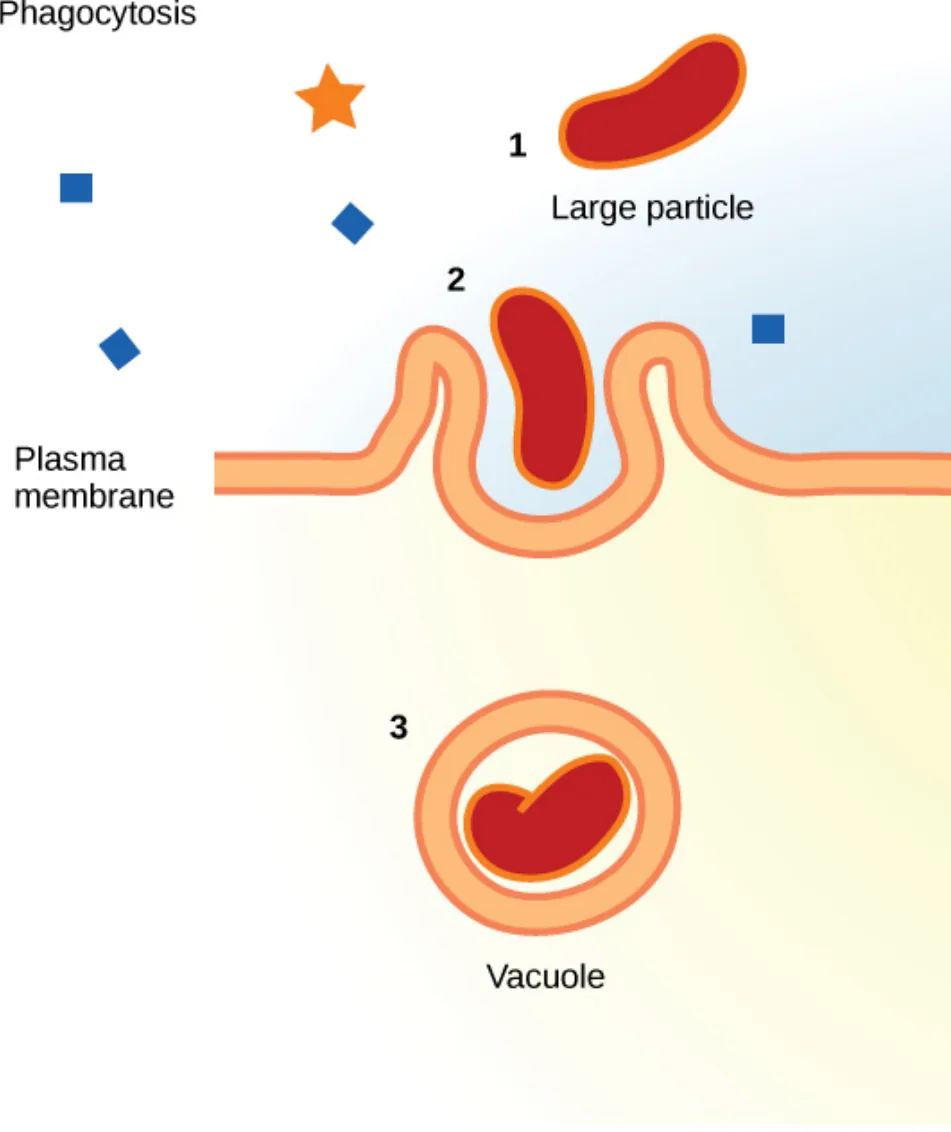
During phagocytosis the cell membrane surrounds a particle and engulfs it completely. Image: OpenStax, Biology for AP Courses, CC BY 4.0.
Phagocytosis
 ⤢ Enlarge
1
Phagocytosis, meaning “cell eating,” is the process by which a cell takes in large particles such as whole cells or other relatively large objects. When microorganisms invade the body, a neutrophil surrounds and engulfs them. The microorganism is then destroyed inside the neutrophil. The figure below shows the membrane wrapping around a particle and taking it in.
2
Before the membrane can engulf a particle, a section of its inner surface is coated with a protein called clathrin
which stabilizes that region.
3
The coated part of the membrane extends outward from the cell, surrounds the particle and eventually encloses it.
4
Once the vesicle is inside the cell, clathrin detaches from the membrane, and the vesicle fuses with a lysosome.
5
The lysosome’s enzymes break down the contents of the newly formed compartment
which is now called an endosome.
6
When the useful nutrients have been extracted from the broken-down material, the endosome fuses with the plasma membrane and releases its remaining contents into the extracellular fluid. The endosome membrane then becomes part of the plasma membrane again.
Science practice connection for AP courses
Science practice connection for AP courses
Activity: draw a representation or diagram that shows how a neutrophil attacks and destroys an invading bacterium.
Your diagram should show the membrane extending around the bacterium, the resulting vesicle, the fusion with a lysosome,
and the release of breakdown products.
Name the organelles involved.
The main organelles are the lysosome
which contains the digestive enzymes, and the vesicle that carries the bacterium into the cell.
The cytoskeleton also helps push the membrane around the particle.
1Pinocytosis2Pinocytosis
Pinocytosis
Pinocytosis
Pinocytosis, or “cell drinking,” was named when scientists assumed that the cell was deliberately taking in extracellular fluid.
In reality, the cell takes in whatever small molecules are dissolved in that fluid, including water
which the cell needs.
Pinocytosis produces a much smaller vesicle than phagocytosis, and the vesicle does not need to fuse with a lysosome.
The diagram below shows the membrane surrounding a small volume of fluid and pinching off.
1 / 2Next ▶
In pinocytosis the membrane folds around a small volume of fluid and pinches off into a small vesicle. Image: OpenStax, Biology for AP Courses, CC BY 4.0.
Pinocytosis
 ⤢ Enlarge
1
A variation called potocytosis uses a coating protein called caveolin on the inner side of the membrane.
2
Caveolin does a job similar to clathrin.
3
The pits that form these small vesicles, called caveolae (singular: caveola), contain membrane receptors and lipid rafts as well as caveolin.
4
Potocytosis brings small molecules into the cell, and it can carry them across the cell so they are released on the opposite side.
5
This movement across the cell is called transcytosis.
6
In some cases, caveolae deliver their cargo to membrane-bound organelles such as the endoplasmic reticulum.
◀ Previous2 / 2
1Receptor-mediated endocytosis2Receptor-mediated endocytosis
In receptor-mediated endocytosis, a specific substance binds to a receptor on the outer membrane surface before the cell takes it in. Image: OpenStax, Biology for AP Courses, CC BY 4.0.
Receptor-mediated endocytosis
 ⤢ Enlarge
1
Receptor-mediated endocytosis is a targeted form of endocytosis. Receptor proteins in the plasma membrane have a strong binding affinity for particular substances
so the cell takes in only those substances. The figure below shows a single type of molecule binding to a receptor on the outer surface of the membrane before it is taken in.
2
As in phagocytosis, clathrin is attached to the inner side of the membrane.
3
If a compound depends on this process and the process fails, the compound is not removed from the tissue fluid or the blood.
4
It stays there and its concentration rises.
5
Some human diseases are caused by this failure.
6
For example, low-density lipoprotein (LDL), often called “bad” cholesterol, is cleared from the blood by receptor-mediated endocytosis.
1 / 2Next ▶
Receptor-mediated endocytosis
Receptor-mediated endocytosis
In familial hypercholesterolemia, the LDL receptors are defective or missing
so cells cannot remove LDL from the blood.
People with this genetic condition have dangerously high blood cholesterol.
The process is designed for specific molecules
but other substances can sometimes enter at the same site. Flu viruses, diphtheria toxin and cholera toxin all have structures that resemble normal receptor-binding sitesso they are able to gain entry into cells.
◀ Previous2 / 2
1Link to learning and a Salmonella question2Link to learning and a Salmonella question
Link to learning and a Salmonella question
1
The Link to Learning box points to an animation of receptor-mediated endocytosis
where you can click on the different parts of the process. Use it to see the receptor, the clathrin coat and the vesicle formation step by step.
2
Salmonella question: Salmonella is one of the most common causes of food-borne illness. When a white blood cell engulfs Salmonella by phagocytosis, the bacterium secretes a protein that stops the encased bacterium from fusing with the cell’s lysosome. What effect would this have?
3
1
4
a. The bacteria will be destroyed and will not cause any illness.
5
2
6
b. The bacteria will survive but will not cause illness.
1 / 2Next ▶
Link to learning and a Salmonella question
Link to learning and a Salmonella question
3
c. The bacteria will be destroyed but will still cause illness.
4
d. The bacteria will survive and possibly cause illness.
Answer: d. Without the lysosome, the enzymes cannot break down the bacterium
so it survives inside the white blood cell and may still cause disease.
◀ Previous2 / 2
1Exocytosis2Exocytosis
Exocytosis
Exocytosis
Exocytosis is the reverse of endocytosis.
It moves material out of the cell into the extracellular fluid.
Waste material is enclosed in a membrane-bound vesicle, and that vesicle fuses with the inside of the plasma membrane.
The fusion opens the envelope on the outside of the cell, and the material is released into the extracellular space.
The figure below shows this sequence.
1 / 2Next ▶
In exocytosis a vesicle fuses with the plasma membrane and releases its contents outside the cell. Image: OpenStax, Biology for AP Courses, CC BY 4.0.
Exocytosis
 ⤢ Enlarge
Exocytosis
Cells also use exocytosis to secrete proteins that form the extracellular matrix. Nerve cells use it to release neurotransmitters. Synaptic vesicles fuse with the membrane at the synapse, and the neurotransmitters are released into the synaptic cleft, the narrow gap between two neurons.
◀ Previous2 / 2
Transport methods, energy requirements and materials transported
1
The table below compares the transport methods covered in this chapter. It shows whether each method uses energy and what kinds of material it moves.
2
Passive transport moves material down its gradient and needs no cellular energy. Active transport uses energy, either directly from ATP or indirectly from a gradient that was already built by active pumping. Only the endocytosis and exocytosis methods move material in bulk, in vesicles, and they are the only methods that can carry macromolecules and whole cells across the membrane.
| Transport method | Active or passive | Material transported |
|---|---|---|
| Diffusion | Passive | Small molecules that cross the membrane directly |
| Osmosis | Passive | Water |
| Facilitated transport (diffusion) | Passive | Sodium, potassium, calcium and glucose |
| Primary active transport | Active | Sodium, potassium and calcium |
| Secondary active transport (co-transport) | Active | Amino acids and lactose |
| Phagocytosis | Active | Large macromolecules, whole cells or cell structures |
| Pinocytosis and potocytosis | Active | Small molecules dissolved in liquid, including water |
| Receptor-mediated endocytosis | Active | Large quantities of specific macromolecules |
Key terms
| Term | Meaning |
|---|---|
| Endocytosis | Active transport in which the plasma membrane folds around a particle and pinches off to form a vesicle inside the cell. |
| Phagocytosis | Endocytosis of large particles such as whole cells or microorganisms, meaning “cell eating.” |
| Pinocytosis | Endocytosis of small droplets of extracellular fluid, meaning “cell drinking.” |
| Receptor-mediated endocytosis | Targeted endocytosis in which a specific substance binds to a membrane receptor before the cell takes it in. |
| Exocytosis | The release of material from the cell when a vesicle fuses with the plasma membrane. |
| Vesicle | A small membrane-bound sac that carries material into or out of the cell, or between compartments inside it. |
| Clathrin | A coating protein on the inner side of the membrane that stabilizes the region where a vesicle forms. |
| Lysosome | A membrane-bound organelle containing digestive enzymes that break down material taken into the cell. |
| Endosome | A compartment formed when a vesicle carrying engulfed material merges with a lysosome for breakdown. |
| Neutrophil | A type of white blood cell that removes invading microorganisms by phagocytosis. |
| Caveolin | A coating protein that performs a function similar to clathrin in potocytosis. |
| Caveola | A small pit in the plasma membrane, rich in receptors and lipid rafts, that forms smaller vesicles than pinocytosis. |
| Potocytosis | A variation of pinocytosis that uses caveolin to move small molecules into the cell. |
| Transcytosis | The movement of molecules through a cell, taken in at one side and released at the opposite side. |
| Lipid raft | A region of the membrane rich in certain lipids and proteins that can help organize receptors and transport. |
| Low-density lipoprotein (LDL) | A cholesterol-carrying particle that cells remove from the blood by receptor-mediated endocytosis. |
| Familial hypercholesterolemia | A genetic disease in which defective or missing LDL receptors leave dangerously high cholesterol in the blood. |
| Synaptic cleft | The narrow gap between two neurons where neurotransmitters are released during exocytosis. |
1Avoid these mistakes2Avoid these mistakes3Avoid these mistakes
Avoid these mistakes
1Avoid this
Thinking that endocytosis is passive because it moves material into the cell. Endocytosis is an active process that requires energy.Avoid this
2Avoid this
Assuming that a large particle can pass through the membrane with enough energy. Large particles must be enclosed in a vesicle.Avoid this
3Avoid this
Confusing phagocytosis with pinocytosis.Avoid this
1 / 3Next ▶
Avoid these mistakes
Phagocytosis takes in large particles, while pinocytosis takes in small droplets of fluid and produces a much smaller vesicle.Avoid this
4Avoid this
Forgetting that a vesicle from phagocytosis merges with a lysosome, and that the material is broken down inside the endosome.Avoid this
5Avoid this
Saying that receptor-mediated endocytosis is nonspecific. It is targeted, because a specific substance binds to a receptor first.Avoid this
6Avoid this
◀ Previous2 / 3Next ▶
Avoid these mistakes
Describing exocytosis as the movement of material into the cell,Avoid this
or forgetting that the vesicle fuses with the plasma membrane to release its contents.Avoid this
7Avoid this
Stating that a substance is absorbed by passive diffusion when it actually needs a co-transport protein or a vesicle to enter the cell.Avoid this
◀ Previous3 / 3