Curriculum
Biology for AP Courses
Unit 1: The Study of Life
0/6
Unit 2: The Chemical Foundation of Life
0/8
Unit 3: Biological Macromolecules
0/12
Unit 4: Cell Structure
0/14
Unit 5: Structure and Function of Plasma Membranes
0/10
Unit 6: Metabolism
0/12
Unit 7: Cellular Respiration
0/16
Unit 8: Photosynthesis
0/8
Unit 9: Cell Communication
0/10
Unit 10: Cell Reproduction
0/12
Unit 11: Meiosis and Sexual Reproduction
0/6
Unit 12: Mendel's Experiments and Heredity
0/8
Unit 13: Modern Understandings of Inheritance
0/6
Unit 14: DNA Structure and Function
0/14
Unit 15: Genes and Proteins
0/13
-
Unit 15 overview: Genes and Proteins
 Preview
-
15.1 The Genetic Code
Preview
-
15.1 The Genetic Code - Check yourself
 Preview
-
15.2 Prokaryotic Transcription
Preview
-
15.2 Prokaryotic Transcription
Preview
-
15.2 Prokaryotic Transcription - Check yourself
Preview
-
15.3 Eukaryotic Transcription
Preview
-
15.3 Eukaryotic Transcription - Check yourself
Preview
-
15.4 RNA Processing in Eukaryotes
Preview
-
15.4 RNA Processing in Eukaryotes - Check yourself
Preview
-
15.5 Ribosomes and Protein Synthesis
Preview
-
15.5 Ribosomes and Protein Synthesis - Check yourself
Preview
-
Unit 15 review quiz: Genes and Proteins
Preview
Unit 16: Gene Regulation
0/16
Unit 17: Biotechnology and Genomics
0/12
Unit 18: Evolution and Origin of Species
0/8
Unit 19: The Evolution of Populations
0/8
Unit 20: Phylogenies and the History of Life
0/8
Unit 21: Viruses
0/10
Unit 22: Prokaryotes: Bacteria and Archaea
0/12
Unit 23: Plant Form and Physiology
0/14
Unit 24: The Animal Body: Basic Form and Function
0/8
Unit 25: Animal Nutrition and the Digestive System
0/10
Unit 26: The Nervous System
0/12
Unit 27: Sensory Systems
0/12
Unit 28: The Endocrine System
0/12
Unit 29: The Musculoskeletal System
0/10
Unit 30: The Respiratory System
0/10
Unit 31: The Circulatory System
0/10
Unit 32: Osmotic Regulation and Excretion
0/12
Unit 33: The Immune System
0/10
Unit 34: Animal Reproduction and Development
0/16
Unit 35: Ecology and the Biosphere
0/12
Unit 36: Population and Community Ecology
0/16
Unit 37: Ecosystems
0/8
Unit 38: Conservation Biology and Biodiversity
0/10
Text lesson
15.1 The Genetic Code
15.1 The Genetic Code — BIOLOGY FOR AP COURSES notes: You will be able to describe the flow of genetic information from DNA to mRNA to protein, explain how a three-nucleotide codon specifies an amino acid, and apply the degenerate and universal features of the genetic code.
1Genes and the three alphabets2Genes and the three alphabets3Genes and the three alphabets4Genes and the three alphabets5Genes and the three alphabets6Genes and the three alphabets
Genes and the three alphabets
Genes and the three alphabets
Since Mendel’s work was rediscovered in the 1900s, scientists have learned that the genetic blueprints stored in DNA can be copied, expressed, and changed by mutation.
1 / 6Next ▶
Genes lie on chromosomes and direct the making of RNA and protein molecules. The two protein examples, shown as folded three-dimensional models, illustrate the wide range of structures that genes can encode. Image: OpenStax, Biology for AP Courses, CC BY 4.0.
Genes and the three alphabets
 ⤢ Enlarge
1
A gene is now understood as a physical stretch of DNA that can be replicated, read to make a product, and altered over time.
2
Figure 15.1 shows this idea at three levels: a chromosome that carries genes, and two protein molecules whose structures are encoded by genes.
3
Three alphabets are involved in turning genes into working molecules.
4
1
5
DNA is written with four letters: A, T, C, and G.
6
2
◀ Previous2 / 6Next ▶
Genes and the three alphabets
Genes and the three alphabets
RNA is written with four letters: A, U, C, and G.
3
Proteins are built from 20 common amino acids.
4
The genetic code is the set of rules that links the nucleotide alphabet to the amino acid alphabet,
so that a nucleotide sequence in a gene determines the amino acid sequence of a polypeptide.
◀ Previous3 / 6Next ▶
Genes and the three alphabets
Genes and the three alphabets
5
Because the four DNA letters can be arranged in an enormous number of orders, one gene can specify a unique protein with a particular shape and function.
The 20 amino acids differ in their side chains.
Each amino acid has the same backbone: a central carbon atom bonded to an amino group (NH
+
), a carboxyl group (COO
◀ Previous4 / 6Next ▶
Genes and the three alphabets
1
−
2
), a hydrogen atom,
3
and a side chain, often called the R group.
4
The side chain determines whether the amino acid is nonpolar, polar, or charged, and whether it is large or small.
5
This variety of side chains is the reason proteins have such different structures and functions.
6
Figure 15.2 shows the structure of all 20 amino acids grouped by the properties of their side chains.
◀ Previous5 / 6Next ▶
The 20 amino acids found in proteins, grouped as nonpolar aliphatic, polar uncharged, positively charged, negatively charged, and nonpolar aromatic. Each shares an amino group and a carboxyl group, and differs only in its side chain. Image: OpenStax, Biology for AP Courses, CC BY 4.0.
Genes and the three alphabets

◀ Previous6 / 6
1The Central Dogma: DNA encodes RNA, RNA encodes protein · Tr2Translation3Transfer RNA (tRNA)4Transfer RNA (tRNA)5Transfer RNA (tRNA)6Transfer RNA (tRNA)
The Central Dogma: DNA encodes RNA, RNA encodes protein · Transcription
The Central Dogma: DNA encodes RNA, RNA encodes protein
The flow of genetic information in a cell is described by the Central Dogma.
It states that genes specify the sequence of messenger RNA (mRNA), and the mRNA in turn specifies the sequence of a protein.
The Central Dogma is carried out in two steps.
Transcription
In
transcription
, a gene is copied into an mRNA molecule.
1 / 6Next ▶
Translation
1
translation
2
, the mRNA is read at a ribosome and used to link amino acids into a polypeptide chain.
◀ Previous2 / 6Next ▶
Transfer RNA (tRNA)
Transfer RNA (tRNA)
Translation also requires two other kinds of RNA:
transfer RNA (tRNA)
,
which brings the correct amino acid to the ribosome,
and ribosomal RNA (rRNA),
which is a structural and catalytic component of the ribosome.
◀ Previous3 / 6Next ▶
Transfer RNA (tRNA)
Transfer RNA (tRNA)
Each step is carried out by specific proteins and RNA molecules that decode one kind of molecule into another.
1
Cells keep the DNA itself intact and protected, and make disposable RNA copies for protein synthesis.
2
Copying DNA into RNA is relatively simple: one RNA nucleotide is added for each DNA nucleotide that is read.
3
◀ Previous4 / 6Next ▶
Transfer RNA (tRNA)
1
Translation is more complex
because three mRNA nucleotides specify one amino acid.
2
4
3
The system is still orderly and colinear: nucleotides 1 to 3 specify amino acid 1, nucleotides 4 to 6 specify amino acid 2,
4
and so on along the message.
5
5
6
Figure 15.3 shows the whole process, from the gene to the protein.
◀ Previous5 / 6Next ▶
Transcription copies a gene from DNA into RNA, RNA processing removes introns and joins exons, and translation at a ribosome links amino acids into a polypeptide according to the codons on the mRNA. Image: OpenStax, Biology for AP Courses, CC BY 4.0.
Transfer RNA (tRNA)
 ⤢ Enlarge
1
The simple scheme has exceptions that were found as scientists studied gene expression with new tools.
2
The human immunodeficiency virus (HIV) is a retrovirus whose genome is single-stranded RNA.
3
When it infects a host cell, the viral enzyme reverse transcriptase uses the RNA as a template to make DNA.
4
That viral DNA is then transcribed into mRNA and translated into proteins
so information flows from RNA back to DNA.
5
Some RNA viruses, such as influenza, never make a DNA copy at all.
6
Their RNA genome is copied directly by a viral RNA-dependent RNA polymerase
which is an RNA-to-RNA process.
◀ Previous6 / 6
1The genetic code is a triplet code2Codon3Codon4Reading frame5Reading frame
The genetic code is a triplet code
The genetic code is a triplet code
The DNA and RNA alphabets have four letters
but the protein alphabet has 20. Scientists first asked how many nucleotides are needed to specify one amino acid.
Two-nucleotide combinations give only 42 = 16 possibilities
which is too few for 20 amino acids.
Three-nucleotide combinations give 43 = 64 possibilities
which is more than enough.
1 / 5Next ▶
Codon
1
Each group of three consecutive nucleotides is called a
2
codon
3
, and the code is therefore a
4
triplet code
5
.
6
Francis Crick and Sydney Brenner tested this experimentally using the chemical mutagen proflavin
which inserts extra nucleotides into a gene.
◀ Previous2 / 5Next ▶
Codon
Codon
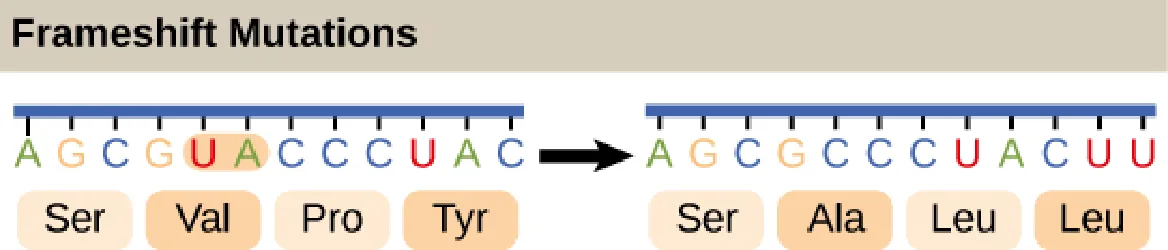
When they inserted one or two nucleotides into the gene of a virus, protein synthesis was completely disrupted.
When they inserted three nucleotides, a functional protein was still made, with one extra amino acid.
◀ Previous3 / 5Next ▶
Reading frame
Reading frame
Inserting one or two nucleotides shifts the
reading frame
,
which is the way the mRNA is divided into codons,
so every codon after the change is different.
Inserting three nucleotides shifts the frame by a full codon
so only one amino acid is added and the rest of the protein is preserved.
◀ Previous4 / 5Next ▶
A frameshift changes how an mRNA is read in groups of three. After the shift, the codons and the amino acids they specify are different from the original message, which usually makes the protein nonfunctional. Image: OpenStax, Biology for AP Courses, CC BY 4.0.
Reading frame
 ⤢ Enlarge
Reading frame
This experiment showed that three nucleotides specify each amino acid.
◀ Previous5 / 5
1Reading the codon table2Reading the codon table3Reading the codon table4Start codon
Reading the codon table
Reading the codon table
Scientists solved the genetic code by translating synthetic mRNAs in a test tube and sequencing the proteins they produced.
1 / 4Next ▶
The genetic code. Each three-letter mRNA codon, read by its first, second, and third letters, specifies one amino acid or a stop signal. AUG codes for methionine and also serves as the start codon. Image: OpenStax, Biology for AP Courses, CC BY 4.0.
Reading the codon table
 ⤢ Enlarge
Reading the codon table
Figure 15.5 summarizes the result.
To read it, find the first letter of the codon in the left column, the second letter in the top row, and the third letter in the right column.
The box where these meet gives the amino acid or a termination signal.
Three of the 64 codons are stop codons, also called nonsense codons: UAA, UAG, and UGA.
They do not add an amino acid.
Instead, they end protein synthesis and release the finished polypeptide from the translation machinery.
◀ Previous2 / 4Next ▶
Reading the codon table
Reading the codon table
The codon AUG has two roles.
◀ Previous3 / 4Next ▶
Start codon
Start codon
It specifies the amino acid methionine, and it is the
start codon
that begins translation.
The start codon, located near the 5′ end of the mRNA, sets the reading frame for the whole message.
Every codon after it is read in groups of three from that point.
◀ Previous4 / 4
1The genetic code is degenerate2The genetic code is degenerate
1The genetic code is universal2The genetic code is universal3The genetic code is universal
Link to Learning: building a protein from a gene
Link to Learning: building a protein from a gene
An online simulation on the textbook’s website lets you transcribe a gene and translate it into a protein, using base pairing and the genetic code. Working through the steps by hand reinforces how each codon becomes an amino acid.
1Degeneracy and protection from mutation2Degeneracy and protection from mutation
1Check your understanding2Check your understanding
Science practice: reading a DNA strand
Science practice: reading a DNA strand
A strand of DNA with the sequence 3′ GCT GTC AAA TTC GAT 5′ can be used to predict an mRNA and then a short peptide. The mRNA is complementary to the template strand, and it is written 5′ to 3′. The worked example below carries out the calculation step by step.
1Scientific method: which has more DNA, a kiwi or a strawberr2Scientific method: which has more DNA, a kiwi or a strawberr3Scientific method: which has more DNA, a kiwi or a strawberr4Scientific method: which has more DNA, a kiwi or a strawberr5Scientific method: which has more DNA, a kiwi or a strawberr
Scientific method: which has more DNA, a kiwi or a strawberry?
Scientific method: which has more DNA, a kiwi or a strawberry?
The question asks whether a kiwifruit and a strawberry of about the same size also contain about the same amount of DNA.
1 / 5Next ▶
A kiwifruit cut in half, and a bowl of strawberries of similar size. The two fruits are compared to see whether their DNA content is similar. Image: OpenStax, Biology for AP Courses, CC BY 4.0.
Scientific method: which has more DNA, a kiwi or a strawberry?
 ⤢ Enlarge
Scientific method: which has more DNA, a kiwi or a strawberry?
Genes are carried on chromosomes made of DNA, and the number of chromosome sets in a cell affects how much DNA it contains.
The common strawberry is octoploid, with 8 sets of chromosomes per cell
while the cultivated kiwi is hexaploid, with 6 sets.
That difference suggests the strawberry may contain more DNA per cell nucleus, although fruit size and cell number also matter.
The experiment isolates DNA from each fruit in at least three repeats
which is called triplicate. The method works in these steps:
1
Make a DNA extraction buffer by mixing 900 mL of water, 50 mL of dish detergent, and two teaspoons of table salt. Invert the bottle to mix.
◀ Previous2 / 5Next ▶
Scientific method: which has more DNA, a kiwi or a strawberry?
1
2
2
Crush a strawberry and a kiwifruit separately, for at least two minutes each, by hand in a plastic bag, with a mortar and pestle,
3
or with a bowl and a blunt tool.
4
3
5
Add 10 mL of the buffer to each crushed fruit and mix for at least one minute.
6
The detergent breaks open membranes and the salt helps DNA stay in solution.
◀ Previous3 / 5Next ▶
Scientific method: which has more DNA, a kiwi or a strawberry?
1
4
2
Filter each mixture through cheesecloth into a funnel over a test tube, to remove the cell debris.
3
5
4
Pour ice-cold ethanol or isopropanol into each tube. DNA is insoluble in cold alcohol
so it appears as a white precipitate at the boundary.
5
6
6
Wind the precipitated DNA around a separate glass rod for each fruit and compare the amounts.
◀ Previous4 / 5Next ▶
Scientific method: which has more DNA, a kiwi or a strawberry?
Scientific method: which has more DNA, a kiwi or a strawberry?
Before the experiment, a hypothesis should state whether the two fruits can be told apart by DNA amount, and which fruit is expected to yield more. The results are then compared with the chromosome counts to judge whether the prediction was supported.
◀ Previous5 / 5
Record, analyze and conclude: kiwi or strawberry · Record, analyze and conclude: kiwi or strawberry
Record, analyze and conclude: kiwi or strawberry
Record your observations: You do not measure DNA volume quantitatively in this activity. For each trial, note whether the two fruits gave the same or different amounts of DNA by eye. If one fruit clearly gave more, record that too. Check whether your observations hold for several pieces of each fruit.
Analyze your data: Did one fruit clearly yield more DNA than the other? Were the results reproducible across the repeats?
Draw a conclusion: Knowing the number of chromosome sets in each fruit, can you conclude that chromosome number always matches the amount of DNA?
Record, analyze and conclude: kiwi or strawberry
Think about the drawbacks of this method, such as uneven piece sizes and judging amounts by eye.
If you had access to a laboratory, how could you standardize the comparison and make it quantitative, for example by measuring the mass of DNA obtained from equal masses of fruit?
1AP Biology framework connections · Big Idea 1 (evolution) · 2Science practices
1Example 1: The mRNA and amino acids from a DNA strand2Worked examples3Example 2: How many codons and how many amino acids4Example 3: Number of possible codons
Key terms
| Term | Meaning |
|---|---|
| Central Dogma | The normal flow of genetic information: DNA specifies mRNA, and mRNA specifies protein. |
| Gene | A stretch of DNA that can be copied and used to make an RNA or protein product. |
| Transcription | The copying of a gene from DNA into an RNA molecule. |
| Translation | The reading of an mRNA at a ribosome to link amino acids into a polypeptide. |
| Messenger RNA (mRNA) | An RNA copy of a gene that carries the message for protein synthesis. |
| Transfer RNA (tRNA) | An RNA that carries a specific amino acid to the ribosome during translation. |
| Ribosomal RNA (rRNA) | RNA that forms part of the structure of the ribosome and helps it work. |
| Genetic code | The set of rules that links nucleotide triplets in mRNA to amino acids or stop signals. |
| Codon | A sequence of three consecutive nucleotides in mRNA that specifies one amino acid or a stop signal. |
| Triplet code | The genetic code, in which each amino acid is specified by three nucleotides. |
| Reading frame | The way an mRNA is divided into consecutive codons, set by the start codon. |
| Start codon | The codon AUG, which specifies methionine and begins translation. |
| Stop codon (nonsense codon) | One of UAA, UAG, or UGA, which ends translation without adding an amino acid. |
| Degenerate | A property of the code in which one amino acid is specified by more than one codon. |
| Universal | A property of the code in which almost all species use the same codon assignments. |
| Reverse transcriptase | A viral enzyme that uses RNA as a template to make DNA. |
1Avoid these mistakes2Avoid these mistakes3Avoid these mistakes