Curriculum
Biology for AP Courses
Unit 1: The Study of Life
0/6
Unit 2: The Chemical Foundation of Life
0/8
Unit 3: Biological Macromolecules
0/12
Unit 4: Cell Structure
0/14
Unit 5: Structure and Function of Plasma Membranes
0/10
Unit 6: Metabolism
0/12
Unit 7: Cellular Respiration
0/16
Unit 8: Photosynthesis
0/8
Unit 9: Cell Communication
0/10
Unit 10: Cell Reproduction
0/12
Unit 11: Meiosis and Sexual Reproduction
0/6
Unit 12: Mendel's Experiments and Heredity
0/8
Unit 13: Modern Understandings of Inheritance
0/6
Unit 14: DNA Structure and Function
0/14
Unit 15: Genes and Proteins
0/13
Unit 16: Gene Regulation
0/16
Unit 17: Biotechnology and Genomics
0/12
Unit 18: Evolution and Origin of Species
0/8
Unit 19: The Evolution of Populations
0/8
Unit 20: Phylogenies and the History of Life
0/8
Unit 21: Viruses
0/10
Unit 22: Prokaryotes: Bacteria and Archaea
0/12
Unit 23: Plant Form and Physiology
0/14
Unit 24: The Animal Body: Basic Form and Function
0/8
Unit 25: Animal Nutrition and the Digestive System
0/10
Unit 26: The Nervous System
0/12
Unit 27: Sensory Systems
0/12
Unit 28: The Endocrine System
0/12
-
Unit 28 overview: The Endocrine System
 Preview
-
28.1 Types of Hormones
Preview
-
28.1 Types of Hormones - Check yourself
 Preview
-
28.2 How Hormones Work
Preview
-
28.2 How Hormones Work - Check yourself
Preview
-
28.3 Regulation of Body Processes
Preview
-
28.3 Regulation of Body Processes - Check yourself
Preview
-
28.4 Regulation of Hormone Production
Preview
-
28.4 Regulation of Hormone Production - Check yourself
Preview
-
28.5 Endocrine Glands
Preview
-
28.5 Endocrine Glands - Check yourself
Preview
-
Unit 28 review quiz: The Endocrine System
Preview
Unit 29: The Musculoskeletal System
0/10
Unit 30: The Respiratory System
0/10
Unit 31: The Circulatory System
0/10
Unit 32: Osmotic Regulation and Excretion
0/12
Unit 33: The Immune System
0/10
Unit 34: Animal Reproduction and Development
0/16
Unit 35: Ecology and the Biosphere
0/12
Unit 36: Population and Community Ecology
0/16
Unit 37: Ecosystems
0/8
Unit 38: Conservation Biology and Biodiversity
0/10
Text lesson
Unit 28 overview: The Endocrine System
Unit 28: The Endocrine System — BIOLOGY FOR AP COURSES notes: By the end of this unit you should be able to explain how hormones act as chemical messengers, classify hormones by chemical structure, describe how target cells receive hormone signals, explain how feedback loops keep hormone levels in range, and match the main endocrine glands to the hormones they produce.
1Introduction2Introduction3Introduction4Introduction5Introduction6Introduction
Introduction
Introduction
1
Every animal must detect changes inside and outside its body and respond to them in a coordinated way.
Two systems carry out most of this work.
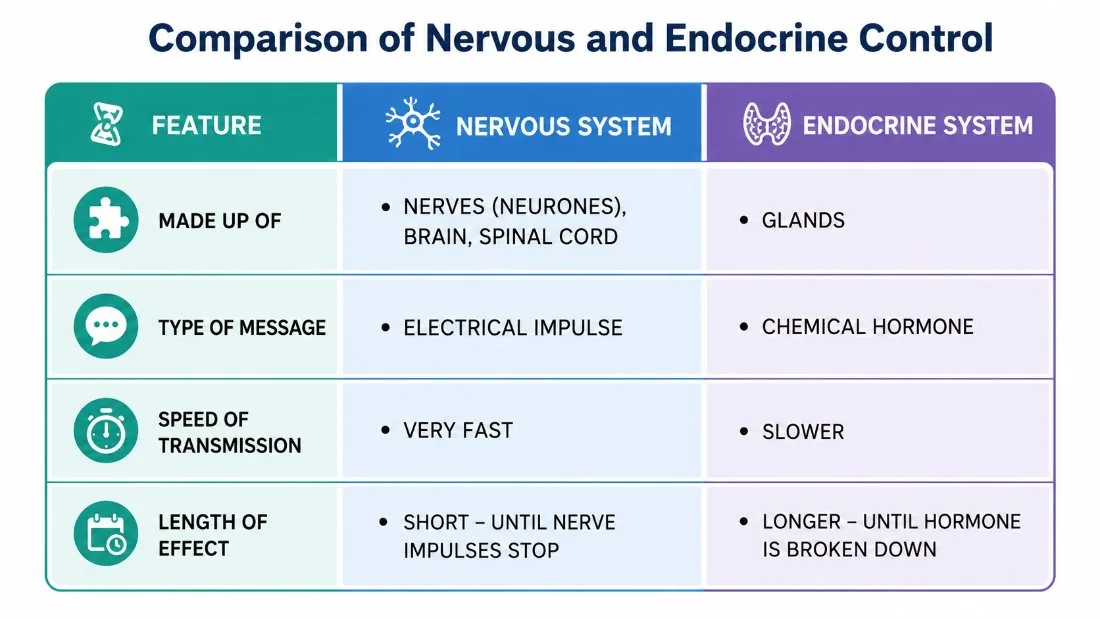
The nervous system sends rapid electrical signals along neurons,
while the endocrine system releases hormones,
which are chemical messengers that travel to cells and organs and change what they do.
1 / 6Next ▶
Introduction
1
Together these systems help the body maintain homeostasis, the stable internal conditions that cells need in order to function.
2
2
3
The endocrine system influences growth, metabolism and sexual development.
4
In humans, two of the most common endocrine disorders are thyroid disease and diabetes mellitus, a condition in which blood glucose is not controlled properly.
5
Hormones also direct large changes in the body.
6
The transformation of a tadpole into a frog, called metamorphosis, is timed and controlled by hormones,
◀ Previous2 / 6Next ▶
Introduction
Introduction
so that the animal’s body is reshaped for life in a new environment.
3
Research on hormones continues to produce medical advances.
Scientists have recently described a small peptide made inside mitochondria, called MOTS-c, that regulates metabolism and improves insulin resistance, with effects that resemble some of the benefits of exercise.
Discoveries of this kind show why it is important to understand how hormones are made, how they are carried, and how cells respond to them.
4
◀ Previous3 / 6Next ▶
Introduction
Introduction
Connection for AP courses: much of the anatomy of animal organ systems is outside the scope of AP Biology,
but the endocrine system is studied in depth because an animal must be able to detect, transmit and respond to information in order to survive.
The nervous and endocrine systems work together.
Nerve signals are action potentials that travel along neurons,
whereas hormones are released from glands, carried in the blood to target cells,
and produce a response there.
◀ Previous4 / 6Next ▶
Introduction
1
You are not expected to memorize every gland and hormone
but you should understand the general pattern by which hormones act.
2
5
3
Why it matters: this unit introduces the chemistry of hormones, the way a target cell receives and amplifies a hormone signal, the feedback loops that control hormone release,
4
and the glands that produce the body’s major hormones.
5
Each of these ideas appears again in the five sections that follow.
6
The chapter has no key equations
so its most useful tools are classification tables, feedback diagrams and receptor pathways.
◀ Previous5 / 6Next ▶
1How the sections connect2How the sections connect3How the sections connect
Chapter summary: 28.1 Types of Hormones
Chapter summary: 28.1 Types of Hormones
Hormones fall into three chemical groups.
Lipid-derived hormones are structurally similar to cholesterol, and the steroid hormones estradiol and testosterone belong to this group.
Amino acid-derived hormones are relatively small molecules built from amino acids,
and the adrenal hormones epinephrine and norepinephrine are examples.
Peptide hormones are chains of amino acids,
from short polypeptides to full proteins,and they include the pituitary hormones, antidiuretic hormone and oxytocin.(also called vasopressin)
1Chapter summary: 28.2 How Hormones Work2Chapter summary: 28.2 How Hormones Work
1Chapter summary: 28.3 Regulation of Body Processes2Chapter summary: 28.3 Regulation of Body Processes3Chapter summary: 28.3 Regulation of Body Processes4Chapter summary: 28.3 Regulation of Body Processes5Chapter summary: 28.3 Regulation of Body Processes
Chapter summary: 28.4 Regulation of Hormone Production
1
Hormone levels are controlled mainly by negative feedback, in which a rising level of a hormone inhibits its own further release.
2
Hormone release is triggered by three kinds of stimuli.
3
Humoral stimuli are changes in the extracellular fluid, such as blood glucose or ion concentrations, that directly trigger a gland.
4
Hormonal stimuli are hormones released by one endocrine gland that cause another gland to release its hormone.
5
Neural stimuli are signals from the nervous system that cause a gland to release its hormone.
1Chapter summary: 28.5 Endocrine Glands2Chapter summary: 28.5 Endocrine Glands3Chapter summary: 28.5 Endocrine Glands
Review and test prep
Review and test prep
The review and test prep questions for this chapter test a small set of ideas: the three chemical classes of hormones and which of them can cross the membrane
the difference between intracellular and plasma membrane receptorsthe stimuli that trigger hormone releasethe feedback loop that controls each hormoneand the gland and hormone pairs such as beta cells and insulin, parathyroid glands and PTH, or the anterior pituitary and TSH.
Many questions also use graphs of hormone concentration over time
so read the axes and the units before choosing an answer.
The Science Practice challenge questions ask you to draw flow charts, justify claims and explain feedback loops in your own words,
so practise writing a short causal chain from stimulus to receptor to response.
Key terms
| Term | Meaning |
|---|---|
| Acromegaly | A condition in adults caused by the overproduction of growth hormone, which enlarges the hands, feet and face bones. |
| Addison’s disease | A disorder in which the adrenal cortex produces too little corticosteroid. |
| Adenylate cyclase | An enzyme that converts ATP into cyclic AMP in a signaling pathway. |
| Adrenal cortex | The outer layer of the adrenal gland, which produces corticosteroids. |
| Adrenal gland | An endocrine gland that sits on top of each kidney. |
| Adrenal medulla | The inner part of the adrenal gland, which produces epinephrine and norepinephrine. |
| Adrenocorticotropic hormone (ACTH) | A hormone from the anterior pituitary that stimulates the adrenal cortex to release corticosteroids during long-term stress. |
| Aldosterone | A steroid hormone from the adrenal cortex that increases sodium reabsorption and potassium secretion by the kidneys. |
| Alpha cell | An endocrine cell in the pancreatic islets that produces glucagon. |
| Amino acid-derived hormone | A hormone made from one or more amino acids, usually a small molecule. |
| Androgen | A male sex hormone, such as testosterone. |
| Anterior pituitary | The front portion of the pituitary gland, which makes six hormones; also called the adenohypophysis. |
| Antidiuretic hormone (ADH) | A hormone made in the hypothalamus and released by the posterior pituitary that increases water reabsorption by the kidneys. |
| Atrial natriuretic peptide (ANP) | A hormone made by the heart that lowers blood volume, blood pressure and sodium concentration. |
| Beta cell | An endocrine cell in the pancreatic islets that produces insulin. |
| Calcitonin | A hormone from the parafollicular cells of the thyroid that lowers blood calcium and promotes bone growth. |
| Colloid | The fluid inside the thyroid gland, which contains the glycoprotein thyroglobulin. |
| Corticosteroid | A hormone released by the adrenal cortex in response to long-term stress. |
| Cortisol | A glucocorticoid made in response to stress. |
| Cushing’s disease | A disorder caused by the overproduction of glucocorticoids. |
| Diabetes insipidus | A disorder caused by too little ADH, which leads to the loss of large volumes of dilute urine. |
| Diabetes mellitus | A disorder caused by low insulin activity, which leads to high blood glucose. |
| Diabetogenic effect | An effect of growth hormone that raises blood glucose, similar to diabetes mellitus. |
| Down-regulation | A decrease in the number of hormone receptors when hormone levels are high. |
| Endocrine gland | A gland that releases hormones into the interstitial fluid, from which they diffuse into the blood and are carried to target tissues. |
| Epinephrine | A hormone from the adrenal medulla that is released during short-term stress. |
| Erythropoietin (EPO) | A hormone made by the kidneys that stimulates red blood cell production in the bone marrow. |
| Estrogens | A group of steroid hormones made by the ovaries that produce female secondary sex characteristics and control the maturation of eggs. |
| First messenger | A hormone that binds a plasma membrane receptor and starts a signal transduction pathway. |
| Follicle-stimulating hormone (FSH) | A hormone from the anterior pituitary that stimulates gamete production. |
| G-protein | A membrane protein activated by a first messenger hormone, which then leads to the formation of cyclic AMP. |
| Gigantism | A condition in children caused by the overproduction of growth hormone. |
| Glucagon | A hormone from the alpha cells of the pancreas that raises blood glucose when levels are low. |
| Glucocorticoid | A corticosteroid that affects glucose metabolism. |
| Gluconeogenesis | The synthesis of glucose from amino acids. |
| Glucose-sparing effect | An effect of growth hormone that causes tissues to use fatty acids instead of glucose as fuel. |
| Glycogenolysis | The breakdown of glycogen into glucose. |
| Goiter | An enlargement of the thyroid gland caused by too little dietary iodine. |
| Gonadotropin | A hormone that regulates the gonads, including FSH and LH. |
| Growth hormone (GH) | A hormone from the anterior pituitary that promotes protein synthesis and body growth. |
| Growth hormone-inhibiting hormone (GHIH) | A hypothalamic hormone that inhibits growth hormone release; also called somatostatin. |
| Growth hormone-releasing hormone (GHRH) | A hypothalamic hormone that triggers the release of growth hormone. |
| Hormonal stimuli | The release of a hormone in response to another hormone. |
| Hormone receptor | A cellular protein that binds a specific hormone. |
| Humoral stimuli | Control of hormone release in response to changes in the extracellular fluid, such as blood glucose or blood ion concentrations. |
| Hyperglycemia | A blood glucose level that is higher than normal. |
| Hyperthyroidism | Overactivity of the thyroid gland. |
| Hypoglycemia | A blood glucose level that is lower than normal. |
| Hypophyseal portal system | A system of blood vessels that carries hypothalamic hormones to the anterior pituitary. |
| Hypothyroidism | Underactivity of the thyroid gland. |
| Insulin | A hormone from the beta cells of the pancreas that lowers blood glucose when levels are high. |
| Insulin-like growth factor (IGF) | A growth-promoting protein made by the liver that mediates many of the effects of growth hormone. |
| Intracellular hormone receptor | A hormone receptor located in the cytoplasm or nucleus of a cell. |
| Islets of Langerhans (pancreatic islets) | Clusters of endocrine cells in the pancreas. |
| Isthmus | The band of thyroid tissue that connects the two lobes of the thyroid gland. |
| Leptin | A hormone made by adipose tissue that promotes satiety and reduces hunger. |
| Lipid-derived hormone | A hormone derived mostly from cholesterol, such as a steroid hormone. |
| Mineralocorticoid | A corticosteroid that regulates ion and water balance. |
| Neural stimuli | Stimulation of an endocrine gland by the nervous system. |
| Norepinephrine | A hormone from the adrenal medulla that is released during short-term stress. |
| Osmoreceptor | A receptor in the hypothalamus that monitors the concentration of electrolytes in the blood. |
| Oxytocin | A hormone released by the posterior pituitary that stimulates uterine contractions during childbirth and milk release during nursing. |
| Pancreas | An organ between the stomach and the small intestine that contains both exocrine and endocrine cells. |
| Parafollicular cell | A thyroid cell that produces the hormone calcitonin. |
| Parathyroid gland | A gland on the surface of the thyroid that produces parathyroid hormone. |
| Parathyroid hormone (PTH) | A hormone from the parathyroid glands that raises blood calcium when levels are low. |
| Peptide hormone | A hormone made of a polypeptide chain. |
| Phosphodiesterase (PDE) | An enzyme that deactivates cyclic AMP, which stops the hormone response. |
| Pituitary dwarfism | A condition in children caused by too little growth hormone. |
| Pituitary gland | An endocrine gland at the base of the brain, with an anterior and a posterior part; also called the hypophysis. |
| Pituitary stalk (infundibulum) | The stalk that connects the pituitary gland to the hypothalamus. |
| Plasma membrane hormone receptor | A hormone receptor on the outer surface of the plasma membrane. |
| Posterior pituitary | The back portion of the pituitary gland, an extension of the brain that releases hormones made in the hypothalamus; also called the neurohypophysis. |
| Prolactin (PRL) | A hormone from the anterior pituitary that stimulates milk production. |
| Prolactin-inhibiting hormone | A hypothalamic hormone that inhibits the release of prolactin. |
| Prolactin-releasing hormone | A hypothalamic hormone that stimulates the release of prolactin. |
| Renin | An enzyme made by the kidneys that starts the cascade leading to aldosterone release. |
| Thymus gland | A gland behind the sternum that produces thymosin hormones, which help develop the immune system. |
| Thyroglobulin | A glycoprotein in the thyroid that is converted into thyroid hormone. |
| Thyroid gland | An endocrine gland in the neck that produces thyroxine and triiodothyronine. |
| Thyroid-stimulating hormone (TSH) | A hormone from the anterior pituitary that controls the release of T3 and T4 from the thyroid. |
| Thyroxine (tetraiodothyronine, T4) | A thyroid hormone containing four iodine atoms that helps control the basal metabolic rate. |
| Triiodothyronine (T3) | A thyroid hormone containing three iodine atoms that helps control the basal metabolic rate. |
| Up-regulation | An increase in the number of hormone receptors on a target cell. |
1Avoid these mistakes2Avoid these mistakes3Avoid these mistakes4Avoid these mistakes