Curriculum
Biology for AP Courses
Unit 1: The Study of Life
0/6
-
Unit 1 overview: The Study of Life
 Text lessonPreview
-
1.1 The Science of Biology
Text lessonPreview
-
1.1 The Science of Biology - Check yourself
 6 questionsPreview
-
1.2 Themes and Concepts of Biology
Text lessonPreview
-
1.2 Themes and Concepts of Biology - Check yourself
6 questionsPreview
-
Unit 1 review quiz: The Study of Life
10 questionsPreview
Unit 2: The Chemical Foundation of Life
0/8
-
Unit 2 overview: The Chemical Foundation of Life
Text lessonPreview
-
2.1 Atoms, Isotopes, Ions, and Molecules: The Building Blocks
Text lessonPreview
-
2.1 Atoms, Isotopes, Ions, and Molecules: The Building Blocks - Check yourself
6 questionsPreview
-
2.2 Water
Text lessonPreview
-
2.2 Water - Check yourself
6 questionsPreview
-
2.3 Carbon
Text lessonPreview
-
2.3 Carbon - Check yourself
6 questionsPreview
-
Unit 2 review quiz: The Chemical Foundation of Life
10 questionsPreview
Unit 3: Biological Macromolecules
0/12
-
Unit 3 overview: Biological Macromolecules
Text lessonPreview
-
3.1 Synthesis of Biological Macromolecules
Text lessonPreview
-
3.1 Synthesis of Biological Macromolecules - Check yourself
6 questionsPreview
-
3.2 Carbohydrates
Text lessonPreview
-
3.2 Carbohydrates - Check yourself
6 questionsPreview
-
3.3 Lipids
Text lessonPreview
-
3.3 Lipids - Check yourself
6 questionsPreview
-
3.4 Proteins
Text lessonPreview
-
3.4 Proteins - Check yourself
6 questionsPreview
-
3.5 Nucleic Acids
Text lessonPreview
-
3.5 Nucleic Acids - Check yourself
6 questionsPreview
-
Unit 3 review quiz: Biological Macromolecules
10 questionsPreview
Unit 4: Cell Structure
0/14
-
Unit 4 overview: Cell Structure
Text lessonPreview
-
4.1 Studying Cells
Text lessonPreview
-
4.1 Studying Cells - Check yourself
6 questionsPreview
-
4.2 Prokaryotic Cells
Text lessonPreview
-
4.2 Prokaryotic Cells - Check yourself
6 questionsPreview
-
4.3 Eukaryotic Cells
Text lessonPreview
-
4.3 Eukaryotic Cells - Check yourself
6 questionsPreview
-
4.4 The Endomembrane System and Proteins
Text lessonPreview
-
4.4 The Endomembrane System and Proteins - Check yourself
6 questionsPreview
-
4.5 Cytoskeleton
Text lessonPreview
-
4.5 Cytoskeleton - Check yourself
6 questionsPreview
-
4.6 Connections between Cells and Cellular Activities
Text lessonPreview
-
4.6 Connections between Cells and Cellular Activities - Check yourself
6 questionsPreview
-
Unit 4 review quiz: Cell Structure
10 questionsPreview
Unit 5: Structure and Function of Plasma Membranes
0/10
-
Unit 5 overview: Structure and Function of Plasma Membranes
Text lessonPreview
-
5.1 Components and Structure
Text lessonPreview
-
5.1 Components and Structure - Check yourself
6 questionsPreview
-
5.2 Passive Transport
Text lessonPreview
-
5.2 Passive Transport - Check yourself
6 questionsPreview
-
5.3 Active Transport
Text lessonPreview
-
5.3 Active Transport - Check yourself
6 questionsPreview
-
5.4 Bulk Transport
Text lessonPreview
-
5.4 Bulk Transport - Check yourself
6 questionsPreview
-
Unit 5 review quiz: Structure and Function of Plasma Membranes
10 questionsPreview
Unit 6: Metabolism
0/12
-
Unit 6 overview: Metabolism
Text lessonPreview
-
6.1 Energy and Metabolism
Text lessonPreview
-
6.1 Energy and Metabolism - Check yourself
6 questionsPreview
-
6.2 Potential, Kinetic, Free, and Activation Energy
Text lessonPreview
-
6.2 Potential, Kinetic, Free, and Activation Energy - Check yourself
6 questionsPreview
-
6.3 The Laws of Thermodynamics
Text lessonPreview
-
6.3 The Laws of Thermodynamics - Check yourself
6 questionsPreview
-
6.4 ATP: Adenosine Triphosphate
Text lessonPreview
-
6.4 ATP: Adenosine Triphosphate - Check yourself
6 questionsPreview
-
6.5 Enzymes
Text lessonPreview
-
6.5 Enzymes - Check yourself
6 questionsPreview
-
Unit 6 review quiz: Metabolism
10 questionsPreview
Unit 7: Cellular Respiration
0/16
-
Unit 7 overview: Cellular Respiration
Text lessonPreview
-
7.1 Energy in Living Systems
Text lessonPreview
-
7.1 Energy in Living Systems - Check yourself
6 questionsPreview
-
7.2 Glycolysis
Text lessonPreview
-
7.2 Glycolysis - Check yourself
6 questionsPreview
-
7.3 Oxidation of Pyruvate and the Citric Acid Cycle
Text lessonPreview
-
7.3 Oxidation of Pyruvate and the Citric Acid Cycle - Check yourself
6 questionsPreview
-
7.4 Oxidative Phosphorylation
Text lessonPreview
-
7.4 Oxidative Phosphorylation - Check yourself
6 questionsPreview
-
7.5 Metabolism without Oxygen
Text lessonPreview
-
7.5 Metabolism without Oxygen - Check yourself
6 questionsPreview
-
7.6 Connections of Carbohydrate, Protein, and Lipid Metabolic Pathways
Text lessonPreview
-
7.6 Connections of Carbohydrate, Protein, and Lipid Metabolic Pathways - Check yourself
6 questionsPreview
-
7.7 Regulation of Cellular Respiration
Text lessonPreview
-
7.7 Regulation of Cellular Respiration - Check yourself
6 questionsPreview
-
Unit 7 review quiz: Cellular Respiration
10 questionsPreview
Unit 8: Photosynthesis
0/8
-
Unit 8 overview: Photosynthesis
Text lessonPreview
-
8.1 Overview of Photosynthesis
Text lessonPreview
-
8.1 Overview of Photosynthesis - Check yourself
6 questionsPreview
-
8.2 The Light-Dependent Reaction of Photosynthesis
Text lessonPreview
-
8.2 The Light-Dependent Reaction of Photosynthesis - Check yourself
6 questionsPreview
-
8.3 Using Light to Make Organic Molecules
Text lessonPreview
-
8.3 Using Light to Make Organic Molecules - Check yourself
6 questionsPreview
-
Unit 8 review quiz: Photosynthesis
10 questionsPreview
Unit 9: Cell Communication
0/10
-
Unit 9 overview: Cell Communication
Text lessonPreview
-
9.1 Signaling Molecules and Cellular Receptors
Text lessonPreview
-
9.1 Signaling Molecules and Cellular Receptors - Check yourself
6 questionsPreview
-
9.2 Propagation of the Signal
Text lessonPreview
-
9.2 Propagation of the Signal - Check yourself
6 questionsPreview
-
9.3 Response to the Signal
Text lessonPreview
-
9.3 Response to the Signal - Check yourself
6 questionsPreview
-
9.4 Signaling in Single-Celled Organisms
Text lessonPreview
-
9.4 Signaling in Single-Celled Organisms - Check yourself
6 questionsPreview
-
Unit 9 review quiz: Cell Communication
10 questionsPreview
Unit 10: Cell Reproduction
0/12
-
Unit 10 overview: Cell Reproduction
Text lessonPreview
-
10.1 Cell Division
Text lessonPreview
-
10.1 Cell Division - Check yourself
6 questionsPreview
-
10.2 The Cell Cycle
Text lessonPreview
-
10.2 The Cell Cycle - Check yourself
6 questionsPreview
-
10.3 Control of the Cell Cycle
Text lessonPreview
-
10.3 Control of the Cell Cycle - Check yourself
6 questionsPreview
-
10.4 Cancer and the Cell Cycle
Text lessonPreview
-
10.4 Cancer and the Cell Cycle - Check yourself
6 questionsPreview
-
10.5 Prokaryotic Cell Division
Text lessonPreview
-
10.5 Prokaryotic Cell Division - Check yourself
6 questionsPreview
-
Unit 10 review quiz: Cell Reproduction
10 questionsPreview
Unit 11: Meiosis and Sexual Reproduction
0/6
-
Unit 11 overview: Meiosis and Sexual Reproduction
Text lessonPreview
-
11.1 The Process of Meiosis
Text lessonPreview
-
11.1 The Process of Meiosis - Check yourself
6 questionsPreview
-
11.2 Sexual Reproduction
Text lessonPreview
-
11.2 Sexual Reproduction - Check yourself
6 questionsPreview
-
Unit 11 review quiz: Meiosis and Sexual Reproduction
10 questionsPreview
Unit 12: Mendel's Experiments and Heredity
0/8
-
Unit 12 overview: Mendel's Experiments and Heredity
Text lessonPreview
-
12.1 Mendel’s Experiments and the Laws of Probability
Text lessonPreview
-
12.1 Mendel’s Experiments and the Laws of Probability - Check yourself
6 questionsPreview
-
12.2 Characteristics and Traits
Text lessonPreview
-
12.2 Characteristics and Traits - Check yourself
6 questionsPreview
-
12.3 Laws of Inheritance
Text lessonPreview
-
12.3 Laws of Inheritance - Check yourself
6 questionsPreview
-
Unit 12 review quiz: Mendel's Experiments and Heredity
10 questionsPreview
Unit 13: Modern Understandings of Inheritance
0/6
-
Unit 13 overview: Modern Understandings of Inheritance
Text lessonPreview
-
13.1 Chromosomal Theory and Genetic Linkages
Text lessonPreview
-
13.1 Chromosomal Theory and Genetic Linkages - Check yourself
6 questionsPreview
-
13.2 Chromosomal Basis of Inherited Disorders
Text lessonPreview
-
13.2 Chromosomal Basis of Inherited Disorders - Check yourself
6 questionsPreview
-
Unit 13 review quiz: Modern Understandings of Inheritance
10 questionsPreview
Unit 14: DNA Structure and Function
0/14
-
Unit 14 overview: DNA Structure and Function
Text lessonPreview
-
14.1 Historical Basis of Modern Understanding
Text lessonPreview
-
14.1 Historical Basis of Modern Understanding - Check yourself
6 questionsPreview
-
14.2 DNA Structure and Sequencing
Text lessonPreview
-
14.2 DNA Structure and Sequencing - Check yourself
6 questionsPreview
-
14.3 Basics of DNA Replication
Text lessonPreview
-
14.3 Basics of DNA Replication - Check yourself
6 questionsPreview
-
14.4 DNA Replication in Prokaryotes
Text lessonPreview
-
14.4 DNA Replication in Prokaryotes - Check yourself
6 questionsPreview
-
14.5 DNA Replication in Eukaryotes
Text lessonPreview
-
14.5 DNA Replication in Eukaryotes - Check yourself
6 questionsPreview
-
14.6 DNA Repair
Text lessonPreview
-
14.6 DNA Repair - Check yourself
6 questionsPreview
-
Unit 14 review quiz: DNA Structure and Function
10 questionsPreview
Unit 15: Genes and Proteins
0/13
-
Unit 15 overview: Genes and Proteins
Text lessonPreview
-
15.1 The Genetic Code
Text lessonPreview
-
15.1 The Genetic Code - Check yourself
6 questionsPreview
-
15.2 Prokaryotic Transcription
Text lessonPreview
-
15.2 Prokaryotic Transcription
Text lessonPreview
-
15.2 Prokaryotic Transcription - Check yourself
6 questionsPreview
-
15.3 Eukaryotic Transcription
Text lessonPreview
-
15.3 Eukaryotic Transcription - Check yourself
6 questionsPreview
-
15.4 RNA Processing in Eukaryotes
Text lessonPreview
-
15.4 RNA Processing in Eukaryotes - Check yourself
6 questionsPreview
-
15.5 Ribosomes and Protein Synthesis
Text lessonPreview
-
15.5 Ribosomes and Protein Synthesis - Check yourself
6 questionsPreview
-
Unit 15 review quiz: Genes and Proteins
10 questionsPreview
Unit 16: Gene Regulation
0/16
-
Unit 16 overview: Gene Regulation
Text lessonPreview
-
16.1 Regulation of Gene Expression
Text lessonPreview
-
16.1 Regulation of Gene Expression - Check yourself
6 questionsPreview
-
16.2 Prokaryotic Gene Regulation
Text lessonPreview
-
16.2 Prokaryotic Gene Regulation - Check yourself
6 questionsPreview
-
16.3 Eukaryotic Epigenetic Gene Regulation
Text lessonPreview
-
16.3 Eukaryotic Epigenetic Gene Regulation - Check yourself
6 questionsPreview
-
16.4 Eukaryotic Transcriptional Gene Regulation
Text lessonPreview
-
16.4 Eukaryotic Transcriptional Gene Regulation - Check yourself
6 questionsPreview
-
16.5 Eukaryotic Post-transcriptional Gene Regulation
Text lessonPreview
-
16.5 Eukaryotic Post-transcriptional Gene Regulation - Check yourself
6 questionsPreview
-
16.6 Eukaryotic Translational and Post-translational Gene Regulation
Text lessonPreview
-
16.6 Eukaryotic Translational and Post-translational Gene Regulation - Check yourself
6 questionsPreview
-
16.7 Cancer and Gene Regulation
Text lessonPreview
-
16.7 Cancer and Gene Regulation - Check yourself
6 questionsPreview
-
Unit 16 review quiz: Gene Regulation
10 questionsPreview
Unit 17: Biotechnology and Genomics
0/12
-
Unit 17 overview: Biotechnology and Genomics
Text lessonPreview
-
17.1 Biotechnology
Text lessonPreview
-
17.1 Biotechnology - Check yourself
6 questionsPreview
-
17.2 Mapping Genomes
Text lessonPreview
-
17.2 Mapping Genomes - Check yourself
6 questionsPreview
-
17.3 Whole-Genome Sequencing
Text lessonPreview
-
17.3 Whole-Genome Sequencing - Check yourself
6 questionsPreview
-
17.4 Applying Genomics
Text lessonPreview
-
17.4 Applying Genomics - Check yourself
6 questionsPreview
-
17.5 Genomics and Proteomics
Text lessonPreview
-
17.5 Genomics and Proteomics - Check yourself
6 questionsPreview
-
Unit 17 review quiz: Biotechnology and Genomics
10 questionsPreview
Unit 18: Evolution and Origin of Species
0/8
-
Unit 18 overview: Evolution and Origin of Species
Text lessonPreview
-
18.1 Understanding Evolution
Text lessonPreview
-
18.1 Understanding Evolution - Check yourself
6 questionsPreview
-
18.2 Formation of New Species
Text lessonPreview
-
18.2 Formation of New Species - Check yourself
6 questionsPreview
-
18.3 Reconnection and Rates of Speciation
Text lessonPreview
-
18.3 Reconnection and Rates of Speciation - Check yourself
6 questionsPreview
-
Unit 18 review quiz: Evolution and Origin of Species
10 questionsPreview
Unit 19: The Evolution of Populations
0/8
-
Unit 19 overview: The Evolution of Populations
Text lessonPreview
-
19.1 Population Evolution
Text lessonPreview
-
19.1 Population Evolution - Check yourself
6 questionsPreview
-
19.2 Population Genetics
Text lessonPreview
-
19.2 Population Genetics - Check yourself
6 questionsPreview
-
19.3 Adaptive Evolution
Text lessonPreview
-
19.3 Adaptive Evolution - Check yourself
6 questionsPreview
-
Unit 19 review quiz: The Evolution of Populations
10 questionsPreview
Unit 20: Phylogenies and the History of Life
0/8
-
Unit 20 overview: Phylogenies and the History of Life
Text lessonPreview
-
20.1 Organizing Life on Earth
Text lessonPreview
-
20.1 Organizing Life on Earth - Check yourself
6 questionsPreview
-
20.2 Determining Evolutionary Relationships
Text lessonPreview
-
20.2 Determining Evolutionary Relationships - Check yourself
6 questionsPreview
-
20.3 Perspectives on the Phylogenetic Tree
Text lessonPreview
-
20.3 Perspectives on the Phylogenetic Tree - Check yourself
6 questionsPreview
-
Unit 20 review quiz: Phylogenies and the History of Life
10 questionsPreview
Unit 21: Viruses
0/10
-
Unit 21 overview: Viruses
Text lessonPreview
-
21.1 Viral Evolution, Morphology, and Classification
Text lessonPreview
-
21.1 Viral Evolution, Morphology, and Classification - Check yourself
6 questionsPreview
-
21.2 Virus Infection and Hosts
Text lessonPreview
-
21.2 Virus Infection and Hosts - Check yourself
6 questionsPreview
-
21.3 Prevention and Treatment of Viral Infections
Text lessonPreview
-
21.3 Prevention and Treatment of Viral Infections - Check yourself
6 questionsPreview
-
21.4 Other Acellular Entities: Prions and Viroids
Text lessonPreview
-
21.4 Other Acellular Entities: Prions and Viroids - Check yourself
6 questionsPreview
-
Unit 21 review quiz: Viruses
10 questionsPreview
Unit 22: Prokaryotes: Bacteria and Archaea
0/12
-
Unit 22 overview: Prokaryotes: Bacteria and Archaea
Text lessonPreview
-
22.1 Prokaryotic Diversity
Text lessonPreview
-
22.1 Prokaryotic Diversity - Check yourself
6 questionsPreview
-
22.2 Structure of Prokaryotes
Text lessonPreview
-
22.2 Structure of Prokaryotes - Check yourself
6 questionsPreview
-
22.3 Prokaryotic Metabolism
Text lessonPreview
-
22.3 Prokaryotic Metabolism - Check yourself
6 questionsPreview
-
22.4 Bacterial Diseases in Humans
Text lessonPreview
-
22.4 Bacterial Diseases in Humans - Check yourself
6 questionsPreview
-
22.5 Beneficial Prokaryotes
Text lessonPreview
-
22.5 Beneficial Prokaryotes - Check yourself
6 questionsPreview
-
Unit 22 review quiz: Prokaryotes: Bacteria and Archaea
10 questionsPreview
Unit 23: Plant Form and Physiology
0/14
-
Unit 23 overview: Plant Form and Physiology
Text lessonPreview
-
23.1 The Plant Body
Text lessonPreview
-
23.1 The Plant Body - Check yourself
6 questionsPreview
-
23.2 Stems
Text lessonPreview
-
23.2 Stems - Check yourself
6 questionsPreview
-
23.3 Roots
Text lessonPreview
-
23.3 Roots - Check yourself
6 questionsPreview
-
23.4 Leaves
Text lessonPreview
-
23.4 Leaves - Check yourself
6 questionsPreview
-
23.5 Transport of Water and Solutes in Plants
Text lessonPreview
-
23.5 Transport of Water and Solutes in Plants - Check yourself
6 questionsPreview
-
23.6 Plant Sensory Systems and Responses
Text lessonPreview
-
23.6 Plant Sensory Systems and Responses - Check yourself
6 questionsPreview
-
Unit 23 review quiz: Plant Form and Physiology
10 questionsPreview
Unit 24: The Animal Body: Basic Form and Function
0/8
-
Unit 24 overview: The Animal Body: Basic Form and Function
Text lessonPreview
-
24.1 Animal Form and Function
Text lessonPreview
-
24.1 Animal Form and Function - Check yourself
6 questionsPreview
-
24.2 Animal Primary Tissues
Text lessonPreview
-
24.2 Animal Primary Tissues - Check yourself
6 questionsPreview
-
24.3 Homeostasis
Text lessonPreview
-
24.3 Homeostasis - Check yourself
6 questionsPreview
-
Unit 24 review quiz: The Animal Body: Basic Form and Function
10 questionsPreview
Unit 25: Animal Nutrition and the Digestive System
0/10
-
Unit 25 overview: Animal Nutrition and the Digestive System
Text lessonPreview
-
25.1 Digestive Systems
Text lessonPreview
-
25.1 Digestive Systems - Check yourself
6 questionsPreview
-
25.2 Nutrition and Energy Production
Text lessonPreview
-
25.2 Nutrition and Energy Production - Check yourself
6 questionsPreview
-
25.3 Digestive System Processes
Text lessonPreview
-
25.3 Digestive System Processes - Check yourself
6 questionsPreview
-
25.4 Digestive System Regulation
Text lessonPreview
-
25.4 Digestive System Regulation - Check yourself
6 questionsPreview
-
Unit 25 review quiz: Animal Nutrition and the Digestive System
10 questionsPreview
Unit 26: The Nervous System
0/12
-
Unit 26 overview: The Nervous System
Text lessonPreview
-
26.1 Neurons and Glial Cells
Text lessonPreview
-
26.1 Neurons and Glial Cells - Check yourself
6 questionsPreview
-
26.2 How Neurons Communicate
Text lessonPreview
-
26.2 How Neurons Communicate - Check yourself
6 questionsPreview
-
26.3 The Central Nervous System
Text lessonPreview
-
26.3 The Central Nervous System - Check yourself
6 questionsPreview
-
26.4 The Peripheral Nervous System
Text lessonPreview
-
26.4 The Peripheral Nervous System - Check yourself
6 questionsPreview
-
26.5 Nervous System Disorders
Text lessonPreview
-
26.5 Nervous System Disorders - Check yourself
6 questionsPreview
-
Unit 26 review quiz: The Nervous System
10 questionsPreview
Unit 27: Sensory Systems
0/12
-
Unit 27 overview: Sensory Systems
Text lessonPreview
-
27.1 Sensory Processes
Text lessonPreview
-
27.1 Sensory Processes - Check yourself
6 questionsPreview
-
27.2 Somatosensation
Text lessonPreview
-
27.2 Somatosensation - Check yourself
6 questionsPreview
-
27.3 Taste and Smell
Text lessonPreview
-
27.3 Taste and Smell - Check yourself
6 questionsPreview
-
27.4 Hearing and Vestibular Sensation
Text lessonPreview
-
27.4 Hearing and Vestibular Sensation - Check yourself
6 questionsPreview
-
27.5 Vision
Text lessonPreview
-
27.5 Vision - Check yourself
6 questionsPreview
-
Unit 27 review quiz: Sensory Systems
10 questionsPreview
Unit 28: The Endocrine System
0/12
-
Unit 28 overview: The Endocrine System
Text lessonPreview
-
28.1 Types of Hormones
Text lessonPreview
-
28.1 Types of Hormones - Check yourself
6 questionsPreview
-
28.2 How Hormones Work
Text lessonPreview
-
28.2 How Hormones Work - Check yourself
6 questionsPreview
-
28.3 Regulation of Body Processes
Text lessonPreview
-
28.3 Regulation of Body Processes - Check yourself
6 questionsPreview
-
28.4 Regulation of Hormone Production
Text lessonPreview
-
28.4 Regulation of Hormone Production - Check yourself
6 questionsPreview
-
28.5 Endocrine Glands
Text lessonPreview
-
28.5 Endocrine Glands - Check yourself
6 questionsPreview
-
Unit 28 review quiz: The Endocrine System
10 questionsPreview
Unit 29: The Musculoskeletal System
0/10
-
Unit 29 overview: The Musculoskeletal System
Text lessonPreview
-
29.1 Types of Skeletal Systems
Text lessonPreview
-
29.1 Types of Skeletal Systems - Check yourself
6 questionsPreview
-
29.2 Bone
Text lessonPreview
-
29.2 Bone - Check yourself
6 questionsPreview
-
29.3 Joints and Skeletal Movement
Text lessonPreview
-
29.3 Joints and Skeletal Movement - Check yourself
6 questionsPreview
-
29.4 Muscle Contraction and Locomotion
Text lessonPreview
-
29.4 Muscle Contraction and Locomotion - Check yourself
6 questionsPreview
-
Unit 29 review quiz: The Musculoskeletal System
10 questionsPreview
Unit 30: The Respiratory System
0/10
-
Unit 30 overview: The Respiratory System
Text lessonPreview
-
30.1 Systems of Gas Exchange
Text lessonPreview
-
30.1 Systems of Gas Exchange - Check yourself
6 questionsPreview
-
30.2 Gas Exchange across Respiratory Surfaces
Text lessonPreview
-
30.2 Gas Exchange across Respiratory Surfaces - Check yourself
6 questionsPreview
-
30.3 Breathing
Text lessonPreview
-
30.3 Breathing - Check yourself
6 questionsPreview
-
30.4 Transport of Gases in Human Bodily Fluids
Text lessonPreview
-
30.4 Transport of Gases in Human Bodily Fluids - Check yourself
6 questionsPreview
-
Unit 30 review quiz: The Respiratory System
10 questionsPreview
Unit 31: The Circulatory System
0/10
-
Unit 31 overview: The Circulatory System
Text lessonPreview
-
31.1 Overview of the Circulatory System
Text lessonPreview
-
31.1 Overview of the Circulatory System - Check yourself
6 questionsPreview
-
31.2 Components of the Blood
Text lessonPreview
-
31.2 Components of the Blood - Check yourself
6 questionsPreview
-
31.3 Mammalian Heart and Blood Vessels
Text lessonPreview
-
31.3 Mammalian Heart and Blood Vessels - Check yourself
6 questionsPreview
-
31.4 Blood Flow and Blood Pressure Regulation
Text lessonPreview
-
31.4 Blood Flow and Blood Pressure Regulation - Check yourself
6 questionsPreview
-
Unit 31 review quiz: The Circulatory System
10 questionsPreview
Unit 32: Osmotic Regulation and Excretion
0/12
-
Unit 32 overview: Osmotic Regulation and Excretion
Text lessonPreview
-
32.1 Osmoregulation and Osmotic Balance
Text lessonPreview
-
32.1 Osmoregulation and Osmotic Balance - Check yourself
6 questionsPreview
-
32.2 The Kidneys and Osmoregulatory Organs
Text lessonPreview
-
32.2 The Kidneys and Osmoregulatory Organs - Check yourself
6 questionsPreview
-
32.3 Excretion Systems
Text lessonPreview
-
32.3 Excretion Systems - Check yourself
6 questionsPreview
-
32.4 Nitrogenous Wastes
Text lessonPreview
-
32.4 Nitrogenous Wastes - Check yourself
6 questionsPreview
-
32.5 Hormonal Control of Osmoregulatory Functions
Text lessonPreview
-
32.5 Hormonal Control of Osmoregulatory Functions - Check yourself
6 questionsPreview
-
Unit 32 review quiz: Osmotic Regulation and Excretion
10 questionsPreview
Unit 33: The Immune System
0/10
-
Unit 33 overview: The Immune System
Text lessonPreview
-
33.1 Innate Immune Response
Text lessonPreview
-
33.1 Innate Immune Response - Check yourself
6 questionsPreview
-
33.2 Adaptive Immune Response
Text lessonPreview
-
33.2 Adaptive Immune Response - Check yourself
6 questionsPreview
-
33.3 Antibodies
Text lessonPreview
-
33.3 Antibodies - Check yourself
6 questionsPreview
-
33.4 Disruptions in the Immune System
Text lessonPreview
-
33.4 Disruptions in the Immune System - Check yourself
6 questionsPreview
-
Unit 33 review quiz: The Immune System
10 questionsPreview
Unit 34: Animal Reproduction and Development
0/16
-
Unit 34 overview: Animal Reproduction and Development
Text lessonPreview
-
34.1 Reproduction Methods
Text lessonPreview
-
34.1 Reproduction Methods - Check yourself
6 questionsPreview
-
34.2 Fertilization
Text lessonPreview
-
34.2 Fertilization - Check yourself
6 questionsPreview
-
34.3 Human Reproductive Anatomy and Gametogenesis
Text lessonPreview
-
34.3 Human Reproductive Anatomy and Gametogenesis - Check yourself
6 questionsPreview
-
34.4 Hormonal Control of Human Reproduction
Text lessonPreview
-
34.4 Hormonal Control of Human Reproduction - Check yourself
6 questionsPreview
-
34.5 Fertilization and Early Embryonic Development
Text lessonPreview
-
34.5 Fertilization and Early Embryonic Development - Check yourself
6 questionsPreview
-
34.6 Organogenesis and Vertebrate Axis Formation
Text lessonPreview
-
34.6 Organogenesis and Vertebrate Axis Formation - Check yourself
6 questionsPreview
-
34.7 Human Pregnancy and Birth
Text lessonPreview
-
34.7 Human Pregnancy and Birth - Check yourself
6 questionsPreview
-
Unit 34 review quiz: Animal Reproduction and Development
10 questionsPreview
Unit 35: Ecology and the Biosphere
0/12
-
Unit 35 overview: Ecology and the Biosphere
Text lessonPreview
-
35.1 The Scope of Ecology
Text lessonPreview
-
35.1 The Scope of Ecology - Check yourself
6 questionsPreview
-
35.2 Biogeography
Text lessonPreview
-
35.2 Biogeography - Check yourself
6 questionsPreview
-
35.3 Terrestrial Biomes
Text lessonPreview
-
35.3 Terrestrial Biomes - Check yourself
6 questionsPreview
-
35.4 Aquatic Biomes
Text lessonPreview
-
35.4 Aquatic Biomes - Check yourself
6 questionsPreview
-
35.5 Climate and the Effects of Global Climate Change
Text lessonPreview
-
35.5 Climate and the Effects of Global Climate Change - Check yourself
6 questionsPreview
-
Unit 35 review quiz: Ecology and the Biosphere
10 questionsPreview
Unit 36: Population and Community Ecology
0/16
-
Unit 36 overview: Population and Community Ecology
Text lessonPreview
-
36.1 Population Demography
Text lessonPreview
-
36.1 Population Demography - Check yourself
6 questionsPreview
-
36.2 Life Histories and Natural Selection
Text lessonPreview
-
36.2 Life Histories and Natural Selection - Check yourself
6 questionsPreview
-
36.3 Environmental Limits to Population Growth
Text lessonPreview
-
36.3 Environmental Limits to Population Growth - Check yourself
6 questionsPreview
-
36.4 Population Dynamics and Regulation
Text lessonPreview
-
36.4 Population Dynamics and Regulation - Check yourself
6 questionsPreview
-
36.5 Human Population Growth
Text lessonPreview
-
36.5 Human Population Growth - Check yourself
6 questionsPreview
-
36.6 Community Ecology
Text lessonPreview
-
36.6 Community Ecology - Check yourself
6 questionsPreview
-
36.7 Behavioral Biology: Proximate and Ultimate Causes of Behavior
Text lessonPreview
-
36.7 Behavioral Biology: Proximate and Ultimate Causes of Behavior - Check yourself
6 questionsPreview
-
Unit 36 review quiz: Population and Community Ecology
10 questionsPreview
Unit 37: Ecosystems
0/8
-
Unit 37 overview: Ecosystems
Text lessonPreview
-
37.1 Ecology for Ecosystems
Text lessonPreview
-
37.1 Ecology for Ecosystems - Check yourself
6 questionsPreview
-
37.2 Energy Flow through Ecosystems
Text lessonPreview
-
37.2 Energy Flow through Ecosystems - Check yourself
6 questionsPreview
-
37.3 Biogeochemical Cycles
Text lessonPreview
-
37.3 Biogeochemical Cycles - Check yourself
6 questionsPreview
-
Unit 37 review quiz: Ecosystems
10 questionsPreview
Unit 38: Conservation Biology and Biodiversity
0/10
-
Unit 38 overview: Conservation Biology and Biodiversity
Text lessonPreview
-
38.1 The Biodiversity Crisis
Text lessonPreview
-
38.1 The Biodiversity Crisis - Check yourself
6 questionsPreview
-
38.2 The Importance of Biodiversity to Human Life
Text lessonPreview
-
38.2 The Importance of Biodiversity to Human Life - Check yourself
6 questionsPreview
-
38.3 Threats to Biodiversity
Text lessonPreview
-
38.3 Threats to Biodiversity - Check yourself
6 questionsPreview
-
38.4 Preserving Biodiversity
Text lessonPreview
-
38.4 Preserving Biodiversity - Check yourself
6 questionsPreview
-
Unit 38 review quiz: Conservation Biology and Biodiversity
10 questionsPreview
Text lesson
34.1 Reproduction Methods
34.1 Reproduction Methods — BIOLOGY FOR AP COURSES notes: You will be able to compare the advantages and disadvantages of asexual and sexual reproduction and give examples of the methods that animals use for each.
1Connection for AP Courses2Connection for AP Courses3Connection for AP Courses
Connection for AP Courses
Connection for AP Courses
Much of the detail about animal reproductive systems is outside the scope of AP Biology, and you may already have studied human reproduction in a health course.
The core ideas, however, are central to the course.
Reproduction is necessary for a species to survive, and animals have evolved many different reproductive strategies.
Earlier you learned that asexual reproduction by mitosis produces genetically identical clones,
and that meiosis followed by fertilization produces offspring that differ genetically from their parents.
Whether or not this material is required for your AP course, the concepts apply to many situations outside the classroom.
This section answers three questions:
1 / 3Next ▶
Connection for AP Courses
1
What are the advantages and disadvantages of asexual and sexual reproduction?
2
What are examples of asexual reproduction methods among animals?
3
What are examples of sexual reproduction methods among animals?
4
Both strategies have costs and benefits.
5
Organisms that reproduce asexually, such as bacteria and some eukaryotes, may be at a disadvantage in an unstable or unpredictable environment.
6
Unless a mutation occurs, their offspring are identical to the parent and may not have the genetic variation needed to survive in new conditions.
◀ Previous2 / 3Next ▶
Connection for AP Courses
Connection for AP Courses
Their rapid rate of reproduction, however, allows a population to respond quickly when conditions change.
Sexual reproduction produces offspring with greater genetic variation
which can be an advantage when the environment changes.
Its drawback is that a population must contain both males and females
which can limit the ability of a small group to colonize a new habitat.
The content of this section supports Big Idea 3 of the AP Biology Curriculum Framework. The table below lists the framework items that the section connects to.
| Framework item | What it states |
|---|---|
| Big Idea 3 | Living systems store, retrieve, transmit and respond to information essential to life processes. |
| Enduring understanding 3.A | Heritable information provides for continuity of life. |
| Essential knowledge 3.A.2 | In eukaryotes, heritable information is passed to the next generation through the cell cycle and mitosis or meiosis, plus fertilization. |
| Science practice 6.2 | Construct explanations of phenomena based on evidence produced through scientific practices. |
| Science practice 7.1 | Connect phenomena and models across spatial and temporal scales. |
| Learning objective 3.9 | Construct an explanation, using visual representations or narratives, of how DNA in chromosomes is transmitted to the next generation through mitosis, or through meiosis followed by fertilization. |
| Learning objective 3.10 | Represent the connection between meiosis and the increased genetic diversity that evolution requires. |
◀ Previous3 / 3
Asexual reproduction
Asexual reproduction
Asexual reproduction involves one parent and produces offspring that are genetically identical to that parent, barring mutation. It occurs in prokaryotic microorganisms such as bacteria, and in some single-celled and many-celled eukaryotes. Animals use several asexual methods: fission, budding, fragmentation and parthenogenesis. Each of them is described below.
1Fission2Fission
Fission
1
Fission, also called binary fission, is asexual reproduction in which an organism grows and then splits into two separate organisms of roughly equal size.
2
It occurs in prokaryotic microorganisms and in some invertebrate multicellular animals.
3
Some single-celled eukaryotes divide by binary fission through mitosis.
4
In other animals, part of the body separates and forms a second individual.
5
Many starfish (asteroid echinoderms) reproduce this way by splitting through the central disk.
6
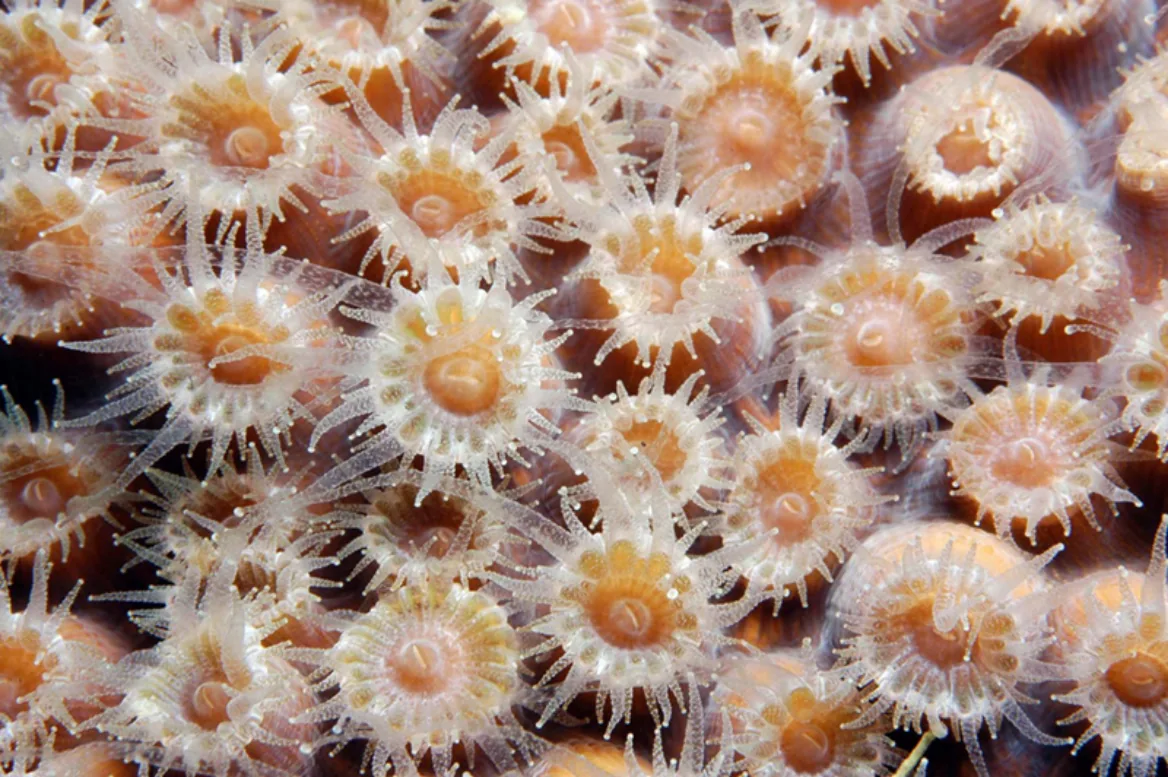
Some sea anemones and some coral polyps also reproduce by fission.
1 / 2Next ▶
Coral polyps that reproduce asexually by splitting into two, which is fission. Image: OpenStax, Biology for AP Courses, CC BY 4.0.
Fission
 ⤢ Enlarge
Fission
The diagram below shows coral polyps reproducing asexually in this way.
◀ Previous2 / 2
1Budding2Budding
Budding
Budding
Budding is asexual reproduction in which an outgrowth from a part of the body develops into a new individual.
The bud may then separate from the parent, or it may stay attached.
Budding is common in invertebrate animals such as corals and hydras.
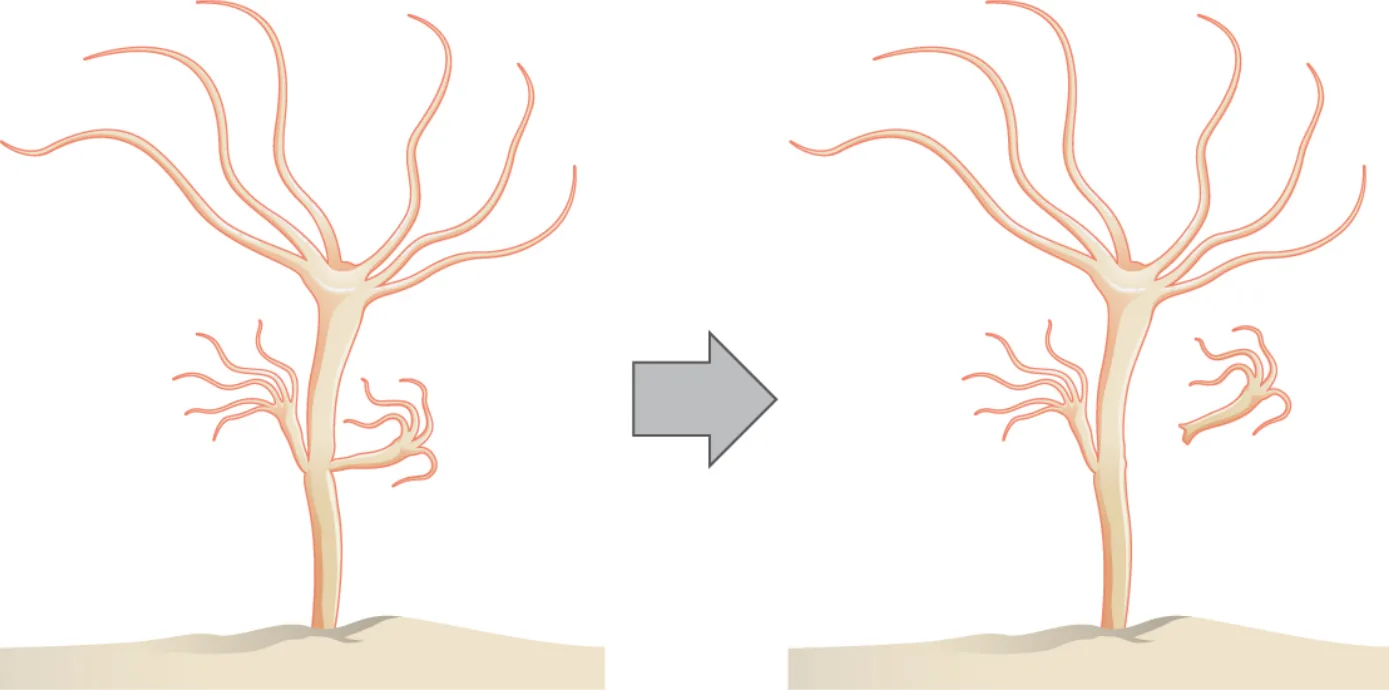
In a hydra, a bud forms on the body wall, develops into a small adult
and then breaks away from the main body.
In corals, the bud does not detach
instead it multiplies and becomes part of a growing colony.
The diagram below shows a hydra forming a bud.
1 / 2Next ▶
A hydra with a small bud on its body; the bud grows into a new adult and then detaches. Image: OpenStax, Biology for AP Courses, CC BY 4.0.
Budding
 ⤢ Enlarge
1
The Link to Learning box points to a video of a hydra budding. The video shows the bud forming on the parent and gradually separating
which is the process described in this paragraph.
2
Check question: Hydras can reproduce through budding. How will the daughter hydra appear? (a) genetically identical to the mother, (b) not genetically identical to the mother, (c) genetically unique, (d) smaller in size.
3
Answer: (a). Budding is asexual
so the daughter receives the same genetic information as the mother. It may be smaller when it first separatesbut size does not describe its genetic makeup, and the daughter is not genetically unique.
◀ Previous2 / 2
1Fragmentation2Fragmentation
Fragmentation
Fragmentation
Fragmentation is the breaking of the body into two or more parts, and each part can regenerate into a complete individual.
This works only if the animal is capable of fragmentation and the part is large enough to regrow.
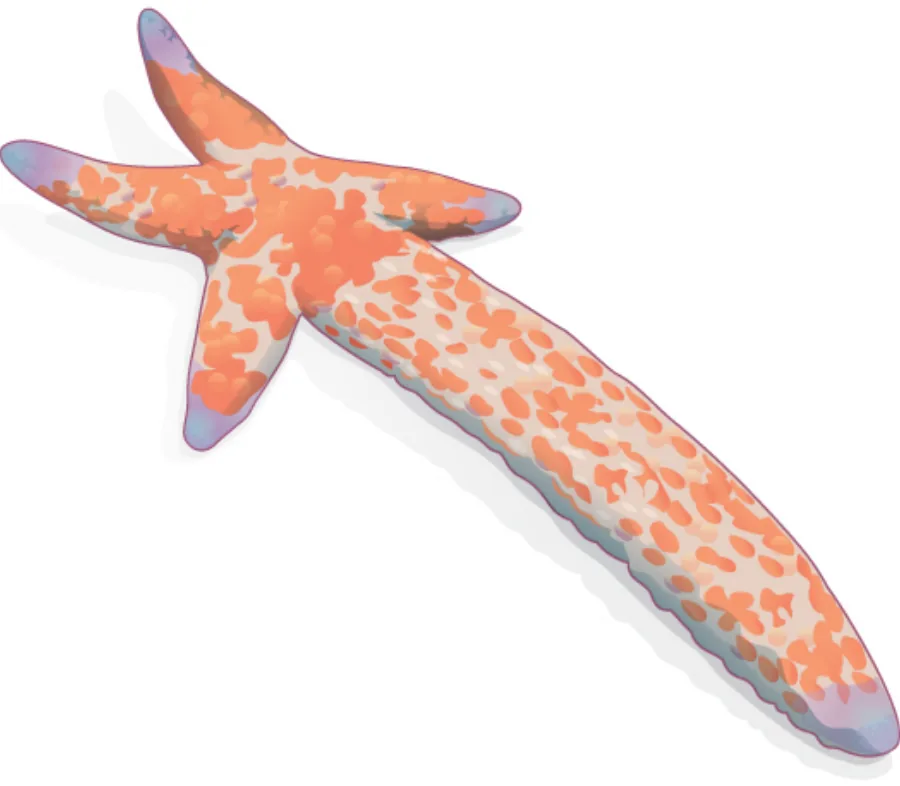
Many sea stars reproduce this way: when an arm breaks off, it regenerates a new sea star.
Fisheries workers once tried to stop sea stars from eating clam and oyster beds by cutting them in half and throwing them back into the sea.
Each half regenerated
so there were twice as many sea stars to prey on the shellfish.
Fragmentation also occurs in annelid worms, turbellarians and sponges (poriferans).
1 / 2Next ▶
A sea star whose separated arm is regenerating into a new individual, showing how fragmentation produces new animals. Image: OpenStax, Biology for AP Courses, CC BY 4.0.
Fragmentation
 ⤢ Enlarge
Fragmentation
The illustration below shows a broken-off sea star arm that is growing into a new individual.
In fragmentation, the two resulting individuals are usually very different in size. In fission, they are of approximately equal size. This difference is a useful way to tell the two processes apart.
◀ Previous2 / 2
1Parthenogenesis2Parthenogenesis
Parthenogenesis
1
Parthenogenesis is asexual reproduction in which an egg develops into a complete individual without being fertilized.
2
Depending on the process and the species, the offspring can be haploid or diploid.
3
Parthenogenesis occurs in invertebrates such as water fleas, rotifers, aphids, stick insects, some ants, wasps and bees.
4
Bees and wasps use it to produce haploid males, called drones.
5
If an egg is fertilized, it develops into a diploid female instead.
6
Some vertebrates, including certain reptiles, amphibians and fish, also reproduce through parthenogenesis.
1 / 2Next ▶
Parthenogenesis
1
Although the process is more common in plants, it has been observed in animals that were separated from males in zoos.
2
Two female Komodo dragons, a hammerhead shark and a blacktip shark produced young when they were isolated from males.
3
Scientists once believed that parthenogenesis in vertebrates happened only in captive animals such as birds, snakes and sharks. Recent research found that about one in five smalltooth sawfish in Florida results from parthenogenesis. This species is endangered, and researchers suspect that this form of reproduction may be an adaptation that helps the species avoid extinction.
◀ Previous2 / 2
Sexual reproduction
Sexual reproduction
Sexual reproduction is the process in which reproductive cells, usually haploid, from two individuals combine to form a new offspring that is usually diploid and genetically unique.
Because the offspring carry new combinations of genes, sexual reproduction can be advantageous in unstable or unpredictable environments.
People usually think of animals as having two separate sexes, male and female, that are fixed at conception.
In the animal kingdom, however, there are many variations on this pattern, as the following parts show.
Science Practice Connection for AP Courses
1
Lab investigation: The AP Biology Investigative Labs include Investigation 7, Cell Division: Mitosis and Meiosis. In this inquiry-based lab, you design and carry out experiments to investigate how eukaryotic cells divide. Some divisions produce genetically identical cells
while others produce gametes with half the normal amount of DNA.
2
Think about it: Why is sexual reproduction useful if two separate cells must combine to form a third? Answer: Combining cells from two parents mixes genes from both
so the offspring differ from each other and from their parents.
3
This variation gives a population a better chance of surviving changing conditions.
4
The cost is that two parents are required
but meiosis followed by fertilization is what creates this new combination of genes.
1Hermaphroditism2Hermaphroditism
Hermaphroditism
Hermaphroditism
Hermaphroditism occurs when one individual has both male and female reproductive parts.
Many invertebrates are hermaphrodites, including earthworms, slugs, tapeworms and snails.
A hermaphrodite may self-fertilize,
meaning it fertilizes its own eggs,or it may mate with another member of its species so that both individuals fertilize each other and produce offspring.
Self-fertilization is common in animals with limited mobility, such as barnacles and clams
which cannot easily find a partner.
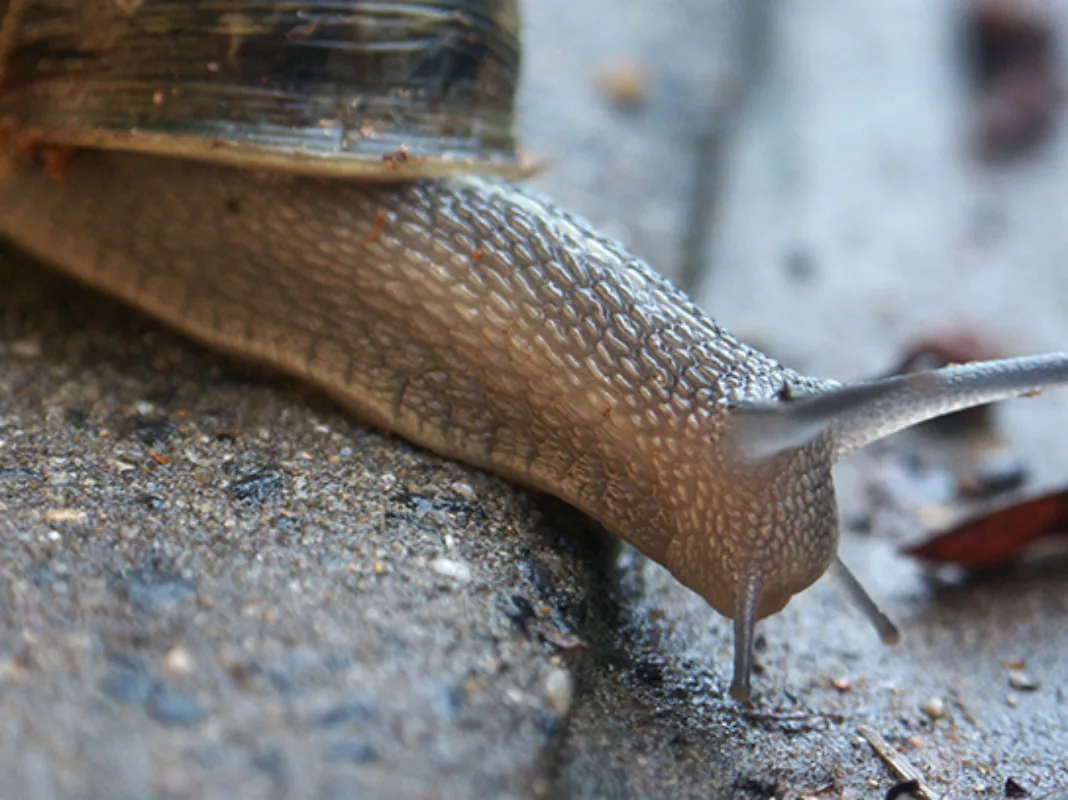
The picture below shows snails
which are often hermaphrodites.
When two snails mate, each one can produce up to one hundred eggs.
1 / 2Next ▶
Snails, which are hermaphrodites: each snail has both male and female reproductive parts. Image: OpenStax, Biology for AP Courses, CC BY 4.0.
Hermaphroditism
◀ Previous2 / 2
1Sex determination2Sex determination3Sex determination4Sex determination
Sex determination
1
1
2
In mammals, sex is determined genetically by the X and Y chromosomes.
3
An individual with two X chromosomes (XX) is female, and an individual with one X and one Y (XY) is male.
4
The presence of a Y chromosome causes male characteristics to develop, and its absence results in female characteristics.
5
The XY system is also found in some insects and plants.
6
2
1 / 4Next ▶
Sex determination
1
In birds, sex is determined by the Z and W chromosomes.
2
An individual with two Z chromosomes (ZZ) is male, and an individual with one Z and one W (ZW) is female.
3
The W chromosome appears to be essential for determining sex, in a way similar to the Y chromosome in mammals.
4
Some fish, crustaceans, insects such as butterflies and moths, and reptiles use the ZW system.
5
3
6
Some species do not determine sex by genetics alone.
◀ Previous2 / 4Next ▶
Sex determination
Sex determination
In some crocodiles and turtles, sex depends on the temperature during critical stages of egg development.
This is called environmental sex determination, or more specifically temperature-dependent sex determination.
In many turtles, cooler temperatures during incubation produce males and warmer temperatures produce females.
In some crocodiles, moderate temperatures produce males
while both warm and cool temperatures produce females.
Some species depend on both genes and temperature.
4
◀ Previous3 / 4Next ▶
Sex determination
1
Some animals change sex during their lives.
2
If an individual is female first and later becomes male, the process is called protogyny, meaning first female.
3
If it is male first and later becomes female, the process is called protandry, meaning first male.
4
Oysters, for example, are born male, grow, and become female to lay eggs.
5
Some oyster species change sex several times.
◀ Previous4 / 4
1Everyday Connection for AP Courses2Everyday Connection for AP Courses
Everyday Connection for AP Courses
Everyday Connection for AP Courses
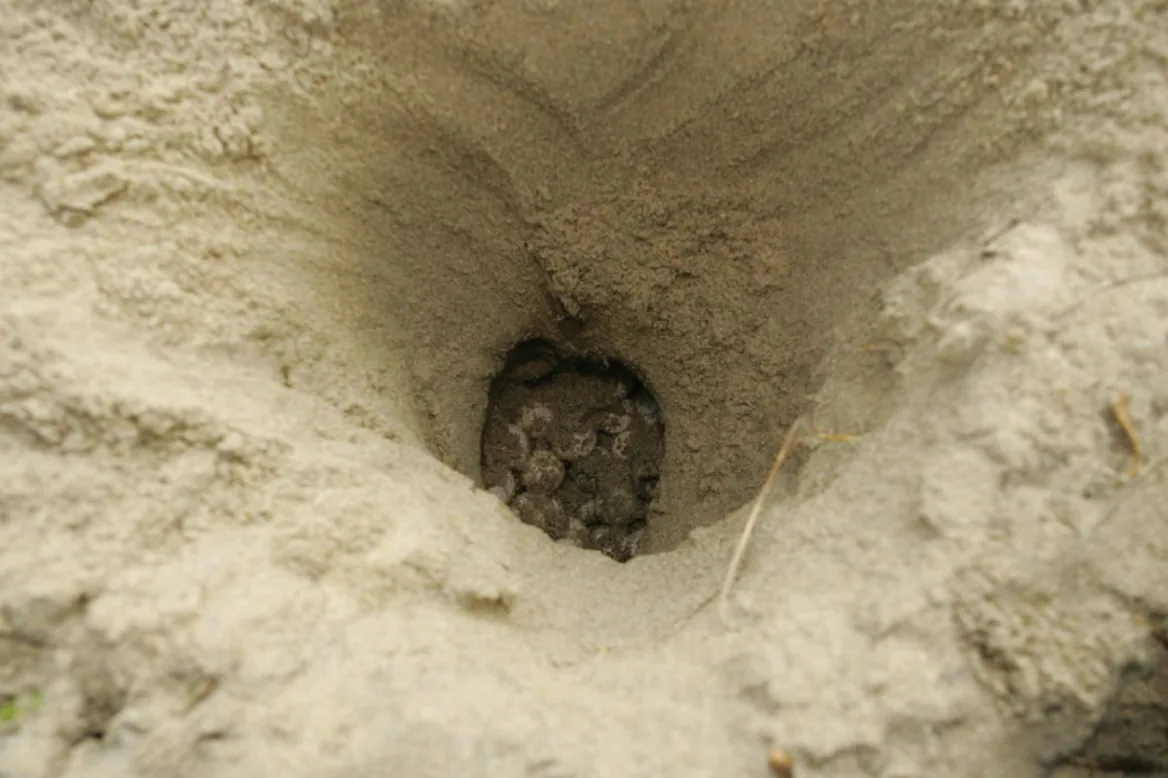
Loggerhead sea turtles are an example of temperature-dependent sex determination.
The temperature during incubation sets the sex of the developing turtles.
If the temperature is warm enough, all the hatchlings will be female.
If the temperature is cooler, all will be male.
At a specific temperature called the pivotal temperature, about half will be female and half will be male.
The picture below shows a turtle nest in the sand.
1 / 2Next ▶
A sea turtle nest in sand with eggs inside; the incubation temperature of these eggs determines the sex of the hatchlings. Image: OpenStax, Biology for AP Courses, CC BY 4.0.
Everyday Connection for AP Courses
 ⤢ Enlarge
Everyday Connection for AP Courses
Plants can also self-fertilize. If pollinating insects do not visit a flower, the stigma of that flower can wrap around pollen from the same flower. The seeds form by meiosis
but the resulting plants are very similar to one another because they come from the same parent. In this way, self-fertilization decreases genetic diversity.
◀ Previous2 / 2
Key terms
| Term | Meaning |
|---|---|
| Asexual reproduction | Reproduction that involves one parent and produces offspring genetically identical to that parent, barring mutation. |
| Sexual reproduction | Reproduction in which reproductive cells from two individuals combine to form a genetically unique offspring. |
| Fission | Asexual reproduction in which an organism splits into two separate individuals of roughly equal size. |
| Budding | Asexual reproduction in which an outgrowth from the body develops into a new individual that may detach. |
| Fragmentation | Asexual reproduction in which the body breaks into parts, and each part regenerates into a complete individual. |
| Parthenogenesis | Asexual reproduction in which an egg develops into a complete individual without being fertilized. |
| Haploid | Having one set of chromosomes, as in most reproductive cells. |
| Diploid | Having two sets of chromosomes, as in most body cells and in fertilized eggs. |
| Hermaphroditism | A condition in which one individual has both male and female reproductive parts. |
| Self-fertilization | The fertilization of an egg by sperm or pollen produced by the same individual. |
| Sex determination | The process that establishes whether an individual develops as male or female. |
| XY system | A sex determination system in which XX individuals are female and XY individuals are male. |
| ZW system | A sex determination system in which ZZ individuals are male and ZW individuals are female. |
| Environmental sex determination | Sex determination by an environmental factor, such as the temperature during egg development. |
| Pivotal temperature | The incubation temperature at which a turtle nest produces about equal numbers of males and females. |
| Protogyny | A sex change in which an individual is female first and later becomes male. |
| Protandry | A sex change in which an individual is male first and later becomes female. |
1Avoid these mistakes2Avoid these mistakes3Avoid these mistakes
Avoid these mistakes
1Avoid this
Assuming that all asexual offspring are unique. Budding, fission and fragmentation produce genetically identical individuals unless a mutation occurs.Avoid this
2Avoid this
Confusing fission with fragmentation.Avoid this
In fission the two individuals are of similar size,Avoid this
while in fragmentation the regenerating part is usually noticeably smaller than the original.Avoid this
1 / 3Next ▶
Avoid these mistakes
3Avoid this
Thinking that parthenogenesis always produces haploid offspring.Avoid this
Bee drones are haploid, but offspring from fertilized eggs in bees are diploid, and the result depends on the species.Avoid this
4Avoid this
Assuming that a hermaphrodite cannot reproduce without a partner.Avoid this
A hermaphrodite may self-fertilize, but it may also mate with another member of its species.Avoid this
◀ Previous2 / 3Next ▶
Avoid these mistakes
5Avoid this
Using the XY system for birds. Birds use the ZW system, in which the female is ZW and the male is ZZ.Avoid this
6Avoid this
Assuming that sex is always fixed by genes. In many turtles and crocodiles, incubation temperature determines sex.Avoid this
7Avoid this
Mixing up protogyny and protandry. Protogyny means female first, and protandry means male first.Avoid this
◀ Previous3 / 3