Curriculum
Edexcel A Level Physics 9PH0
1. Working as a Physicist
0/17
-
1. Working as a Physicist
 Text lessonPreview
-
1.1.2 Practical Skills
Text lessonPreview
-
1.1.2 Practical Skills - Check yourself
 6 questionsPreview
-
1.1.3 Estimating Physical Quantities
Text lessonPreview
-
1.1.3 Estimating Physical Quantities - Check yourself
6 questionsPreview
-
1.1.4 Limitations of Measurements
Text lessonPreview
-
1.1.4 Limitations of Measurements - Check yourself
6 questionsPreview
-
1.1.5 Scientific Communication
Text lessonPreview
-
1.1.5 Scientific Communication - Check yourself
6 questionsPreview
-
1.1.6 Applications of Science
Text lessonPreview
-
1.1.6 Applications of Science - Check yourself
6 questionsPreview
-
1.1.7 The Scientific Community
Text lessonPreview
-
1.1.7 The Scientific Community - Check yourself
6 questionsPreview
-
1.1.8 Science and Society
Text lessonPreview
-
1.1.8 Science and Society - Check yourself
6 questionsPreview
-
1.2.1 SI Units
Text lessonPreview
-
1.2.1 SI Units - Check yourself
6 questionsPreview
2. Mechanics
0/43
-
2. Mechanics
Text lessonPreview
-
1.1.1 Equations of Motion
Text lessonPreview
-
1.1.5 Resolving Vectors
Text lessonPreview
-
1.1.5 Resolving Vectors - Check yourself
6 questionsPreview
-
1.2.2 Mass, Weight and Gravitational Field Strength
Text lessonPreview
-
1.2.2 Mass, Weight and Gravitational Field Strength - Check yourself
6 questionsPreview
-
1.2.3 Core Practical 1- Investigating the Acceleration of Freefall
Text lessonPreview
-
1.2.3 Core Practical 1- Investigating the Acceleration of Freefall - Check yourself
6 questionsPreview
-
1.2.4 Newton's Third Law of Motion
Text lessonPreview
-
1.2.4 Newton's Third Law of Motion - Check yourself
6 questionsPreview
-
1.2.5 Momentum
Text lessonPreview
-
1.2.5 Momentum - Check yourself
6 questionsPreview
-
1.2.6 Conservation of Linear Momentum
Text lessonPreview
-
1.2.6 Conservation of Linear Momentum - Check yourself
6 questionsPreview
-
1.3.2 Centre of Gravity and The Principle of Moments
Text lessonPreview
-
1.3.2 Centre of Gravity and The Principle of Moments - Check yourself
6 questionsPreview
-
1.4.1 Scalars and Vectors
Text lessonPreview
-
1.4.1 Scalars and Vectors - Check yourself
6 questionsPreview
-
1.4.1 Work
Text lessonPreview
-
1.4.1 Work - Check yourself
6 questionsPreview
-
2.1.2 Motion Graphs
Text lessonPreview
-
2.1.3 Properties of Motion Graphs
Text lessonPreview
-
2.1.3 Properties of Motion Graphs - Check yourself
6 questionsPreview
-
2.1.6 Finding the Resultant Vector
Text lessonPreview
-
2.1.6 Finding the Resultant Vector - Check yourself
6 questionsPreview
-
2.1.7 Projectiles
Text lessonPreview
-
2.1.7 Projectiles - Check yourself
6 questionsPreview
-
2.1.8 Forces as Vectors
Text lessonPreview
-
2.1.8 Forces as Vectors - Check yourself
6 questionsPreview
-
3.1.2 Force and Acceleration
Text lessonPreview
-
3.1.2 Force and Acceleration - Check yourself
6 questionsPreview
-
4.1.2 Moments
Text lessonPreview
-
4.1.2 Moments - Check yourself
6 questionsPreview
-
5.1.2 The Principle of Conservation of Energy
Text lessonPreview
-
5.1.2 The Principle of Conservation of Energy - Check yourself
6 questionsPreview
-
5.1.3 Efficiency
Text lessonPreview
-
5.1.3 Efficiency - Check yourself
6 questionsPreview
-
5.1.4 Power
Text lessonPreview
-
5.1.4 Power - Check yourself
6 questionsPreview
-
5.2.1 Gravitational Potential Energy
Text lessonPreview
-
5.2.1 Gravitational Potential Energy - Check yourself
6 questionsPreview
-
5.2.2 Kinetic Energy
Text lessonPreview
-
5.2.2 Kinetic Energy - Check yourself
6 questionsPreview
3. Electric Circuits
0/41
-
3. Electric Circuits
Text lessonPreview
-
2.6.4 Charge Conservation in Circuits
Text lessonPreview
-
2.6.4 Charge Conservation in Circuits - Check yourself
6 questionsPreview
-
2.6.5 Energy Conservation in Circuits
Text lessonPreview
-
2.6.5 Energy Conservation in Circuits - Check yourself
6 questionsPreview
-
2.6.6 Resistance in Series and Parallel
Text lessonPreview
-
2.6.6 Resistance in Series and Parallel - Check yourself
6 questionsPreview
-
2.6.8 Current-Potential Difference Graphs
Text lessonPreview
-
2.6.8 Current-Potential Difference Graphs - Check yourself
6 questionsPreview
-
2.7.1 Electrical Resistivity
Text lessonPreview
-
2.7.1 Electrical Resistivity - Check yourself
6 questionsPreview
-
2.7.4 Potential Difference and Conductor Length
Text lessonPreview
-
2.7.4 Potential Difference and Conductor Length - Check yourself
6 questionsPreview
-
2.7.6 Potential Dividers and Variable Resistance
Text lessonPreview
-
2.7.6 Potential Dividers and Variable Resistance - Check yourself
6 questionsPreview
-
2.8.3 E.M.F. vs. Terminal Potential Difference
Text lessonPreview
-
2.8.3 E.M.F. vs. Terminal Potential Difference - Check yourself
6 questionsPreview
-
2.8.5 Resistance and Temperature
Text lessonPreview
-
2.8.5 Resistance and Temperature - Check yourself
6 questionsPreview
-
2.8.6 Resistance and Illumination
Text lessonPreview
-
2.8.6 Resistance and Illumination - Check yourself
6 questionsPreview
-
3.2.2 Core Practical 2- Investigating Resistivity
Text lessonPreview
-
3.2.2 Core Practical 2- Investigating Resistivity - Check yourself
6 questionsPreview
-
3.2.3 Current and Drift Velocity
Text lessonPreview
-
3.2.3 Current and Drift Velocity - Check yourself
6 questionsPreview
-
3.3.4 Core Practical 3- Investigating E.M.F. and Internal Resistance
Text lessonPreview
-
3.3.4 Core Practical 3- Investigating E.M.F. and Internal Resistance - Check yourself
6 questionsPreview
-
9.1.1 Electric Current
Text lessonPreview
-
9.1.1 Electric Current - Check yourself
6 questionsPreview
-
9.2.1 Potential Difference
Text lessonPreview
-
9.2.1 Potential Difference - Check yourself
6 questionsPreview
-
9.2.2 Electrical Power
Text lessonPreview
-
9.2.2 Electrical Power - Check yourself
6 questionsPreview
-
9.3.2 Ohm's Law
Text lessonPreview
-
9.3.2 Ohm's Law - Check yourself
6 questionsPreview
-
10.1.2 Electromotive Force
Text lessonPreview
-
10.1.2 Electromotive Force - Check yourself
6 questionsPreview
-
10.1.3 Internal Resistance
Text lessonPreview
-
10.1.3 Internal Resistance - Check yourself
6 questionsPreview
-
10.3.1 Potential Dividers
Text lessonPreview
-
10.3.1 Potential Dividers - Check yourself
6 questionsPreview
4. Materials
0/22
-
4. Materials
Text lessonPreview
-
1.5.3 Viscous Drag
Text lessonPreview
-
1.5.3 Viscous Drag - Check yourself
6 questionsPreview
-
1.6.2 Stress, Strain and The Young Modulus
Text lessonPreview
-
1.6.2 Stress, Strain and The Young Modulus - Check yourself
6 questionsPreview
-
1.6.3 Force-Extension Graphs
Text lessonPreview
-
1.6.3 Force-Extension Graphs - Check yourself
6 questionsPreview
-
1.6.4 Stress-Strain Graphs
Text lessonPreview
-
1.6.4 Stress-Strain Graphs - Check yourself
6 questionsPreview
-
1.6.6 Elastic Strain Energy
Text lessonPreview
-
1.6.6 Elastic Strain Energy - Check yourself
6 questionsPreview
-
4.1.4 Core Practical 4- Investigating Viscosity
Text lessonPreview
-
4.1.4 Core Practical 4- Investigating Viscosity - Check yourself
6 questionsPreview
-
4.2.5 Core Practical 5- Investigating Young Modulus
Text lessonPreview
-
4.2.5 Core Practical 5- Investigating Young Modulus - Check yourself
6 questionsPreview
-
4.3.1 Density
Text lessonPreview
-
4.3.1 Density - Check yourself
6 questionsPreview
-
4.3.4 Upthrust
Text lessonPreview
-
4.3.4 Upthrust - Check yourself
6 questionsPreview
-
6.1.2 Hooke's Law
Text lessonPreview
-
6.1.2 Hooke's Law - Check yourself
6 questionsPreview
-
4.2.1 Hooke's Law
Text lessonPreview
5. Waves and Particle Nature of Light
0/76
-
5. Waves and Particle Nature of Light
Text lessonPreview
-
2.1.1 Properties of Waves
Text lessonPreview
-
2.1.1 Properties of Waves - Check yourself
6 questionsPreview
-
2.1.3 Longitudinal Waves
Text lessonPreview
-
2.1.3 Longitudinal Waves - Check yourself
6 questionsPreview
-
2.1.4 Transverse Waves
Text lessonPreview
-
2.1.4 Transverse Waves - Check yourself
18 questionsPreview
-
2.1.5 Representing Waves on Graphs
Text lessonPreview
-
2.2.1 Interference and Superposition of Waves
Text lessonPreview
-
2.2.1 Interference and Superposition of Waves - Check yourself
6 questionsPreview
-
2.2.2 Phase and Path Difference
Text lessonPreview
-
2.2.2 Phase and Path Difference - Check yourself
6 questionsPreview
-
2.2.4 Wave Speed on a Stretched String
Text lessonPreview
-
2.2.4 Wave Speed on a Stretched String - Check yourself
6 questionsPreview
-
2.3.1 Equation for the Intensity of Radiation
Text lessonPreview
-
2.3.1 Equation for the Intensity of Radiation - Check yourself
6 questionsPreview
-
2.3.2 Refraction and Refractive Index
Text lessonPreview
-
2.3.2 Refraction and Refractive Index - Check yourself
6 questionsPreview
-
2.3.3 Critical Angle
Text lessonPreview
-
2.3.3 Critical Angle - Check yourself
6 questionsPreview
-
2.3.4 Total Internal Reflection
Text lessonPreview
-
2.3.4 Total Internal Reflection - Check yourself
6 questionsPreview
-
2.3.5 Measuring Refractive Index
Text lessonPreview
-
2.3.5 Measuring Refractive Index - Check yourself
12 questionsPreview
-
2.3.6 Plane Polarisation
Text lessonPreview
-
2.3.6 Plane Polarisation - Check yourself
6 questionsPreview
-
2.4.2 The Diffraction Grating Equation
Text lessonPreview
-
2.4.2 The Diffraction Grating Equation - Check yourself
6 questionsPreview
-
2.4.4 The Wave Nature of Electrons
Text lessonPreview
-
2.4.5 The de Broglie Equation
Text lessonPreview
-
2.4.5 The de Broglie Equation - Check yourself
6 questionsPreview
-
2.4.6 Transmission and Reflection of Waves
Text lessonPreview
-
2.4.6 Transmission and Reflection of Waves - Check yourself
6 questionsPreview
-
2.4.7 Pulse-Echo Technique
Text lessonPreview
-
2.4.7 Pulse-Echo Technique - Check yourself
6 questionsPreview
-
2.4.9 Energy of a Photon
Text lessonPreview
-
2.4.9 Energy of a Photon - Check yourself
6 questionsPreview
-
2.5.1 The Photoelectric Effect
Text lessonPreview
-
2.5.1 The Photoelectric Effect - Check yourself
6 questionsPreview
-
2.5.2 The Photoelectric Equation
Text lessonPreview
-
2.5.2 The Photoelectric Equation - Check yourself
6 questionsPreview
-
2.5.4 The Particle Nature of EM Radiation
Text lessonPreview
-
2.5.4 The Particle Nature of EM Radiation - Check yourself
6 questionsPreview
-
2.5.5 Atomic Line Spectra
Text lessonPreview
-
2.5.5 Atomic Line Spectra - Check yourself
6 questionsPreview
-
5.1.6 Core Practical 6- Investigating the Speed of Sound
Text lessonPreview
-
5.1.6 Core Practical 6- Investigating the Speed of Sound - Check yourself
6 questionsPreview
-
5.2.5 Core Practical 7- Investigating Stationary Waves
Text lessonPreview
-
5.2.5 Core Practical 7- Investigating Stationary Waves - Check yourself
6 questionsPreview
-
5.3.6 Converging and Diverging Lenses
Text lessonPreview
-
5.3.6 Converging and Diverging Lenses - Check yourself
6 questionsPreview
-
5.3.7 Using Ray Diagrams
Text lessonPreview
-
5.3.7 Using Ray Diagrams - Check yourself
6 questionsPreview
-
5.3.8 Power of a Lens
Text lessonPreview
-
5.3.8 Power of a Lens - Check yourself
6 questionsPreview
-
5.3.9 Thin Lenses in Combination
Text lessonPreview
-
5.3.9 Thin Lenses in Combination - Check yourself
6 questionsPreview
-
5.3.10 Real and Virtual Images
Text lessonPreview
-
5.3.10 Real and Virtual Images - Check yourself
6 questionsPreview
-
5.3.11 The Lens Equation
Text lessonPreview
-
5.3.11 The Lens Equation - Check yourself
6 questionsPreview
-
5.3.12 Magnification
Text lessonPreview
-
5.3.12 Magnification - Check yourself
6 questionsPreview
-
5.4.3 Core Practical 8- Investigating Diffraction Gratings
Text lessonPreview
-
5.4.3 Core Practical 8- Investigating Diffraction Gratings - Check yourself
6 questionsPreview
-
7.1.3 The Wave Equation
Text lessonPreview
-
7.1.3 The Wave Equation - Check yourself
6 questionsPreview
-
8.1.2 Stationary Waves
Text lessonPreview
-
8.1.2 Stationary Waves - Check yourself
6 questionsPreview
-
8.2.1 Diffraction
Text lessonPreview
-
8.2.1 Diffraction - Check yourself
6 questionsPreview
-
22.1.3 The Electronvolt
Text lessonPreview
-
22.1.3 The Electronvolt - Check yourself
6 questionsPreview
-
22.3.1 Wave-Particle Duality
Text lessonPreview
-
22.3.1 Wave-Particle Duality - Check yourself
6 questionsPreview
-
5.4.8 Wave-Particle Duality
Text lessonPreview
6. Further Mechanics
0/23
-
6. Further Mechanics
Text lessonPreview
-
3.3.2 Elastic and Inelastic Collisions
Text lessonPreview
-
3.3.2 Elastic and Inelastic Collisions - Check yourself
6 questionsPreview
-
4.1.1 Impulse
Text lessonPreview
-
4.1.1 Impulse - Check yourself
6 questionsPreview
-
4.1.2 Core Practical 9- Investigating Impulse
Text lessonPreview
-
4.1.2 Core Practical 9- Investigating Impulse - Check yourself
6 questionsPreview
-
4.1.3 Applying Conservation of Linear Momentum
Text lessonPreview
-
4.1.3 Applying Conservation of Linear Momentum - Check yourself
12 questionsPreview
-
4.1.4 Core Practical 10- Investigating Collisions using ICT
Text lessonPreview
-
4.1.4 Core Practical 10- Investigating Collisions using ICT - Check yourself
6 questionsPreview
-
4.1.6 Energy-Momentum Relation
Text lessonPreview
-
4.1.6 Energy-Momentum Relation - Check yourself
6 questionsPreview
-
4.2.2 Angular Velocity
Text lessonPreview
-
4.2.4 Maintaining Circular Motion
Text lessonPreview
-
4.2.5 Centripetal Force
Text lessonPreview
-
4.2.5 Centripetal Force - Check yourself
6 questionsPreview
-
12.1.1 Radians and Angular Displacement
Text lessonPreview
-
12.1.1 Radians and Angular Displacement - Check yourself
24 questionsPreview
-
12.2.1 Centripetal Acceleration
Text lessonPreview
-
6.1.5 Elastic and Inelastic Collisions
Text lessonPreview
-
6.2.1 Radians and Angular Displacement
Text lessonPreview
-
6.2.3 Centripetal Acceleration
Text lessonPreview
7. Electric and Magnetic Fields
0/46
-
7. Electric and Magnetic Fields
Text lessonPreview
-
4.3.1 Defining an Electric Field
Text lessonPreview
-
4.3.1 Defining an Electric Field - Check yourself
6 questionsPreview
-
4.3.2 Electric Field Strength
Text lessonPreview
-
4.3.2 Electric Field Strength - Check yourself
6 questionsPreview
-
4.3.3 Electric Force between Two Charges
Text lessonPreview
-
4.3.3 Electric Force between Two Charges - Check yourself
6 questionsPreview
-
4.3.4 Electric Field due to a Point Charge
Text lessonPreview
-
4.3.4 Electric Field due to a Point Charge - Check yourself
6 questionsPreview
-
4.3.5 Electric Field and Potential
Text lessonPreview
-
4.3.5 Electric Field and Potential - Check yourself
6 questionsPreview
-
4.3.7 Electric Potential for a Radial Field
Text lessonPreview
-
4.3.7 Electric Potential for a Radial Field - Check yourself
6 questionsPreview
-
4.3.8 Representing Radial and Uniform Electric Fields
Text lessonPreview
-
4.3.8 Representing Radial and Uniform Electric Fields - Check yourself
6 questionsPreview
-
4.4.2 Energy Stored by a Capacitor
Text lessonPreview
-
4.4.2 Energy Stored by a Capacitor - Check yourself
6 questionsPreview
-
4.4.3 Charge and Discharge Curves
Text lessonPreview
-
4.4.3 Charge and Discharge Curves - Check yourself
6 questionsPreview
-
4.4.4 Core Practical 11- Investigating Capacitor Charge and Discharge
Text lessonPreview
-
4.4.4 Core Practical 11- Investigating Capacitor Charge and Discharge - Check yourself
6 questionsPreview
-
4.4.5 Exponential Discharge in a Capacitor
Text lessonPreview
-
4.4.5 Exponential Discharge in a Capacitor - Check yourself
6 questionsPreview
-
4.5.1 Magnetic Flux Density, Flux and Flux Linkage
Text lessonPreview
-
4.5.1 Magnetic Flux Density, Flux and Flux Linkage - Check yourself
6 questionsPreview
-
4.5.2 Magnetic Force on a Charged Particle
Text lessonPreview
-
4.5.2 Magnetic Force on a Charged Particle - Check yourself
6 questionsPreview
-
4.5.3 Magnetic Force on a Current-Carrying Conductor
Text lessonPreview
-
4.5.3 Magnetic Force on a Current-Carrying Conductor - Check yourself
6 questionsPreview
-
4.5.4 Induced E.M.F in a Moving Coil
Text lessonPreview
-
4.5.4 Induced E.M.F in a Moving Coil - Check yourself
6 questionsPreview
-
4.5.5 Induced E.M.F between Linked Coils
Text lessonPreview
-
4.5.5 Induced E.M.F between Linked Coils - Check yourself
6 questionsPreview
-
7.4.3 Lenz's Law
Text lessonPreview
-
7.4.3 Lenz's Law - Check yourself
6 questionsPreview
-
7.4.4 Faraday's Law
Text lessonPreview
-
7.4.4 Faraday's Law - Check yourself
6 questionsPreview
-
7.4.5 Alternating Currents and Potential Differences
Text lessonPreview
-
7.4.5 Alternating Currents and Potential Differences - Check yourself
6 questionsPreview
-
7.4.6 Root-Mean-Square Current and Potential Difference
Text lessonPreview
-
7.4.6 Root-Mean-Square Current and Potential Difference - Check yourself
6 questionsPreview
-
18.2.1 Electric Field Between Parallel Plates
Text lessonPreview
-
18.2.1 Electric Field Between Parallel Plates - Check yourself
6 questionsPreview
-
19.1.1 Capacitance
Text lessonPreview
-
19.1.1 Capacitance - Check yourself
6 questionsPreview
-
7.1.6 Electric Field between Parallel Plates
Text lessonPreview
8. Nuclear and Particle Physics
0/29
-
8. Nuclear and Particle Physics
Text lessonPreview
-
4.6.2 The Nuclear Model of the Atom
Text lessonPreview
-
4.6.2 The Nuclear Model of the Atom - Check yourself
6 questionsPreview
-
4.6.3 Thermionic Emission
Text lessonPreview
-
4.6.3 Thermionic Emission - Check yourself
6 questionsPreview
-
4.6.4 Particle Accelerators and Detectors
Text lessonPreview
-
4.6.4 Particle Accelerators and Detectors - Check yourself
6 questionsPreview
-
4.6.5 Radius of a Charged Particle in a Magnetic Field
Text lessonPreview
-
4.6.5 Radius of a Charged Particle in a Magnetic Field - Check yourself
6 questionsPreview
-
4.6.6 Interpreting Particle Tracks
Text lessonPreview
-
4.6.6 Interpreting Particle Tracks - Check yourself
6 questionsPreview
-
4.6.7 High Energy Particle Collisions
Text lessonPreview
-
4.6.7 High Energy Particle Collisions - Check yourself
6 questionsPreview
-
4.6.8 Annihilation of Matter and Antimatter
Text lessonPreview
-
4.6.8 Annihilation of Matter and Antimatter - Check yourself
6 questionsPreview
-
4.6.9 Unit Conversions for Energy and Mass
Text lessonPreview
-
4.6.9 Unit Conversions for Energy and Mass - Check yourself
6 questionsPreview
-
4.6.10 Relativistic Situations
Text lessonPreview
-
4.6.10 Relativistic Situations - Check yourself
6 questionsPreview
-
4.7.1 The Standard Model
Text lessonPreview
-
4.7.1 The Standard Model - Check yourself
6 questionsPreview
-
4.7.2 Antimatter
Text lessonPreview
-
4.7.2 Antimatter - Check yourself
6 questionsPreview
-
4.7.3 Conservation Laws in Particle Physics
Text lessonPreview
-
4.7.3 Conservation Laws in Particle Physics - Check yourself
6 questionsPreview
-
4.7.4 Particle Interaction Equations
Text lessonPreview
-
4.7.4 Particle Interaction Equations - Check yourself
6 questionsPreview
-
11.1.3 Nucleon and Proton Number
Text lessonPreview
-
8.1.1 Nucleon and Proton Number
Text lessonPreview
9. Thermodynamics
0/27
-
9. Thermodynamics
Text lessonPreview
-
5.1.1 Specific Heat Capacity and Latent Heat
Text lessonPreview
-
5.1.1 Specific Heat Capacity and Latent Heat - Check yourself
6 questionsPreview
-
5.1.2 Core Practical 12- Calibrating a Thermistor
Text lessonPreview
-
5.1.2 Core Practical 12- Calibrating a Thermistor - Check yourself
6 questionsPreview
-
5.1.3 Core Practical 13- Investigating Specific Latent Heat
Text lessonPreview
-
5.1.3 Core Practical 13- Investigating Specific Latent Heat - Check yourself
6 questionsPreview
-
5.2.2 Temperature and Absolute Zero
Text lessonPreview
-
5.2.4 Core Practical 14- Investigating Gas Pressure and Volume
Text lessonPreview
-
5.2.4 Core Practical 14- Investigating Gas Pressure and Volume - Check yourself
6 questionsPreview
-
5.2.5 Average Molecular Kinetic Energy
Text lessonPreview
-
5.2.5 Average Molecular Kinetic Energy - Check yourself
6 questionsPreview
-
5.8.1 Black Body Radiation
Text lessonPreview
-
5.8.1 Black Body Radiation - Check yourself
6 questionsPreview
-
5.8.2 Stefan-Boltzmann Law
Text lessonPreview
-
5.8.2 Stefan-Boltzmann Law - Check yourself
6 questionsPreview
-
5.8.3 Wien’s Law
Text lessonPreview
-
5.8.3 Wien’s Law - Check yourself
6 questionsPreview
-
9.2.3 Kinetic Theory of Gases Equation
Text lessonPreview
-
9.2.3 Kinetic Theory of Gases Equation - Check yourself
6 questionsPreview
-
15.2.2 Ideal Gas Equation
Text lessonPreview
-
15.2.2 Ideal Gas Equation - Check yourself
12 questionsPreview
-
16.1.1 Internal energy
Text lessonPreview
-
16.1.1 Internal energy - Check yourself
6 questionsPreview
-
9.2.1 Internal Energy
Text lessonPreview
-
9.2.4 Ideal Gas Equation
Text lessonPreview
-
9.3.3 Wien's Law
Text lessonPreview
10. Space
0/17
-
10. Space
Text lessonPreview
-
5.9.1 Inverse Square Law of Flux
Text lessonPreview
-
5.9.1 Inverse Square Law of Flux - Check yourself
6 questionsPreview
-
5.9.2 Parallax
Text lessonPreview
-
5.9.2 Parallax - Check yourself
6 questionsPreview
-
5.9.3 Standard Candles
Text lessonPreview
-
5.9.3 Standard Candles - Check yourself
6 questionsPreview
-
5.9.4 The Hertzsprung-Russell Diagram
Text lessonPreview
-
5.9.4 The Hertzsprung-Russell Diagram - Check yourself
6 questionsPreview
-
5.9.5 The Life Cycle of Stars
Text lessonPreview
-
5.9.5 The Life Cycle of Stars - Check yourself
6 questionsPreview
-
5.10.1 Doppler Shift
Text lessonPreview
-
5.10.1 Doppler Shift - Check yourself
6 questionsPreview
-
5.10.2 Equations for Cosmology
Text lessonPreview
-
5.10.2 Equations for Cosmology - Check yourself
6 questionsPreview
-
5.10.3 Cosmology
Text lessonPreview
-
5.10.3 Cosmology - Check yourself
6 questionsPreview
11. Nuclear Radiation
0/21
-
11. Nuclear Radiation
Text lessonPreview
-
5.3.1 Nuclear Binding Energy and Mass Deficit
Text lessonPreview
-
5.3.1 Nuclear Binding Energy and Mass Deficit - Check yourself
6 questionsPreview
-
5.3.2 Atomic Mass Unit
Text lessonPreview
-
5.3.2 Atomic Mass Unit - Check yourself
6 questionsPreview
-
5.3.3 Binding Energy per Nucleon Graph
Text lessonPreview
-
5.3.3 Binding Energy per Nucleon Graph - Check yourself
6 questionsPreview
-
5.3.4 Nuclear Fusion
Text lessonPreview
-
5.3.4 Nuclear Fusion - Check yourself
6 questionsPreview
-
5.4.1 Background Radiation
Text lessonPreview
-
5.4.1 Background Radiation - Check yourself
6 questionsPreview
-
5.4.2 Alpha, Beta and Gamma Radiation
Text lessonPreview
-
5.4.2 Alpha, Beta and Gamma Radiation - Check yourself
6 questionsPreview
-
5.4.3 Nuclear Decay Equations
Text lessonPreview
-
5.4.3 Nuclear Decay Equations - Check yourself
6 questionsPreview
-
5.4.4 Core Practical 15- Investigating Gamma Radiation Absorption
Text lessonPreview
-
5.4.4 Core Practical 15- Investigating Gamma Radiation Absorption - Check yourself
6 questionsPreview
-
5.4.5 The Random Nature of Nuclear Decay
Text lessonPreview
-
5.4.5 The Random Nature of Nuclear Decay - Check yourself
6 questionsPreview
-
5.4.6 Equations for Nuclear Physics
Text lessonPreview
-
5.4.6 Equations for Nuclear Physics - Check yourself
6 questionsPreview
12. Gravitational Fields
0/16
-
12. Gravitational Fields
Text lessonPreview
-
5.7.3 Newton’s Law of Universal Gravitation
Text lessonPreview
-
5.7.3 Newton’s Law of Universal Gravitation - Check yourself
6 questionsPreview
-
5.7.4 Gravitational Field due to a Point Mass
Text lessonPreview
-
5.7.4 Gravitational Field due to a Point Mass - Check yourself
6 questionsPreview
-
5.7.5 Gravitational Potential for a Radial Field
Text lessonPreview
-
5.7.5 Gravitational Potential for a Radial Field - Check yourself
6 questionsPreview
-
5.7.6 Comparing Electric and Gravitational Fields
Text lessonPreview
-
5.7.6 Comparing Electric and Gravitational Fields - Check yourself
6 questionsPreview
-
5.7.7 Orbital Motion
Text lessonPreview
-
5.7.7 Orbital Motion - Check yourself
6 questionsPreview
-
13.1.1 Gravitational Fields
Text lessonPreview
-
13.1.1 Gravitational Fields - Check yourself
6 questionsPreview
-
13.3.1 Gravitational Field Strength
Text lessonPreview
-
13.3.1 Gravitational Field Strength - Check yourself
6 questionsPreview
-
12.1.3 Newton's Law of Universal Gravitation
Text lessonPreview
13. Oscillations
0/23
-
13. Oscillations
Text lessonPreview
-
5.5.1 Conditions for Simple Harmonic Motion
Text lessonPreview
-
5.5.1 Conditions for Simple Harmonic Motion - Check yourself
6 questionsPreview
-
5.5.2 Equations for Simple Harmonic Motion
Text lessonPreview
-
5.5.2 Equations for Simple Harmonic Motion - Check yourself
6 questionsPreview
-
5.5.3 Period of Simple Harmonic Oscillators
Text lessonPreview
-
5.5.3 Period of Simple Harmonic Oscillators - Check yourself
6 questionsPreview
-
5.5.4 Displacement-Time Graph for an Oscillator
Text lessonPreview
-
5.5.4 Displacement-Time Graph for an Oscillator - Check yourself
6 questionsPreview
-
5.5.5 Velocity-Time Graph for an Oscillator
Text lessonPreview
-
5.5.5 Velocity-Time Graph for an Oscillator - Check yourself
6 questionsPreview
-
5.6.2 Core Practical 16- Investigating Resonance
Text lessonPreview
-
5.6.2 Core Practical 16- Investigating Resonance - Check yourself
6 questionsPreview
-
5.6.3 Damped and Undamped Oscillating Systems
Text lessonPreview
-
5.6.3 Damped and Undamped Oscillating Systems - Check yourself
6 questionsPreview
-
5.6.4 Free and Forced Oscillations
Text lessonPreview
-
5.6.4 Free and Forced Oscillations - Check yourself
6 questionsPreview
-
5.6.5 Resonance Graphs
Text lessonPreview
-
5.6.5 Resonance Graphs - Check yourself
6 questionsPreview
-
5.6.6 Damping and Plastic Deformation
Text lessonPreview
-
5.6.6 Damping and Plastic Deformation - Check yourself
6 questionsPreview
-
17.3.2 Resonance
Text lessonPreview
-
17.3.2 Resonance - Check yourself
6 questionsPreview
Text lesson
19.1.1 Capacitance
4.4.1 Capacitance — EDEXCEL IAL PHYSICS (IAS & A2) notes: Define capacitance, use C = Q/V and describe how a parallel-plate capacitor stores charge.
1What a capacitor does · Construction · Symbol2Charging · Final state · Current
What a capacitor does · Construction · Symbol
What a capacitor does
Capacitor = a device that stores electric charge and, as a result, electrical energy, often used as a backup release of energy if power fails
Construction
two conducting plates connected to a voltage supply, with a dielectric between them so charge does not flow across
(air, plastic or ceramic)
Symbol
two parallel lines
1 / 2Next ▶
Charging · Final state · Current
Charging
electrons move from one plate to the other
giving equal and opposite charges +Q and -Q
Final state
the p.d. across the plates equals the supply voltage and a uniform field exists between them
Current
no charge flows through the dielectric,
so the charging current is only a transient movement onto and off the plates and falls to zero when fully charged
◀ Previous2 / 2
1Definition of capacitance · Equation · Farad2Practical units · Meaning of Q · Greater capacitance
Definition of capacitance · Equation · Farad
Definition of capacitance
Capacitance = the charge stored per unit potential difference across the plates
Equation
C = Q/V, with C in farads (F), Q in coulombs (C) and V in volts (V)What the symbols mean: C = capacitance (F) · Q = charge stored (C) · V = potential difference (V)
Farad
one farad is one coulomb per volt
1 / 2Next ▶
Practical units · Meaning of Q · Greater capacitance
Practical units
microfarads (μF, 10-6 F), nanofarads (nF, 10-9 F) and picofarads (pF, 10-12 F)
because a farad is very large
Meaning of Q
the magnitude of charge on one plate, not the net charge
which is zero
Greater capacitance
more charge is stored for the same p.d.
◀ Previous2 / 2
1Ideal capacitor · Gradient · Doubling2V against Q
Ideal capacitor · Gradient · Doubling
Ideal capacitor
C is constant
so Q against V is a straight line through the origin
Gradient
the gradient of Q against V is the capacitance
Doubling
doubling the p.d. doubles the charge stored
1 / 2Next ▶
V against Q
V against Q
the gradient is 1/C and the area under it gives the energy stored
◀ Previous2 / 2
1Plate area · Plate separation · Dielectric2Scaling
Plate area · Plate separation · Dielectric
Plate area
larger area A gives larger capacitance, C ∝ A, since more charge can spread over the plates
Plate separation
larger separation d gives smaller capacitance, C ∝ 1/d
because the field is weaker for the same charge
Dielectric
a dielectric of high permittivity gives larger capacitance
because the polarised dielectric reduces the field for a given charge
1 / 2Next ▶
Parallel-plate capacitors and dielectrics: Field lines between charged parallel plates connected to a battery, with the field proportional to the charge.
Scaling
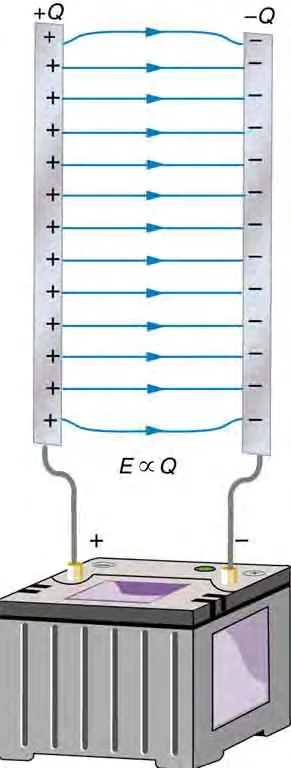 ⤢ Enlarge
Scaling
doubling the area doubles C and doubling the separation halves C
◀ Previous2 / 2
Uses of capacitors
Smoothing
they fill the gaps between voltage peaks of a rectified supply
Energy store
for example camera flashes
Signals
they block direct current while passing alternating signals
Timing and tuning circuits
the rate of charging sets the time constant
1Polarised capacitors · Maximum voltage · Safety2Not a battery · Charging current3Units
Polarised capacitors · Maximum voltage · Safety
Polarised capacitors
electrolytic capacitors must be connected the right way round
Maximum voltage
every capacitor has a maximum working voltage above which the dielectric breaks down
Safety
a capacitor can keep its charge after the supply is disconnected
so large capacitors can be dangerous in switched-off equipment
1 / 3Next ▶
Not a battery · Charging current
Not a battery
a battery keeps a fixed e.m.f. while supplying charge, whereas the p.d. across a capacitor falls as it gives up charge
Charging current
through a resistor it is largest at the start and decays to zero
◀ Previous2 / 3Next ▶
Units
1
convert μF using 1 μF = 10-6 F so that Q = CV gives coulombs
2
For an isolated spherical conductor, the charge stored means the charge on its surface.
3
The potential difference across a capacitor increases as more charge is stored on its plates.
4
Each extra unit of charge becomes harder to add as the plate gets more charged
because the repulsion from existing charge grows.
◀ Previous3 / 3
1Capacitance and Energy Stored on a Charged Conductor
- Capacitance C of a conductor or capacitor is defined as the charge stored per unit electric potential (C = Q / V); the energy stored is represented by the area under a charge-potential graph: E = ½·Q·V = ½·C·V2 = ½·Q2 / C.
2Exponential Capacitor Discharge Curves
- When a capacitor discharges through a circuit resistance R, the charge Q, terminal voltage V,
- and discharging current I decrease exponentially over time from their initial values: Q = Q₀·e−t / RC,
- where the time constant τ = R·C is the time taken to fall to 1/e (≈37%) of initial value.
3Linearising Discharge Graphs Using Natural Logarithms
- Taking the natural logarithm of the exponential discharge equation yields ln(V) = ln(V₀) – t / (RC); plotting ln(V) against time t produces a straight line graph with a negative gradient equal to -1 / (RC), enabling experimental determination of the time constant.
4Capacitance and Energy Stored on a Charged Conductor
- Capacitance C of a conductor or capacitor is defined as the charge stored per unit electric potential (C = Q / V); the energy stored is represented by the area under a charge-potential graph: E = ½·Q·V = ½·C·V2 = ½·Q2 / C.
5Exponential Capacitor Discharge Curves
- When a capacitor discharges through a circuit resistance R, the charge Q, terminal voltage V,
- and discharging current I decrease exponentially over time from their initial values: Q = Q₀·e−t / RC,
- where the time constant τ = R·C is the time taken to fall to 1/e (≈37%) of initial value.
6Linearising Discharge Graphs Using Natural Logarithms
- Taking the natural logarithm of the exponential discharge equation yields ln(V) = ln(V₀) – t / (RC); plotting ln(V) against time t produces a straight line graph with a negative gradient equal to -1 / (RC), enabling experimental determination of the time constant.
7Natural logarithm
- Ln, the inverse of the exponential function
8Discharge
- Removing charge, for example by touching with a finger.
9Exponential
- A function where the rate of change is proportional to the value.
10Resistance
- Opposition to current, R = V / I, in ohms (Ω).
11Terminal
- Connection point of a cell, labelled + or −.
12Exponential decay
- Decay in which equal fractions are lost in equal times
Key terms
| Term | Meaning |
|---|---|
| Capacitance | Charge stored per unit potential difference, C = Q/V. |
| Farad | One coulomb per volt, the unit of capacitance. |
| Dielectric | An insulating material between the plates of a capacitor. |
| Parallel-plate capacitor | Two conducting plates separated by an insulator. |
| Working voltage | The maximum p.d. a capacitor can withstand before breakdown. |
1Avoid these mistakes2Avoid these mistakes
Avoid these mistakes
1Avoid this
Confusing the symbol C for capacitance with the unit C (coulomb).Avoid this
2Avoid this
Saying the capacitor has charge Qthe charges on the plates are +Q and -Q and the net charge is zero.
3Avoid this
Not converting μF, nF or pF to F before calculating.Avoid this
1 / 2Next ▶
Avoid these mistakes
4Avoid this
Thinking charge flows through the dielectric.Avoid this
◀ Previous2 / 2