Curriculum
Edexcel A Level Physics 9PH0
1. Working as a Physicist
0/17
2. Mechanics
0/43
3. Electric Circuits
0/41
4. Materials
0/22
5. Waves and Particle Nature of Light
0/76
-
5. Waves and Particle Nature of Light
 Preview
-
2.1.1 Properties of Waves
Preview
-
2.1.1 Properties of Waves - Check yourself
 Preview
-
2.1.3 Longitudinal Waves
Preview
-
2.1.3 Longitudinal Waves - Check yourself
Preview
-
2.1.4 Transverse Waves
Preview
-
2.1.4 Transverse Waves - Check yourself
Preview
-
2.1.5 Representing Waves on Graphs
Preview
-
2.2.1 Interference and Superposition of Waves
Preview
-
2.2.1 Interference and Superposition of Waves - Check yourself
Preview
-
2.2.2 Phase and Path Difference
Preview
-
2.2.2 Phase and Path Difference - Check yourself
Preview
-
2.2.4 Wave Speed on a Stretched String
Preview
-
2.2.4 Wave Speed on a Stretched String - Check yourself
Preview
-
2.3.1 Equation for the Intensity of Radiation
Preview
-
2.3.1 Equation for the Intensity of Radiation - Check yourself
Preview
-
2.3.2 Refraction and Refractive Index
Preview
-
2.3.2 Refraction and Refractive Index - Check yourself
Preview
-
2.3.3 Critical Angle
Preview
-
2.3.3 Critical Angle - Check yourself
Preview
-
2.3.4 Total Internal Reflection
Preview
-
2.3.4 Total Internal Reflection - Check yourself
Preview
-
2.3.5 Measuring Refractive Index
Preview
-
2.3.5 Measuring Refractive Index - Check yourself
Preview
-
2.3.6 Plane Polarisation
Preview
-
2.3.6 Plane Polarisation - Check yourself
Preview
-
2.4.2 The Diffraction Grating Equation
Preview
-
2.4.2 The Diffraction Grating Equation - Check yourself
Preview
-
2.4.4 The Wave Nature of Electrons
Preview
-
2.4.5 The de Broglie Equation
Preview
-
2.4.5 The de Broglie Equation - Check yourself
Preview
-
2.4.6 Transmission and Reflection of Waves
Preview
-
2.4.6 Transmission and Reflection of Waves - Check yourself
Preview
-
2.4.7 Pulse-Echo Technique
Preview
-
2.4.7 Pulse-Echo Technique - Check yourself
Preview
-
2.4.9 Energy of a Photon
Preview
-
2.4.9 Energy of a Photon - Check yourself
Preview
-
2.5.1 The Photoelectric Effect
Preview
-
2.5.1 The Photoelectric Effect - Check yourself
Preview
-
2.5.2 The Photoelectric Equation
Preview
-
2.5.2 The Photoelectric Equation - Check yourself
Preview
-
2.5.4 The Particle Nature of EM Radiation
Preview
-
2.5.4 The Particle Nature of EM Radiation - Check yourself
Preview
-
2.5.5 Atomic Line Spectra
Preview
-
2.5.5 Atomic Line Spectra - Check yourself
Preview
-
5.1.6 Core Practical 6- Investigating the Speed of Sound
Preview
-
5.1.6 Core Practical 6- Investigating the Speed of Sound - Check yourself
Preview
-
5.2.5 Core Practical 7- Investigating Stationary Waves
Preview
-
5.2.5 Core Practical 7- Investigating Stationary Waves - Check yourself
Preview
-
5.3.6 Converging and Diverging Lenses
Preview
-
5.3.6 Converging and Diverging Lenses - Check yourself
Preview
-
5.3.7 Using Ray Diagrams
Preview
-
5.3.7 Using Ray Diagrams - Check yourself
Preview
-
5.3.8 Power of a Lens
Preview
-
5.3.8 Power of a Lens - Check yourself
Preview
-
5.3.9 Thin Lenses in Combination
Preview
-
5.3.9 Thin Lenses in Combination - Check yourself
Preview
-
5.3.10 Real and Virtual Images
Preview
-
5.3.10 Real and Virtual Images - Check yourself
Preview
-
5.3.11 The Lens Equation
Preview
-
5.3.11 The Lens Equation - Check yourself
Preview
-
5.3.12 Magnification
Preview
-
5.3.12 Magnification - Check yourself
Preview
-
5.4.3 Core Practical 8- Investigating Diffraction Gratings
Preview
-
5.4.3 Core Practical 8- Investigating Diffraction Gratings - Check yourself
Preview
-
7.1.3 The Wave Equation
Preview
-
7.1.3 The Wave Equation - Check yourself
Preview
-
8.1.2 Stationary Waves
Preview
-
8.1.2 Stationary Waves - Check yourself
Preview
-
8.2.1 Diffraction
Preview
-
8.2.1 Diffraction - Check yourself
Preview
-
22.1.3 The Electronvolt
Preview
-
22.1.3 The Electronvolt - Check yourself
Preview
-
22.3.1 Wave-Particle Duality
Preview
-
22.3.1 Wave-Particle Duality - Check yourself
Preview
-
5.4.8 Wave-Particle Duality
Preview
6. Further Mechanics
0/23
7. Electric and Magnetic Fields
0/46
8. Nuclear and Particle Physics
0/29
9. Thermodynamics
0/27
10. Space
0/17
11. Nuclear Radiation
0/21
12. Gravitational Fields
0/16
13. Oscillations
0/23
Text lesson
2.3.3 Critical Angle
2.3.3 Critical Angle — EDEXCEL IAL PHYSICS (IAS & A2) notes: Define the critical angle and use sin C = n2/n1 to calculate it.
1Speed · Angles · Increasing incidence2At 90°
1Critical angle C · Condition2Derivation
Critical angle C · Condition
Critical angle C
the angle of incidence in the denser medium at which the angle of refraction is 90°.
Condition
it exists only when light passes from a more dense to a less dense material.
1 / 2Next ▶
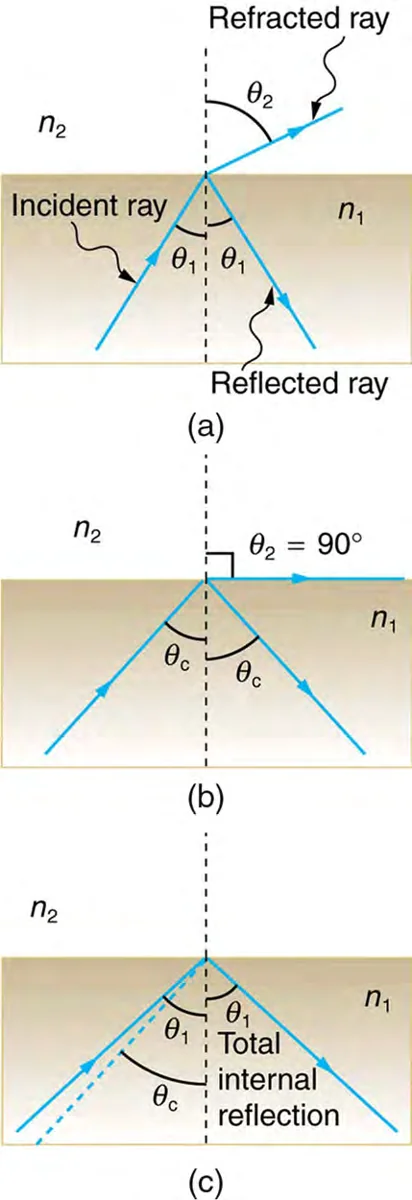
Total internal reflection and the critical angle: Refraction, the critical angle and total internal reflection at a boundary shown in three stages.
Derivation
 ⤢ Enlarge
Derivation
from n1 sin θ1 = n2 sin θ2 with θ1 = C and θ2 = 90°.
sin C = n2/n1, with n1 the larger index.
For a material of index n and air (n2 = 1), sin C = 1/n.What the symbols mean: c = critical angle · n = refractive index of the denser material (no unit)
◀ Previous2 / 2
What happens near the critical angle
What happens near the critical angle
No critical angle
if n1 is less than n2, sin C would exceed 1, which is impossible.
| Angle of incidence | Result |
|---|---|
| Below C | Most light is refracted out, bending away from the normal; a small fraction is partially reflected. |
| At C | The refracted ray travels along the boundary. |
| Above C | No refracted ray; all the light is reflected (total internal reflection). |
1Typical values · Ratio · Wavelength2Graph
1Measuring the critical angle2Measuring the critical angle
Applications
Applications
Diamond its small critical angle traps light
which reflects several times and makes it sparkle.
Refractometers find the refractive index of liquids from the angle at which the field changes from light to dark.
Fibre-optic and fingerprint sensors contact changes the boundary index and so the light reflected.
Refraction is the change of direction of light at a boundary between two transparent media, caused by a change in its speed.
Refractive index is the ratio of light’s speed in a vacuum to its speed in the material
which means it is always greater than 1.
Light slows down and bends towards the normal when it enters a denser medium.
More from the specification
Critical angle derivation
- Critical angle derivation equating refracted ray angles to ninety degrees using Snell’s law provides a direct means to compute the critical angle.
Transverse Wave Polarisation
- Polarisation restricts particle vibrations of a transverse wave to a single plane perpendicular to the direction of wave travel; longitudinal waves cannot be polarised.
Polarising Filters and Malus's Law
- When plane-polarised light passes through a polarising filter at an angle θ, transmitted intensity follows Malus’s law: I = I₀ cos2θ, dropping to zero when filters are crossed.
- (vertical and horizontal)
Critical Angle in Optical Media
- Total internal reflection occurs when light travelling in a denser medium meets an air boundary at an angle of incidence greater than the critical angle (c = arcsin(1/n)).
- (such as a semicircular perspex block)
Experimental Determination of Critical Angle
- By tracing light rays passing through a perspex block, the critical angle is identified when the refracted ray emerges parallel to the boundary at 90°.
Critical angle in perspex
- Critical angle in perspex when light passes from a denser perspex block into air, refraction along the boundary occurs at the critical angle.
Plane polarisation
- Plane polarisation transverse waves oscillating strictly in a single vertical or horizontal plane are described as plane polarised.
Wave intensity
- Wave intensity the transmitted intensity depends on the square of wave amplitude and the orientation of the polarising filter.
Filter
- A material that transmits some colours of light and absorbs others.
Progressive wave
- Wave that transfers energy without transferring matter.
Intensity
- Power per unit area perpendicular to the wave direction.
Polarisation
- Restriction of the oscillations of a transverse wave to one plane.
Polarised
- With a slight separation of charge
Perspex
- Transparent plastic block used in refraction experiments.
Perpendicular
- At right angles.
Stress
- Force per unit cross-sectional area, σ = F/A.
What the symbols mean: σ = stress (Pa) · F = tensile force (N) · A = cross-sectional area (m2)
Proportional
- Changing by the same factor as another quantity.
Key terms
| Term | Meaning |
|---|---|
| Critical angle | The angle of incidence in the denser medium for which the refraction angle is 90°. |
| Optically denser | Having a higher refractive index. |
| Normal | The line perpendicular to the boundary. |
| Angle of refraction | The angle between the refracted ray and the normal. |
| Total internal reflection | All the light is reflected at a boundary when the angle exceeds C. |
1Avoid these mistakes2Avoid these mistakes