Curriculum
Edexcel A Level Physics 9PH0
1. Working as a Physicist
0/17
2. Mechanics
0/43
3. Electric Circuits
0/41
4. Materials
0/22
5. Waves and Particle Nature of Light
0/76
-
5. Waves and Particle Nature of Light
 Preview
-
2.1.1 Properties of Waves
Preview
-
2.1.1 Properties of Waves - Check yourself
 Preview
-
2.1.3 Longitudinal Waves
Preview
-
2.1.3 Longitudinal Waves - Check yourself
Preview
-
2.1.4 Transverse Waves
Preview
-
2.1.4 Transverse Waves - Check yourself
Preview
-
2.1.5 Representing Waves on Graphs
Preview
-
2.2.1 Interference and Superposition of Waves
Preview
-
2.2.1 Interference and Superposition of Waves - Check yourself
Preview
-
2.2.2 Phase and Path Difference
Preview
-
2.2.2 Phase and Path Difference - Check yourself
Preview
-
2.2.4 Wave Speed on a Stretched String
Preview
-
2.2.4 Wave Speed on a Stretched String - Check yourself
Preview
-
2.3.1 Equation for the Intensity of Radiation
Preview
-
2.3.1 Equation for the Intensity of Radiation - Check yourself
Preview
-
2.3.2 Refraction and Refractive Index
Preview
-
2.3.2 Refraction and Refractive Index - Check yourself
Preview
-
2.3.3 Critical Angle
Preview
-
2.3.3 Critical Angle - Check yourself
Preview
-
2.3.4 Total Internal Reflection
Preview
-
2.3.4 Total Internal Reflection - Check yourself
Preview
-
2.3.5 Measuring Refractive Index
Preview
-
2.3.5 Measuring Refractive Index - Check yourself
Preview
-
2.3.6 Plane Polarisation
Preview
-
2.3.6 Plane Polarisation - Check yourself
Preview
-
2.4.2 The Diffraction Grating Equation
Preview
-
2.4.2 The Diffraction Grating Equation - Check yourself
Preview
-
2.4.4 The Wave Nature of Electrons
Preview
-
2.4.5 The de Broglie Equation
Preview
-
2.4.5 The de Broglie Equation - Check yourself
Preview
-
2.4.6 Transmission and Reflection of Waves
Preview
-
2.4.6 Transmission and Reflection of Waves - Check yourself
Preview
-
2.4.7 Pulse-Echo Technique
Preview
-
2.4.7 Pulse-Echo Technique - Check yourself
Preview
-
2.4.9 Energy of a Photon
Preview
-
2.4.9 Energy of a Photon - Check yourself
Preview
-
2.5.1 The Photoelectric Effect
Preview
-
2.5.1 The Photoelectric Effect - Check yourself
Preview
-
2.5.2 The Photoelectric Equation
Preview
-
2.5.2 The Photoelectric Equation - Check yourself
Preview
-
2.5.4 The Particle Nature of EM Radiation
Preview
-
2.5.4 The Particle Nature of EM Radiation - Check yourself
Preview
-
2.5.5 Atomic Line Spectra
Preview
-
2.5.5 Atomic Line Spectra - Check yourself
Preview
-
5.1.6 Core Practical 6- Investigating the Speed of Sound
Preview
-
5.1.6 Core Practical 6- Investigating the Speed of Sound - Check yourself
Preview
-
5.2.5 Core Practical 7- Investigating Stationary Waves
Preview
-
5.2.5 Core Practical 7- Investigating Stationary Waves - Check yourself
Preview
-
5.3.6 Converging and Diverging Lenses
Preview
-
5.3.6 Converging and Diverging Lenses - Check yourself
Preview
-
5.3.7 Using Ray Diagrams
Preview
-
5.3.7 Using Ray Diagrams - Check yourself
Preview
-
5.3.8 Power of a Lens
Preview
-
5.3.8 Power of a Lens - Check yourself
Preview
-
5.3.9 Thin Lenses in Combination
Preview
-
5.3.9 Thin Lenses in Combination - Check yourself
Preview
-
5.3.10 Real and Virtual Images
Preview
-
5.3.10 Real and Virtual Images - Check yourself
Preview
-
5.3.11 The Lens Equation
Preview
-
5.3.11 The Lens Equation - Check yourself
Preview
-
5.3.12 Magnification
Preview
-
5.3.12 Magnification - Check yourself
Preview
-
5.4.3 Core Practical 8- Investigating Diffraction Gratings
Preview
-
5.4.3 Core Practical 8- Investigating Diffraction Gratings - Check yourself
Preview
-
7.1.3 The Wave Equation
Preview
-
7.1.3 The Wave Equation - Check yourself
Preview
-
8.1.2 Stationary Waves
Preview
-
8.1.2 Stationary Waves - Check yourself
Preview
-
8.2.1 Diffraction
Preview
-
8.2.1 Diffraction - Check yourself
Preview
-
22.1.3 The Electronvolt
Preview
-
22.1.3 The Electronvolt - Check yourself
Preview
-
22.3.1 Wave-Particle Duality
Preview
-
22.3.1 Wave-Particle Duality - Check yourself
Preview
-
5.4.8 Wave-Particle Duality
Preview
6. Further Mechanics
0/23
7. Electric and Magnetic Fields
0/46
8. Nuclear and Particle Physics
0/29
9. Thermodynamics
0/27
10. Space
0/17
11. Nuclear Radiation
0/21
12. Gravitational Fields
0/16
13. Oscillations
0/23
Text lesson
2.3.4 Total Internal Reflection
2.3.4 Total Internal Reflection — EDEXCEL IAL PHYSICS (IAS & A2) notes: State the conditions for total internal reflection and explain its use in optical fibres and prisms.
1Conditions for total internal reflection2Conditions for total internal reflection
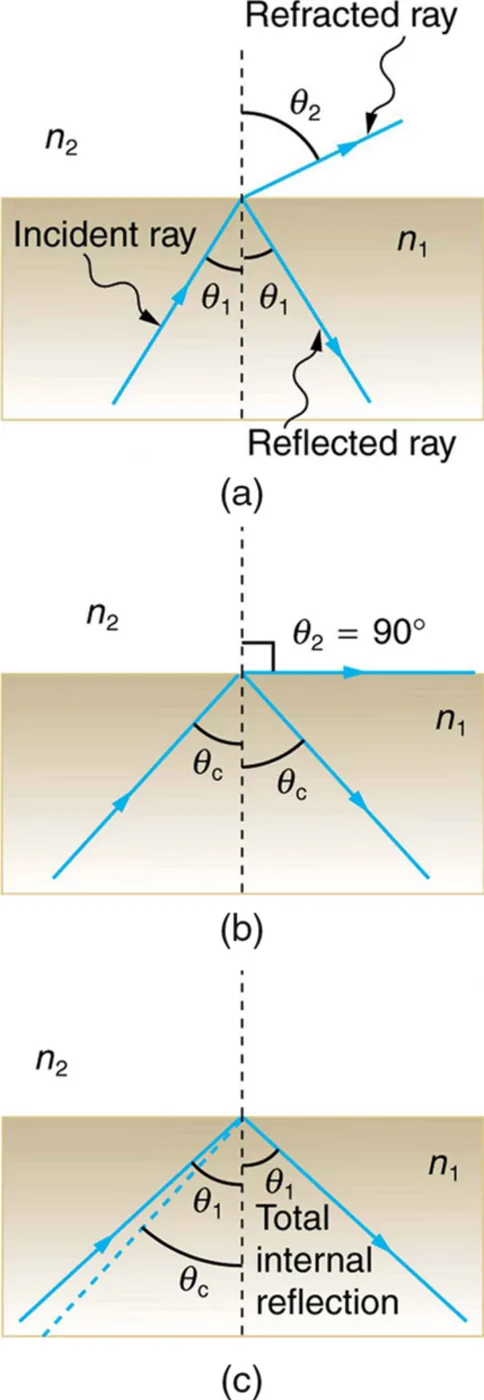
Total internal reflection and the critical angle: Three ray diagrams show a ray moving from a material with a higher index into one with a lower index: the refracted ray bends away from the normal, reaches 90 degrees at the critical angle, and is totally reflected at a larger incident angle.
Refraction, critical angle and TIR
 ⤢ Enlarge
Refraction, critical angle and TIR
Name
give the whole name, total internal reflection, and say all of the light is reflected.
| Angle of incidence | What happens |
|---|---|
| Less than C | Refraction into the less dense medium, with some partial reflection. |
| Equal to C | The refracted ray travels along the boundary. |
| Greater than C | Total internal reflection; no light is transmitted. |
1Optical fibres2Optical fibres
Optical fibres
Optical fibres
Structure a thin core of higher refractive index ncore, surrounded by cladding of lower index nclad.
How light travels light enters the core at a small angle to the axis, strikes the boundary above the critical angle (sin C = nclad/ncore) and is totally reflected repeatedly.
Its lower index is essential for TIR.
It protects the core from scratches and moisture.
It stops light leaking between fibres.
Telecommunications pulses of infrared light travel with little loss and no electrical interference.
1 / 2Next ▶
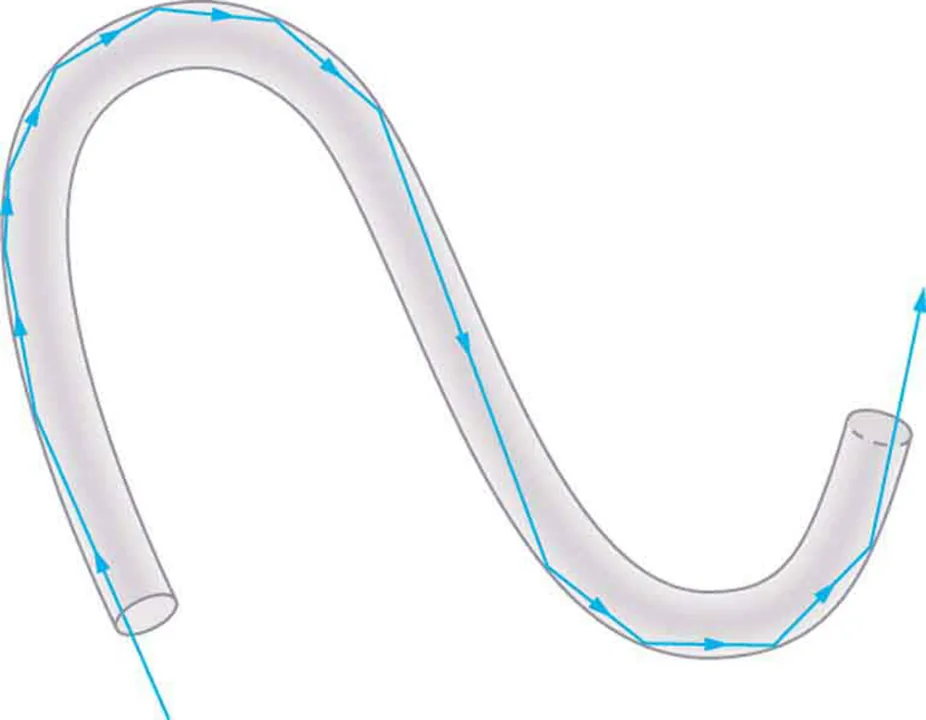
Fiber optics: endoscopes to telephones: Light entering a thin fiber meets the inside wall at large angles and is completely reflected, so it follows the fiber even around bends.
Optical fibres
 ⤢ Enlarge
Optical fibres
Medicine bundles of fibres form an endoscope to see inside the body.
◀ Previous2 / 2
Modal dispersion · Material dispersion · Attenuation
Modal dispersion
rays along the axis take a shorter path than rays that zigzag at steeper angles.
A short pulse spreads out in time.
A very narrow single-mode core reduces this.
Material dispersion
different wavelengths travel at slightly different speeds in glass.
A monochromatic laser source reduces it.
Attenuation
absorption and scattering reduce the signal power
so repeaters amplify the signal every tens of kilometres.
1Prisms and reflectors2Prisms and reflectors
Prisms and reflectors
Prisms and reflectors
(45°, 45°, 90°) — the critical angle for ordinary glass is about 42°.
A ray hitting the hypotenuse at 45° is totally reflected.
Turning a ray through 90° used in periscopes and binoculars.
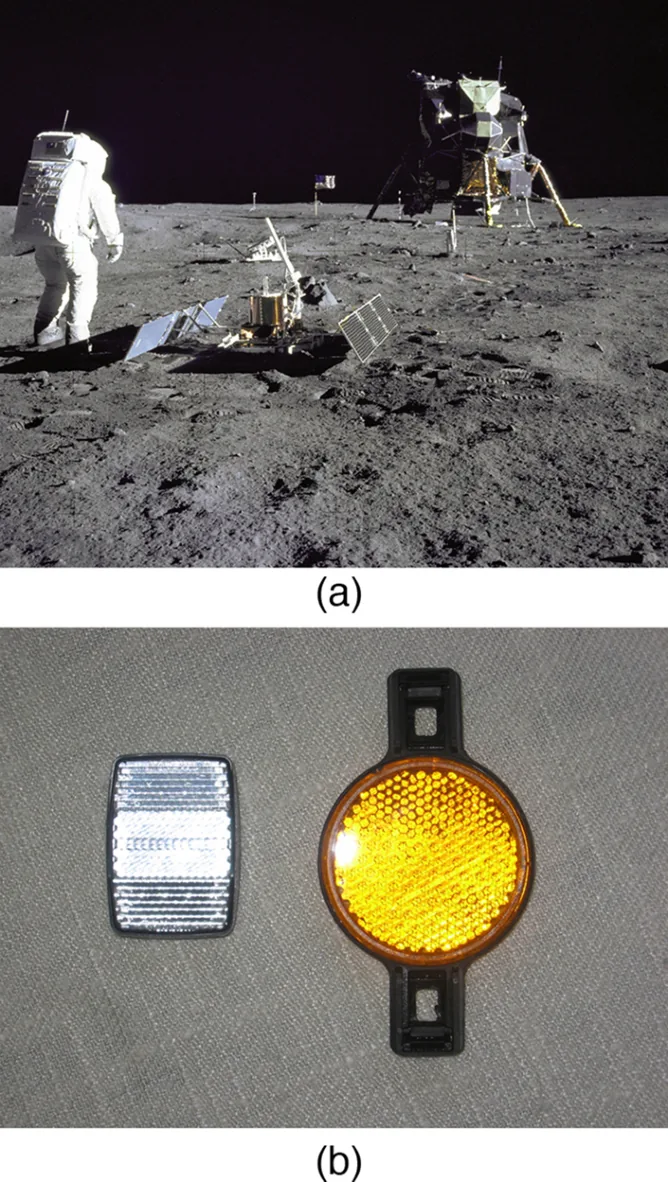
Turning a ray through 180° used in bicycle reflectors and road signs.
Image quality the almost lossless reflection gives bright, clear images.
1 / 2Next ▶
Corner reflectors: An astronaut’s corner reflector on the Moon, and a bicycle reflector whose bright spots are reflections of a camera flash.
Prisms and reflectors
◀ Previous2 / 2
1Smooth, clean boundary · Frustrated TIR · Scratches2Pure silica
1Total internal reflection verification
- Total internal reflection verification shining rays at angles exceeding the critical angle provides an optical means to guide light through glass fibres.
2Conditions for Total Internal Reflection
- Total internal reflection (TIR) occurs when light travelling in an optically denser medium strikes the boundary with a less dense medium at an angle of incidence to the normal greater than the critical angle c, such that all incident light is reflected back into the denser medium.
- (such as a glass or perspex block)
3Critical Angle Equation and Refractive Index
- The critical angle c is the angle of incidence in the denser medium for which the angle of refraction along the boundary surface is exactly 90°; applying Snell’s law gives sin c = 1 / n,
- where n is the refractive index of the denser medium.
4Polarisation of Transverse Waves
- Polarisation is a property unique to transverse waves where particle oscillations are restricted to a single plane perpendicular to the direction of energy propagation;
- when unpolarised light reflects off a transparent surface or passes through a Polaroid filter, the transmitted wave is plane-polarised,
- reducing its transmitted intensity.
5Angles from the normal
- Angles from the normal incidence and reflection angles are always measured between the ray path and the normal perpendicular to the boundary surface.
6TIR in a semicircular block
- TIR in a semicircular block rays entering normal to curved perspex continue undeviated to the flat surface without changing direction.
7Polarisation of reflected waves
- Polarisation of reflected waves light reflecting off non-metallic boundaries becomes partially polarised parallel to the surface plane.
8Stress
- Force per unit cross-sectional area, σ = F/A.
What the symbols mean: σ = stress (Pa) · F = tensile force (N) · A = cross-sectional area (m2)
9Proportional
- Changing by the same factor as another quantity.
10Filter
- A material that transmits some colours of light and absorbs others.
11Progressive wave
- Wave that transfers energy without transferring matter.
12Intensity
- Power per unit area perpendicular to the wave direction.
13Polarisation
- Restriction of the oscillations of a transverse wave to one plane.
14Polarised
- With a slight separation of charge
15Normal
- Line at 90° to a surface.
16Perspex
- Transparent plastic block used in refraction experiments.
Key terms
| Term | Meaning |
|---|---|
| Total internal reflection | Complete reflection of light at a boundary with a less dense medium when the angle of incidence exceeds the critical angle. |
| Core | The central, higher-index region of an optical fibre. |
| Cladding | The lower-index layer surrounding the core. |
| Modal dispersion | Pulse broadening because different paths have different lengths. |
| Attenuation | The loss of signal power along a fibre. |
1Avoid these mistakes2Avoid these mistakes