Curriculum
Edexcel A Level Physics 9PH0
1. Working as a Physicist
0/17
-
1. Working as a Physicist
 Text lessonTrial
-
1.1.2 Practical Skills
Text lessonPreview
-
1.1.2 Practical Skills - Check yourself
 6 questionsPreview
-
1.1.3 Estimating Physical Quantities
Text lessonPreview
-
1.1.3 Estimating Physical Quantities - Check yourself
6 questionsPreview
-
1.1.4 Limitations of Measurements
Text lessonPreview
-
1.1.4 Limitations of Measurements - Check yourself
6 questionsPreview
-
1.1.5 Scientific Communication
Text lessonPreview
-
1.1.5 Scientific Communication - Check yourself
6 questionsPreview
-
1.1.6 Applications of Science
Text lessonPreview
-
1.1.6 Applications of Science - Check yourself
6 questionsPreview
-
1.1.7 The Scientific Community
Text lessonPreview
-
1.1.7 The Scientific Community - Check yourself
6 questionsPreview
-
1.1.8 Science and Society
Text lessonPreview
-
1.1.8 Science and Society - Check yourself
6 questionsPreview
-
1.2.1 SI Units
Text lessonPreview
-
1.2.1 SI Units - Check yourself
6 questionsPreview
2. Mechanics
0/43
-
2. Mechanics
Text lessonPreview
-
1.1.1 Equations of Motion
Text lessonPreview
-
1.1.5 Resolving Vectors
Text lessonPreview
-
1.1.5 Resolving Vectors - Check yourself
6 questionsPreview
-
1.2.2 Mass, Weight and Gravitational Field Strength
Text lessonPreview
-
1.2.2 Mass, Weight and Gravitational Field Strength - Check yourself
6 questionsPreview
-
1.2.3 Core Practical 1- Investigating the Acceleration of Freefall
Text lessonPreview
-
1.2.3 Core Practical 1- Investigating the Acceleration of Freefall - Check yourself
6 questionsPreview
-
1.2.4 Newton's Third Law of Motion
Text lessonPreview
-
1.2.4 Newton's Third Law of Motion - Check yourself
6 questionsPreview
-
1.2.5 Momentum
Text lessonPreview
-
1.2.5 Momentum - Check yourself
6 questionsPreview
-
1.2.6 Conservation of Linear Momentum
Text lessonPreview
-
1.2.6 Conservation of Linear Momentum - Check yourself
6 questionsPreview
-
1.3.2 Centre of Gravity and The Principle of Moments
Text lessonPreview
-
1.3.2 Centre of Gravity and The Principle of Moments - Check yourself
6 questionsPreview
-
1.4.1 Scalars and Vectors
Text lessonPreview
-
1.4.1 Scalars and Vectors - Check yourself
6 questionsPreview
-
1.4.1 Work
Text lessonPreview
-
1.4.1 Work - Check yourself
6 questionsPreview
-
2.1.2 Motion Graphs
Text lessonPreview
-
2.1.3 Properties of Motion Graphs
Text lessonPreview
-
2.1.3 Properties of Motion Graphs - Check yourself
6 questionsPreview
-
2.1.6 Finding the Resultant Vector
Text lessonPreview
-
2.1.6 Finding the Resultant Vector - Check yourself
6 questionsPreview
-
2.1.7 Projectiles
Text lessonPreview
-
2.1.7 Projectiles - Check yourself
6 questionsPreview
-
2.1.8 Forces as Vectors
Text lessonPreview
-
2.1.8 Forces as Vectors - Check yourself
6 questionsPreview
-
3.1.2 Force and Acceleration
Text lessonPreview
-
3.1.2 Force and Acceleration - Check yourself
6 questionsPreview
-
4.1.2 Moments
Text lessonPreview
-
4.1.2 Moments - Check yourself
6 questionsPreview
-
5.1.2 The Principle of Conservation of Energy
Text lessonPreview
-
5.1.2 The Principle of Conservation of Energy - Check yourself
6 questionsPreview
-
5.1.3 Efficiency
Text lessonPreview
-
5.1.3 Efficiency - Check yourself
6 questionsPreview
-
5.1.4 Power
Text lessonPreview
-
5.1.4 Power - Check yourself
6 questionsPreview
-
5.2.1 Gravitational Potential Energy
Text lessonPreview
-
5.2.1 Gravitational Potential Energy - Check yourself
6 questionsPreview
-
5.2.2 Kinetic Energy
Text lessonPreview
-
5.2.2 Kinetic Energy - Check yourself
6 questionsPreview
3. Electric Circuits
0/41
-
3. Electric Circuits
Text lessonPreview
-
2.6.4 Charge Conservation in Circuits
Text lessonPreview
-
2.6.4 Charge Conservation in Circuits - Check yourself
6 questionsPreview
-
2.6.5 Energy Conservation in Circuits
Text lessonPreview
-
2.6.5 Energy Conservation in Circuits - Check yourself
6 questionsPreview
-
2.6.6 Resistance in Series and Parallel
Text lessonPreview
-
2.6.6 Resistance in Series and Parallel - Check yourself
6 questionsPreview
-
2.6.8 Current-Potential Difference Graphs
Text lessonPreview
-
2.6.8 Current-Potential Difference Graphs - Check yourself
6 questionsPreview
-
2.7.1 Electrical Resistivity
Text lessonPreview
-
2.7.1 Electrical Resistivity - Check yourself
6 questionsPreview
-
2.7.4 Potential Difference and Conductor Length
Text lessonPreview
-
2.7.4 Potential Difference and Conductor Length - Check yourself
6 questionsPreview
-
2.7.6 Potential Dividers and Variable Resistance
Text lessonPreview
-
2.7.6 Potential Dividers and Variable Resistance - Check yourself
6 questionsPreview
-
2.8.3 E.M.F. vs. Terminal Potential Difference
Text lessonPreview
-
2.8.3 E.M.F. vs. Terminal Potential Difference - Check yourself
6 questionsPreview
-
2.8.5 Resistance and Temperature
Text lessonPreview
-
2.8.5 Resistance and Temperature - Check yourself
6 questionsPreview
-
2.8.6 Resistance and Illumination
Text lessonPreview
-
2.8.6 Resistance and Illumination - Check yourself
6 questionsPreview
-
3.2.2 Core Practical 2- Investigating Resistivity
Text lessonPreview
-
3.2.2 Core Practical 2- Investigating Resistivity - Check yourself
6 questionsPreview
-
3.2.3 Current and Drift Velocity
Text lessonPreview
-
3.2.3 Current and Drift Velocity - Check yourself
6 questionsPreview
-
3.3.4 Core Practical 3- Investigating E.M.F. and Internal Resistance
Text lessonPreview
-
3.3.4 Core Practical 3- Investigating E.M.F. and Internal Resistance - Check yourself
6 questionsPreview
-
9.1.1 Electric Current
Text lessonPreview
-
9.1.1 Electric Current - Check yourself
6 questionsPreview
-
9.2.1 Potential Difference
Text lessonPreview
-
9.2.1 Potential Difference - Check yourself
6 questionsPreview
-
9.2.2 Electrical Power
Text lessonPreview
-
9.2.2 Electrical Power - Check yourself
6 questionsPreview
-
9.3.2 Ohm's Law
Text lessonPreview
-
9.3.2 Ohm's Law - Check yourself
6 questionsPreview
-
10.1.2 Electromotive Force
Text lessonPreview
-
10.1.2 Electromotive Force - Check yourself
6 questionsPreview
-
10.1.3 Internal Resistance
Text lessonPreview
-
10.1.3 Internal Resistance - Check yourself
6 questionsPreview
-
10.3.1 Potential Dividers
Text lessonPreview
-
10.3.1 Potential Dividers - Check yourself
6 questionsPreview
4. Materials
0/22
-
4. Materials
Text lessonPreview
-
1.5.3 Viscous Drag
Text lessonPreview
-
1.5.3 Viscous Drag - Check yourself
6 questionsPreview
-
1.6.2 Stress, Strain and The Young Modulus
Text lessonPreview
-
1.6.2 Stress, Strain and The Young Modulus - Check yourself
6 questionsPreview
-
1.6.3 Force-Extension Graphs
Text lessonPreview
-
1.6.3 Force-Extension Graphs - Check yourself
6 questionsPreview
-
1.6.4 Stress-Strain Graphs
Text lessonPreview
-
1.6.4 Stress-Strain Graphs - Check yourself
6 questionsPreview
-
1.6.6 Elastic Strain Energy
Text lessonPreview
-
1.6.6 Elastic Strain Energy - Check yourself
6 questionsPreview
-
4.1.4 Core Practical 4- Investigating Viscosity
Text lessonPreview
-
4.1.4 Core Practical 4- Investigating Viscosity - Check yourself
6 questionsPreview
-
4.2.5 Core Practical 5- Investigating Young Modulus
Text lessonPreview
-
4.2.5 Core Practical 5- Investigating Young Modulus - Check yourself
6 questionsPreview
-
4.3.1 Density
Text lessonPreview
-
4.3.1 Density - Check yourself
6 questionsPreview
-
4.3.4 Upthrust
Text lessonPreview
-
4.3.4 Upthrust - Check yourself
6 questionsPreview
-
6.1.2 Hooke's Law
Text lessonPreview
-
6.1.2 Hooke's Law - Check yourself
6 questionsPreview
-
4.2.1 Hooke's Law
Text lessonPreview
5. Waves and Particle Nature of Light
0/76
-
5. Waves and Particle Nature of Light
Text lessonPreview
-
2.1.1 Properties of Waves
Text lessonPreview
-
2.1.1 Properties of Waves - Check yourself
6 questionsPreview
-
2.1.3 Longitudinal Waves
Text lessonPreview
-
2.1.3 Longitudinal Waves - Check yourself
6 questionsPreview
-
2.1.4 Transverse Waves
Text lessonPreview
-
2.1.4 Transverse Waves - Check yourself
18 questionsPreview
-
2.1.5 Representing Waves on Graphs
Text lessonPreview
-
2.2.1 Interference and Superposition of Waves
Text lessonPreview
-
2.2.1 Interference and Superposition of Waves - Check yourself
6 questionsPreview
-
2.2.2 Phase and Path Difference
Text lessonPreview
-
2.2.2 Phase and Path Difference - Check yourself
6 questionsPreview
-
2.2.4 Wave Speed on a Stretched String
Text lessonPreview
-
2.2.4 Wave Speed on a Stretched String - Check yourself
6 questionsPreview
-
2.3.1 Equation for the Intensity of Radiation
Text lessonPreview
-
2.3.1 Equation for the Intensity of Radiation - Check yourself
6 questionsPreview
-
2.3.2 Refraction and Refractive Index
Text lessonPreview
-
2.3.2 Refraction and Refractive Index - Check yourself
6 questionsPreview
-
2.3.3 Critical Angle
Text lessonPreview
-
2.3.3 Critical Angle - Check yourself
6 questionsPreview
-
2.3.4 Total Internal Reflection
Text lessonPreview
-
2.3.4 Total Internal Reflection - Check yourself
6 questionsPreview
-
2.3.5 Measuring Refractive Index
Text lessonPreview
-
2.3.5 Measuring Refractive Index - Check yourself
12 questionsPreview
-
2.3.6 Plane Polarisation
Text lessonPreview
-
2.3.6 Plane Polarisation - Check yourself
6 questionsPreview
-
2.4.2 The Diffraction Grating Equation
Text lessonPreview
-
2.4.2 The Diffraction Grating Equation - Check yourself
6 questionsPreview
-
2.4.4 The Wave Nature of Electrons
Text lessonPreview
-
2.4.5 The de Broglie Equation
Text lessonPreview
-
2.4.5 The de Broglie Equation - Check yourself
6 questionsPreview
-
2.4.6 Transmission and Reflection of Waves
Text lessonPreview
-
2.4.6 Transmission and Reflection of Waves - Check yourself
6 questionsPreview
-
2.4.7 Pulse-Echo Technique
Text lessonPreview
-
2.4.7 Pulse-Echo Technique - Check yourself
6 questionsPreview
-
2.4.9 Energy of a Photon
Text lessonPreview
-
2.4.9 Energy of a Photon - Check yourself
6 questionsPreview
-
2.5.1 The Photoelectric Effect
Text lessonPreview
-
2.5.1 The Photoelectric Effect - Check yourself
6 questionsPreview
-
2.5.2 The Photoelectric Equation
Text lessonPreview
-
2.5.2 The Photoelectric Equation - Check yourself
6 questionsPreview
-
2.5.4 The Particle Nature of EM Radiation
Text lessonPreview
-
2.5.4 The Particle Nature of EM Radiation - Check yourself
6 questionsPreview
-
2.5.5 Atomic Line Spectra
Text lessonPreview
-
2.5.5 Atomic Line Spectra - Check yourself
6 questionsPreview
-
5.1.6 Core Practical 6- Investigating the Speed of Sound
Text lessonPreview
-
5.1.6 Core Practical 6- Investigating the Speed of Sound - Check yourself
6 questionsPreview
-
5.2.5 Core Practical 7- Investigating Stationary Waves
Text lessonPreview
-
5.2.5 Core Practical 7- Investigating Stationary Waves - Check yourself
6 questionsPreview
-
5.3.6 Converging and Diverging Lenses
Text lessonPreview
-
5.3.6 Converging and Diverging Lenses - Check yourself
6 questionsPreview
-
5.3.7 Using Ray Diagrams
Text lessonPreview
-
5.3.7 Using Ray Diagrams - Check yourself
6 questionsPreview
-
5.3.8 Power of a Lens
Text lessonPreview
-
5.3.8 Power of a Lens - Check yourself
6 questionsPreview
-
5.3.9 Thin Lenses in Combination
Text lessonPreview
-
5.3.9 Thin Lenses in Combination - Check yourself
6 questionsPreview
-
5.3.10 Real and Virtual Images
Text lessonPreview
-
5.3.10 Real and Virtual Images - Check yourself
6 questionsPreview
-
5.3.11 The Lens Equation
Text lessonPreview
-
5.3.11 The Lens Equation - Check yourself
6 questionsPreview
-
5.3.12 Magnification
Text lessonPreview
-
5.3.12 Magnification - Check yourself
6 questionsPreview
-
5.4.3 Core Practical 8- Investigating Diffraction Gratings
Text lessonPreview
-
5.4.3 Core Practical 8- Investigating Diffraction Gratings - Check yourself
6 questionsPreview
-
7.1.3 The Wave Equation
Text lessonPreview
-
7.1.3 The Wave Equation - Check yourself
6 questionsPreview
-
8.1.2 Stationary Waves
Text lessonPreview
-
8.1.2 Stationary Waves - Check yourself
6 questionsPreview
-
8.2.1 Diffraction
Text lessonPreview
-
8.2.1 Diffraction - Check yourself
6 questionsPreview
-
22.1.3 The Electronvolt
Text lessonPreview
-
22.1.3 The Electronvolt - Check yourself
6 questionsPreview
-
22.3.1 Wave-Particle Duality
Text lessonPreview
-
22.3.1 Wave-Particle Duality - Check yourself
6 questionsPreview
-
5.4.8 Wave-Particle Duality
Text lessonPreview
6. Further Mechanics
0/23
-
6. Further Mechanics
Text lessonPreview
-
3.3.2 Elastic and Inelastic Collisions
Text lessonPreview
-
3.3.2 Elastic and Inelastic Collisions - Check yourself
6 questionsPreview
-
4.1.1 Impulse
Text lessonPreview
-
4.1.1 Impulse - Check yourself
6 questionsPreview
-
4.1.2 Core Practical 9- Investigating Impulse
Text lessonPreview
-
4.1.2 Core Practical 9- Investigating Impulse - Check yourself
6 questionsPreview
-
4.1.3 Applying Conservation of Linear Momentum
Text lessonPreview
-
4.1.3 Applying Conservation of Linear Momentum - Check yourself
12 questionsPreview
-
4.1.4 Core Practical 10- Investigating Collisions using ICT
Text lessonPreview
-
4.1.4 Core Practical 10- Investigating Collisions using ICT - Check yourself
6 questionsPreview
-
4.1.6 Energy-Momentum Relation
Text lessonPreview
-
4.1.6 Energy-Momentum Relation - Check yourself
6 questionsPreview
-
4.2.2 Angular Velocity
Text lessonPreview
-
4.2.4 Maintaining Circular Motion
Text lessonPreview
-
4.2.5 Centripetal Force
Text lessonPreview
-
4.2.5 Centripetal Force - Check yourself
6 questionsPreview
-
12.1.1 Radians and Angular Displacement
Text lessonPreview
-
12.1.1 Radians and Angular Displacement - Check yourself
24 questionsPreview
-
12.2.1 Centripetal Acceleration
Text lessonPreview
-
6.1.5 Elastic and Inelastic Collisions
Text lessonPreview
-
6.2.1 Radians and Angular Displacement
Text lessonPreview
-
6.2.3 Centripetal Acceleration
Text lessonPreview
7. Electric and Magnetic Fields
0/46
-
7. Electric and Magnetic Fields
Text lessonPreview
-
4.3.1 Defining an Electric Field
Text lessonPreview
-
4.3.1 Defining an Electric Field - Check yourself
6 questionsPreview
-
4.3.2 Electric Field Strength
Text lessonPreview
-
4.3.2 Electric Field Strength - Check yourself
6 questionsPreview
-
4.3.3 Electric Force between Two Charges
Text lessonPreview
-
4.3.3 Electric Force between Two Charges - Check yourself
6 questionsPreview
-
4.3.4 Electric Field due to a Point Charge
Text lessonPreview
-
4.3.4 Electric Field due to a Point Charge - Check yourself
6 questionsPreview
-
4.3.5 Electric Field and Potential
Text lessonPreview
-
4.3.5 Electric Field and Potential - Check yourself
6 questionsPreview
-
4.3.7 Electric Potential for a Radial Field
Text lessonPreview
-
4.3.7 Electric Potential for a Radial Field - Check yourself
6 questionsPreview
-
4.3.8 Representing Radial and Uniform Electric Fields
Text lessonPreview
-
4.3.8 Representing Radial and Uniform Electric Fields - Check yourself
6 questionsPreview
-
4.4.2 Energy Stored by a Capacitor
Text lessonPreview
-
4.4.2 Energy Stored by a Capacitor - Check yourself
6 questionsPreview
-
4.4.3 Charge and Discharge Curves
Text lessonPreview
-
4.4.3 Charge and Discharge Curves - Check yourself
6 questionsPreview
-
4.4.4 Core Practical 11- Investigating Capacitor Charge and Discharge
Text lessonPreview
-
4.4.4 Core Practical 11- Investigating Capacitor Charge and Discharge - Check yourself
6 questionsPreview
-
4.4.5 Exponential Discharge in a Capacitor
Text lessonPreview
-
4.4.5 Exponential Discharge in a Capacitor - Check yourself
6 questionsPreview
-
4.5.1 Magnetic Flux Density, Flux and Flux Linkage
Text lessonPreview
-
4.5.1 Magnetic Flux Density, Flux and Flux Linkage - Check yourself
6 questionsPreview
-
4.5.2 Magnetic Force on a Charged Particle
Text lessonPreview
-
4.5.2 Magnetic Force on a Charged Particle - Check yourself
6 questionsPreview
-
4.5.3 Magnetic Force on a Current-Carrying Conductor
Text lessonPreview
-
4.5.3 Magnetic Force on a Current-Carrying Conductor - Check yourself
6 questionsPreview
-
4.5.4 Induced E.M.F in a Moving Coil
Text lessonPreview
-
4.5.4 Induced E.M.F in a Moving Coil - Check yourself
6 questionsPreview
-
4.5.5 Induced E.M.F between Linked Coils
Text lessonPreview
-
4.5.5 Induced E.M.F between Linked Coils - Check yourself
6 questionsPreview
-
7.4.3 Lenz's Law
Text lessonPreview
-
7.4.3 Lenz's Law - Check yourself
6 questionsPreview
-
7.4.4 Faraday's Law
Text lessonPreview
-
7.4.4 Faraday's Law - Check yourself
6 questionsPreview
-
7.4.5 Alternating Currents and Potential Differences
Text lessonPreview
-
7.4.5 Alternating Currents and Potential Differences - Check yourself
6 questionsPreview
-
7.4.6 Root-Mean-Square Current and Potential Difference
Text lessonPreview
-
7.4.6 Root-Mean-Square Current and Potential Difference - Check yourself
6 questionsPreview
-
18.2.1 Electric Field Between Parallel Plates
Text lessonPreview
-
18.2.1 Electric Field Between Parallel Plates - Check yourself
6 questionsPreview
-
19.1.1 Capacitance
Text lessonPreview
-
19.1.1 Capacitance - Check yourself
6 questionsPreview
-
7.1.6 Electric Field between Parallel Plates
Text lessonPreview
8. Nuclear and Particle Physics
0/29
-
8. Nuclear and Particle Physics
Text lessonPreview
-
4.6.2 The Nuclear Model of the Atom
Text lessonPreview
-
4.6.2 The Nuclear Model of the Atom - Check yourself
6 questionsPreview
-
4.6.3 Thermionic Emission
Text lessonPreview
-
4.6.3 Thermionic Emission - Check yourself
6 questionsPreview
-
4.6.4 Particle Accelerators and Detectors
Text lessonPreview
-
4.6.4 Particle Accelerators and Detectors - Check yourself
6 questionsPreview
-
4.6.5 Radius of a Charged Particle in a Magnetic Field
Text lessonPreview
-
4.6.5 Radius of a Charged Particle in a Magnetic Field - Check yourself
6 questionsPreview
-
4.6.6 Interpreting Particle Tracks
Text lessonPreview
-
4.6.6 Interpreting Particle Tracks - Check yourself
6 questionsPreview
-
4.6.7 High Energy Particle Collisions
Text lessonPreview
-
4.6.7 High Energy Particle Collisions - Check yourself
6 questionsPreview
-
4.6.8 Annihilation of Matter and Antimatter
Text lessonPreview
-
4.6.8 Annihilation of Matter and Antimatter - Check yourself
6 questionsPreview
-
4.6.9 Unit Conversions for Energy and Mass
Text lessonPreview
-
4.6.9 Unit Conversions for Energy and Mass - Check yourself
6 questionsPreview
-
4.6.10 Relativistic Situations
Text lessonPreview
-
4.6.10 Relativistic Situations - Check yourself
6 questionsPreview
-
4.7.1 The Standard Model
Text lessonPreview
-
4.7.1 The Standard Model - Check yourself
6 questionsPreview
-
4.7.2 Antimatter
Text lessonPreview
-
4.7.2 Antimatter - Check yourself
6 questionsPreview
-
4.7.3 Conservation Laws in Particle Physics
Text lessonPreview
-
4.7.3 Conservation Laws in Particle Physics - Check yourself
6 questionsPreview
-
4.7.4 Particle Interaction Equations
Text lessonPreview
-
4.7.4 Particle Interaction Equations - Check yourself
6 questionsPreview
-
11.1.3 Nucleon and Proton Number
Text lessonPreview
-
8.1.1 Nucleon and Proton Number
Text lessonPreview
9. Thermodynamics
0/27
-
9. Thermodynamics
Text lessonPreview
-
5.1.1 Specific Heat Capacity and Latent Heat
Text lessonPreview
-
5.1.1 Specific Heat Capacity and Latent Heat - Check yourself
6 questionsPreview
-
5.1.2 Core Practical 12- Calibrating a Thermistor
Text lessonPreview
-
5.1.2 Core Practical 12- Calibrating a Thermistor - Check yourself
6 questionsPreview
-
5.1.3 Core Practical 13- Investigating Specific Latent Heat
Text lessonPreview
-
5.1.3 Core Practical 13- Investigating Specific Latent Heat - Check yourself
6 questionsPreview
-
5.2.2 Temperature and Absolute Zero
Text lessonPreview
-
5.2.4 Core Practical 14- Investigating Gas Pressure and Volume
Text lessonPreview
-
5.2.4 Core Practical 14- Investigating Gas Pressure and Volume - Check yourself
6 questionsPreview
-
5.2.5 Average Molecular Kinetic Energy
Text lessonPreview
-
5.2.5 Average Molecular Kinetic Energy - Check yourself
6 questionsPreview
-
5.8.1 Black Body Radiation
Text lessonPreview
-
5.8.1 Black Body Radiation - Check yourself
6 questionsPreview
-
5.8.2 Stefan-Boltzmann Law
Text lessonPreview
-
5.8.2 Stefan-Boltzmann Law - Check yourself
6 questionsPreview
-
5.8.3 Wien’s Law
Text lessonPreview
-
5.8.3 Wien’s Law - Check yourself
6 questionsPreview
-
9.2.3 Kinetic Theory of Gases Equation
Text lessonPreview
-
9.2.3 Kinetic Theory of Gases Equation - Check yourself
6 questionsPreview
-
15.2.2 Ideal Gas Equation
Text lessonPreview
-
15.2.2 Ideal Gas Equation - Check yourself
12 questionsPreview
-
16.1.1 Internal energy
Text lessonPreview
-
16.1.1 Internal energy - Check yourself
6 questionsPreview
-
9.2.1 Internal Energy
Text lessonPreview
-
9.2.4 Ideal Gas Equation
Text lessonPreview
-
9.3.3 Wien's Law
Text lessonPreview
10. Space
0/17
-
10. Space
Text lessonPreview
-
5.9.1 Inverse Square Law of Flux
Text lessonPreview
-
5.9.1 Inverse Square Law of Flux - Check yourself
6 questionsPreview
-
5.9.2 Parallax
Text lessonPreview
-
5.9.2 Parallax - Check yourself
6 questionsPreview
-
5.9.3 Standard Candles
Text lessonPreview
-
5.9.3 Standard Candles - Check yourself
6 questionsPreview
-
5.9.4 The Hertzsprung-Russell Diagram
Text lessonPreview
-
5.9.4 The Hertzsprung-Russell Diagram - Check yourself
6 questionsPreview
-
5.9.5 The Life Cycle of Stars
Text lessonPreview
-
5.9.5 The Life Cycle of Stars - Check yourself
6 questionsPreview
-
5.10.1 Doppler Shift
Text lessonPreview
-
5.10.1 Doppler Shift - Check yourself
6 questionsPreview
-
5.10.2 Equations for Cosmology
Text lessonPreview
-
5.10.2 Equations for Cosmology - Check yourself
6 questionsPreview
-
5.10.3 Cosmology
Text lessonPreview
-
5.10.3 Cosmology - Check yourself
6 questionsPreview
11. Nuclear Radiation
0/21
-
11. Nuclear Radiation
Text lessonPreview
-
5.3.1 Nuclear Binding Energy and Mass Deficit
Text lessonPreview
-
5.3.1 Nuclear Binding Energy and Mass Deficit - Check yourself
6 questionsPreview
-
5.3.2 Atomic Mass Unit
Text lessonPreview
-
5.3.2 Atomic Mass Unit - Check yourself
6 questionsPreview
-
5.3.3 Binding Energy per Nucleon Graph
Text lessonPreview
-
5.3.3 Binding Energy per Nucleon Graph - Check yourself
6 questionsPreview
-
5.3.4 Nuclear Fusion
Text lessonPreview
-
5.3.4 Nuclear Fusion - Check yourself
6 questionsPreview
-
5.4.1 Background Radiation
Text lessonPreview
-
5.4.1 Background Radiation - Check yourself
6 questionsPreview
-
5.4.2 Alpha, Beta and Gamma Radiation
Text lessonPreview
-
5.4.2 Alpha, Beta and Gamma Radiation - Check yourself
6 questionsPreview
-
5.4.3 Nuclear Decay Equations
Text lessonPreview
-
5.4.3 Nuclear Decay Equations - Check yourself
6 questionsPreview
-
5.4.4 Core Practical 15- Investigating Gamma Radiation Absorption
Text lessonPreview
-
5.4.4 Core Practical 15- Investigating Gamma Radiation Absorption - Check yourself
6 questionsPreview
-
5.4.5 The Random Nature of Nuclear Decay
Text lessonPreview
-
5.4.5 The Random Nature of Nuclear Decay - Check yourself
6 questionsPreview
-
5.4.6 Equations for Nuclear Physics
Text lessonPreview
-
5.4.6 Equations for Nuclear Physics - Check yourself
6 questionsPreview
12. Gravitational Fields
0/16
-
12. Gravitational Fields
Text lessonPreview
-
5.7.3 Newton’s Law of Universal Gravitation
Text lessonPreview
-
5.7.3 Newton’s Law of Universal Gravitation - Check yourself
6 questionsPreview
-
5.7.4 Gravitational Field due to a Point Mass
Text lessonPreview
-
5.7.4 Gravitational Field due to a Point Mass - Check yourself
6 questionsPreview
-
5.7.5 Gravitational Potential for a Radial Field
Text lessonPreview
-
5.7.5 Gravitational Potential for a Radial Field - Check yourself
6 questionsPreview
-
5.7.6 Comparing Electric and Gravitational Fields
Text lessonPreview
-
5.7.6 Comparing Electric and Gravitational Fields - Check yourself
6 questionsPreview
-
5.7.7 Orbital Motion
Text lessonPreview
-
5.7.7 Orbital Motion - Check yourself
6 questionsPreview
-
13.1.1 Gravitational Fields
Text lessonPreview
-
13.1.1 Gravitational Fields - Check yourself
6 questionsPreview
-
13.3.1 Gravitational Field Strength
Text lessonPreview
-
13.3.1 Gravitational Field Strength - Check yourself
6 questionsPreview
-
12.1.3 Newton's Law of Universal Gravitation
Text lessonPreview
13. Oscillations
0/23
-
13. Oscillations
Text lessonPreview
-
5.5.1 Conditions for Simple Harmonic Motion
Text lessonPreview
-
5.5.1 Conditions for Simple Harmonic Motion - Check yourself
6 questionsPreview
-
5.5.2 Equations for Simple Harmonic Motion
Text lessonPreview
-
5.5.2 Equations for Simple Harmonic Motion - Check yourself
6 questionsPreview
-
5.5.3 Period of Simple Harmonic Oscillators
Text lessonPreview
-
5.5.3 Period of Simple Harmonic Oscillators - Check yourself
6 questionsPreview
-
5.5.4 Displacement-Time Graph for an Oscillator
Text lessonPreview
-
5.5.4 Displacement-Time Graph for an Oscillator - Check yourself
6 questionsPreview
-
5.5.5 Velocity-Time Graph for an Oscillator
Text lessonPreview
-
5.5.5 Velocity-Time Graph for an Oscillator - Check yourself
6 questionsPreview
-
5.6.2 Core Practical 16- Investigating Resonance
Text lessonPreview
-
5.6.2 Core Practical 16- Investigating Resonance - Check yourself
6 questionsPreview
-
5.6.3 Damped and Undamped Oscillating Systems
Text lessonPreview
-
5.6.3 Damped and Undamped Oscillating Systems - Check yourself
6 questionsPreview
-
5.6.4 Free and Forced Oscillations
Text lessonPreview
-
5.6.4 Free and Forced Oscillations - Check yourself
6 questionsPreview
-
5.6.5 Resonance Graphs
Text lessonPreview
-
5.6.5 Resonance Graphs - Check yourself
6 questionsPreview
-
5.6.6 Damping and Plastic Deformation
Text lessonPreview
-
5.6.6 Damping and Plastic Deformation - Check yourself
6 questionsPreview
-
17.3.2 Resonance
Text lessonPreview
-
17.3.2 Resonance - Check yourself
6 questionsPreview
Text lesson
13. Oscillations
Oscillations: Simple Harmonic Motion, Damping and Resonance — EDEXCEL A LEVEL PHYSICS 9PH0 notes: Apply the equations of simple harmonic motion, interpret SHM graphs, and describe damping, free and forced oscillations and resonance.
1Conditions for simple harmonic motion2Restoring force3Restoring force4Conditions for simple harmonic motion
Conditions for simple harmonic motion
Conditions for simple harmonic motion
Simple harmonic motion (SHM) is a specific type of oscillation.
The motion is periodic: it repeats at regular intervals determined by its frequency or time period,
and a freely swinging object always takes the same time to complete one oscillation.
1 / 4Next ▶
Restoring force
1
In SHM a
2
restoring force
3
F always acts to return the object to its equilibrium position,
4
and it is proportional to the displacement x from equilibrium and directed towards it: F = −kx,
5
where k is a constant depending on the system.
6
The minus sign shows that the force is opposite to the displacement.
◀ Previous2 / 4Next ▶
Restoring force
Restoring force
This has the same form as Hooke’s law.
Worked example: a 200 g toy robot is attached to a pole by a spring of constant 90 N m−1 and oscillates horizontally.
◀ Previous3 / 4Next ▶
Conditions for simple harmonic motion
Conditions for simple harmonic motion
(a) At an amplitude of 5 cm = 0.05 m from equilibrium, F = −kx = −90 × 0.05 = −4.5 N.
(b) a = F ÷ m = −4.5 ÷ 0.200 = −22.5 m s
−2
: the robot decelerates at 22.5 m s
at that point.
Convert all quantities to SI units (200 g = 0.2 kg
5 cm = 0.05 m).
◀ Previous4 / 4
1Equations of SHM2Equations of SHM3Equations of SHM4Equations of SHM5Equations of SHM
Equations of SHM
Equations of SHM
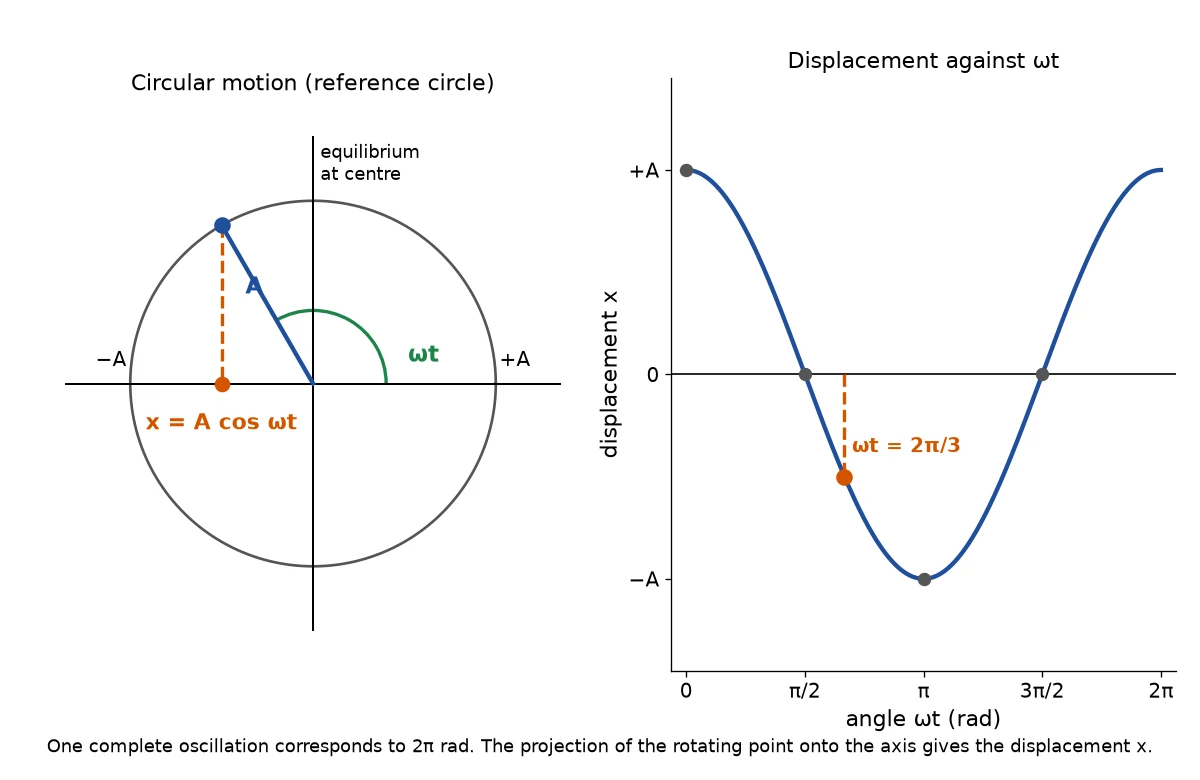
The defining equation of SHM is a = −ω2x: the acceleration is directly proportional to the displacement and in the opposite direction.
1 / 5Next ▶
Equations of SHM
1
Here ω is the angular frequency (rad s
2
−1
3
), ω = 2πf = 2π/T.
4
A solution is the displacement equation: x = A cos ωt (starting at maximum displacement) or x = A sin ωt (starting at equilibrium),
5
where A is the amplitude.
(the maximum and minimum displacements are −A and +A)
6
The two graphs represent the same SHM
the difference is the starting position.
◀ Previous2 / 5Next ▶
Equations of SHM
Equations of SHM
Velocity: v = −Aω sin ωt, and v = ±ω√(A
2
− x
).
The maximum speed vmax = Aω occurs at the equilibrium position (x = 0).
A greater amplitude means a greater distance travelled in the same time and so a greater speed.
◀ Previous3 / 5Next ▶
Equations of SHM
1
The symbol v is velocity
but questions mostly ask for the magnitude.
2
Maximum acceleration a
3
max
4
= ω
5
A occurs at the maximum displacement.
6
Angular frequency is in rad s
◀ Previous4 / 5Next ▶
Reference circle showing a rotating point projected onto the displacement axis, beside a plot of displacement against angle ωt as a cosine curve
Equations of SHM
 ⤢ Enlarge
Equations of SHM
, not degrees (set the calculator to radians), and you often need to convert between T, f and ω.
Worked example: a 55 g mass is suspended from a spring, pulled 4.3 cm down and released at t = 0. It oscillates with period 0.8 s. ω = 2π ÷ 0.8 = 7.85 rad s−1. vmax = Aω = 0.043 × 7.85 = 0.34 m s−1
amax = ω2A = 7.852 × 0.043 = 2.6 m s−2x = 0.043 cos(7.85t) m.
◀ Previous5 / 5
1Period of oscillators and the graphs of SHM2Period of oscillators and the graphs of SHM3Period of oscillators and the graphs of SHM4Period of oscillators and the graphs of SHM
Period of oscillators and the graphs of SHM
Period of oscillators and the graphs of SHM
For a mass m on a spring of constant k: T = 2π√(m/k). For a simple pendulum of length l (small angles): T = 2π√(l/g). In both cases the period is independent of the amplitude. Plotting T2 against m for a spring gives a straight line through the origin with gradient 4π2/k.
What the symbols mean:
T = period (s) · l = length of the pendulum (m) · g = 9.81 m s
−2
The graphs of undamped SHM are always sinusoidal (sine or cosine curves), whatever the starting point.
1
1 / 4Next ▶
Period of oscillators and the graphs of SHM
1
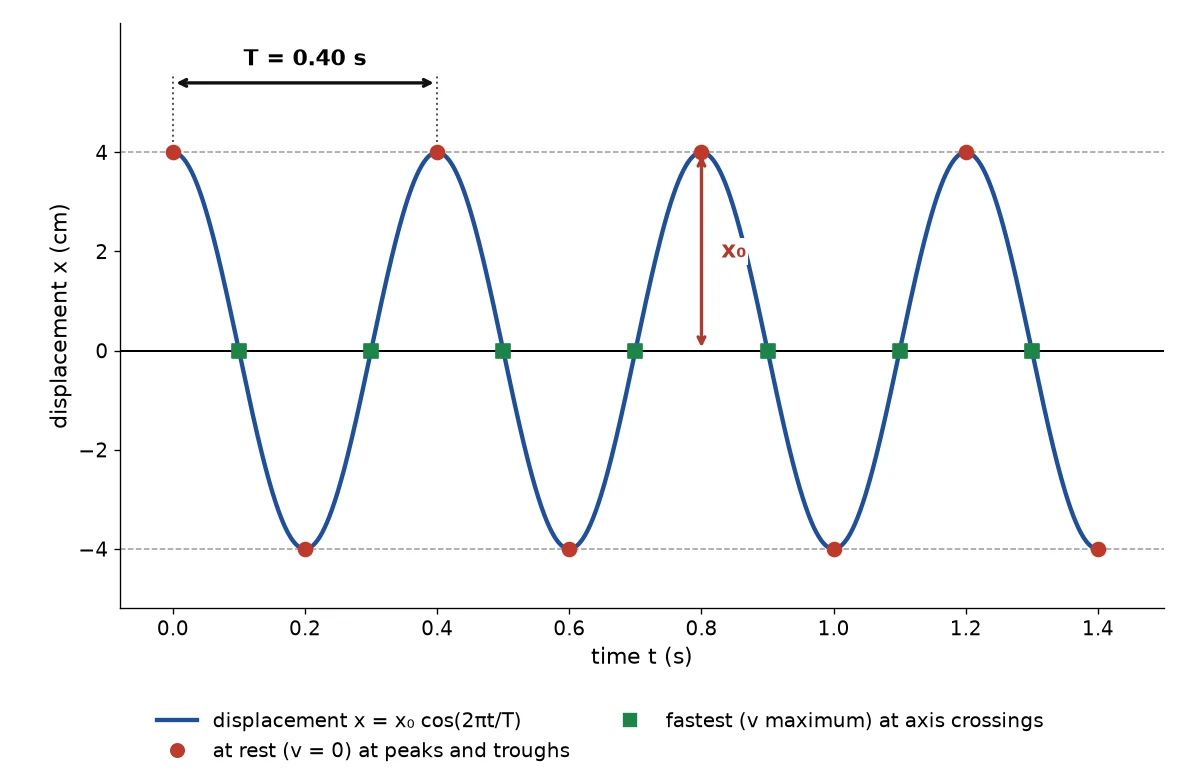
Displacement-time: a cosine or sine curve whose amplitude is A.
2
2
3
Velocity-time: the gradient of the x-t graph
it is a quarter-cycle ahead of displacement (maximum at x = 0, zero at the amplitude).
4
3
5
Acceleration-time: in antiphase with displacement.
6
4
◀ Previous2 / 4Next ▶
Period of oscillators and the graphs of SHM
1
Reading the period from a graph, for example 0.2 s for a swing, gives f = 1/T = 5 Hz.
2
5
3
If you trace the oscillations on paper pulled sideways behind a mass-spring system, you obtain a curved periodic graph that decreases in amplitude because of damping.
4
Energy in SHM: the total energy E = ½mω2A2 remains constant for an undamped oscillator
kinetic energy is maximum at the equilibrium position and potential energy is maximum at the amplitude positions, with continuous exchange between them.
◀ Previous3 / 4Next ▶
Displacement-time graph of a sinusoidal oscillation with amplitude x₀ and period T = 0.40 s, marking rest points at peaks and fastest points at axis crossings
Period of oscillators and the graphs of SHM
◀ Previous4 / 4
1Free and forced oscillations, and damping2Forced oscillations3Light damping · Critical damping · Heavy damping
Free and forced oscillations, and damping
1
Free oscillations occur when there is no transfer of energy to or from the surroundings: the system is displaced and then left to oscillate at its natural frequency f0.
2
Strictly this occurs only in a vacuum
but anything vibrating in air is still treated as a free vibration if no external forces act.
1 / 3Next ▶
Forced oscillations
Forced oscillations
In
forced oscillations
an external periodic driving force with frequency f acts on the system.
Examples: a glass shattering from a high-pitched sound (forced, in resonance) and the interior of a car vibrating at high speed (forced).
Avoid writing ‘a free oscillation is not forced to oscillate’: mark schemes look for reference to internal and external forces and energy transfers.
In practice all oscillators eventually stop: their amplitude decreases because energy is transferred to the surroundings by resistive forces (damping). There are three degrees of damping:
◀ Previous2 / 3Next ▶
Light damping · Critical damping · Heavy damping
Light damping
the oscillator oscillates with gradually decreasing amplitude (the amplitude decreases exponentially, not linearly), e.g. a swinging pendulum.
Critical damping
the system returns to equilibrium in the shortest possible time without oscillating, e.g. car suspension or door closers.
The displacement falls to 0 without passing below.
Heavy damping
no oscillations,
and the displacement returns to zero very slowly: the graph has a slowly decreasing gradient and then a horizontal line at x = 0.
◀ Previous3 / 3
1Resonance and Core Practical 162Resonance3Resonance4Resonance5Resonance6Resonance7Resonance
Resonance and Core Practical 16
Resonance and Core Practical 16
The driving frequency f is the frequency of the applied force.
1 / 7Next ▶
Resonance
1
All oscillating systems have a natural frequency f
2
0
3
.
4
occurs for a forced oscillation when the driving frequency equals the natural frequency
the amplitude is then at its maximum,
5
because energy is transferred from the driver to the system most efficiently.
(the maximum kinetic energy)
◀ Previous2 / 7Next ▶
Resonance
Resonance
If the driving frequency does not quite match, the amplitude increases but not as much.
An organ pipe
where air resonates in a column and sets up a stationary wave, is an example.
A graph of amplitude against driving frequency is a resonance curve.
1
The amplitude rises as f approaches f
and peaks at f = f
◀ Previous3 / 7Next ▶
Resonance
1
2
2
Increased damping lowers the peak, broadens the curve and moves the peak slightly to the left (to a lower frequency than f
3
).
4
3
5
Damping therefore reduces the sharpness of resonance and the amplitude at resonance.
6
4
◀ Previous4 / 7Next ▶
Resonance
Resonance
Damping and amplitude are inversely related.
Core Practical 16 (resonance
finding an unknown mass): use the oscillation time period of known masses on a spring to determine an unknown mass graphically.
Dependent variable: period.
Method: set up the spring with a 100 g mass
mark a fiducial marker about 5 cm below the bottom of the springextend the spring so the bottom is level with the marker, release and time 10 or more oscillations,
then divide for T
repeat for other masses.
With ω = √(k/m) and T = 2π√(m/k), T
◀ Previous5 / 7Next ▶
Resonance
Resonance
= (4π
/k)m
so plot T
against m: a straight line through the origin with gradient 4π
/k.
Measure T for the unknown mass
then read off its mass from the graph.
5
◀ Previous6 / 7Next ▶
Resonance
Resonance
Clamp the stand to the desk and wear safety glasses in case the spring snaps.
◀ Previous7 / 7
1Damping and plastic deformation2Damping and plastic deformation
Damping and plastic deformation
Damping and plastic deformation
Damping can be due to plastic deformation of the material: kinetic energy of the oscillator is transferred to permanent deformation of a ductile material (most metals, particularly copper, gold and silver, are ductile
non-metals are generally not).
1 / 2Next ▶
Damping and plastic deformation
Damping and plastic deformation
A climbing rope is designed to extend when loaded suddenly: it stretches to reduce the amplitude of oscillation when a climber falls onto it,
and provides critical damping by stopping the climber bouncing.
This differs from a rescue rope or a bungee cord
which are designed differently.
In engineering, buildings and bridges use damping (tuned mass dampers) to prevent destructive resonance.
◀ Previous2 / 2
1Worked examples2Worked examples
Worked examples
1
Worked example 1. A mass of 0.40 kg on a spring of k = 25 N m−1 oscillates. Calculate the period. [2]
2
T = 2π√(m/k) = 2π√(0.40/25) = 0.79 s.
3
What the symbols mean:
4
T = period (s) · m = mass on the spring (kg) · k = spring constant (N m
5
−1
6
)
1 / 2Next ▶
Worked examples
Worked examples
Worked example 2. An oscillator has amplitude 3.0 cm and frequency 4.0 Hz. Calculate its maximum speed and maximum acceleration. [3]
ω = 2π × 4.0 = 25.1 rad s−1. vmax = Aω = 0.030 × 25.1 = 0.75 m s−1
amax = ω2A = 25.12 × 0.030 = 19 m s−2.
Worked example 3. Explain what happens to the amplitude at resonance and why. [3]
The amplitude is a maximum when the driving frequency equals the natural frequency
because energy is transferred from the driver to the oscillator most efficiently.
Worked example 4. Describe how critical damping differs from light damping. [2]
Critically damped systems return to equilibrium in the shortest time with no oscillation
lightly damped systems oscillate with gradually decreasing amplitude.
◀ Previous2 / 2
Key terms
| Term | Meaning |
|---|---|
| Simple harmonic motion | Oscillation in which acceleration is proportional to displacement and directed towards equilibrium. |
| Amplitude | Maximum displacement from the equilibrium position. |
| Angular frequency | ω = 2πf, in rad s−1. |
| Natural frequency | Frequency of free oscillation of a system. |
| Resonance | Maximum amplitude when driving frequency equals natural frequency. |
| Critical damping | Damping that returns the system to equilibrium fastest without oscillating. |
| Restoring force | Force that acts towards the equilibrium position. |
| Forced oscillation | Oscillation caused by an external periodic driving force. |
1Avoid these mistakes2Avoid these mistakes
Avoid these mistakes
1Avoid this
Using degrees instead of radians for ωt.Avoid this
2Avoid this
Forgetting the minus sign in a = −ωAvoid this
x.Avoid this
3Avoid this
1 / 2Next ▶
Avoid these mistakes
Saying that the period of a pendulum depends on the mass or amplitude.Avoid this
4Avoid this
Saying heavy damping gives the fastest return to equilibrium (critical damping does).Avoid this
◀ Previous2 / 2