Curriculum
Edexcel A Level Physics 9PH0
1. Working as a Physicist
0/17
-
1. Working as a Physicist
 Text lessonPreview
-
1.1.2 Practical Skills
Text lessonPreview
-
1.1.2 Practical Skills - Check yourself
 6 questionsPreview
-
1.1.3 Estimating Physical Quantities
Text lessonPreview
-
1.1.3 Estimating Physical Quantities - Check yourself
6 questionsPreview
-
1.1.4 Limitations of Measurements
Text lessonPreview
-
1.1.4 Limitations of Measurements - Check yourself
6 questionsPreview
-
1.1.5 Scientific Communication
Text lessonPreview
-
1.1.5 Scientific Communication - Check yourself
6 questionsPreview
-
1.1.6 Applications of Science
Text lessonPreview
-
1.1.6 Applications of Science - Check yourself
6 questionsPreview
-
1.1.7 The Scientific Community
Text lessonPreview
-
1.1.7 The Scientific Community - Check yourself
6 questionsPreview
-
1.1.8 Science and Society
Text lessonPreview
-
1.1.8 Science and Society - Check yourself
6 questionsPreview
-
1.2.1 SI Units
Text lessonPreview
-
1.2.1 SI Units - Check yourself
6 questionsPreview
2. Mechanics
0/43
-
2. Mechanics
Text lessonPreview
-
1.1.1 Equations of Motion
Text lessonPreview
-
1.1.5 Resolving Vectors
Text lessonPreview
-
1.1.5 Resolving Vectors - Check yourself
6 questionsPreview
-
1.2.2 Mass, Weight and Gravitational Field Strength
Text lessonPreview
-
1.2.2 Mass, Weight and Gravitational Field Strength - Check yourself
6 questionsPreview
-
1.2.3 Core Practical 1- Investigating the Acceleration of Freefall
Text lessonPreview
-
1.2.3 Core Practical 1- Investigating the Acceleration of Freefall - Check yourself
6 questionsPreview
-
1.2.4 Newton's Third Law of Motion
Text lessonPreview
-
1.2.4 Newton's Third Law of Motion - Check yourself
6 questionsPreview
-
1.2.5 Momentum
Text lessonPreview
-
1.2.5 Momentum - Check yourself
6 questionsPreview
-
1.2.6 Conservation of Linear Momentum
Text lessonPreview
-
1.2.6 Conservation of Linear Momentum - Check yourself
6 questionsPreview
-
1.3.2 Centre of Gravity and The Principle of Moments
Text lessonPreview
-
1.3.2 Centre of Gravity and The Principle of Moments - Check yourself
6 questionsPreview
-
1.4.1 Scalars and Vectors
Text lessonPreview
-
1.4.1 Scalars and Vectors - Check yourself
6 questionsPreview
-
1.4.1 Work
Text lessonPreview
-
1.4.1 Work - Check yourself
6 questionsPreview
-
2.1.2 Motion Graphs
Text lessonPreview
-
2.1.3 Properties of Motion Graphs
Text lessonPreview
-
2.1.3 Properties of Motion Graphs - Check yourself
6 questionsPreview
-
2.1.6 Finding the Resultant Vector
Text lessonPreview
-
2.1.6 Finding the Resultant Vector - Check yourself
6 questionsPreview
-
2.1.7 Projectiles
Text lessonPreview
-
2.1.7 Projectiles - Check yourself
6 questionsPreview
-
2.1.8 Forces as Vectors
Text lessonPreview
-
2.1.8 Forces as Vectors - Check yourself
6 questionsPreview
-
3.1.2 Force and Acceleration
Text lessonPreview
-
3.1.2 Force and Acceleration - Check yourself
6 questionsPreview
-
4.1.2 Moments
Text lessonPreview
-
4.1.2 Moments - Check yourself
6 questionsPreview
-
5.1.2 The Principle of Conservation of Energy
Text lessonPreview
-
5.1.2 The Principle of Conservation of Energy - Check yourself
6 questionsPreview
-
5.1.3 Efficiency
Text lessonPreview
-
5.1.3 Efficiency - Check yourself
6 questionsPreview
-
5.1.4 Power
Text lessonPreview
-
5.1.4 Power - Check yourself
6 questionsPreview
-
5.2.1 Gravitational Potential Energy
Text lessonPreview
-
5.2.1 Gravitational Potential Energy - Check yourself
6 questionsPreview
-
5.2.2 Kinetic Energy
Text lessonPreview
-
5.2.2 Kinetic Energy - Check yourself
6 questionsPreview
3. Electric Circuits
0/41
-
3. Electric Circuits
Text lessonPreview
-
2.6.4 Charge Conservation in Circuits
Text lessonPreview
-
2.6.4 Charge Conservation in Circuits - Check yourself
6 questionsPreview
-
2.6.5 Energy Conservation in Circuits
Text lessonPreview
-
2.6.5 Energy Conservation in Circuits - Check yourself
6 questionsPreview
-
2.6.6 Resistance in Series and Parallel
Text lessonPreview
-
2.6.6 Resistance in Series and Parallel - Check yourself
6 questionsPreview
-
2.6.8 Current-Potential Difference Graphs
Text lessonPreview
-
2.6.8 Current-Potential Difference Graphs - Check yourself
6 questionsPreview
-
2.7.1 Electrical Resistivity
Text lessonPreview
-
2.7.1 Electrical Resistivity - Check yourself
6 questionsPreview
-
2.7.4 Potential Difference and Conductor Length
Text lessonPreview
-
2.7.4 Potential Difference and Conductor Length - Check yourself
6 questionsPreview
-
2.7.6 Potential Dividers and Variable Resistance
Text lessonPreview
-
2.7.6 Potential Dividers and Variable Resistance - Check yourself
6 questionsPreview
-
2.8.3 E.M.F. vs. Terminal Potential Difference
Text lessonPreview
-
2.8.3 E.M.F. vs. Terminal Potential Difference - Check yourself
6 questionsPreview
-
2.8.5 Resistance and Temperature
Text lessonPreview
-
2.8.5 Resistance and Temperature - Check yourself
6 questionsPreview
-
2.8.6 Resistance and Illumination
Text lessonPreview
-
2.8.6 Resistance and Illumination - Check yourself
6 questionsPreview
-
3.2.2 Core Practical 2- Investigating Resistivity
Text lessonPreview
-
3.2.2 Core Practical 2- Investigating Resistivity - Check yourself
6 questionsPreview
-
3.2.3 Current and Drift Velocity
Text lessonPreview
-
3.2.3 Current and Drift Velocity - Check yourself
6 questionsPreview
-
3.3.4 Core Practical 3- Investigating E.M.F. and Internal Resistance
Text lessonPreview
-
3.3.4 Core Practical 3- Investigating E.M.F. and Internal Resistance - Check yourself
6 questionsPreview
-
9.1.1 Electric Current
Text lessonPreview
-
9.1.1 Electric Current - Check yourself
6 questionsPreview
-
9.2.1 Potential Difference
Text lessonPreview
-
9.2.1 Potential Difference - Check yourself
6 questionsPreview
-
9.2.2 Electrical Power
Text lessonPreview
-
9.2.2 Electrical Power - Check yourself
6 questionsPreview
-
9.3.2 Ohm's Law
Text lessonPreview
-
9.3.2 Ohm's Law - Check yourself
6 questionsPreview
-
10.1.2 Electromotive Force
Text lessonPreview
-
10.1.2 Electromotive Force - Check yourself
6 questionsPreview
-
10.1.3 Internal Resistance
Text lessonPreview
-
10.1.3 Internal Resistance - Check yourself
6 questionsPreview
-
10.3.1 Potential Dividers
Text lessonPreview
-
10.3.1 Potential Dividers - Check yourself
6 questionsPreview
4. Materials
0/22
-
4. Materials
Text lessonPreview
-
1.5.3 Viscous Drag
Text lessonPreview
-
1.5.3 Viscous Drag - Check yourself
6 questionsPreview
-
1.6.2 Stress, Strain and The Young Modulus
Text lessonPreview
-
1.6.2 Stress, Strain and The Young Modulus - Check yourself
6 questionsPreview
-
1.6.3 Force-Extension Graphs
Text lessonPreview
-
1.6.3 Force-Extension Graphs - Check yourself
6 questionsPreview
-
1.6.4 Stress-Strain Graphs
Text lessonPreview
-
1.6.4 Stress-Strain Graphs - Check yourself
6 questionsPreview
-
1.6.6 Elastic Strain Energy
Text lessonPreview
-
1.6.6 Elastic Strain Energy - Check yourself
6 questionsPreview
-
4.1.4 Core Practical 4- Investigating Viscosity
Text lessonPreview
-
4.1.4 Core Practical 4- Investigating Viscosity - Check yourself
6 questionsPreview
-
4.2.5 Core Practical 5- Investigating Young Modulus
Text lessonPreview
-
4.2.5 Core Practical 5- Investigating Young Modulus - Check yourself
6 questionsPreview
-
4.3.1 Density
Text lessonPreview
-
4.3.1 Density - Check yourself
6 questionsPreview
-
4.3.4 Upthrust
Text lessonPreview
-
4.3.4 Upthrust - Check yourself
6 questionsPreview
-
6.1.2 Hooke's Law
Text lessonPreview
-
6.1.2 Hooke's Law - Check yourself
6 questionsPreview
-
4.2.1 Hooke's Law
Text lessonPreview
5. Waves and Particle Nature of Light
0/76
-
5. Waves and Particle Nature of Light
Text lessonPreview
-
2.1.1 Properties of Waves
Text lessonPreview
-
2.1.1 Properties of Waves - Check yourself
6 questionsPreview
-
2.1.3 Longitudinal Waves
Text lessonPreview
-
2.1.3 Longitudinal Waves - Check yourself
6 questionsPreview
-
2.1.4 Transverse Waves
Text lessonPreview
-
2.1.4 Transverse Waves - Check yourself
18 questionsPreview
-
2.1.5 Representing Waves on Graphs
Text lessonPreview
-
2.2.1 Interference and Superposition of Waves
Text lessonPreview
-
2.2.1 Interference and Superposition of Waves - Check yourself
6 questionsPreview
-
2.2.2 Phase and Path Difference
Text lessonPreview
-
2.2.2 Phase and Path Difference - Check yourself
6 questionsPreview
-
2.2.4 Wave Speed on a Stretched String
Text lessonPreview
-
2.2.4 Wave Speed on a Stretched String - Check yourself
6 questionsPreview
-
2.3.1 Equation for the Intensity of Radiation
Text lessonPreview
-
2.3.1 Equation for the Intensity of Radiation - Check yourself
6 questionsPreview
-
2.3.2 Refraction and Refractive Index
Text lessonPreview
-
2.3.2 Refraction and Refractive Index - Check yourself
6 questionsPreview
-
2.3.3 Critical Angle
Text lessonPreview
-
2.3.3 Critical Angle - Check yourself
6 questionsPreview
-
2.3.4 Total Internal Reflection
Text lessonPreview
-
2.3.4 Total Internal Reflection - Check yourself
6 questionsPreview
-
2.3.5 Measuring Refractive Index
Text lessonPreview
-
2.3.5 Measuring Refractive Index - Check yourself
12 questionsPreview
-
2.3.6 Plane Polarisation
Text lessonPreview
-
2.3.6 Plane Polarisation - Check yourself
6 questionsPreview
-
2.4.2 The Diffraction Grating Equation
Text lessonPreview
-
2.4.2 The Diffraction Grating Equation - Check yourself
6 questionsPreview
-
2.4.4 The Wave Nature of Electrons
Text lessonPreview
-
2.4.5 The de Broglie Equation
Text lessonPreview
-
2.4.5 The de Broglie Equation - Check yourself
6 questionsPreview
-
2.4.6 Transmission and Reflection of Waves
Text lessonPreview
-
2.4.6 Transmission and Reflection of Waves - Check yourself
6 questionsPreview
-
2.4.7 Pulse-Echo Technique
Text lessonPreview
-
2.4.7 Pulse-Echo Technique - Check yourself
6 questionsPreview
-
2.4.9 Energy of a Photon
Text lessonPreview
-
2.4.9 Energy of a Photon - Check yourself
6 questionsPreview
-
2.5.1 The Photoelectric Effect
Text lessonPreview
-
2.5.1 The Photoelectric Effect - Check yourself
6 questionsPreview
-
2.5.2 The Photoelectric Equation
Text lessonPreview
-
2.5.2 The Photoelectric Equation - Check yourself
6 questionsPreview
-
2.5.4 The Particle Nature of EM Radiation
Text lessonPreview
-
2.5.4 The Particle Nature of EM Radiation - Check yourself
6 questionsPreview
-
2.5.5 Atomic Line Spectra
Text lessonPreview
-
2.5.5 Atomic Line Spectra - Check yourself
6 questionsPreview
-
5.1.6 Core Practical 6- Investigating the Speed of Sound
Text lessonPreview
-
5.1.6 Core Practical 6- Investigating the Speed of Sound - Check yourself
6 questionsPreview
-
5.2.5 Core Practical 7- Investigating Stationary Waves
Text lessonPreview
-
5.2.5 Core Practical 7- Investigating Stationary Waves - Check yourself
6 questionsPreview
-
5.3.6 Converging and Diverging Lenses
Text lessonPreview
-
5.3.6 Converging and Diverging Lenses - Check yourself
6 questionsPreview
-
5.3.7 Using Ray Diagrams
Text lessonPreview
-
5.3.7 Using Ray Diagrams - Check yourself
6 questionsPreview
-
5.3.8 Power of a Lens
Text lessonPreview
-
5.3.8 Power of a Lens - Check yourself
6 questionsPreview
-
5.3.9 Thin Lenses in Combination
Text lessonPreview
-
5.3.9 Thin Lenses in Combination - Check yourself
6 questionsPreview
-
5.3.10 Real and Virtual Images
Text lessonPreview
-
5.3.10 Real and Virtual Images - Check yourself
6 questionsPreview
-
5.3.11 The Lens Equation
Text lessonPreview
-
5.3.11 The Lens Equation - Check yourself
6 questionsPreview
-
5.3.12 Magnification
Text lessonPreview
-
5.3.12 Magnification - Check yourself
6 questionsPreview
-
5.4.3 Core Practical 8- Investigating Diffraction Gratings
Text lessonPreview
-
5.4.3 Core Practical 8- Investigating Diffraction Gratings - Check yourself
6 questionsPreview
-
7.1.3 The Wave Equation
Text lessonPreview
-
7.1.3 The Wave Equation - Check yourself
6 questionsPreview
-
8.1.2 Stationary Waves
Text lessonPreview
-
8.1.2 Stationary Waves - Check yourself
6 questionsPreview
-
8.2.1 Diffraction
Text lessonPreview
-
8.2.1 Diffraction - Check yourself
6 questionsPreview
-
22.1.3 The Electronvolt
Text lessonPreview
-
22.1.3 The Electronvolt - Check yourself
6 questionsPreview
-
22.3.1 Wave-Particle Duality
Text lessonPreview
-
22.3.1 Wave-Particle Duality - Check yourself
6 questionsPreview
-
5.4.8 Wave-Particle Duality
Text lessonPreview
6. Further Mechanics
0/23
-
6. Further Mechanics
Text lessonPreview
-
3.3.2 Elastic and Inelastic Collisions
Text lessonPreview
-
3.3.2 Elastic and Inelastic Collisions - Check yourself
6 questionsPreview
-
4.1.1 Impulse
Text lessonPreview
-
4.1.1 Impulse - Check yourself
6 questionsPreview
-
4.1.2 Core Practical 9- Investigating Impulse
Text lessonPreview
-
4.1.2 Core Practical 9- Investigating Impulse - Check yourself
6 questionsPreview
-
4.1.3 Applying Conservation of Linear Momentum
Text lessonPreview
-
4.1.3 Applying Conservation of Linear Momentum - Check yourself
12 questionsPreview
-
4.1.4 Core Practical 10- Investigating Collisions using ICT
Text lessonPreview
-
4.1.4 Core Practical 10- Investigating Collisions using ICT - Check yourself
6 questionsPreview
-
4.1.6 Energy-Momentum Relation
Text lessonPreview
-
4.1.6 Energy-Momentum Relation - Check yourself
6 questionsPreview
-
4.2.2 Angular Velocity
Text lessonPreview
-
4.2.4 Maintaining Circular Motion
Text lessonPreview
-
4.2.5 Centripetal Force
Text lessonPreview
-
4.2.5 Centripetal Force - Check yourself
6 questionsPreview
-
12.1.1 Radians and Angular Displacement
Text lessonPreview
-
12.1.1 Radians and Angular Displacement - Check yourself
24 questionsPreview
-
12.2.1 Centripetal Acceleration
Text lessonPreview
-
6.1.5 Elastic and Inelastic Collisions
Text lessonPreview
-
6.2.1 Radians and Angular Displacement
Text lessonPreview
-
6.2.3 Centripetal Acceleration
Text lessonPreview
7. Electric and Magnetic Fields
0/46
-
7. Electric and Magnetic Fields
Text lessonPreview
-
4.3.1 Defining an Electric Field
Text lessonPreview
-
4.3.1 Defining an Electric Field - Check yourself
6 questionsPreview
-
4.3.2 Electric Field Strength
Text lessonPreview
-
4.3.2 Electric Field Strength - Check yourself
6 questionsPreview
-
4.3.3 Electric Force between Two Charges
Text lessonPreview
-
4.3.3 Electric Force between Two Charges - Check yourself
6 questionsPreview
-
4.3.4 Electric Field due to a Point Charge
Text lessonPreview
-
4.3.4 Electric Field due to a Point Charge - Check yourself
6 questionsPreview
-
4.3.5 Electric Field and Potential
Text lessonPreview
-
4.3.5 Electric Field and Potential - Check yourself
6 questionsPreview
-
4.3.7 Electric Potential for a Radial Field
Text lessonPreview
-
4.3.7 Electric Potential for a Radial Field - Check yourself
6 questionsPreview
-
4.3.8 Representing Radial and Uniform Electric Fields
Text lessonPreview
-
4.3.8 Representing Radial and Uniform Electric Fields - Check yourself
6 questionsPreview
-
4.4.2 Energy Stored by a Capacitor
Text lessonPreview
-
4.4.2 Energy Stored by a Capacitor - Check yourself
6 questionsPreview
-
4.4.3 Charge and Discharge Curves
Text lessonPreview
-
4.4.3 Charge and Discharge Curves - Check yourself
6 questionsPreview
-
4.4.4 Core Practical 11- Investigating Capacitor Charge and Discharge
Text lessonPreview
-
4.4.4 Core Practical 11- Investigating Capacitor Charge and Discharge - Check yourself
6 questionsPreview
-
4.4.5 Exponential Discharge in a Capacitor
Text lessonPreview
-
4.4.5 Exponential Discharge in a Capacitor - Check yourself
6 questionsPreview
-
4.5.1 Magnetic Flux Density, Flux and Flux Linkage
Text lessonPreview
-
4.5.1 Magnetic Flux Density, Flux and Flux Linkage - Check yourself
6 questionsPreview
-
4.5.2 Magnetic Force on a Charged Particle
Text lessonPreview
-
4.5.2 Magnetic Force on a Charged Particle - Check yourself
6 questionsPreview
-
4.5.3 Magnetic Force on a Current-Carrying Conductor
Text lessonPreview
-
4.5.3 Magnetic Force on a Current-Carrying Conductor - Check yourself
6 questionsPreview
-
4.5.4 Induced E.M.F in a Moving Coil
Text lessonPreview
-
4.5.4 Induced E.M.F in a Moving Coil - Check yourself
6 questionsPreview
-
4.5.5 Induced E.M.F between Linked Coils
Text lessonPreview
-
4.5.5 Induced E.M.F between Linked Coils - Check yourself
6 questionsPreview
-
7.4.3 Lenz's Law
Text lessonPreview
-
7.4.3 Lenz's Law - Check yourself
6 questionsPreview
-
7.4.4 Faraday's Law
Text lessonPreview
-
7.4.4 Faraday's Law - Check yourself
6 questionsPreview
-
7.4.5 Alternating Currents and Potential Differences
Text lessonPreview
-
7.4.5 Alternating Currents and Potential Differences - Check yourself
6 questionsPreview
-
7.4.6 Root-Mean-Square Current and Potential Difference
Text lessonPreview
-
7.4.6 Root-Mean-Square Current and Potential Difference - Check yourself
6 questionsPreview
-
18.2.1 Electric Field Between Parallel Plates
Text lessonPreview
-
18.2.1 Electric Field Between Parallel Plates - Check yourself
6 questionsPreview
-
19.1.1 Capacitance
Text lessonPreview
-
19.1.1 Capacitance - Check yourself
6 questionsPreview
-
7.1.6 Electric Field between Parallel Plates
Text lessonPreview
8. Nuclear and Particle Physics
0/29
-
8. Nuclear and Particle Physics
Text lessonPreview
-
4.6.2 The Nuclear Model of the Atom
Text lessonPreview
-
4.6.2 The Nuclear Model of the Atom - Check yourself
6 questionsPreview
-
4.6.3 Thermionic Emission
Text lessonPreview
-
4.6.3 Thermionic Emission - Check yourself
6 questionsPreview
-
4.6.4 Particle Accelerators and Detectors
Text lessonPreview
-
4.6.4 Particle Accelerators and Detectors - Check yourself
6 questionsPreview
-
4.6.5 Radius of a Charged Particle in a Magnetic Field
Text lessonPreview
-
4.6.5 Radius of a Charged Particle in a Magnetic Field - Check yourself
6 questionsPreview
-
4.6.6 Interpreting Particle Tracks
Text lessonPreview
-
4.6.6 Interpreting Particle Tracks - Check yourself
6 questionsPreview
-
4.6.7 High Energy Particle Collisions
Text lessonPreview
-
4.6.7 High Energy Particle Collisions - Check yourself
6 questionsPreview
-
4.6.8 Annihilation of Matter and Antimatter
Text lessonPreview
-
4.6.8 Annihilation of Matter and Antimatter - Check yourself
6 questionsPreview
-
4.6.9 Unit Conversions for Energy and Mass
Text lessonPreview
-
4.6.9 Unit Conversions for Energy and Mass - Check yourself
6 questionsPreview
-
4.6.10 Relativistic Situations
Text lessonPreview
-
4.6.10 Relativistic Situations - Check yourself
6 questionsPreview
-
4.7.1 The Standard Model
Text lessonPreview
-
4.7.1 The Standard Model - Check yourself
6 questionsPreview
-
4.7.2 Antimatter
Text lessonPreview
-
4.7.2 Antimatter - Check yourself
6 questionsPreview
-
4.7.3 Conservation Laws in Particle Physics
Text lessonPreview
-
4.7.3 Conservation Laws in Particle Physics - Check yourself
6 questionsPreview
-
4.7.4 Particle Interaction Equations
Text lessonPreview
-
4.7.4 Particle Interaction Equations - Check yourself
6 questionsPreview
-
11.1.3 Nucleon and Proton Number
Text lessonPreview
-
8.1.1 Nucleon and Proton Number
Text lessonPreview
9. Thermodynamics
0/27
-
9. Thermodynamics
Text lessonPreview
-
5.1.1 Specific Heat Capacity and Latent Heat
Text lessonPreview
-
5.1.1 Specific Heat Capacity and Latent Heat - Check yourself
6 questionsPreview
-
5.1.2 Core Practical 12- Calibrating a Thermistor
Text lessonPreview
-
5.1.2 Core Practical 12- Calibrating a Thermistor - Check yourself
6 questionsPreview
-
5.1.3 Core Practical 13- Investigating Specific Latent Heat
Text lessonPreview
-
5.1.3 Core Practical 13- Investigating Specific Latent Heat - Check yourself
6 questionsPreview
-
5.2.2 Temperature and Absolute Zero
Text lessonPreview
-
5.2.4 Core Practical 14- Investigating Gas Pressure and Volume
Text lessonPreview
-
5.2.4 Core Practical 14- Investigating Gas Pressure and Volume - Check yourself
6 questionsPreview
-
5.2.5 Average Molecular Kinetic Energy
Text lessonPreview
-
5.2.5 Average Molecular Kinetic Energy - Check yourself
6 questionsPreview
-
5.8.1 Black Body Radiation
Text lessonPreview
-
5.8.1 Black Body Radiation - Check yourself
6 questionsPreview
-
5.8.2 Stefan-Boltzmann Law
Text lessonPreview
-
5.8.2 Stefan-Boltzmann Law - Check yourself
6 questionsPreview
-
5.8.3 Wien’s Law
Text lessonPreview
-
5.8.3 Wien’s Law - Check yourself
6 questionsPreview
-
9.2.3 Kinetic Theory of Gases Equation
Text lessonPreview
-
9.2.3 Kinetic Theory of Gases Equation - Check yourself
6 questionsPreview
-
15.2.2 Ideal Gas Equation
Text lessonPreview
-
15.2.2 Ideal Gas Equation - Check yourself
12 questionsPreview
-
16.1.1 Internal energy
Text lessonPreview
-
16.1.1 Internal energy - Check yourself
6 questionsPreview
-
9.2.1 Internal Energy
Text lessonPreview
-
9.2.4 Ideal Gas Equation
Text lessonPreview
-
9.3.3 Wien's Law
Text lessonPreview
10. Space
0/17
-
10. Space
Text lessonPreview
-
5.9.1 Inverse Square Law of Flux
Text lessonPreview
-
5.9.1 Inverse Square Law of Flux - Check yourself
6 questionsPreview
-
5.9.2 Parallax
Text lessonPreview
-
5.9.2 Parallax - Check yourself
6 questionsPreview
-
5.9.3 Standard Candles
Text lessonPreview
-
5.9.3 Standard Candles - Check yourself
6 questionsPreview
-
5.9.4 The Hertzsprung-Russell Diagram
Text lessonPreview
-
5.9.4 The Hertzsprung-Russell Diagram - Check yourself
6 questionsPreview
-
5.9.5 The Life Cycle of Stars
Text lessonPreview
-
5.9.5 The Life Cycle of Stars - Check yourself
6 questionsPreview
-
5.10.1 Doppler Shift
Text lessonPreview
-
5.10.1 Doppler Shift - Check yourself
6 questionsPreview
-
5.10.2 Equations for Cosmology
Text lessonPreview
-
5.10.2 Equations for Cosmology - Check yourself
6 questionsPreview
-
5.10.3 Cosmology
Text lessonPreview
-
5.10.3 Cosmology - Check yourself
6 questionsPreview
11. Nuclear Radiation
0/21
-
11. Nuclear Radiation
Text lessonPreview
-
5.3.1 Nuclear Binding Energy and Mass Deficit
Text lessonPreview
-
5.3.1 Nuclear Binding Energy and Mass Deficit - Check yourself
6 questionsPreview
-
5.3.2 Atomic Mass Unit
Text lessonPreview
-
5.3.2 Atomic Mass Unit - Check yourself
6 questionsPreview
-
5.3.3 Binding Energy per Nucleon Graph
Text lessonPreview
-
5.3.3 Binding Energy per Nucleon Graph - Check yourself
6 questionsPreview
-
5.3.4 Nuclear Fusion
Text lessonPreview
-
5.3.4 Nuclear Fusion - Check yourself
6 questionsPreview
-
5.4.1 Background Radiation
Text lessonPreview
-
5.4.1 Background Radiation - Check yourself
6 questionsPreview
-
5.4.2 Alpha, Beta and Gamma Radiation
Text lessonPreview
-
5.4.2 Alpha, Beta and Gamma Radiation - Check yourself
6 questionsPreview
-
5.4.3 Nuclear Decay Equations
Text lessonPreview
-
5.4.3 Nuclear Decay Equations - Check yourself
6 questionsPreview
-
5.4.4 Core Practical 15- Investigating Gamma Radiation Absorption
Text lessonPreview
-
5.4.4 Core Practical 15- Investigating Gamma Radiation Absorption - Check yourself
6 questionsPreview
-
5.4.5 The Random Nature of Nuclear Decay
Text lessonPreview
-
5.4.5 The Random Nature of Nuclear Decay - Check yourself
6 questionsPreview
-
5.4.6 Equations for Nuclear Physics
Text lessonPreview
-
5.4.6 Equations for Nuclear Physics - Check yourself
6 questionsPreview
12. Gravitational Fields
0/16
-
12. Gravitational Fields
Text lessonPreview
-
5.7.3 Newton’s Law of Universal Gravitation
Text lessonPreview
-
5.7.3 Newton’s Law of Universal Gravitation - Check yourself
6 questionsPreview
-
5.7.4 Gravitational Field due to a Point Mass
Text lessonPreview
-
5.7.4 Gravitational Field due to a Point Mass - Check yourself
6 questionsPreview
-
5.7.5 Gravitational Potential for a Radial Field
Text lessonPreview
-
5.7.5 Gravitational Potential for a Radial Field - Check yourself
6 questionsPreview
-
5.7.6 Comparing Electric and Gravitational Fields
Text lessonPreview
-
5.7.6 Comparing Electric and Gravitational Fields - Check yourself
6 questionsPreview
-
5.7.7 Orbital Motion
Text lessonPreview
-
5.7.7 Orbital Motion - Check yourself
6 questionsPreview
-
13.1.1 Gravitational Fields
Text lessonPreview
-
13.1.1 Gravitational Fields - Check yourself
6 questionsPreview
-
13.3.1 Gravitational Field Strength
Text lessonPreview
-
13.3.1 Gravitational Field Strength - Check yourself
6 questionsPreview
-
12.1.3 Newton's Law of Universal Gravitation
Text lessonPreview
13. Oscillations
0/23
-
13. Oscillations
Text lessonPreview
-
5.5.1 Conditions for Simple Harmonic Motion
Text lessonPreview
-
5.5.1 Conditions for Simple Harmonic Motion - Check yourself
6 questionsPreview
-
5.5.2 Equations for Simple Harmonic Motion
Text lessonPreview
-
5.5.2 Equations for Simple Harmonic Motion - Check yourself
6 questionsPreview
-
5.5.3 Period of Simple Harmonic Oscillators
Text lessonPreview
-
5.5.3 Period of Simple Harmonic Oscillators - Check yourself
6 questionsPreview
-
5.5.4 Displacement-Time Graph for an Oscillator
Text lessonPreview
-
5.5.4 Displacement-Time Graph for an Oscillator - Check yourself
6 questionsPreview
-
5.5.5 Velocity-Time Graph for an Oscillator
Text lessonPreview
-
5.5.5 Velocity-Time Graph for an Oscillator - Check yourself
6 questionsPreview
-
5.6.2 Core Practical 16- Investigating Resonance
Text lessonPreview
-
5.6.2 Core Practical 16- Investigating Resonance - Check yourself
6 questionsPreview
-
5.6.3 Damped and Undamped Oscillating Systems
Text lessonPreview
-
5.6.3 Damped and Undamped Oscillating Systems - Check yourself
6 questionsPreview
-
5.6.4 Free and Forced Oscillations
Text lessonPreview
-
5.6.4 Free and Forced Oscillations - Check yourself
6 questionsPreview
-
5.6.5 Resonance Graphs
Text lessonPreview
-
5.6.5 Resonance Graphs - Check yourself
6 questionsPreview
-
5.6.6 Damping and Plastic Deformation
Text lessonPreview
-
5.6.6 Damping and Plastic Deformation - Check yourself
6 questionsPreview
-
17.3.2 Resonance
Text lessonPreview
-
17.3.2 Resonance - Check yourself
6 questionsPreview
Text lesson
1.4.1 Work
1.4.1 Work — EDEXCEL IAL PHYSICS (IAS & A2) notes: Calculate the work done by a force, including forces at an angle and from force–displacement graphs.
1Work done2Equation3Unit4Scalar
Work done
Work done
the amount of energy transferred when an external force moves an object over a distance.
1 / 4Next ▶
Equation
1
W = Fs,
when the force is parallel to the displacement.What the symbols mean: W = work done = energy transferred (J) · F = force (N) · d, s or x = distance moved in the direction of the force (m)
2
W is work done in joules (J).
3
F is the average force in the direction of motion (N).
4
s is the displacement (m).
◀ Previous2 / 4Next ▶
Unit
Unit
1 J is the work done when a force of 1 N moves its point of application 1 m in the direction of the force.
◀ Previous3 / 4Next ▶
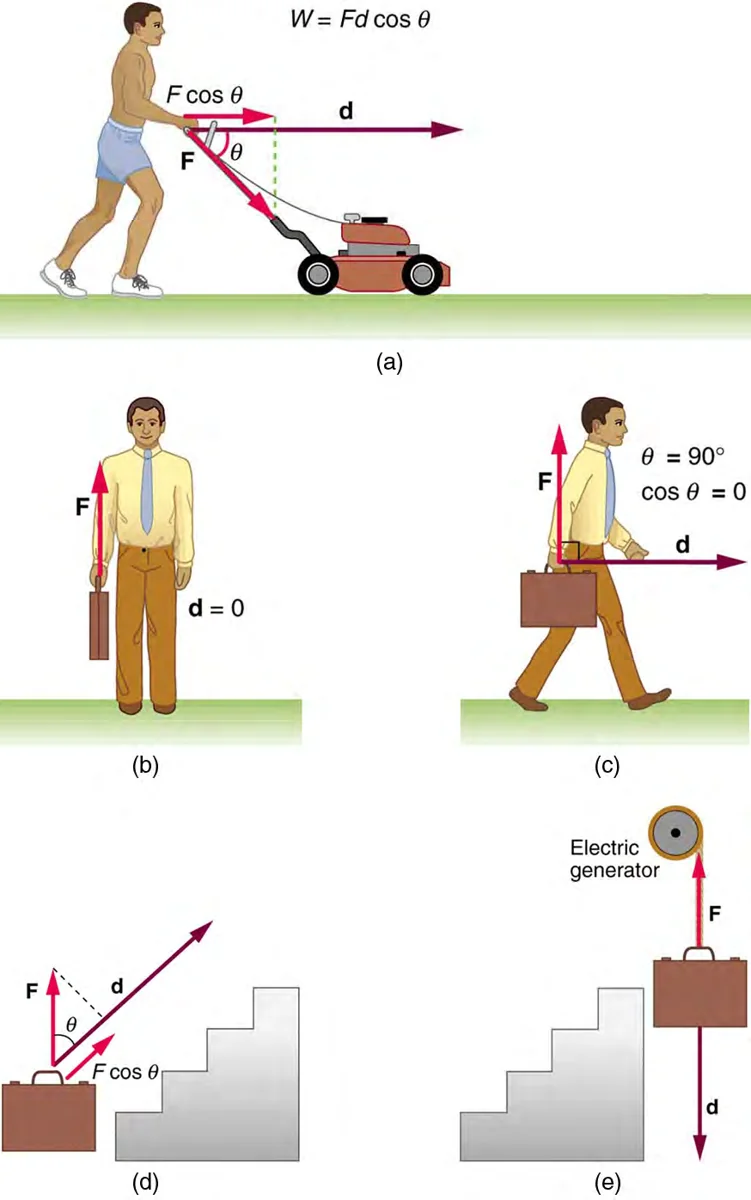
Work by a force: the dot product and the integral: Work depends on the angle between force and displacement, in several example cases.
Scalar
 ⤢ Enlarge
Scalar
work is a scalar quantity.
◀ Previous4 / 4
Force at an angle
1
W = Fs cos θ
where θ is the angle between the force and the displacement.
2
Only the component of force parallel to the motion does work.
3
If the angle is measured from the vertical, the parallel component uses sine instead.
4
Resolve first find the force component along the direction of motion before using W = Fs.
5
Suitcase example pulling a suitcase at 30° above the horizontal does work F s cos 30°.
Special cases of the angle
| Angle | Work done | Meaning |
|---|---|---|
| θ = 0° | W = Fs (maximum) | Force along the motion, e.g. pushing a trolley along the floor. |
| θ = 90° | W = 0 | Force perpendicular to the motion, e.g. a normal reaction or a satellite’s centripetal force. |
| θ = 180° | W = −Fs | Force opposes the motion, e.g. friction, which removes kinetic energy as thermal energy. |
Energy transfer by work
Force along the motion
the object gains energy.
Force opposite to the motion
the object loses energy.
Pushing a block
work is done against friction, and the kinetic energy is transferred to heat and sound.
Work against gravity
lifting a mass m through height h at constant speed does work mgh, stored as gravitational potential energy.
Work–energy relationship · Equation
Work–energy relationship
the work done by the resultant force equals the change in kinetic energy.
Equation
W = ΔEk = 1/2mv2 − 1/2mu2.
It follows from F = ma and v2 = u2 + 2as.
1Area under the graph · Constant force · Spring2Irregular curves · Negative area
Area under the graph · Constant force · Spring
Area under the graph
the work done by the force.
Constant force
the graph is a rectangle with area Fs.
Spring
force rises linearly with extension
giving a triangle of area 1/2Fxwhich is the elastic energy stored.
1 / 2Next ▶
Irregular curves · Negative area
Irregular curves
count squares and multiply by the work value of one square.
Negative area
where the force opposes the displacement it counts as negative work.
◀ Previous2 / 2
1Base units · Larger units2Moment versus work
Base units · Larger units
Base units
1 J = 1 N m = 1 kg m2 s-2.
Larger units
the kilojoule (1000 J) and the kilowatt-hour (3.6 × 10⁶ J).
1 / 2Next ▶
Moment versus work
1
both are in N m
but work is force along the displacement and a moment is a turning effectso only work is quoted in joules.
2
A force can make an object accelerate, and the work it does then transfers energy to the object.
3
An object keeps its kinetic energy unless its speed changes.
4
Pushing or pulling at an angle is common because it avoids bending over to reach the level of the load.
5
On a slope, weight splits into a component along the slope (weight × sin θ) and one at right angles to it (weight × cos θ).
◀ Previous2 / 2
More from the specification
Work Done and Energy Transfer along a Slope
- Work done represents energy transferred when a force acts through a distance (W = F·s·cos θ); pulling an object up an inclined slope or lifting a volume of water converts mechanical work into gravitational potential energy (ΔEp = m·g·h).
Mechanical Power and Rate of Energy Conversion
- Power is defined as the rate at which energy is converted or work is done by a system, measured in watts (W,
- (P = W / t = F·v)
What the symbols mean: P = power (W = J s−1) · W or E = work done / energy transferred (J) · t = time (s) · F = force (N) · v = velocity (m s−1)
- (P = W / t = F·v)
- where 1 W = 1 J·s−1).
Conservation of Energy and System Efficiency
- By the principle of conservation of energy, total input energy in a closed system equals final energy; efficiency is calculated as the ratio of useful output power to total input power,
- which means energy converted to internal thermal energy reduces useful performance.
Gravitational field
- Region where mass experiences gravitational force.
Final speed
- Speed at the end, v
Significant figures
- Digits carrying meaningful information in a number.
Efficiency
- Useful output divided by total input.
Key terms
| Term | Meaning |
|---|---|
| Work done | Energy transferred when a force moves its point of application; W = Fs cos θ. |
| Joule | The unit of work and energy; 1 J = 1 N m. |
| Work–energy relationship | The work done by the resultant force equals the change in kinetic energy. |
| Negative work | Work done by a force that opposes the displacement. |
| Area under a force–displacement graph | The work done by the force. |
1Avoid these mistakes2Avoid these mistakes
Avoid these mistakes
1Avoid this
Using the full force when it acts at an angleonly the component F cos θ along the motion does work.
2Avoid this
Giving work in newtons or wattswork is in joules.
3Avoid this
Counting work done by a force perpendicular to the motionit is zero.
1 / 2Next ▶
Avoid these mistakes
4Avoid this
Forgetting that friction does negative workit removes energy from the object.
◀ Previous2 / 2