Curriculum
Edexcel A Level Physics 9PH0
1. Working as a Physicist
0/17
2. Mechanics
0/43
3. Electric Circuits
0/41
4. Materials
0/22
5. Waves and Particle Nature of Light
0/76
-
5. Waves and Particle Nature of Light
 Preview
-
2.1.1 Properties of Waves
Preview
-
2.1.1 Properties of Waves - Check yourself
 Preview
-
2.1.3 Longitudinal Waves
Preview
-
2.1.3 Longitudinal Waves - Check yourself
Preview
-
2.1.4 Transverse Waves
Preview
-
2.1.4 Transverse Waves - Check yourself
Preview
-
2.1.5 Representing Waves on Graphs
Preview
-
2.2.1 Interference and Superposition of Waves
Preview
-
2.2.1 Interference and Superposition of Waves - Check yourself
Preview
-
2.2.2 Phase and Path Difference
Preview
-
2.2.2 Phase and Path Difference - Check yourself
Preview
-
2.2.4 Wave Speed on a Stretched String
Preview
-
2.2.4 Wave Speed on a Stretched String - Check yourself
Preview
-
2.3.1 Equation for the Intensity of Radiation
Preview
-
2.3.1 Equation for the Intensity of Radiation - Check yourself
Preview
-
2.3.2 Refraction and Refractive Index
Preview
-
2.3.2 Refraction and Refractive Index - Check yourself
Preview
-
2.3.3 Critical Angle
Preview
-
2.3.3 Critical Angle - Check yourself
Preview
-
2.3.4 Total Internal Reflection
Preview
-
2.3.4 Total Internal Reflection - Check yourself
Preview
-
2.3.5 Measuring Refractive Index
Preview
-
2.3.5 Measuring Refractive Index - Check yourself
Preview
-
2.3.6 Plane Polarisation
Preview
-
2.3.6 Plane Polarisation - Check yourself
Preview
-
2.4.2 The Diffraction Grating Equation
Preview
-
2.4.2 The Diffraction Grating Equation - Check yourself
Preview
-
2.4.4 The Wave Nature of Electrons
Preview
-
2.4.5 The de Broglie Equation
Preview
-
2.4.5 The de Broglie Equation - Check yourself
Preview
-
2.4.6 Transmission and Reflection of Waves
Preview
-
2.4.6 Transmission and Reflection of Waves - Check yourself
Preview
-
2.4.7 Pulse-Echo Technique
Preview
-
2.4.7 Pulse-Echo Technique - Check yourself
Preview
-
2.4.9 Energy of a Photon
Preview
-
2.4.9 Energy of a Photon - Check yourself
Preview
-
2.5.1 The Photoelectric Effect
Preview
-
2.5.1 The Photoelectric Effect - Check yourself
Preview
-
2.5.2 The Photoelectric Equation
Preview
-
2.5.2 The Photoelectric Equation - Check yourself
Preview
-
2.5.4 The Particle Nature of EM Radiation
Preview
-
2.5.4 The Particle Nature of EM Radiation - Check yourself
Preview
-
2.5.5 Atomic Line Spectra
Preview
-
2.5.5 Atomic Line Spectra - Check yourself
Preview
-
5.1.6 Core Practical 6- Investigating the Speed of Sound
Preview
-
5.1.6 Core Practical 6- Investigating the Speed of Sound - Check yourself
Preview
-
5.2.5 Core Practical 7- Investigating Stationary Waves
Preview
-
5.2.5 Core Practical 7- Investigating Stationary Waves - Check yourself
Preview
-
5.3.6 Converging and Diverging Lenses
Preview
-
5.3.6 Converging and Diverging Lenses - Check yourself
Preview
-
5.3.7 Using Ray Diagrams
Preview
-
5.3.7 Using Ray Diagrams - Check yourself
Preview
-
5.3.8 Power of a Lens
Preview
-
5.3.8 Power of a Lens - Check yourself
Preview
-
5.3.9 Thin Lenses in Combination
Preview
-
5.3.9 Thin Lenses in Combination - Check yourself
Preview
-
5.3.10 Real and Virtual Images
Preview
-
5.3.10 Real and Virtual Images - Check yourself
Preview
-
5.3.11 The Lens Equation
Preview
-
5.3.11 The Lens Equation - Check yourself
Preview
-
5.3.12 Magnification
Preview
-
5.3.12 Magnification - Check yourself
Preview
-
5.4.3 Core Practical 8- Investigating Diffraction Gratings
Preview
-
5.4.3 Core Practical 8- Investigating Diffraction Gratings - Check yourself
Preview
-
7.1.3 The Wave Equation
Preview
-
7.1.3 The Wave Equation - Check yourself
Preview
-
8.1.2 Stationary Waves
Preview
-
8.1.2 Stationary Waves - Check yourself
Preview
-
8.2.1 Diffraction
Preview
-
8.2.1 Diffraction - Check yourself
Preview
-
22.1.3 The Electronvolt
Preview
-
22.1.3 The Electronvolt - Check yourself
Preview
-
22.3.1 Wave-Particle Duality
Preview
-
22.3.1 Wave-Particle Duality - Check yourself
Preview
-
5.4.8 Wave-Particle Duality
Preview
6. Further Mechanics
0/23
7. Electric and Magnetic Fields
0/46
8. Nuclear and Particle Physics
0/29
9. Thermodynamics
0/27
10. Space
0/17
11. Nuclear Radiation
0/21
12. Gravitational Fields
0/16
13. Oscillations
0/23
Text lesson
2.2.2 Phase and Path Difference
2.2.2 Phase and Path Difference — EDEXCEL IAL PHYSICS (IAS & A2) notes: Use phase difference and path difference to decide whether coherent waves interfere constructively or destructively.
1Phase difference2Phase difference
1Path difference2Path difference
Path difference
Path difference
the difference in distance travelled by two waves from their sources to the point where they meet.
Expression it is generally given in multiples of the wavelength.
Repeat a path difference of one wavelength leaves the waves exactly in step again.
φ = (Δx/λ) × 360°, or φ = 2πΔx/λ in radians.
Δx and λ must be in the same unit.
1 / 2Next ▶
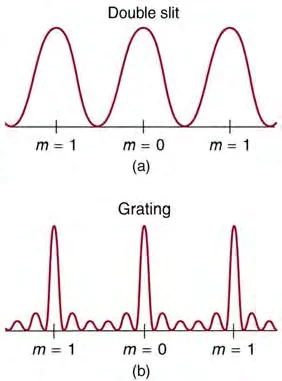
Double-slit interference: Double-slit fringes compared with the much sharper maxima from a grating.
Path difference
◀ Previous2 / 2
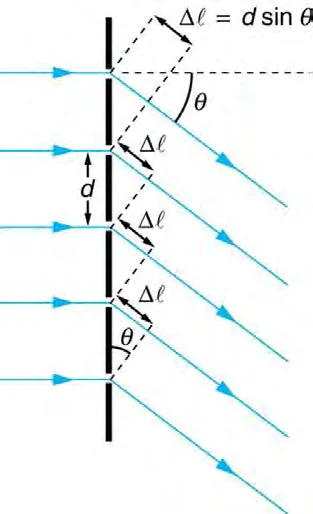
Diffraction gratings: Path difference d sin theta between rays from neighbouring slits of a grating.
Conditions for maxima and minima
 ⤢ Enlarge
Coherent in-phase sources
these conditions apply when the sources emit in phase.
Central line
on the line equidistant from both sources Δx = 0
so the centre is a maximum.
Sources in antiphase
the conditions swap and the centre is a minimum.
| Interference | Path difference | Phase difference |
|---|---|---|
| Constructive | nλ (n = 0, 1, 2, 3 …) | A multiple of 2π |
| Destructive | (n + ½)λ | An odd multiple of π |
1Method · Point P1 example · Point P2 example2Crests
Loudspeakers · Double slit
Loudspeakers
a microphone at distances d1 and d2 gives Δx = |d1 − d2|.
Moving the microphone makes the signal alternate between maxima and minima.
Adjacent minima are one wavelength apart in path difference
so λ and v = fλ can be found.
Double slit
the path difference to a point on the screen is approximately ax/D.
a is the slit separation, x the distance from the central maximum and D the slit-to-screen distance.
Setting ax/D = nλ gives the fringe relationship λ = ax/D.
1Phase along a progressive wave2Phase along a progressive wave
1Checklist for interference at a point2Checklist for interference at a point3Checklist for interference at a point
1
Formation of Stationary Waves
- When two progressive waves of identical frequency, wavelength,
- and speed travel in opposite directions along a stretched string, their continuous superposition creates a stationary (standing) wave.
2
Nodes and Antinodes
- Superposition produces stationary points of zero displacement called nodes and points of maximum displacement called antinodes (constructive interference), spaced at half-wavelength (λ/2) intervals.
- (destructive interference)
3
Wave Speed and String Tension
- The speed of transverse waves on a stretched string depends on tension T and mass per unit length μ according to v = √(T / μ),
- which determines the resonant harmonic frequencies.
4
Harmonics and Phase Difference
- In a vibrating string, all particles located between two consecutive nodes vibrate in phase with the same frequency,
- while particles in adjacent loops vibrate completely in antiphase.
- (π radians out of phase)
5
Formation of Stationary Waves
- When two progressive waves of identical frequency, wavelength,
- and speed travel in opposite directions along a stretched string, their continuous superposition creates a stationary (standing) wave.
6
Nodes and Antinodes
- Superposition produces stationary points of zero displacement called nodes and points of maximum displacement called antinodes (constructive interference), spaced at half-wavelength (λ/2) intervals.
- (destructive interference)
7
Wave Speed and String Tension
- The speed of transverse waves on a stretched string depends on tension T and mass per unit length μ according to v = √(T / μ),
- which determines the resonant harmonic frequencies.
8
Harmonics and Phase Difference
- In a vibrating string, all particles located between two consecutive nodes vibrate in phase with the same frequency,
- while particles in adjacent loops vibrate completely in antiphase.
- (π radians out of phase)
9
Frequency
- Revolutions per second, f = 1/T.
What the symbols mean: T = period, the time for one complete wave (s) · f = frequency (Hz)
10
Stationary
- Not moving.
11
Tension
- Force transmitted along a string or rope.
12
Superposition
- Resultant displacement is the sum of the displacements of the individual waves.
13
Harmonic
- Resonant mode of a stationary wave, with frequency a whole-number multiple of the fundamental where allowed.
14
Antinode
- Point of maximum amplitude on a stationary wave.
15
Amplitude
- Maximum displacement from equilibrium.
16
Vibration
- A repeated backwards and forwards movement.
Key terms
| Term | Meaning |
|---|---|
| Phase difference | The angle between the wave cycles of two points or waves. |
| In phase | A phase difference of 0 or a multiple of 360°. |
| Antiphase | A phase difference of 180° (an odd multiple of π rad). |
| Path difference | The difference in distance travelled by two waves reaching the same point. |
| Coherent | Having the same frequency and a constant phase difference. |
1Avoid these mistakes2Avoid these mistakes