4.1Electricity and Magnetism
Characteristics of living organisms — Question Bank (Cambridge) — Cambridge IGCSE Physics 0625 Revision Notes & Topical Questions
5 min read Lesson 4 of 65 Unit quiz
Cambridge Past Paper Bank
4.1 Characteristics of living organisms
16 Multiple-Choice Questions with Official Mark Schemes
Question 1
0610/12_Spring_2021_Q1
Question 2
0610/23_Summer_2010_Q5
Question 3
0610/23_Summer_2020_Q1
Question 4
0610/21_Summer_2019_Q1
Question 5
0610/22_Winter_2009_Q4
Question 6
0610/23_Winter_2014_Q28
Question 7
0610/23_Winter_2012_Q1
Question 8
0610/23_Summer_2011_Q22
Question 9
0610/21_Summer_2011_Q1
Question 10
0610/22_Winter_2019_Q2
Question 11
0610/13_Winter_2018_Q1
Question 12
0610/22_Spring_2022_Q29
Question 13
0610/23_Winter_2011_Q28
Question 14
0610/22_Spring_2026_Q10
Question 15
0610/12_Summer_2023_Q13
Question 16
0610/23_Winter_2014_Q35
Cambridge Lower Secondary Stage 7
4.1 Characteristics of living organisms – Complete Question Bank & Mark Scheme
Total Questions16 Questions with Verified Solutions & Past Paper Mark Schemes
Multiple Choice Questions (Exam Practice)
Question 1
Paper Ref: 0610/12_Spring_2021_Q1
Paper Ref: 0610/12_Spring_2021_Q1
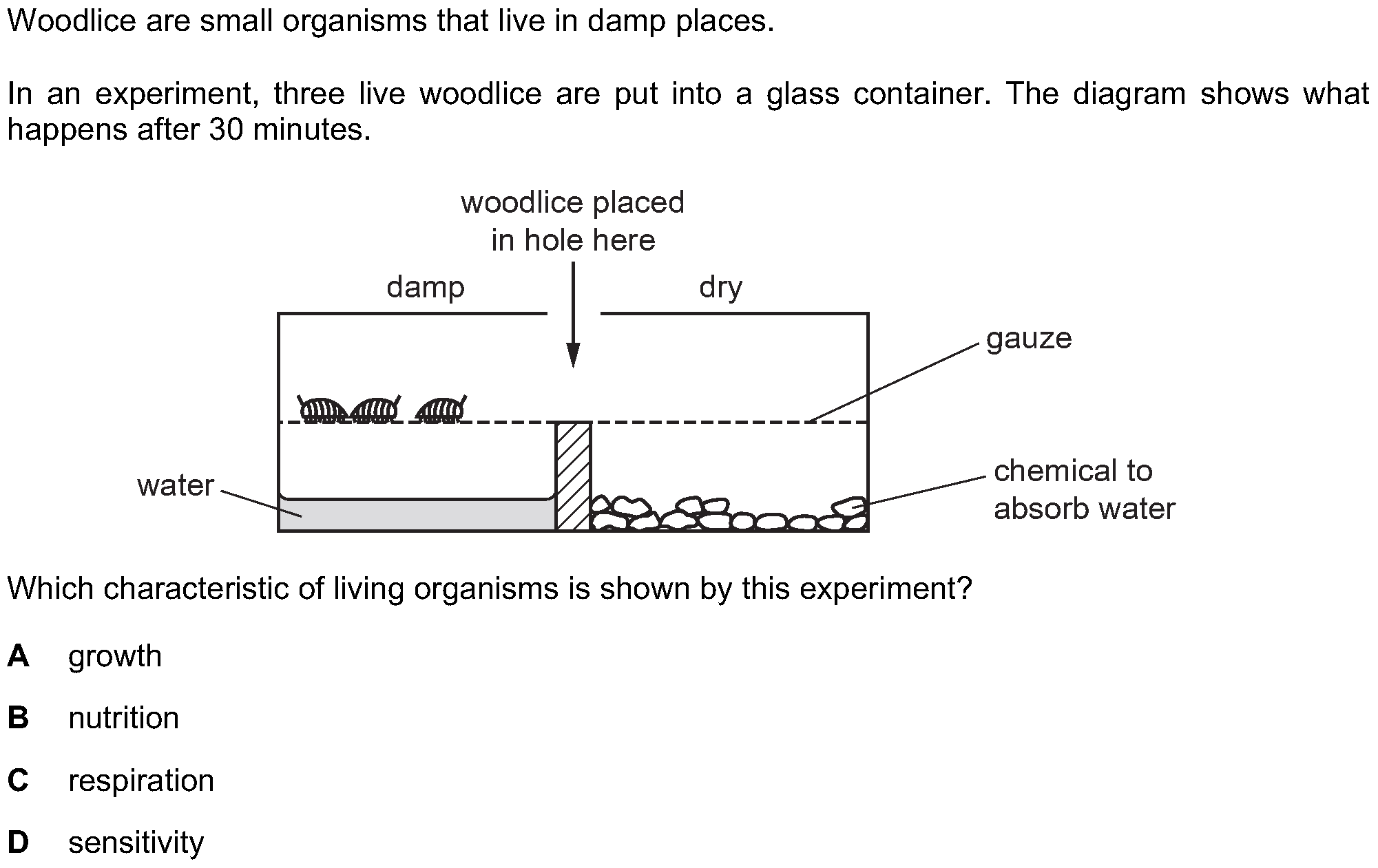
Woodlice are small organisms that live in damp places.
In an experiment, three live woodlice are put into a glass container. The diagram shows what
happens after 30 minutes.
woodlice placed
in hole here
damp dry
gauze
chemical to
absorb water
water
Which characteristic of living organisms is shown by this experiment?
A growth
B nutrition
C_ respiration
D
sensitivity
Options:
A
B
C
D
Correct Key: D
A
B
C
D
Correct Key: D
Question 2
Paper Ref: 0610/23_Summer_2010_Q5
Paper Ref: 0610/23_Summer_2010_Q5
What is defined as the chemical reactions that break down food molecules in cells to release
energy?
excretion
B movement
C nutrition
D respiration
energy?
excretion
B movement
C nutrition
D respiration
Options:
A
B
C
D
Correct Key: D
A
B
C
D
Correct Key: D
Question 3
Paper Ref: 0610/23_Summer_2020_Q1
Paper Ref: 0610/23_Summer_2020_Q1
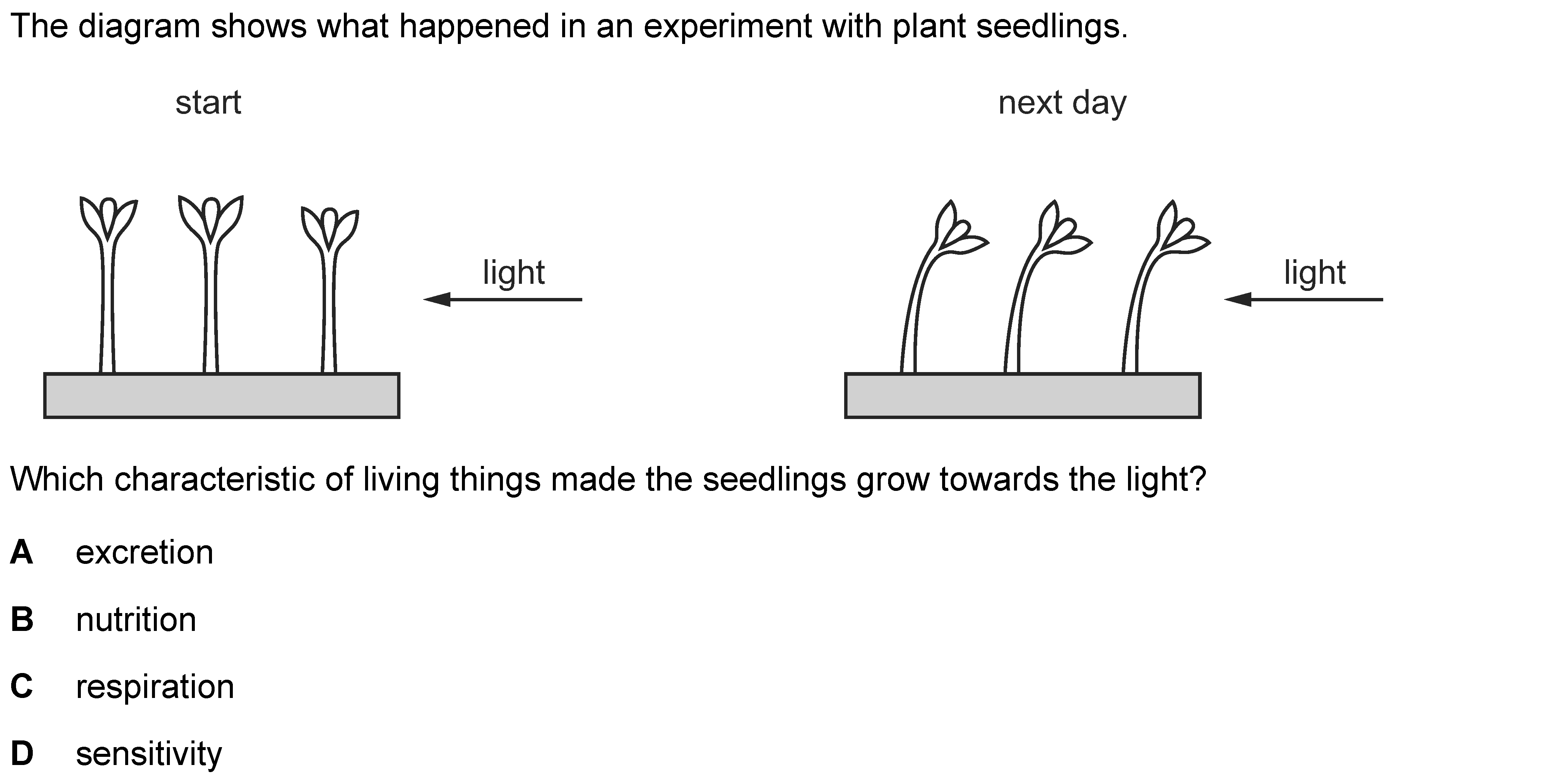
The diagram shows what happened in an experiment with plant seedlings.
start next day
light light
—_—_—_—_ —_—_—_—__
Which characteristic of living things made the seedlings grow towards the light?
A excretion
B nutrition
C respiration
D
sensitivity
start next day
light light
—_—_—_—_ —_—_—_—__
Which characteristic of living things made the seedlings grow towards the light?
A excretion
B nutrition
C respiration
D
sensitivity
Options:
A
B
C
D
Correct Key: D
A
B
C
D
Correct Key: D
Question 4
Paper Ref: 0610/21_Summer_2019_Q1
Paper Ref: 0610/21_Summer_2019_Q1
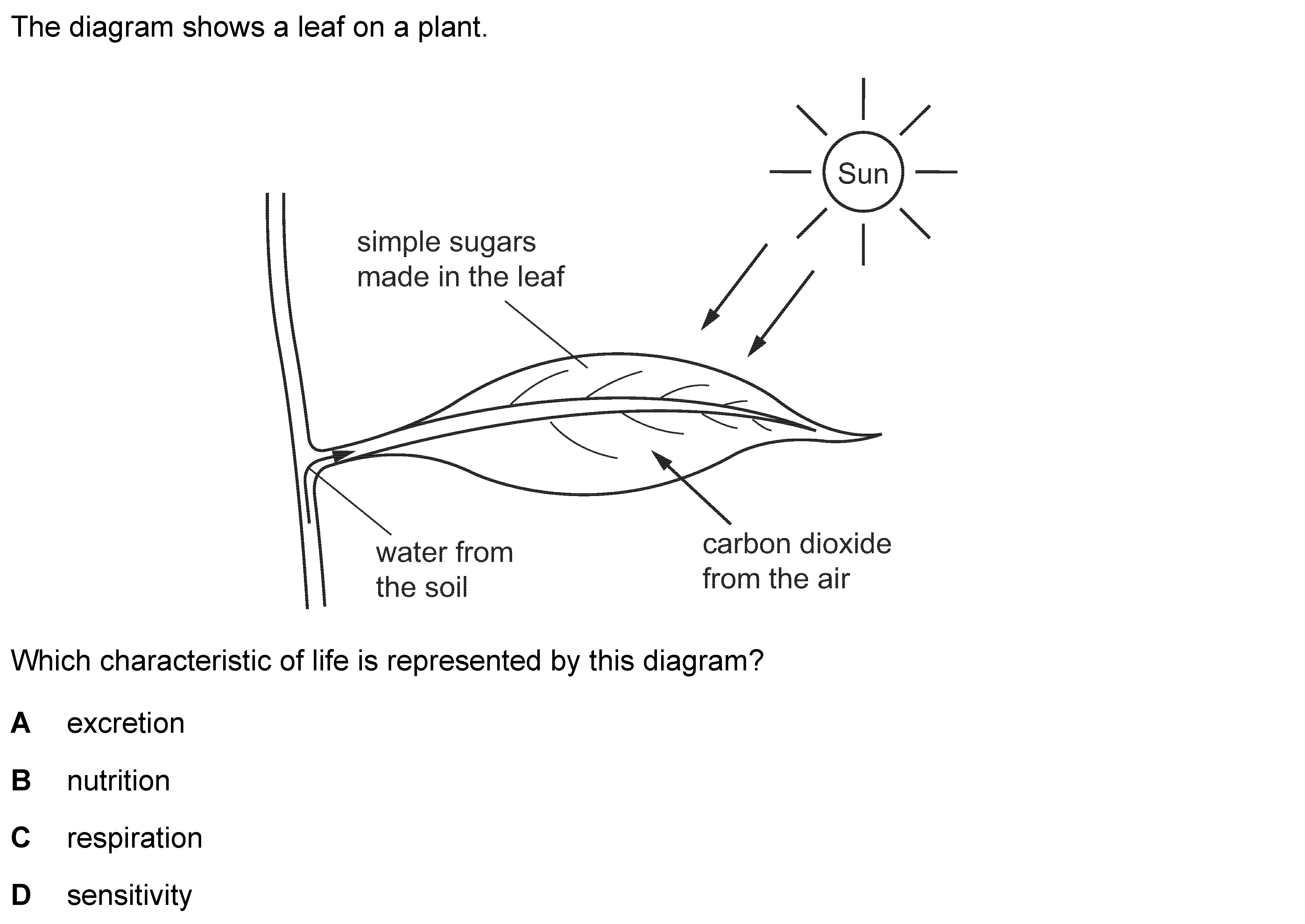
The diagram shows a leaf on a plant.
Which characteristic of life is represented by this diagram?
A
B
C
D
excretion
nutrition
respiration
sensitivity
simple sugars
made in the leaf
water from
the soil
carbon dioxide
from the air
Which characteristic of life is represented by this diagram?
A
B
C
D
excretion
nutrition
respiration
sensitivity
simple sugars
made in the leaf
water from
the soil
carbon dioxide
from the air
Options:
A
B
C
D
Correct Key: B
A
B
C
D
Correct Key: B
Question 5
Paper Ref: 0610/22_Winter_2009_Q4
Paper Ref: 0610/22_Winter_2009_Q4
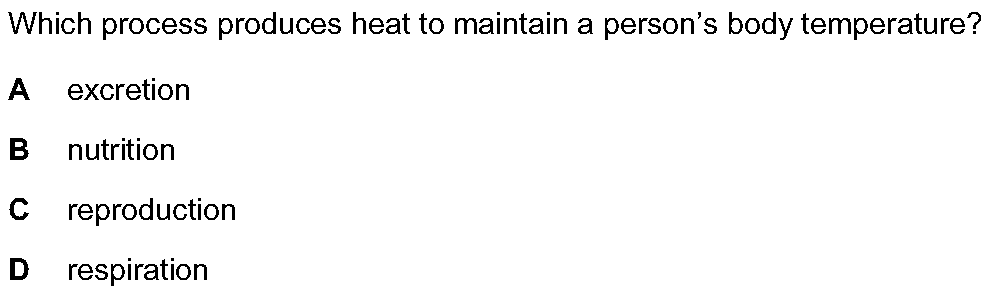
Which process produces heat to maintain a person’s body temperature?
excretion
B nutrition
C reproduction
D respiration
excretion
B nutrition
C reproduction
D respiration
Options:
A
B
C
D
Correct Key: D
A
B
C
D
Correct Key: D
Question 6
Paper Ref: 0610/23_Winter_2014_Q28
Paper Ref: 0610/23_Winter_2014_Q28
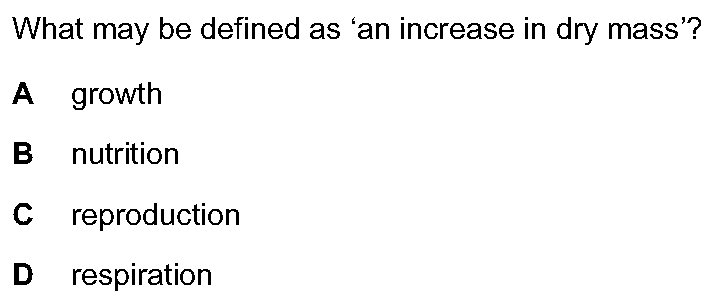
What may be defined as ‘an increase in dry mass’?
growth
B nutrition
C reproduction
D respiration
growth
B nutrition
C reproduction
D respiration
Options:
A
B
C
D
Correct Key: A
A
B
C
D
Correct Key: A
Question 7
Paper Ref: 0610/23_Winter_2012_Q1
Paper Ref: 0610/23_Winter_2012_Q1
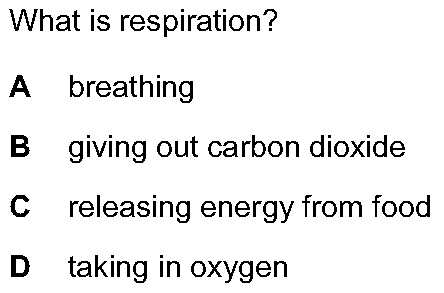
What is respiration?
oo BD
breathing
giving out carbon dioxide
releasing energy from food
taking in oxygen
oo BD
breathing
giving out carbon dioxide
releasing energy from food
taking in oxygen
Options:
A
B
C
D
Correct Key: C
A
B
C
D
Correct Key: C
Question 8
Paper Ref: 0610/23_Summer_2011_Q22
Paper Ref: 0610/23_Summer_2011_Q22
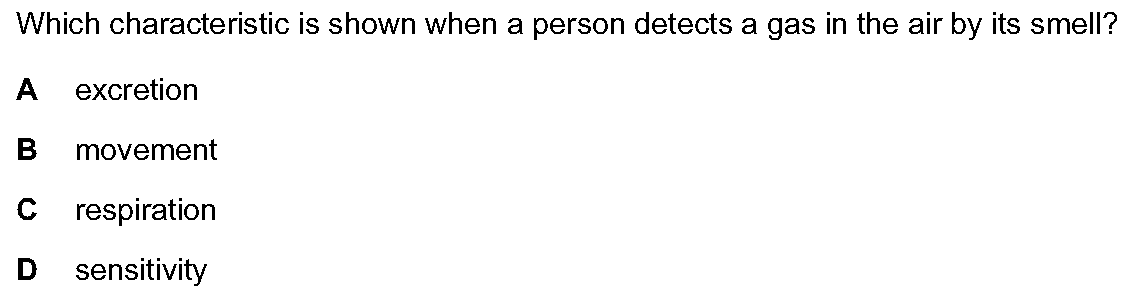
Which characteristic is shown when a person detects a gas in the air by its smell?
excretion
B movement
C_srespiration
D – sensitivity
excretion
B movement
C_srespiration
D – sensitivity
Options:
A
B
C
D
Correct Key: D
A
B
C
D
Correct Key: D
Question 9
Paper Ref: 0610/21_Summer_2011_Q1
Paper Ref: 0610/21_Summer_2011_Q1
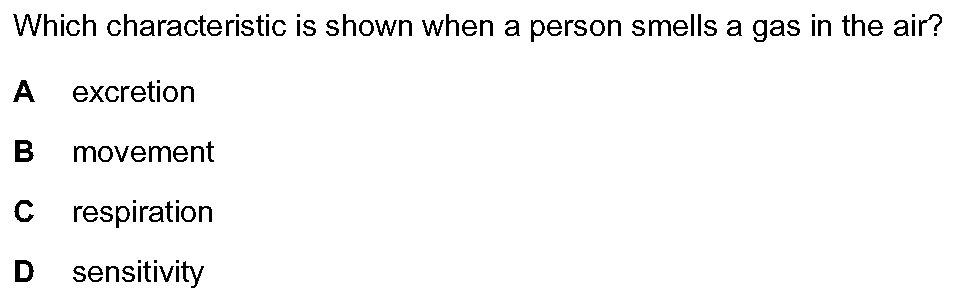
Which characteristic is shown when a person smells a gas in the air?
excretion
B movement
C_srespiration
D – sensitivity
excretion
B movement
C_srespiration
D – sensitivity
Options:
A
B
C
D
Correct Key: D
A
B
C
D
Correct Key: D
Question 10
Paper Ref: 0610/22_Winter_2019_Q2
Paper Ref: 0610/22_Winter_2019_Q2
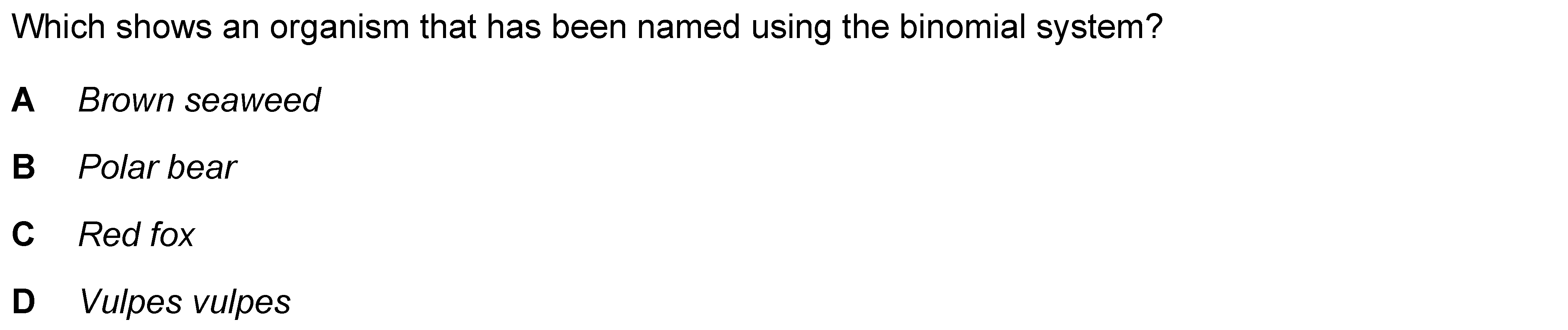
Which shows an organism that has been named using the binomial system?
A Brown seaweed
B Polar bear
C Red fox
D
Vulpes vulpes
A Brown seaweed
B Polar bear
C Red fox
D
Vulpes vulpes
Options:
A
B
C
D
Correct Key: D
A
B
C
D
Correct Key: D
Question 11
Paper Ref: 0610/13_Winter_2018_Q1
Paper Ref: 0610/13_Winter_2018_Q1
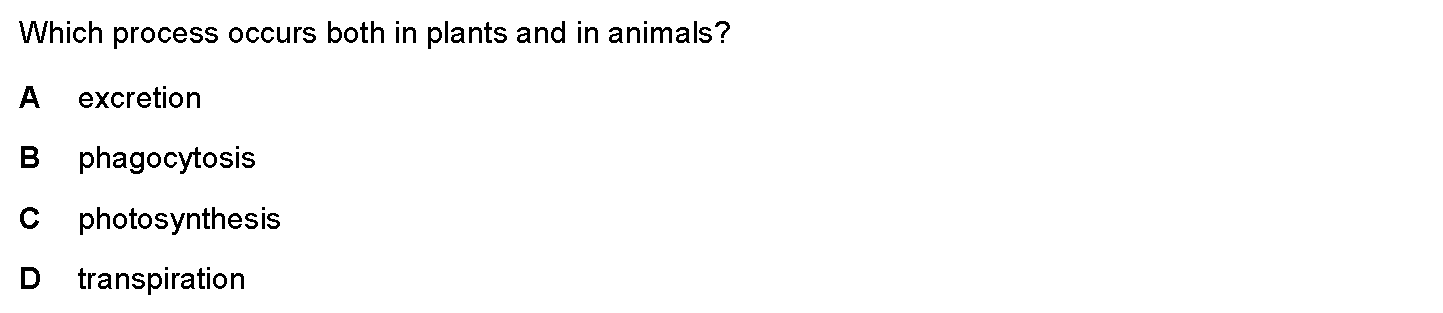
Which process occurs both in plants and in animals?
0 9 DW
excretion
phagocytosis
photosynthesis
transpiration
0 9 DW
excretion
phagocytosis
photosynthesis
transpiration
Options:
A
B
C
D
Correct Key: A
A
B
C
D
Correct Key: A
Question 12
Paper Ref: 0610/22_Spring_2022_Q29
Paper Ref: 0610/22_Spring_2022_Q29
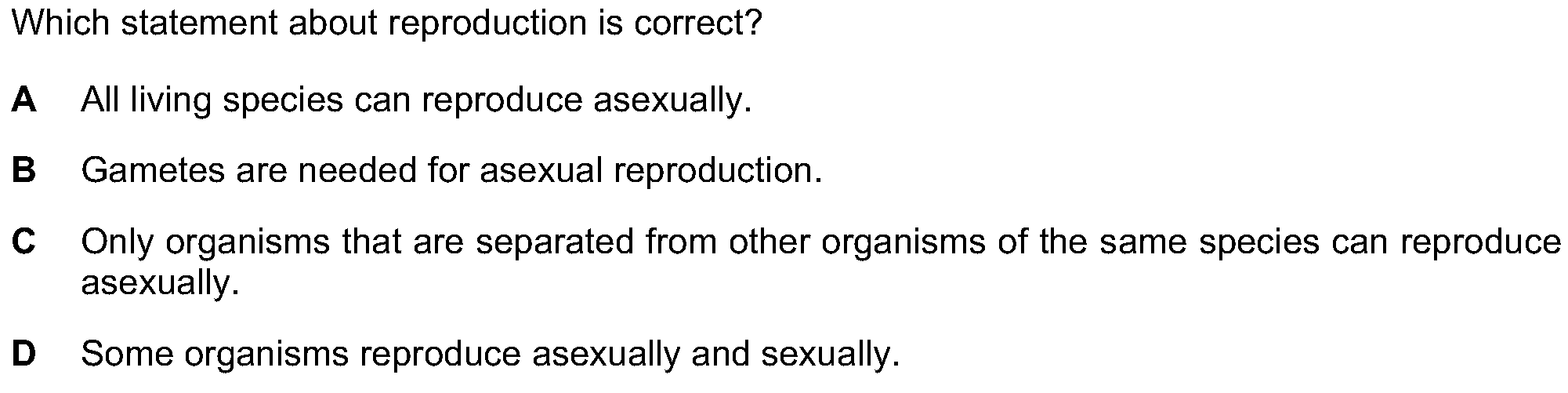
Which statement about reproduction is correct?
A
B
Cc
All living species can reproduce asexually.
Gametes are needed for asexual reproduction.
Only organisms that are separated from other organisms of the same species can reproduce
asexually.
Some organisms reproduce asexually and sexually.
A
B
Cc
All living species can reproduce asexually.
Gametes are needed for asexual reproduction.
Only organisms that are separated from other organisms of the same species can reproduce
asexually.
Some organisms reproduce asexually and sexually.
Options:
A
B
C
D
Correct Key: D
A
B
C
D
Correct Key: D
Question 13
Paper Ref: 0610/23_Winter_2011_Q28
Paper Ref: 0610/23_Winter_2011_Q28
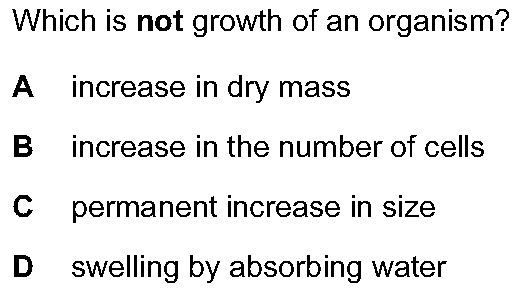
Which is not growth of an organism?
oo BD
increase in dry mass
increase in the number of cells
permanent increase in size
swelling by absorbing water
oo BD
increase in dry mass
increase in the number of cells
permanent increase in size
swelling by absorbing water
Options:
A
B
C
D
Correct Key: D
A
B
C
D
Correct Key: D
Question 14
Paper Ref: 0610/22_Spring_2026_Q10
Paper Ref: 0610/22_Spring_2026_Q10
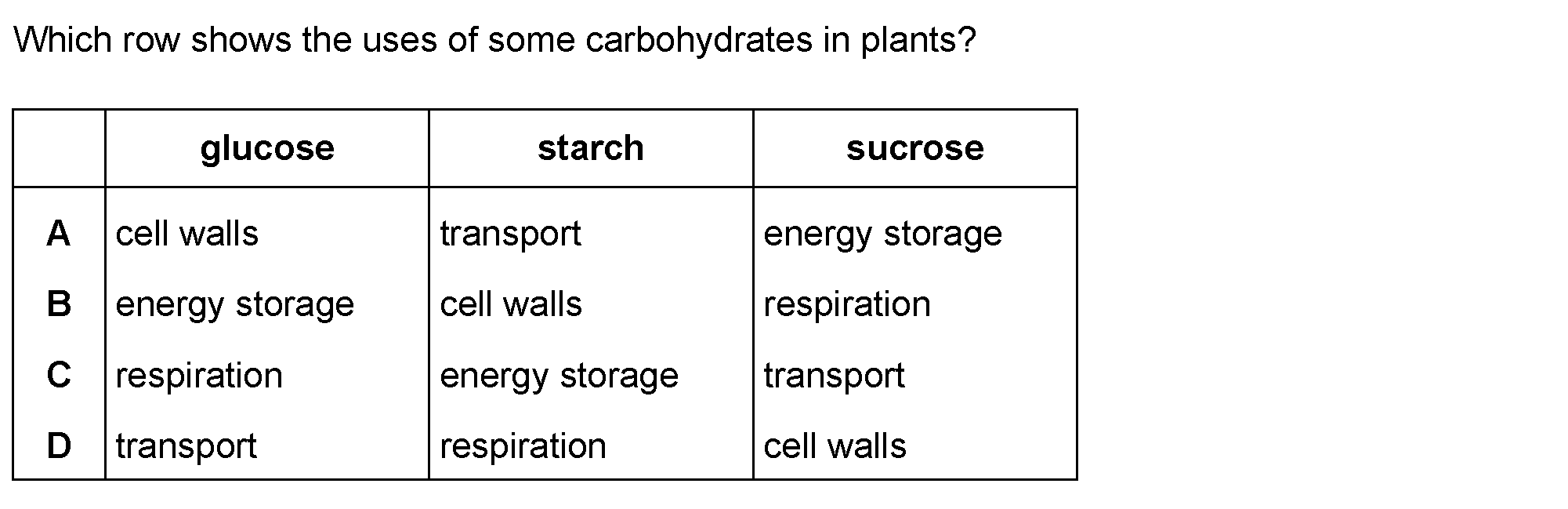
Which row shows the uses of some carbohydrates in plants?
cell walls transport energy storage
energy storage cell walls respiration
respiration energy storage transport
transport respiration cell walls
cell walls transport energy storage
energy storage cell walls respiration
respiration energy storage transport
transport respiration cell walls
Options:
A
B
C
D
Correct Key: C
A
B
C
D
Correct Key: C
Question 15
Paper Ref: 0610/12_Summer_2023_Q13
Paper Ref: 0610/12_Summer_2023_Q13
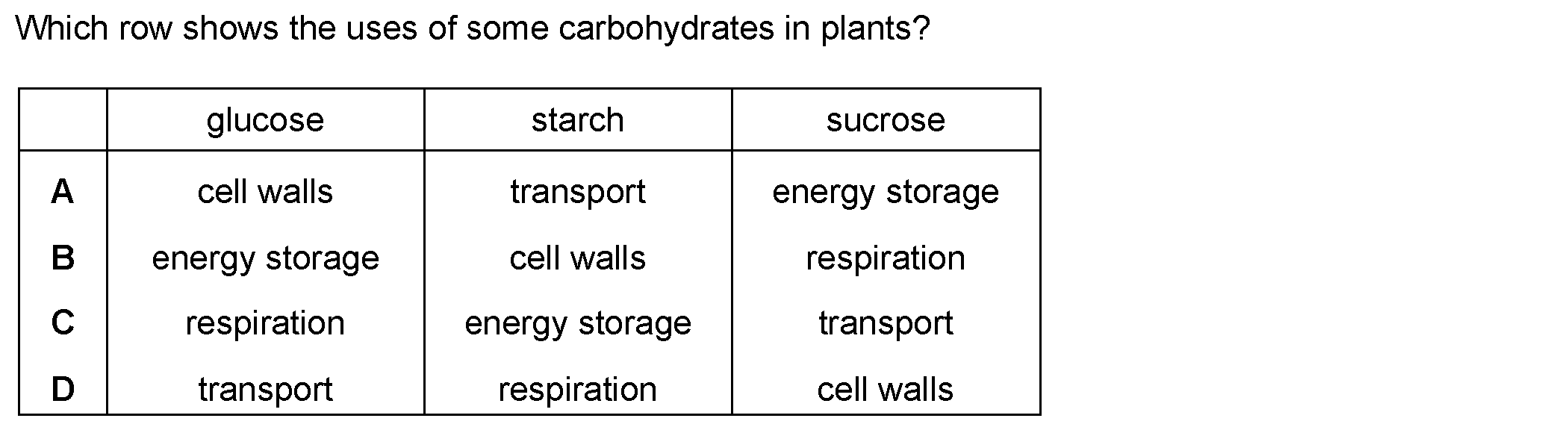
Which row shows the uses of some carbohydrates in plants?
— glucose starch sucrose
cell walls transport energy storage
energy storage cell walls respiration
respiration energy storage transport
transport respiration cell walls
— glucose starch sucrose
cell walls transport energy storage
energy storage cell walls respiration
respiration energy storage transport
transport respiration cell walls
Options:
A
B
C
D
Correct Key: C
A
B
C
D
Correct Key: C
Question 16
Paper Ref: 0610/23_Winter_2014_Q35
Paper Ref: 0610/23_Winter_2014_Q35
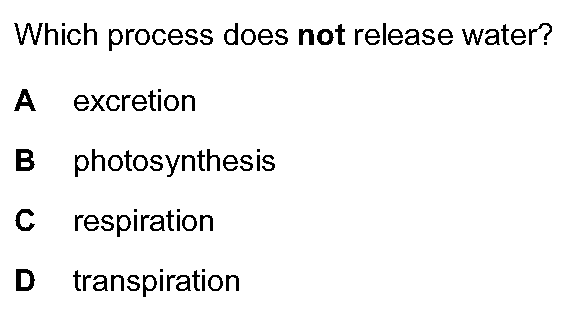
Which process does not release water?
oo BD
excretion
photosynthesis
respiration
transpiration
oo BD
excretion
photosynthesis
respiration
transpiration
Options:
A
B
C
D
Correct Key: B
A
B
C
D
Correct Key: B
Structured Questions Mark Scheme & Answers
•1•.• • • •[•S•P• •S•7• •P•1• • •·• • •Q•8• • •P•a•r•t• •(•a•)• • •·• • •S•p•e•c•i•m•e•n• • •·• • •L•o•w•e•r• •S•e•c• •0•8•9•3•]• • • • • • •a•n•y• •t•w•o• •f•r•o•m• •2• •e•a•c•h• •c•o•r•r•e•c•t• •a•n•s•w•e•r• •=• •1• •m•a•r•k• •(•t•h•e•y• •c•a•n•)• •••c•c•e•p•t• •m•o•v•e• •m•o•v•e•m•e•n•t• •r•e•p•r•o•d•u•c•e• •r•e•p•r•o•d•u•c•t•i•o•n• •s•e•n•s•e• •s•e•n•s•i•t•i•v•i•t•y• •/• •i•r•r•i•t•a•b•i•l•i•t•y• •g•r•o•w• •g•r•o•w•t•h• •r•e•s•p•i•r•e• •r•e•s•p•i•r•a•t•i•o•n• •e•x•c•r•e•t•e• •e•x•c•r•e•t•i•o•n• •e•a•t• •f•o•o•d• •n•u•t•r•i•t•i•o•n•
•2•.• • • •[•S•P• •S•7• •P•1• • •·• • •Q•8• • •P•a•r•t• •(•b•)• • •·• • •S•p•e•c•i•m•e•n• • •·• • •L•o•w•e•r• •S•e•c• •0•8•9•3•]• • • • • • •(•L•i•l•y•)• •2• •e•a•c•h• •c•o•r•r•e•c•t• •a•n•s•w•e•r• •=• •1• •m•a•r•k• •a• •v•i•r•u•s• •c•a•n• •r•e•p•r•o•d•u•c•e• •/• •r•e•p•l•i•c•a•t•e• •(•M•i•a•)• •a• •v•i•r•u•s• •c•a•n•n•o•t• •m•o•v•e• •/• •c•a•n•n•o•t• •g•r•o•w• •/• •c•a•n•n•o•t• •r•e•s•p•i•r•e• •/• •c•a•n•n•o•t• •••c•c•e•p•t• •a• •v•i•r•u•s• •c•a•n• •o•n•l•y• •r•e•p•r•o•d•u•c•e• •i•n•s•i•d•e• •a• •l•i•v•i•n•g• •e•a•t• •f•o•o•d• •/• •c•a•n•n•o•t• •s•e•n•s•e• •/• •c•a•n•n•o•t• •e•x•c•r•e•t•e• •c•e•l•l• •©• •U•C•L•E•S• •2•0•2•0• •P•a•g•e• •9• •o•f• •1•2• •S•7•/•0•1• •S•c•i•e•n•c•e• •S•t•a•g•e• •7• •P•a•p•e•r• •1• •M•a•r•k• •S•c•h•e•m•e• •F•r•o•m• •2•0•2•0•
•3•.• • • •[•P•R•I• •2•0•0•7•B• •P•2• • •·• • •Q•1• • •P•a•r•t• •(•a•)• • •·• • •2•0•0•7• • •·• • •P•r•i•m•a•r•y• •0•8•4•6•]• • • • • • •(•n•o• •p•u•b•l•i•s•h•e•d• •m•a•r•k• •s•c•h•e•m•e• •f•o•r• •t•h•i•s• •p•a•p•e•r•)•
•4•.• • • •[•P•R•I• •2•0•0•7•B• •P•2• • •·• • •Q•1• • •P•a•r•t• •(•b•)• • •·• • •2•0•0•7• • •·• • •P•r•i•m•a•r•y• •0•8•4•6•]• • • • • • •(•n•o• •p•u•b•l•i•s•h•e•d• •m•a•r•k• •s•c•h•e•m•e• •f•o•r• •t•h•i•s• •p•a•p•e•r•)•
•5•.• • • •[•P•R•I• •2•0•0•7•B• •P•2• • •·• • •Q•1• • •P•a•r•t• •(•c•)• • •·• • •2•0•0•7• • •·• • •P•r•i•m•a•r•y• •0•8•4•6•]• • • • • • •(•n•o• •p•u•b•l•i•s•h•e•d• •m•a•r•k• •s•c•h•e•m•e• •f•o•r• •t•h•i•s• •p•a•p•e•r•)•
•6•.• • • •[•P•R•I• •2•0•0•7•B• •P•2• • •·• • •Q•4• • •P•a•r•t• •(•a•)• • •·• • •2•0•0•7• • •·• • •P•r•i•m•a•r•y• •0•8•4•6•]• • • • • • •(•n•o• •p•u•b•l•i•s•h•e•d• •m•a•r•k• •s•c•h•e•m•e• •f•o•r• •t•h•i•s• •p•a•p•e•r•)•
•7•.• • • •[•P•R•I• •2•0•0•7•B• •P•2• • •·• • •Q•4• • •P•a•r•t• •(•b•)• • •·• • •2•0•0•7• • •·• • •P•r•i•m•a•r•y• •0•8•4•6•]• • • • • • •(•n•o• •p•u•b•l•i•s•h•e•d• •m•a•r•k• •s•c•h•e•m•e• •f•o•r• •t•h•i•s• •p•a•p•e•r•)•
•8•.• • • •[•P•R•I• •2•0•0•7•C• •P•1• • •·• • •Q•5• • •P•a•r•t• •(•c•)• • •·• • •2•0•0•7• • •·• • •P•r•i•m•a•r•y• •0•8•4•6•]• • • • • • •(•n•o• •p•u•b•l•i•s•h•e•d• •m•a•r•k• •s•c•h•e•m•e• •f•o•r• •t•h•i•s• •p•a•p•e•r•)•
Last updated:
\n