5.6Electricity and Magnetism
Indicators and the pH scale — Question Bank (Cambridge) — Cambridge IGCSE Physics 0625 Revision Notes & Topical Questions
10 min read Lesson 65 of 65 Unit quiz
Curriculum Equation Key pH & Acid-Base Equilibrium FormulasFast Exam Solution
pH = -log[H⁺] | pOH = -log[OH⁻] | pH + pOH = 14 | [H⁺][OH⁻] = 10⁻¹⁴
Word Equation & Conditions: pH + pOH = 14
Cambridge Past Paper Bank
5.6 Indicators and the pH scale
9 Multiple-Choice Questions with Official Mark Schemes
Question 1
0620/21_Summer_2026_Q19
Question 2
0620/12_Spring_2021_Q18
Question 3
0620/23_Summer_2014_Q21
Question 4
0620/21_Summer_2014_Q20
Question 5
5129/11_Winter_2020_Q19
Question 6
0620/11_Summer_2025_Q18
Question 7
0620/23_Summer_2014_Q25
Question 8
5129/12_Winter_2021_Q19
Question 9
0620/23_Summer_2015_Q16
Cambridge Lower Secondary Stage 7
5.6 Indicators and the pH scale – Complete Question Bank & Mark Scheme
Total Questions9 Questions with Verified Solutions & Past Paper Mark Schemes
Multiple Choice Questions (Exam Practice)
Question 1
Paper Ref: 0620/21_Summer_2026_Q19
Paper Ref: 0620/21_Summer_2026_Q19
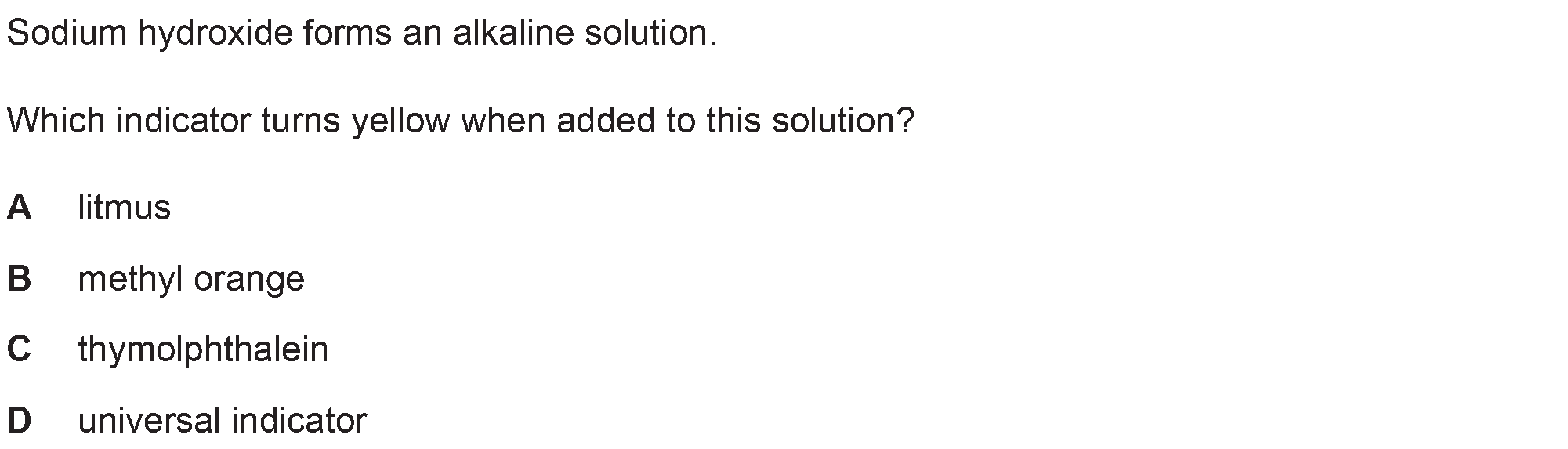
Sodium hydroxide forms an alkaline solution.
Which indicator turns yellow when added to this solution?
A litmus
B- methyl orange
>)
thymolphthalein
D_ universal indicator
Which indicator turns yellow when added to this solution?
A litmus
B- methyl orange
>)
thymolphthalein
D_ universal indicator
Options:
A
B
C
D
Correct Key: B
A
B
C
D
Correct Key: B
Question 2
Paper Ref: 0620/12_Spring_2021_Q18
Paper Ref: 0620/12_Spring_2021_Q18
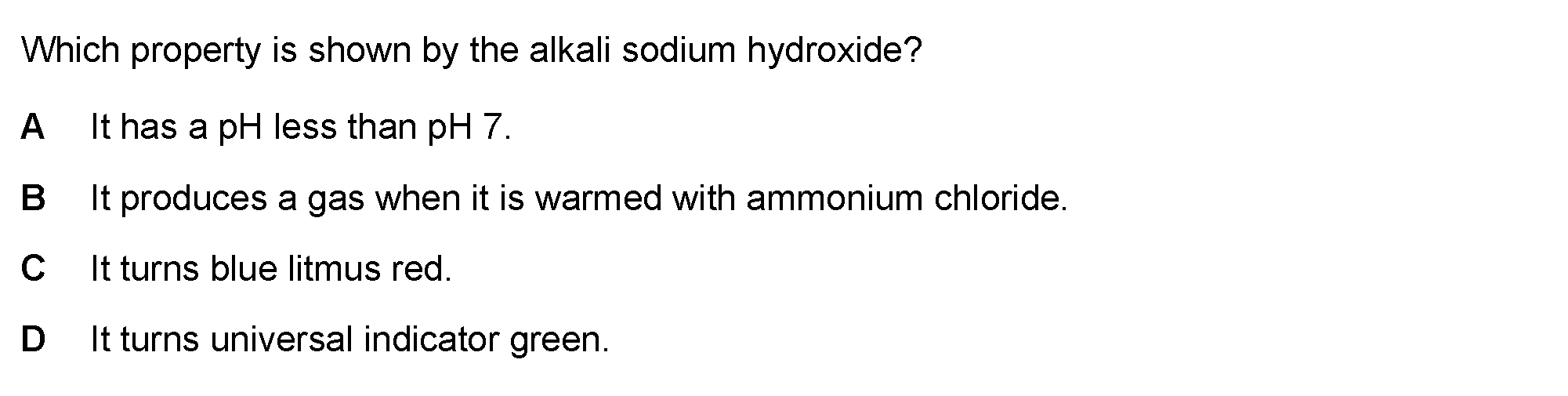
Which property is shown by the alkali sodium hydroxide?
A
B
Cc
D
It has a pH less than pH 7.
It produces a gas when it is warmed with ammonium chloride.
It turns blue litmus red.
It turns universal indicator green.
A
B
Cc
D
It has a pH less than pH 7.
It produces a gas when it is warmed with ammonium chloride.
It turns blue litmus red.
It turns universal indicator green.
Options:
A
B
C
D
Correct Key: B
A
B
C
D
Correct Key: B
Question 3
Paper Ref: 0620/23_Summer_2014_Q21
Paper Ref: 0620/23_Summer_2014_Q21
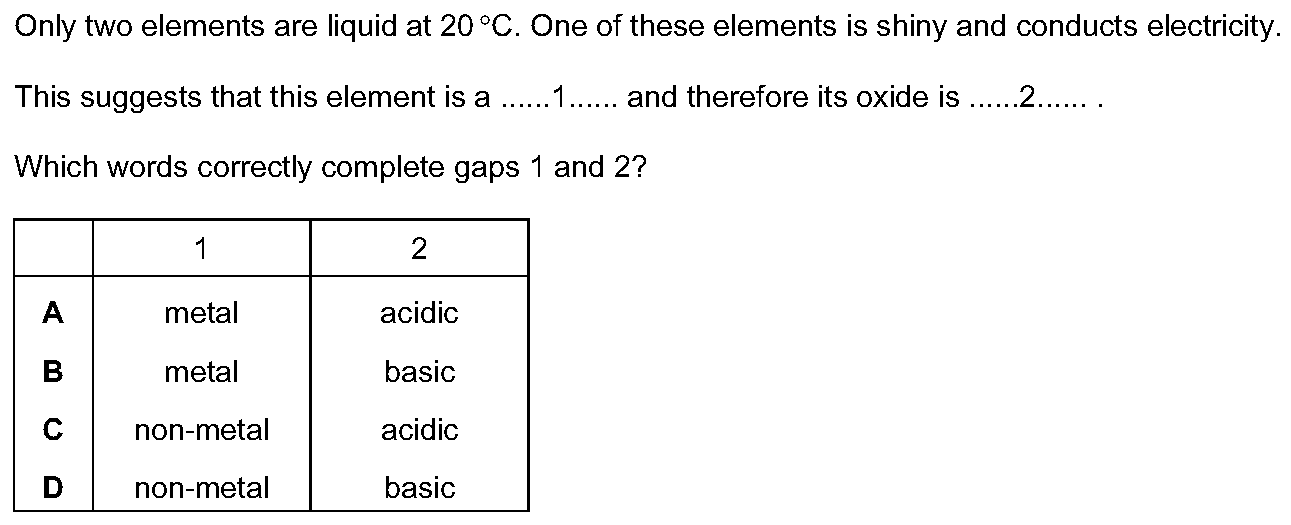
Only two elements are liquid at 20°C. One of these elements is shiny and conducts electricity.
This suggests that this element is a …… Vee and therefore its oxide is …… Qo.
Which words correctly complete gaps 1 and 2?
1 2
A metal acidic
B metal basic
Cc non-metal acidic
D non-metal basic
This suggests that this element is a …… Vee and therefore its oxide is …… Qo.
Which words correctly complete gaps 1 and 2?
1 2
A metal acidic
B metal basic
Cc non-metal acidic
D non-metal basic
Options:
A
B
C
D
Correct Key: B
A
B
C
D
Correct Key: B
Question 4
Paper Ref: 0620/21_Summer_2014_Q20
Paper Ref: 0620/21_Summer_2014_Q20
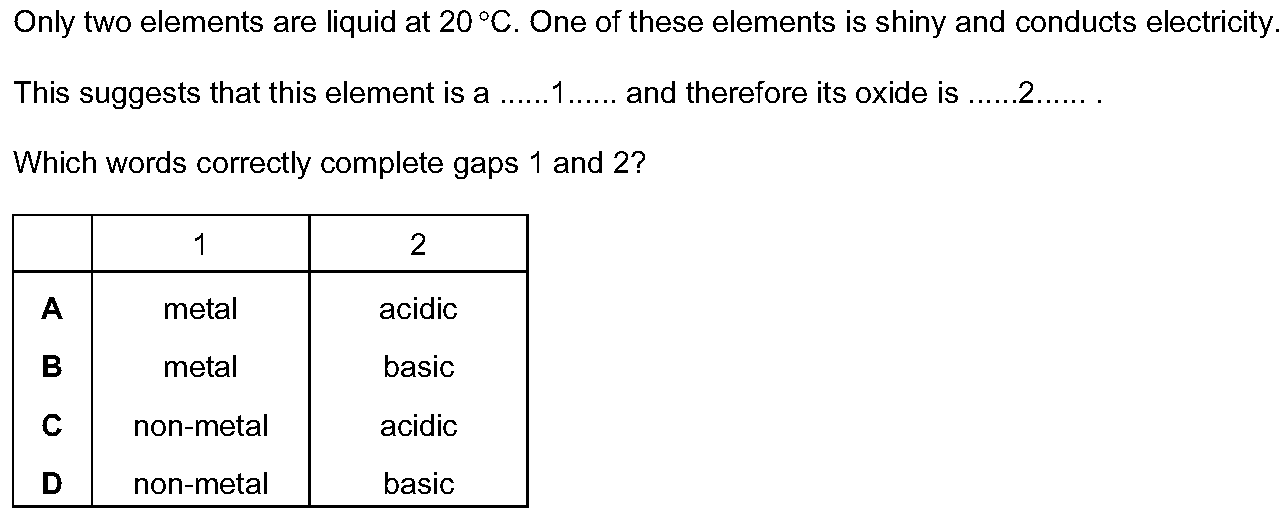
Only two elements are liquid at 20°C. One of these elements is shiny and conducts electricity.
This suggests that this element is a …… Vee and therefore its oxide is …… Qo.
Which words correctly complete gaps 1 and 2?
metal acidic
metal basic
non-metal acidic
non-metal basic
This suggests that this element is a …… Vee and therefore its oxide is …… Qo.
Which words correctly complete gaps 1 and 2?
metal acidic
metal basic
non-metal acidic
non-metal basic
Options:
A
B
C
D
Correct Key: B
A
B
C
D
Correct Key: B
Question 5
Paper Ref: 5129/11_Winter_2020_Q19
Paper Ref: 5129/11_Winter_2020_Q19
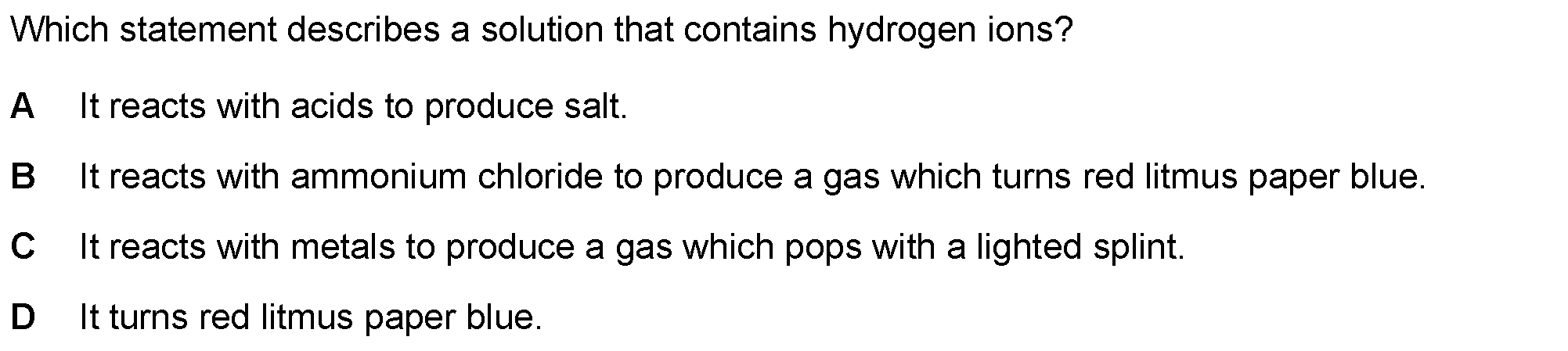
Which statement describes a solution that contains hydrogen ions?
A
B
Cc
D
It reacts with acids to produce salt.
It reacts with ammonium chloride to produce a gas which turns red litmus paper blue.
It reacts with metals to produce a gas which pops with a lighted splint.
It turns red litmus paper blue.
A
B
Cc
D
It reacts with acids to produce salt.
It reacts with ammonium chloride to produce a gas which turns red litmus paper blue.
It reacts with metals to produce a gas which pops with a lighted splint.
It turns red litmus paper blue.
Options:
A
B
C
D
Correct Key: C
A
B
C
D
Correct Key: C
Question 6
Paper Ref: 0620/11_Summer_2025_Q18
Paper Ref: 0620/11_Summer_2025_Q18
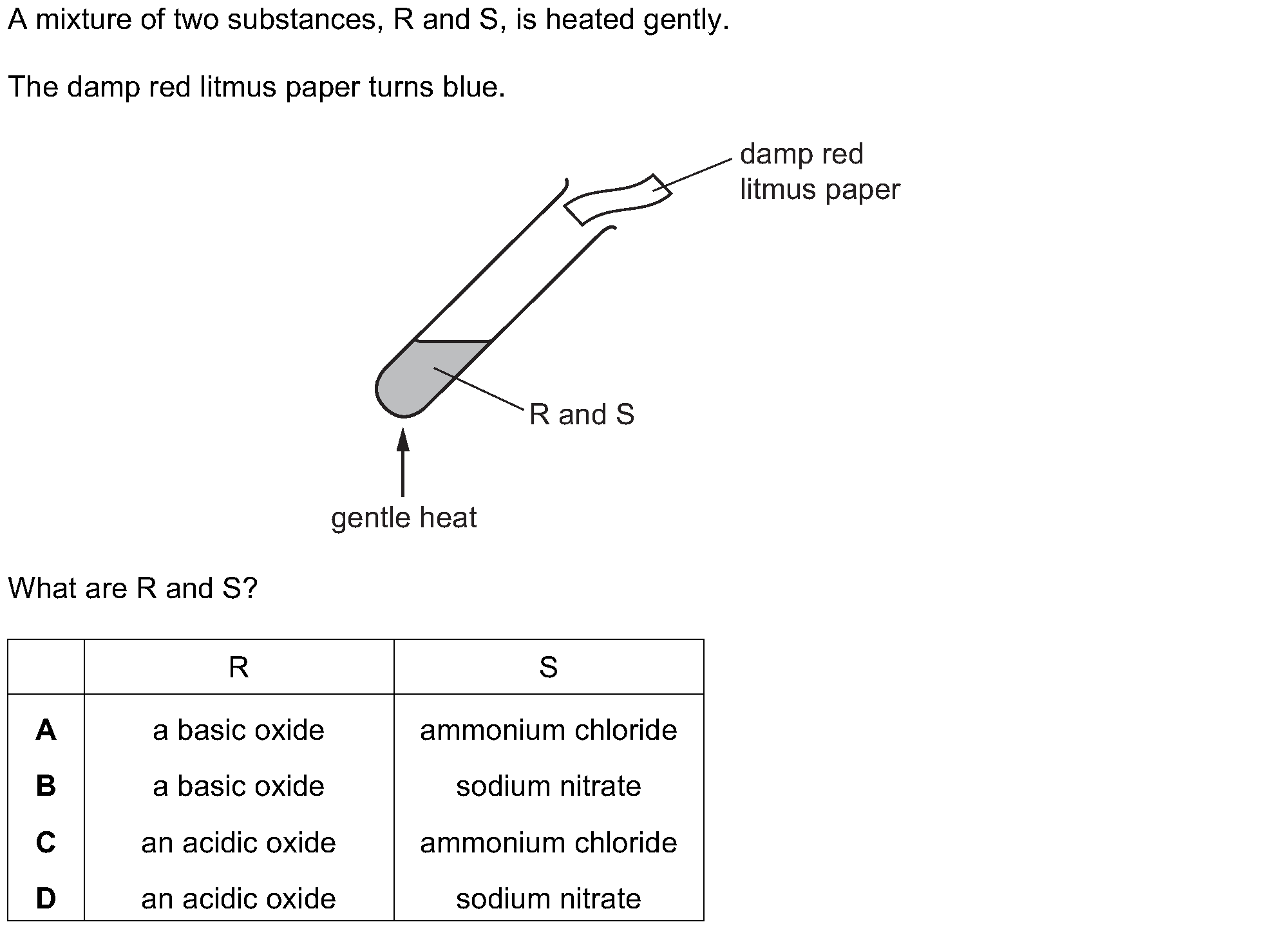
A mixture of two substances, R and §S, is heated gently.
The damp red litmus paper turns blue.
damp red
ae litmus paper
Rands
gentle heat
What are R and S?
R Ss
A basic oxide ammonium chloride
B a basic oxide sodium nitrate
Cc an acidic oxide ammonium chloride
D an acidic oxide sodium nitrate
The damp red litmus paper turns blue.
damp red
ae litmus paper
Rands
gentle heat
What are R and S?
R Ss
A basic oxide ammonium chloride
B a basic oxide sodium nitrate
Cc an acidic oxide ammonium chloride
D an acidic oxide sodium nitrate
Options:
A
B
C
D
Correct Key: A
A
B
C
D
Correct Key: A
Question 7
Paper Ref: 0620/23_Summer_2014_Q25
Paper Ref: 0620/23_Summer_2014_Q25
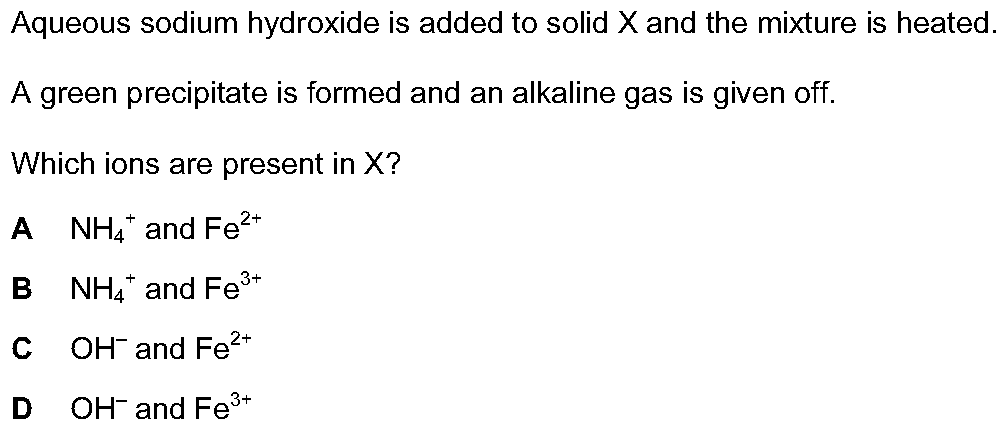
Aqueous sodium hydroxide is added to solid X and the mixture is heated.
A green precipitate is formed and an alkaline gas is given off.
Which ions are present in X?
NH,” and Fe”*
NH,” and Fe**
OH and Fe**
D OH -andFe*
oO W
A green precipitate is formed and an alkaline gas is given off.
Which ions are present in X?
NH,” and Fe”*
NH,” and Fe**
OH and Fe**
D OH -andFe*
oO W
Options:
A
B
C
D
Correct Key: A
A
B
C
D
Correct Key: A
Question 8
Paper Ref: 5129/12_Winter_2021_Q19
Paper Ref: 5129/12_Winter_2021_Q19
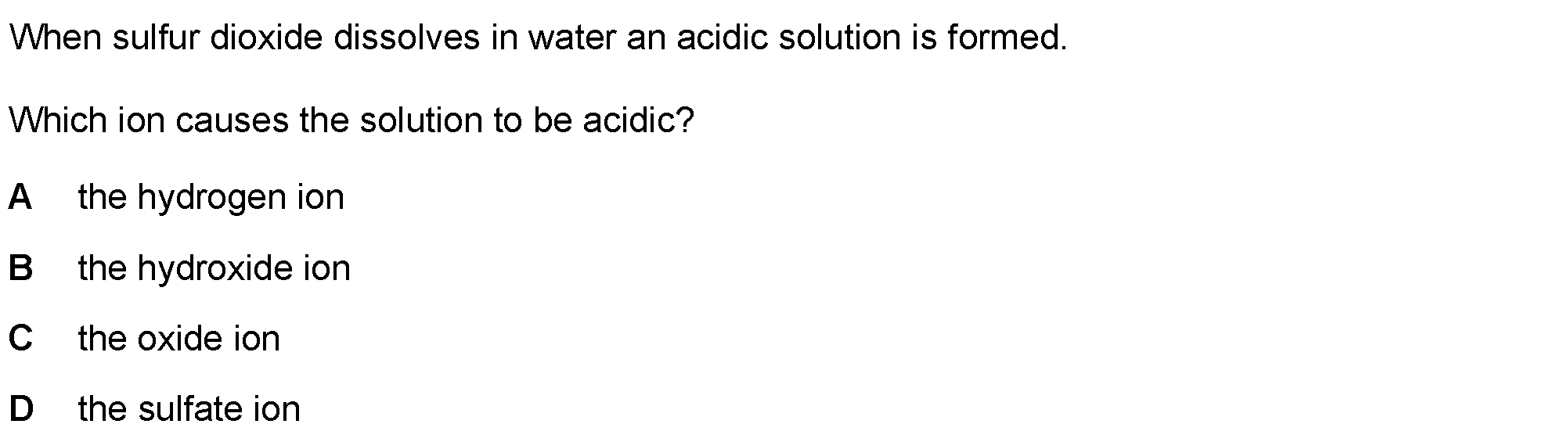
When sulfur dioxide dissolves in water an acidic solution is formed.
Which ion causes the solution to be acidic?
A the hydrogen ion
B the hydroxide ion
C the oxide ion
D
the sulfate ion
Which ion causes the solution to be acidic?
A the hydrogen ion
B the hydroxide ion
C the oxide ion
D
the sulfate ion
Options:
A
B
C
D
Correct Key: A
A
B
C
D
Correct Key: A
Question 9
Paper Ref: 0620/23_Summer_2015_Q16
Paper Ref: 0620/23_Summer_2015_Q16
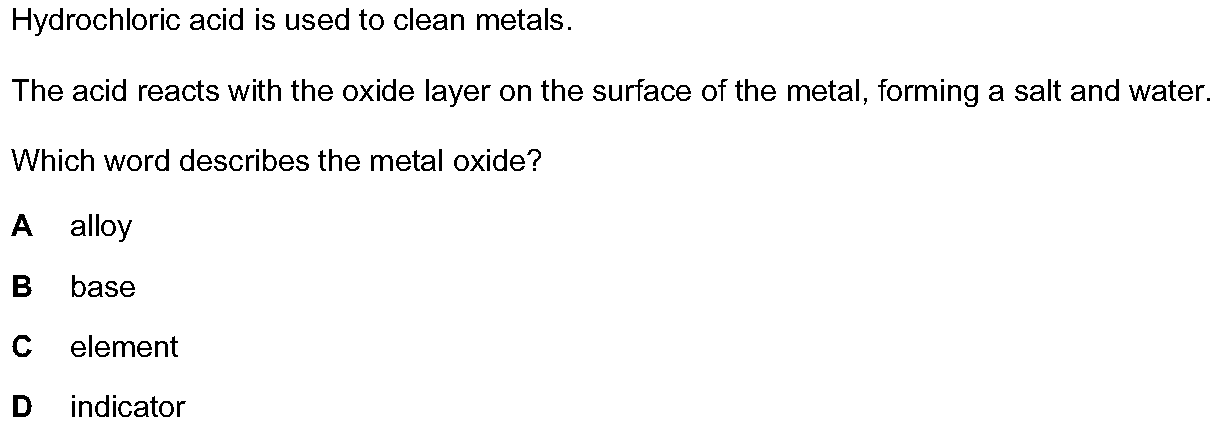
Hydrochloric acid is used to clean metals.
The acid reacts with the oxide layer on the surface of the metal, forming a salt and water.
Which word describes the metal oxide?
A alloy
B_ base
Cc element
D
indicator
The acid reacts with the oxide layer on the surface of the metal, forming a salt and water.
Which word describes the metal oxide?
A alloy
B_ base
Cc element
D
indicator
Options:
A
B
C
D
Correct Key: B
A
B
C
D
Correct Key: B
Structured Questions Mark Scheme & Answers
•1•.• • • •[•P•R•I• •2•0•0•8•C• •P•1• • •·• • •Q•8• • •P•a•r•t• •(•b•)• • •·• • •2•0•0•8• • •·• • •P•r•i•m•a•r•y• •0•8•4•6•]• • • • • • •(•n•o• •p•u•b•l•i•s•h•e•d• •m•a•r•k• •s•c•h•e•m•e• •f•o•r• •t•h•i•s• •p•a•p•e•r•)•
•2•.• • • •[•P•R•I• •2•0•0•8•C• •P•1• • •·• • •Q•8• • •P•a•r•t• •(•c•)• • •·• • •2•0•0•8• • •·• • •P•r•i•m•a•r•y• •0•8•4•6•]• • • • • • •(•n•o• •p•u•b•l•i•s•h•e•d• •m•a•r•k• •s•c•h•e•m•e• •f•o•r• •t•h•i•s• •p•a•p•e•r•)•
•3•.• • • •[•P•T• •S•7• •2•0•2•5• •P•1• • •·• • •Q•1•0• • •P•a•r•t• •(•a•)• • •·• • •2•0•2•5• • •·• • •L•o•w•e•r• •S•e•c• •0•8•9•3•]• • • • • • •I•s• •t•h•e• •s•o•l•u•t•i•o•n• •a•c•i•d•i•c•,• •3• •a•l•l• •f•o•u•r• •c•o•r•r•e•c•t• •=• •3• •m•a•r•k•s• •s•o•l•u•t•i•o•n• •a•l•k•a•l•i•n•e• •o•r• •n•e•u•t•r•a•l•?• •t•w•o• •o•r• •t•h•r•e•e• •c•o•r•r•e•c•t• •=• •2• •m•a•r•k•s• •J• •a•l•k•a•l•i•n•e• •o•n•e• •c•o•r•r•e•c•t• •=• •1• •m•a•r•k• •K• •n•e•u•t•r•a•l• •L• •a•l•k•a•l•i•n•e• •M• •a•c•i•d•i•c•
•4•.• • • •[•P•T• •S•7• •2•0•2•5• •P•1• • •·• • •Q•1•0• • •P•a•r•t• •(•b•)• • •·• • •2•0•2•5• • •·• • •L•o•w•e•r• •S•e•c• •0•8•9•3•]• • • • • • •(•a•d•d•)• •U•n•i•v•e•r•s•a•l• •I•n•d•i•c•a•t•o•r• •a•n•d• •(•o•b•s•e•r•v•e• •t•h•a•t• •i•t•)• •h•a•s• •t•h•e• •s•a•m•e• •1• •c•o•l•o•u•r• •©• •U•C•L•E•S• •2•0•2•5• •P•a•g•e• •9• •o•f• •1•0• •S•7•/•0•1• •S•c•i•e•n•c•e• •S•t•a•g•e• •7• •P•a•p•e•r• •1• •M•a•r•k• •S•c•h•e•m•e• •2•0•2•5•
•5•.• • • •[•P•T• •S•7• •2•0•2•6• •P•1• • •·• • •Q•6• • •P•a•r•t• •(•a•)• • •·• • •2•0•2•6• • •·• • •L•o•w•e•r• •S•e•c• •0•8•9•3•]• • • • • • •r•e•d• •1• •••c•c•e•p•t• •p•i•n•k•,• •o•r•a•n•g•e• •o•r• •y•e•l•l•o•w•
•6•.• • • •[•P•T• •S•7• •2•0•2•6• •P•1• • •·• • •Q•6• • •P•a•r•t• •(•b•)• • •·• • •2•0•2•6• • •·• • •L•o•w•e•r• •S•e•c• •0•8•9•3•]• • • • • • •2• •e•a•c•h• •c•o•r•r•e•c•t• •a•n•s•w•e•r• •=• •1• •m•a•r•k• •i•t• •f•i•z•z•e•s• •••c•c•e•p•t• •g•a•s• •i•s• •p•r•o•d•u•c•e•d• •U•n•i•v•e•r•s•a•l• •I•n•d•i•c•a•t•o•r• •c•h•a•n•g•e•s• •c•o•l•o•u•r• •t•o• •b•l•u•e• •o•r• •(•i•d•e•a• •t•h•a•t•)• •c•h•a•n•g•e• •i•n• •p•H• •f•r•o•m• •3• •t•o• •1•2• •••c•c•e•p•t• •n•e•w• •s•u•b•s•t•a•n•c•e• •f•o•r•m•e•d• •a•s• •a•n• •a•d•d•i•t•i•o•n•a•l• •m•a•r•k•i•n•g• •p•o•i•n•t• •n•e•u•t•r•a•l•i•s•a•t•i•o•n• •1• •©• •C•a•m•b•r•i•d•g•e• •U•n•i•v•e•r•s•i•t•y• •P•r•e•s•s• •&• •••s•s•e•s•s•m•e•n•t• •2•0•2•6• •P•a•g•e• •5• •o•f• •1•2• •S•7•/•0•1• •S•c•i•e•n•c•e• •S•t•a•g•e• •7• •P•a•p•e•r• •1• •M•a•r•k• •S•c•h•e•m•e• •2•0•2•6•
•7•.• • • •[•P•T• •S•7• •2•0•2•6• •P•2• • •·• • •Q•1•0• • •P•a•r•t• •(•a•)• • •·• • •2•0•2•6• • •·• • •L•o•w•e•r• •S•e•c• •0•8•9•3•]• • • • • • •a•p•p•r•o•p•r•i•a•t•e• •l•i•n•e•a•r• •s•c•a•l•e•s• •t•h•a•t• •a•l•l•o•w•s• •p•o•i•n•t•s• •t•o• •b•e• •p•l•o•t•t•e•d• •t•o• •2• •a•p•p•r•o•p•r•i•a•t•e• •s•c•a•l•e•s• •=• •1• •m•a•r•k• •c•o•v•e•r• •a•t• •l•e•a•s•t• •h•a•l•f• •t•h•e• •g•r•i•d• •r•e•s•u•l•t•s• •p•l•o•t•t•e•d• •c•o•r•r•e•c•t•l•y• •a•l•l• •r•e•s•u•l•t•s• •p•l•o•t•t•e•d• •=• •1• •m•a•r•k• •••c•c•e•p•t• •t•o•l•e•r•a•n•c•e• •o•f• •±• •h•a•l•f• •a• •s•m•a•l•l• •s•q•u•a•r•e•
•8•.• • • •[•P•T• •S•7• •2•0•2•6• •P•2• • •·• • •Q•1•0• • •P•a•r•t• •(•a•)• • •·• • •2•0•2•6• • •·• • •L•o•w•e•r• •S•e•c• •0•8•9•3•]• • • • • • •a•p•p•r•o•p•r•i•a•t•e• •l•i•n•e•a•r• •s•c•a•l•e•s• •t•h•a•t• •a•l•l•o•w•s• •p•o•i•n•t•s• •t•o• •b•e• •p•l•o•t•t•e•d• •t•o• •2• •a•p•p•r•o•p•r•i•a•t•e• •s•c•a•l•e•s• •=• •1• •m•a•r•k• •c•o•v•e•r• •a•t• •l•e•a•s•t• •h•a•l•f• •t•h•e• •g•r•i•d• •r•e•s•u•l•t•s• •p•l•o•t•t•e•d• •c•o•r•r•e•c•t•l•y• •a•l•l• •r•e•s•u•l•t•s• •p•l•o•t•t•e•d• •=• •1• •m•a•r•k• •••c•c•e•p•t• •t•o•l•e•r•a•n•c•e• •o•f• •±• •h•a•l•f• •a• •s•m•a•l•l• •s•q•u•a•r•e•
Last updated:
\n