4.4Electricity and Magnetism
Keeping a fetus healthy — Question Bank (Cambridge) — Cambridge IGCSE Physics 0625 Revision Notes & Topical Questions
20 min read Lesson 43 of 65 Unit quiz
Cambridge Past Paper Bank
4.4 Keeping a fetus healthy
11 Multiple-Choice Questions with Official Mark Schemes
Question 1
0610/23_Summer_2011_Q10
Question 2
0610/21_Summer_2011_Q27
Question 3
0610/12_Winter_2025_Q26
Question 4
0610/22_Spring_2022_Q30
Question 5
0610/23_Winter_2025_Q28
Question 6
0610/21_Winter_2011_Q9
Question 7
0610/23_Summer_2024_Q27

Question 8
0610/22_Winter_2019_Q29
Question 9
0610/22_Summer_2026_Q28
Question 10
0610/22_Spring_2026_Q27
Question 11
0610/21_Summer_2021_Q31
Cambridge Lower Secondary Stage 9
4.4 Keeping a fetus healthy – Complete Question Bank & Mark Scheme
Total Questions11 Questions with Verified Solutions & Past Paper Mark Schemes
Multiple Choice Questions (Exam Practice)
Question 1
Paper Ref: 0610/23_Summer_2011_Q10
Paper Ref: 0610/23_Summer_2011_Q10
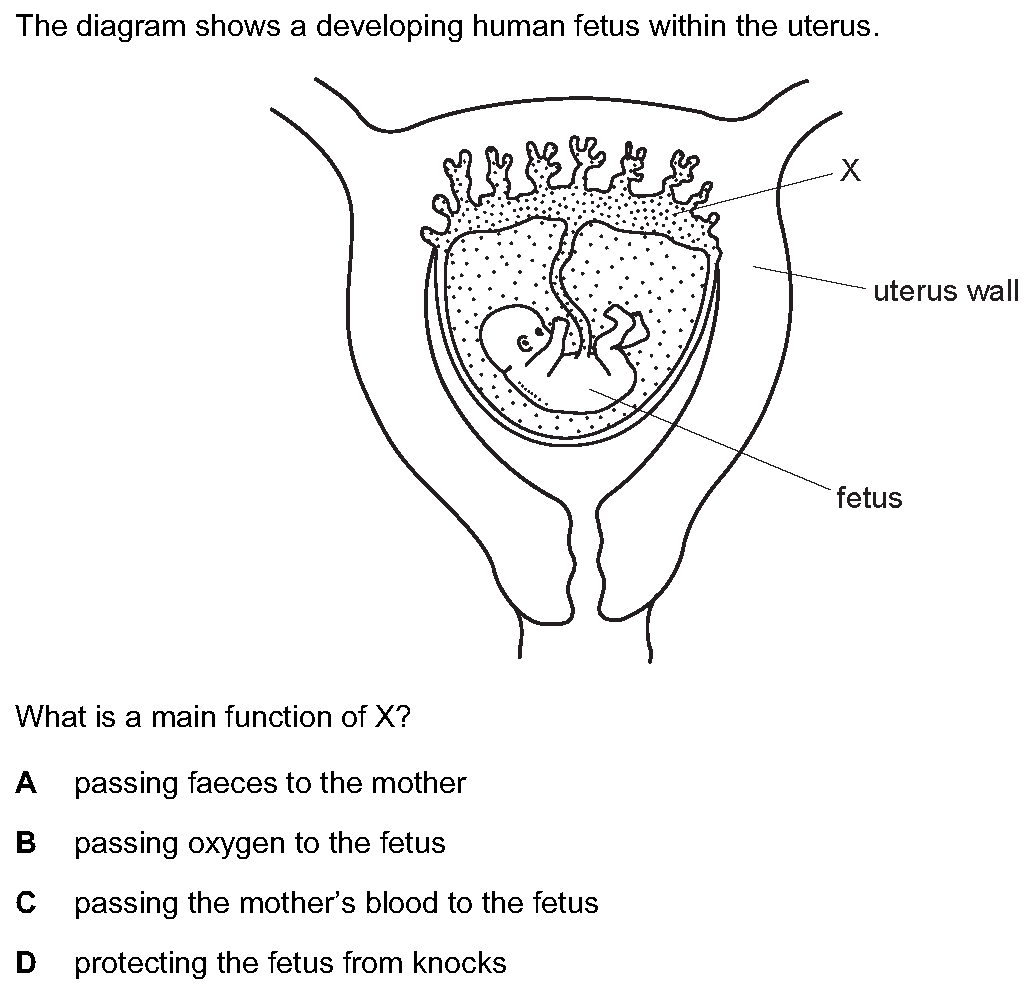
The diagram shows a developing human fetus within the uterus.
uterus wall
fetus
What is a main function of X?
oo BD
passing faeces to the mother
passing oxygen to the fetus
passing the mother’s blood to the fetus
protecting the fetus from knocks
uterus wall
fetus
What is a main function of X?
oo BD
passing faeces to the mother
passing oxygen to the fetus
passing the mother’s blood to the fetus
protecting the fetus from knocks
Options:
A
B
C
D
Correct Key: B
A
B
C
D
Correct Key: B
Question 2
Paper Ref: 0610/21_Summer_2011_Q27
Paper Ref: 0610/21_Summer_2011_Q27
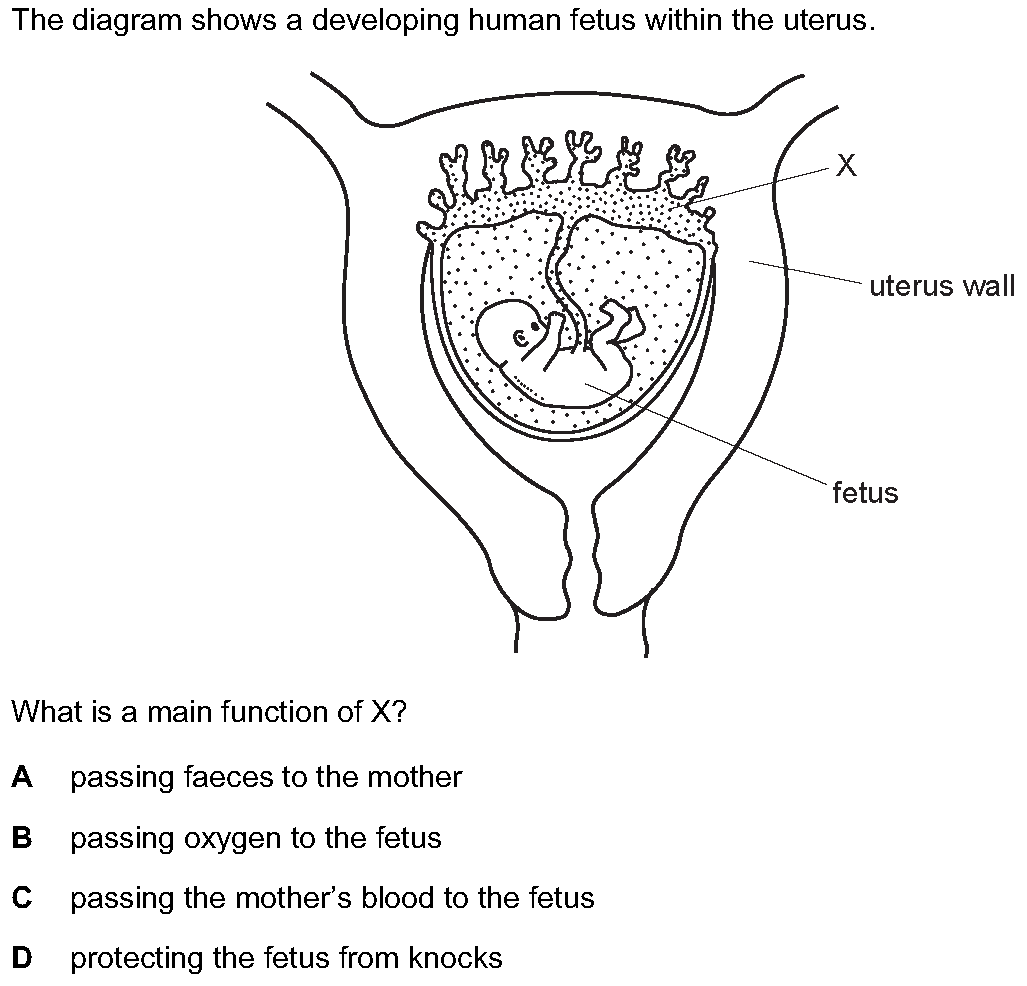
The diagram shows a developing human fetus within the uterus.
uterus wall
fetus
What is a main function of X?
oo BD
passing faeces to the mother
passing oxygen to the fetus
passing the mother’s blood to the fetus
protecting the fetus from knocks
uterus wall
fetus
What is a main function of X?
oo BD
passing faeces to the mother
passing oxygen to the fetus
passing the mother’s blood to the fetus
protecting the fetus from knocks
Options:
A
B
C
D
Correct Key: B
A
B
C
D
Correct Key: B
Question 3
Paper Ref: 0610/12_Winter_2025_Q26
Paper Ref: 0610/12_Winter_2025_Q26
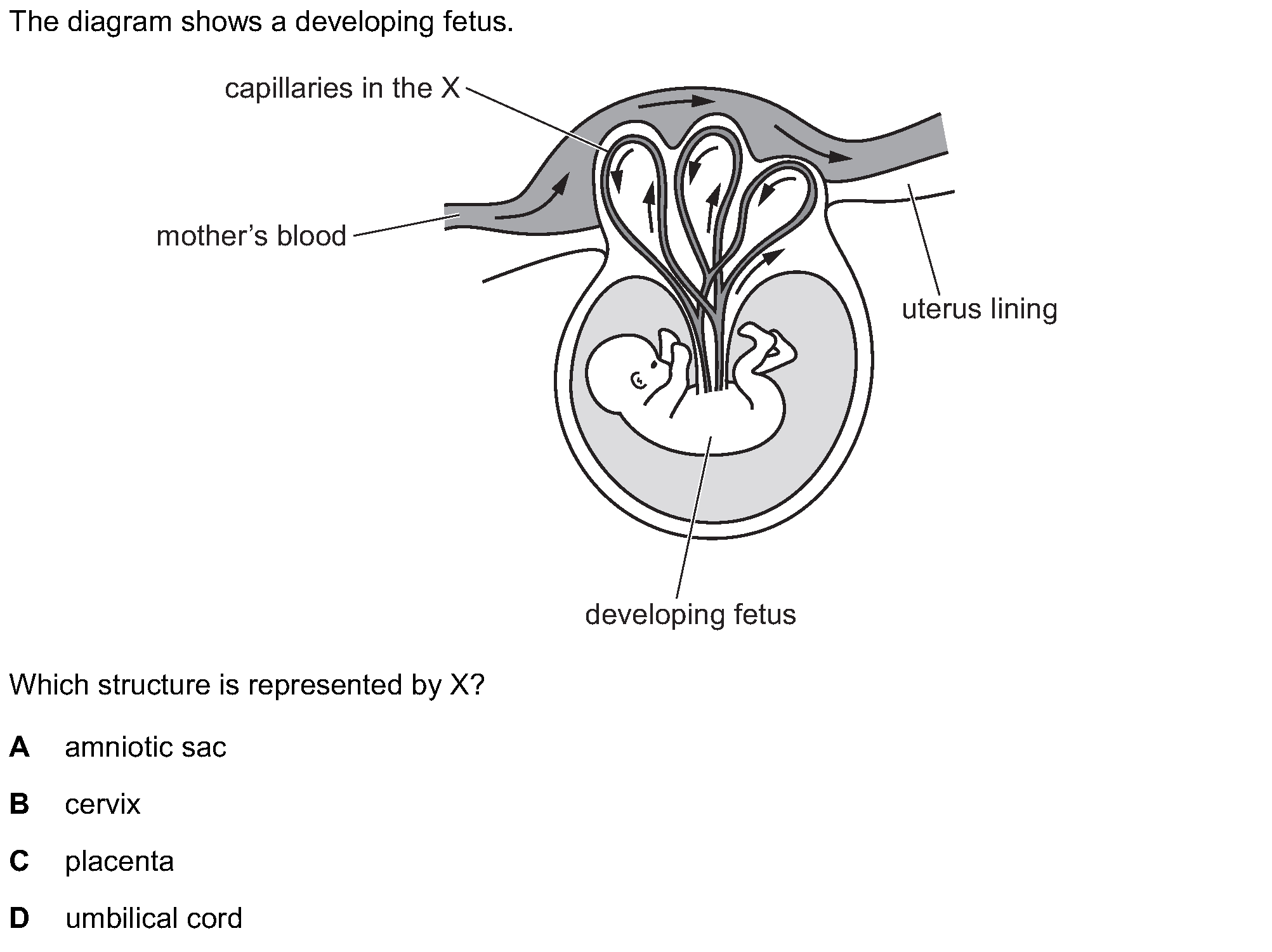
The diagram shows a developing fetus.
capillaries in the X
mother’s blood — —
developing fetus
Which structure is represented by X?
A amniotic sac
B~ cervix
C placenta
D
umbilical cord
capillaries in the X
mother’s blood — —
developing fetus
Which structure is represented by X?
A amniotic sac
B~ cervix
C placenta
D
umbilical cord
Options:
A
B
C
D
Correct Key: C
A
B
C
D
Correct Key: C
Question 4
Paper Ref: 0610/22_Spring_2022_Q30
Paper Ref: 0610/22_Spring_2022_Q30
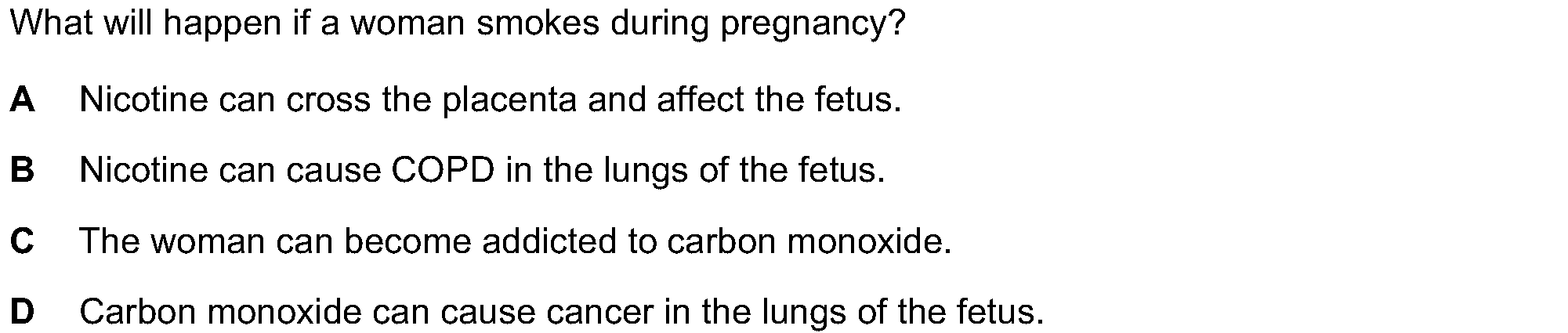
What will happen if a woman smokes during pregnancy?
A
B
Cc
D
Nicotine can cross the placenta and affect the fetus.
Nicotine can cause COPD in the lungs of the fetus.
The woman can become addicted to carbon monoxide.
Carbon monoxide can cause cancer in the lungs of the fetus.
A
B
Cc
D
Nicotine can cross the placenta and affect the fetus.
Nicotine can cause COPD in the lungs of the fetus.
The woman can become addicted to carbon monoxide.
Carbon monoxide can cause cancer in the lungs of the fetus.
Options:
A
B
C
D
Correct Key: A
A
B
C
D
Correct Key: A
Question 5
Paper Ref: 0610/23_Winter_2025_Q28
Paper Ref: 0610/23_Winter_2025_Q28
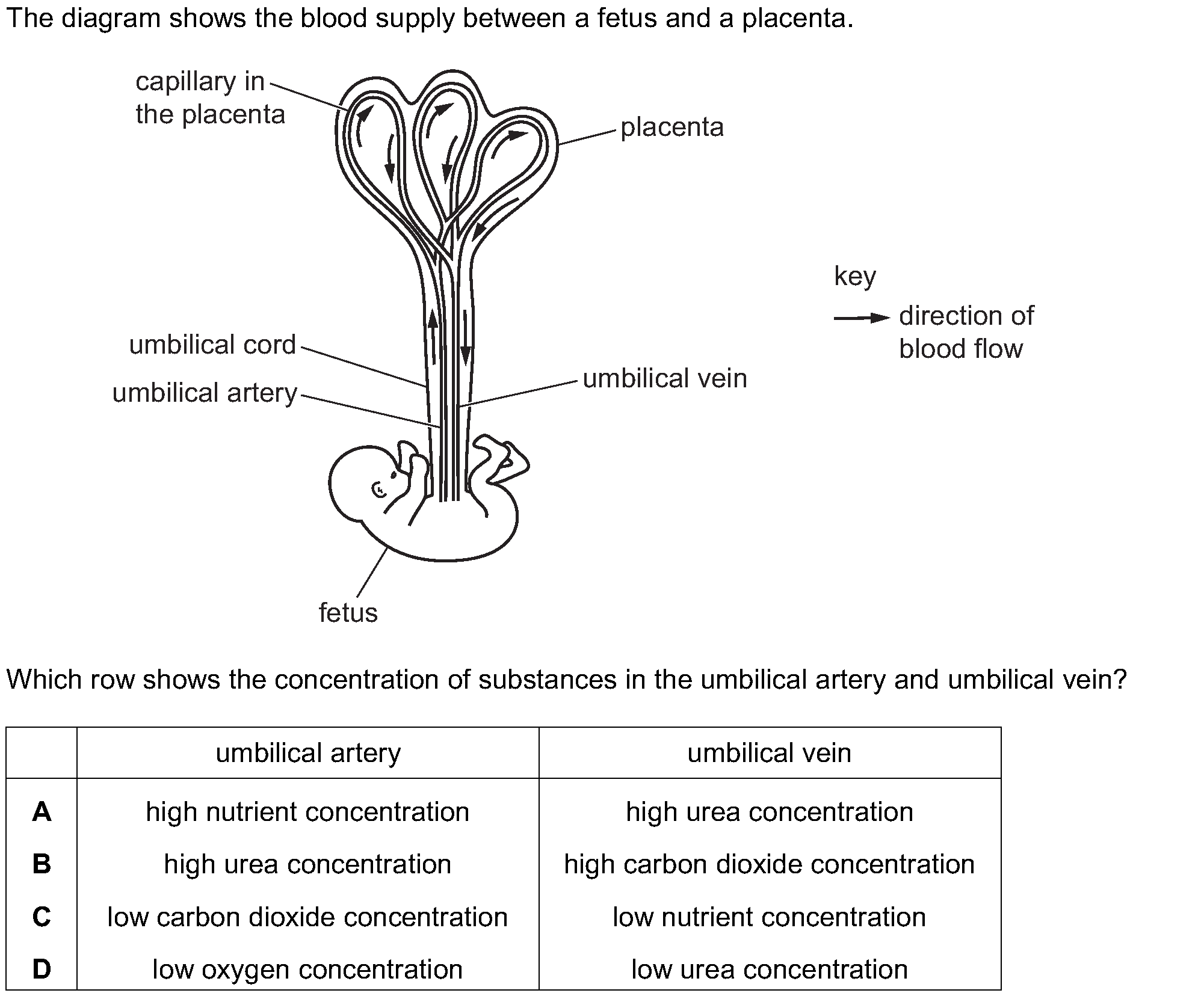
The diagram shows the blood supply between a fetus and a placenta.
capillary in
the placenta placenta
key
—-» direction of
blood flow
umbilical cord
umbilical artery umbilical vein
fetus
Which row shows the concentration of substances in the umbilical artery and umbilical vein?
umbilical artery umbilical vein
A high nutrient concentration high urea concentration
B high urea concentration high carbon dioxide concentration
Cc low carbon dioxide concentration low nutrient concentration
D low oxygen concentration low urea concentration
Options:
A
B
C
D
Correct Key: D
A
B
C
D
Correct Key: D
Question 6
Paper Ref: 0610/21_Winter_2011_Q9
Paper Ref: 0610/21_Winter_2011_Q9
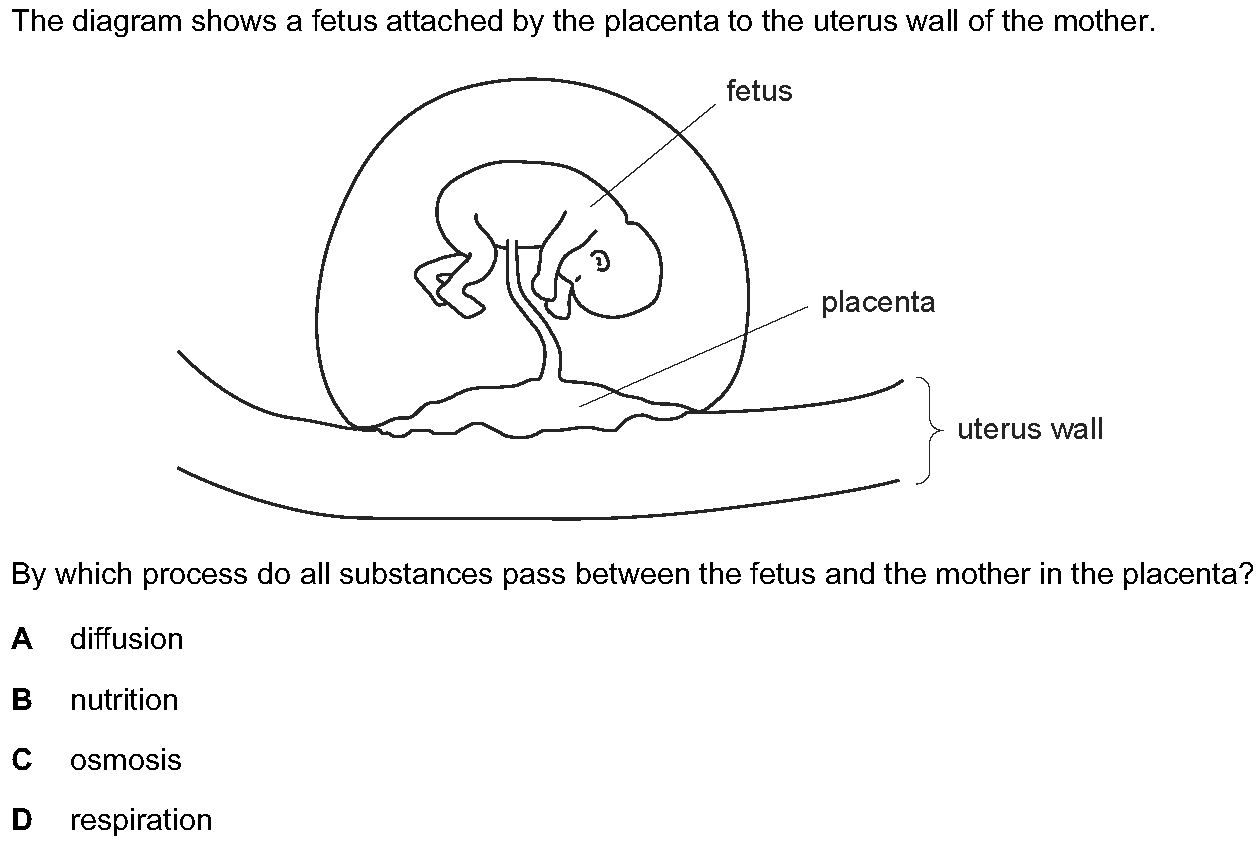
The diagram shows a fetus attached by the placenta to the uterus wall of the mother.
fetus
placenta
} uterus wall
By which process do all substances pass between the fetus and the mother in the placenta?
diffusion
B nutrition
C osmosis
D respiration
fetus
placenta
} uterus wall
By which process do all substances pass between the fetus and the mother in the placenta?
diffusion
B nutrition
C osmosis
D respiration
Options:
A
B
C
D
Correct Key: A
A
B
C
D
Correct Key: A
Question 7
Paper Ref: 0610/23_Summer_2024_Q27
Paper Ref: 0610/23_Summer_2024_Q27
What is a function of the placenta?
A acts as a barrier to prevent some toxins reaching the fetus
exchanges blood between the mother and the fetus
prevents the transfer of excretory products from the fetus
0 OO DW
protects the fetus from mechanical damage
A acts as a barrier to prevent some toxins reaching the fetus
exchanges blood between the mother and the fetus
prevents the transfer of excretory products from the fetus
0 OO DW
protects the fetus from mechanical damage
Options:
A
B
C
D
Correct Key: A
A
B
C
D
Correct Key: A
Question 8
Paper Ref: 0610/22_Winter_2019_Q29
Paper Ref: 0610/22_Winter_2019_Q29
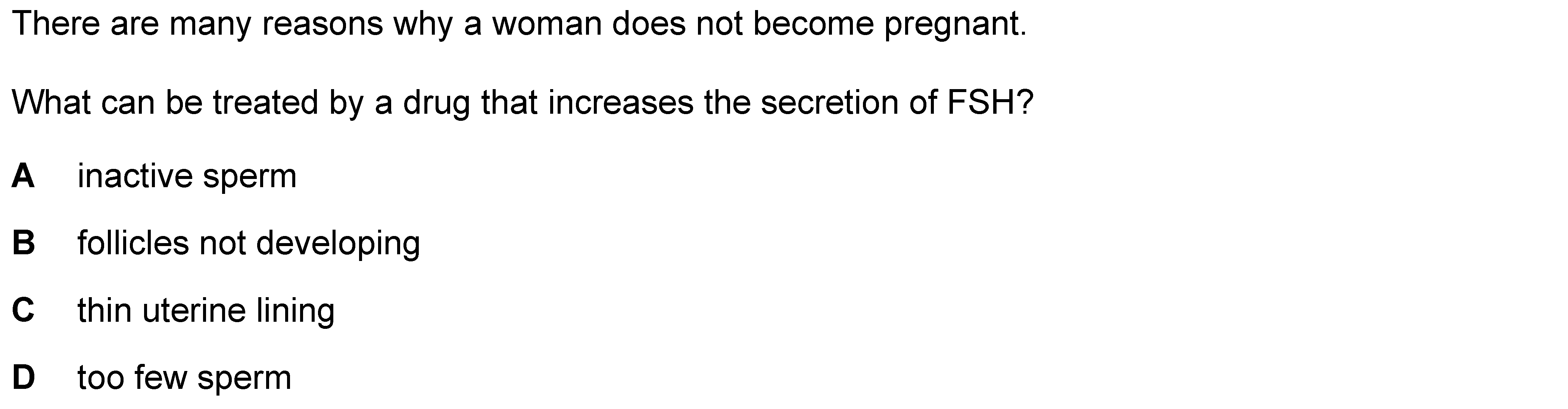
There are many reasons why a woman does not become pregnant.
What can be treated by a drug that increases the secretion of FSH?
A
B
C
D
inactive sperm
follicles not developing
thin uterine lining
too few sperm
What can be treated by a drug that increases the secretion of FSH?
A
B
C
D
inactive sperm
follicles not developing
thin uterine lining
too few sperm
Options:
A
B
C
D
Correct Key: B
A
B
C
D
Correct Key: B
Question 9
Paper Ref: 0610/22_Summer_2026_Q28
Paper Ref: 0610/22_Summer_2026_Q28
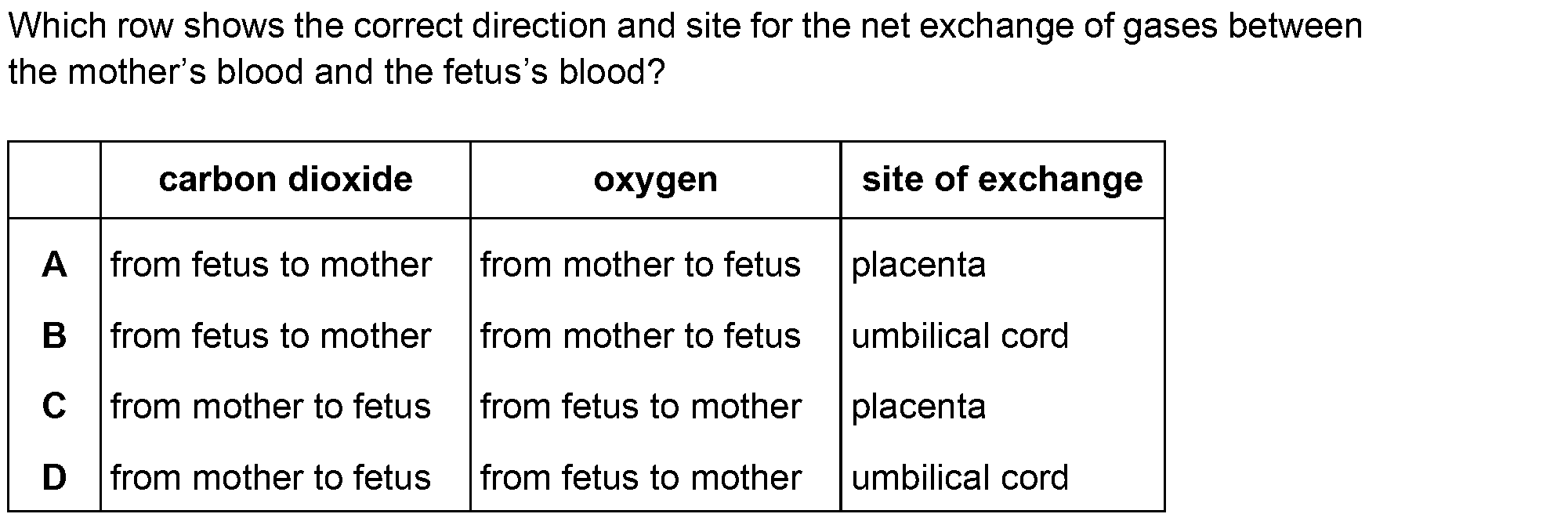
Which row shows the correct direction and site for the net exchange of gases between
the mother’s blood and the fetus’s blood?
from fetus to mother |from mother to fetus | placenta
from fetus to mother /|from mother to fetus | umbilical cord
from mother to fetus |from fetus to mother | placenta
from mother to fetus |from fetus to mother |umbilical cord
the mother’s blood and the fetus’s blood?
from fetus to mother |from mother to fetus | placenta
from fetus to mother /|from mother to fetus | umbilical cord
from mother to fetus |from fetus to mother | placenta
from mother to fetus |from fetus to mother |umbilical cord
Options:
A
B
C
D
Correct Key: A
A
B
C
D
Correct Key: A
Question 10
Paper Ref: 0610/22_Spring_2026_Q27
Paper Ref: 0610/22_Spring_2026_Q27
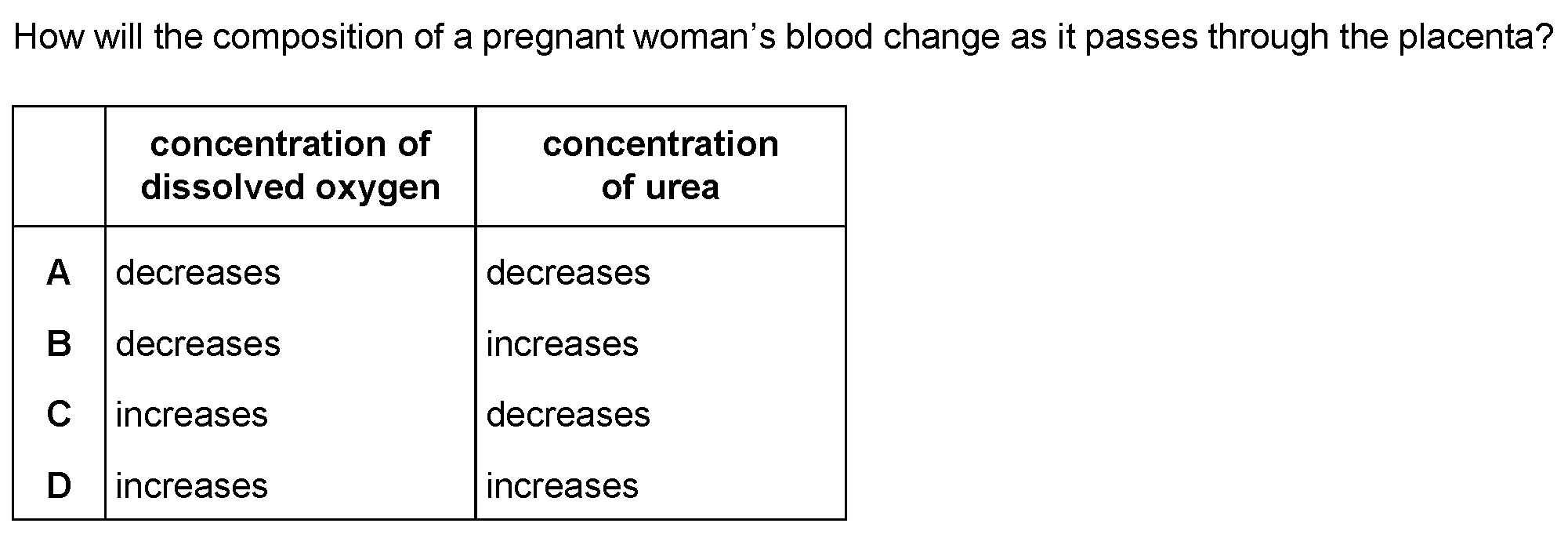
How will the composition of a pregnant woman's blood change as it passes through the placenta?
concentration of concentration
dissolved oxygen of urea
decreases decreases
decreases increases
increases decreases
increases increases
concentration of concentration
dissolved oxygen of urea
decreases decreases
decreases increases
increases decreases
increases increases
Options:
A
B
C
D
Correct Key: B
A
B
C
D
Correct Key: B
Question 11
Paper Ref: 0610/21_Summer_2021_Q31
Paper Ref: 0610/21_Summer_2021_Q31
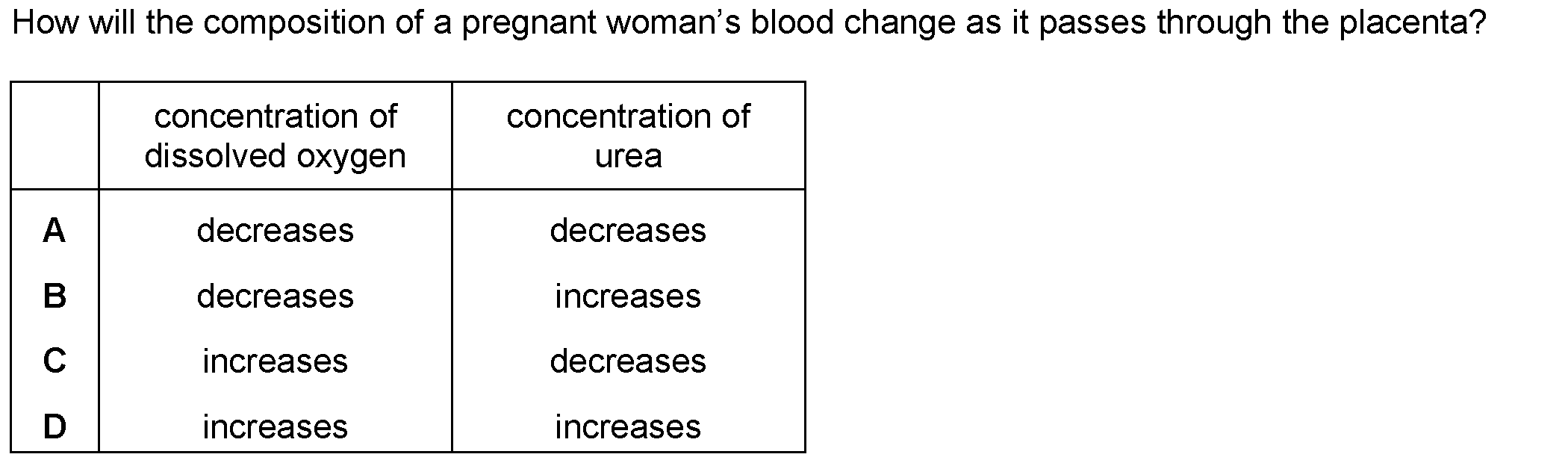
How will the composition of a pregnant woman’s blood change as it passes through the placenta?
concentration of concentration of
dissolved oxygen urea
decreases decreases
decreases increases
increases decreases
increases increases
concentration of concentration of
dissolved oxygen urea
decreases decreases
decreases increases
increases decreases
increases increases
Options:
A
B
C
D
Correct Key: B
A
B
C
D
Correct Key: B
Structured Questions Mark Scheme & Answers
•1•.• • • •[•▍• •P•R•I• •2•0•1•7•C• •P•1• • •·• • •Q•1•3• • •P•a•r•t• •(•b•)• • •·• • •2•0•1•7• • •·• • •P•r•i•m•a•r•y• •0•8•4•6•]• • • • • • •1• •m•o•r•e• •t•h•a•n• •o•n•e• •a•n•s•w•e•r• •c•i•r•c•l•e•d• •=• •0• •m•a•r•k•s• •b•e•a•t•s• •p•e•r• •m•i•n•u•t•e• •••s•s•e•m•b•l•e•d• •b•y• •N•.•S•.• •b•e•a•t•s• •p•u•l•s•e• •m•i•n•u•t•e• •b•e•a•t•s• •p•u•l•s•e• •m•o•m•e•n•t• •b•i•t•s• •p•e•r• •m•i•n•u•t•e• •b•i•t•s• •p•e•r• •m•o•m•e•n•t• •H•i•s• •r•e•s•t•i•n•g• •p•u•l•s•e• •r•a•t•e• •i•s• •6•5• •b•p•m•.• •2• •t•h•r•e•e• •c•o•r•r•e•c•t• •=• •2• •m•a•r•k•s• •o•n•e• •o•r• •t•w•o• •c•o•r•r•e•c•t• •=• •1• •m•a•r•k• •H•i•s• •h•i•g•h•e•s•t• •p•u•l•s•e• •r•a•t•e• •i•s• •9•2• •b•p•m•.• •H•i•s• •a•v•e•r•a•g•e• •(•m•e•a•n•)• •p•u•l•s•e• •r•a•t•e• •i•s• •8•0• •b•p•m•.• •1•6•7•/•3•8•4• •©• •U•C•L•E•S• •2•0•1•7• •P•a•g•e• •9• •o•f• •1•3•
•2•.• • • •[•▍• •P•T• •S•9• •2•0•2•6• •P•1• • •·• • •Q•9• • •P•a•r•t• •(•a•)• • •·• • •2•0•2•6• • •·• • •L•o•w•e•r• •S•e•c• •0•8•9•3•]• • • • • • •a•s• •f•e•t•a•l• •a•g•e• •i•n•c•r•e•a•s•e•s•,• •b•i•r•t•h• •m•a•s•s• •i•n•c•r•e•a•s•e•s• •1• •••c•c•e•p•t• •o•r•a•
•3•.• • • •[•▍• •P•T• •S•9• •2•0•2•6• •P•1• • •·• • •Q•9• • •P•a•r•t• •(•b•)• • •·• • •2•0•2•6• • •·• • •L•o•w•e•r• •S•e•c• •0•8•9•3•]• • • • • • •(•i•d•e•a• •t•h•a•t•)• •a•t• •t•h•e• •s•a•m•e• •f•e•t•a•l• •a•g•e•,• •b•a•b•i•e•s• •f•r•o•m• •m•o•t•h•e•r•s• •w•h•o• •1• •••c•c•e•p•t• •t•h•e• •l•i•n•e• •f•o•r• •m•o•t•h•e•r•s• •w•h•o• •d•i•d• •s•m•o•k•e• •i•s• •d•i•d• •n•o•t• •s•m•o•k•e• •h•a•v•e• •a• •h•i•g•h•e•r• •b•i•r•t•h• •m•a•s•s• •(•t•h•a•n• •t•h•o•s•e• •f•r•o•m• •a•l•w•a•y•s• •l•o•w•e•r• •t•h•a•n• •t•h•e• •l•i•n•e• •f•o•r• •m•o•t•h•e•r•s• •w•h•o• •d•i•d• •m•o•t•h•e•r•s• •w•h•o• •d•i•d• •s•m•o•k•e•)• •n•o•t• •s•m•o•k•e•
•4•.• • • •[•▍• •P•T• •S•8• •2•0•2•5• •P•2• • •·• • •Q•5• • •P•a•r•t• •(•b•)• • •·• • •2•0•2•5• • •·• • •L•o•w•e•r• •S•e•c• •0•8•9•3•]• • • • • • •6•5•%• •1• •d•r•i•n•k•i•n•g• •a•l•c•o•h•o•l• •1• •••c•c•e•p•t• •a•n•y• •o•t•h•e•r• •r•e•a•s•o•n•a•b•l•e• •l•i•f•e•s•t•y•l•e• •c•h•o•i•c•e•
•5•.• • • •[•▍• •C•P• •M•a•y• •2•0•2•4• •P•1• • •·• • •Q•4• • •P•a•r•t• •(•b•)• • •·• • •2•0•2•4• • •·• • •L•o•w•e•r• •S•e•c• •0•8•9•3•]• • • • • • •d•i•e•t• •o•r• •d•r•u•g•s• •o•r• •g•e•n•e•t•i•c• •d•i•s•o•r•d•e•r•s• •1• •••c•c•e•p•t• •a•n•y• •r•e•a•s•o•n•a•b•l•e• •a•n•s•w•e•r•,• •e•.•g•.• •d•i•s•e•a•s•e• •o•r• •s•u•b•s•t•a•n•c•e• •a•b•u•s•e• •o•r• •v•i•t•a•m•i•n• •d•e•f•i•c•i•e•n•c•i•e•s• •o•r• •b•r•e•a•t•h•i•n•g• •d•i•f•f•i•c•u•l•t•i•e•s• •o•r• •e•x•c•e•s•s• •w•e•i•g•h•t• •o•r• •d•i•a•b•e•t•e•s• •o•r• •p•r•e•-•e•c•l•a•m•p•s•i•a• •o•r• •a•b•n•o•r•m•a•l• •b•l•o•o•d• •p•r•e•s•s•u•r•e• •o•r• •a•l•c•o•h•o•l• •o•r• •n•u•t•r•i•e•n•t•s• •c•o•n•s•u•m•e•d• •o•r• •m•i•n•e•r•a•l•s• •o•r• •f•o•l•i•c• •a•c•i•d• •o•r• •c•a•f•f•e•i•n•e• •o•r• •d•r•i•n•k•i•n•g• •c•o•f•f•e•e• •o•r• •g•e•n•e•(•t•i•c•)• •I•g•n•o•r•e• •s•m•o•k•i•n•g• •N•o•t•e• •f•o•o•d• •c•o•n•s•u•m•p•t•i•o•n• •o•r• •d•r•i•n•k•i•n•g• •i•s• •n•o•t• •s•u•f•f•i•c•i•e•n•t•
•6•.• • • •[•▍• •C•P• •O•c•t•o•b•e•r• •2•0•2•4• •P•2• • •·• • •Q•1•4• • •P•a•r•t• •(•a•)• • •·• • •2•0•2•4• • •·• • •L•o•w•e•r• •S•e•c• •0•8•9•3•]• • • • • • •a•n•y• •o•n•e• •f•r•o•m• •(•i•d•e•a• •o•f•)• •1• •N•o•t•e• •i•f• •L•i•l•y• •g•i•v•e•n• •a•c•c•e•p•t• •a•n•s•w•e•r•s• •t•h•a•t• •s•u•g•g•e•s•t• •t•h•e• •m•o•t•h•e•r• •s•h•o•u•l•d• •h•a•v•e• •a• •g•o•o•d• •d•i•e•t• •o•r• •s•h•o•u•l•d• •a•v•o•i•d• •a• •p•o•o•r• •d•i•e•t• •L•i•l•y• •a•n•d• •b•e•c•a•u•s•e• •i•d•e•a• •t•h•a•t• •a• •g•o•o•d• •d•i•e•t• •l•e•a•d•s• •t•o• •h•e•a•l•t•h•y• •L•i•l•y• •a•n•d• •i•d•e•a• •t•h•a•t• •a• •h•e•a•l•t•h•y• •d•i•e•t• •l•e•a•d•s• •t•o• •a• •h•e•a•l•t•h•y• •b•i•r•t•h• •m•a•s•s• •b•a•b•y• •o•r• •f•e•t•u•s• •L•i•l•y• •a•n•d• •b•e•c•a•u•s•e• •t•h•e•r•e• •i•s• •a• •b•e•t•t•e•r• •c•h•a•n•c•e• •o•f• •b•a•b•y• •L•i•l•y• •a•n•d• •i•d•e•a• •t•h•a•t• •a• •p•r•e•g•n•a•n•t• •m•o•t•h•e•r• •s•h•o•u•l•d• •h•a•v•e• •s•u•r•v•i•v•i•n•g• •b•i•r•t•h• •a• •b•a•l•a•n•c•e•d• •d•i•e•t• •L•i•l•y• •a•n•d• •f•e•t•u•s• •g•e•t•t•i•n•g• •a•l•l• •n•u•t•r•i•e•n•t•s• •n•e•e•d•e•d• •o•r• •a•n•d• •f•e•t•u•s• •g•e•t•t•i•n•g• •n•u•t•r•i•e•n•t•s• •n•e•e•d•s• •f•o•r• •g•r•o•w•t•h• •o•r• •b•o•n•e• •g•r•o•w•t•h• •e•t•c• •L•i•l•y• •a•n•d• •(•i•d•e•a• •t•h•a•t•)• •m•o•t•h•e•r• •s•h•o•u•l•d• •a•v•o•i•d• •a•l•c•o•h•o•l• •o•r• •(•i•d•e•a• •t•h•a•t•)• •m•o•t•h•e•r• •s•h•o•u•l•d• •a•v•o•i•d• •d•r•u•g•s• •L•i•l•y• •a•n•d• •(•i•d•e•a• •t•h•a•t•)• •f•e•t•u•s• •g•e•t•s• •t•h•e• •n•u•t•r•i•e•n•t•s• •t•h•e• •m•o•t•h•e•r• •g•e•t•s• •L•i•l•y• •a•n•d• •t•h•e• •m•o•t•h•e•r•’•s• •e•a•t•i•n•g• •h•a•b•i•t•s• •a•f•f•e•c•t• •t•h•e• •b•a•b•y• •L•i•l•y• •a•n•d• •b•e•c•a•u•s•e• •i•t• •i•s• •a•n• •u•n•k•n•o•w•n• •s•e•c•o•n•d•a•r•y• •s•o•u•r•c•e• •o•n• •t•h•e• •i•n•t•e•r•n•e•t• •L•i•l•y• •a•n•d• •b•e•c•a•u•s•e• •t•h•e• •i•n•t•e•r•n•e•t• •d•a•t•a• •c•o•u•l•d• •b•e• •b•i•a•s•e•d• •J•a•m•i•l•a• •a•n•d• •b•e•c•a•u•s•e• •s•h•e• •h•a•s• •u•s•e•d• •s•o•m•e• •s•e•c•o•n•d•a•r•y• •d•a•t•a• •J•a•m•i•l•a• •a•n•d• •b•e•c•a•u•s•e• •L•i•l•y• •i•s• •j•u•s•t• •a•n• •o•p•i•n•i•o•n• •o•r• •n•o•t• •b•a•c•k•e•d• •u•p• •w•i•t•h• •d•a•t•a•
•7•.• • • •[•▍• •C•P• •O•c•t•o•b•e•r• •2•0•2•4• •P•2• • •·• • •Q•1•4• • •P•a•r•t• •(•b•)• • •·• • •2•0•2•4• • •·• • •L•o•w•e•r• •S•e•c• •0•8•9•3•]• • • • • • •a•n•y• •o•n•e• •f•r•o•m• •(•i•d•e•a• •o•f•)• •1• •N•o•t•e• •i•f• •L•i•l•y• •g•i•v•e•n• •a•c•c•e•p•t• •a•n•s•w•e•r•s• •t•h•a•t• •s•u•g•g•e•s•t• •t•h•e• •m•o•t•h•e•r• •s•h•o•u•l•d• •h•a•v•e• •a• •g•o•o•d• •d•i•e•t• •o•r• •s•h•o•u•l•d• •a•v•o•i•d• •a• •p•o•o•r• •d•i•e•t• •L•i•l•y• •a•n•d• •b•e•c•a•u•s•e• •i•d•e•a• •t•h•a•t• •a• •g•o•o•d• •d•i•e•t• •l•e•a•d•s• •t•o• •h•e•a•l•t•h•y• •L•i•l•y• •a•n•d• •i•d•e•a• •t•h•a•t• •a• •h•e•a•l•t•h•y• •d•i•e•t• •l•e•a•d•s• •t•o• •a• •h•e•a•l•t•h•y• •b•i•r•t•h• •m•a•s•s• •b•a•b•y• •o•r• •f•e•t•u•s• •L•i•l•y• •a•n•d• •b•e•c•a•u•s•e• •t•h•e•r•e• •i•s• •a• •b•e•t•t•e•r• •c•h•a•n•c•e• •o•f• •b•a•b•y• •L•i•l•y• •a•n•d• •i•d•e•a• •t•h•a•t• •a• •p•r•e•g•n•a•n•t• •m•o•t•h•e•r• •s•h•o•u•l•d• •h•a•v•e• •s•u•r•v•i•v•i•n•g• •b•i•r•t•h• •a• •b•a•l•a•n•c•e•d• •d•i•e•t• •L•i•l•y• •a•n•d• •f•e•t•u•s• •g•e•t•t•i•n•g• •a•l•l• •n•u•t•r•i•e•n•t•s• •n•e•e•d•e•d• •o•r• •a•n•d• •f•e•t•u•s• •g•e•t•t•i•n•g• •n•u•t•r•i•e•n•t•s• •n•e•e•d•s• •f•o•r• •g•r•o•w•t•h• •o•r• •b•o•n•e• •g•r•o•w•t•h• •e•t•c• •L•i•l•y• •a•n•d• •(•i•d•e•a• •t•h•a•t•)• •m•o•t•h•e•r• •s•h•o•u•l•d• •a•v•o•i•d• •a•l•c•o•h•o•l• •o•r• •(•i•d•e•a• •t•h•a•t•)• •m•o•t•h•e•r• •s•h•o•u•l•d• •a•v•o•i•d• •d•r•u•g•s• •L•i•l•y• •a•n•d• •(•i•d•e•a• •t•h•a•t•)• •f•e•t•u•s• •g•e•t•s• •t•h•e• •n•u•t•r•i•e•n•t•s• •t•h•e• •m•o•t•h•e•r• •g•e•t•s• •L•i•l•y• •a•n•d• •t•h•e• •m•o•t•h•e•r•’•s• •e•a•t•i•n•g• •h•a•b•i•t•s• •a•f•f•e•c•t• •t•h•e• •b•a•b•y• •L•i•l•y• •a•n•d• •b•e•c•a•u•s•e• •i•t• •i•s• •a•n• •u•n•k•n•o•w•n• •s•e•c•o•n•d•a•r•y• •s•o•u•r•c•e• •o•n• •t•h•e• •i•n•t•e•r•n•e•t• •L•i•l•y• •a•n•d• •b•e•c•a•u•s•e• •t•h•e• •i•n•t•e•r•n•e•t• •d•a•t•a• •c•o•u•l•d• •b•e• •b•i•a•s•e•d• •J•a•m•i•l•a• •a•n•d• •b•e•c•a•u•s•e• •s•h•e• •h•a•s• •u•s•e•d• •s•o•m•e• •s•e•c•o•n•d•a•r•y• •d•a•t•a• •J•a•m•i•l•a• •a•n•d• •b•e•c•a•u•s•e• •L•i•l•y• •i•s• •j•u•s•t• •a•n• •o•p•i•n•i•o•n• •o•r• •n•o•t• •b•a•c•k•e•d• •u•p• •w•i•t•h• •d•a•t•a•
•8•.• • • •[•▍• •P•R•I• •2•0•0•8•B• •P•2• • •·• • •Q•1• • •P•a•r•t• •(•b•)• • •·• • •2•0•0•8• • •·• • •P•r•i•m•a•r•y• •0•8•4•6•]• • • • • • •(•n•o• •p•u•b•l•i•s•h•e•d• •m•a•r•k• •s•c•h•e•m•e• •f•o•r• •t•h•i•s• •p•a•p•e•r•)•
Last updated:
\n