4.1Electricity and Magnetism
Plants and water — Question Bank (Cambridge) — Cambridge IGCSE Physics 0625 Revision Notes & Topical Questions
10 min read Lesson 2 of 65 Unit quiz
Cambridge Past Paper Bank
4.1 Plants and water
15 Multiple-Choice Questions with Official Mark Schemes
Question 1
0610/12_Summer_2026_Q15
Question 2
0610/21_Winter_2025_Q3
Question 3
0610/22_Spring_2021_Q17
Question 4
0610/21_Summer_2009_Q5
Question 5
5129/11_Summer_2022_Q6
Question 6
0610/12_Winter_2024_Q21
Question 7
0610/23_Winter_2022_Q16
Question 8
0610/22_Summer_2014_Q9
Question 9
0610/23_Summer_2020_Q6
Question 10
0610/21_Winter_2018_Q15
Question 11
0610/22_Summer_2022_Q15
Question 12
0610/21_Winter_2020_Q16
Question 13
0610/11_Winter_2020_Q18
Question 14
0610/21_Winter_2018_Q3
Question 15
0610/23_Summer_2024_Q3
Cambridge Lower Secondary Stage 9
4.1 Plants and water – Complete Question Bank & Mark Scheme
Total Questions15 Questions with Verified Solutions & Past Paper Mark Schemes
Multiple Choice Questions (Exam Practice)
Question 1
Paper Ref: 0610/12_Summer_2026_Q15
Paper Ref: 0610/12_Summer_2026_Q15
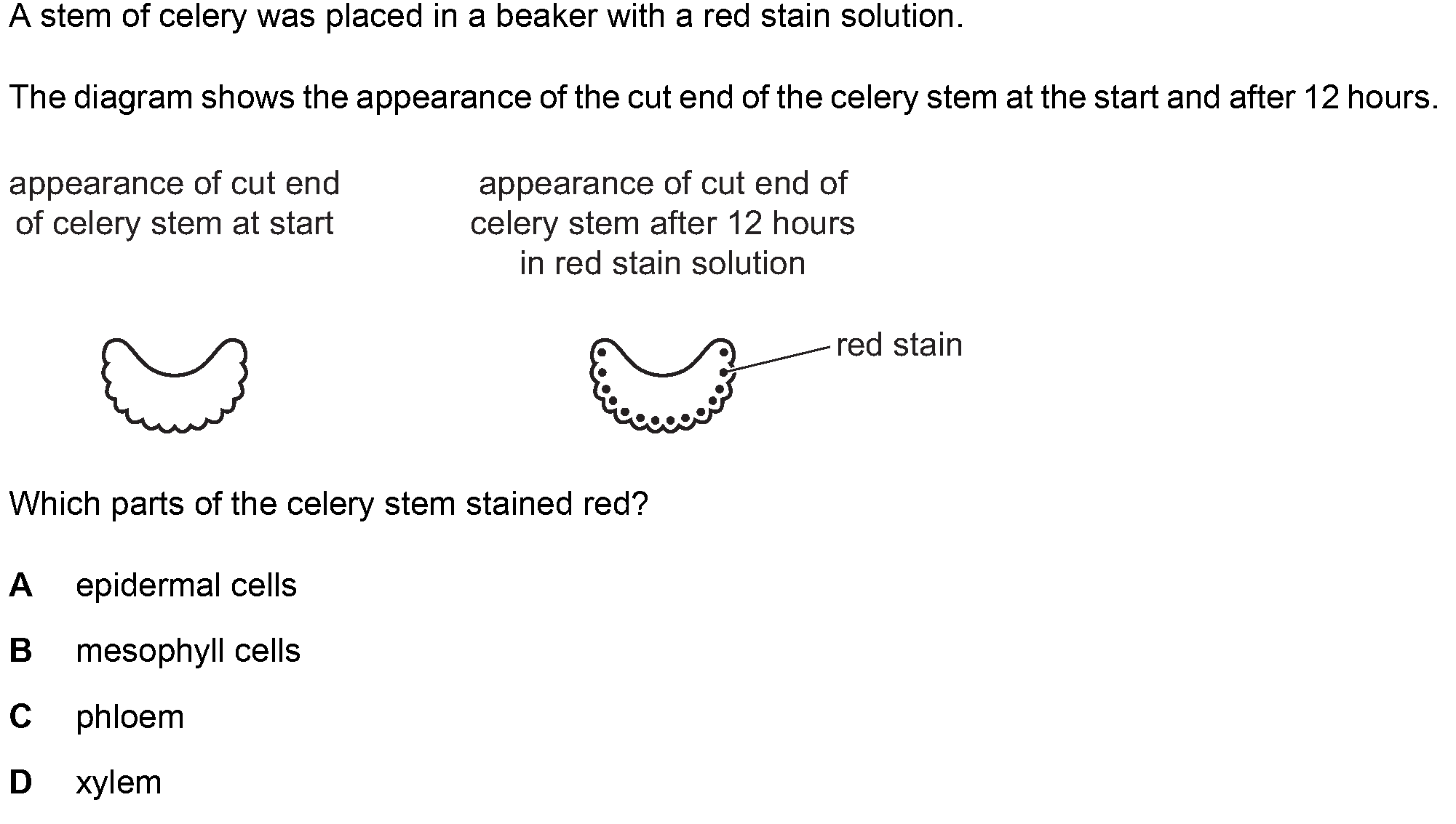
A stem of celery was placed in a beaker with a red stain solution.
The diagram shows the appearance of the cut end of the celery stem at the start and after 12 hours.
appearance of cut end appearance of cut end of
of celery stem at start celery stem after 12 hours
in red stain solution
Which parts of the celery stem stained red?
A epidermal cells
mesophyll cells
phloem
oO ©} W
xylem
Options:
A
B
C
D
Correct Key: D
A
B
C
D
Correct Key: D
Question 2
Paper Ref: 0610/21_Winter_2025_Q3
Paper Ref: 0610/21_Winter_2025_Q3
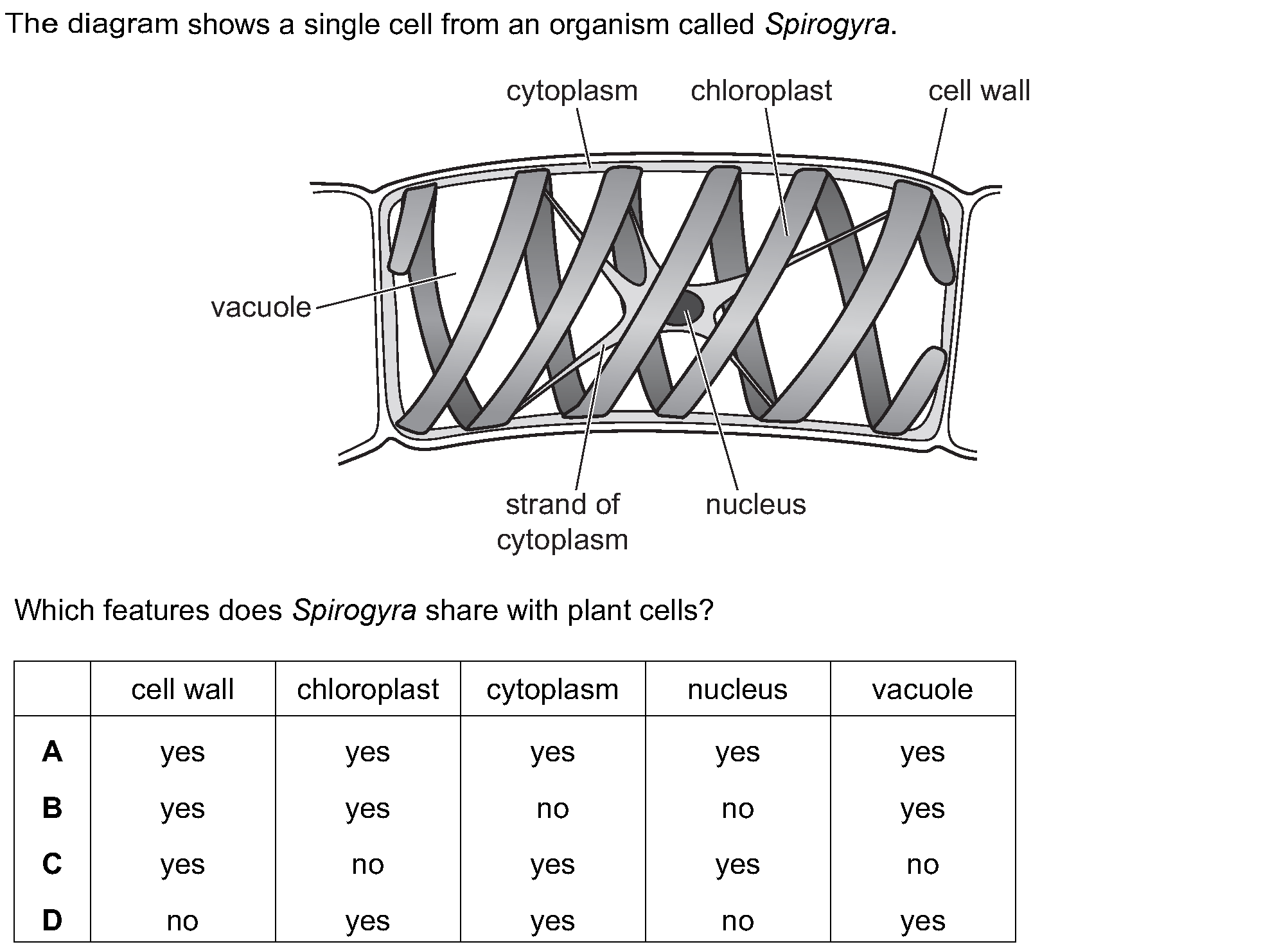
The diagram shows a single cell from an organism called Spirogyra.
cytoplasm — chloroplast cell wall
eee
strand of nucleus
cytoplasm
Which features does Spirogyra share with plant cells?
cell wall chloroplast | cytoplasm nucleus vacuole
A yes yes yes yes yes
B yes yes no no yes
Cc yes no yes yes no
D no yes yes no yes
cytoplasm — chloroplast cell wall
eee
strand of nucleus
cytoplasm
Which features does Spirogyra share with plant cells?
cell wall chloroplast | cytoplasm nucleus vacuole
A yes yes yes yes yes
B yes yes no no yes
Cc yes no yes yes no
D no yes yes no yes
Options:
A
B
C
D
Correct Key: A
A
B
C
D
Correct Key: A
Question 3
Paper Ref: 0610/22_Spring_2021_Q17
Paper Ref: 0610/22_Spring_2021_Q17
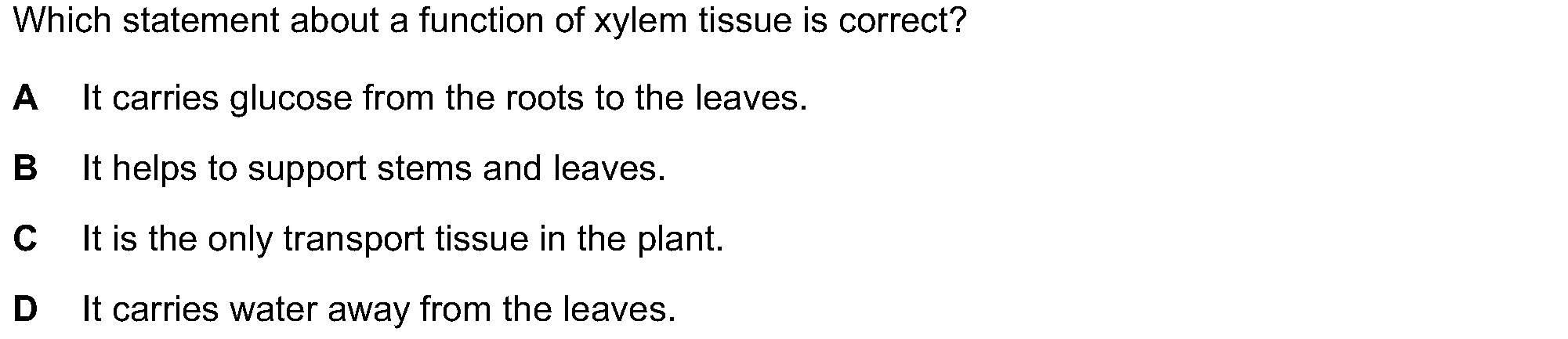
Which statement about a function of xylem tissue is correct?
A
B
Cc
D
It carries glucose from the roots to the leaves.
It helps to support stems and leaves.
It is the only transport tissue in the plant.
It carries water away from the leaves.
A
B
Cc
D
It carries glucose from the roots to the leaves.
It helps to support stems and leaves.
It is the only transport tissue in the plant.
It carries water away from the leaves.
Options:
A
B
C
D
Correct Key: B
A
B
C
D
Correct Key: B
Question 4
Paper Ref: 0610/21_Summer_2009_Q5
Paper Ref: 0610/21_Summer_2009_Q5
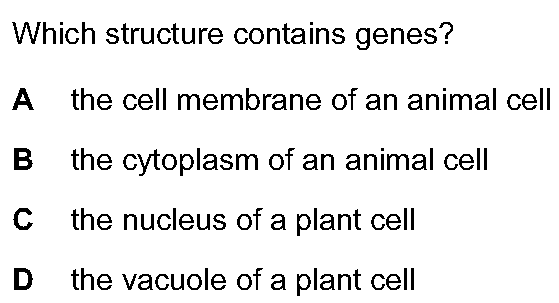
Which structure contains genes?
oo BD
the cell membrane of an animal cell
the cytoplasm of an animal cell
the nucleus of a plant cell
the vacuole of a plant cell
oo BD
the cell membrane of an animal cell
the cytoplasm of an animal cell
the nucleus of a plant cell
the vacuole of a plant cell
Options:
A
B
C
D
Correct Key: C
A
B
C
D
Correct Key: C
Question 5
Paper Ref: 5129/11_Summer_2022_Q6
Paper Ref: 5129/11_Summer_2022_Q6
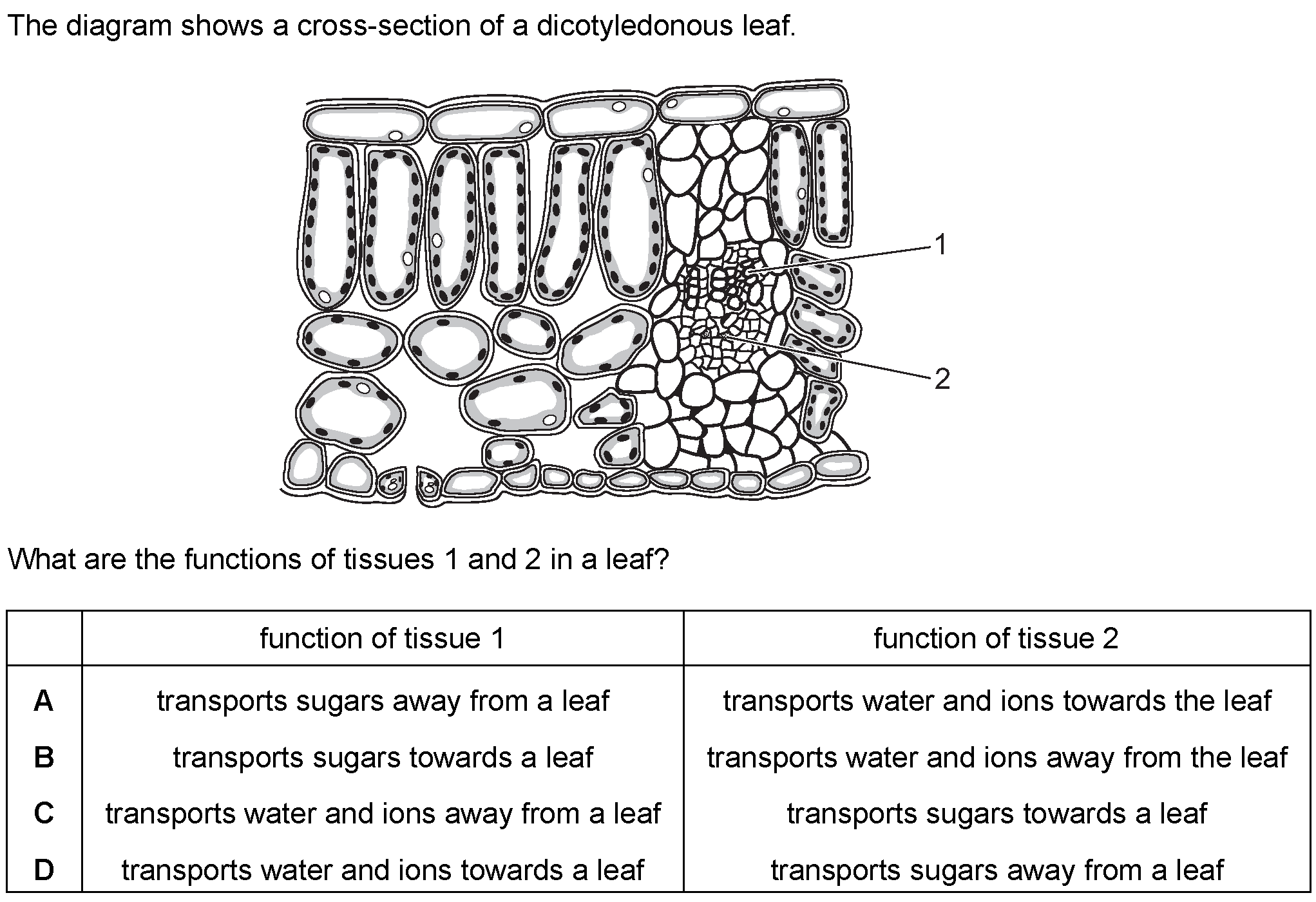
The diagram shows a cross-section of a dicotyledonous leaf.
What are the functions of tissues 1 and 2 in a leaf?
function of tissue 1 function of tissue 2
transports sugars away from a leaf transports water and ions towards the leaf
transports sugars towards a leaf transports water and ions away from the leaf
transports water and ions away from a leaf transports sugars towards a leaf
transports water and ions towards a leaf transports sugars away from a leaf
Options:
A
B
C
D
Correct Key: D
A
B
C
D
Correct Key: D
Question 6
Paper Ref: 0610/12_Winter_2024_Q21
Paper Ref: 0610/12_Winter_2024_Q21
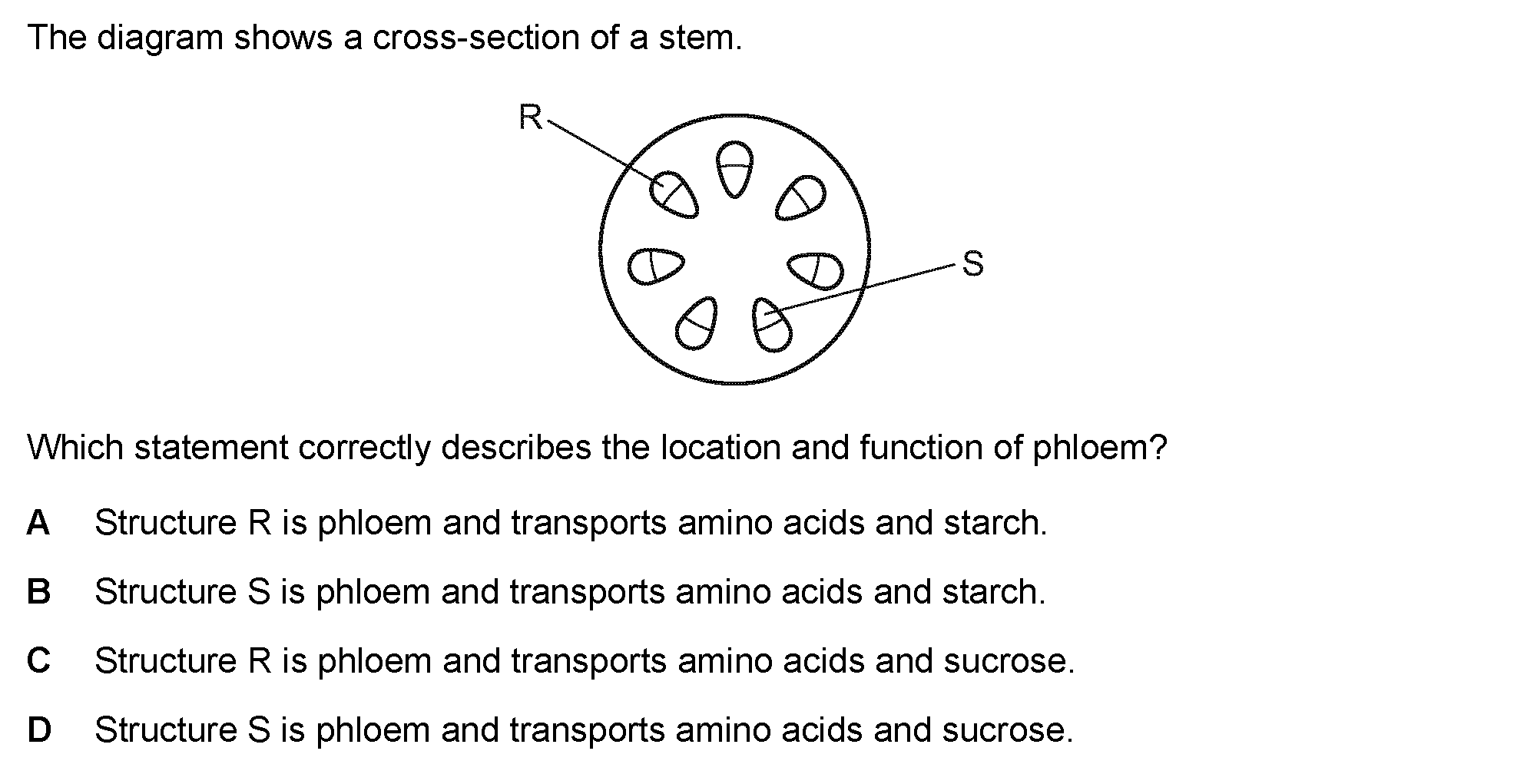
The diagram shows a cross-section of a stem.
R
alo
Co Ds
e
Which statement correctly describes the location and function of phloem?
A
B
Cc
D
Structure R is phloem and transports amino acids and starch.
Structure S is phloem and transports amino acids and starch.
Structure R is phloem and transports amino acids and sucrose.
Structure S is phloem and transports amino acids and sucrose.
Options:
A
B
C
D
Correct Key: C
A
B
C
D
Correct Key: C
Question 7
Paper Ref: 0610/23_Winter_2022_Q16
Paper Ref: 0610/23_Winter_2022_Q16
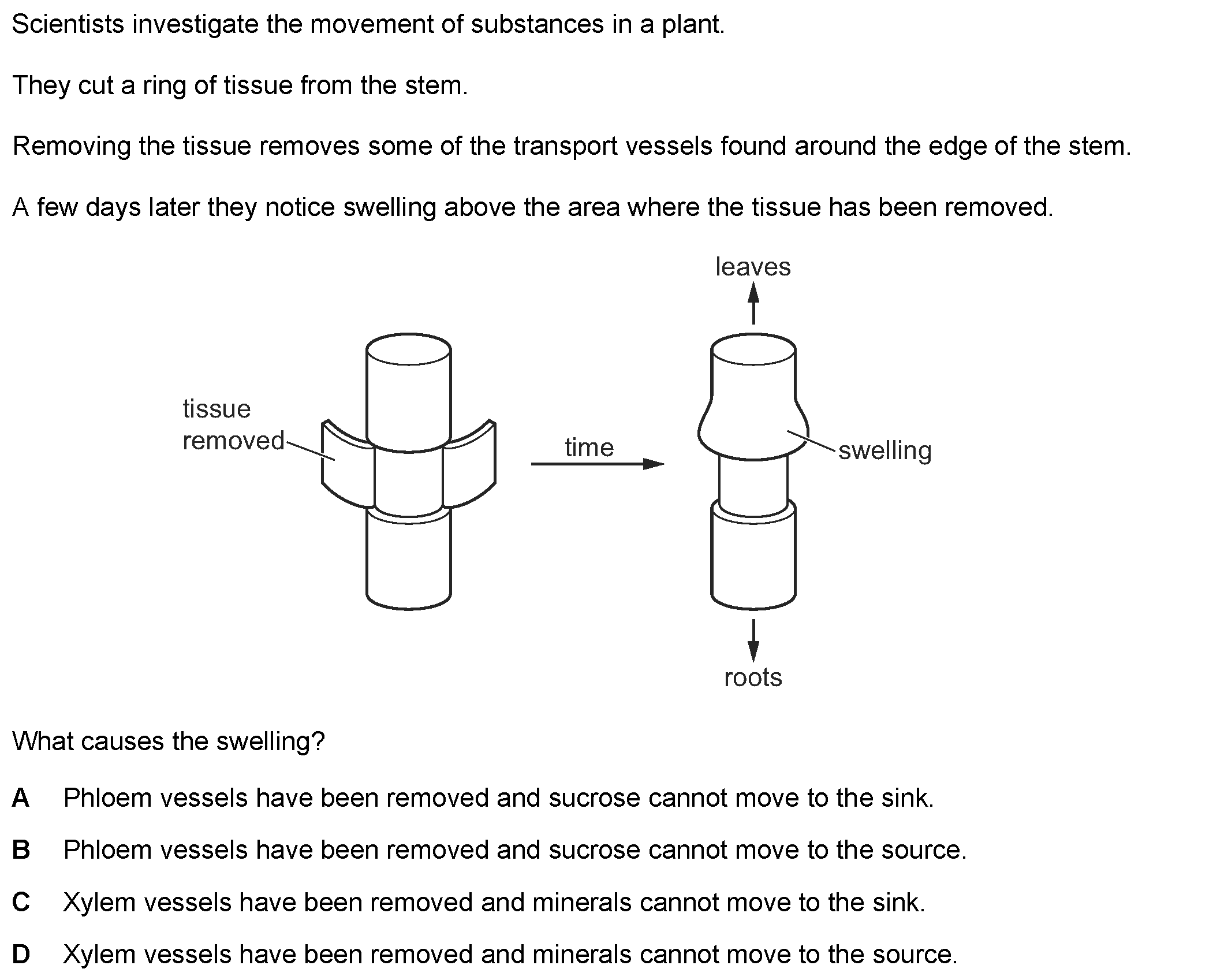
Scientists investigate the movement of substances in a plant.
They cut a ring of tissue from the stem.
Removing the tissue removes some of the transport vessels found around the edge of the stem.
A few days later they notice swelling above the area where the tissue has been removed.
leaves
tissue
removed~ |" time 2~ swelling
roots
What causes the swelling?
Phloem vessels have been removed and sucrose cannot move to the sink.
B_ Phloem vessels have been removed and sucrose cannot move to the source.
C Xylem vessels have been removed and minerals cannot move to the sink.
D Xylem vessels have been removed and minerals cannot move to the source.
Options:
A
B
C
D
Correct Key: A
A
B
C
D
Correct Key: A
Question 8
Paper Ref: 0610/22_Summer_2014_Q9
Paper Ref: 0610/22_Summer_2014_Q9
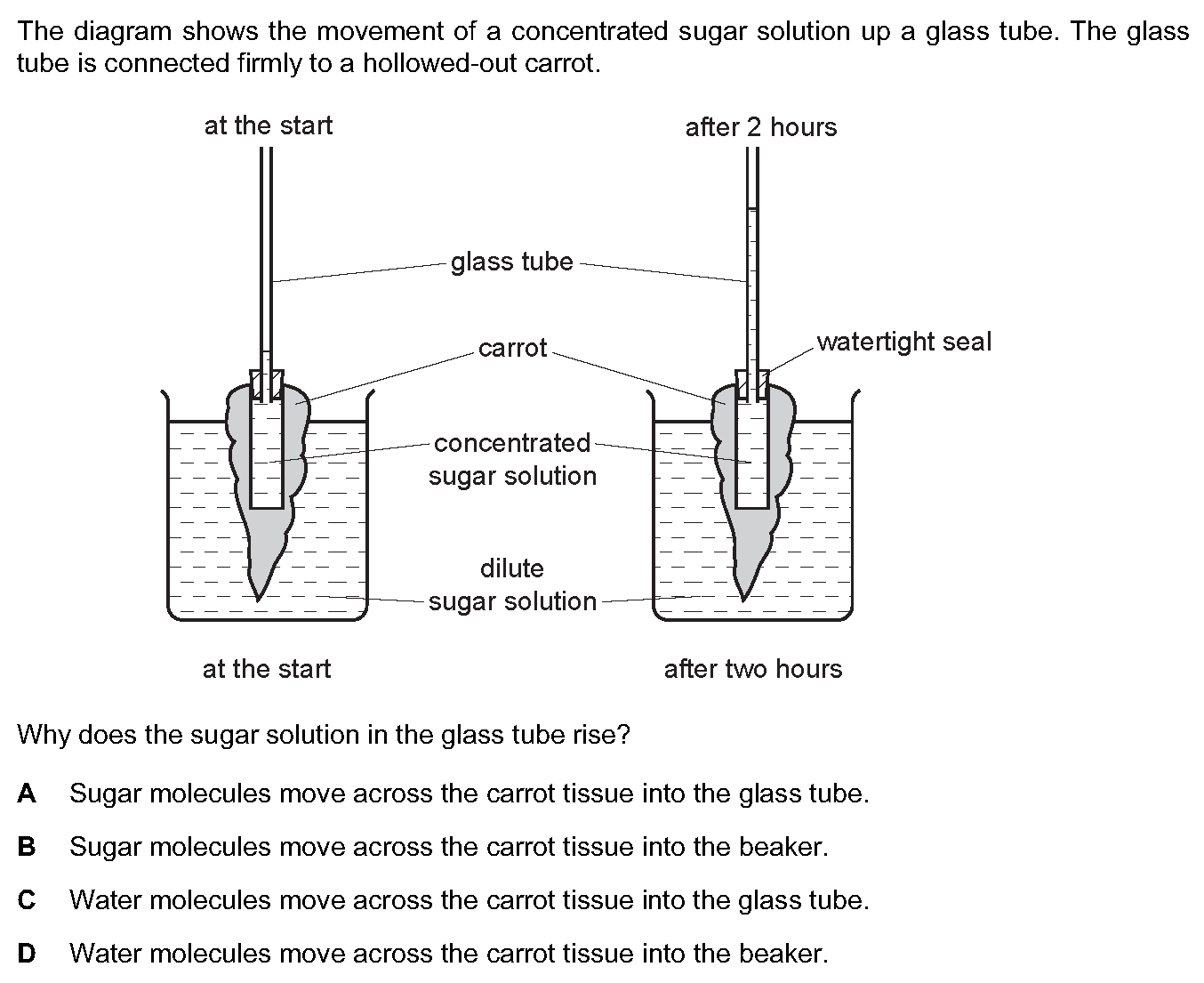
The diagram shows the movement of a concentrated sugar solution up a glass tube. The glass
tube is connected firmly to a hollowed-out carrot.
at the start after 2 hours
glass tube
carrot watertight seal
concentrated
sugar solution
dilute
sugar solution
at the start after two hours
Why does the sugar solution in the glass tube rise?
Sugar molecules move across the carrot tissue into the glass tube.
is]
Sugar molecules move across the carrot tissue into the beaker.
Qa
Water molecules move across the carrot tissue into the glass tube.
i=]
Water molecules move across the carrot tissue into the beaker.
Options:
A
B
C
D
Correct Key: C
A
B
C
D
Correct Key: C
Question 9
Paper Ref: 0610/23_Summer_2020_Q6
Paper Ref: 0610/23_Summer_2020_Q6
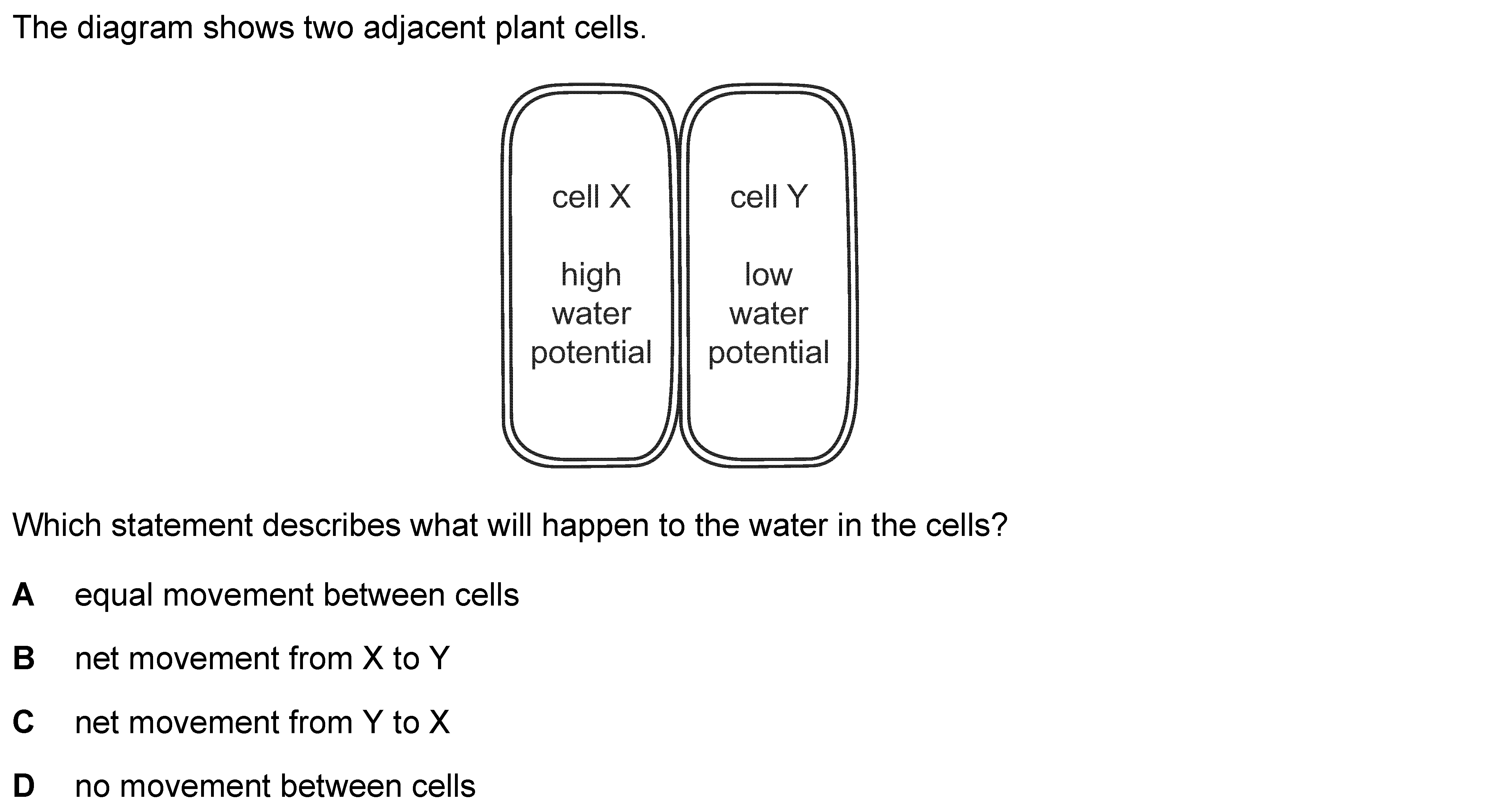
The diagram shows two adjacent plant cells.
cell X cell Y
high low
water water
potential |] potential
Which statement describes what will happen to the water in the cells?
A
B
C
D
equal movement between cells
net movement from X to Y
net movement from Y to X
no movement between cells
cell X cell Y
high low
water water
potential |] potential
Which statement describes what will happen to the water in the cells?
A
B
C
D
equal movement between cells
net movement from X to Y
net movement from Y to X
no movement between cells
Options:
A
B
C
D
Correct Key: B
A
B
C
D
Correct Key: B
Question 10
Paper Ref: 0610/21_Winter_2018_Q15
Paper Ref: 0610/21_Winter_2018_Q15
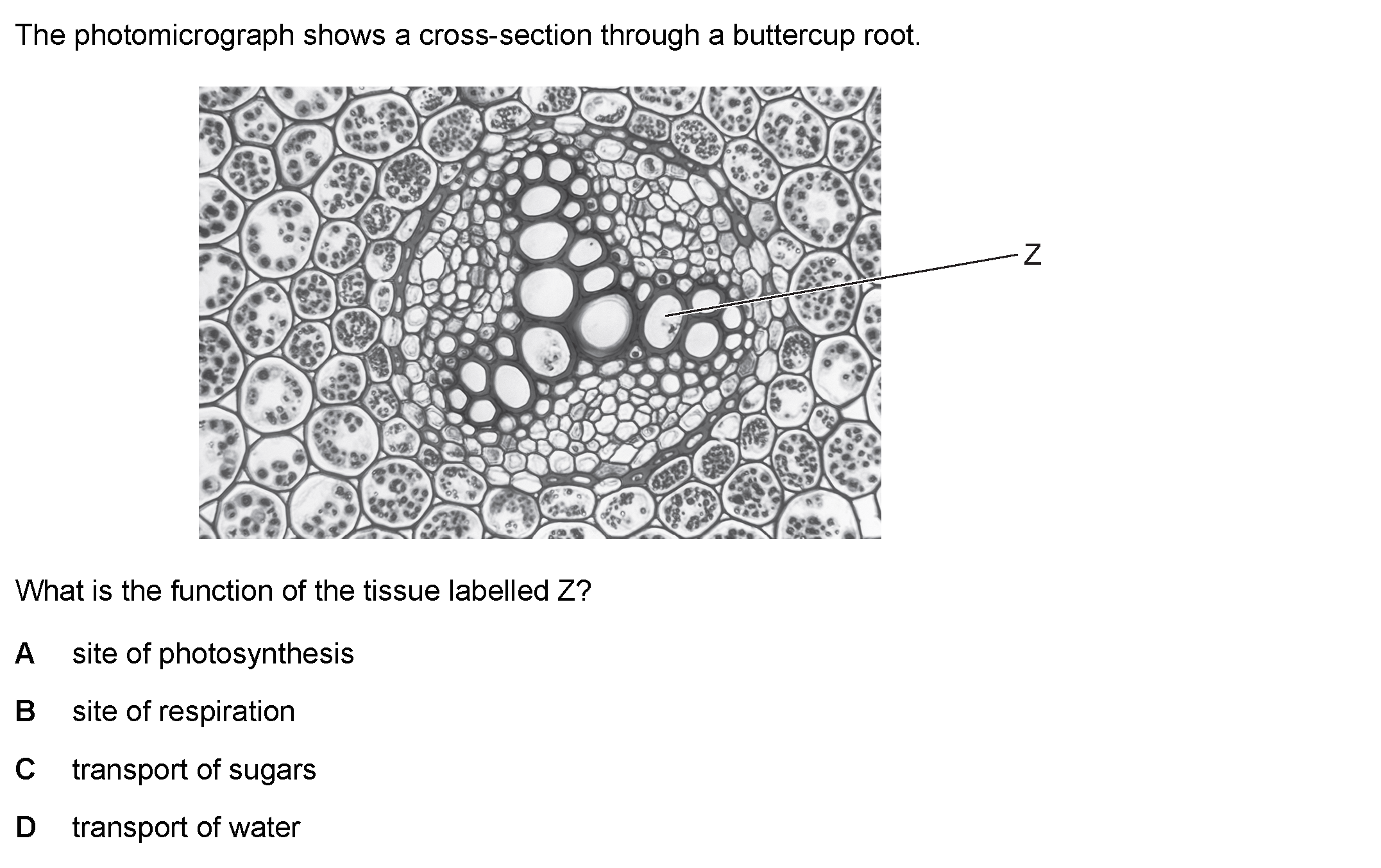
The photomicrograph shows a cross-section through a buttercup root.
What is the function of the tissue labelled Z?
A _ site of photosynthesis
site of respiration
transport of sugars
0 O WW
transport of water
What is the function of the tissue labelled Z?
A _ site of photosynthesis
site of respiration
transport of sugars
0 O WW
transport of water
Options:
A
B
C
D
Correct Key: D
A
B
C
D
Correct Key: D
Question 11
Paper Ref: 0610/22_Summer_2022_Q15
Paper Ref: 0610/22_Summer_2022_Q15
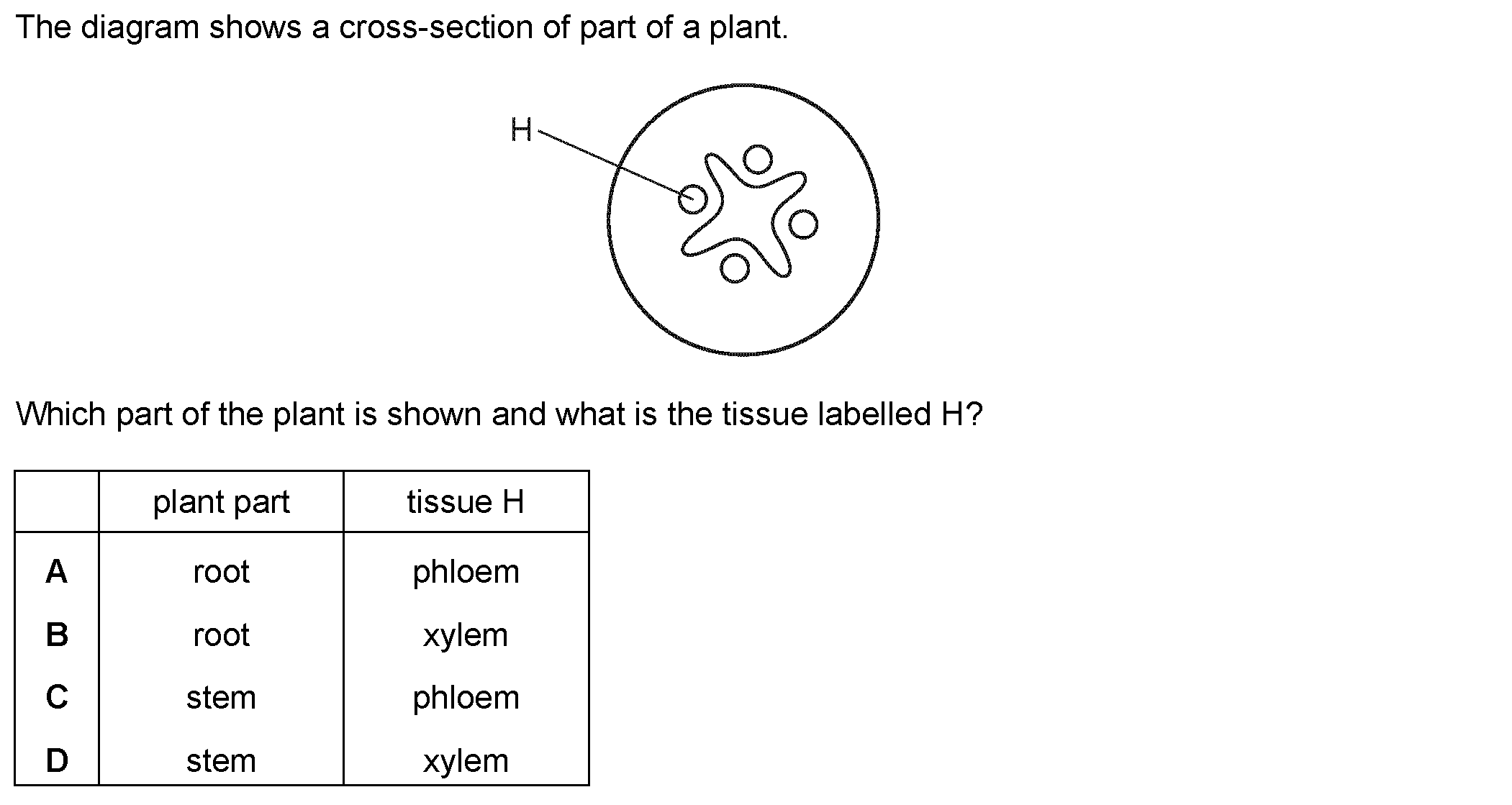
The diagram shows a cross-section of part of a plant.
Which part of the plant is shown and what is the tissue labelled H?
Which part of the plant is shown and what is the tissue labelled H?
Options:
A
B
C
D
Correct Key: A
A
B
C
D
Correct Key: A
Question 12
Paper Ref: 0610/21_Winter_2020_Q16
Paper Ref: 0610/21_Winter_2020_Q16
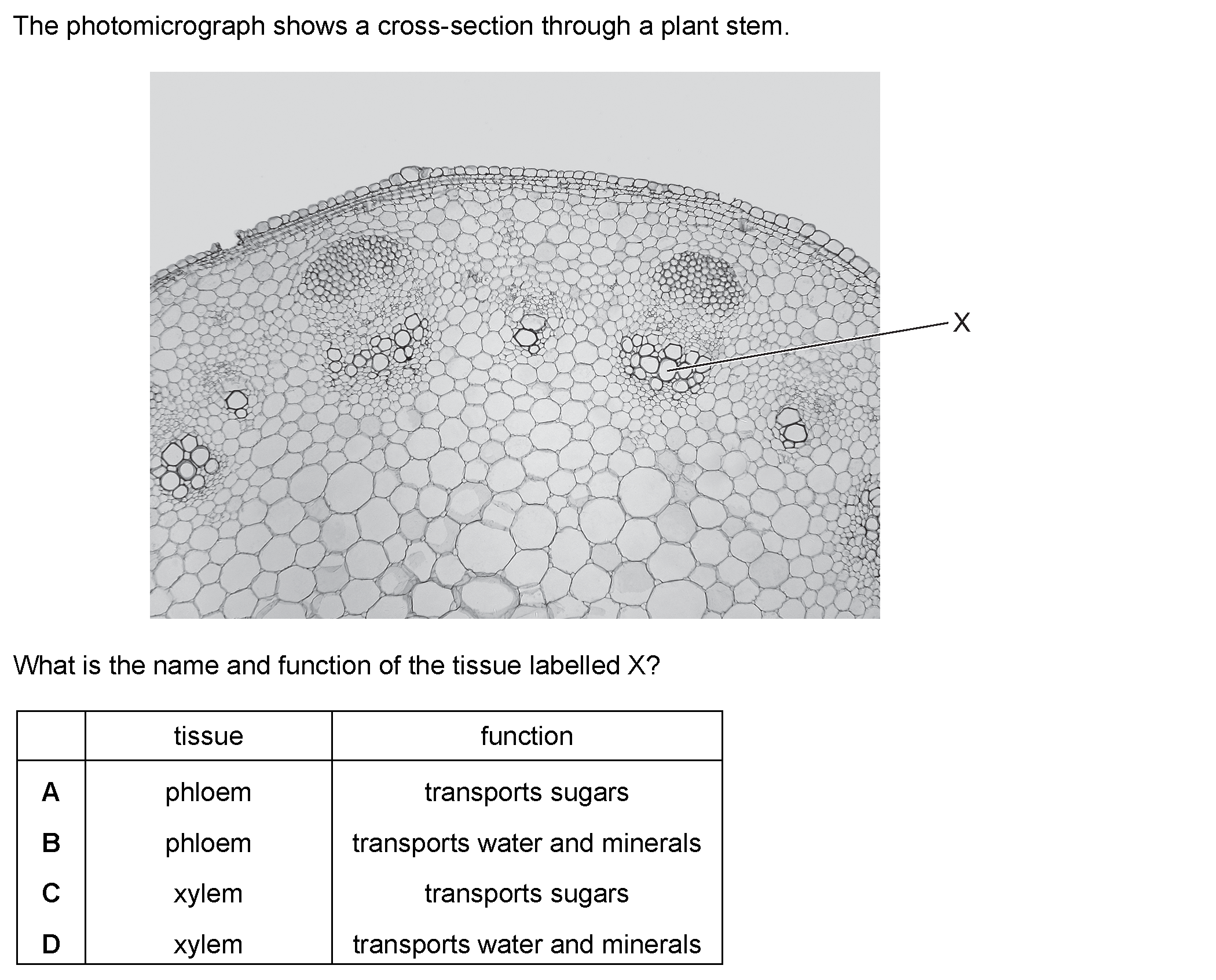
The photomicrograph shows a cross-section through a plant stem.
What is the name and function of the tissue labelled X?
| | tissue function
transports sugars
transports water and minerals
transports sugars
transports water and minerals
What is the name and function of the tissue labelled X?
| | tissue function
transports sugars
transports water and minerals
transports sugars
transports water and minerals
Options:
A
B
C
D
Correct Key: D
A
B
C
D
Correct Key: D
Question 13
Paper Ref: 0610/11_Winter_2020_Q18
Paper Ref: 0610/11_Winter_2020_Q18
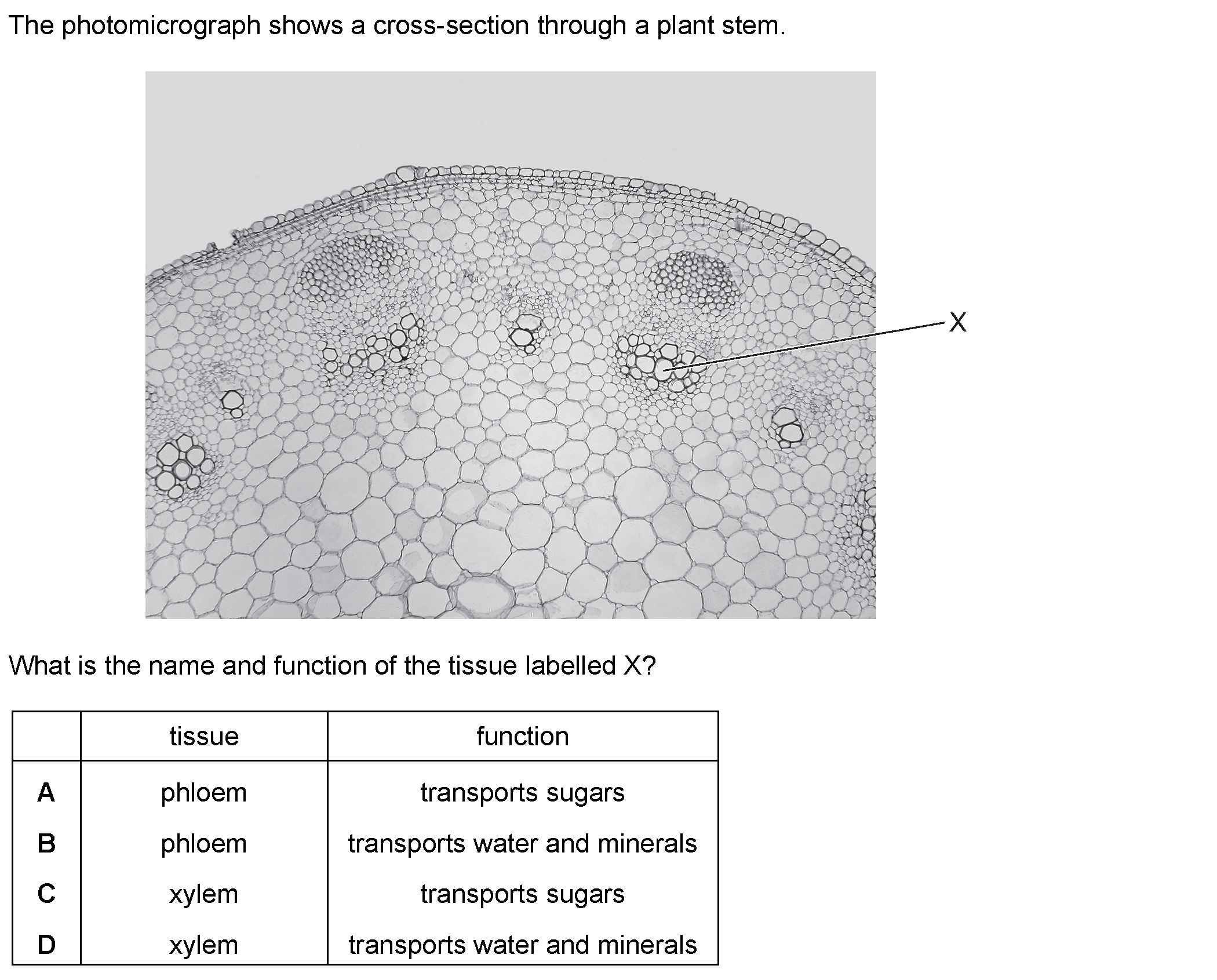
The photomicrograph shows a cross-section through a plant stem.
What is the name and function of the tissue labelled X?
| | tissue function
transports sugars
transports water and minerals
transports sugars
transports water and minerals
What is the name and function of the tissue labelled X?
| | tissue function
transports sugars
transports water and minerals
transports sugars
transports water and minerals
Options:
A
B
C
D
Correct Key: D
A
B
C
D
Correct Key: D
Question 14
Paper Ref: 0610/21_Winter_2018_Q3
Paper Ref: 0610/21_Winter_2018_Q3
Which part of a plant cell controls the movement of substances into and out of the cell?
A cell membrane
Bcell wall
Cc cytoplasm
D
vacuole
A cell membrane
Bcell wall
Cc cytoplasm
D
vacuole
Options:
A
B
C
D
Correct Key: A
A
B
C
D
Correct Key: A
Question 15
Paper Ref: 0610/23_Summer_2024_Q3
Paper Ref: 0610/23_Summer_2024_Q3
Some components of cells are listed.
| cell membrane
cell wall
chloroplasts
KR WwW ND
cytoplasm
Which cell components are present in plant cells but absent in animal cells?
A 1and2 B 1and4 C 2and3 D 3and4
| cell membrane
cell wall
chloroplasts
KR WwW ND
cytoplasm
Which cell components are present in plant cells but absent in animal cells?
A 1and2 B 1and4 C 2and3 D 3and4
Options:
A
B
C
D
Correct Key: C
A
B
C
D
Correct Key: C
Structured Questions Mark Scheme & Answers
•1•.• • • •[•S•P• •S•9• •P•2• • •·• • •Q•1• • •P•a•r•t• •(•a•)• • •·• • •S•p•e•c•i•m•e•n• • •·• • •L•o•w•e•r• •S•e•c• •0•8•9•3•]• • • • • • •d•i•f•f•u•s•i•o•n• •1• •••c•c•e•p•t• •o•s•m•o•s•i•s• •x•y•l•e•m• •(•v•e•s•s•e•l•s•)• •1• •l•e•a•v•e•s• •/• •s•t•o•m•a•t•a• •1•
•2•.• • • •[•S•P• •S•9• •P•2• • •·• • •Q•1• • •P•a•r•t• •(•b•)• • •·• • •S•p•e•c•i•m•e•n• • •·• • •L•o•w•e•r• •S•e•c• •0•8•9•3•]• • • • • • •t•e•m•p•e•r•a•t•u•r•e• •(•o•f• •t•h•e• •a•i•r•)• •1• •a•n•y• •t•w•o• •f•r•o•m• •2• •s•a•m•e• •s•h•o•o•t• •/• •s•a•m•e• •p•l•a•n•t• •s•a•m•e• •n•u•m•b•e•r• •o•f• •l•e•a•v•e•s• •/• •s•u•r•f•a•c•e• •a•r•e•a• •s•a•m•e• •s•p•e•c•i•e•s• •o•f• •p•l•a•n•t• •s•a•m•e• •h•u•m•i•d•i•t•y• •k•e•e•p• •o•u•t• •o•f• •d•r•a•u•g•h•t•s• •t•a•k•e• •m•e•a•s•u•r•e•m•e•n•t•s• •o•v•e•r• •s•a•m•e• •t•i•m•e• •i•n•t•e•r•v•a•l• •s•a•m•e• •a•m•o•u•n•t• •o•f• •l•i•g•h•t• •v•o•l•u•m•e• •o•f• •w•a•t•e•r• •l•o•s•t• •1• •••c•c•e•p•t• •a•m•o•u•n•t• •f•o•r• •v•o•l•u•m•e• •i•n• •a• •g•i•v•e•n• •t•i•m•e• •••c•c•e•p•t• •r•e•f•e•r•e•n•c•e• •t•o• •h•o•w• •f•a•r• •t•h•e• •w•a•t•e•r• •l•e•v•e•l• •d•r•o•p•s• •o•r• •t•i•m•e• •t•a•k•e•n• •t•o• •l•o•s•e• •a• •f•i•x•e•d• •v•o•l•u•m•e• •o•f• •w•a•t•e•r• •a•s• •t•e•m•p•e•r•a•t•u•r•e• •(•o•f• •t•h•e• •a•i•r•)• •i•n•c•r•e•a•s•e•s• •t•h•e• •r•a•t•e• •o•f• •t•r•a•n•s•p•i•r•a•t•i•o•n• •1• •N•o•t•e• •a•n•s•w•e•r• •m•u•s•t• •b•e• •c•o•m•p•a•r•a•t•i•v•e• •i•n•c•r•e•a•s•e•s• •/• •o•r•a• •©• •U•C•L•E•S• •2•0•2•0• •P•a•g•e• •3• •o•f• •1•0• •S•9•/•0•2• •S•c•i•e•n•c•e• •S•t•a•g•e• •9• •P•a•p•e•r• •2• •M•a•r•k• •S•c•h•e•m•e• •F•r•o•m• •2•0•2•0•
•3•.• • • •[•S•P• •S•9• •P•2• • •·• • •Q•1• • •P•a•r•t• •(•b•)• • •·• • •S•p•e•c•i•m•e•n• • •·• • •L•o•w•e•r• •S•e•c• •0•8•9•3•]• • • • • • •t•e•m•p•e•r•a•t•u•r•e• •(•o•f• •t•h•e• •a•i•r•)• •1• •a•n•y• •t•w•o• •f•r•o•m• •2• •s•a•m•e• •s•h•o•o•t• •/• •s•a•m•e• •p•l•a•n•t• •s•a•m•e• •n•u•m•b•e•r• •o•f• •l•e•a•v•e•s• •/• •s•u•r•f•a•c•e• •a•r•e•a• •s•a•m•e• •s•p•e•c•i•e•s• •o•f• •p•l•a•n•t• •s•a•m•e• •h•u•m•i•d•i•t•y• •k•e•e•p• •o•u•t• •o•f• •d•r•a•u•g•h•t•s• •t•a•k•e• •m•e•a•s•u•r•e•m•e•n•t•s• •o•v•e•r• •s•a•m•e• •t•i•m•e• •i•n•t•e•r•v•a•l• •s•a•m•e• •a•m•o•u•n•t• •o•f• •l•i•g•h•t• •v•o•l•u•m•e• •o•f• •w•a•t•e•r• •l•o•s•t• •1• •••c•c•e•p•t• •a•m•o•u•n•t• •f•o•r• •v•o•l•u•m•e• •i•n• •a• •g•i•v•e•n• •t•i•m•e• •••c•c•e•p•t• •r•e•f•e•r•e•n•c•e• •t•o• •h•o•w• •f•a•r• •t•h•e• •w•a•t•e•r• •l•e•v•e•l• •d•r•o•p•s• •o•r• •t•i•m•e• •t•a•k•e•n• •t•o• •l•o•s•e• •a• •f•i•x•e•d• •v•o•l•u•m•e• •o•f• •w•a•t•e•r• •a•s• •t•e•m•p•e•r•a•t•u•r•e• •(•o•f• •t•h•e• •a•i•r•)• •i•n•c•r•e•a•s•e•s• •t•h•e• •r•a•t•e• •o•f• •t•r•a•n•s•p•i•r•a•t•i•o•n• •1• •N•o•t•e• •a•n•s•w•e•r• •m•u•s•t• •b•e• •c•o•m•p•a•r•a•t•i•v•e• •i•n•c•r•e•a•s•e•s• •/• •o•r•a• •©• •U•C•L•E•S• •2•0•2•0• •P•a•g•e• •3• •o•f• •1•0• •S•9•/•0•2• •S•c•i•e•n•c•e• •S•t•a•g•e• •9• •P•a•p•e•r• •2• •M•a•r•k• •S•c•h•e•m•e• •F•r•o•m• •2•0•2•0•
•4•.• • • •[•P•R•I• •2•0•0•7•B• •P•2• • •·• • •Q•2• • •P•a•r•t• •(•a•)• • •·• • •2•0•0•7• • •·• • •P•r•i•m•a•r•y• •0•8•4•6•]• • • • • • •(•n•o• •p•u•b•l•i•s•h•e•d• •m•a•r•k• •s•c•h•e•m•e• •f•o•r• •t•h•i•s• •p•a•p•e•r•)•
•5•.• • • •[•P•R•I• •2•0•0•7•B• •P•2• • •·• • •Q•2• • •P•a•r•t• •(•b•)• • •·• • •2•0•0•7• • •·• • •P•r•i•m•a•r•y• •0•8•4•6•]• • • • • • •(•n•o• •p•u•b•l•i•s•h•e•d• •m•a•r•k• •s•c•h•e•m•e• •f•o•r• •t•h•i•s• •p•a•p•e•r•)•
•6•.• • • •[•P•R•I• •2•0•0•8•B• •P•2• • •·• • •Q•3• • •P•a•r•t• •(•a•)• • •·• • •2•0•0•8• • •·• • •P•r•i•m•a•r•y• •0•8•4•6•]• • • • • • •(•n•o• •p•u•b•l•i•s•h•e•d• •m•a•r•k• •s•c•h•e•m•e• •f•o•r• •t•h•i•s• •p•a•p•e•r•)•
•7•.• • • •[•P•R•I• •2•0•0•8•B• •P•2• • •·• • •Q•3• • •P•a•r•t• •(•b•)• • •·• • •2•0•0•8• • •·• • •P•r•i•m•a•r•y• •0•8•4•6•]• • • • • • •(•n•o• •p•u•b•l•i•s•h•e•d• •m•a•r•k• •s•c•h•e•m•e• •f•o•r• •t•h•i•s• •p•a•p•e•r•)•
•8•.• • • •[•P•R•I• •2•0•0•8•B• •P•2• • •·• • •Q•3• • •P•a•r•t• •(•c•)• • •·• • •2•0•0•8• • •·• • •P•r•i•m•a•r•y• •0•8•4•6•]• • • • • • •(•n•o• •p•u•b•l•i•s•h•e•d• •m•a•r•k• •s•c•h•e•m•e• •f•o•r• •t•h•i•s• •p•a•p•e•r•)•
Last updated:
\n