5.5Electricity and Magnetism
Rearranging atoms — Question Bank (Cambridge) — Cambridge IGCSE Physics 0625 Revision Notes & Topical Questions
10 min read Lesson 61 of 65 Unit quiz
Cambridge Past Paper Bank
5.5 Rearranging atoms
14 Multiple-Choice Questions with Official Mark Schemes
Question 1
0620/21_Winter_2023_Q7
Question 2
0620/21_Summer_2022_Q9
Question 3
0620/13_Summer_2017_Q12
Question 4
0620/23_Summer_2017_Q7
Question 5
0620/12_Spring_2022_Q12
Question 6
0620/12_Winter_2018_Q9
Question 7
0620/11_Winter_2017_Q9
Question 8
0620/22_Spring_2025_Q10
Question 9
0620/11_Summer_2024_Q9
Question 10
0620/21_Winter_2024_Q10
Question 11
0620/22_Spring_2021_Q10
Question 12
0620/21_Winter_2020_Q11
Question 13
0620/22_Summer_2013_Q7
Question 14
0620/23_Summer_2012_Q8
Cambridge Lower Secondary Stage 9
5.5 Rearranging atoms – Complete Question Bank & Mark Scheme
Total Questions14 Questions with Verified Solutions & Past Paper Mark Schemes
Multiple Choice Questions (Exam Practice)
Question 1
Paper Ref: 0620/21_Winter_2023_Q7
Paper Ref: 0620/21_Winter_2023_Q7
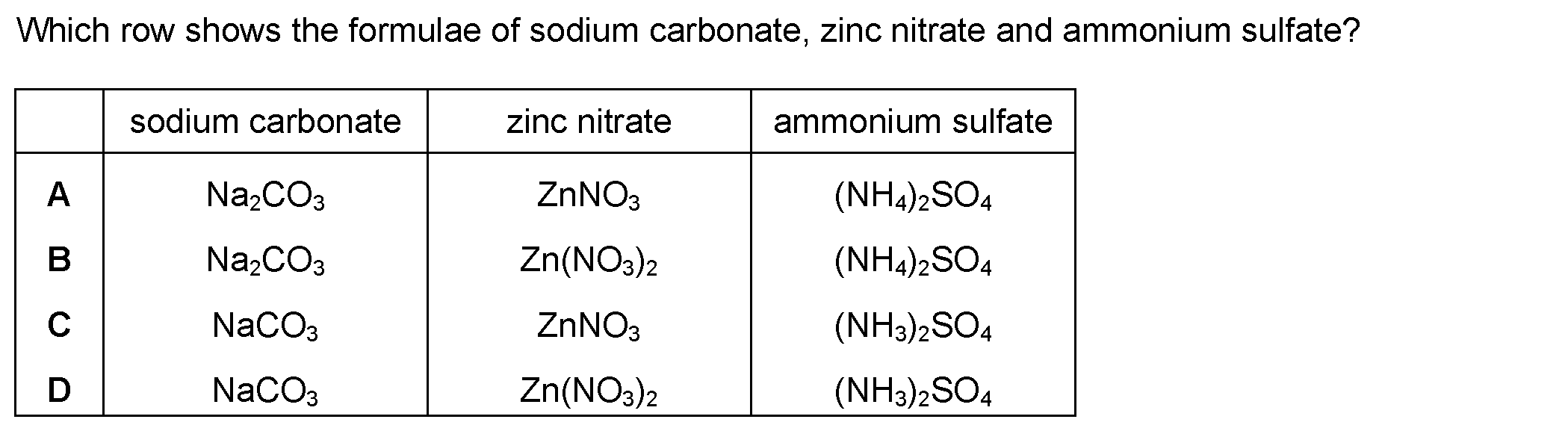
Which row shows the formulae of sodium carbonate, zinc nitrate and ammonium sulfate?
— sodium carbonate zinc nitrate ammonium sulfate
— sodium carbonate zinc nitrate ammonium sulfate
Options:
A
B
C
D
Correct Key: B
A
B
C
D
Correct Key: B
Question 2
Paper Ref: 0620/21_Summer_2022_Q9
Paper Ref: 0620/21_Summer_2022_Q9
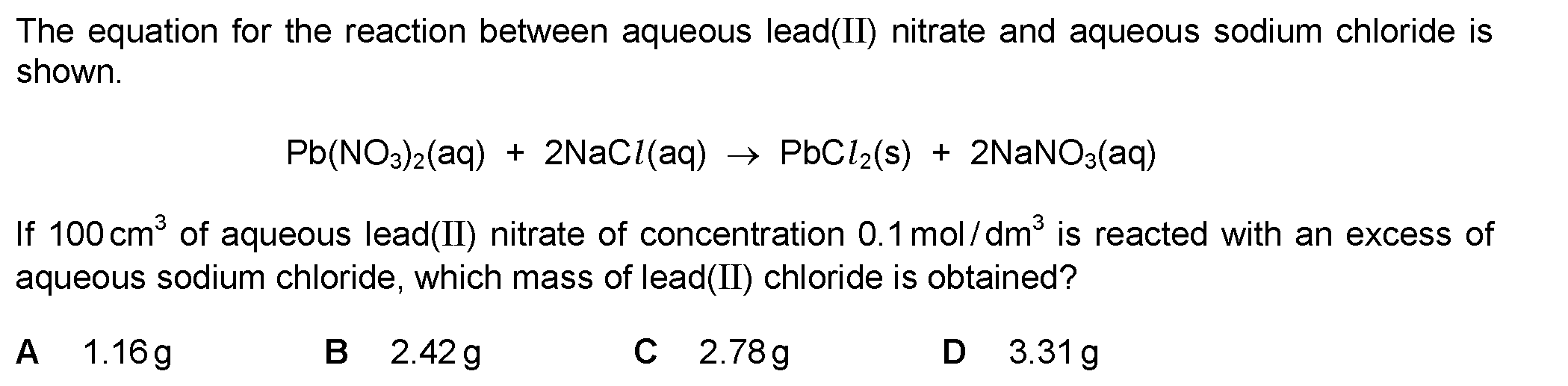
The equation for the reaction between aqueous lead(II) nitrate and aqueous sodium chloride is
shown.
Pb(NOs3)2(aq) + 2NaCl(aq) > PbCi2(s) + 2NaNO3;(aq)
If 100cm? of aqueous lead(II) nitrate of concentration 0.1 mol/dm? is reacted with an excess of
aqueous sodium chloride, which mass of lead(II) chloride is obtained?
A 1.169 B 242g C 278g D 331g
shown.
Pb(NOs3)2(aq) + 2NaCl(aq) > PbCi2(s) + 2NaNO3;(aq)
If 100cm? of aqueous lead(II) nitrate of concentration 0.1 mol/dm? is reacted with an excess of
aqueous sodium chloride, which mass of lead(II) chloride is obtained?
A 1.169 B 242g C 278g D 331g
Options:
A
B
C
D
Correct Key: C
A
B
C
D
Correct Key: C
Question 3
Paper Ref: 0620/13_Summer_2017_Q12
Paper Ref: 0620/13_Summer_2017_Q12
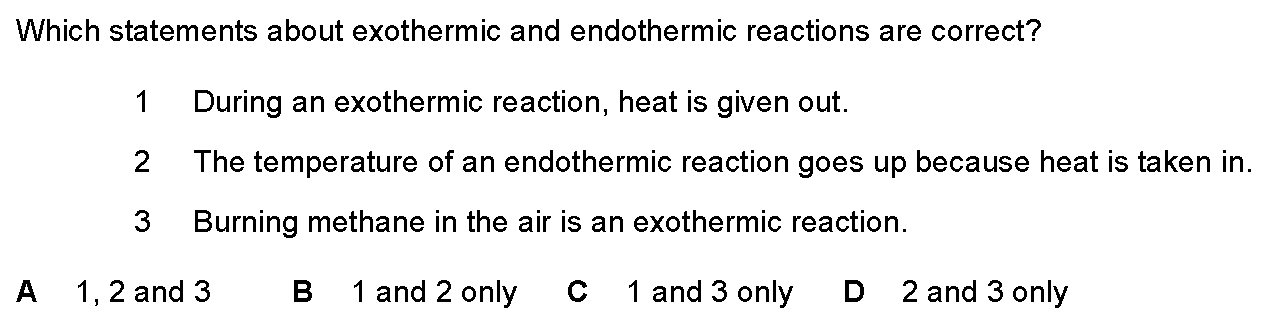
Which statements about exothermic and endothermic reactions are correct?
1 During an exothermic reaction, heat is given out.
2 The temperature of an endothermic reaction goes up because heat is taken in.
3 Burning methane in the air is an exothermic reaction.
A 1,2and3 B tand2only C tand3only D 2and3only
1 During an exothermic reaction, heat is given out.
2 The temperature of an endothermic reaction goes up because heat is taken in.
3 Burning methane in the air is an exothermic reaction.
A 1,2and3 B tand2only C tand3only D 2and3only
Options:
A
B
C
D
Correct Key: C
A
B
C
D
Correct Key: C
Question 4
Paper Ref: 0620/23_Summer_2017_Q7
Paper Ref: 0620/23_Summer_2017_Q7
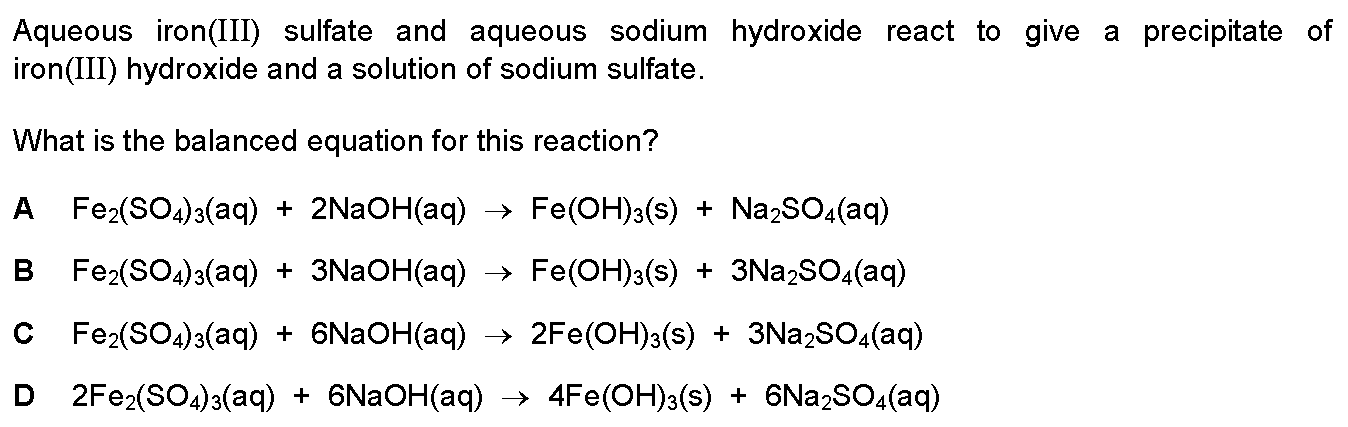
Aqueous iron(II) sulfate and aqueous sodium hydroxide react to give a precipitate of
iron(II hydroxide and a solution of sodium sulfate.
What is the balanced equation for this reaction?
A Fe2(SO,.)3(aq) + 2NaOH(aq) > Fe(OH)a(s) + NazSO,(aq)
B Fe2(S$O,)3(aq) + 3NaOH(aq) > Fe(OH)s(s) + 3Na2SO,(aq)
C Fe2(SO4)3(aq) + 6NaOH(aq) > 2Fe(OH)3(s) + 3NazSOx(aq)
D 2Fe2(SO.)3(aq) + 6NaOH(aq) > 4Fe(OH)3(s) + 6NazSOx(aq)
Options:
A
B
C
D
Correct Key: C
A
B
C
D
Correct Key: C
Question 5
Paper Ref: 0620/12_Spring_2022_Q12
Paper Ref: 0620/12_Spring_2022_Q12
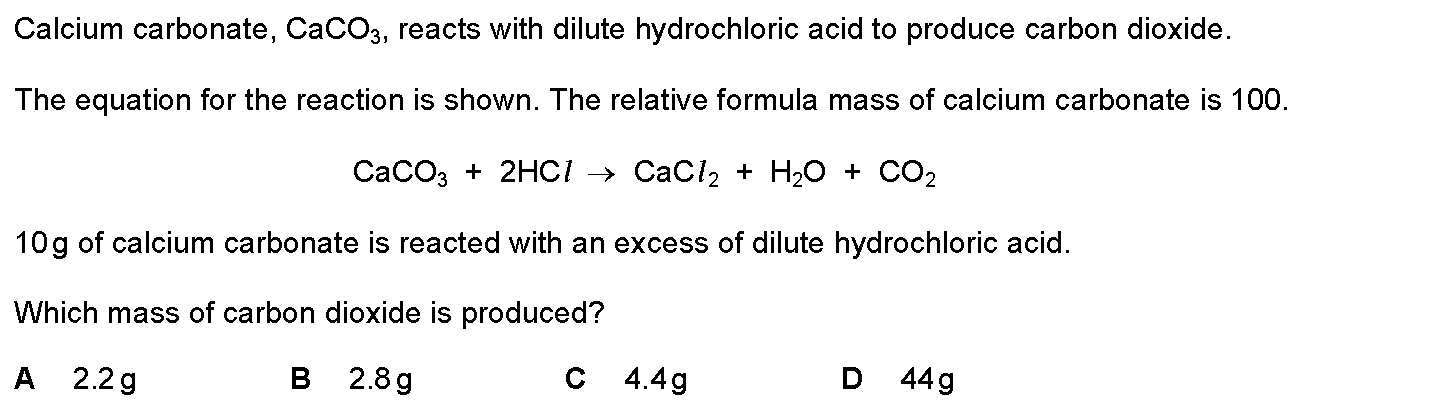
Calcium carbonate, CaCQs, reacts with dilute hydrochloric acid to produce carbon dioxide.
The equation for the reaction is shown. The relative formula mass of calcium carbonate is 100.
CaCO; + 2HCI > CaCl, + H.0 + CO,
10g of calcium carbonate is reacted with an excess of dilute hydrochloric acid.
Which mass of carbon dioxide is produced?
A 2.2g B 2.89 C 44g D 44g
The equation for the reaction is shown. The relative formula mass of calcium carbonate is 100.
CaCO; + 2HCI > CaCl, + H.0 + CO,
10g of calcium carbonate is reacted with an excess of dilute hydrochloric acid.
Which mass of carbon dioxide is produced?
A 2.2g B 2.89 C 44g D 44g
Options:
A
B
C
D
Correct Key: C
A
B
C
D
Correct Key: C
Question 6
Paper Ref: 0620/12_Winter_2018_Q9
Paper Ref: 0620/12_Winter_2018_Q9
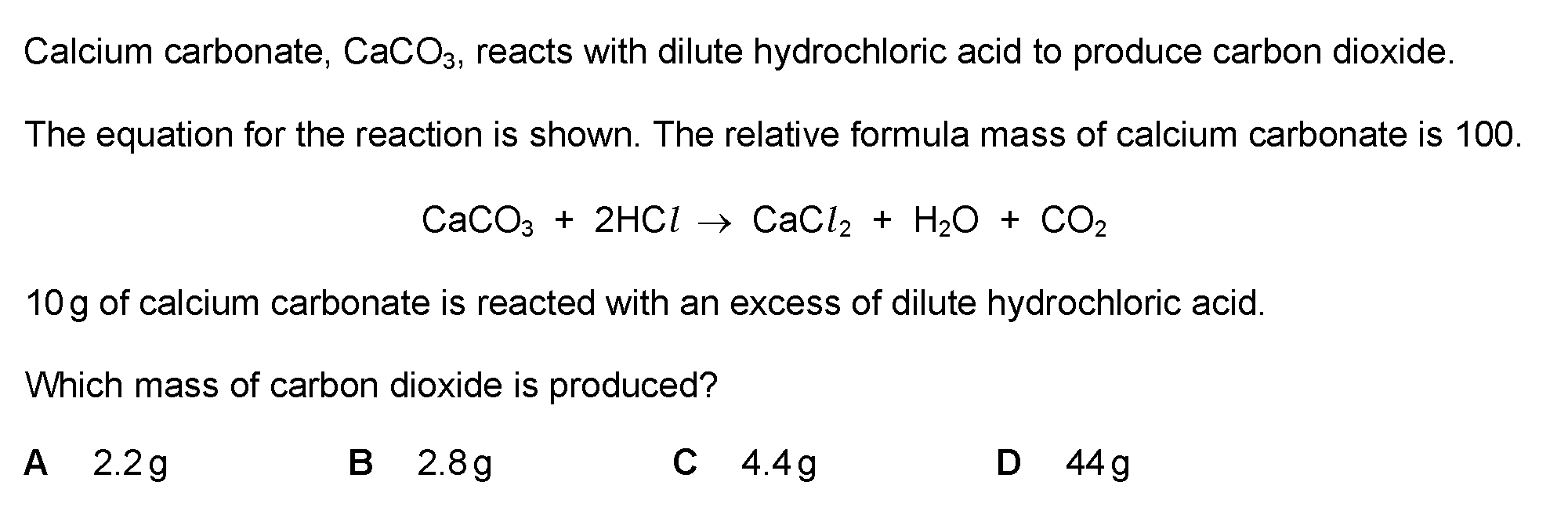
Calcium carbonate, CaCOs, reacts with dilute hydrochloric acid to produce carbon dioxide.
The equation for the reaction is shown. The relative formula mass of calcium carbonate is 100.
CaCO, + 2HCI > CaCl, + H,O0 + CO,
10g of calcium carbonate is reacted with an excess of dilute hydrochloric acid.
Which mass of carbon dioxide is produced?
A 22g B 28g C 44g D 44g
The equation for the reaction is shown. The relative formula mass of calcium carbonate is 100.
CaCO, + 2HCI > CaCl, + H,O0 + CO,
10g of calcium carbonate is reacted with an excess of dilute hydrochloric acid.
Which mass of carbon dioxide is produced?
A 22g B 28g C 44g D 44g
Options:
A
B
C
D
Correct Key: C
A
B
C
D
Correct Key: C
Question 7
Paper Ref: 0620/11_Winter_2017_Q9
Paper Ref: 0620/11_Winter_2017_Q9
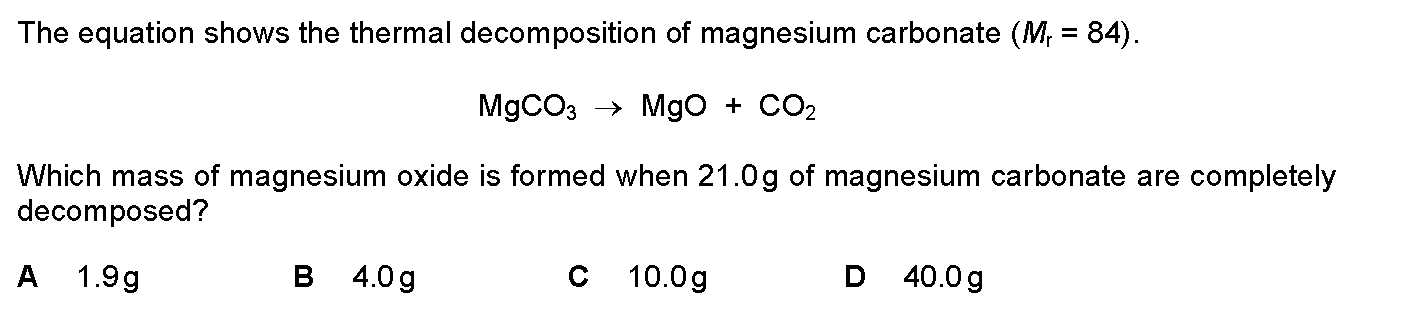
The equation shows the thermal decomposition of magnesium carbonate (M, = 84).
MgCOz3 — MgO + CO,
Which mass of magnesium oxide is formed when 21.0g of magnesium carbonate are completely
decomposed?
A 199 B 40g C 10.0g D 40.0g
MgCOz3 — MgO + CO,
Which mass of magnesium oxide is formed when 21.0g of magnesium carbonate are completely
decomposed?
A 199 B 40g C 10.0g D 40.0g
Options:
A
B
C
D
Correct Key: C
A
B
C
D
Correct Key: C
Question 8
Paper Ref: 0620/22_Spring_2025_Q10
Paper Ref: 0620/22_Spring_2025_Q10
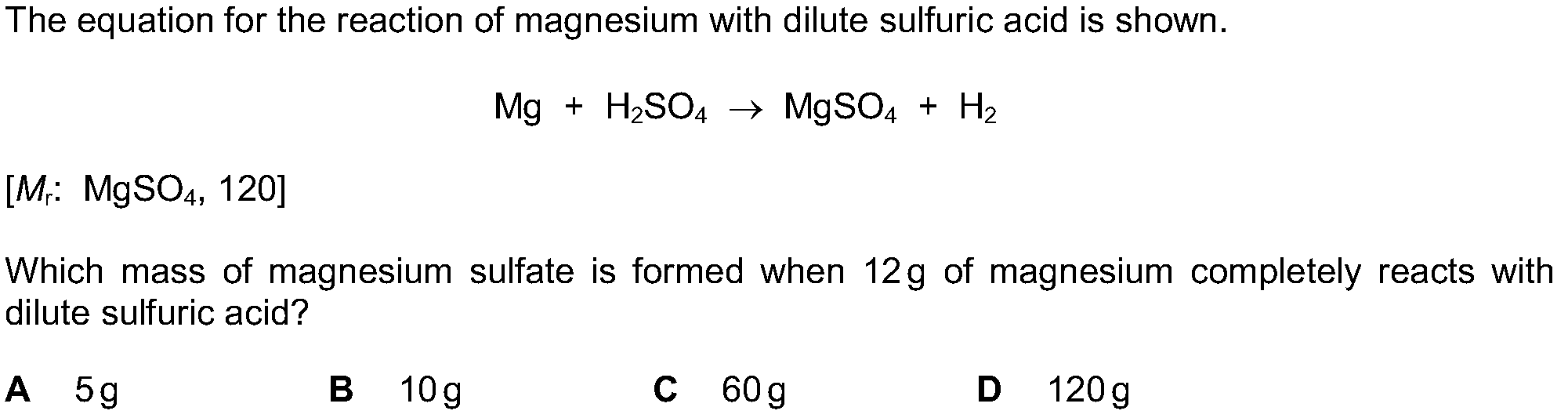
The equation for the reaction of magnesium with dilute sulfuric acid is shown.
[M,: MgSQ,, 120]
Which mass of magnesium sulfate is formed when 12g of magnesium completely reacts with
dilute sulfuric acid?
A 5g B 10g C 60g D 120g
[M,: MgSQ,, 120]
Which mass of magnesium sulfate is formed when 12g of magnesium completely reacts with
dilute sulfuric acid?
A 5g B 10g C 60g D 120g
Options:
A
B
C
D
Correct Key: C
A
B
C
D
Correct Key: C
Question 9
Paper Ref: 0620/11_Summer_2024_Q9
Paper Ref: 0620/11_Summer_2024_Q9
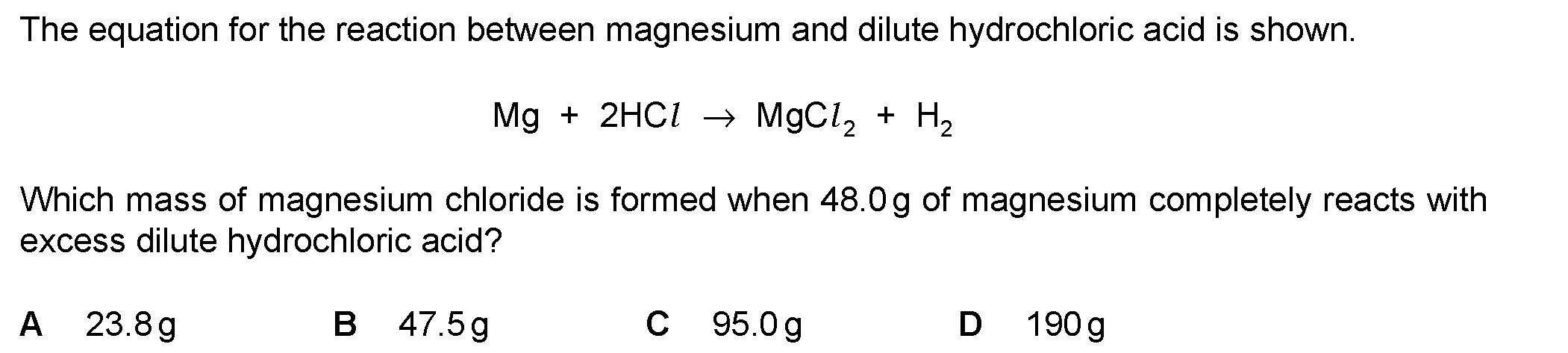
The equation for the reaction between magnesium and dilute hydrochloric acid is shown.
Mg + 2HCI > MgCl, + H,
Which mass of magnesium chloride is formed when 48.0g of magnesium completely reacts with
excess dilute hydrochloric acid?
A 23.89 B 47.59 C 95.0g D 190g
Mg + 2HCI > MgCl, + H,
Which mass of magnesium chloride is formed when 48.0g of magnesium completely reacts with
excess dilute hydrochloric acid?
A 23.89 B 47.59 C 95.0g D 190g
Options:
A
B
C
D
Correct Key: D
A
B
C
D
Correct Key: D
Question 10
Paper Ref: 0620/21_Winter_2024_Q10
Paper Ref: 0620/21_Winter_2024_Q10
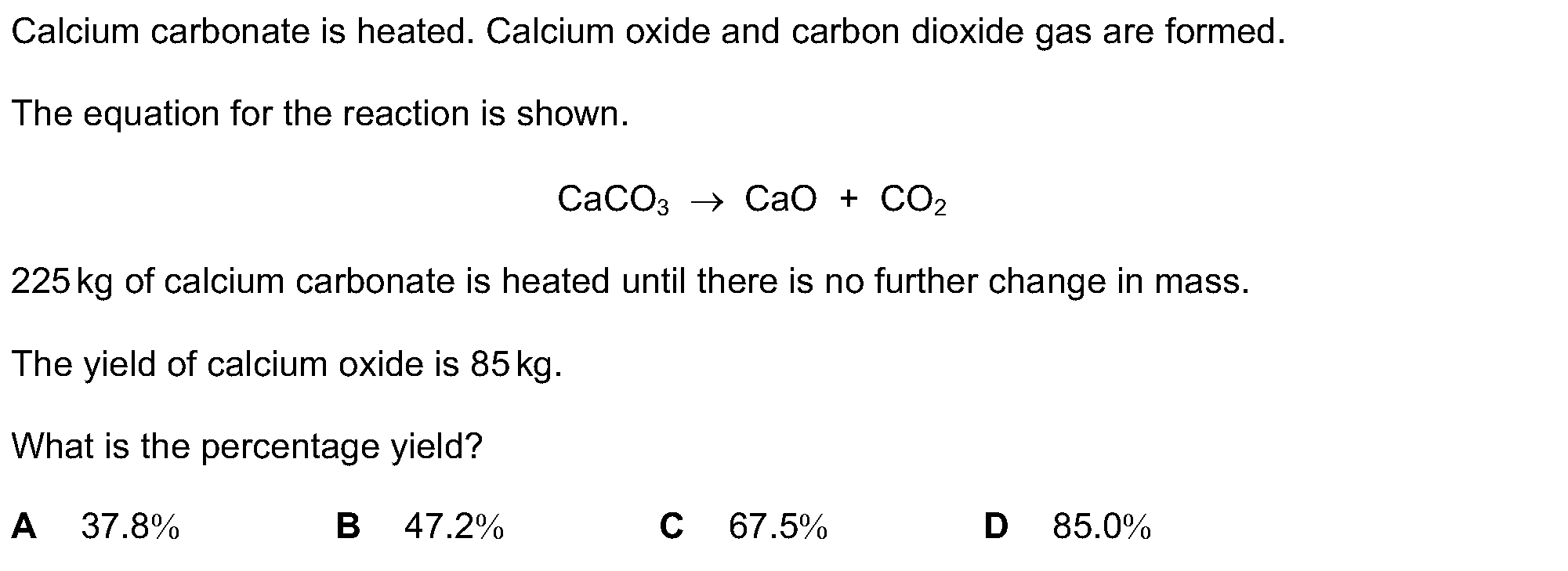
Calcium carbonate is heated. Calcium oxide and carbon dioxide gas are formed.
The equation for the reaction is shown.
CaCO; > CaO + CO,
225 kg of calcium carbonate is heated until there is no further change in mass.
The yield of calcium oxide is 85kg.
What is the percentage yield?
A 37.8% Bo 47.2% C 67.5% D 85.0%
The equation for the reaction is shown.
CaCO; > CaO + CO,
225 kg of calcium carbonate is heated until there is no further change in mass.
The yield of calcium oxide is 85kg.
What is the percentage yield?
A 37.8% Bo 47.2% C 67.5% D 85.0%
Options:
A
B
C
D
Correct Key: C
A
B
C
D
Correct Key: C
Question 11
Paper Ref: 0620/22_Spring_2021_Q10
Paper Ref: 0620/22_Spring_2021_Q10
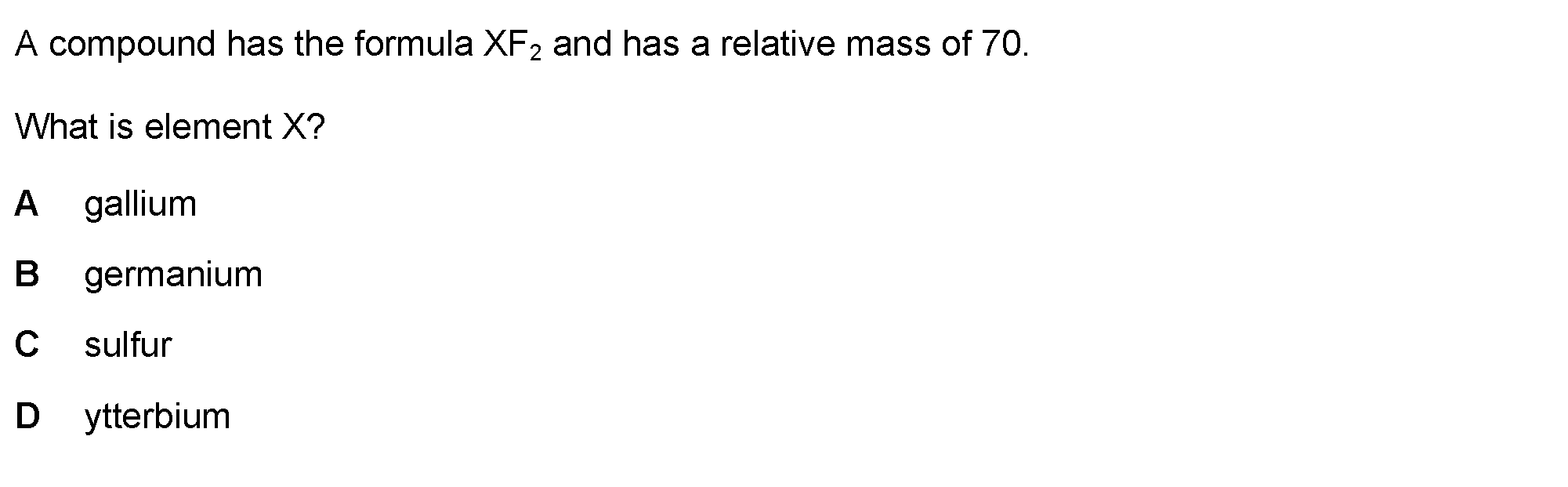
A compound has the formula XF, and has a relative mass of 70.
What is element X?
A gallium
B germanium
C sulfur
D- ytterbium
What is element X?
A gallium
B germanium
C sulfur
D- ytterbium
Options:
A
B
C
D
Correct Key: C
A
B
C
D
Correct Key: C
Question 12
Paper Ref: 0620/21_Winter_2020_Q11
Paper Ref: 0620/21_Winter_2020_Q11
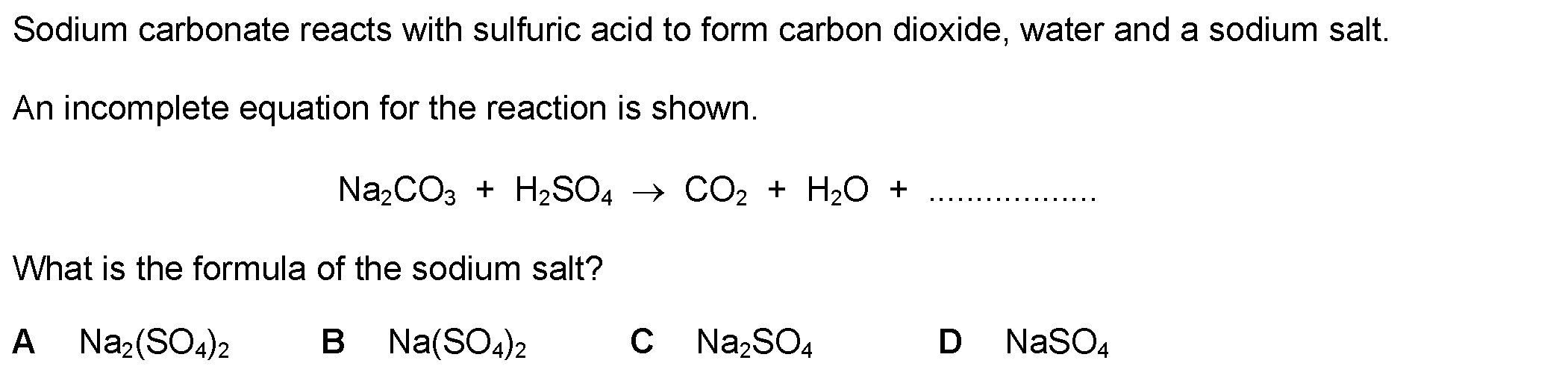
Sodium carbonate reacts with sulfuric acid to form carbon dioxide, water and a sodium salt.
An incomplete equation for the reaction is shown.
NazCO3 + H2SO4 3 CO2 + HeO F oo.
What is the formula of the sodium salt?
An incomplete equation for the reaction is shown.
NazCO3 + H2SO4 3 CO2 + HeO F oo.
What is the formula of the sodium salt?
Options:
A
B
C
D
Correct Key: C
A
B
C
D
Correct Key: C
Question 13
Paper Ref: 0620/22_Summer_2013_Q7
Paper Ref: 0620/22_Summer_2013_Q7
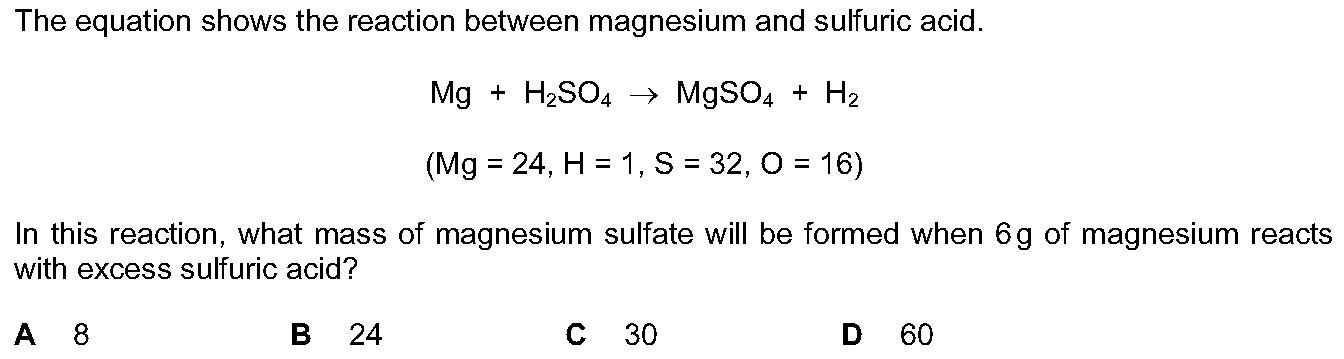
The equation shows the reaction between magnesium and sulfuric acid.
(Mg = 24, H= 1, S = 32, O = 16)
In this reaction, what mass of magnesium sulfate will be formed when 6g of magnesium reacts
with excess sulfuric acid?
A 8 B 24 Cc 30 D 60
(Mg = 24, H= 1, S = 32, O = 16)
In this reaction, what mass of magnesium sulfate will be formed when 6g of magnesium reacts
with excess sulfuric acid?
A 8 B 24 Cc 30 D 60
Options:
A
B
C
D
Correct Key: C
A
B
C
D
Correct Key: C
Question 14
Paper Ref: 0620/23_Summer_2012_Q8
Paper Ref: 0620/23_Summer_2012_Q8
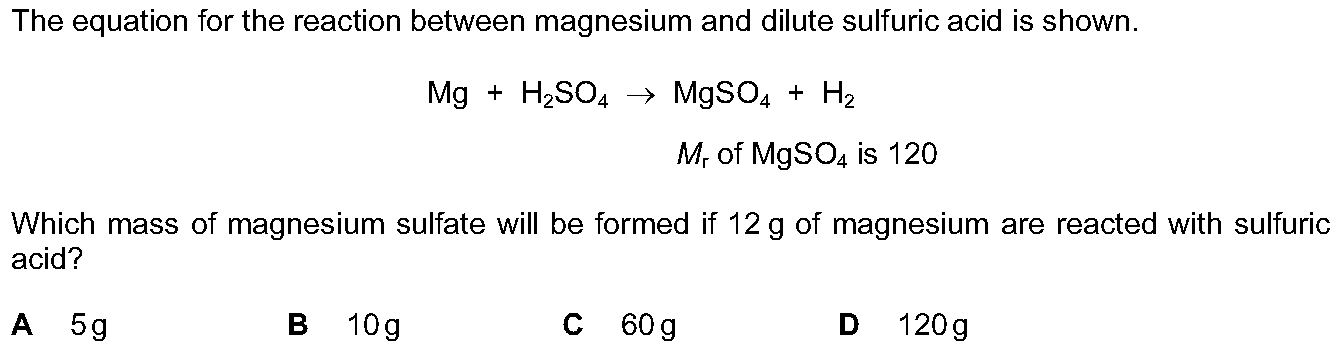
The equation for the reaction between magnesium and dilute sulfuric acid is shown.
Mg + H,SO, > MgSO, + He
M, of MgSO, is 120
Which mass of magnesium sulfate will be formed if 12 g of magnesium are reacted with sulfuric
acid?
A 5g B 10g C 60g D 120g
Mg + H,SO, > MgSO, + He
M, of MgSO, is 120
Which mass of magnesium sulfate will be formed if 12 g of magnesium are reacted with sulfuric
acid?
A 5g B 10g C 60g D 120g
Options:
A
B
C
D
Correct Key: C
A
B
C
D
Correct Key: C
Structured Questions Mark Scheme & Answers
•1•.• • • •[•C•P• •O•c•t•o•b•e•r• •2•0•2•5• •P•1• • •·• • •Q•6• • •P•a•r•t• •(•a•)• • •·• • •2•0•2•5• • •·• • •L•o•w•e•r• •S•e•c• •0•8•9•3•]• • • • • • •c•o•p•p•e•r• •+• •s•u•l•f•u•r•i•c• •c•o•p•p•e•r• •+• •c•a•r•b•o•n• •+• •w•a•t•e•r• •2• •c•o•r•r•e•c•t• •r•e•a•c•t•a•n•t•s• •a•n•y• •o•r•d•e•r• •=• •1• •m•a•r•k• •c•a•r•b•o•n•a•t•e• •a•c•i•d• •s•u•l•f•a•t•e• •d•i•o•x•i•d•e• •c•o•r•r•e•c•t• •p•r•o•d•u•c•t•s• •a•n•y• •o•r•d•e•r• •=• •1• •m•a•r•k• •••c•c•e•p•t• •=• •f•o•r• •••c•c•e•p•t• •c•o•r•r•e•c•t• •f•o•r•m•u•l•a•e• •b•u•t• •w•o•r•d•s• •t•a•k•e• •p•r•e•c•e•d•e•n•c•e• •D•o• •n•o•t• •a•c•c•e•p•t• •‘•a•n•d•’• •f•o•r• •a• •p•l•u•s• •s•i•g•n•
•2•.• • • •[•S•P• •S•9• •P•1• • •·• • •Q•8• • •P•a•r•t• •(•a•)• • •·• • •S•p•e•c•i•m•e•n• • •·• • •L•o•w•e•r• •S•e•c• •0•8•9•3•]• • • • • • •h•y•d•r•o•g•e•n• •1• •••c•c•e•p•t• •H• •/• •H•2• •b•u•t• •n•a•m•e• •t•a•k•e•s• •p•r•e•c•e•d•e•n•c•e•
•3•.• • • •[•S•P• •S•9• •P•1• • •·• • •Q•8• • •P•a•r•t• •(•c•)• • •·• • •S•p•e•c•i•m•e•n• • •·• • •L•o•w•e•r• •S•e•c• •0•8•9•3•]• • • • • • •e•v•a•p•o•r•a•t•i•o•n• •1• •••c•c•e•p•t• •b•o•i•l•i•n•g• •I•g•n•o•r•e• •c•r•y•s•t•a•l•l•i•s•a•t•i•o•n•
•4•.• • • •[•S•P• •S•9• •P•1• • •·• • •Q•8• • •P•a•r•t• •(•d•)• • •·• • •S•p•e•c•i•m•e•n• • •·• • •L•o•w•e•r• •S•e•c• •0•8•9•3•]• • • • • • •z•i•n•c• •o•x•i•d•e• •+• •s•u•l•f•u•r•i•c• •a•c•i•d• •→• •z•i•n•c• •s•u•l•f•a•t•e• •+• •w•a•t•e•r• •1• •o•r•d•e•r• •o•n• •e•a•c•h• •s•i•d•e• •u•n•i•m•p•o•r•t•a•n•t•
•5•.• • • •[•C•P• •M•a•y• •2•0•2•4• •P•2• • •·• • •Q•1•1• • •P•a•r•t• •(•b•)• • •·• • •2•0•2•4• • •·• • •L•o•w•e•r• •S•e•c• •0•8•9•3•]• • • • • • •i•r•o•n• •+• •c•o•p•p•e•r• •s•u•l•f•a•t•e• •i•r•o•n• •s•u•l•f•a•t•e• •+• •c•o•p•p•e•r• •1• •••c•c•e•p•t• •r•e•a•c•t•a•n•t•s• •i•n• •e•i•t•h•e•r• •o•r•d•e•r• •a•n•d• •p•r•o•d•u•c•t•s• •i•n• •e•i•t•h•e•r• •o•r•d•e•r• •••c•c•e•p•t• •c•o•r•r•e•c•t• •f•o•r•m•u•l•a•e•,• •b•u•t• •w•o•r•d•s• •t•a•k•e• •p•r•e•c•e•d•e•n•c•e•
•6•.• • • •[•C•P• •O•c•t•o•b•e•r• •2•0•2•4• •P•2• • •·• • •Q•7• • •P•a•r•t• •(•a•)• • •·• • •2•0•2•4• • •·• • •L•o•w•e•r• •S•e•c• •0•8•9•3•]• • • • • • •m•a•g•n•e•s•i•u•m• •s•u•l•f•a•t•e• •+• •z•i•n•c• •1• •B•o•t•h• •r•e•q•u•i•r•e•d• •e•i•t•h•e•r• •o•r•d•e•r• •f•o•r• •t•h•e• •m•a•r•k• •••c•c•e•p•t• •c•o•r•r•e•c•t• •f•o•r•m•u•l•a•e• •o•r• •m•i•x• •o•f• •w•o•r•d•s• •a•n•d• •f•o•r•m•u•l•a•e•,• •b•u•t• •w•o•r•d•s• •t•a•k•e• •p•r•e•c•e•d•e•n•c•e• •e•.•g•.• •M•g•S•O•4• •+• •Z•n•
•7•.• • • •[•C•P• •M•a•r•c•h• •2•0•2•6• •P•1• • •·• • •Q•1•0• • •·• • •2•0•2•6• • •·• • •L•o•w•e•r• •S•e•c• •0•8•9•3•]• • • • • • •2•K• •+• •2•H•2•O• •• •2•K•O•H• •+• •H•2• •2• •r•e•a•c•t•a•n•t•s• •c•o•r•r•e•c•t• •i•n• •a•n•y• •o•r•d•e•r• •=• •1• •m•a•r•k• •p•r•o•d•u•c•t•s• •c•o•r•r•e•c•t• •i•n• •a•n•y• •o•r•d•e•r•=• •1• •m•a•r•k• •••c•c•e•p•t• •b•a•l•a•n•c•e•d• •a•n•d• •u•n•b•a•l•a•n•c•e•d• •e•q•u•a•t•i•o•n•s• •p•r•o•v•i•d•i•n•g• •t•h•e• •f•o•r•m•u•l•a• •a•r•e• •c•o•r•r•e•c•t• •e•.•g•.• •K• •+• •H•2•O• •• •K•O•H• •+• •H•2• •I•g•n•o•r•e• •a• •w•o•r•d• •e•q•u•a•t•i•o•n• •D•o• •n•o•t• •a•c•c•e•p•t• •h• •f•o•r• •H• •a•n•d• •k• •f•o•r• •K•
•8•.• • • •[•C•P• •M•a•r•c•h• •2•0•2•6• •P•2• • •·• • •Q•2• • •P•a•r•t• •(•a•)• • •·• • •2•0•2•6• • •·• • •L•o•w•e•r• •S•e•c• •0•8•9•3•]• • • • • • •(•z•i•n•c• •+• •c•o•p•p•e•r• •s•u•l•f•a•t•e•)• •→• •c•o•p•p•e•r• •+• •z•i•n•c• •s•u•l•f•a•t•e• •2• •e•a•c•h• •c•o•r•r•e•c•t• •p•r•o•d•u•c•t•,• •e•i•t•h•e•r• •o•r•d•e•r• •=• •1• •m•a•r•k• •••c•c•e•p•t• •c•o•r•r•e•c•t• •f•o•r•m•u•l•a•e•,• •C•u• •a•n•d• •Z•n•S•O•4•,• •b•u•t• •n•a•m•e•s• •t•a•k•e• •p•r•e•c•e•d•e•n•c•e•
Last updated:
\n