4.3Electricity and Magnetism
Excretion in humans — Question Bank (Cambridge) — Cambridge IGCSE Physics 0625 Revision Notes & Topical Questions
20 min read Lesson 32 of 65 Unit quiz
Cambridge Past Paper Bank
4.3 Excretion in humans
26 Multiple-Choice Questions with Official Mark Schemes
Question 1
0610/23_Winter_2019_Q25
Question 2
0610/22_Winter_2022_Q23
Question 3
0610/12_Spring_2021_Q24
Question 4
0610/12_Summer_2026_Q22
Question 5
0610/23_Winter_2025_Q19
Question 6
0610/22_Winter_2009_Q24
Question 7
0610/21_Winter_2009_Q22
Question 8
0610/23_Summer_2022_Q23
Question 9
0610/21_Summer_2021_Q25
Question 10
0610/22_Spring_2020_Q25
Question 11
0610/21_Winter_2024_Q24
Question 12
0610/12_Spring_2024_Q29
Question 13
0610/22_Summer_2012_Q23
Question 14
0610/23_Winter_2023_Q22
Question 15
0610/21_Winter_2020_Q22
Question 16
0610/21_Summer_2026_Q20
Question 17
0610/11_Winter_2025_Q22
Question 18
0610/22_Winter_2021_Q24
Question 19
0610/21_Winter_2021_Q23
Question 20
0610/13_Winter_2021_Q25
Question 21
0610/21_Summer_2009_Q22
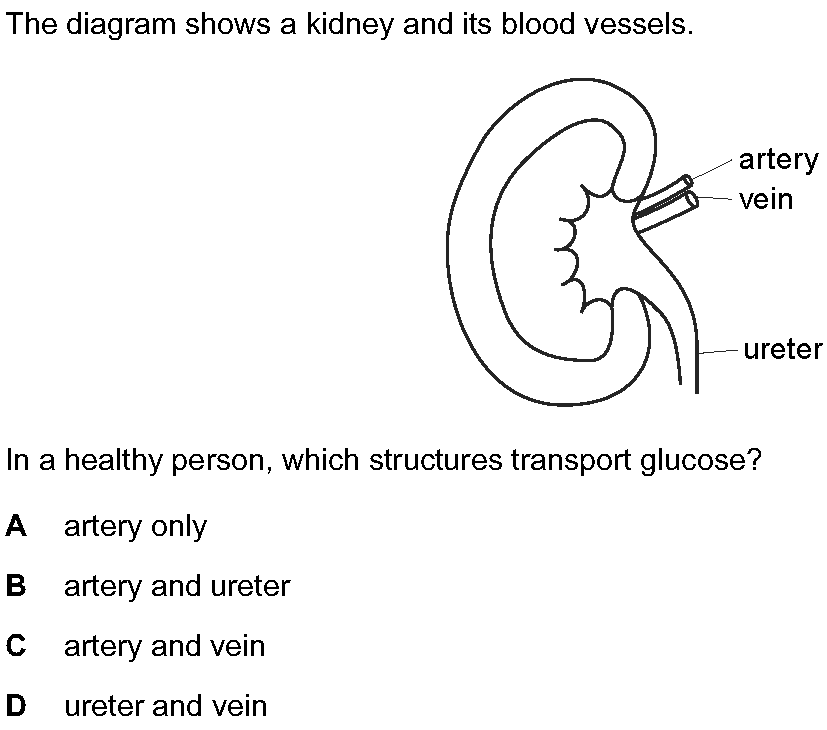
Question 22
0610/22_Winter_2016_Q25
Question 23
0610/22_Summer_2014_Q22
Question 24
0610/23_Winter_2015_Q21
Question 25
0610/23_Winter_2015_Q17
Question 26
0610/23_Summer_2013_Q24
Cambridge Lower Secondary Stage 9
4.3 Excretion in humans – Complete Question Bank & Mark Scheme
Total Questions26 Questions with Verified Solutions & Past Paper Mark Schemes
Multiple Choice Questions (Exam Practice)
Question 1
Paper Ref: 0610/23_Winter_2019_Q25
Paper Ref: 0610/23_Winter_2019_Q25
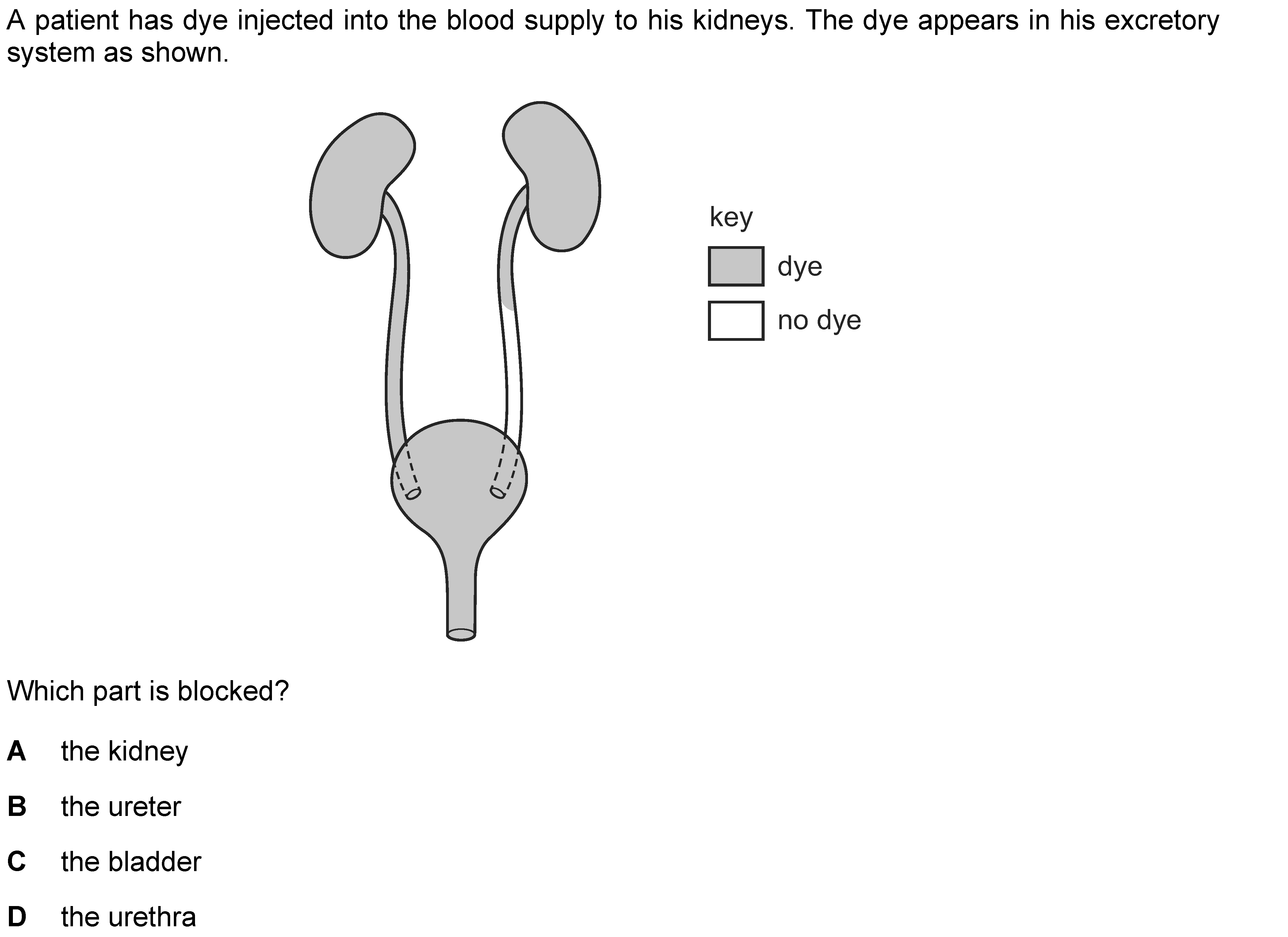
A patient has dye injected into the blood supply to his kidneys. The dye appears in his excretory
system as shown.
key
|__| dye
[| no dye
Which part is blocked?
A the kidney
B the ureter
C the bladder
D
the urethra
system as shown.
key
|__| dye
[| no dye
Which part is blocked?
A the kidney
B the ureter
C the bladder
D
the urethra
Options:
A
B
C
D
Correct Key: B
A
B
C
D
Correct Key: B
Question 2
Paper Ref: 0610/22_Winter_2022_Q23
Paper Ref: 0610/22_Winter_2022_Q23
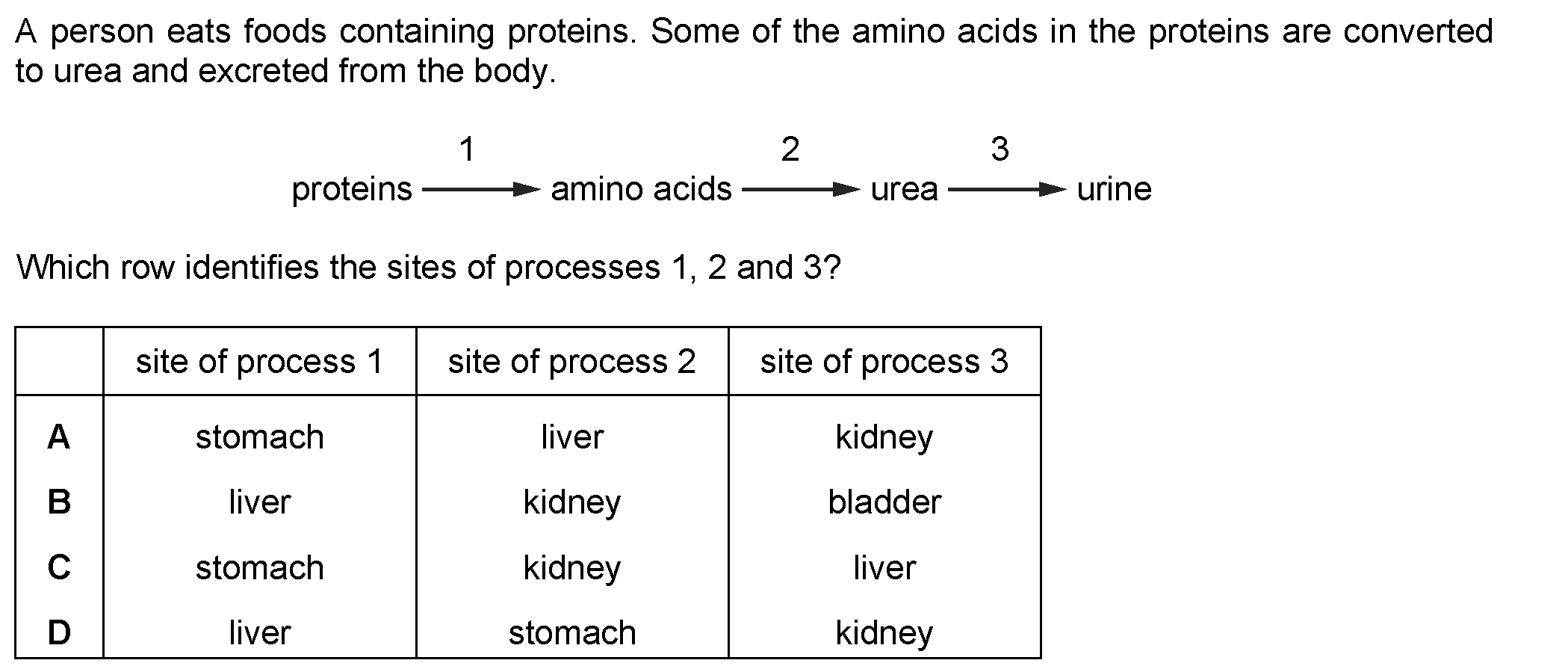
A person eats foods containing proteins. Some of the amino acids in the proteins are converted
to urea and excreted from the body.
1 2 3
proteins ——— amino acids ———» urea ——— urine
Which row identifies the sites of processes 1, 2 and 3?
— site of process 1 site of process 2 site of process 3
stomach liver kidney
liver kidney bladder
stomach kidney liver
liver stomach kidney
to urea and excreted from the body.
1 2 3
proteins ——— amino acids ———» urea ——— urine
Which row identifies the sites of processes 1, 2 and 3?
— site of process 1 site of process 2 site of process 3
stomach liver kidney
liver kidney bladder
stomach kidney liver
liver stomach kidney
Options:
A
B
C
D
Correct Key: A
A
B
C
D
Correct Key: A
Question 3
Paper Ref: 0610/12_Spring_2021_Q24
Paper Ref: 0610/12_Spring_2021_Q24
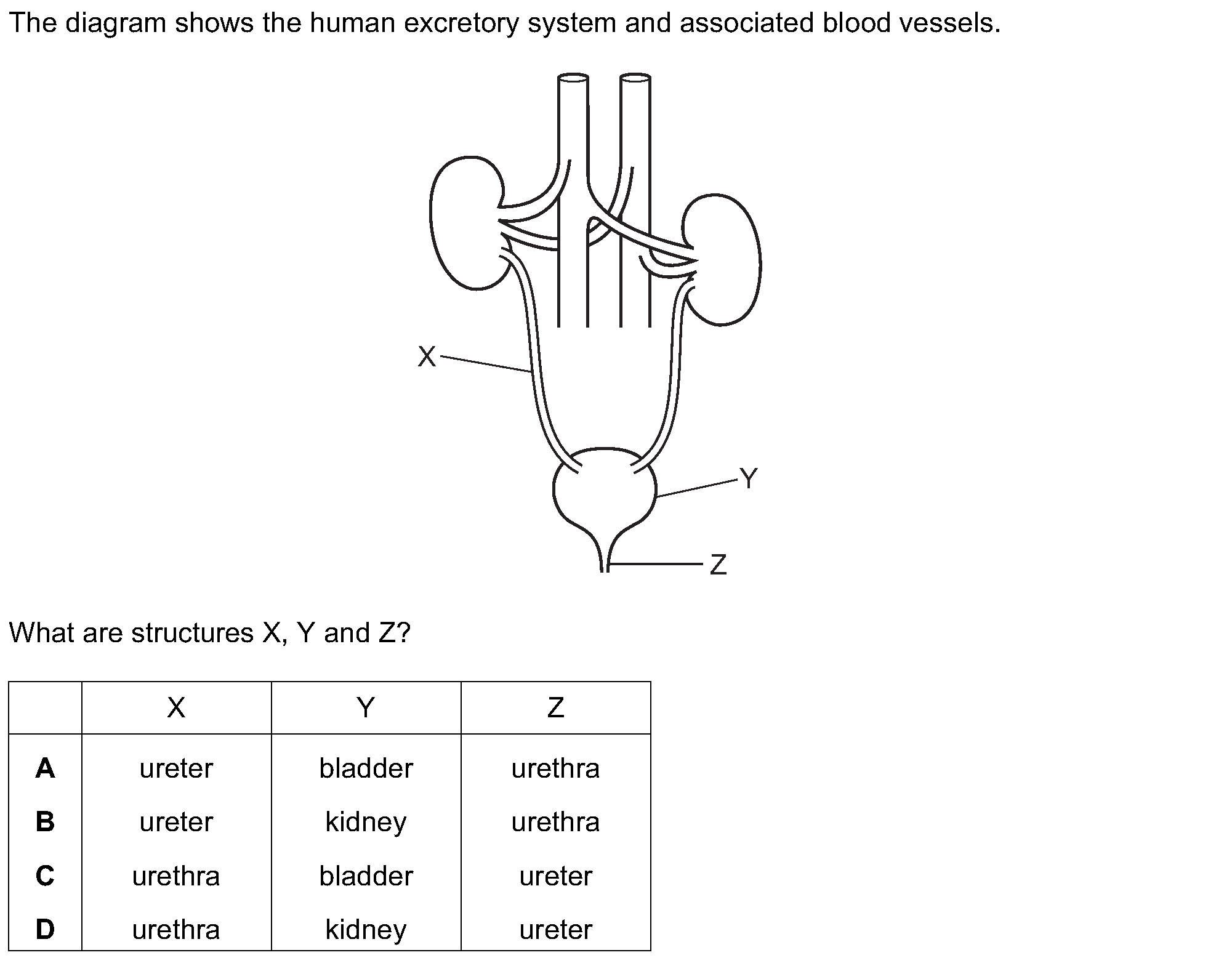
The diagram shows the human excretory system and associated blood vessels.
What are structures X, Y and 2?
X Y Z
A ureter bladder urethra
B ureter kidney urethra
Cc urethra bladder ureter
D urethra kidney ureter
What are structures X, Y and 2?
X Y Z
A ureter bladder urethra
B ureter kidney urethra
Cc urethra bladder ureter
D urethra kidney ureter
Options:
A
B
C
D
Correct Key: A
A
B
C
D
Correct Key: A
Question 4
Paper Ref: 0610/12_Summer_2026_Q22
Paper Ref: 0610/12_Summer_2026_Q22
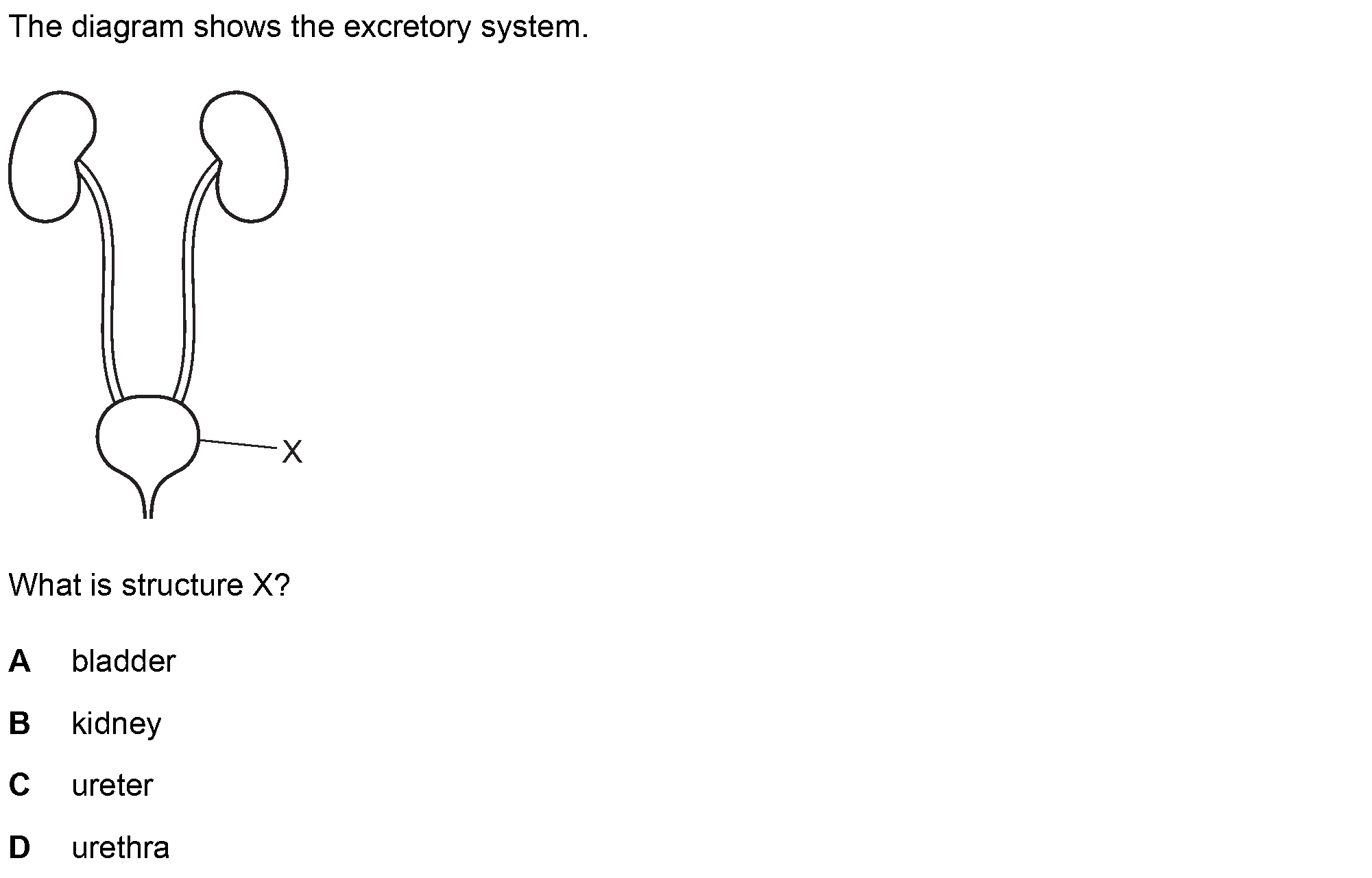
The diagram shows the excretory system.
What is structure X?
A __ bladder
B_ kidney
C ureter
D_ urethra
What is structure X?
A __ bladder
B_ kidney
C ureter
D_ urethra
Options:
A
B
C
D
Correct Key: A
A
B
C
D
Correct Key: A
Question 5
Paper Ref: 0610/23_Winter_2025_Q19
Paper Ref: 0610/23_Winter_2025_Q19
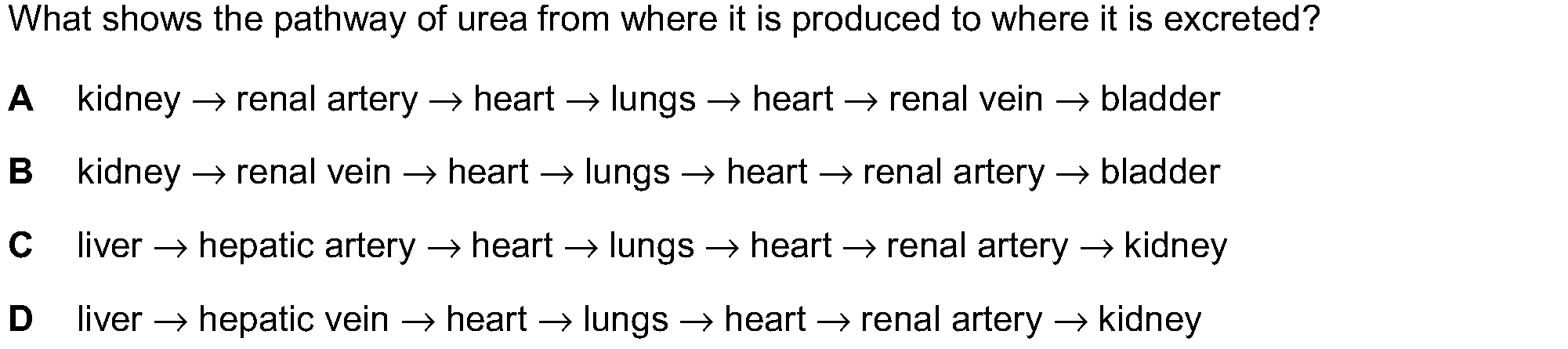
What shows the pathway of urea from where it is produced to where it is excreted?
A
B
Cc
D
kidney — renal artery > heart — lungs > heart — renal vein > bladder
kidney > renal vein > heart > lungs — heart > renal artery > bladder
liver > hepatic artery — heart > lungs — heart > renal artery > kidney
liver > hepatic vein > heart — lungs > heart — renal artery — kidney
A
B
Cc
D
kidney — renal artery > heart — lungs > heart — renal vein > bladder
kidney > renal vein > heart > lungs — heart > renal artery > bladder
liver > hepatic artery — heart > lungs — heart > renal artery > kidney
liver > hepatic vein > heart — lungs > heart — renal artery — kidney
Options:
A
B
C
D
Correct Key: D
A
B
C
D
Correct Key: D
Question 6
Paper Ref: 0610/22_Winter_2009_Q24
Paper Ref: 0610/22_Winter_2009_Q24
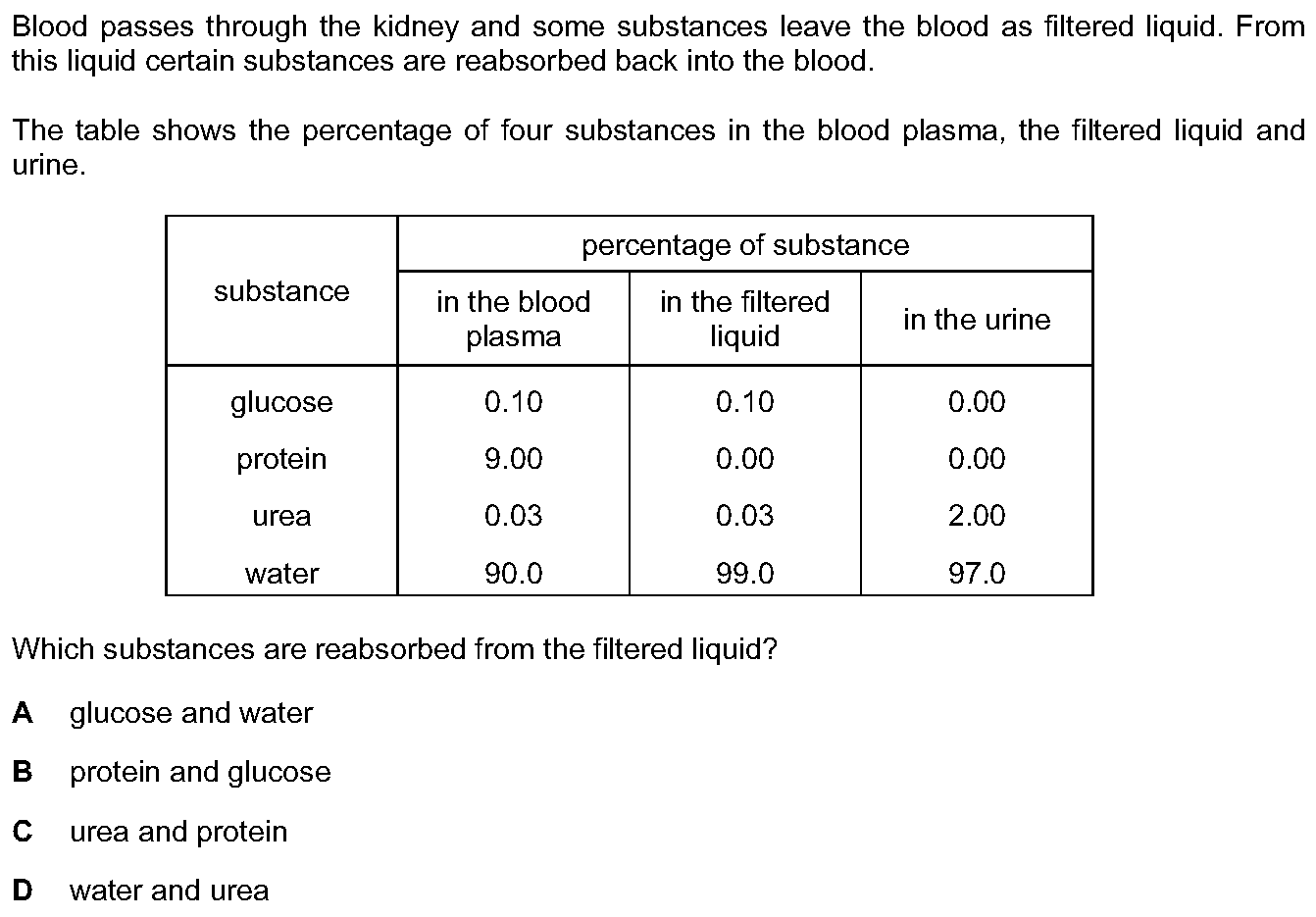
Blood passes through the kidney and some substances leave the blood as filtered liquid. From
this liquid certain substances are reabsorbed back into the blood.
The table shows the percentage of four substances in the blood plasma, the filtered liquid and
urine.
substance
glucose
protein
urea
water
percentage of substance
in the blood
plasma
in the filtered
liquid
in the urine
Which substances are reabsorbed from the filtered liquid?
glucose and water
B protein and glucose
C urea and protein
D_ water and urea
Options:
A
B
C
D
Correct Key: A
A
B
C
D
Correct Key: A
Question 7
Paper Ref: 0610/21_Winter_2009_Q22
Paper Ref: 0610/21_Winter_2009_Q22
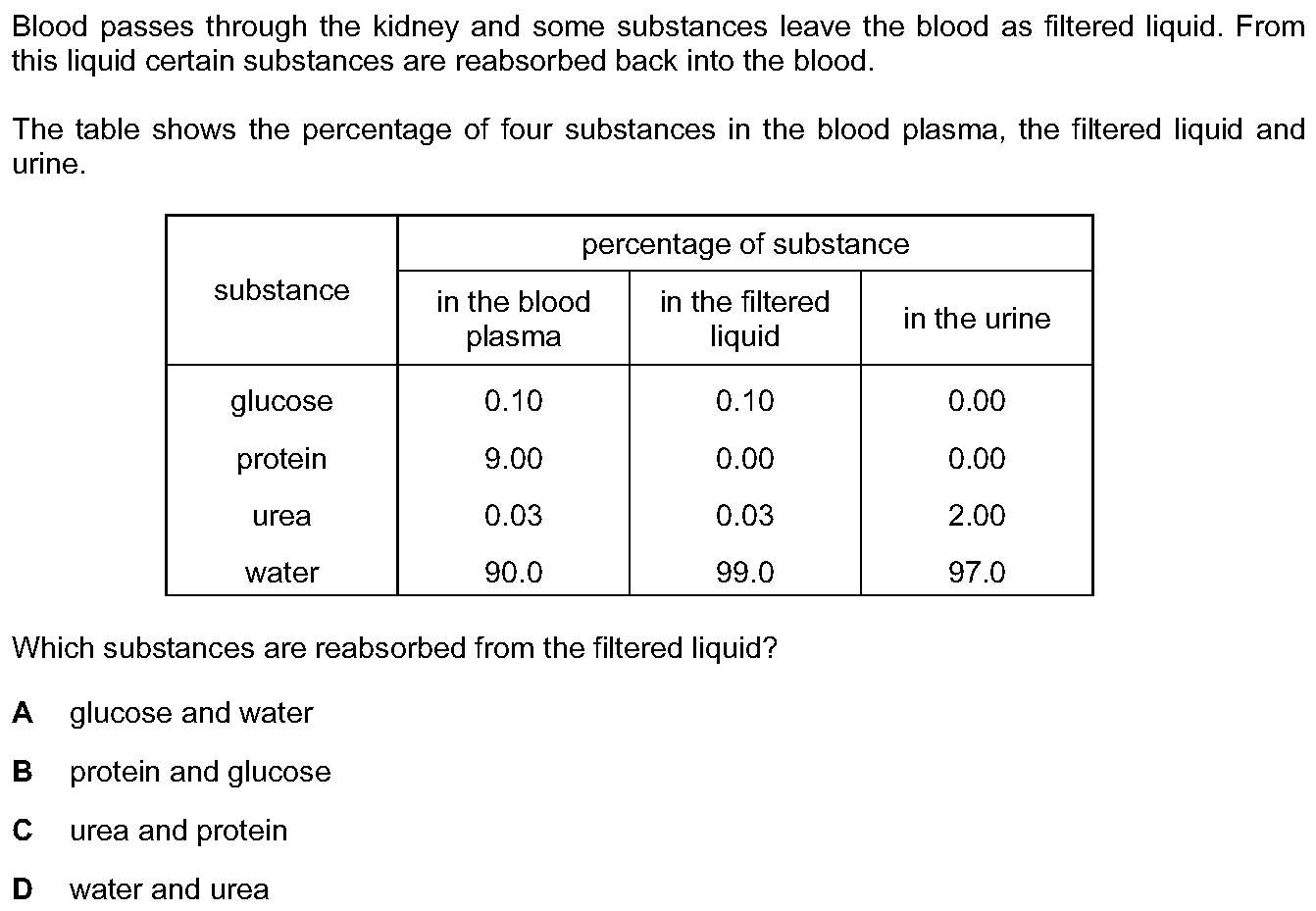
Blood passes through the kidney and some substances leave the blood as filtered liquid. From
this liquid certain substances are reabsorbed back into the blood.
The table shows the percentage of four substances in the blood plasma, the filtered liquid and
urine.
substance
percentage of substance
in the blood in the filtered F F
in the urine
plasma liquid
glucose 0.10 0.10 0.00
protein 9.00 0.00 0.00
urea 0.03 0.03 2.00
water 90.0 99.0 97.0
Which substances are reabsorbed from the filtered liquid?
glucose and water
is]
protein and glucose
Qa
urea and protein
i=]
water and urea
Options:
A
B
C
D
Correct Key: A
A
B
C
D
Correct Key: A
Question 8
Paper Ref: 0610/23_Summer_2022_Q23
Paper Ref: 0610/23_Summer_2022_Q23
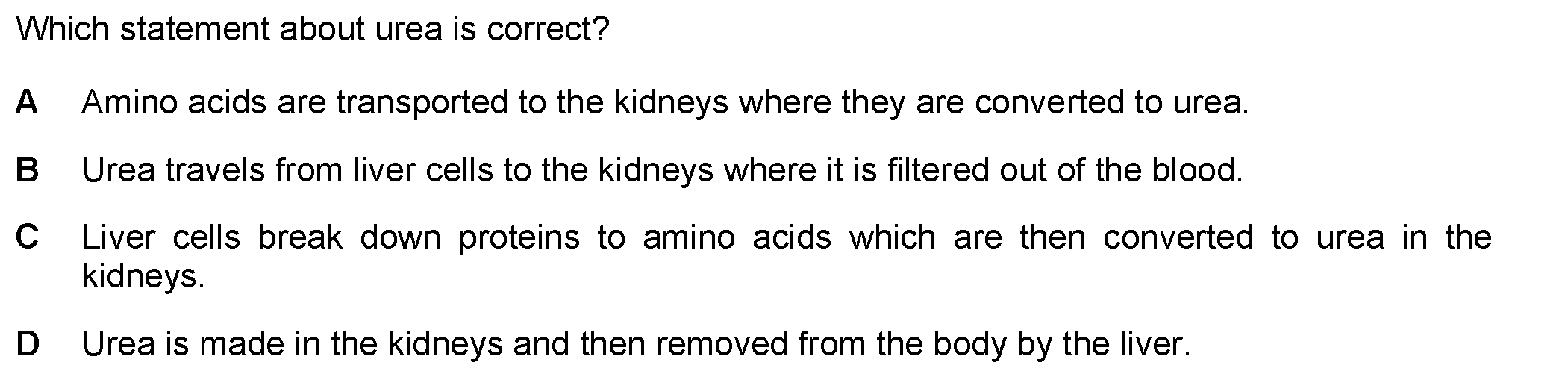
Which statement about urea is correct?
A Amino acids are transported to the kidneys where they are converted to urea.
B Urea travels from liver cells to the kidneys where it is filtered out of the blood.
C Liver cells break down proteins to amino acids which are then converted to urea in the
kidneys.
D_ Urea is made in the kidneys and then removed from the body by the liver.
Options:
A
B
C
D
Correct Key: B
A
B
C
D
Correct Key: B
Question 9
Paper Ref: 0610/21_Summer_2021_Q25
Paper Ref: 0610/21_Summer_2021_Q25
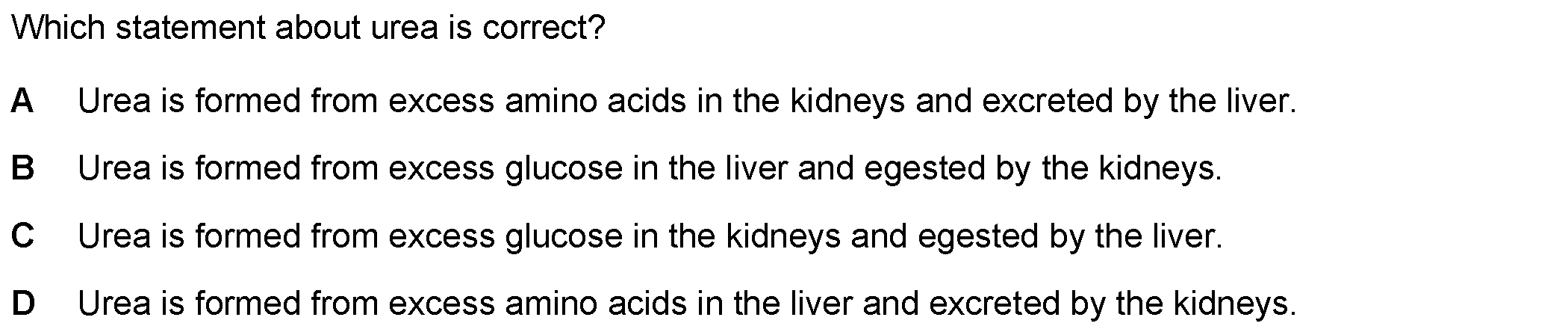
Which statement about urea is correct?
A Urea is formed from excess amino acids in the kidneys and excreted by the liver.
Urea is formed from excess glucose in the liver and egested by the kidneys.
Urea is formed from excess glucose in the kidneys and egested by the liver.
0 O WW
Urea is formed from excess amino acids in the liver and excreted by the kidneys.
Options:
A
B
C
D
Correct Key: D
A
B
C
D
Correct Key: D
Question 10
Paper Ref: 0610/22_Spring_2020_Q25
Paper Ref: 0610/22_Spring_2020_Q25
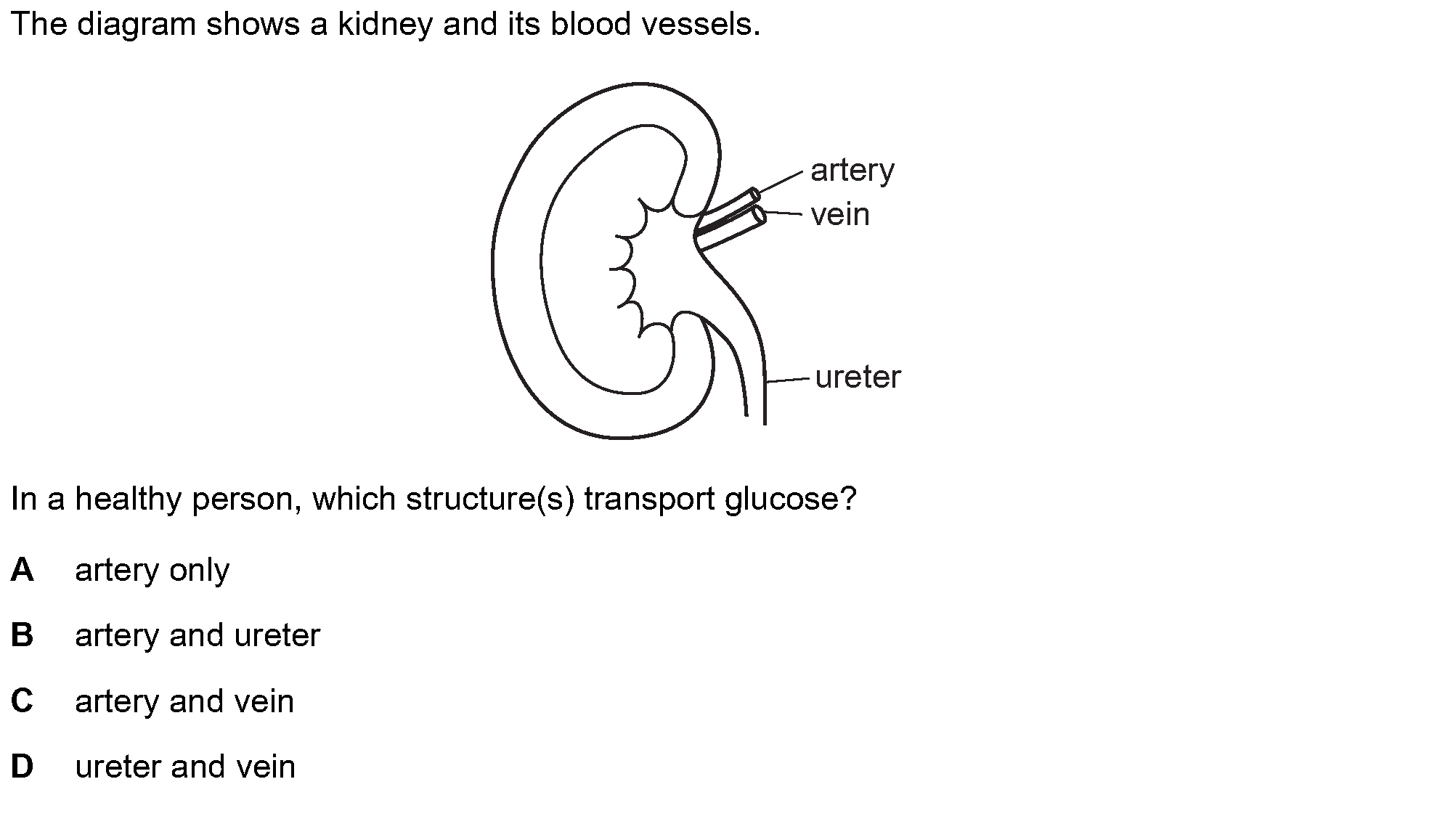
The diagram shows a kidney and its blood vessels.
artery
vein
ureter
In a healthy person, which structure(s) transport glucose?
A artery only
B artery and ureter
C artery and vein
D_ ureter and vein
artery
vein
ureter
In a healthy person, which structure(s) transport glucose?
A artery only
B artery and ureter
C artery and vein
D_ ureter and vein
Options:
A
B
C
D
Correct Key: C
A
B
C
D
Correct Key: C
Question 11
Paper Ref: 0610/21_Winter_2024_Q24
Paper Ref: 0610/21_Winter_2024_Q24
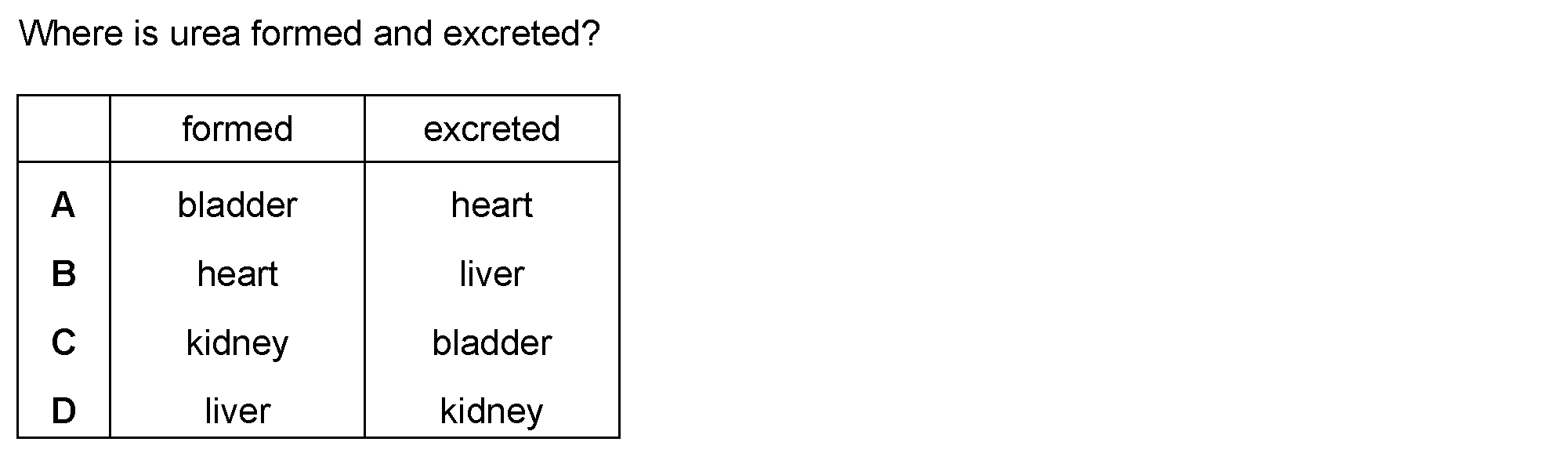
Where is urea formed and excreted?
<a o
bladder heart
heart liver
kidney bladder
liver kidney
<a o
bladder heart
heart liver
kidney bladder
liver kidney
Options:
A
B
C
D
Correct Key: D
A
B
C
D
Correct Key: D
Question 12
Paper Ref: 0610/12_Spring_2024_Q29
Paper Ref: 0610/12_Spring_2024_Q29
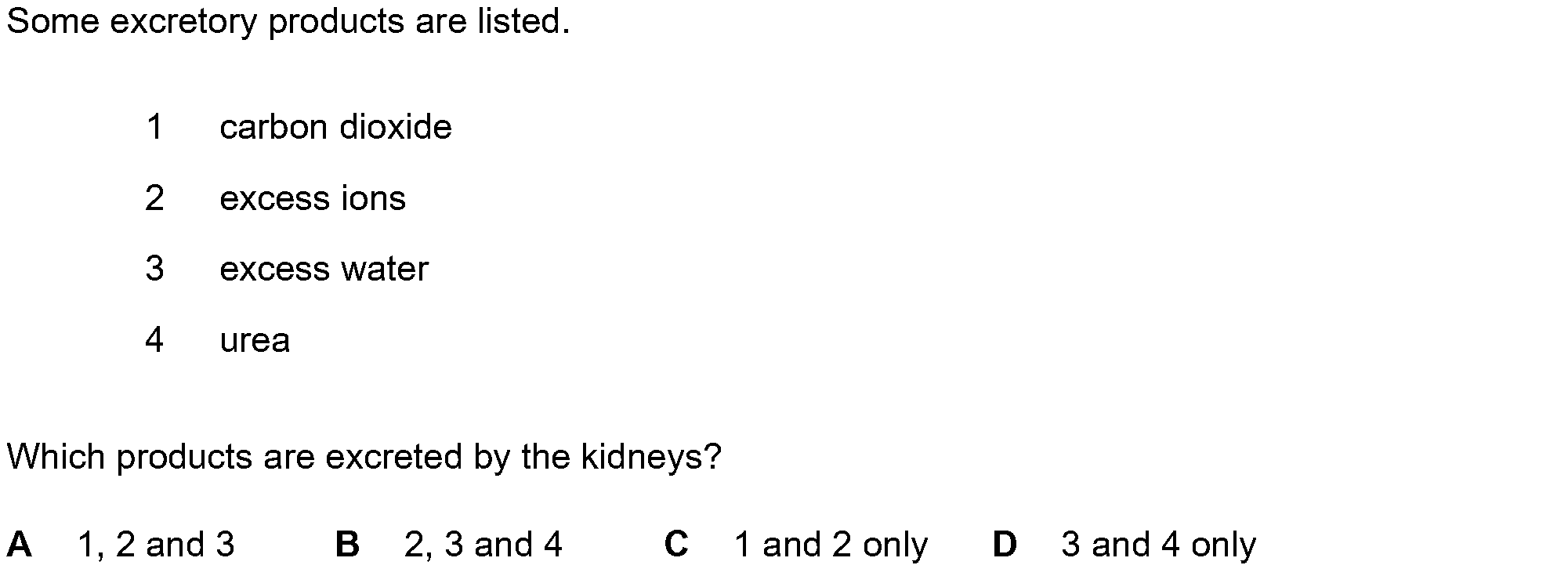
Some excretory products are listed.
1 carbon dioxide
excess ions
excess water
kk WwW ND
urea
Which products are excreted by the kidneys?
A 1,2and3 B 2,3and4 C 1 and 2 only D 3and 4 only
1 carbon dioxide
excess ions
excess water
kk WwW ND
urea
Which products are excreted by the kidneys?
A 1,2and3 B 2,3and4 C 1 and 2 only D 3and 4 only
Options:
A
B
C
D
Correct Key: B
A
B
C
D
Correct Key: B
Question 13
Paper Ref: 0610/22_Summer_2012_Q23
Paper Ref: 0610/22_Summer_2012_Q23
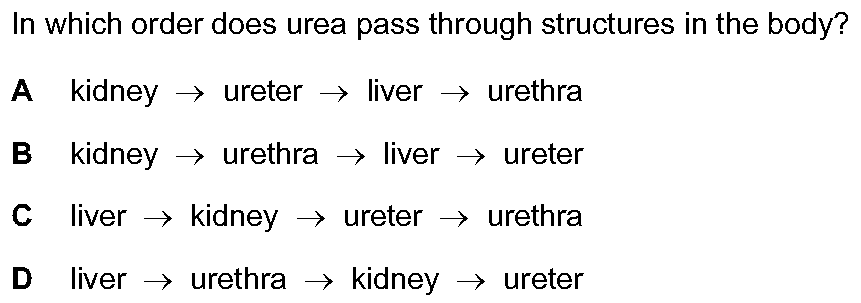
In which order does urea pass through structures in the body?
A
B
c
D
kidney — ureter — liver —> urethra
kidney — urethra —> liver > ureter
liver + kidney —> ureter > urethra
liver > urethra > kidney —> ureter
A
B
c
D
kidney — ureter — liver —> urethra
kidney — urethra —> liver > ureter
liver + kidney —> ureter > urethra
liver > urethra > kidney —> ureter
Options:
A
B
C
D
Correct Key: C
A
B
C
D
Correct Key: C
Question 14
Paper Ref: 0610/23_Winter_2023_Q22
Paper Ref: 0610/23_Winter_2023_Q22
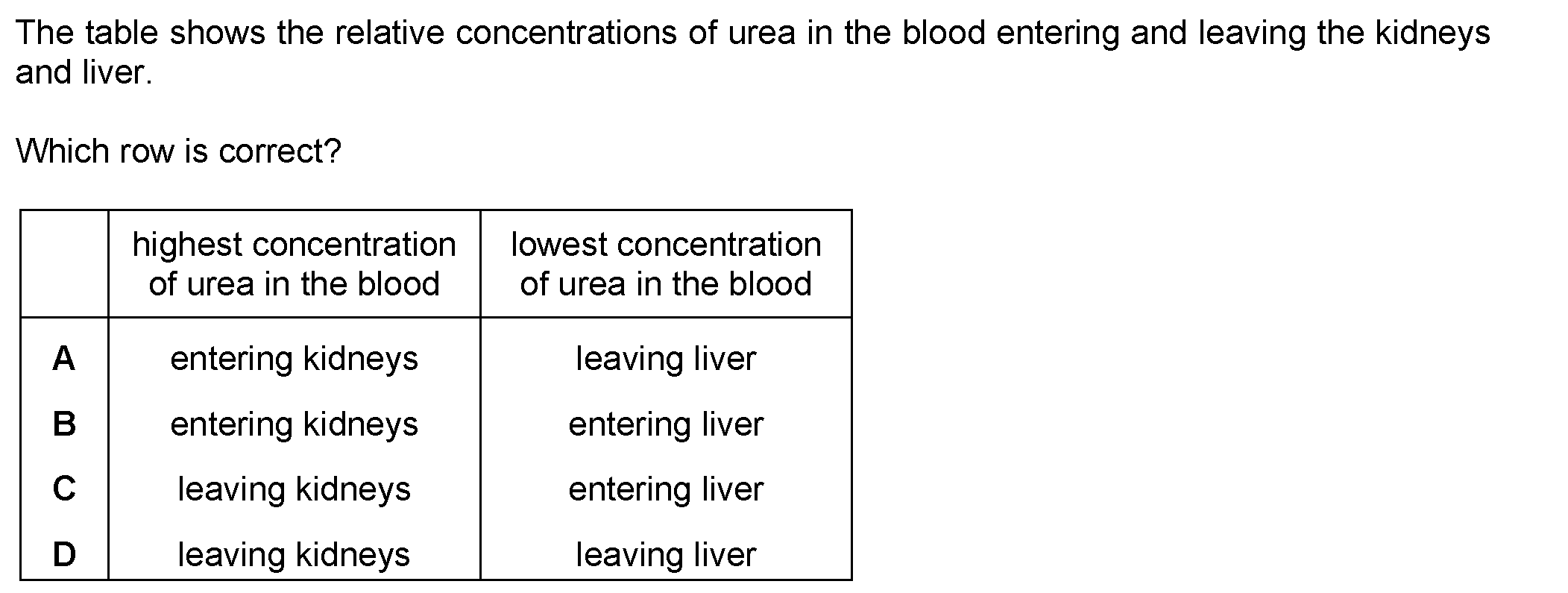
The table shows the relative concentrations of urea in the blood entering and leaving the kidneys
and liver.
Which row is correct?
highest concentration | lowest concentration
of urea in the blood of urea in the blood
entering kidneys leaving liver
entering kidneys entering liver
leaving kidneys entering liver
leaving kidneys leaving liver
and liver.
Which row is correct?
highest concentration | lowest concentration
of urea in the blood of urea in the blood
entering kidneys leaving liver
entering kidneys entering liver
leaving kidneys entering liver
leaving kidneys leaving liver
Options:
A
B
C
D
Correct Key: B
A
B
C
D
Correct Key: B
Question 15
Paper Ref: 0610/21_Winter_2020_Q22
Paper Ref: 0610/21_Winter_2020_Q22
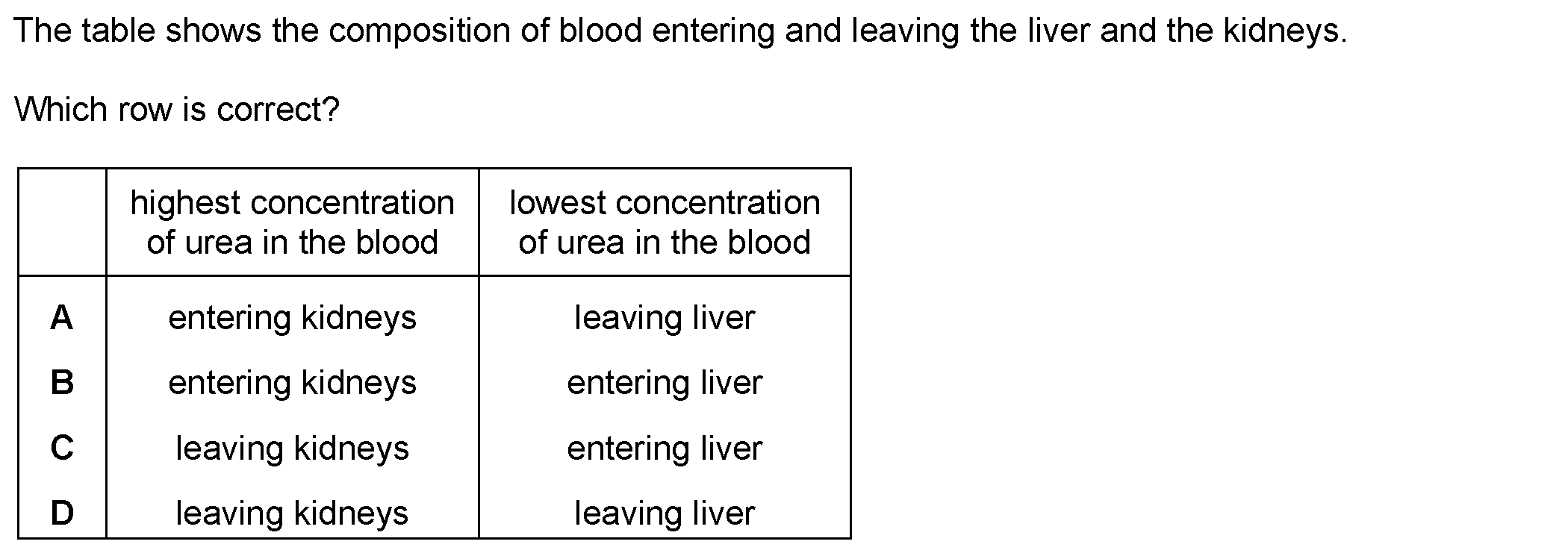
The table shows the composition of blood entering and leaving the liver and the kidneys.
Which row is correct?
highest concentration | lowest concentration
of urea in the blood of urea in the blood
entering kidneys leaving liver
entering kidneys entering liver
leaving kidneys entering liver
leaving kidneys leaving liver
Which row is correct?
highest concentration | lowest concentration
of urea in the blood of urea in the blood
entering kidneys leaving liver
entering kidneys entering liver
leaving kidneys entering liver
leaving kidneys leaving liver
Options:
A
B
C
D
Correct Key: B
A
B
C
D
Correct Key: B
Question 16
Paper Ref: 0610/21_Summer_2026_Q20
Paper Ref: 0610/21_Summer_2026_Q20
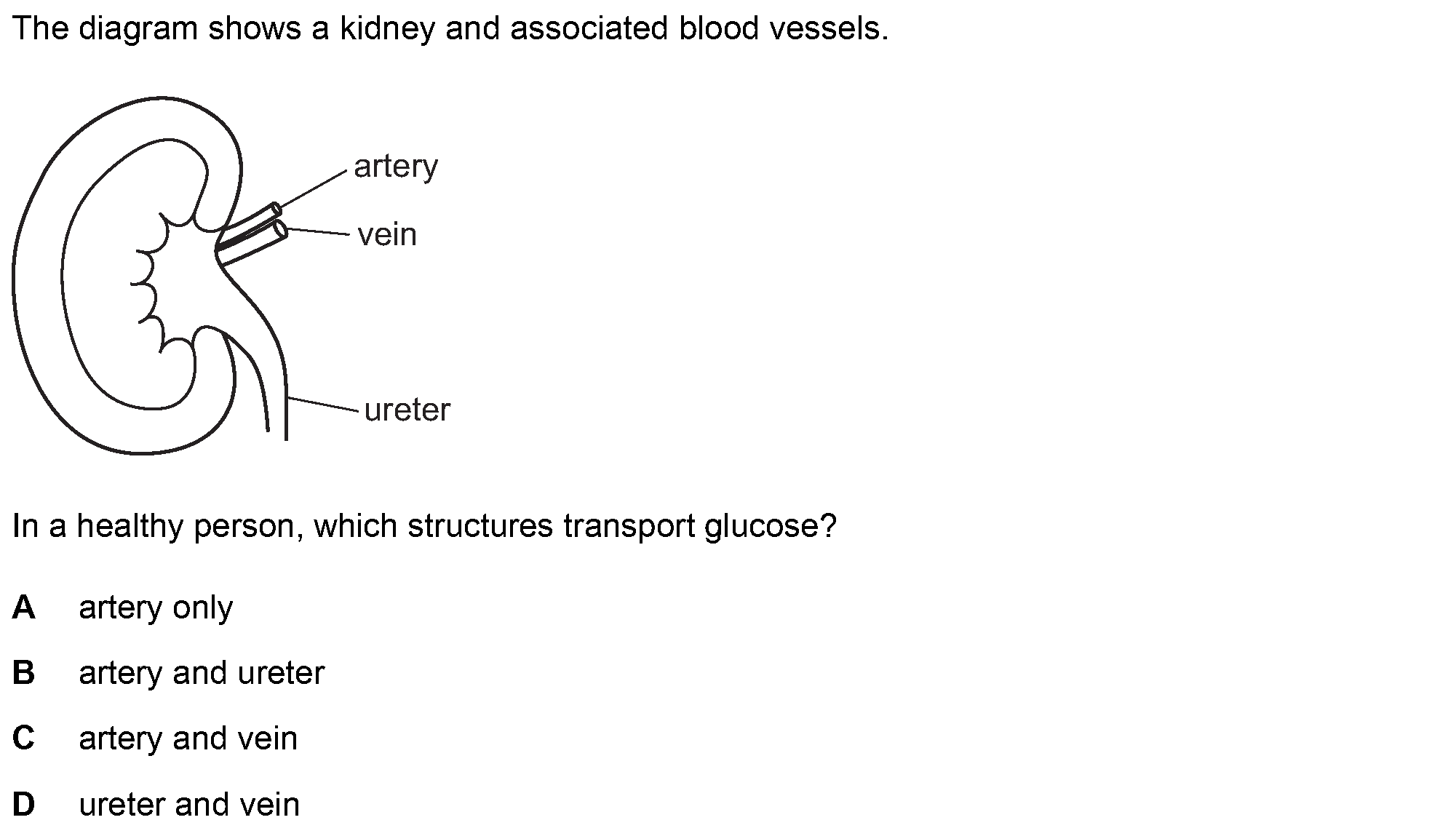
The diagram shows a kidney and associated blood vessels.
artery
vein
ureter
In a healthy person, which structures transport glucose?
A artery only
artery and ureter
artery and vein
oO Oo WW
ureter and vein
artery
vein
ureter
In a healthy person, which structures transport glucose?
A artery only
artery and ureter
artery and vein
oO Oo WW
ureter and vein
Options:
A
B
C
D
Correct Key: C
A
B
C
D
Correct Key: C
Question 17
Paper Ref: 0610/11_Winter_2025_Q22
Paper Ref: 0610/11_Winter_2025_Q22
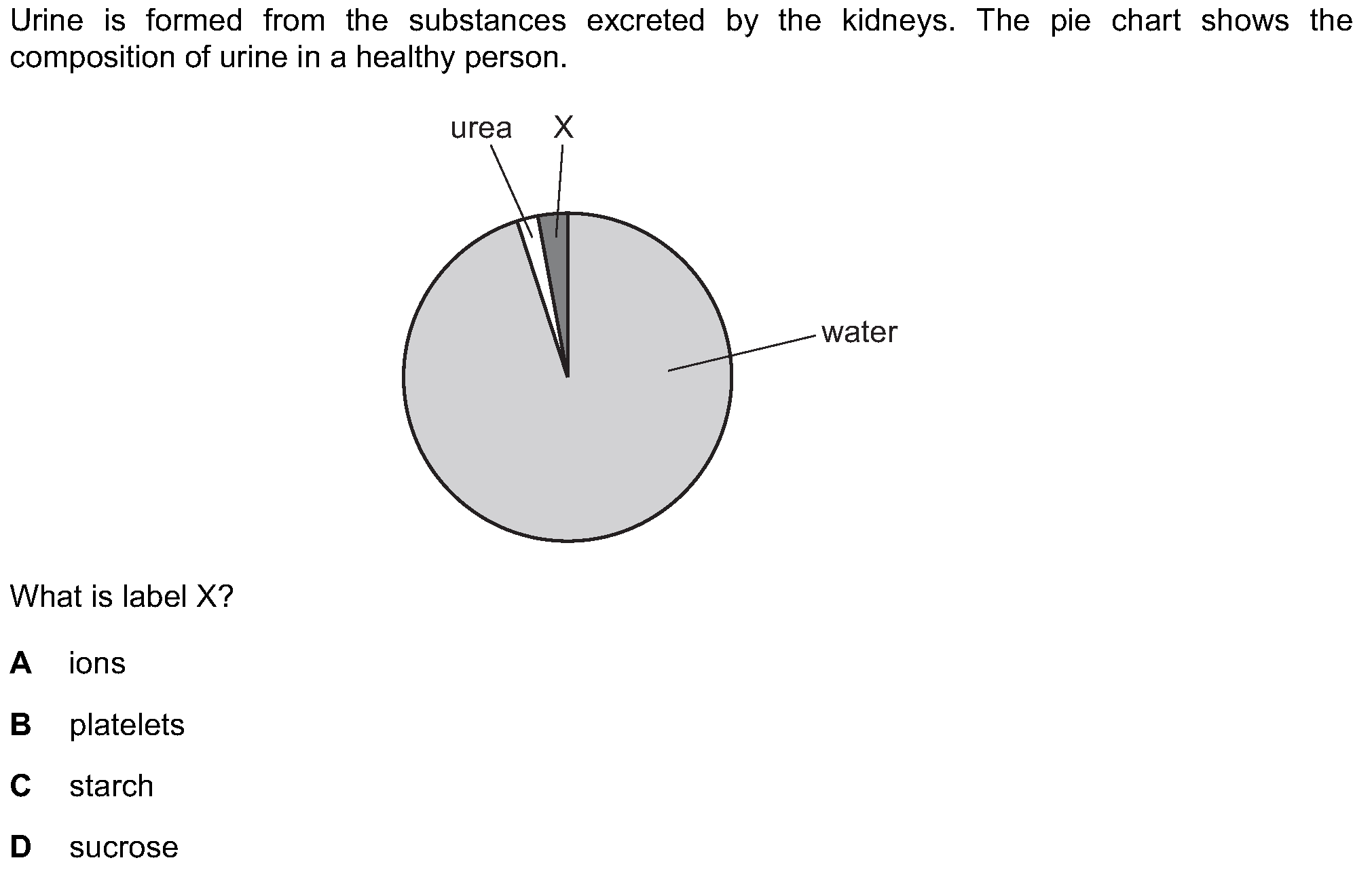
Urine is formed from the substances excreted by the kidneys. The pie chart shows the
composition of urine in a healthy person.
urea X
water
What is label X?
A_ ions
B platelets
C starch
D sucrose
composition of urine in a healthy person.
urea X
water
What is label X?
A_ ions
B platelets
C starch
D sucrose
Options:
A
B
C
D
Correct Key: A
A
B
C
D
Correct Key: A
Question 18
Paper Ref: 0610/22_Winter_2021_Q24
Paper Ref: 0610/22_Winter_2021_Q24
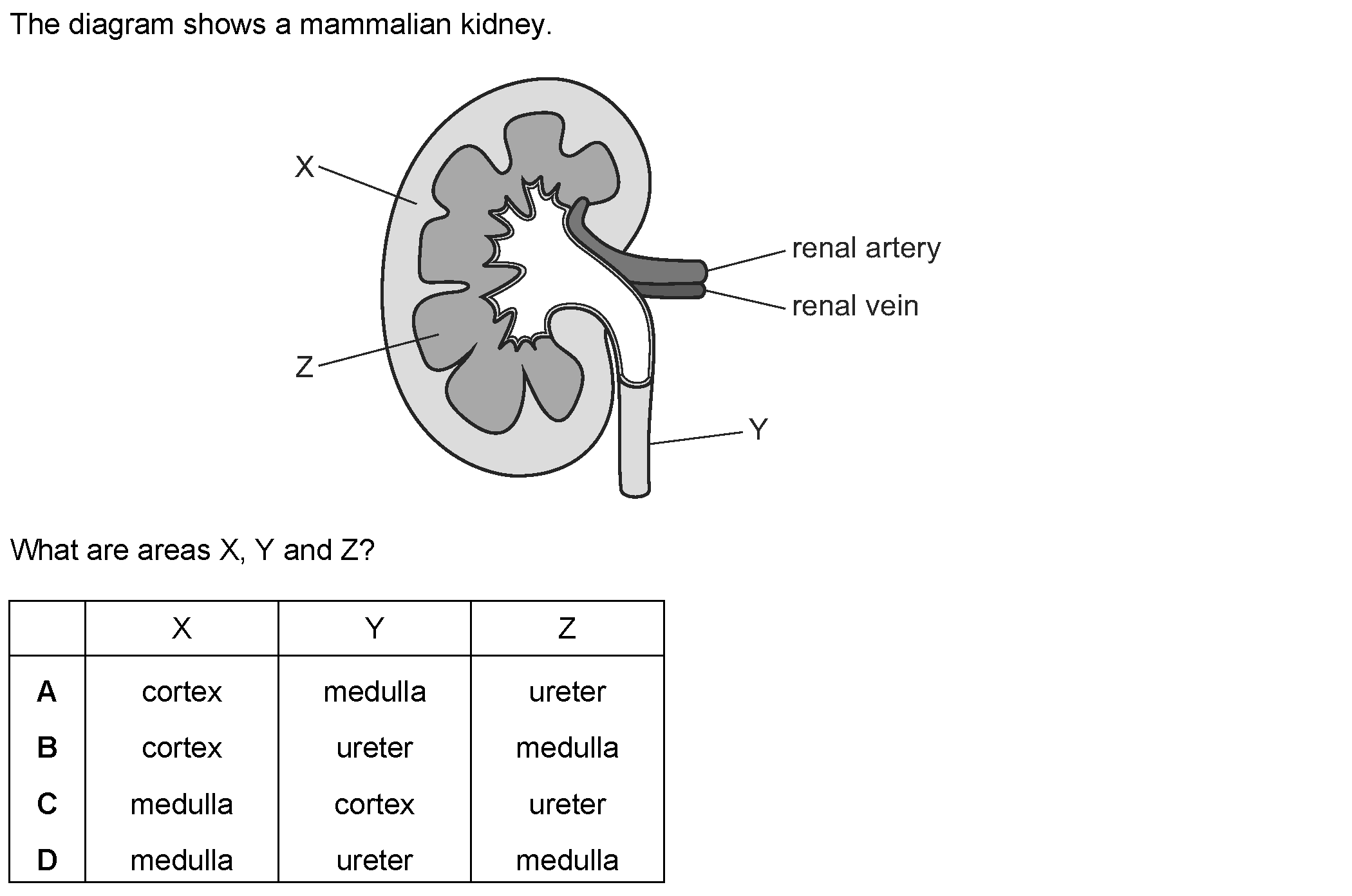
The diagram shows a mammalian kidney.
renal artery
renal vein
What are areas X, Y and Z?
cortex medulla ureter
cortex ureter medulla
medulla cortex ureter
medulla ureter medulla
renal artery
renal vein
What are areas X, Y and Z?
cortex medulla ureter
cortex ureter medulla
medulla cortex ureter
medulla ureter medulla
Options:
A
B
C
D
Correct Key: B
A
B
C
D
Correct Key: B
Question 19
Paper Ref: 0610/21_Winter_2021_Q23
Paper Ref: 0610/21_Winter_2021_Q23
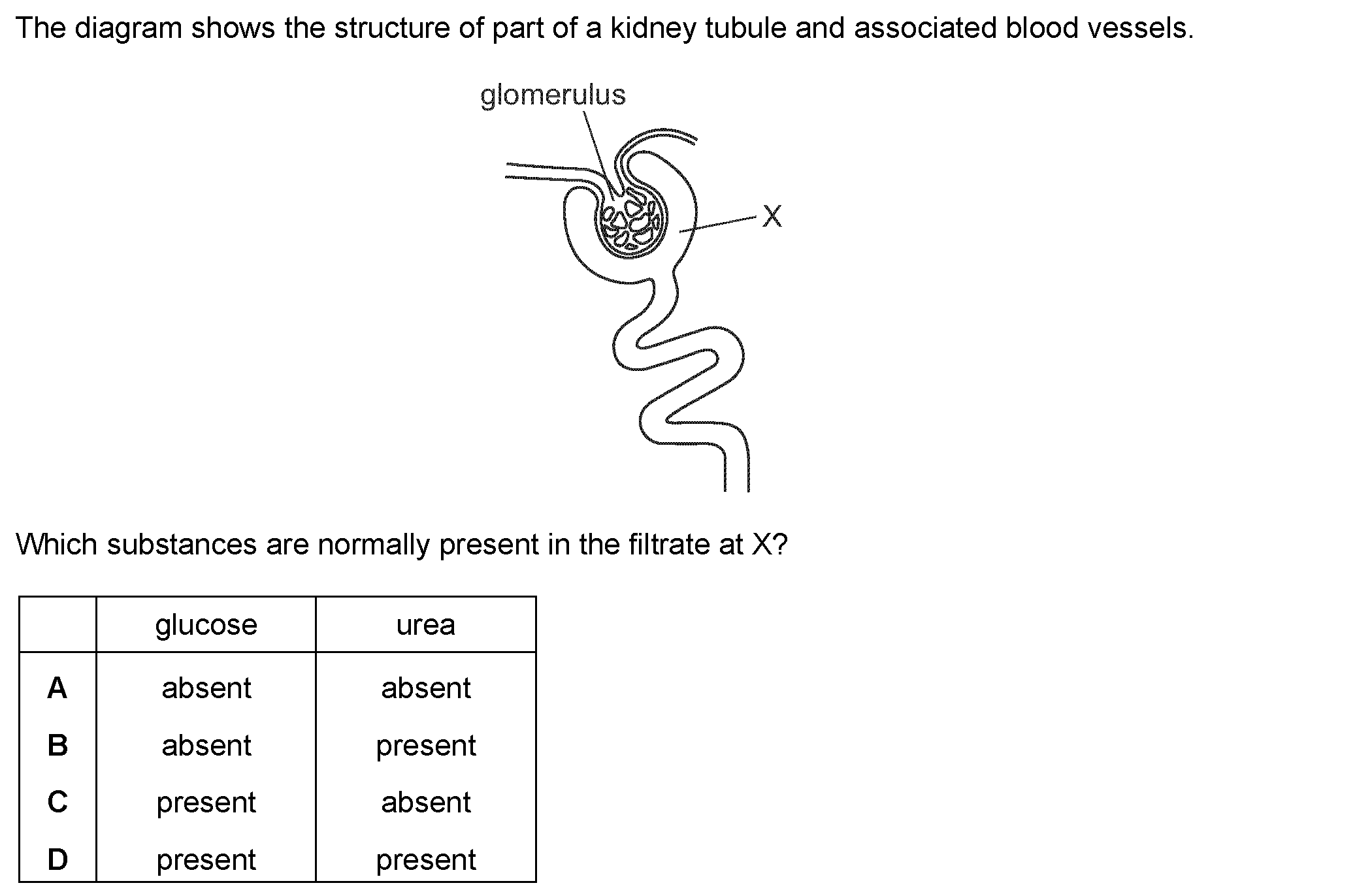
The diagram shows the structure of part of a kidney tubule and associated blood vessels.
glomerulus
oH) | —x
Which substances are normally present in the filtrate at X?
— glucose urea
absent absent
absent present
present absent
present present
glomerulus
oH) | —x
Which substances are normally present in the filtrate at X?
— glucose urea
absent absent
absent present
present absent
present present
Options:
A
B
C
D
Correct Key: D
A
B
C
D
Correct Key: D
Question 20
Paper Ref: 0610/13_Winter_2021_Q25
Paper Ref: 0610/13_Winter_2021_Q25
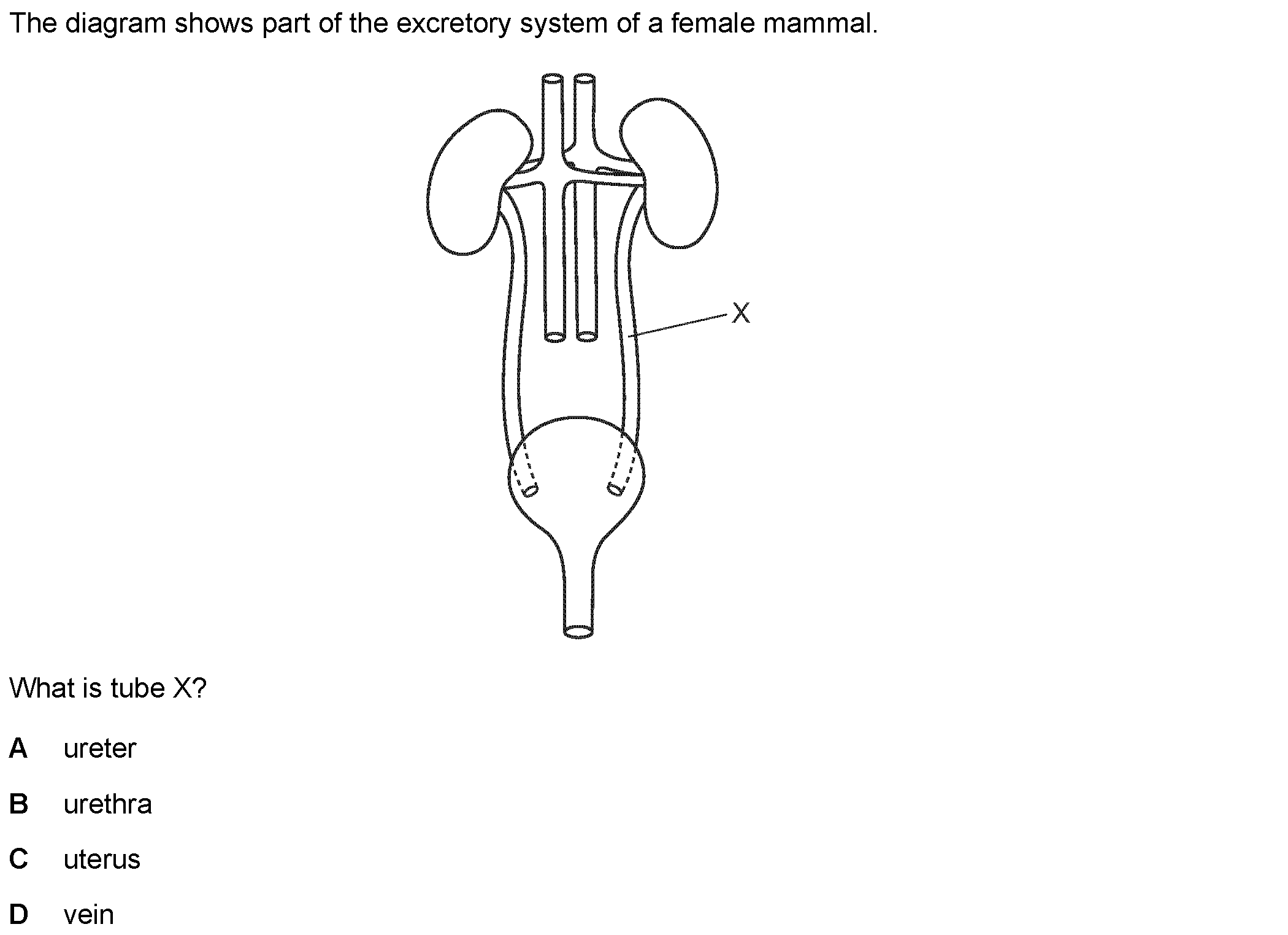
The diagram shows part of the excretory system of a female mammal.
What is tube X?
A ureter
B~ urethra
C uterus
D- vein
What is tube X?
A ureter
B~ urethra
C uterus
D- vein
Options:
A
B
C
D
Correct Key: A
A
B
C
D
Correct Key: A
Question 21
Paper Ref: 0610/21_Summer_2009_Q22
Paper Ref: 0610/21_Summer_2009_Q22
The diagram shows a kidney and its blood vessels.
artery
vein
ureter
In a healthy person, which structures transport glucose?
A artery only
B artery and ureter
Csartery and vein
D_ ureter and vein
artery
vein
ureter
In a healthy person, which structures transport glucose?
A artery only
B artery and ureter
Csartery and vein
D_ ureter and vein
Options:
A
B
C
D
Correct Key: C
A
B
C
D
Correct Key: C
Question 22
Paper Ref: 0610/22_Winter_2016_Q25
Paper Ref: 0610/22_Winter_2016_Q25
In a kidney tubule, which substances are filtered out of the blood in the glomerulus?
glucose, protein, salts and water
B glucose, protein, urea and water
C_ glucose, salts, urea and water
D protein, salts, urea and water
glucose, protein, salts and water
B glucose, protein, urea and water
C_ glucose, salts, urea and water
D protein, salts, urea and water
Options:
A
B
C
D
Correct Key: C
A
B
C
D
Correct Key: C
Question 23
Paper Ref: 0610/22_Summer_2014_Q22
Paper Ref: 0610/22_Summer_2014_Q22
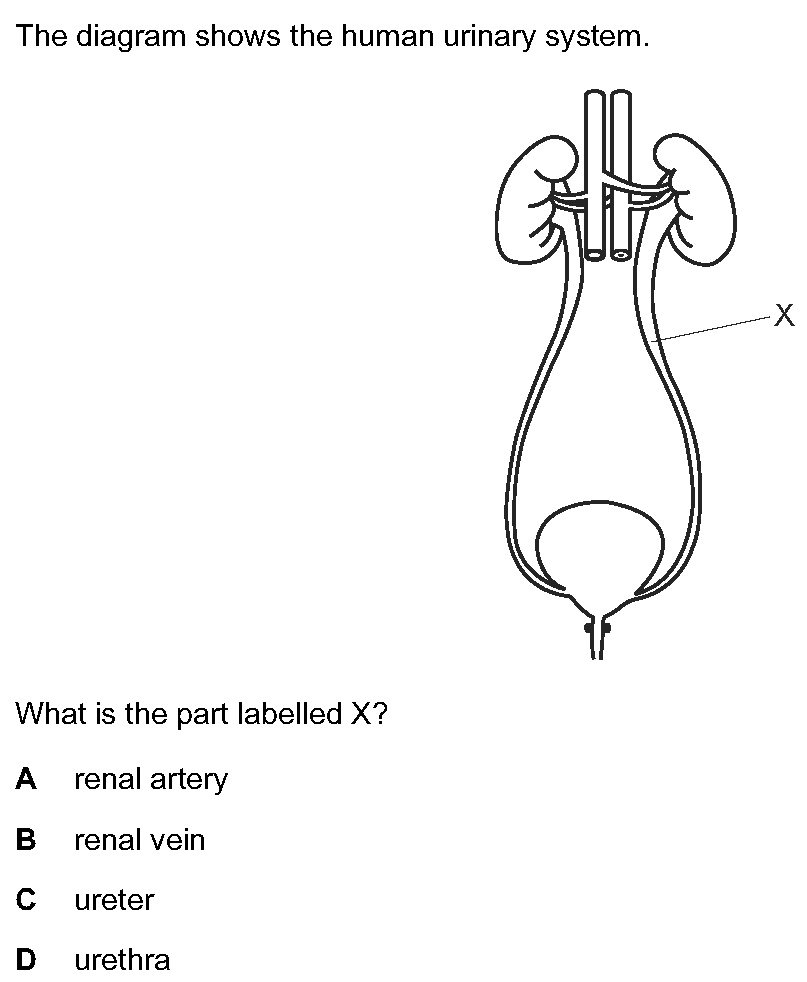
The diagram shows the human urinary system.
What is the part labelled X?
A renal artery
Brenal vein
C ureter
D
urethra
What is the part labelled X?
A renal artery
Brenal vein
C ureter
D
urethra
Options:
A
B
C
D
Correct Key: C
A
B
C
D
Correct Key: C
Question 24
Paper Ref: 0610/23_Winter_2015_Q21
Paper Ref: 0610/23_Winter_2015_Q21
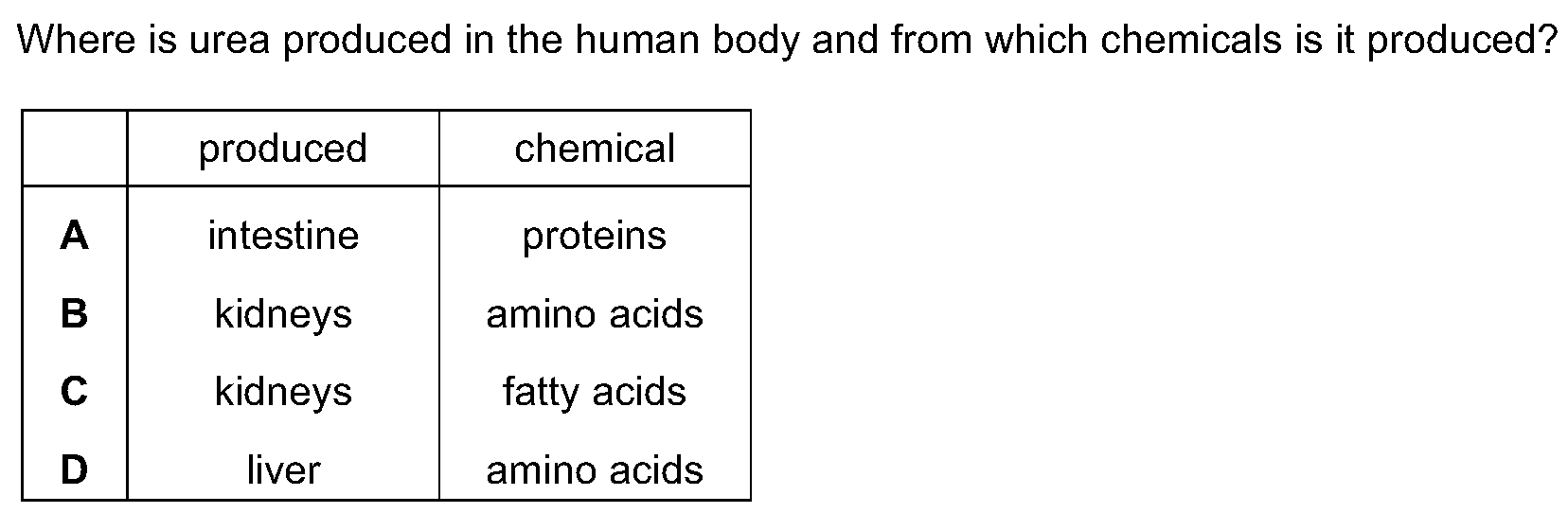
Where is urea produced in the human body and from which chemicals is it produced?
produced chemical
intestine proteins
kidneys amino acids
kidneys fatty acids
liver amino acids
produced chemical
intestine proteins
kidneys amino acids
kidneys fatty acids
liver amino acids
Options:
A
B
C
D
Correct Key: D
A
B
C
D
Correct Key: D
Question 25
Paper Ref: 0610/23_Winter_2015_Q17
Paper Ref: 0610/23_Winter_2015_Q17
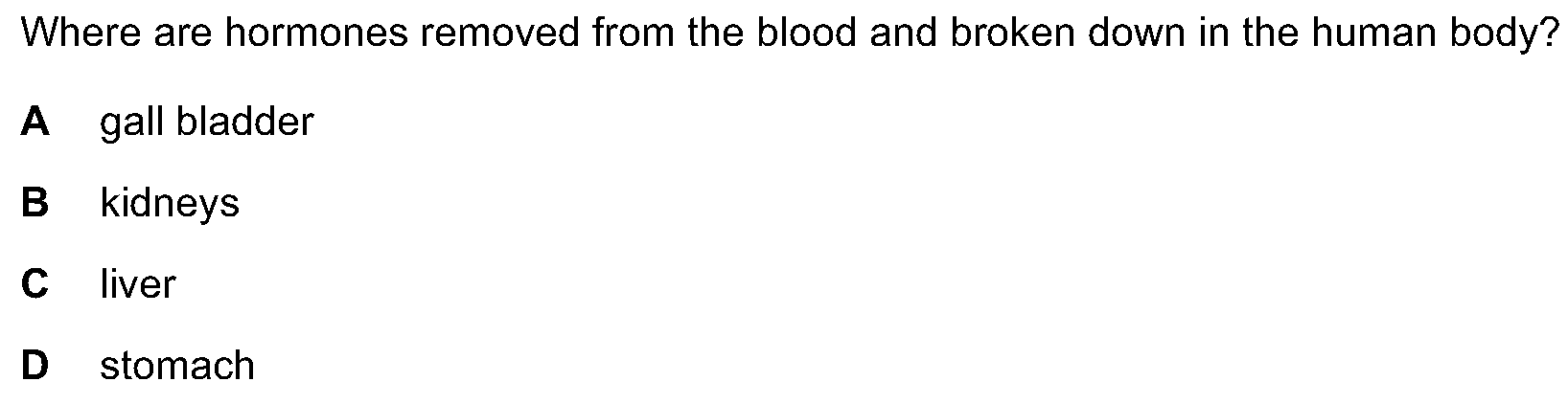
Where are hormones removed from the blood and broken down in the human body?
A gall bladder
B_ kidneys
C siiver
D_ stomach
A gall bladder
B_ kidneys
C siiver
D_ stomach
Options:
A
B
C
D
Correct Key: C
A
B
C
D
Correct Key: C
Question 26
Paper Ref: 0610/23_Summer_2013_Q24
Paper Ref: 0610/23_Summer_2013_Q24
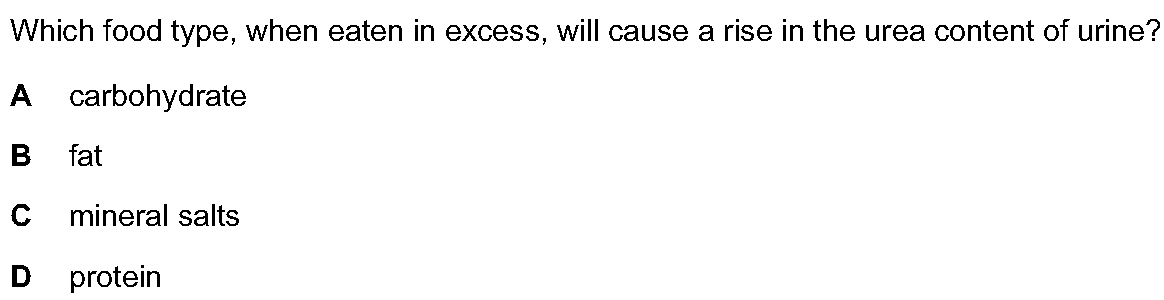
Which food type, when eaten in excess, will cause a rise in the urea content of urine?
carbohydrate
B fat
C_ mineral salts
D protein
carbohydrate
B fat
C_ mineral salts
D protein
Options:
A
B
C
D
Correct Key: D
A
B
C
D
Correct Key: D
Structured Questions Mark Scheme & Answers
•1•.• • • •[•P•R•I• •2•0•1•8•B• •P•2• • •·• • •Q•1•3• • •P•a•r•t• •(•a•)• • •·• • •2•0•1•8• • •·• • •P•r•i•m•a•r•y• •0•8•4•6•]• • • • • • ••• •–• •k•i•d•n•e•y• •2• •e•a•c•h• •c•o•r•r•e•c•t• •a•n•s•w•e•r• •=• •1• •m•a•r•k• •B• •–• •b•l•a•d•d•e•r• •T•h•e• •f•u•n•c•t•i•o•n• •o•f• •o•r•g•a•n• ••• •i•s• •t•o• •f•i•l•t•e•r• •b•l•o•o•d• •/• •2• •e•a•c•h• •c•o•r•r•e•c•t• •a•n•s•w•e•r• •=• •1• •m•a•r•k• •c•l•e•a•n• •t•h•e• •b•l•o•o•d•.• •T•h•e• •f•u•n•c•t•i•o•n• •o•f• •o•r•g•a•n• •B• •i•s• •t•o• •s•t•o•r•e• •u•r•i•n•e•.• •1•0•0•/•3•8•4• •©• •U•C•L•E•S• •2•0•1•8• •P•a•g•e• •1•0• •o•f• •1•4•
•2•.• • • •[•P•R•I• •2•0•1•8•B• •P•2• • •·• • •Q•1•3• • •P•a•r•t• •(•b•)• • •·• • •2•0•1•8• • •·• • •P•r•i•m•a•r•y• •0•8•4•6•]• • • • • • ••• •–• •k•i•d•n•e•y• •2• •e•a•c•h• •c•o•r•r•e•c•t• •a•n•s•w•e•r• •=• •1• •m•a•r•k• •B• •–• •b•l•a•d•d•e•r• •T•h•e• •f•u•n•c•t•i•o•n• •o•f• •o•r•g•a•n• ••• •i•s• •t•o• •f•i•l•t•e•r• •b•l•o•o•d• •/• •2• •e•a•c•h• •c•o•r•r•e•c•t• •a•n•s•w•e•r• •=• •1• •m•a•r•k• •c•l•e•a•n• •t•h•e• •b•l•o•o•d•.• •T•h•e• •f•u•n•c•t•i•o•n• •o•f• •o•r•g•a•n• •B• •i•s• •t•o• •s•t•o•r•e• •u•r•i•n•e•.• •1•0•0•/•3•8•4• •©• •U•C•L•E•S• •2•0•1•8• •P•a•g•e• •1•0• •o•f• •1•4•
•3•.• • • •[•C•P• •M•a•y• •2•0•2•4• •P•2• • •·• • •Q•1• • •P•a•r•t• •(•a•)• • •·• • •2•0•2•4• • •·• • •L•o•w•e•r• •S•e•c• •0•8•9•3•]• • • • • • •(•r•e•n•a•l•)• •v•e•i•n• •3• •a•l•l• •f•i•v•e• •c•o•r•r•e•c•t• •=• •3• •m•a•r•k•s• •t•h•r•e•e• •o•r• •f•o•u•r• •c•o•r•r•e•c•t• •=• •2• •m•a•r•k•s• •k•i•d•n•e•y• •o•n•e• •o•r• •t•w•o• •c•o•r•r•e•c•t• •=• •1• •m•a•r•k• •u•r•e•t•e•r• •b•l•a•d•d•e•r• •u•r•e•t•h•r•a•
•4•.• • • •[•C•P• •M•a•y• •2•0•2•4• •P•2• • •·• • •Q•1• • •P•a•r•t• •(•b•)• • •·• • •2•0•2•4• • •·• • •L•o•w•e•r• •S•e•c• •0•8•9•3•]• • • • • • •1• •••c•c•e•p•t• •e•c•f• •f•o•r• •n•a•m•e• •o•f• •u•r•e•t•e•r• •f•r•o•m• •(•a•)• •(•i•d•e•a• •t•h•a•t•)• •c•h•i•l•d• •B• •h•a•s• •a•n• •e•x•t•r•a• •u•r•e•t•e•r• •o•r• •c•h•i•l•d• •B• •h•a•s• •m•o•r•e• •••c•c•e•p•t• •o•r•a• •f•o•r• •c•h•i•l•d• ••• •u•r•e•t•e•r•s• •o•r• •c•h•i•l•d• •B• •h•a•s• •3• •u•r•e•t•e•r•s• •(•n•o•t• •2•)• •I•g•n•o•r•e• •c•h•i•l•d• ••• •h•a•s• •a• •n•o•r•m•a•l• •r•e•n•a•l• •s•y•s•t•e•m• •o•r• •c•h•i•l•d• •B• •h•a•s• •a•n• •a•b•n•o•r•m•a•l• •r•e•n•a•l• •s•y•s•t•e•m•
•5•.• • • •[•C•P• •M•a•y• •2•0•2•4• •P•2• • •·• • •Q•1• • •P•a•r•t• •(•b•)• • •·• • •2•0•2•4• • •·• • •L•o•w•e•r• •S•e•c• •0•8•9•3•]• • • • • • •1• •••c•c•e•p•t• •e•c•f• •f•o•r• •n•a•m•e• •o•f• •u•r•e•t•e•r• •f•r•o•m• •(•a•)• •(•i•d•e•a• •t•h•a•t•)• •c•h•i•l•d• •B• •h•a•s• •a•n• •e•x•t•r•a• •u•r•e•t•e•r• •o•r• •c•h•i•l•d• •B• •h•a•s• •m•o•r•e• •••c•c•e•p•t• •o•r•a• •f•o•r• •c•h•i•l•d• ••• •u•r•e•t•e•r•s• •o•r• •c•h•i•l•d• •B• •h•a•s• •3• •u•r•e•t•e•r•s• •(•n•o•t• •2•)• •I•g•n•o•r•e• •c•h•i•l•d• ••• •h•a•s• •a• •n•o•r•m•a•l• •r•e•n•a•l• •s•y•s•t•e•m• •o•r• •c•h•i•l•d• •B• •h•a•s• •a•n• •a•b•n•o•r•m•a•l• •r•e•n•a•l• •s•y•s•t•e•m•
•6•.• • • •[•C•P• •M•a•y• •2•0•2•5• •P•2• • •·• • •Q•1• • •P•a•r•t• •(•a•)• • •·• • •2•0•2•5• • •·• • •L•o•w•e•r• •S•e•c• •0•8•9•3•]• • • • • • •k•i•d•n•e•y•(•s•)• •1• •u•r•i•n•e• •1• •••c•c•e•p•t• •u•r•e•a• •(•a•n•d• •w•a•t•e•r•)• •••0•8•9•3•/•0•2• •C•h•e•c•k•p•o•i•n•t• •S•e•c•o•n•d•a•r•y• •–• •M•a•r•k• •S•c•h•e•m•e• •••p•r•i•l• •2•0•2•5•
•7•.• • • •[•C•P• •M•a•y• •2•0•2•5• •P•2• • •·• • •Q•1• • •P•a•r•t• •(•b•)• • •·• • •2•0•2•5• • •·• • •L•o•w•e•r• •S•e•c• •0•8•9•3•]• • • • • • •2• •c•o•r•r•e•c•t• •s•t•r•e•n•g•t•h• •=• •1• •m•a•r•k• •c•o•r•r•e•c•t• •l•i•m•i•t•a•t•i•o•n• •=• •1• •m•a•r•k• •(•s•t•r•e•n•g•t•h•)• •s•h•o•w•s• •f•i•l•t•r•a•t•i•o•n• •I•g•n•o•r•e• •r•e•p•r•e•s•e•n•t•s• •t•h•e• •r•e•n•a•l• •s•y•s•t•e•m• •a•c•c•u•r•a•t•e•l•y• •o•r• •r•e•m•o•v•e•s• •s•o•m•e• •i•m•p•u•r•i•t•i•e•s• •I•g•n•o•r•e• •c•l•e•a•n•s• •t•h•e• •w•a•t•e•r• •/• •s•t•r•a•i•n•s• •t•h•e• •b•l•o•o•d• •(•l•i•m•i•t•a•t•i•o•n•)• •(•i•d•e•a• •t•h•a•t•)• •d•o•e•s• •n•o•t• •s•h•o•w• •l•i•q•u•i•d• •b•e•i•n•g• •s•t•o•r•e•d• •i•n• •••c•c•e•p•t• •o•r•a• •f•o•r• •l•i•m•i•t•a•t•i•o•n•s• •t•h•e• •b•l•a•d•d•e•r• •o•r• •l•i•q•u•i•d• •i•s• •c•o•n•t•i•n•u•a•l•l•y• •l•e•a•v•i•n•g• •t•h•e• •b•l•a•d•d•e•r• •o•r• •n•o•t• •a• •c•o•n•t•i•n•u•a•l• •p•r•o•c•e•s•s• •o•r• •w•a•t•e•r• •h•a•s• •t•o• •b•e• •p•o•u•r•e•d• •i•n•t•o• •t•h•e• •k•i•d•n•e•y•s• •o•r• •i•m•p•u•r•i•t•i•e•s• •r•e•m•a•i•n• •i•n• •t•h•e• •b•o•t•t•l•e•s• •••c•c•e•p•t• •i•n• •k•i•d•n•e•y•s• •t•h•e• •i•m•p•u•r•i•t•i•e•s• •l•e•a•v•e• •a•s• •u•r•i•n•e• •o•r• •(•i•d•e•a• •t•h•a•t•)• •i•t• •d•o•e•s• •n•o•t• •s•h•o•w• •t•h•e• •e•n•t•i•r•e• •r•e•n•a•l• •s•y•s•t•e•m• •••c•c•e•p•t• •h•i•g•h•e•r• •l•e•v•e•l• •i•d•e•a•s• •s•u•c•h• •a•s•,• •d•o•e•s• •n•o•t• •s•h•o•w• •r•e•a•b•s•o•r•p•t•i•o•n•,• •a•r•t•e•r•y• •a•n•d• •v•e•i•n•,• •c•o•r•t•e•x• •a•n•d• •m•e•d•u•l•l•a•,• •B•o•w•m•a•n•’•s• •c•a•p•s•u•l•e•,• •l•o•o•p• •o•f• •H•e•n•l•e• •e•t•c•.• •o•r• •(•i•d•e•a• •t•h•a•t•)• •i•t• •d•o•e•s• •n•o•t• •s•h•o•w• •t•h•e• •w•a•s•t•e• •p•r•o•d•u•c•t•s• •p•r•e•s•e•n•t• •i•n• •I•g•n•o•r•e• •k•i•d•n•e•y•s• •d•o• •n•o•t• •h•a•v•e• •r•o•c•k•s• •a•n•d• •s•a•n•d• •u•r•i•n•e• •o•r• •i•t• •s•h•o•w•s• •c•l•e•a•n• •w•a•t•e•r• •(•n•o•t• •w•a•s•t•e• •p•r•o•d•u•c•t•s•)• •o•r• •(•i•d•e•a• •t•h•a•t•)• •i•t• •i•s• •n•o•t• •c•l•e•a•r• •i•f• •t•h•e• •w•a•t•e•r• •t•h•a•t• •g•o•e•s• •i•n• •a•n•d• •l•e•a•v•e•s• •i•s• •b•l•o•o•d• •o•r• •(•i•d•e•a• •t•h•a•t•)• •n•o•t• •t•o• •s•c•a•l•e• •••0•8•9•3•/•0•2• •C•h•e•c•k•p•o•i•n•t• •S•e•c•o•n•d•a•r•y• •–• •M•a•r•k• •S•c•h•e•m•e• •••p•r•i•l• •2•0•2•5•
•8•.• • • •[•C•P• •M•a•y• •2•0•2•5• •P•2• • •·• • •Q•1• • •P•a•r•t• •(•c•)• • •·• • •2•0•2•5• • •·• • •L•o•w•e•r• •S•e•c• •0•8•9•3•]• • • • • • •n•e•w• •e•v•i•d•e•n•c•e• •o•r• •m•o•r•e• •u•n•d•e•r•s•t•a•n•d•i•n•g• •1• •••c•c•e•p•t• •t•e•c•h•n•o•l•o•g•y• •a•d•v•a•n•c•e•s• •o•r• •c•o•r•r•e•c•t•i•n•g• •m•i•s•t•a•k•e•s• •i•n• •t•h•e• •m•o•d•e•l• •o•r• •s•c•i•e•n•t•i•f•i•c• •r•e•s•e•a•r•c•h• •g•e•t•s• •b•e•t•t•e•r•
Last updated:
\n