5.4Electricity and Magnetism
Other ways of making salts — Question Bank (Cambridge) — Cambridge IGCSE Physics 0625 Revision Notes & Topical Questions
15 min read Lesson 57 of 65 Unit quiz
Cambridge Past Paper Bank
5.4 Other ways of making salts
16 Multiple-Choice Questions with Official Mark Schemes
Question 1
0620/23_Winter_2018_Q20
Question 2
5129/12_Winter_2023_Q22
Question 3
5129/11_Summer_2020_Q21
Question 4
0620/11_Summer_2019_Q13
Question 5
5129/11_Winter_2022_Q20
Question 6
0620/22_Summer_2020_Q20
Question 7
5129/11_Summer_2025_Q21
Question 8
5129/12_Winter_2022_Q14
Question 9
0620/23_Summer_2019_Q14
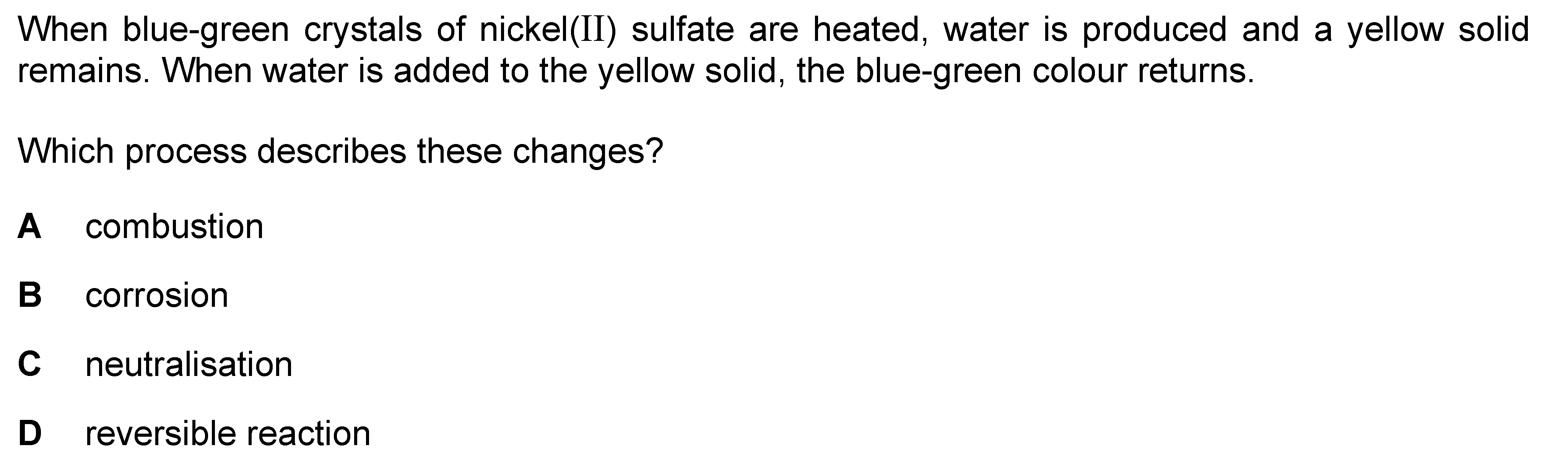
Question 10
0620/23_Summer_2023_Q19
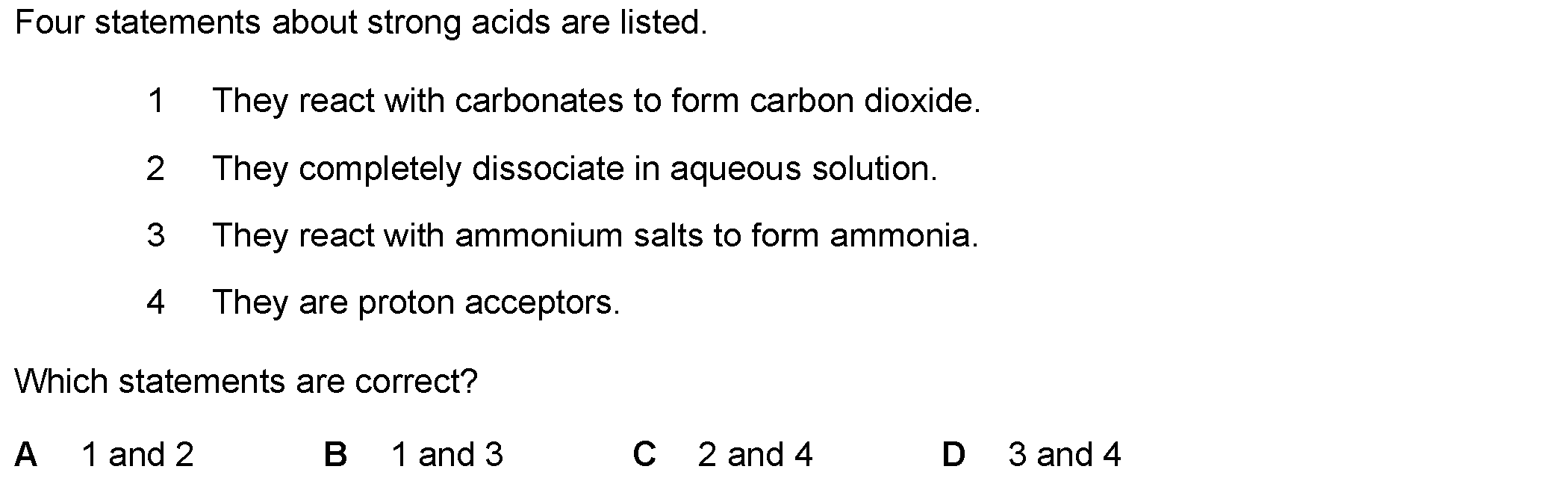
Question 11
0620/22_Summer_2015_Q15
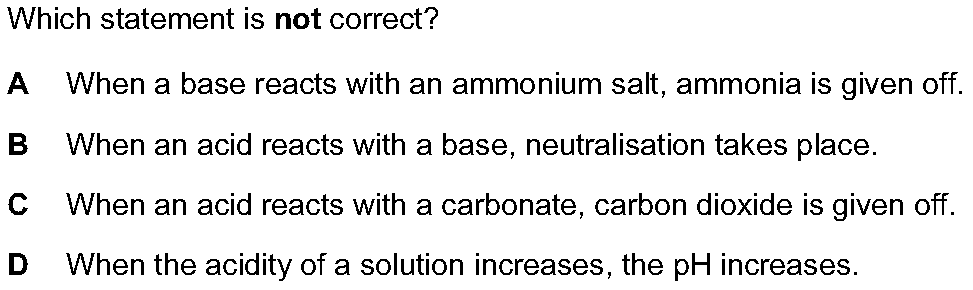
Question 12
0620/23_Winter_2017_Q28
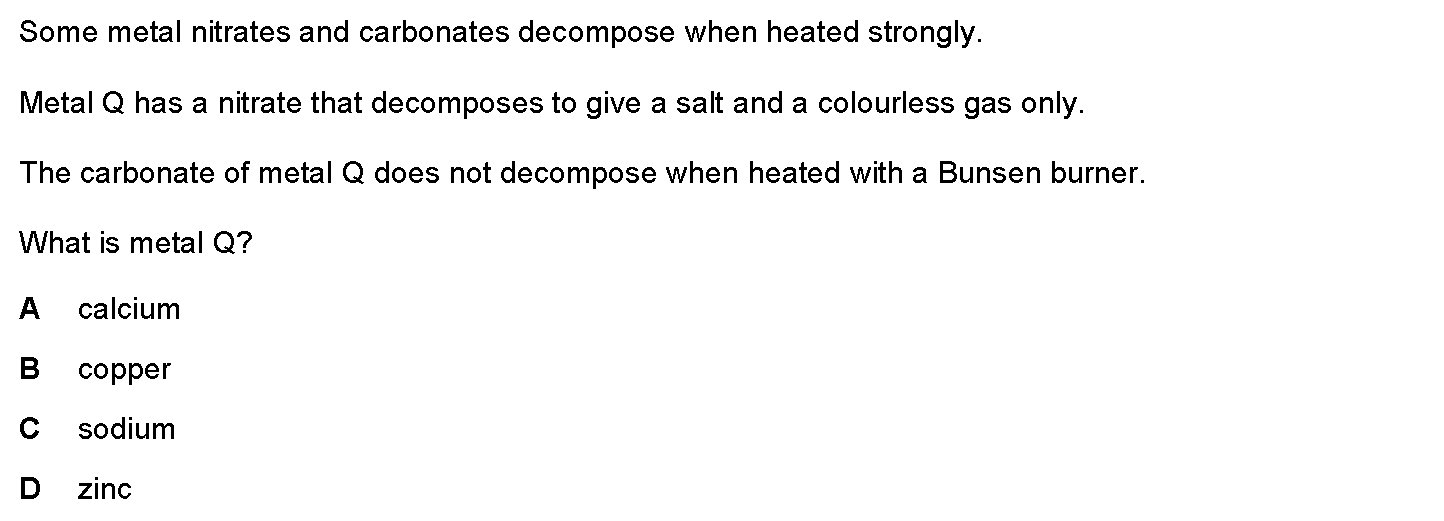
Question 13
5129/11_Summer_2021_Q20
Question 14
0620/12_Spring_2025_Q37
Question 15
0620/23_Summer_2010_Q20
Question 16
0620/22_Summer_2018_Q1
Cambridge Lower Secondary Stage 9
5.4 Other ways of making salts – Complete Question Bank & Mark Scheme
Total Questions16 Questions with Verified Solutions & Past Paper Mark Schemes
Multiple Choice Questions (Exam Practice)
Question 1
Paper Ref: 0620/23_Winter_2018_Q20
Paper Ref: 0620/23_Winter_2018_Q20
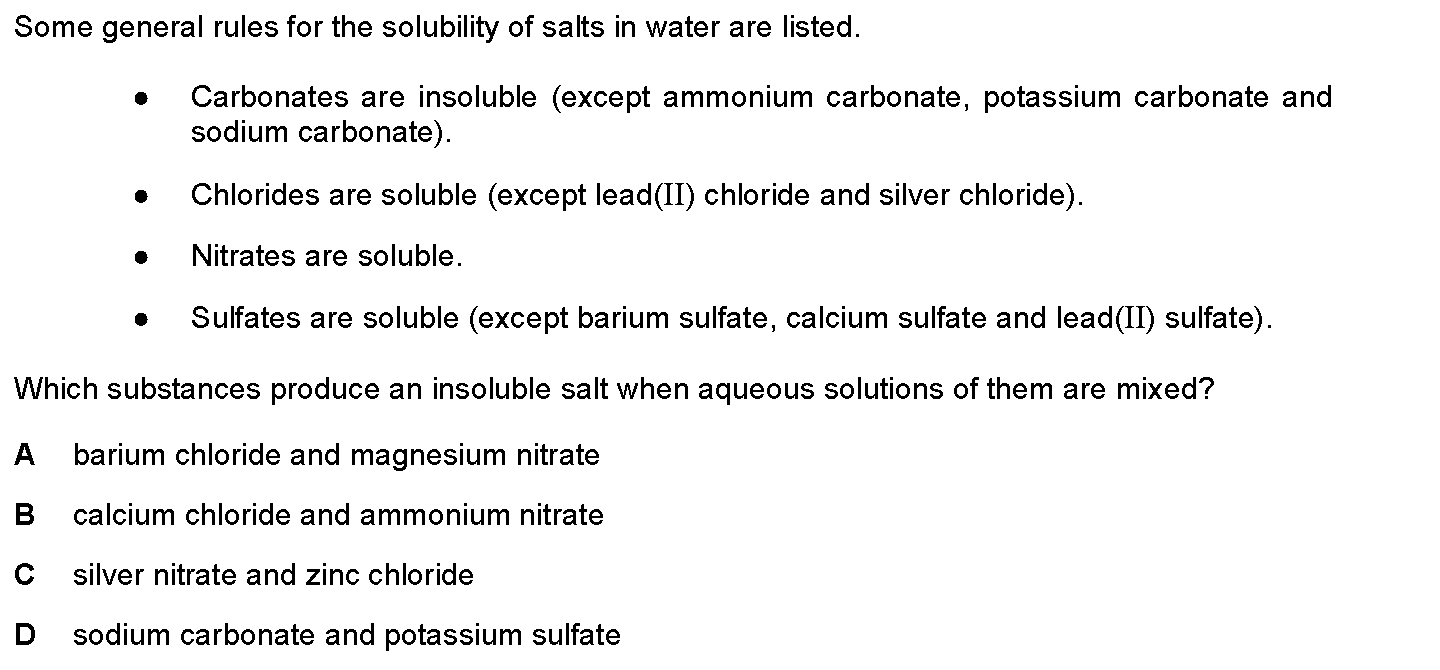
Some general rules for the solubility of salts in water are listed.
e Carbonates are insoluble (except ammonium carbonate, potassium carbonate and
sodium carbonate).
e Chlorides are soluble (except lead(II) chloride and silver chloride).
e Nitrates are soluble.
e Sulfates are soluble (except barium sulfate, calcium sulfate and lead(II) sulfate).
Which substances produce an insoluble salt when aqueous solutions of them are mixed?
barium chloride and magnesium nitrate
Bs calcium chloride and ammonium nitrate
C _ silver nitrate and zinc chloride
D_ sodium carbonate and potassium sulfate
Options:
A
B
C
D
Correct Key: C
A
B
C
D
Correct Key: C
Question 2
Paper Ref: 5129/12_Winter_2023_Q22
Paper Ref: 5129/12_Winter_2023_Q22
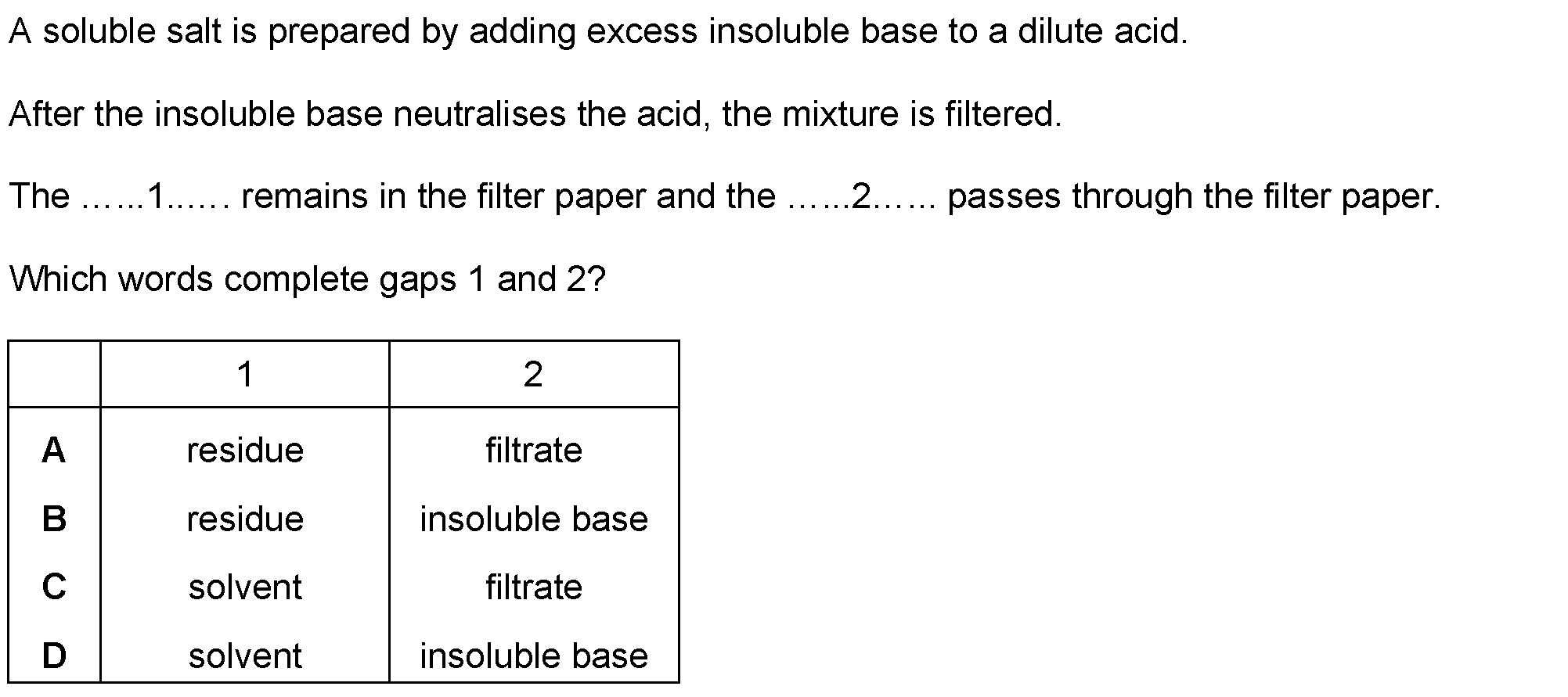
A soluble salt is prepared by adding excess insoluble base to a dilute acid.
After the insoluble base neutralises the acid, the mixture is filtered.
The ……1…… remains in the filter paper and the ……2…… passes through the filter paper.
Which words complete gaps 1 and 2?
residue filtrate
residue insoluble base
solvent filtrate
solvent insoluble base
After the insoluble base neutralises the acid, the mixture is filtered.
The ……1…… remains in the filter paper and the ……2…… passes through the filter paper.
Which words complete gaps 1 and 2?
residue filtrate
residue insoluble base
solvent filtrate
solvent insoluble base
Options:
A
B
C
D
Correct Key: A
A
B
C
D
Correct Key: A
Question 3
Paper Ref: 5129/11_Summer_2020_Q21
Paper Ref: 5129/11_Summer_2020_Q21
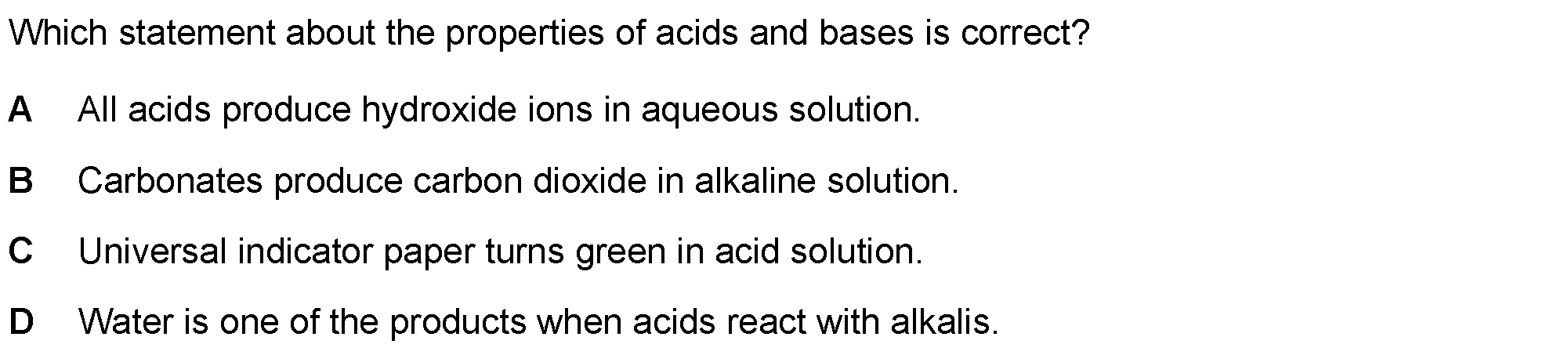
Which statement about the properties of acids and bases is correct?
A
B
Cc
D
All acids produce hydroxide ions in aqueous solution.
Carbonates produce carbon dioxide in alkaline solution.
Universal indicator paper turns green in acid solution.
Water is one of the products when acids react with alkalis.
A
B
Cc
D
All acids produce hydroxide ions in aqueous solution.
Carbonates produce carbon dioxide in alkaline solution.
Universal indicator paper turns green in acid solution.
Water is one of the products when acids react with alkalis.
Options:
A
B
C
D
Correct Key: D
A
B
C
D
Correct Key: D
Question 4
Paper Ref: 0620/11_Summer_2019_Q13
Paper Ref: 0620/11_Summer_2019_Q13
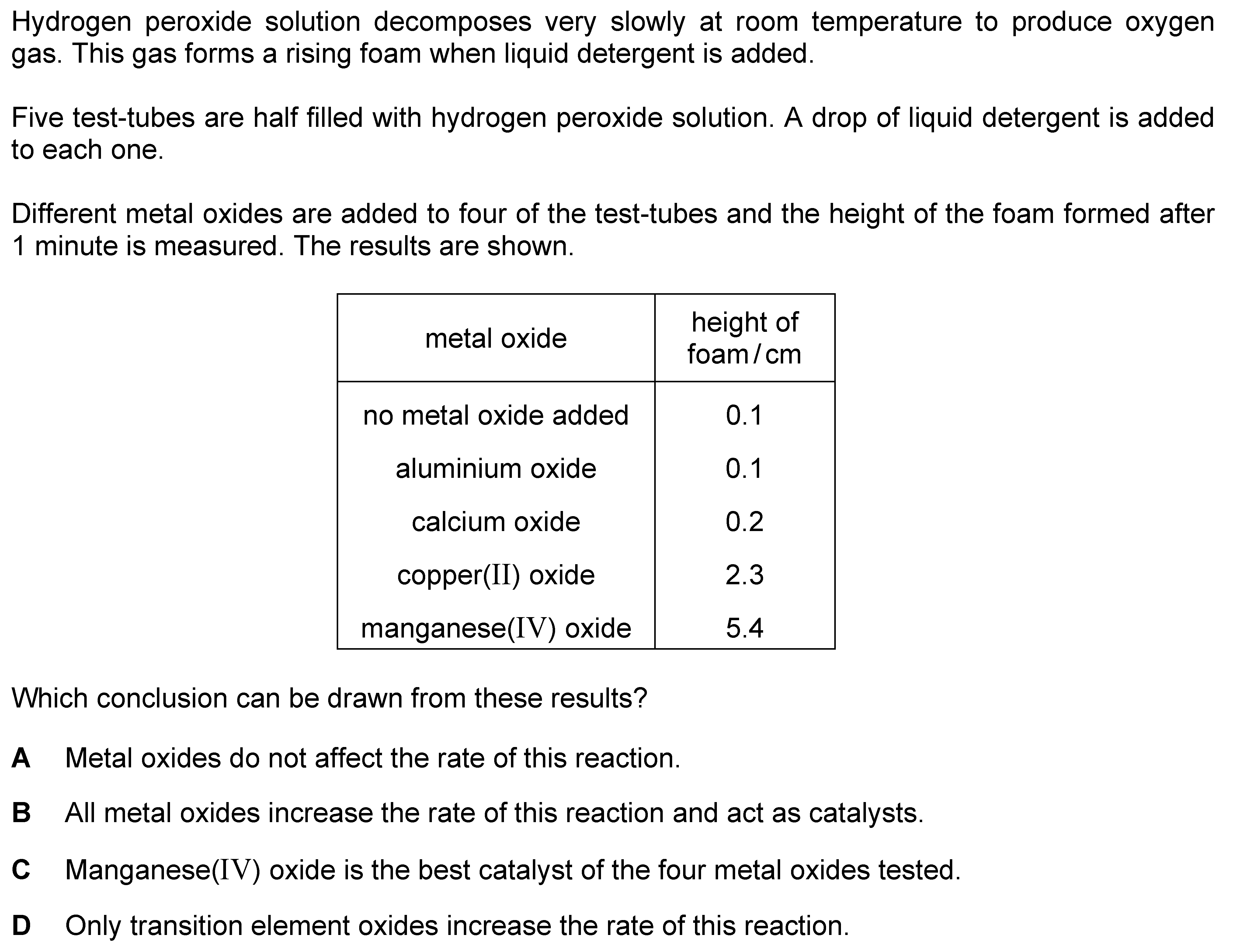
Hydrogen peroxide solution decomposes very slowly at room temperature to produce oxygen
gas. This gas forms a rising foam when liquid detergent is added.
Five test-tubes are half filled with hydrogen peroxide solution. A drop of liquid detergent is added
to each one.
Different metal oxides are added to four of the test-tubes and the height of the foam formed after
1 minute is measured. The results are shown.
metal oxide height of
foam/cm
no metal oxide added
aluminium oxide
calcium oxide
copper(II) oxide
manganese(IV) oxide
Which conclusion can be drawn from these results?
A Metal oxides do not affect the rate of this reaction.
All metal oxides increase the rate of this reaction and act as catalysts.
Manganese(IV) oxide is the best catalyst of the four metal oxides tested.
0 OO DW
Only transition element oxides increase the rate of this reaction.
Options:
A
B
C
D
Correct Key: C
A
B
C
D
Correct Key: C
Question 5
Paper Ref: 5129/11_Winter_2022_Q20
Paper Ref: 5129/11_Winter_2022_Q20
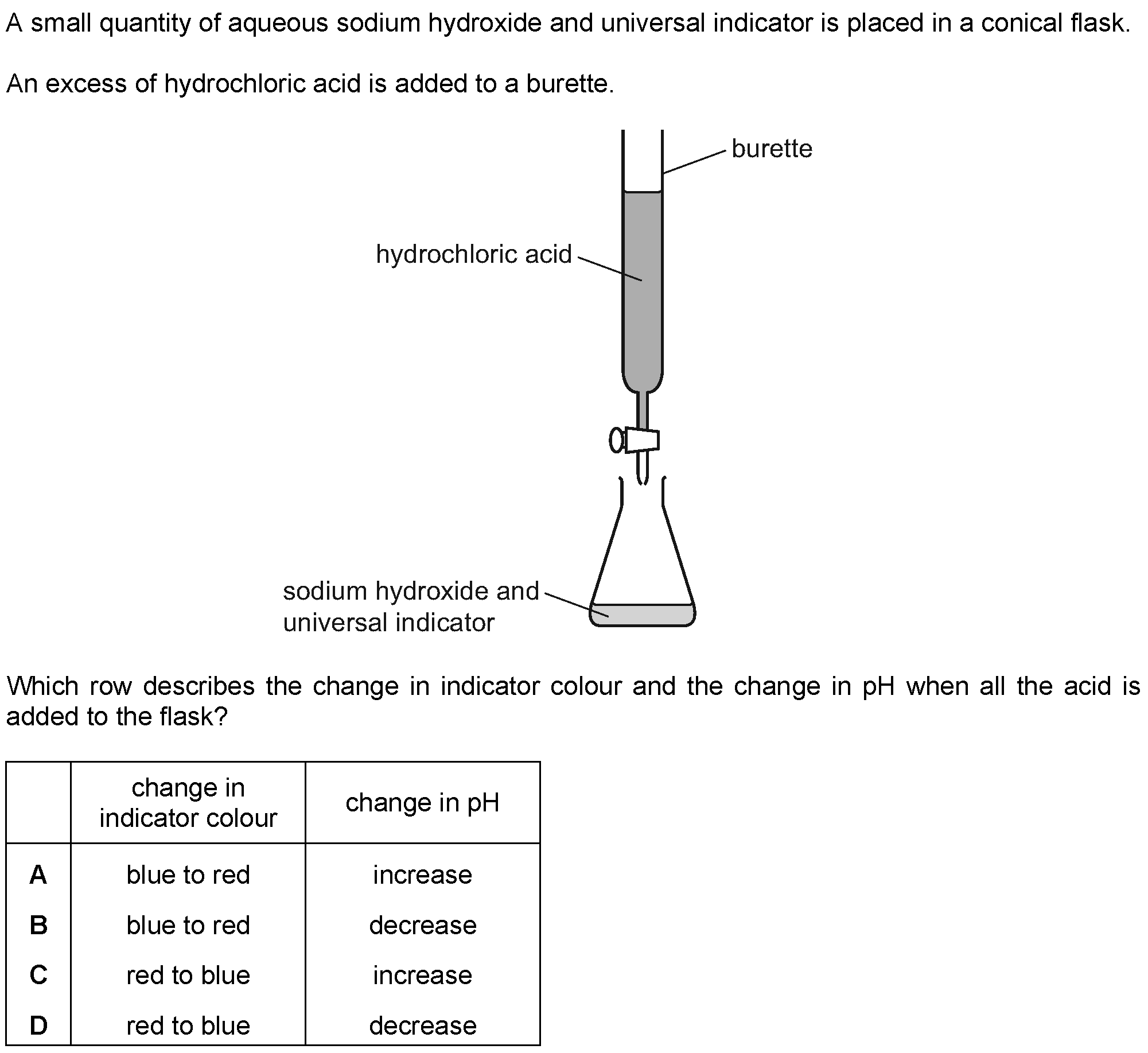
A small quantity of aqueous sodium hydroxide and universal indicator is placed in a conical flask.
An excess of hydrochloric acid is added to a burette.
burette
hydrochloric acid
sodium hydroxide and
universal indicator
Which row describes the change in indicator colour and the change in pH when all the acid is
added to the flask?
change in
blue to red increase
blue to red decrease
red to blue increase
red to blue decrease
Options:
A
B
C
D
Correct Key: B
A
B
C
D
Correct Key: B
Question 6
Paper Ref: 0620/22_Summer_2020_Q20
Paper Ref: 0620/22_Summer_2020_Q20
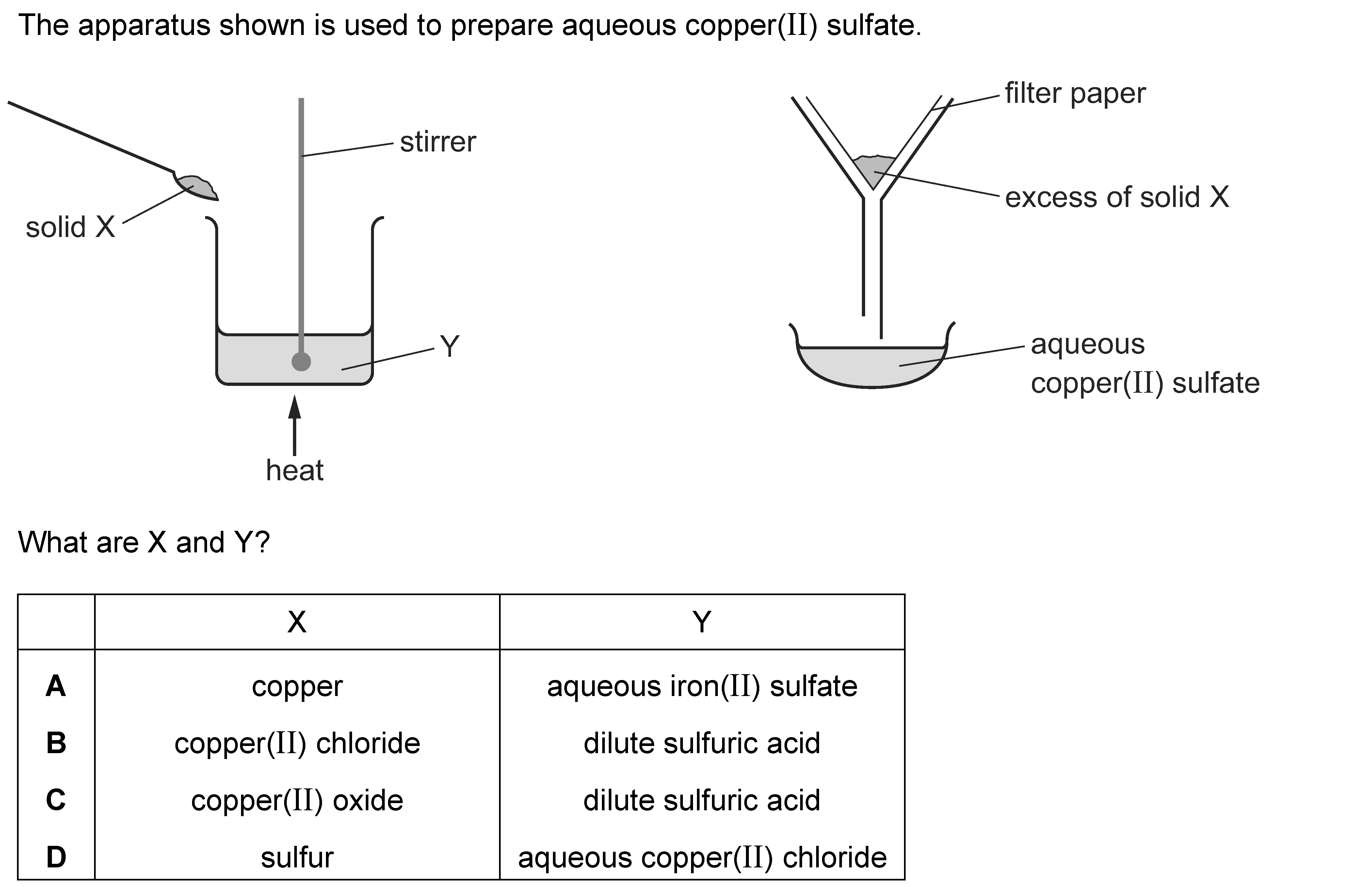
The apparatus shown is used to prepare aqueous copper(II) sulfate.
filter paper
stirrer
excess of solid X
solid X
Y \ a aqueous
copper(II) sulfate
heat
What are X and Y?
copper aqueous iron(II) sulfate
copper(II) chloride dilute sulfuric acid
copper(II) oxide dilute sulfuric acid
sulfur aqueous copper(II) chloride
filter paper
stirrer
excess of solid X
solid X
Y \ a aqueous
copper(II) sulfate
heat
What are X and Y?
copper aqueous iron(II) sulfate
copper(II) chloride dilute sulfuric acid
copper(II) oxide dilute sulfuric acid
sulfur aqueous copper(II) chloride
Options:
A
B
C
D
Correct Key: C
A
B
C
D
Correct Key: C
Question 7
Paper Ref: 5129/11_Summer_2025_Q21
Paper Ref: 5129/11_Summer_2025_Q21
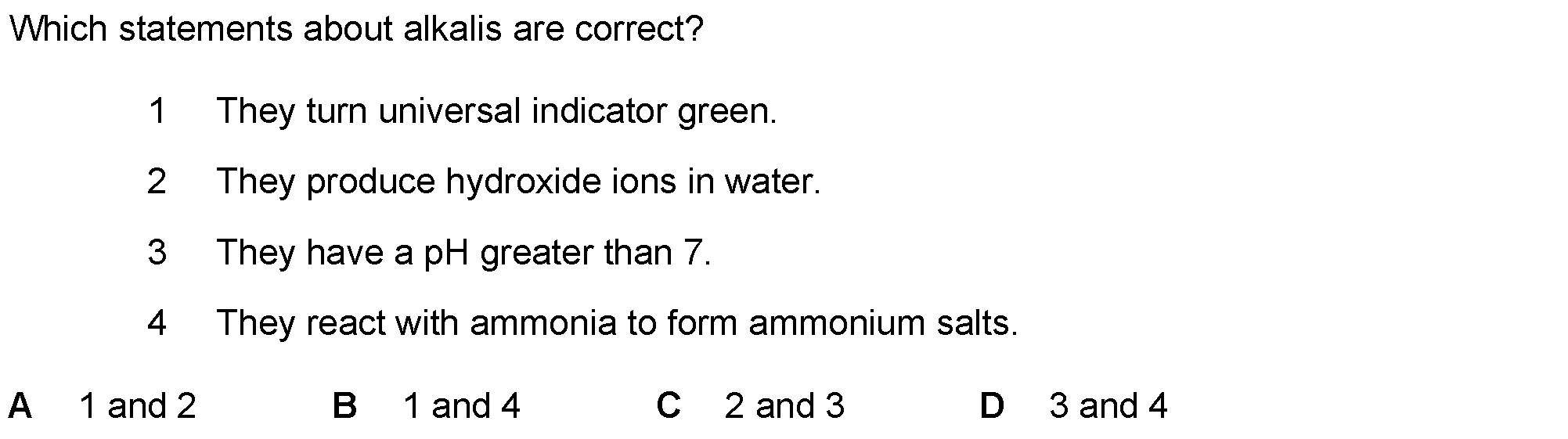
Which statements about alkalis are correct?
1 They turn universal indicator green.
2 They produce hydroxide ions in water.
3 They have a pH greater than 7.
4
They react with ammonia to form ammonium salts.
A 1and2 B 1and4 C 2and3 D 3and4
1 They turn universal indicator green.
2 They produce hydroxide ions in water.
3 They have a pH greater than 7.
4
They react with ammonia to form ammonium salts.
A 1and2 B 1and4 C 2and3 D 3and4
Options:
A
B
C
D
Correct Key: C
A
B
C
D
Correct Key: C
Question 8
Paper Ref: 5129/12_Winter_2022_Q14
Paper Ref: 5129/12_Winter_2022_Q14
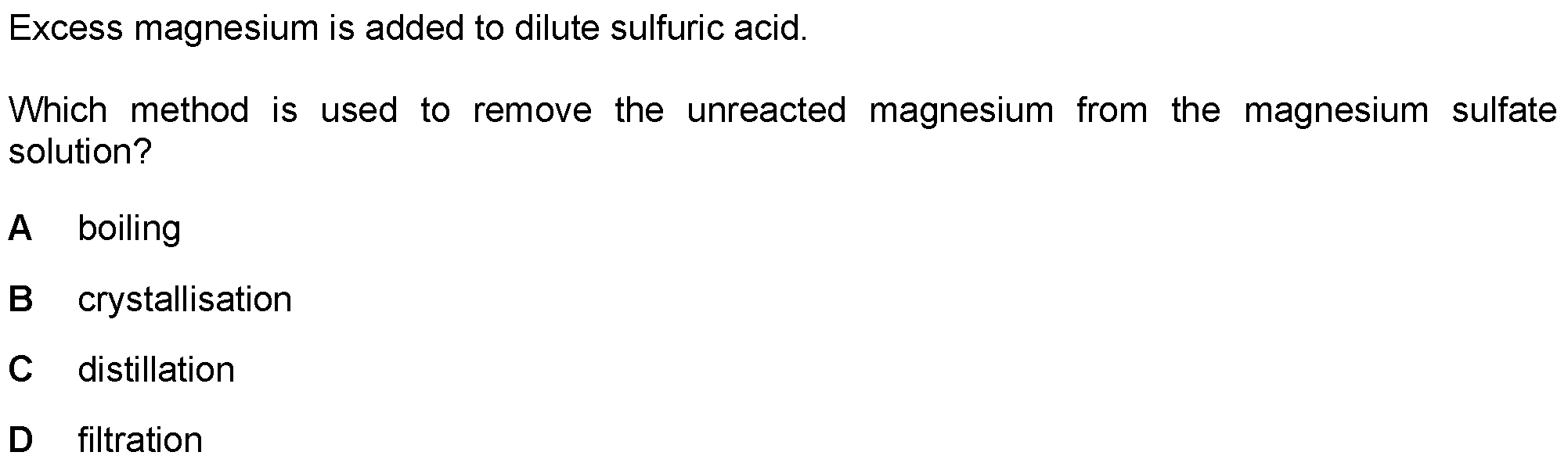
Excess magnesium is added to dilute sulfuric acid.
Which method is used to remove the unreacted magnesium from the magnesium sulfate
solution?
A boiling
B crystallisation
C distillation
D
filtration
Which method is used to remove the unreacted magnesium from the magnesium sulfate
solution?
A boiling
B crystallisation
C distillation
D
filtration
Options:
A
B
C
D
Correct Key: D
A
B
C
D
Correct Key: D
Question 9
Paper Ref: 0620/23_Summer_2019_Q14
Paper Ref: 0620/23_Summer_2019_Q14
When blue-green crystals of nickel(II) sulfate are heated, water is produced and a yellow solid
remains. When water is added to the yellow solid, the blue-green colour returns.
Which process describes these changes?
A combustion
B corrosion
C neutralisation
D
reversible reaction
remains. When water is added to the yellow solid, the blue-green colour returns.
Which process describes these changes?
A combustion
B corrosion
C neutralisation
D
reversible reaction
Options:
A
B
C
D
Correct Key: D
A
B
C
D
Correct Key: D
Question 10
Paper Ref: 0620/23_Summer_2023_Q19
Paper Ref: 0620/23_Summer_2023_Q19
Four statements about strong acids are listed.
1 They react with carbonates to form carbon dioxide.
2 They completely dissociate in aqueous solution.
3 They react with ammonium salts to form ammonia.
4
They are proton acceptors.
Which statements are correct?
A 1and2 B 1and3 C 2and4 D 3and4
1 They react with carbonates to form carbon dioxide.
2 They completely dissociate in aqueous solution.
3 They react with ammonium salts to form ammonia.
4
They are proton acceptors.
Which statements are correct?
A 1and2 B 1and3 C 2and4 D 3and4
Options:
A
B
C
D
Correct Key: A
A
B
C
D
Correct Key: A
Question 11
Paper Ref: 0620/22_Summer_2015_Q15
Paper Ref: 0620/22_Summer_2015_Q15
Which statement is not correct?
oo BD
When a base reacts with an ammonium salt, ammonia is given off.
When an acid reacts with a base, neutralisation takes place.
When an acid reacts with a carbonate, carbon dioxide is given off.
When the acidity of a solution increases, the pH increases.
oo BD
When a base reacts with an ammonium salt, ammonia is given off.
When an acid reacts with a base, neutralisation takes place.
When an acid reacts with a carbonate, carbon dioxide is given off.
When the acidity of a solution increases, the pH increases.
Options:
A
B
C
D
Correct Key: D
A
B
C
D
Correct Key: D
Question 12
Paper Ref: 0620/23_Winter_2017_Q28
Paper Ref: 0620/23_Winter_2017_Q28
Some metal nitrates and carbonates decompose when heated strongly.
Metal Q has a nitrate that decomposes to give a salt and a colourless gas only.
The carbonate of metal Q does not decompose when heated with a Bunsen burner.
What is metal Q?
A calcium
Bscopper
Cc sodium
D
zine
Metal Q has a nitrate that decomposes to give a salt and a colourless gas only.
The carbonate of metal Q does not decompose when heated with a Bunsen burner.
What is metal Q?
A calcium
Bscopper
Cc sodium
D
zine
Options:
A
B
C
D
Correct Key: C
A
B
C
D
Correct Key: C
Question 13
Paper Ref: 5129/11_Summer_2021_Q20
Paper Ref: 5129/11_Summer_2021_Q20
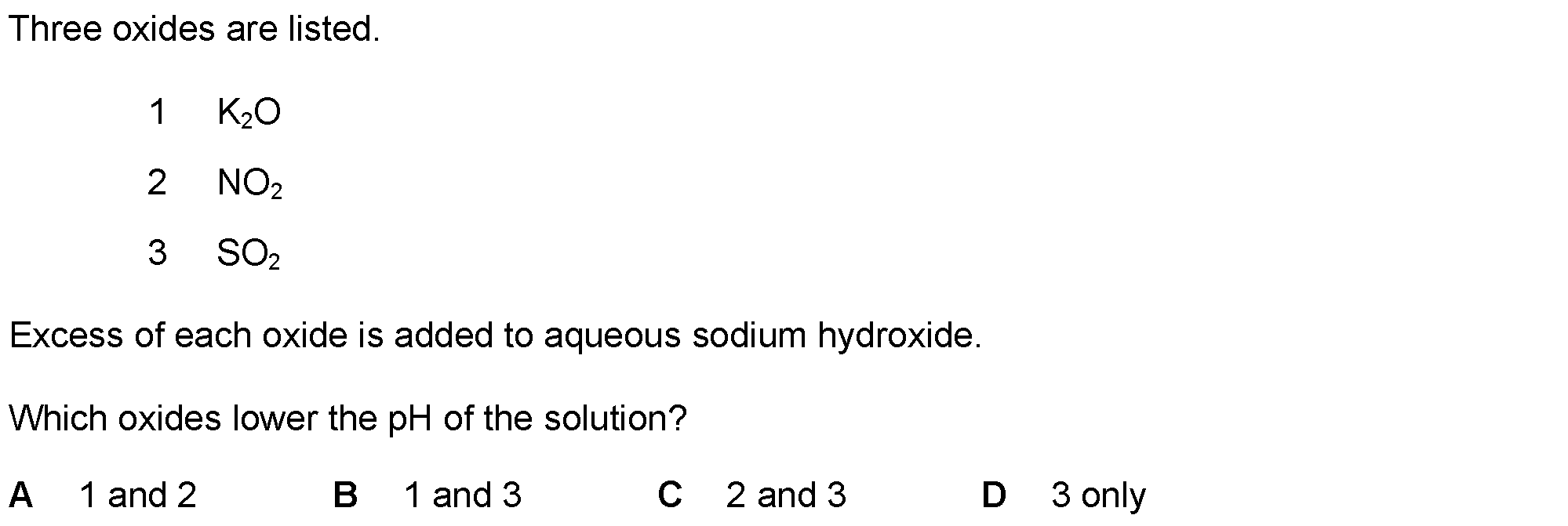
Three oxides are listed.
1. KO
2 NO,
3 SQ
Excess of each oxide is added to aqueous sodium hydroxide.
Which oxides lower the pH of the solution?
A 1and2 B tand3 C 2and3
D 3only
1. KO
2 NO,
3 SQ
Excess of each oxide is added to aqueous sodium hydroxide.
Which oxides lower the pH of the solution?
A 1and2 B tand3 C 2and3
D 3only
Options:
A
B
C
D
Correct Key: C
A
B
C
D
Correct Key: C
Question 14
Paper Ref: 0620/12_Spring_2025_Q37
Paper Ref: 0620/12_Spring_2025_Q37
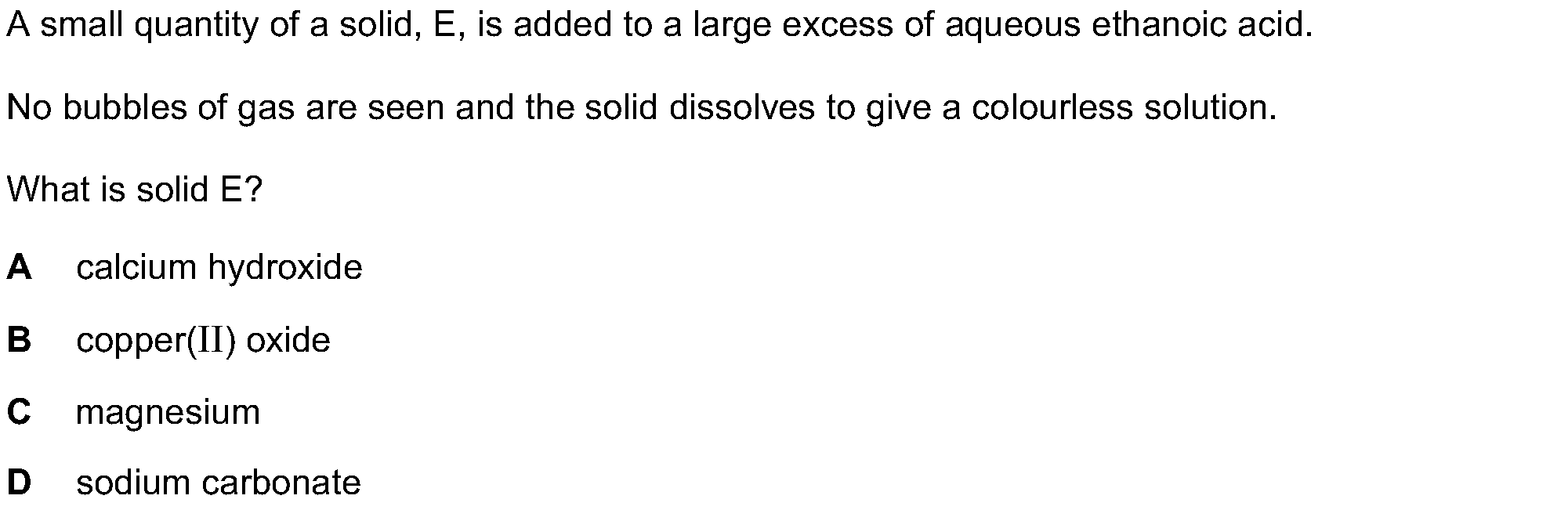
A small quantity of a solid, E, is added to a large excess of aqueous ethanoic acid.
No bubbles of gas are seen and the solid dissolves to give a colourless solution.
What is solid E?
A_ calcium hydroxide
B- copper(II) oxide
C magnesium
D
sodium carbonate
No bubbles of gas are seen and the solid dissolves to give a colourless solution.
What is solid E?
A_ calcium hydroxide
B- copper(II) oxide
C magnesium
D
sodium carbonate
Options:
A
B
C
D
Correct Key: A
A
B
C
D
Correct Key: A
Question 15
Paper Ref: 0620/23_Summer_2010_Q20
Paper Ref: 0620/23_Summer_2010_Q20
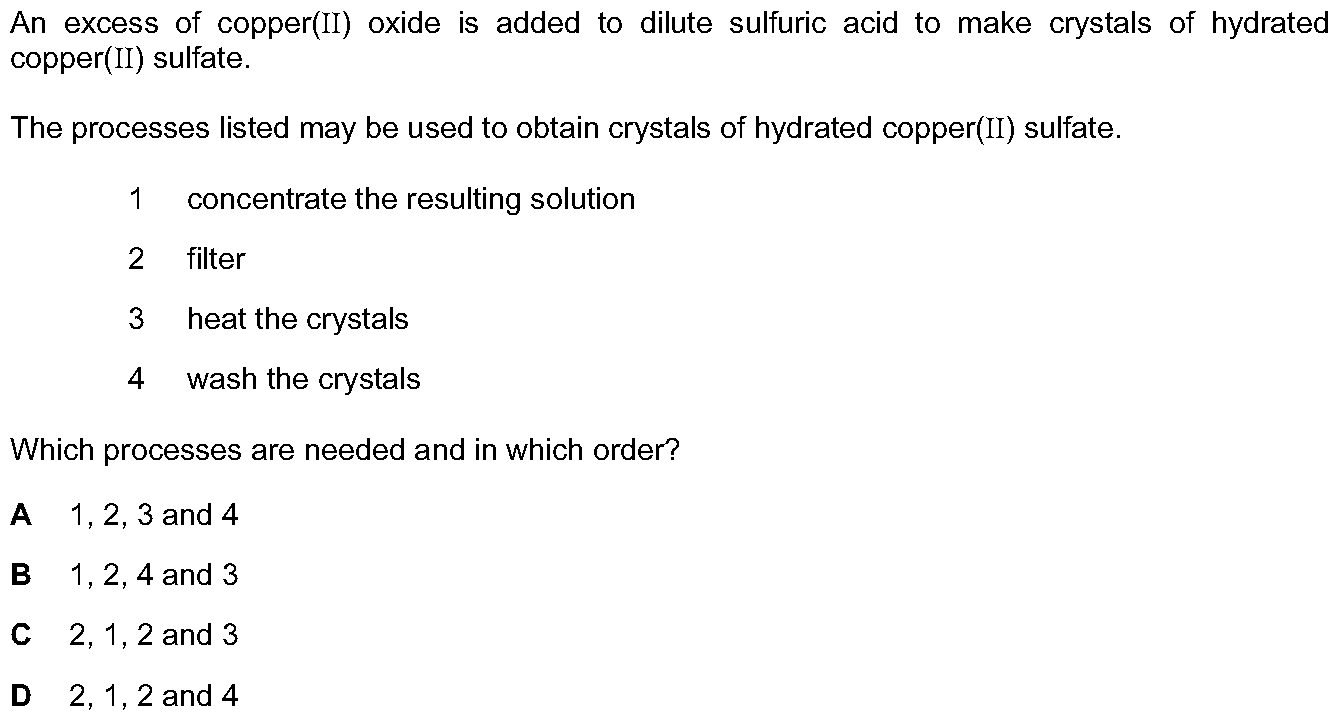
An excess of copper(II) oxide is added to dilute sulfuric acid to make crystals of hydrated
copper(II) sulfate.
The processes listed may be used to obtain crystals of hydrated copper(II) sulfate.
1 concentrate the resulting solution
2 filter
3. heat the crystals
4
wash the crystals
Which processes are needed and in which order?
1,2,3 and 4
B 1,2,4and3
CG 2,1,2and3
D 2,1,2and4
copper(II) sulfate.
The processes listed may be used to obtain crystals of hydrated copper(II) sulfate.
1 concentrate the resulting solution
2 filter
3. heat the crystals
4
wash the crystals
Which processes are needed and in which order?
1,2,3 and 4
B 1,2,4and3
CG 2,1,2and3
D 2,1,2and4
Options:
A
B
C
D
Correct Key: D
A
B
C
D
Correct Key: D
Question 16
Paper Ref: 0620/22_Summer_2018_Q1
Paper Ref: 0620/22_Summer_2018_Q1
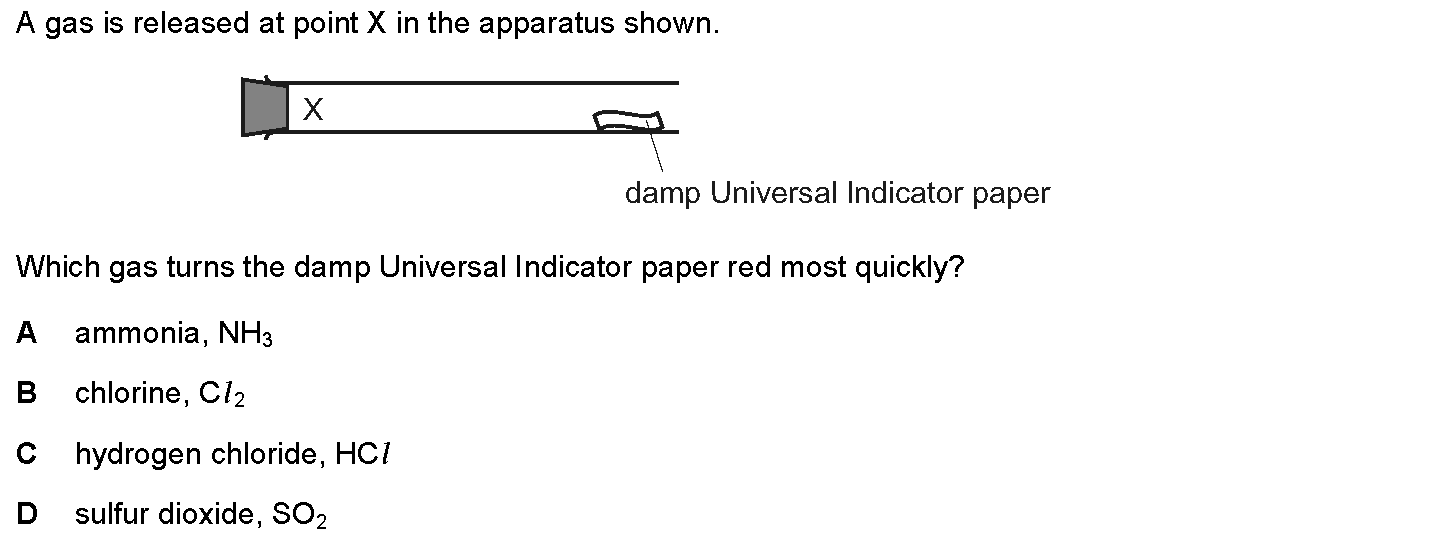
A gas is released at point X in the apparatus shown.
Bee
damp Universal Indicator paper
Which gas turns the damp Universal Indicator paper red most quickly?
A
B
c
D
ammonia, NH3
chlorine, Cl.
hydrogen chloride, HC/
sulfur dioxide, SO
Bee
damp Universal Indicator paper
Which gas turns the damp Universal Indicator paper red most quickly?
A
B
c
D
ammonia, NH3
chlorine, Cl.
hydrogen chloride, HC/
sulfur dioxide, SO
Options:
A
B
C
D
Correct Key: C
A
B
C
D
Correct Key: C
Structured Questions Mark Scheme & Answers
•1•.• • • •[•C•P• •M•a•r•c•h• •2•0•2•6• •P•2• • •·• • •Q•6• • •P•a•r•t• •(•a•)• • •·• • •2•0•2•6• • •·• • •L•o•w•e•r• •S•e•c• •0•8•9•3•]• • • • • • •h•y•d•r•o•c•h•l•o•r•i•c• •a•c•i•d• •• •2• •t•w•o• •c•o•r•r•e•c•t• •a•n•s•w•e•r•s• •=• •2• •m•a•r•k•s• •s•u•l•f•u•r•i•c• •a•c•i•d• •o•n•e• •c•o•r•r•e•c•t• •a•n•s•w•e•r• •=• •1• •m•a•r•k• •m•a•g•n•e•s•i•u•m• •n•i•t•r•a•t•e• •o•n•e• •o•r• •t•w•o• •c•o•r•r•e•c•t• •a•n•d• •o•n•e• •i•n•c•o•r•r•e•c•t• •=• •1• •m•a•r•k• •c•a•l•c•i•u•m• •s•u•l•f•a•t•e• •t•w•o• •i•n•c•o•r•r•e•c•t• •a•n•s•w•e•r•s• •=• •0• •m•a•r•k•s• •m•a•g•n•e•s•i•u•m• •• •••c•c•e•p•t• •a•n•y• •o•t•h•e•r• •i•n•d•i•c•a•t•i•o•n•s• •o•f• •t•h•e• •c•o•r•r•e•c•t• •a•n•s•w•e•r• •e•.•g•.• •c•i•r•c•l•i•n•g• •o•r• •u•n•d•e•r•l•i•n•i•n•g•,• •b•u•t• •t•i•c•k•i•n•g• •w•a•t•e•r• •t•a•k•e•s• •p•r•e•c•e•d•e•n•c•e•
•2•.• • • •[•S•P• •S•9• •P•1• • •·• • •Q•8• • •P•a•r•t• •(•b•)• • •·• • •S•p•e•c•i•m•e•n• • •·• • •L•o•w•e•r• •S•e•c• •0•8•9•3•]• • • • • • •f•i•l•t•r•a•t•i•o•n• •/• •f•i•l•t•e•r•i•n•g• •1•
•3•.• • • •[•C•P• •M•a•r•c•h• •2•0•2•6• •P•2• • •·• • •Q•6• • •P•a•r•t• •(•c•)• • •·• • •2•0•2•6• • •·• • •L•o•w•e•r• •S•e•c• •0•8•9•3•]• • • • • • •a•n•y• •t•h•r•e•e• •f•r•o•m• •3• •e•a•c•h• •c•o•r•r•e•c•t• •a•n•s•w•e•r• •=• •1• •m•a•r•k• •M•1• •(•s•l•o•w•l•y• •/• •g•e•n•t•l•y•)• •h•e•a•t• •s•o•l•u•t•i•o•n• •t•o• •r•e•d•u•c•e• •t•h•e• •v•o•l•u•m•e• •o•r• •D•o• •n•o•t• •a•c•c•e•p•t• •b•o•i•l• •t•o• •d•r•y•n•e•s•s• •o•r• •h•e•a•t• •t•o• •d•r•y•n•e•s•s• •h•e•a•t• •t•o• •g•e•t• •a• •s•a•t•u•r•a•t•e•d• •s•o•l•u•t•i•o•n• •o•r• •h•e•a•t• •u•n•t•i•l• •c•r•y•s•t•a•l•l•i•z•a•t•i•o•n• •f•o•r• •M•1• •p•o•i•n•t• •••c•c•e•p•t• •f•o•r• •M•2• •e•v•a•p•o•r•a•t•e• •(•s•l•o•w•l•y•)• •t•o• •d•r•y•n•e•s•s• •o•r• •M•2• •l•e•a•v•e• •s•o•l•u•t•i•o•n• •t•o• •c•r•y•s•t•a•l•l•i•s•e• •o•r• •s•l•o•w•l•y• •e•v•a•p•o•r•a•t•e• •t•h•e• •l•e•t• •i•t• •e•v•a•p•o•r•a•t•e• •s•o•l•u•t•i•o•n• •••c•c•e•p•t• •f•o•r• •M•2• •l•e•a•v•e• •t•h•e• •s•o•l•u•t•i•o•n• •(•t•o• •e•v•a•p•o•r•a•t•e•)• •M•3• •f•i•l•t•e•r• •t•h•e• •m•i•x•t•u•r•e• •t•o• •c•o•l•l•e•c•t• •c•r•y•s•t•a•l•s• •o•r• •p•i•c•k• •o•u•t• •t•h•e• •f•o•r• •a•t• •l•e•a•s•t• •1• •d•a•y• •o•r• •l•e•a•v•e• •t•h•e• •s•o•l•u•t•i•o•n• •t•o• •c•o•o•l• •c•r•y•s•t•a•l•s• •d•o•w•n• •(•t•o• •m•a•k•e• •c•r•y•s•t•a•l•s•)• •M•4• •p•a•t• •c•r•y•s•t•a•l•s• •w•i•t•h• •f•i•l•t•e•r• •p•a•p•e•r• •N•o•t•e• •f•o•r• •M•3• •t•h•i•s• •m•u•s•t• •i•m•p•l•y• •t•h•a•t• •a•s• •a• •r•e•s•u•l•t• •c•r•y•s•t•a•l•s• •a•r•e• •o•b•t•a•i•n•e•d•
•4•.• • • •[•C•P• •M•a•y• •2•0•2•4• •P•1• • •·• • •Q•1•0• • •P•a•r•t• •(•a•)• • •·• • •2•0•2•4• • •·• • •L•o•w•e•r• •S•e•c• •0•8•9•3•]• • • • • • •2• •e•a•c•h• •c•o•r•r•e•c•t• •a•n•s•w•e•r• •=• •1• •m•a•r•k• •s•u•l•f•u•r•i•c• •(•a•c•i•d•)• •••c•c•e•p•t• •H•2•S•O•4•,• •b•u•t• •n•a•m•e• •t•a•k•e•s• •p•r•e•c•e•d•e•n•c•e• •D•o• •n•o•t• •a•c•c•e•p•t• •s•u•l•f•u•r• •a•c•i•d• •o•r• •s•u•l•f•i•c• •a•c•i•d• •o•r• •s•u•l•f•r•i•c• •a•c•i•d• •m•a•g•n•e•s•i•u•m• •(•c•a•r•b•o•n•a•t•e•)• •••c•c•e•p•t• •M•g•C•O•3•,• •b•u•t• •n•a•m•e• •t•a•k•e•s• •p•r•e•c•e•d•e•n•c•e•
•5•.• • • •[•C•P• •M•a•y• •2•0•2•4• •P•1• • •·• • •Q•1•0• • •P•a•r•t• •(•b•)• • •·• • •2•0•2•4• • •·• • •L•o•w•e•r• •S•e•c• •0•8•9•3•]• • • • • • •2• •e•a•c•h• •c•o•r•r•e•c•t• •a•n•s•w•e•r• •=• •1• •m•a•r•k• •f•i•l•t•e•r• •(•t•h•e• •m•i•x•t•u•r•e•)• •••c•c•e•p•t• •f•i•l•t•r•a•t•i•o•n• •I•g•n•o•r•e• •r•e•f•e•r•e•n•c•e• •t•o• •h•e•a•t•i•n•g• •r•e•a•c•t•i•o•n• •m•i•x•t•u•r•e• •b•e•f•o•r•e• •f•i•l•t•e•r•i•n•g• •o•f•f• •z•i•n•c• •c•a•r•b•o•n•a•t•e• •N•o•t•e• •t•h•e• •f•i•l•t•e•r•i•n•g• •t•o• •r•e•m•o•v•e• •z•i•n•c• •c•a•r•b•o•n•a•t•e• •m•u•s•t• •b•e• •b•e•f•o•r•e• •t•h•e• •e•v•a•p•o•r•a•t•i•n•g• •s•t•e•p• •N•o•t•e• •m•u•s•t• •b•e• •a•n• •i•d•e•a• •o•f• •a• •s•l•o•w• •p•r•o•c•e•s•s• •t•o• •g•i•v•e• •t•h•e• •s•l•o•w•l•y• •e•v•a•p•o•r•a•t•e• •t•h•e• •(•f•i•l•t•r•a•t•e•)• •o•r• •b•o•i•l• •a•w•a•y• •h•a•l•f• •o•f• •m•a•r•k• •f•o•r• •e•v•a•p•o•r•a•t•i•o•n• •t•h•e• •f•i•l•t•r•a•t•e• •o•r• •l•e•a•v•e• •s•o•l•u•t•i•o•n• •t•o• •c•r•y•s•t•a•l•l•i•s•e• •••c•c•e•p•t• •p•a•r•t•i•a•l• •e•v•a•p•o•r•a•t•i•o•n• •o•r• •h•e•a•t•i•n•g• •u•n•t•i•l• •f•i•r•s•t• •a•p•p•e•a•r•a•n•c•e• •o•f• •c•r•y•s•t•a•l•s• •o•r• •h•e•a•t• •t•o• •g•e•t• •a• •s•a•t•u•r•a•t•e•d• •s•o•l•u•t•i•o•n• •N•o•t•e• •c•r•y•s•t•a•l•l•i•s•e• •o•n• •i•t•s• •o•w•n• •i•s• •n•o•t• •s•u•f•f•i•c•i•e•n•t• •D•o• •n•o•t• •a•c•c•e•p•t• •i•d•e•a• •o•f• •h•e•a•t•i•n•g• •t•o• •d•r•y•n•e•s•s• •a•s• •a• •f•a•s•t• •p•r•o•c•e•s•s• •o•r• •e•v•a•p•o•r•a•t•i•n•g• •t•o• •d•r•y•n•e•s•s• •a•s• •a• •f•a•s•t• •p•r•o•c•e•s•s• •o•r• •h•e•a•t•i•n•g• •f•i•l•t•r•a•t•e• •i•n• •o•v•e•n•
•6•.• • • •[•P•R•I• •2•0•1•5•B• •P•2• • •·• • •Q•5• • •P•a•r•t• •(•c•)• • •·• • •2•0•1•5• • •·• • •P•r•i•m•a•r•y• •0•8•4•6•]• • • • • • •(•n•o• •p•u•b•l•i•s•h•e•d• •m•a•r•k• •s•c•h•e•m•e• •f•o•r• •t•h•i•s• •p•a•p•e•r•)•
•7•.• • • •[•P•T• •S•9• •2•0•2•5• •P•1• • •·• • •Q•1•0• • •·• • •2•0•2•5• • •·• • •L•o•w•e•r• •S•e•c• •0•8•9•3•]• • • • • • •3• •e•a•c•h• •c•o•r•r•e•c•t• •a•n•s•w•e•r• •=• •1• •m•a•r•k• •(•i•d•e•a• •t•h•a•t•)• •B•l•e•s•s•y• •a•d•d•s• •e•x•c•e•s•s• •z•i•n•c• •c•a•r•b•o•n•a•t•e• •t•o• •d•i•l•u•t•e• •s•u•l•f•u•r•i•c• •a•c•i•d• •o•r• •••W• •f•i•l•t•e•r•s• •t•h•e• •m•i•x•t•u•r•e• •••c•c•e•p•t• •f•i•l•t•r•a•t•i•o•n• •I•g•n•o•r•e• •s•i•e•v•i•n•g• •s•l•o•w•l•y• •e•v•a•p•o•r•a•t•e•s• •(•t•h•e• •f•i•l•t•r•a•t•e•)• •o•r• •b•o•i•l•s• •a•w•a•y• •h•a•l•f• •o•f• •f•i•l•t•r•a•t•e• •D•o• •n•o•t• •a•c•c•e•p•t• •h•e•a•t• •t•o• •d•r•y•n•e•s•s• •o•r• •b•o•i•l• •t•o• •d•r•y•n•e•s•s• •o•r• •l•e•a•v•e•s• •(•f•i•l•t•r•a•t•e•)• •t•o• •c•r•y•s•t•a•l•l•i•s•e• •s•l•o•w•l•y• •D•o• •n•o•t• •a•c•c•e•p•t• •e•v•a•p•o•r•a•t•e• •r•e•s•i•d•u•e• •s•l•o•w•l•y• •©• •U•C•L•E•S• •2•0•2•5• •P•a•g•e• •9• •o•f• •1•4• •S•9•/•0•1• •S•c•i•e•n•c•e• •S•t•a•g•e• •9• •P•a•p•e•r• •1• •M•a•r•k• •S•c•h•e•m•e• •2•0•2•5•
Last updated:
\n