5.3Motion, Forces and Energy
Metal mixtures — Question Bank (Cambridge) — Cambridge IGCSE Physics 0625 Revision Notes & Topical Questions
15 min read Lesson 53 of 91 Unit quiz
Cambridge Past Paper Bank
5.3 Metal mixtures
23 Multiple-Choice Questions with Official Mark Schemes
Question 1
0620/23_Summer_2021_Q31
Question 2
0620/13_Summer_2021_Q32
Question 3
0620/22_Summer_2018_Q27
Question 4
0620/12_Summer_2018_Q26
Question 5
0620/12_Winter_2023_Q26
Question 6
0620/12_Winter_2025_Q28
Question 7
0620/22_Winter_2018_Q26
Question 8
0620/21_Summer_2016_Q27
Question 9
0620/12_Winter_2021_Q27
Question 10
0620/23_Winter_2023_Q27
Question 11
0620/21_Summer_2026_Q25
Question 12
0620/23_Summer_2012_Q26
Question 13
0620/12_Spring_2025_Q25
Question 14
0620/22_Winter_2009_Q30
Question 15
0620/23_Summer_2013_Q30
Question 16
5129/11_Summer_2020_Q24
Question 17
0620/12_Spring_2026_Q22
Question 18
0620/23_Summer_2013_Q24
Question 19
0620/22_Summer_2021_Q28
Question 20
5129/11_Winter_2021_Q22
Question 21
5129/12_Winter_2025_Q24
Question 22
5129/12_Summer_2021_Q23
Question 23
0620/12_Winter_2016_Q27
Cambridge Lower Secondary Stage 7
5.3 Metal mixtures – Complete Question Bank & Mark Scheme
Total Questions23 Questions with Verified Solutions & Past Paper Mark Schemes
Multiple Choice Questions (Exam Practice)
Question 1
Paper Ref: 0620/23_Summer_2021_Q31
Paper Ref: 0620/23_Summer_2021_Q31
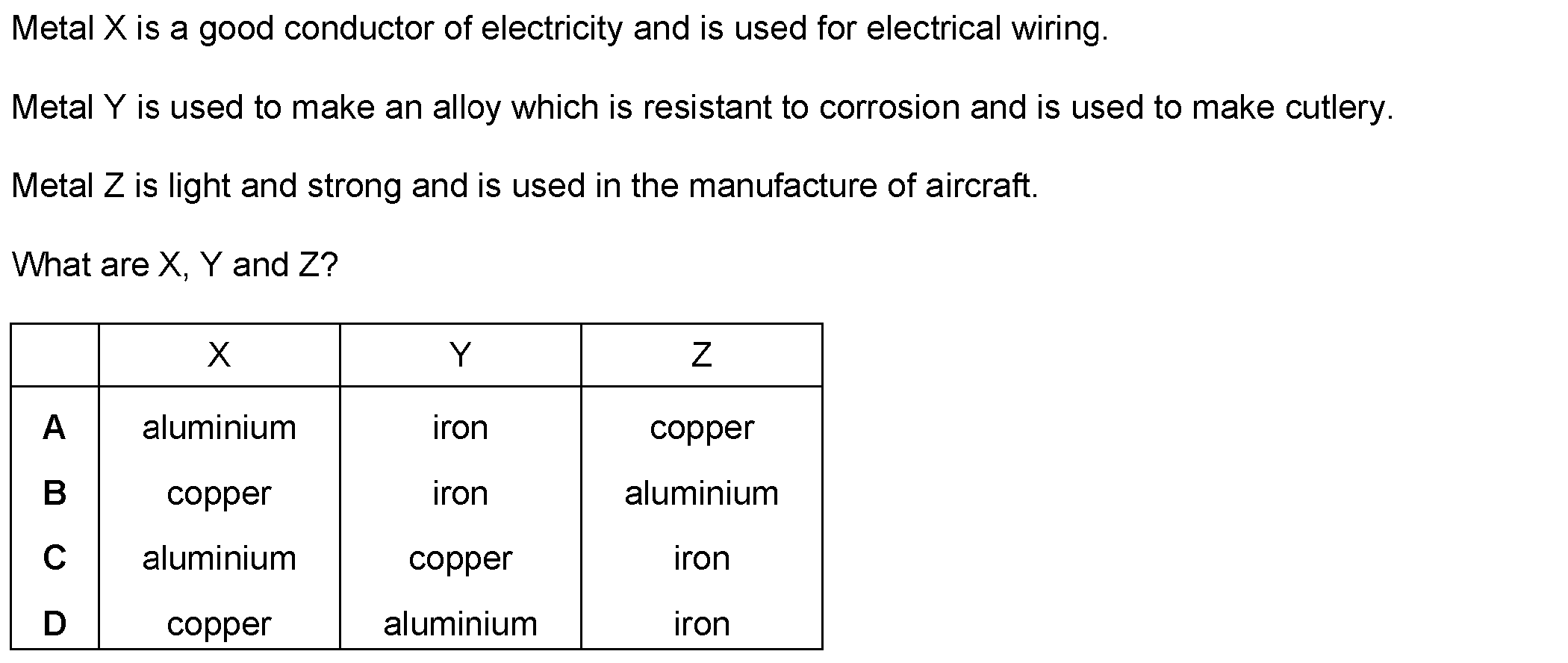
Metal X is a good conductor of electricity and is used for electrical wiring.
Metal Y is used to make an alloy which is resistant to corrosion and is used to make cutlery.
Metal Z is light and strong and is used in the manufacture of aircraft.
What are X, Y and 2?
aluminium i copper
copper aluminium
aluminium copper iron
copper aluminium iron
Metal Y is used to make an alloy which is resistant to corrosion and is used to make cutlery.
Metal Z is light and strong and is used in the manufacture of aircraft.
What are X, Y and 2?
aluminium i copper
copper aluminium
aluminium copper iron
copper aluminium iron
Options:
A
B
C
D
Correct Key: B
A
B
C
D
Correct Key: B
Question 2
Paper Ref: 0620/13_Summer_2021_Q32
Paper Ref: 0620/13_Summer_2021_Q32
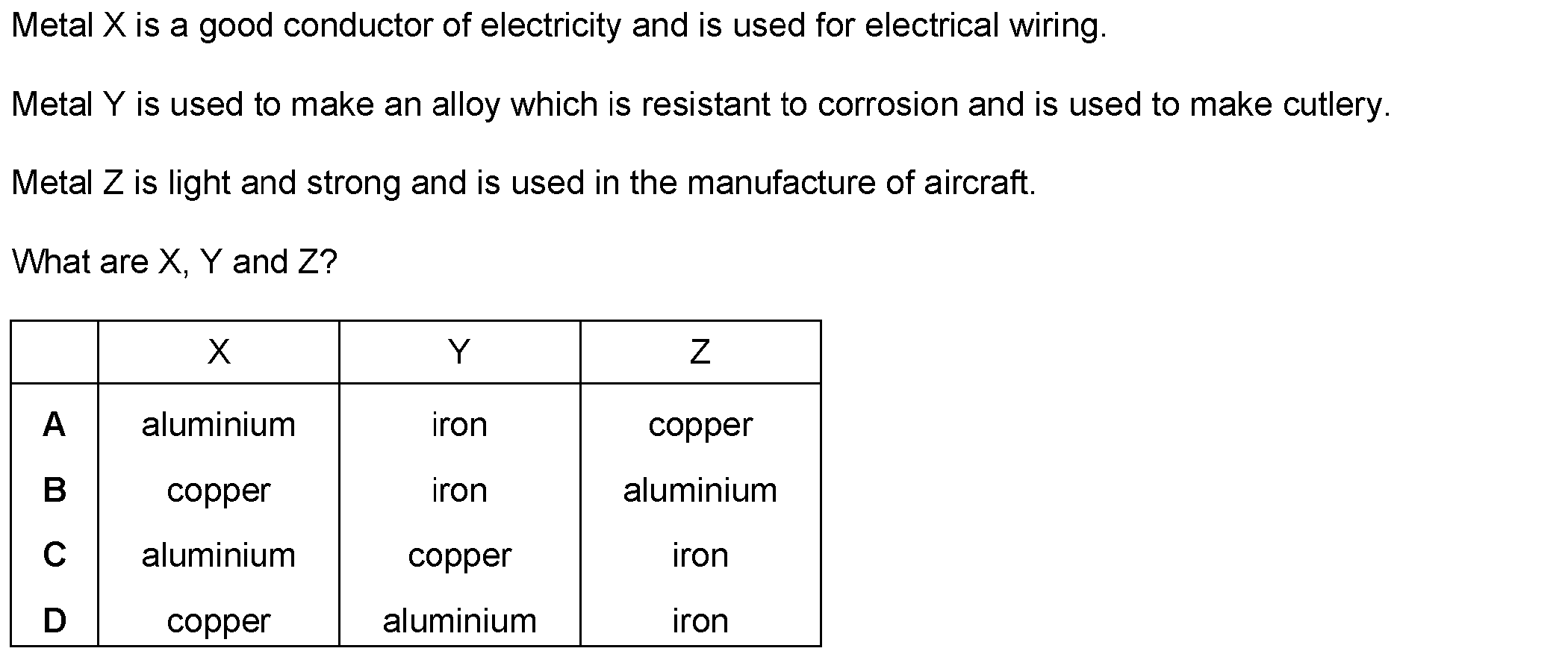
Metal X is a good conductor of electricity and is used for electrical wiring.
Metal Y is used to make an alloy which is resistant to corrosion and is used to make cutlery.
Metal Z is light and strong and is used in the manufacture of aircraft.
What are X, Y and Z?
aluminium copper
copper aluminium
aluminium copper iron
copper aluminium iron
Metal Y is used to make an alloy which is resistant to corrosion and is used to make cutlery.
Metal Z is light and strong and is used in the manufacture of aircraft.
What are X, Y and Z?
aluminium copper
copper aluminium
aluminium copper iron
copper aluminium iron
Options:
A
B
C
D
Correct Key: B
A
B
C
D
Correct Key: B
Question 3
Paper Ref: 0620/22_Summer_2018_Q27
Paper Ref: 0620/22_Summer_2018_Q27
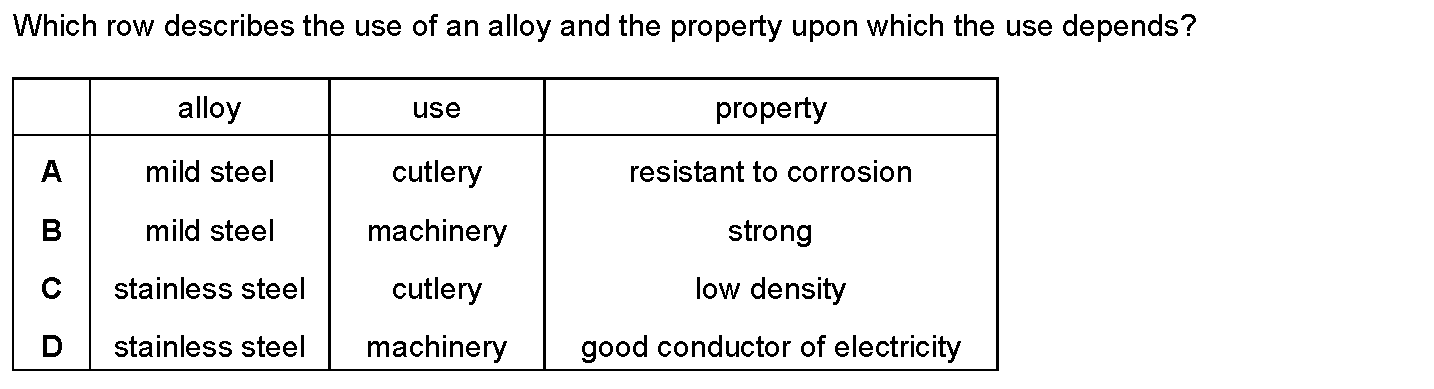
Which row describes the use of an alloy and the property upon which the use depends?
alloy use property
A mild steel cutlery resistant to corrosion
B mild steel machinery strong
C | stainless steel cutlery low density
D | stainless steel machinery good conductor of electricity
alloy use property
A mild steel cutlery resistant to corrosion
B mild steel machinery strong
C | stainless steel cutlery low density
D | stainless steel machinery good conductor of electricity
Options:
A
B
C
D
Correct Key: B
A
B
C
D
Correct Key: B
Question 4
Paper Ref: 0620/12_Summer_2018_Q26
Paper Ref: 0620/12_Summer_2018_Q26
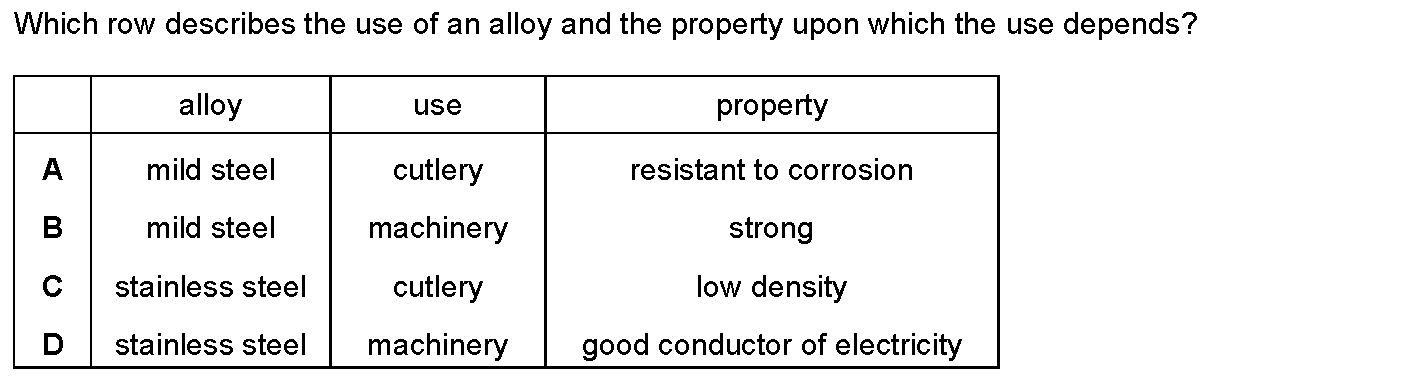
Which row describes the use of an alloy and the property upon which the use depends?
alloy use property
A mild steel cutlery resistant to corrosion
B mild steel machinery strong
C | stainless steel cutlery low density
D | stainless steel machinery good conductor of electricity
alloy use property
A mild steel cutlery resistant to corrosion
B mild steel machinery strong
C | stainless steel cutlery low density
D | stainless steel machinery good conductor of electricity
Options:
A
B
C
D
Correct Key: B
A
B
C
D
Correct Key: B
Question 5
Paper Ref: 0620/12_Winter_2023_Q26
Paper Ref: 0620/12_Winter_2023_Q26
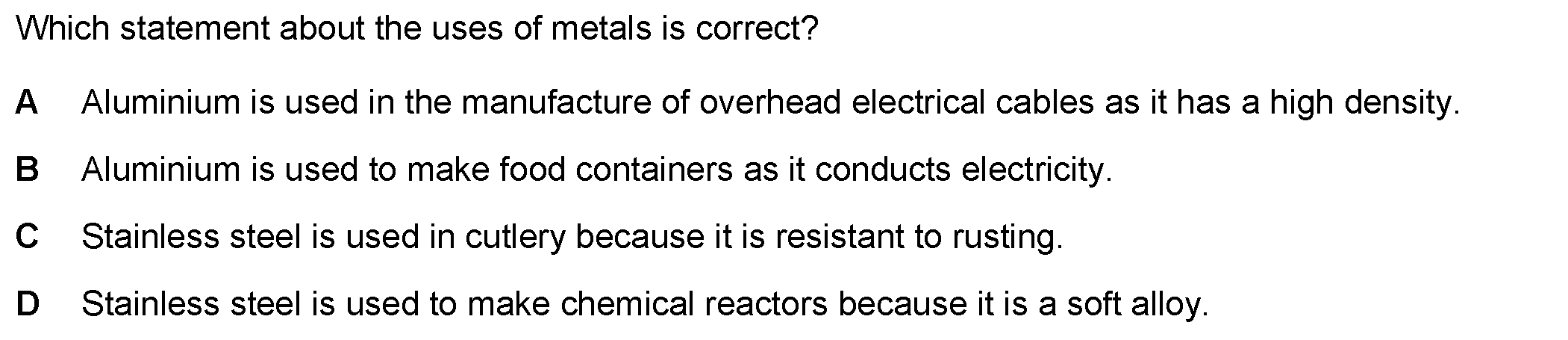
Which statement about the uses of metals is correct?
0 OO DW
Aluminium is used in the manufacture of overhead electrical cables as it has a high density.
Aluminium is used to make food containers as it conducts electricity.
Stainless steel is used in cutlery because it is resistant to rusting.
Stainless steel is used to make chemical reactors because it is a soft alloy.
Options:
A
B
C
D
Correct Key: C
A
B
C
D
Correct Key: C
Question 6
Paper Ref: 0620/12_Winter_2025_Q28
Paper Ref: 0620/12_Winter_2025_Q28
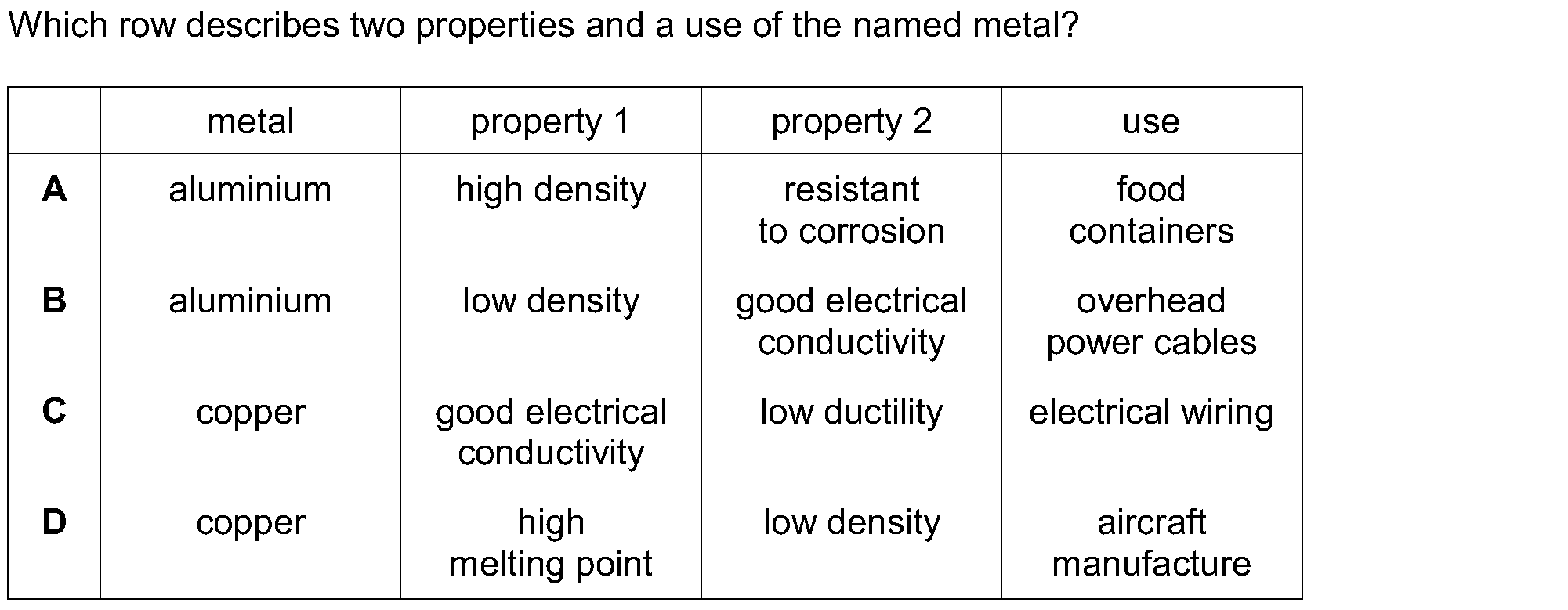
Which row describes two properties and a use of the named metal?
metal property 1 property 2 use
A aluminium high density resistant food
to corrosion containers
B aluminium low density good electrical overhead
conductivity power cables
Cc copper good electrical low ductility electrical wiring
conductivity
D copper high low density aircraft
melting point manufacture
Options:
A
B
C
D
Correct Key: B
A
B
C
D
Correct Key: B
Question 7
Paper Ref: 0620/22_Winter_2018_Q26
Paper Ref: 0620/22_Winter_2018_Q26
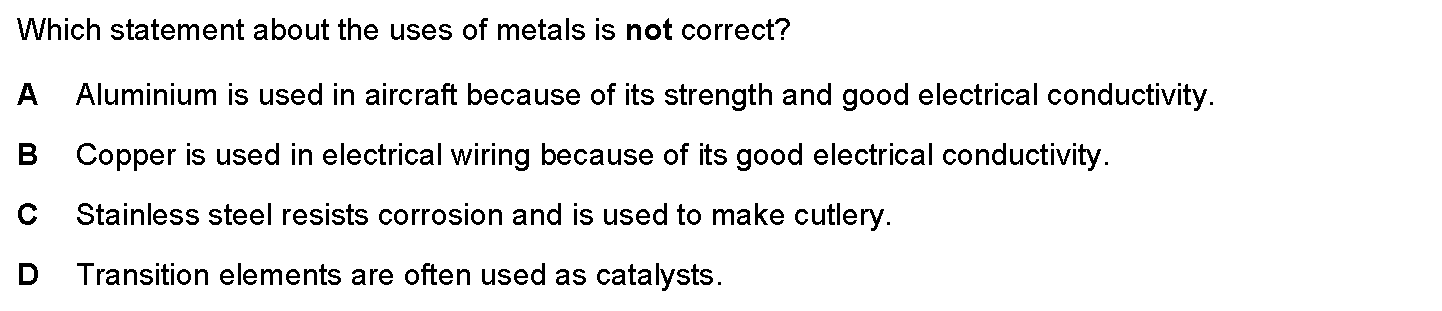
Which statement about the uses of metals is not correct?
0 9 DW
Aluminium is used in aircraft because of its strength and good electrical conductivity.
Copper is used in electrical wiring because of its good electrical conductivity.
Stainless steel resists corrosion and is used to make cutlery.
Transition elements are often used as catalysts.
0 9 DW
Aluminium is used in aircraft because of its strength and good electrical conductivity.
Copper is used in electrical wiring because of its good electrical conductivity.
Stainless steel resists corrosion and is used to make cutlery.
Transition elements are often used as catalysts.
Options:
A
B
C
D
Correct Key: A
A
B
C
D
Correct Key: A
Question 8
Paper Ref: 0620/21_Summer_2016_Q27
Paper Ref: 0620/21_Summer_2016_Q27
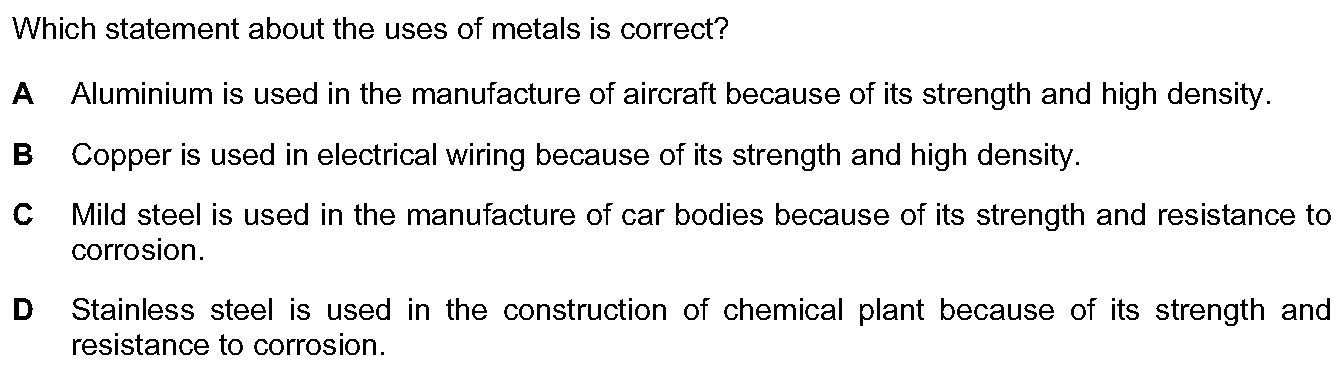
Which statement about the uses of metals is correct?
A Aluminium is used in the manufacture of aircraft because of its strength and high density.
B_ Copper is used in electrical wiring because of its strength and high density.
C_ Mild steel is used in the manufacture of car bodies because of its strength and resistance to
corrosion.
D_ Stainless steel is used in the construction of chemical plant because of its strength and
resistance to corrosion.
Options:
A
B
C
D
Correct Key: D
A
B
C
D
Correct Key: D
Question 9
Paper Ref: 0620/12_Winter_2021_Q27
Paper Ref: 0620/12_Winter_2021_Q27
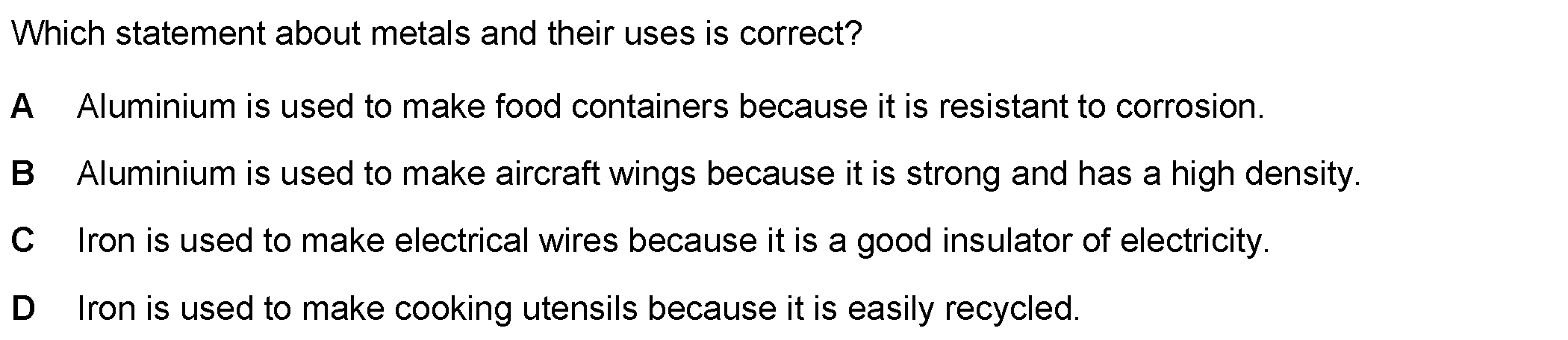
Which statement about metals and their uses is correct?
A Aluminium is used to make food containers because it is resistant to corrosion.
Aluminium is used to make aircraft wings because it is strong and has a high density.
lron is used to make electrical wires because it is a good insulator of electricity.
0 OO WW
Iron is used to make cooking utensils because it is easily recycled.
Options:
A
B
C
D
Correct Key: A
A
B
C
D
Correct Key: A
Question 10
Paper Ref: 0620/23_Winter_2023_Q27
Paper Ref: 0620/23_Winter_2023_Q27
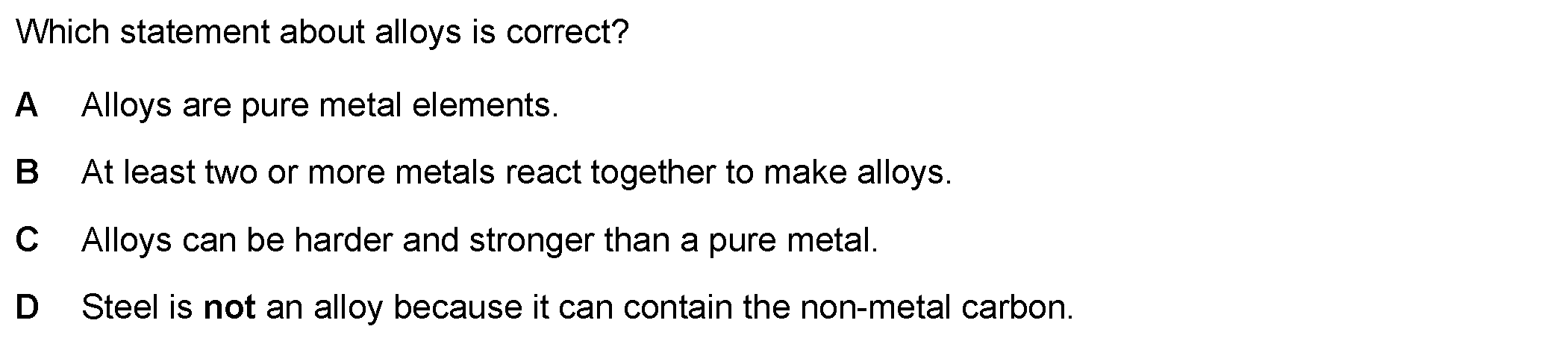
Which statement about alloys is correct?
0 O WW
Alloys are pure metal elements.
At least two or more metals react together to make alloys.
Alloys can be harder and stronger than a pure metal.
Steel is not an alloy because it can contain the non-metal carbon.
0 O WW
Alloys are pure metal elements.
At least two or more metals react together to make alloys.
Alloys can be harder and stronger than a pure metal.
Steel is not an alloy because it can contain the non-metal carbon.
Options:
A
B
C
D
Correct Key: C
A
B
C
D
Correct Key: C
Question 11
Paper Ref: 0620/21_Summer_2026_Q25
Paper Ref: 0620/21_Summer_2026_Q25
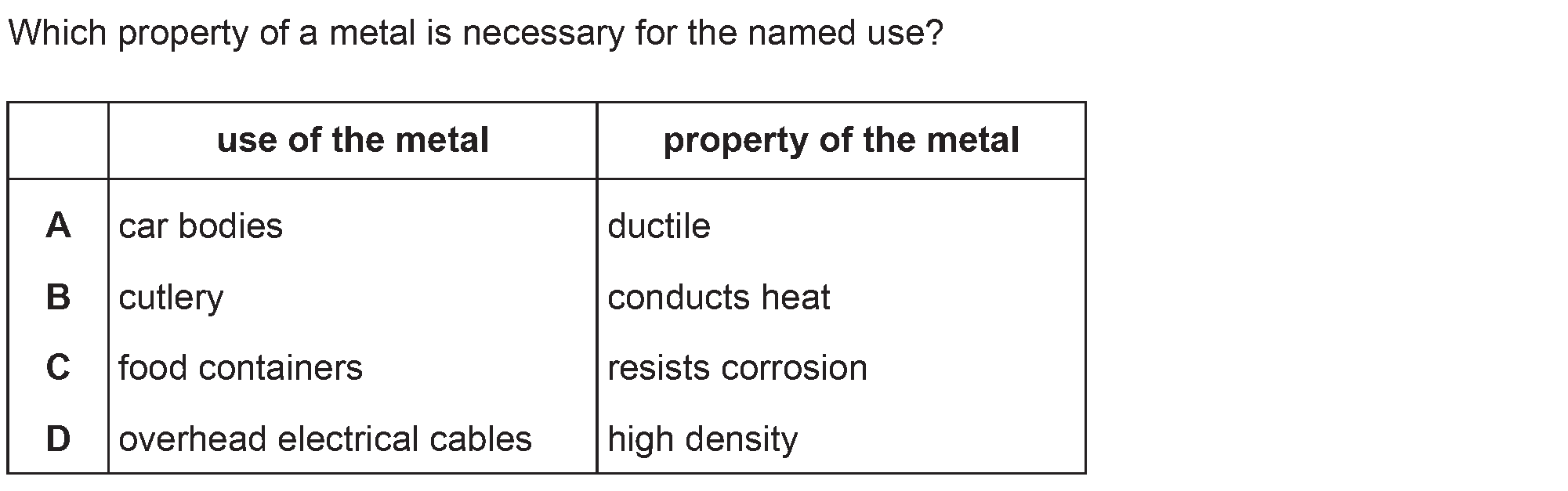
Which property of a metal is necessary for the named use?
— use of the metal property of the metal
car bodies ductile
cutlery conducts heat
food containers resists corrosion
overhead electrical cables high density
— use of the metal property of the metal
car bodies ductile
cutlery conducts heat
food containers resists corrosion
overhead electrical cables high density
Options:
A
B
C
D
Correct Key: C
A
B
C
D
Correct Key: C
Question 12
Paper Ref: 0620/23_Summer_2012_Q26
Paper Ref: 0620/23_Summer_2012_Q26
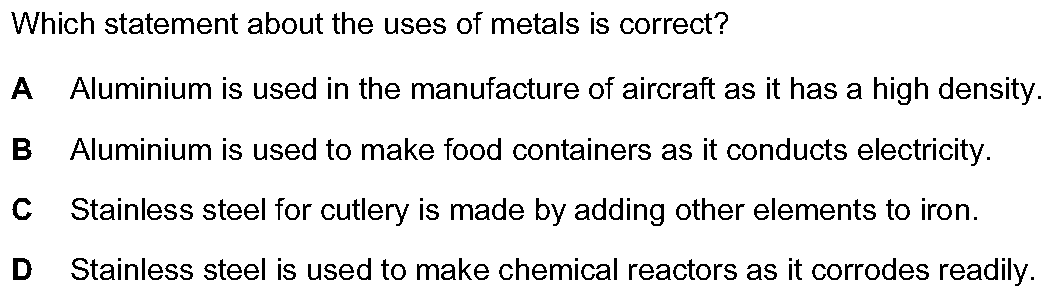
Which statement about the uses of metals is correct?
oo BD
Aluminium is used in the manufacture of aircraft as it has a high density.
Aluminium is used to make food containers as it conducts electricity.
Stainless steel for cutlery is made by adding other elements to iron.
Stainless steel is used to make chemical reactors as it corrodes readily.
oo BD
Aluminium is used in the manufacture of aircraft as it has a high density.
Aluminium is used to make food containers as it conducts electricity.
Stainless steel for cutlery is made by adding other elements to iron.
Stainless steel is used to make chemical reactors as it corrodes readily.
Options:
A
B
C
D
Correct Key: C
A
B
C
D
Correct Key: C
Question 13
Paper Ref: 0620/12_Spring_2025_Q25
Paper Ref: 0620/12_Spring_2025_Q25
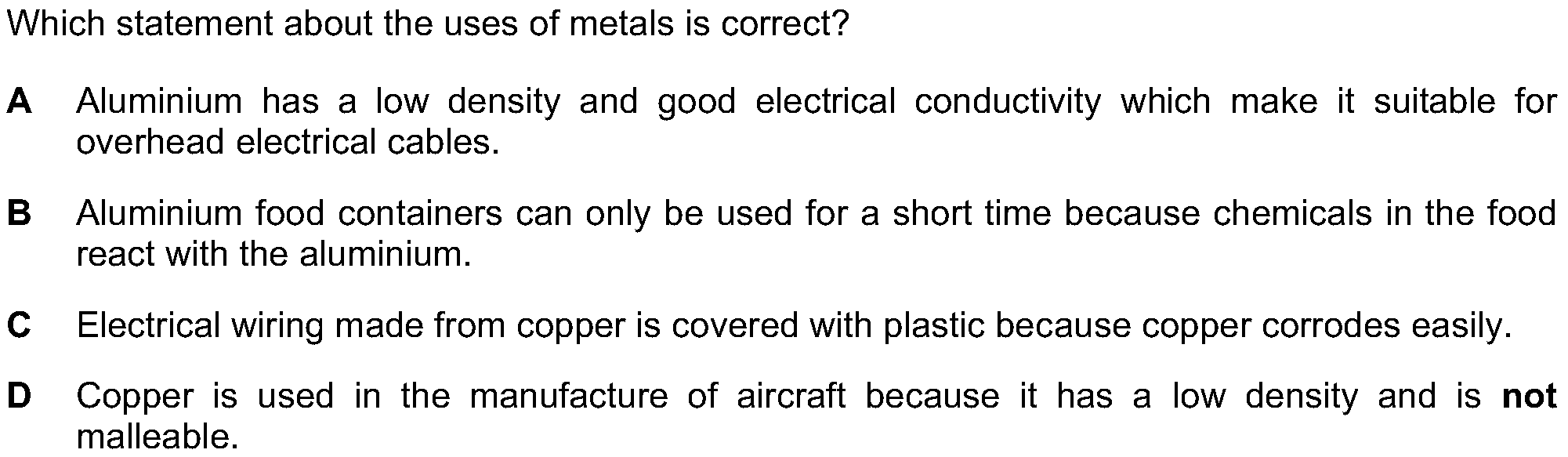
Which statement about the uses of metals is correct?
A
B
Aluminium has a low density and good electrical conductivity which make it suitable for
overhead electrical cables.
Aluminium food containers can only be used for a short time because chemicals in the food
react with the aluminium.
Electrical wiring made from copper is covered with plastic because copper corrodes easily.
Copper is used in the manufacture of aircraft because it has a low density and is not
malleable.
Options:
A
B
C
D
Correct Key: A
A
B
C
D
Correct Key: A
Question 14
Paper Ref: 0620/22_Winter_2009_Q30
Paper Ref: 0620/22_Winter_2009_Q30
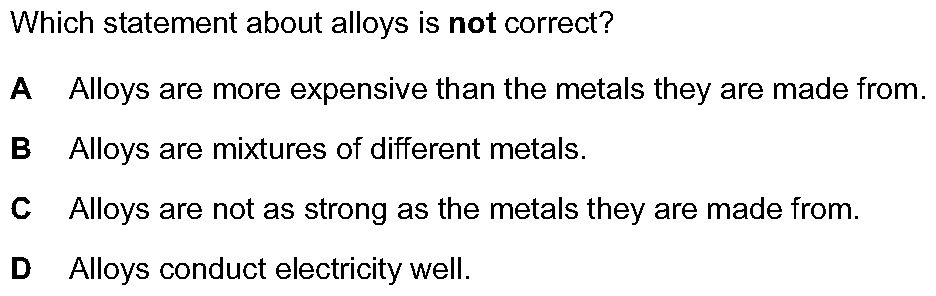
Which statement about alloys is not correct?
oo BD
Alloys are more expensive than the metals they are made from.
Alloys are mixtures of different metals.
Alloys are not as strong as the metals they are made from.
Alloys conduct electricity well.
oo BD
Alloys are more expensive than the metals they are made from.
Alloys are mixtures of different metals.
Alloys are not as strong as the metals they are made from.
Alloys conduct electricity well.
Options:
A
B
C
D
Correct Key: C
A
B
C
D
Correct Key: C
Question 15
Paper Ref: 0620/23_Summer_2013_Q30
Paper Ref: 0620/23_Summer_2013_Q30
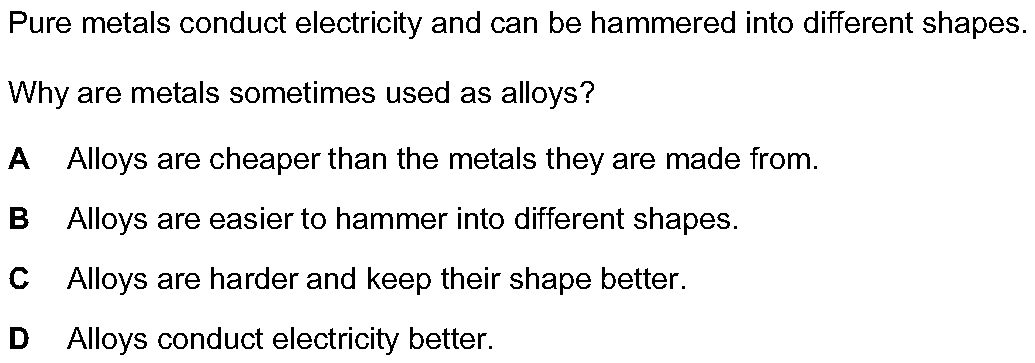
Pure metals conduct electricity and can be hammered into different shapes.
Why are metals sometimes used as alloys?
Alloys are cheaper than the metals they are made from.
B_ Alloys are easier to hammer into different shapes.
C_ Alloys are harder and keep their shape better.
D_ Alloys conduct electricity better.
Why are metals sometimes used as alloys?
Alloys are cheaper than the metals they are made from.
B_ Alloys are easier to hammer into different shapes.
C_ Alloys are harder and keep their shape better.
D_ Alloys conduct electricity better.
Options:
A
B
C
D
Correct Key: C
A
B
C
D
Correct Key: C
Question 16
Paper Ref: 5129/11_Summer_2020_Q24
Paper Ref: 5129/11_Summer_2020_Q24
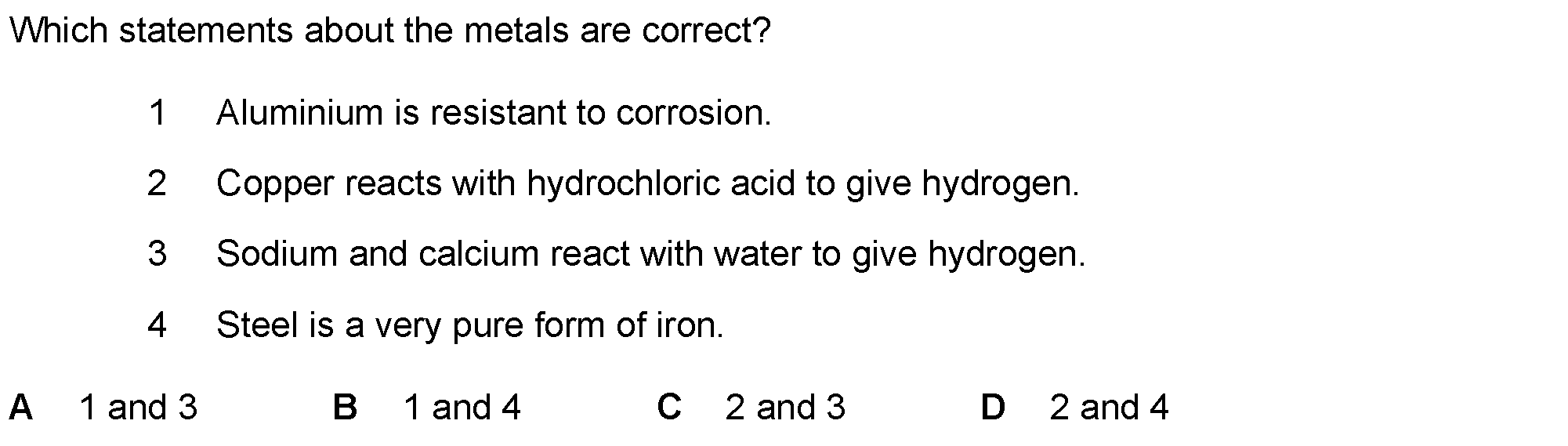
Which statements about the metals are correct?
A
1
2
3
4
1 and 3
Aluminium is resistant to corrosion.
Copper reacts with hydrochloric acid to give hydrogen.
Sodium and calcium react with water to give hydrogen.
Steel is a very pure form of iron.
B iand4 C 2and3 D 2and4
A
1
2
3
4
1 and 3
Aluminium is resistant to corrosion.
Copper reacts with hydrochloric acid to give hydrogen.
Sodium and calcium react with water to give hydrogen.
Steel is a very pure form of iron.
B iand4 C 2and3 D 2and4
Options:
A
B
C
D
Correct Key: A
A
B
C
D
Correct Key: A
Question 17
Paper Ref: 0620/12_Spring_2026_Q22
Paper Ref: 0620/12_Spring_2026_Q22
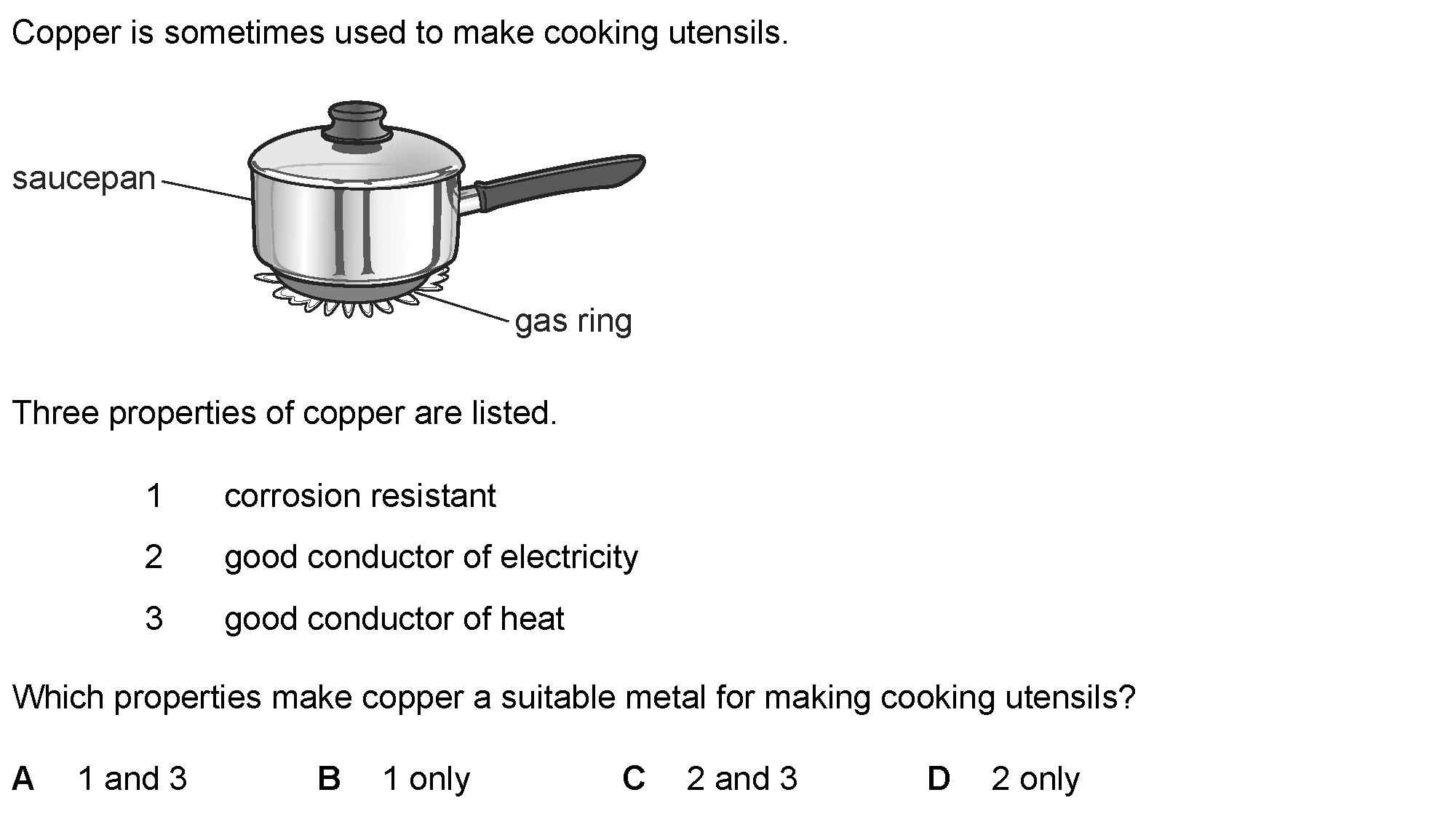
Copper is sometimes used to make cooking utensils.
saucepan
gas ring
Three properties of copper are listed.
1 corrosion resistant
2 good conductor of electricity
3 good conductor of heat
Which properties make copper a suitable metal for making cooking utensils?
A 1and3 B 1only C 2and3 D 2only
saucepan
gas ring
Three properties of copper are listed.
1 corrosion resistant
2 good conductor of electricity
3 good conductor of heat
Which properties make copper a suitable metal for making cooking utensils?
A 1and3 B 1only C 2and3 D 2only
Options:
A
B
C
D
Correct Key: A
A
B
C
D
Correct Key: A
Question 18
Paper Ref: 0620/23_Summer_2013_Q24
Paper Ref: 0620/23_Summer_2013_Q24
Which property makes aluminium ideal for making food containers?
A
B
c
D
conducts electricity
conducts heat
mechanical strength
resistance to corrosion
A
B
c
D
conducts electricity
conducts heat
mechanical strength
resistance to corrosion
Options:
A
B
C
D
Correct Key: D
A
B
C
D
Correct Key: D
Question 19
Paper Ref: 0620/22_Summer_2021_Q28
Paper Ref: 0620/22_Summer_2021_Q28
Mild steel consists mostly of iron. Mild steel can be prevented from rusting by a process called
galvanising.
Copper is not a very strong metal, however if it is mixed with a suitable metal a strong alloy called
brass is produced.
Which statement is correct?
A
B
Cc
D
Copper corrodes very quickly when wet and brass does not.
Copper is mixed with zinc to produce brass.
Galvanising mild steel changes it from a pure metal into an alloy.
When a steel object is galvanised this means it is coated with a thin layer of tin.
Options:
A
B
C
D
Correct Key: B
A
B
C
D
Correct Key: B
Question 20
Paper Ref: 5129/11_Winter_2021_Q22
Paper Ref: 5129/11_Winter_2021_Q22
Which substance is an alloy and is used to make cutlery?
A
B
Cc
D
brass
copper
mild steel
stainless steel
A
B
Cc
D
brass
copper
mild steel
stainless steel
Options:
A
B
C
D
Correct Key: D
A
B
C
D
Correct Key: D
Question 21
Paper Ref: 5129/12_Winter_2025_Q24
Paper Ref: 5129/12_Winter_2025_Q24
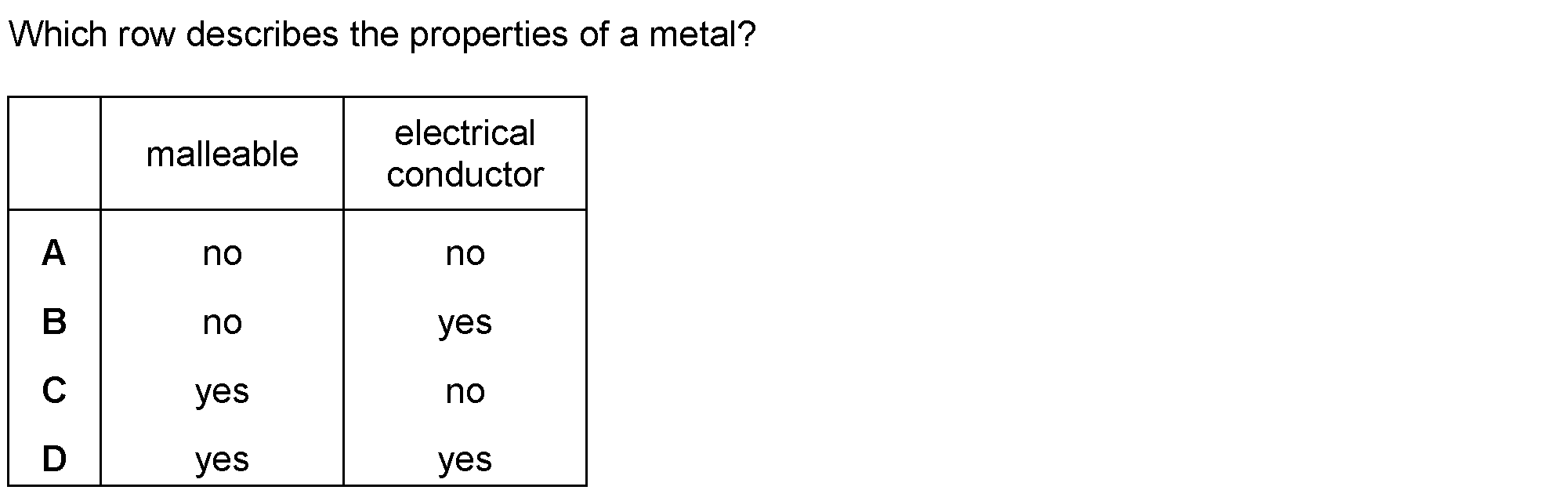
Which row describes the properties of a metal?
electrical
malleable
conductor
A no no
no
electrical
malleable
conductor
A no no
no
Options:
A
B
C
D
Correct Key: D
A
B
C
D
Correct Key: D
Question 22
Paper Ref: 5129/12_Summer_2021_Q23
Paper Ref: 5129/12_Summer_2021_Q23
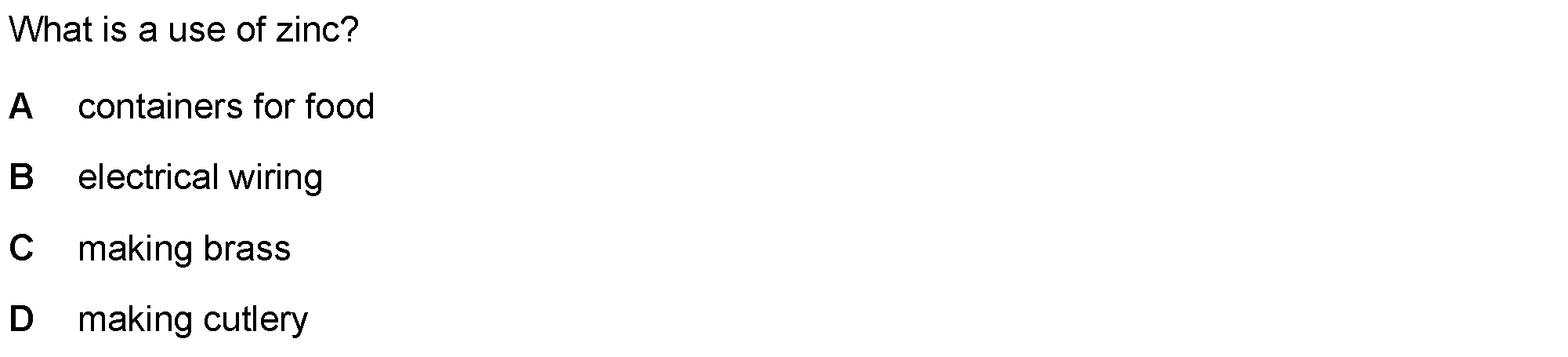
What is a use of zinc?
A containers for food
electrical wiring
making brass
0 O WW
making cutlery
A containers for food
electrical wiring
making brass
0 O WW
making cutlery
Options:
A
B
C
D
Correct Key: C
A
B
C
D
Correct Key: C
Question 23
Paper Ref: 0620/12_Winter_2016_Q27
Paper Ref: 0620/12_Winter_2016_Q27
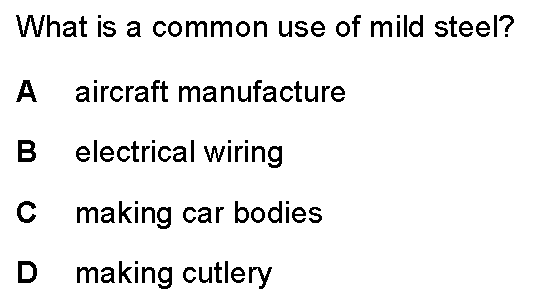
What is a common use of mild steel?
0 9 DW
aircraft manufacture
electrical wiring
making car bodies
making cutlery
0 9 DW
aircraft manufacture
electrical wiring
making car bodies
making cutlery
Options:
A
B
C
D
Correct Key: C
A
B
C
D
Correct Key: C
Structured Questions Mark Scheme & Answers
•1•.• • • •[•P•R•I• •2•0•2•0••• •P•1• • •·• • •Q•2• • •·• • •2•0•2•0• • •·• • •P•r•i•m•a•r•y• •0•8•4•6•]• • • • • • •3• •e•a•c•h• •c•o•r•r•e•c•t• •a•n•s•w•e•r• •=• •1• •m•a•r•k• •m•i•x•t•u•r•e• •m•e•t•h•o•d• •o•f• •s•e•p•a•r•a•t•i•n•g• •c•o•p•p•e•r• •p•o•w•d•e•r• •a•n•d• •s•t•e•e•l• •p•o•w•d•e•r• •m•a•g•n•e•t•i•c• •a•t•t•r•a•c•t•i•o•n• •/• •m•a•g•n•e•t• •c•o•p•p•e•r• •p•o•w•d•e•r• •a•n•d• •z•i•n•c• •l•u•m•p•s• •s•i•e•v•i•n•g• •••c•c•e•p•t• •p•i•c•k•i•n•g• •o•u•t• •w•i•t•h• •t•w•e•e•z•e•s• •o•r• •f•o•r•c•e•p•s• •s•a•n•d• •a•n•d• •w•a•t•e•r• •f•i•l•t•r•a•t•i•o•n• •••c•c•e•p•t• •e•v•a•p•o•r•a•t•i•o•n•
•2•.• • • •[•P•T• •S•7• •2•0•2•5• •P•2• • •·• • •Q•1•0• • •P•a•r•t• •(•b•)• • •·• • •2•0•2•5• • •·• • •L•o•w•e•r• •S•e•c• •0•8•9•3•]• • • • • • •a•n•y• •t•h•r•e•e• •f•r•o•m• •3• •e•a•c•h• •c•o•r•r•e•c•t• •a•n•s•w•e•r• •=• •1• •m•a•r•k• •s•t•r•o•n•g• •N•o•t•e• •i•f• •n•o• •m•a•r•k•s• •a•w•a•r•d•e•d• •f•o•r• •b•o•t•h• •t•h•e•r•m•a•l• •g•o•o•d• •t•h•e•r•m•a•l• •c•o•n•d•u•c•t•i•v•i•t•y• •c•o•n•d•u•c•t•i•v•i•t•y• •a•n•d• •e•l•e•c•t•r•i•c•a•l• •c•o•n•d•u•c•t•i•v•i•t•y•,• •t•h•e•n• •a•c•c•e•p•t• •m•e•t•a•l•s• •h•a•v•e• •g•o•o•d• •c•o•n•d•u•c•t•i•v•i•t•y• •=• •1• •m•a•r•k• •g•o•o•d• •e•l•e•c•t•r•i•c•a•l• •c•o•n•d•u•c•t•i•v•i•t•y• •h•a•r•d• •s•o•n•o•r•o•u•s• •••c•c•e•p•t• •m•e•t•a•l•s• •m•a•k•e• •a• •r•i•n•g•i•n•g• •n•o•i•s•e• •w•h•e•n• •h•i•t• •d•u•c•t•i•l•e• •••c•c•e•p•t• •m•e•t•a•l•s• •c•a•n• •b•e• •d•r•a•w•n• •i•n•t•o• •w•i•r•e•s• •m•a•l•l•e•a•b•l•e• •••c•c•e•p•t• •m•e•t•a•l•s• •c•a•n• •b•e• •b•e•a•t•e•n• •i•n•t•o• •s•h•a•p•e•s• •s•h•i•n•y• •o•r• •l•u•s•t•r•o•u•s• •I•g•n•o•r•e• •r•e•f•e•r•e•n•c•e•s• •t•o• •b•o•i•l•i•n•g• •p•o•i•n•t• •o•r• •m•e•l•t•i•n•g• •p•o•i•n•t• •o•r• •d•e•n•s•i•t•y•
•3•.• • • •[•P•T• •S•7• •2•0•2•6• •P•1• • •·• • •Q•1•6• • •·• • •2•0•2•6• • •·• • •L•o•w•e•r• •S•e•c• •0•8•9•3•]• • • • • • •a•n•y• •t•h•r•e•e• •f•r•o•m• •3• •e•a•c•h• •c•o•r•r•e•c•t• •a•n•s•w•e•r• •=• •1• •m•a•r•k• •g•o•o•d• •m•a•l•l•e•a•b•i•l•i•t•y• •o•r• •m•a•l•l•e•a•b•l•e• •g•o•o•d• •d•u•c•t•i•l•i•t•y• •o•r• •d•u•c•t•i•l•e• •o•r• •c•a•n• •b•e• •d•r•a•w•n• •i•n•t•o• •a• •w•i•r•e• •l•u•s•t•r•o•u•s• •o•r• •s•h•i•n•y• •g•o•o•d• •e•l•e•c•t•r•i•c•a•l• •c•o•n•d•u•c•t•i•v•i•t•y• •o•r• •c•o•n•d•u•c•t• •e•l•e•c•t•r•i•c•i•t•y• •o•r• •e•l•e•c•t•r•i•c•a•l• •c•o•n•d•u•c•t•o•r•s• •g•o•o•d• •t•h•e•r•m•a•l• •c•o•n•d•u•c•t•i•v•i•t•y• •o•r• •c•o•n•d•u•c•t• •h•e•a•t• •o•r• •h•e•a•t• •c•o•n•d•u•c•t•o•r•s• •s•t•r•o•n•g• •h•i•g•h• •d•e•n•s•i•t•y• •h•i•g•h• •m•e•l•t•i•n•g• •p•o•i•n•t• •••c•c•e•p•t• •s•o•n•o•r•o•u•s• •o•r• •‘•r•i•n•g•’• •w•h•e•n• •h•i•t• •©• •C•a•m•b•r•i•d•g•e• •U•n•i•v•e•r•s•i•t•y• •P•r•e•s•s• •&• •••s•s•e•s•s•m•e•n•t• •2•0•2•6• •P•a•g•e• •1•2• •o•f• •1•2•
•4•.• • • •[•P•T• •S•7• •2•0•2•3• •P•2• • •·• • •Q•1•2• • •·• • •2•0•2•3• • •·• • •L•o•w•e•r• •S•e•c• •s•o•u•r•c•e• •a•d•d•i•t•i•o•n•]• • • • • • •N•o• •m•a•t•c•h•i•n•g• •m•a•r•k•-•s•c•h•e•m•e• •e•n•t•r•y• •w•a•s• •f•o•u•n•d• •i•n• •M•a•r•k•_•S•c•h•e•m•e•s•.•d•o•c•x•.•
•5•.• • • •[•P•T• •S•7• •2•0•1•4• •P•2• • •·• • •Q•4• • •·• • •2•0•1•4• • •·• • •L•o•w•e•r• •S•e•c• •s•o•u•r•c•e• •a•d•d•i•t•i•o•n•]• • • • • • •N•o• •m•a•t•c•h•i•n•g• •m•a•r•k•-•s•c•h•e•m•e• •e•n•t•r•y• •w•a•s• •f•o•u•n•d• •i•n• •M•a•r•k•_•S•c•h•e•m•e•s•.•d•o•c•x•.•
•6•.• • • •[•P•T• •S•7• •2•0•2•4• •P•2• • •·• • •Q•2• • •·• • •2•0•2•4• • •·• • •L•o•w•e•r• •S•e•c• •s•o•u•r•c•e• •a•d•d•i•t•i•o•n•]• • • • • • •N•o• •m•a•t•c•h•i•n•g• •m•a•r•k•-•s•c•h•e•m•e• •e•n•t•r•y• •w•a•s• •f•o•u•n•d• •i•n• •M•a•r•k•_•S•c•h•e•m•e•s•.•d•o•c•x•.•
•7•.• • • •[•P•R•I• •2•0•1•7••• •P•1• • •·• • •Q•1•8• • •·• • •2•0•1•7• • •·• • •P•r•i•m•a•r•y• •0•8•4•6•]• • • • • • •3• •e•a•c•h• •c•o•r•r•e•c•t• •t•i•c•k• •=• •1• •m•a•r•k• •f•o•u•r• •t•i•c•k•s• •t•h•r•e•e• •c•o•r•r•e•c•t• •=• •2• •m•a•r•k•s• •c•o•n•d•u•c•t•s• •e•l•e•c•t•r•i•c•i•t•y• •• •f•o•u•r• •t•i•c•k•s• •t•w•o• •c•o•r•r•e•c•t• •=• •1• •m•a•r•k• •l•o•w• •m•e•l•t•i•n•g• •p•o•i•n•t• •f•i•v•e• •t•i•c•k•s• •=• •0• •m•a•r•k•s• •s•h•i•n•y• •• •s•o•f•t• •s•o•l•u•b•l•e• •i•n• •w•a•t•e•r• •s•t•r•o•n•g• •• •©• •U•C•L•E•S• •2•0•1•7• •P•a•g•e• •1•5• •o•f• •1•6• •••s•s•e•m•b•l•e•d• •b•y• •N•.•S•.• •1•4•3•/•3•8•4• •B•L•••N•K• •P•••G•E• •©• •U•C•L•E•S• •2•0•1•7• •P•a•g•e• •1•6• •o•f• •1•6• •••s•s•e•m•b•l•e•d• •b•y• •N•.•S•.• •1•4•4•/•3•8•4•
•8•.• • • •[•P•T• •S•7• •2•0•1•4• •P•1• • •·• • •Q•1•1• • •·• • •2•0•1•4• • •·• • •L•o•w•e•r• •S•e•c• •s•o•u•r•c•e• •a•d•d•i•t•i•o•n•]• • • • • • •N•o• •m•a•t•c•h•i•n•g• •m•a•r•k•-•s•c•h•e•m•e• •e•n•t•r•y• •w•a•s• •f•o•u•n•d• •i•n• •M•a•r•k•_•S•c•h•e•m•e•s•.•d•o•c•x•.•
Last updated:
\n