5.3Motion, Forces and Energy
Salts — Question Bank (Cambridge) — Cambridge IGCSE Physics 0625 Revision Notes & Topical Questions
20 min read Lesson 51 of 91 Unit quiz
Cambridge Past Paper Bank
5.3 Salts
22 Multiple-Choice Questions with Official Mark Schemes
Question 1
0620/22_Spring_2020_Q21
Question 2
0620/12_Winter_2022_Q18
Question 3
0620/22_Summer_2023_Q18
Question 4
0620/11_Winter_2022_Q30
Question 5
0620/22_Summer_2018_Q19
Question 6
0620/13_Summer_2026_Q31
Question 7
0620/11_Winter_2023_Q29
Question 8
0620/23_Summer_2022_Q19
Question 9
0620/12_Summer_2026_Q18
Question 10
0620/12_Summer_2016_Q33
Question 11
0620/23_Summer_2014_Q32
Question 12
0620/23_Winter_2014_Q32
Question 13
0620/11_Summer_2024_Q18
Question 14
0620/11_Winter_2021_Q30
Question 15
0620/11_Summer_2021_Q30
Question 16
0620/21_Winter_2019_Q20

Question 17
0620/12_Summer_2018_Q30
Question 18
0620/22_Winter_2016_Q33
Question 19
0620/21_Winter_2015_Q30
Question 20
0620/22_Summer_2012_Q33
Question 21
0620/11_Winter_2022_Q31
Question 22
0620/11_Winter_2020_Q34
Cambridge Lower Secondary Stage 9
5.3 Salts – Complete Question Bank & Mark Scheme
Total Questions22 Questions with Verified Solutions & Past Paper Mark Schemes
Multiple Choice Questions (Exam Practice)
Question 1
Paper Ref: 0620/22_Spring_2020_Q21
Paper Ref: 0620/22_Spring_2020_Q21
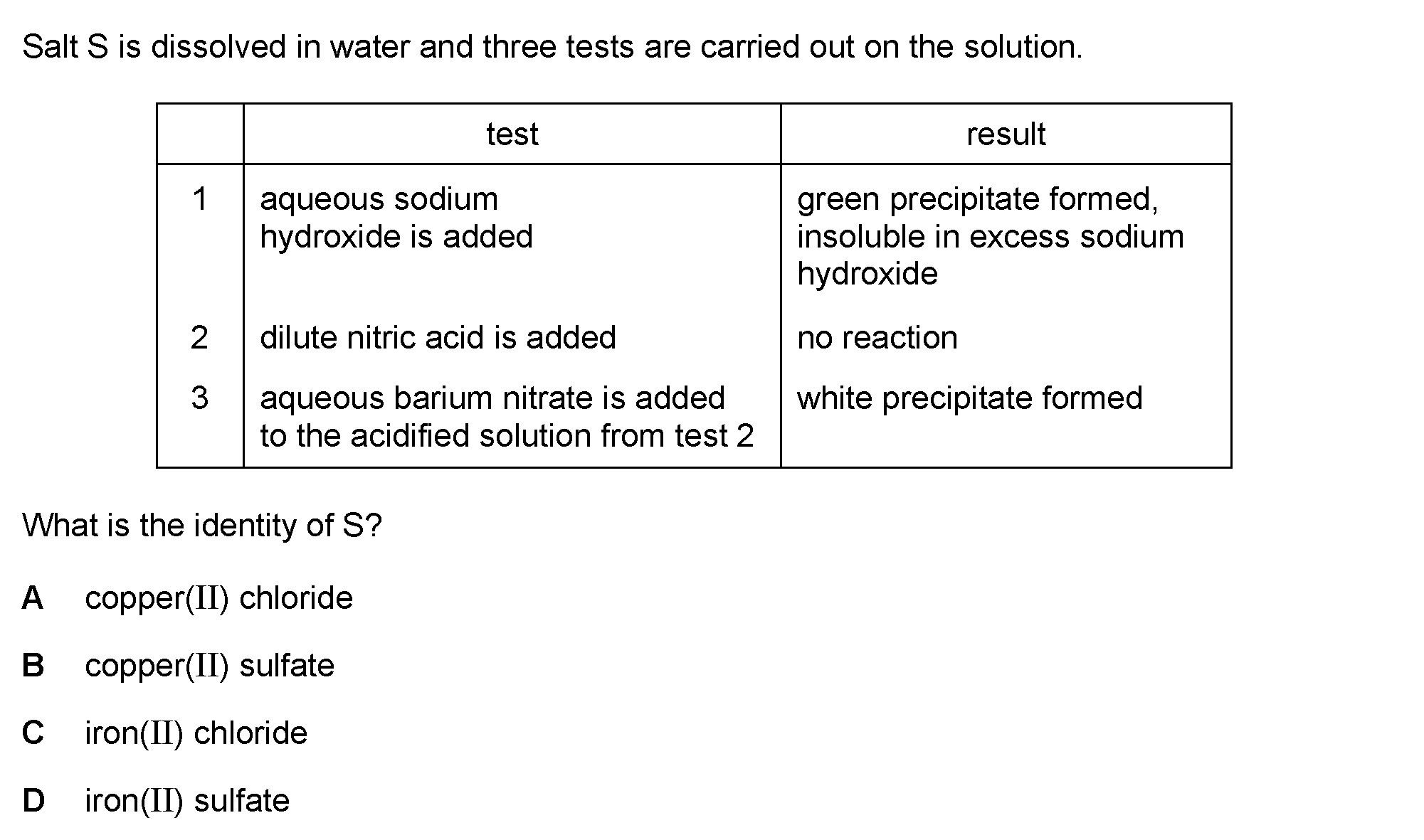
Salt S is dissolved in water and three tests are carried out on the solution.
aqueous sodium
hydroxide is added
dilute nitric acid is added
aqueous barium nitrate is added
to the acidified solution from test 2
What is the identity of S?
A
B
Cc
D
copper(II) chloride
copper(II) sulfate
iron(II) chloride
iron(II) sulfate
green precipitate formed,
insoluble in excess sodium
hydroxide
no reaction
white precipitate formed
Options:
A
B
C
D
Correct Key: D
A
B
C
D
Correct Key: D
Question 2
Paper Ref: 0620/12_Winter_2022_Q18
Paper Ref: 0620/12_Winter_2022_Q18
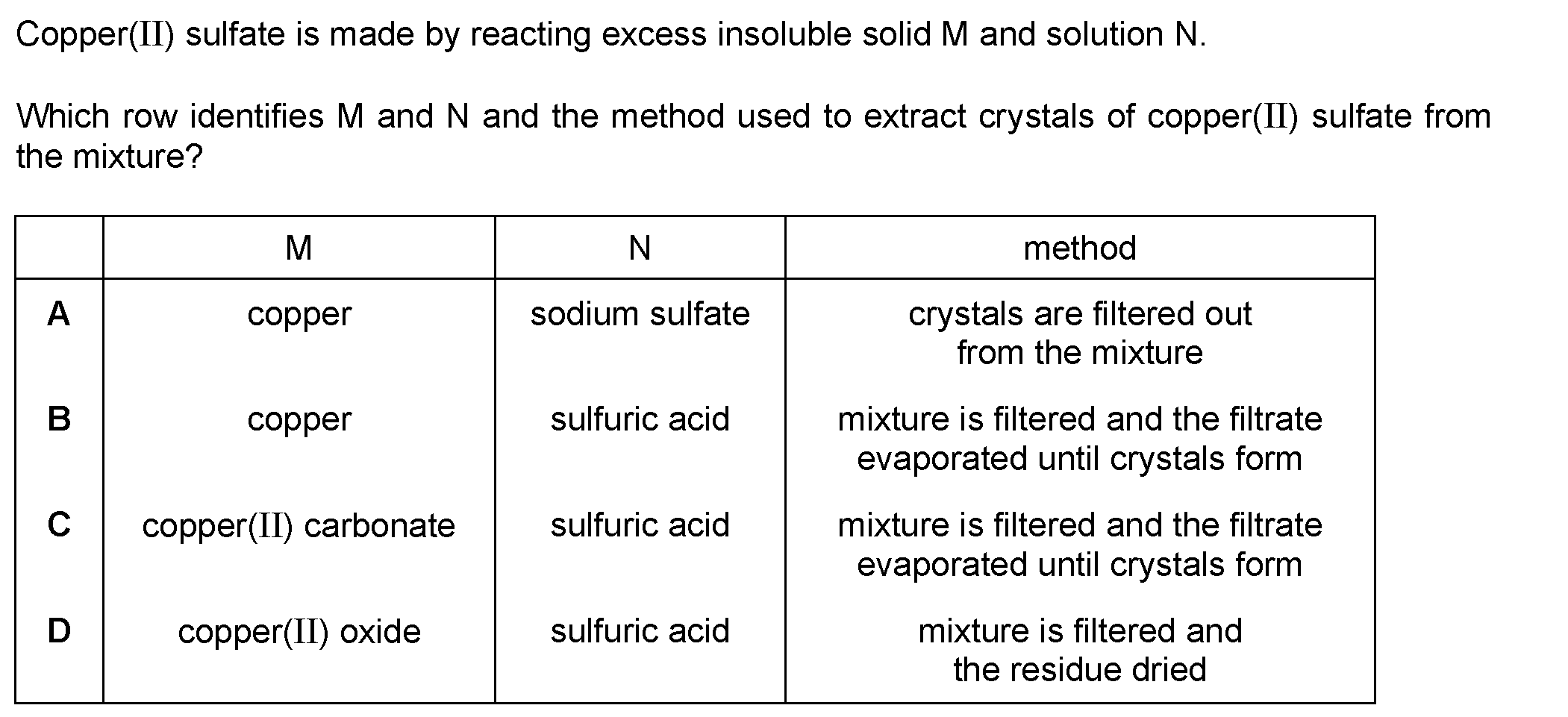
Copper(II) sulfate is made by reacting excess insoluble solid M and solution N.
Which row identifies M and N and the method used to extract crystals of copper(II) sulfate from
the mixture?
copper sodium sulfate crystals are filtered out
from the mixture
copper sulfuric acid mixture is filtered and the filtrate
evaporated until crystals form
copper(II) carbonate sulfuric acid mixture is filtered and the filtrate
evaporated until crystals form
copper(II) oxide sulfuric acid mixture is filtered and
the residue dried
Options:
A
B
C
D
Correct Key: C
A
B
C
D
Correct Key: C
Question 3
Paper Ref: 0620/22_Summer_2023_Q18
Paper Ref: 0620/22_Summer_2023_Q18
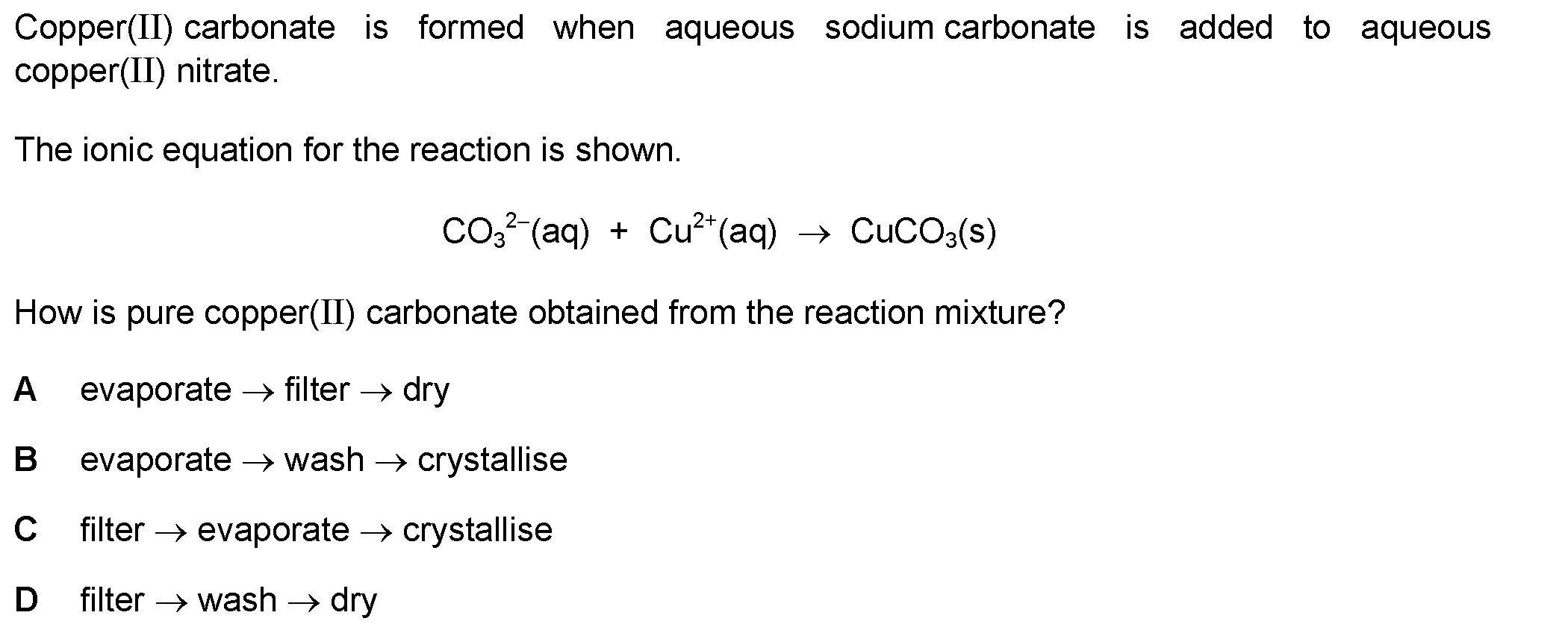
Copper(II) carbonate is formed when aqueous sodiumcarbonate is added to
copper(II) nitrate.
The ionic equation for the reaction is shown.
CO,;7 (aq) + Cu?*(aq) > CuCO,(s)
How is pure copper(II) carbonate obtained from the reaction mixture?
A
B
Cc
D
evaporate — filter > dry
evaporate — wash — crystallise
filter + evaporate —> crystallise
filter > wash —> dry
aqueous
copper(II) nitrate.
The ionic equation for the reaction is shown.
CO,;7 (aq) + Cu?*(aq) > CuCO,(s)
How is pure copper(II) carbonate obtained from the reaction mixture?
A
B
Cc
D
evaporate — filter > dry
evaporate — wash — crystallise
filter + evaporate —> crystallise
filter > wash —> dry
aqueous
Options:
A
B
C
D
Correct Key: D
A
B
C
D
Correct Key: D
Question 4
Paper Ref: 0620/11_Winter_2022_Q30
Paper Ref: 0620/11_Winter_2022_Q30
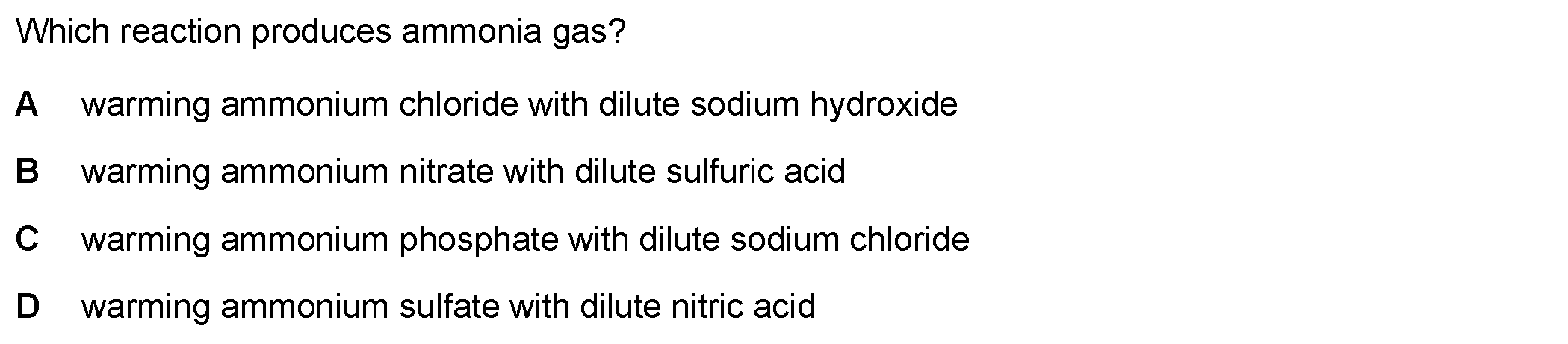
Which reaction produces ammonia gas?
A
B
Cc
D
warming ammonium chloride with dilute sodium hydroxide
warming ammonium nitrate with dilute sulfuric acid
warming ammonium phosphate with dilute sodium chloride
warming ammonium sulfate with dilute nitric acid
A
B
Cc
D
warming ammonium chloride with dilute sodium hydroxide
warming ammonium nitrate with dilute sulfuric acid
warming ammonium phosphate with dilute sodium chloride
warming ammonium sulfate with dilute nitric acid
Options:
A
B
C
D
Correct Key: A
A
B
C
D
Correct Key: A
Question 5
Paper Ref: 0620/22_Summer_2018_Q19
Paper Ref: 0620/22_Summer_2018_Q19
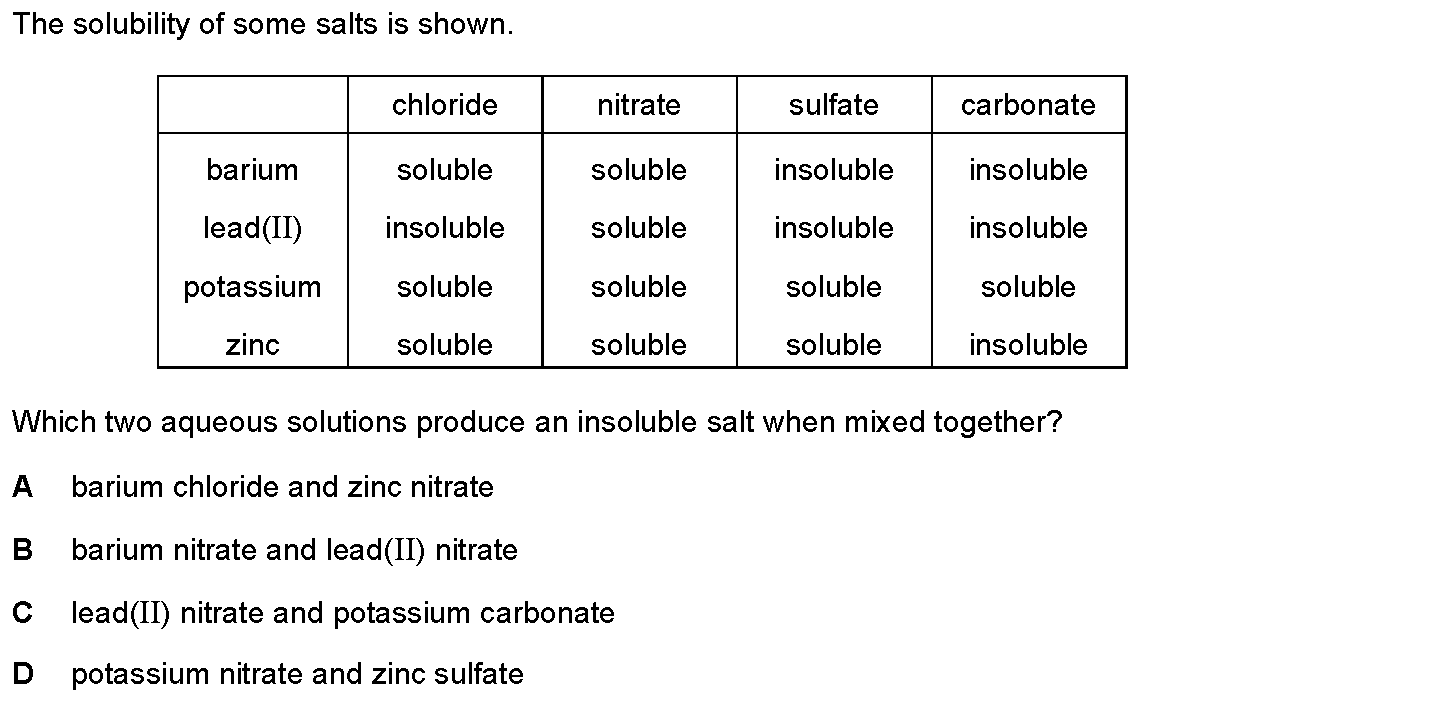
The solubility of some salts is shown.
chloride nitrate sulfate carbonate
barium soluble soluble insoluble insoluble
lead(I]) insoluble soluble insoluble insoluble
potassium soluble soluble soluble soluble
zine soluble soluble soluble insoluble
Which two aqueous solutions produce an insoluble salt when mixed together?
A
B
c
D
barium chloride and zinc nitrate
barium nitrate and lead(II) nitrate
lead(I]) nitrate and potassium carbonate
potassium nitrate and zinc sulfate
Options:
A
B
C
D
Correct Key: C
A
B
C
D
Correct Key: C
Question 6
Paper Ref: 0620/13_Summer_2026_Q31
Paper Ref: 0620/13_Summer_2026_Q31
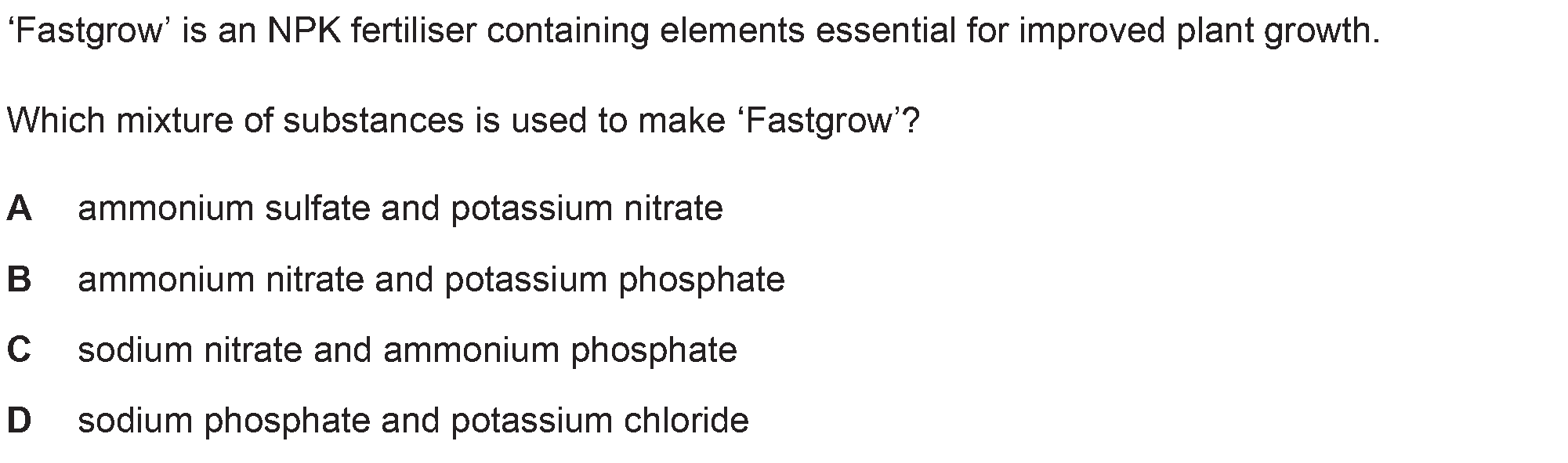
‘Fastgrow’ is an NPK fertiliser containing elements essential for improved plant growth.
Which mixture of substances is used to make ‘Fastgrow’?
A
B
Cc
D
ammonium sulfate and potassium nitrate
ammonium nitrate and potassium phosphate
sodium nitrate and ammonium phosphate
sodium phosphate and potassium chloride
Which mixture of substances is used to make ‘Fastgrow’?
A
B
Cc
D
ammonium sulfate and potassium nitrate
ammonium nitrate and potassium phosphate
sodium nitrate and ammonium phosphate
sodium phosphate and potassium chloride
Options:
A
B
C
D
Correct Key: B
A
B
C
D
Correct Key: B
Question 7
Paper Ref: 0620/11_Winter_2023_Q29
Paper Ref: 0620/11_Winter_2023_Q29
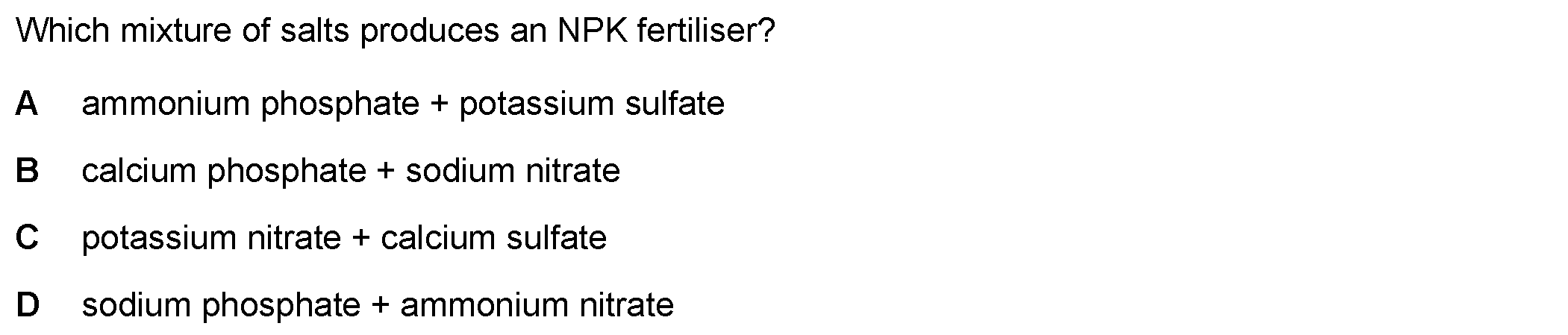
Which mixture of salts produces an NPK fertiliser?
0 OO DW
ammonium phosphate + potassium sulfate
calcium phosphate + sodium nitrate
potassium nitrate + calcium sulfate
sodium phosphate + ammonium nitrate
0 OO DW
ammonium phosphate + potassium sulfate
calcium phosphate + sodium nitrate
potassium nitrate + calcium sulfate
sodium phosphate + ammonium nitrate
Options:
A
B
C
D
Correct Key: A
A
B
C
D
Correct Key: A
Question 8
Paper Ref: 0620/23_Summer_2022_Q19
Paper Ref: 0620/23_Summer_2022_Q19
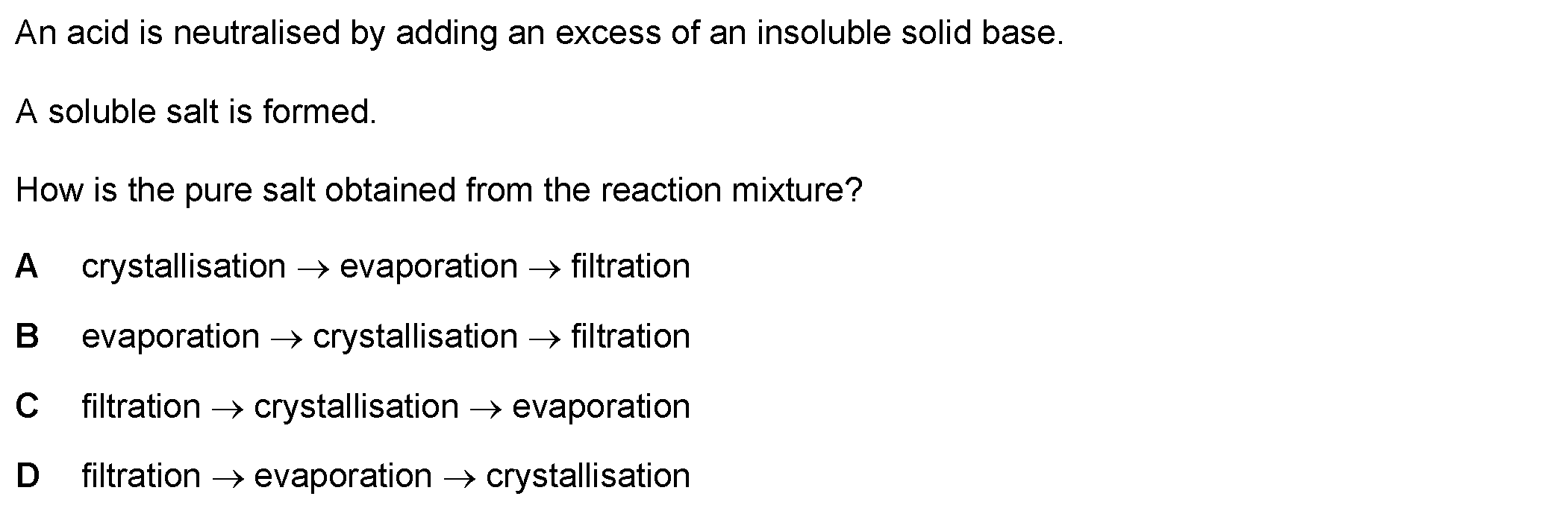
An acid is neutralised by adding an excess of an insoluble solid base.
A soluble salt is formed.
How is the pure salt obtained from the reaction mixture?
A crystallisation + evaporation — filtration
B- evaporation > crystallisation — filtration
C filtration > crystallisation + evaporation
D
filtration + evaporation —> crystallisation
A soluble salt is formed.
How is the pure salt obtained from the reaction mixture?
A crystallisation + evaporation — filtration
B- evaporation > crystallisation — filtration
C filtration > crystallisation + evaporation
D
filtration + evaporation —> crystallisation
Options:
A
B
C
D
Correct Key: D
A
B
C
D
Correct Key: D
Question 9
Paper Ref: 0620/12_Summer_2026_Q18
Paper Ref: 0620/12_Summer_2026_Q18
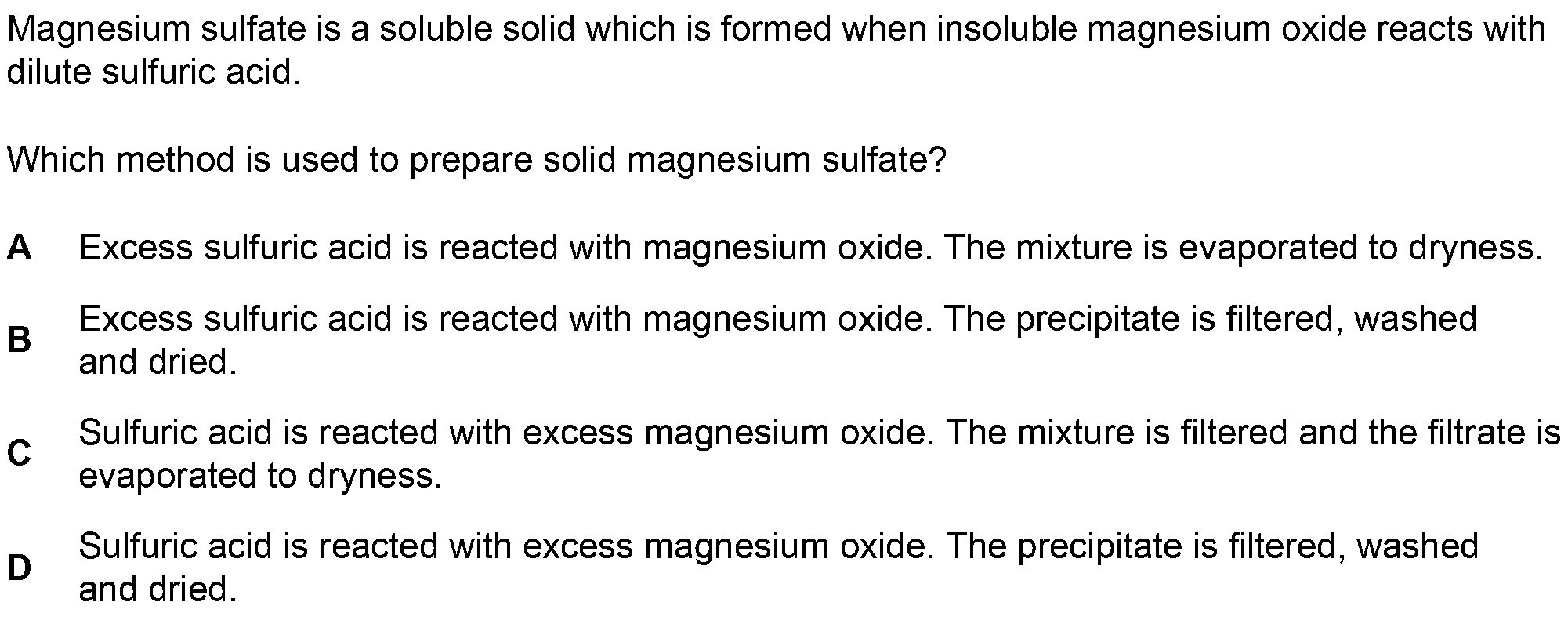
Magnesium sulfate is a soluble solid which is formed when insoluble magnesium oxide reacts with
dilute sulfuric acid.
Which method is used to prepare solid magnesium sulfate?
A Excess sulfuric acid is reacted with magnesium oxide. The mixture is evaporated to dryness.
Excess sulfuric acid is reacted with magnesium oxide. The precipitate is filtered, washed
B and dried.
Cc Sulfuric acid is reacted with excess magnesium oxide. The mixture is filtered and the filtrate is
evaporated to dryness.
D Sulfuric acid is reacted with excess magnesium oxide. The precipitate is filtered, washed
and dried.
Options:
A
B
C
D
Correct Key: C
A
B
C
D
Correct Key: C
Question 10
Paper Ref: 0620/12_Summer_2016_Q33
Paper Ref: 0620/12_Summer_2016_Q33
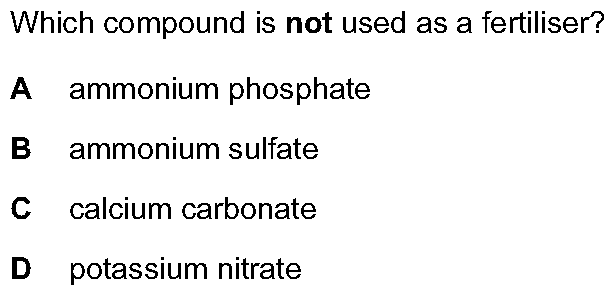
Which compound is not used as a fertiliser?
oo BD
ammonium phosphate
ammonium sulfate
calcium carbonate
potassium nitrate
oo BD
ammonium phosphate
ammonium sulfate
calcium carbonate
potassium nitrate
Options:
A
B
C
D
Correct Key: C
A
B
C
D
Correct Key: C
Question 11
Paper Ref: 0620/23_Summer_2014_Q32
Paper Ref: 0620/23_Summer_2014_Q32
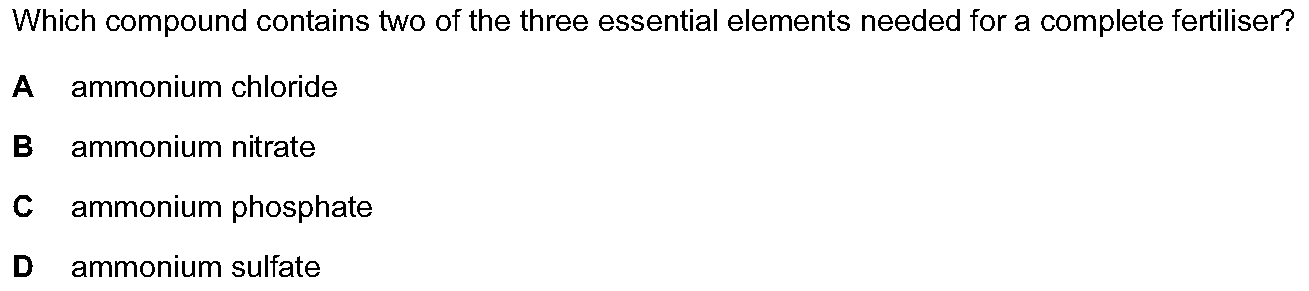
Which compound contains two of the three essential elements needed for a complete fertiliser?
ammonium chloride
B ammonium nitrate
C ammonium phosphate
D ammonium sulfate
ammonium chloride
B ammonium nitrate
C ammonium phosphate
D ammonium sulfate
Options:
A
B
C
D
Correct Key: C
A
B
C
D
Correct Key: C
Question 12
Paper Ref: 0620/23_Winter_2014_Q32
Paper Ref: 0620/23_Winter_2014_Q32
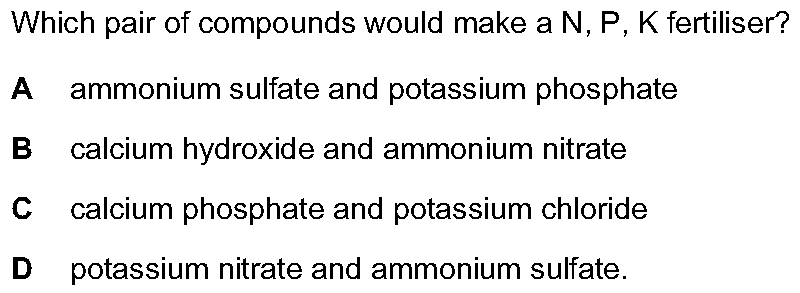
Which pair of compounds would make a N, P, K fertiliser?
A ammonium sulfate and potassium phosphate
B calcium hydroxide and ammonium nitrate
C_ calcium phosphate and potassium chloride
D
potassium nitrate and ammonium sulfate.
A ammonium sulfate and potassium phosphate
B calcium hydroxide and ammonium nitrate
C_ calcium phosphate and potassium chloride
D
potassium nitrate and ammonium sulfate.
Options:
A
B
C
D
Correct Key: A
A
B
C
D
Correct Key: A
Question 13
Paper Ref: 0620/11_Summer_2024_Q18
Paper Ref: 0620/11_Summer_2024_Q18
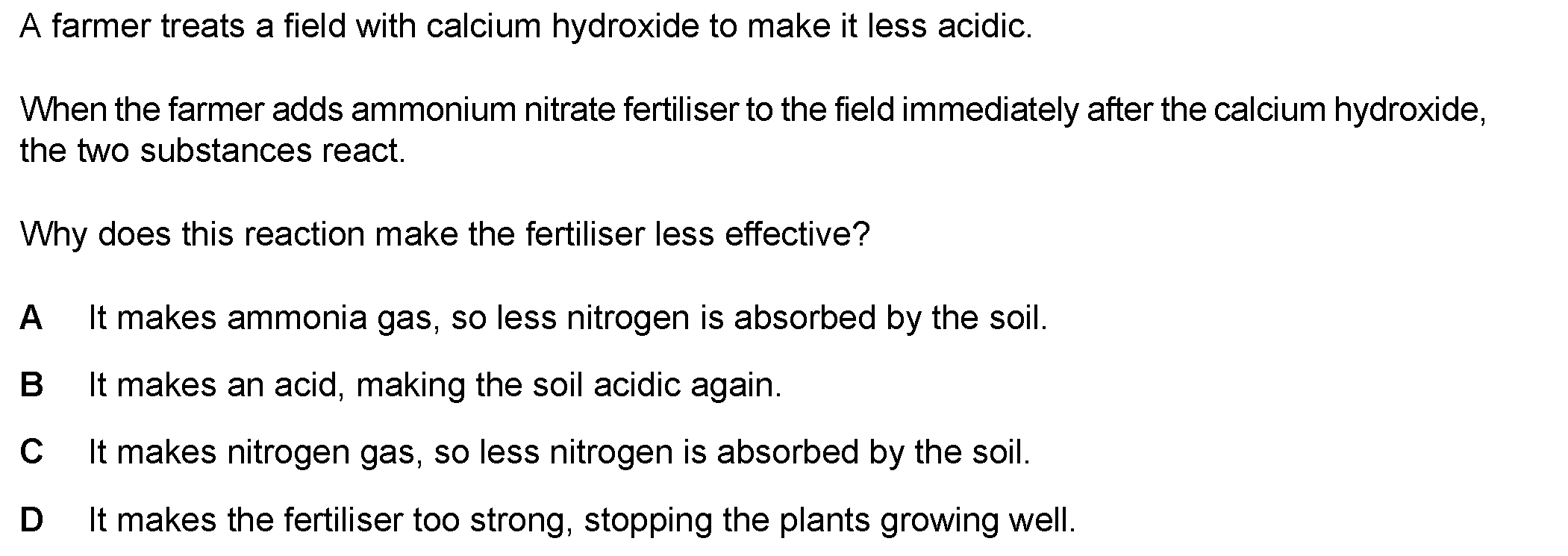
A farmer treats a field with calcium hydroxide to make it less acidic.
When the farmer adds ammonium nitrate fertiliser to the field immediately after the calcium hydroxide,
the two substances react.
Why does this reaction make the fertiliser less effective?
A |It makes ammonia gas, so less nitrogen is absorbed by the soil.
B |t makes an acid, making the soil acidic again.
C It makes nitrogen gas, so less nitrogen is absorbed by the soil.
D
It makes the fertiliser too strong, stopping the plants growing well.
Options:
A
B
C
D
Correct Key: A
A
B
C
D
Correct Key: A
Question 14
Paper Ref: 0620/11_Winter_2021_Q30
Paper Ref: 0620/11_Winter_2021_Q30
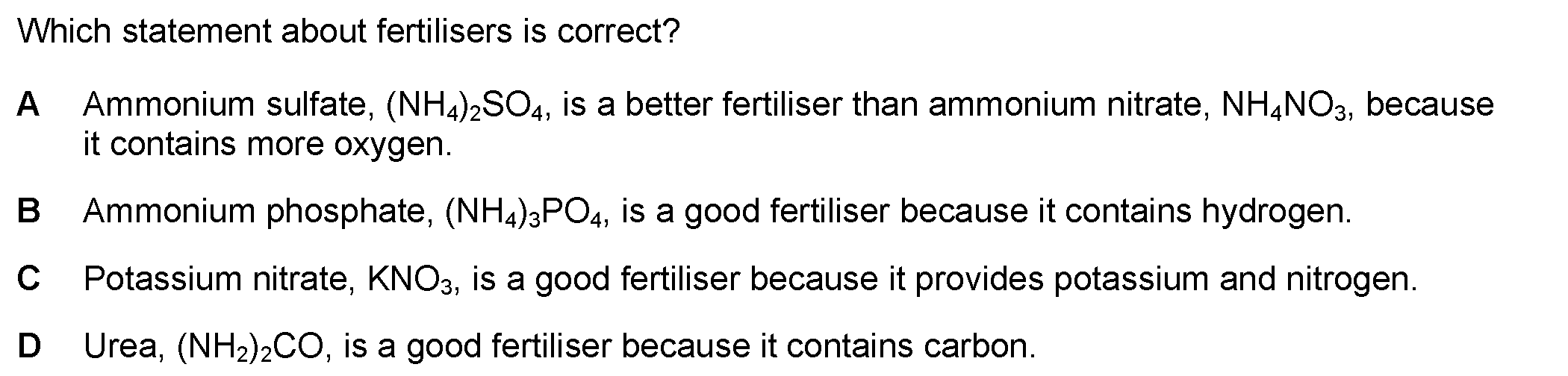
Which statement about fertilisers is correct?
A Ammonium sulfate, (NH,4)2SOu, is a better fertiliser than ammonium nitrate, NHzNO3, because
it contains more oxygen.
Ammonium phosphate, (NH4)3PO,, is a good fertiliser because it contains hydrogen.
Potassium nitrate, KNOs, is a good fertiliser because it provides potassium and nitrogen.
Urea, (NH2)2CO, is a good fertiliser because it contains carbon.
Options:
A
B
C
D
Correct Key: C
A
B
C
D
Correct Key: C
Question 15
Paper Ref: 0620/11_Summer_2021_Q30
Paper Ref: 0620/11_Summer_2021_Q30
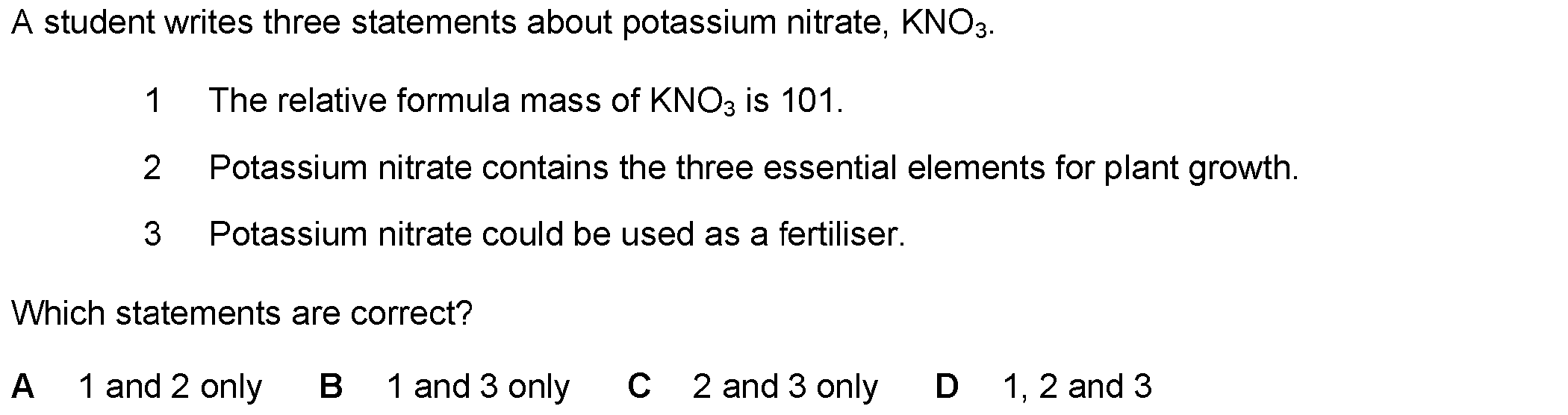
A student writes three statements about potassium nitrate, KNO3.
1 The relative formula mass of KNQs3 is 101.
2 Potassium nitrate contains the three essential elements for plant growth.
3 Potassium nitrate could be used as a fertiliser.
Which statements are correct?
A iand2only B 1and3only C 2Z2and3only D 1,2and3
1 The relative formula mass of KNQs3 is 101.
2 Potassium nitrate contains the three essential elements for plant growth.
3 Potassium nitrate could be used as a fertiliser.
Which statements are correct?
A iand2only B 1and3only C 2Z2and3only D 1,2and3
Options:
A
B
C
D
Correct Key: B
A
B
C
D
Correct Key: B
Question 16
Paper Ref: 0620/21_Winter_2019_Q20
Paper Ref: 0620/21_Winter_2019_Q20
Carbonic acid is a weak acid formed when carbon dioxide dissolves in water.
What is the pH of the solution?
A 1 B 5 C 7 D 9
What is the pH of the solution?
A 1 B 5 C 7 D 9
Options:
A
B
C
D
Correct Key: B
A
B
C
D
Correct Key: B
Question 17
Paper Ref: 0620/12_Summer_2018_Q30
Paper Ref: 0620/12_Summer_2018_Q30
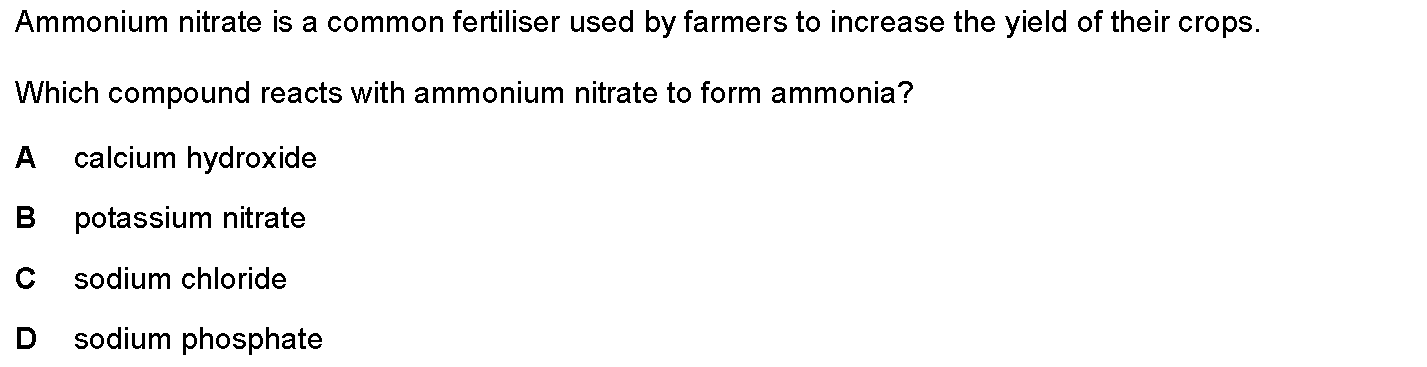
Ammonium nitrate is a common fertiliser used by farmers to increase the yield of their crops.
Which compound reacts with ammonium nitrate to form ammonia?
calcium hydroxide
B potassium nitrate
C sodium chloride
D_ sodium phosphate
Which compound reacts with ammonium nitrate to form ammonia?
calcium hydroxide
B potassium nitrate
C sodium chloride
D_ sodium phosphate
Options:
A
B
C
D
Correct Key: A
A
B
C
D
Correct Key: A
Question 18
Paper Ref: 0620/22_Winter_2016_Q33
Paper Ref: 0620/22_Winter_2016_Q33
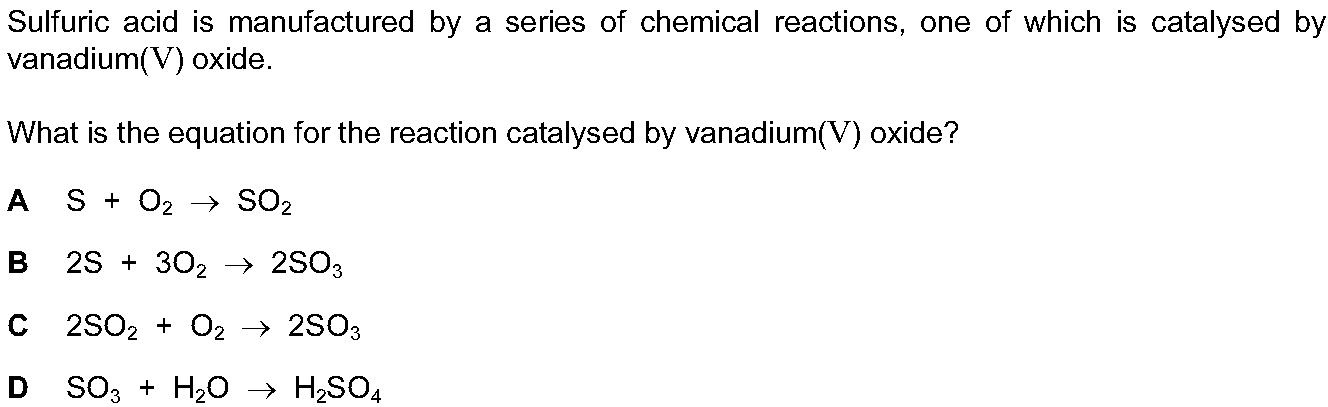
Sulfuric acid is manufactured by a series of chemical reactions, one of which is catalysed by
vanadium(V) oxide.
What is the equation for the reaction catalysed by vanadium(V) oxide?
A S+ OO; > SO,
B 28 + 30, > 280,
CG 280, + O2 > 280;
D SO; + HO > H,SO,
vanadium(V) oxide.
What is the equation for the reaction catalysed by vanadium(V) oxide?
A S+ OO; > SO,
B 28 + 30, > 280,
CG 280, + O2 > 280;
D SO; + HO > H,SO,
Options:
A
B
C
D
Correct Key: C
A
B
C
D
Correct Key: C
Question 19
Paper Ref: 0620/21_Winter_2015_Q30
Paper Ref: 0620/21_Winter_2015_Q30
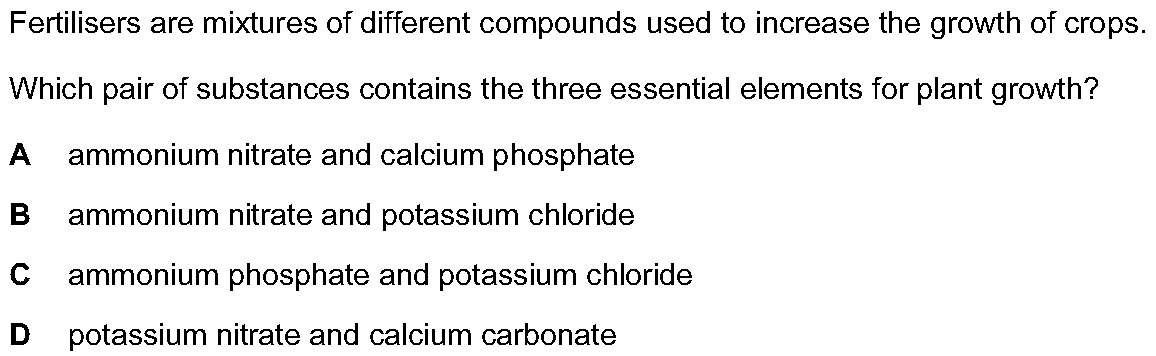
Fertilisers are mixtures of different compounds used to increase the growth of crops.
Which pair of substances contains the three essential elements for plant growth?
oO W
ammonium nitrate and calcium phosphate
ammonium nitrate and potassium chloride
ammonium phosphate and potassium chloride
potassium nitrate and calcium carbonate
Which pair of substances contains the three essential elements for plant growth?
oO W
ammonium nitrate and calcium phosphate
ammonium nitrate and potassium chloride
ammonium phosphate and potassium chloride
potassium nitrate and calcium carbonate
Options:
A
B
C
D
Correct Key: C
A
B
C
D
Correct Key: C
Question 20
Paper Ref: 0620/22_Summer_2012_Q33
Paper Ref: 0620/22_Summer_2012_Q33
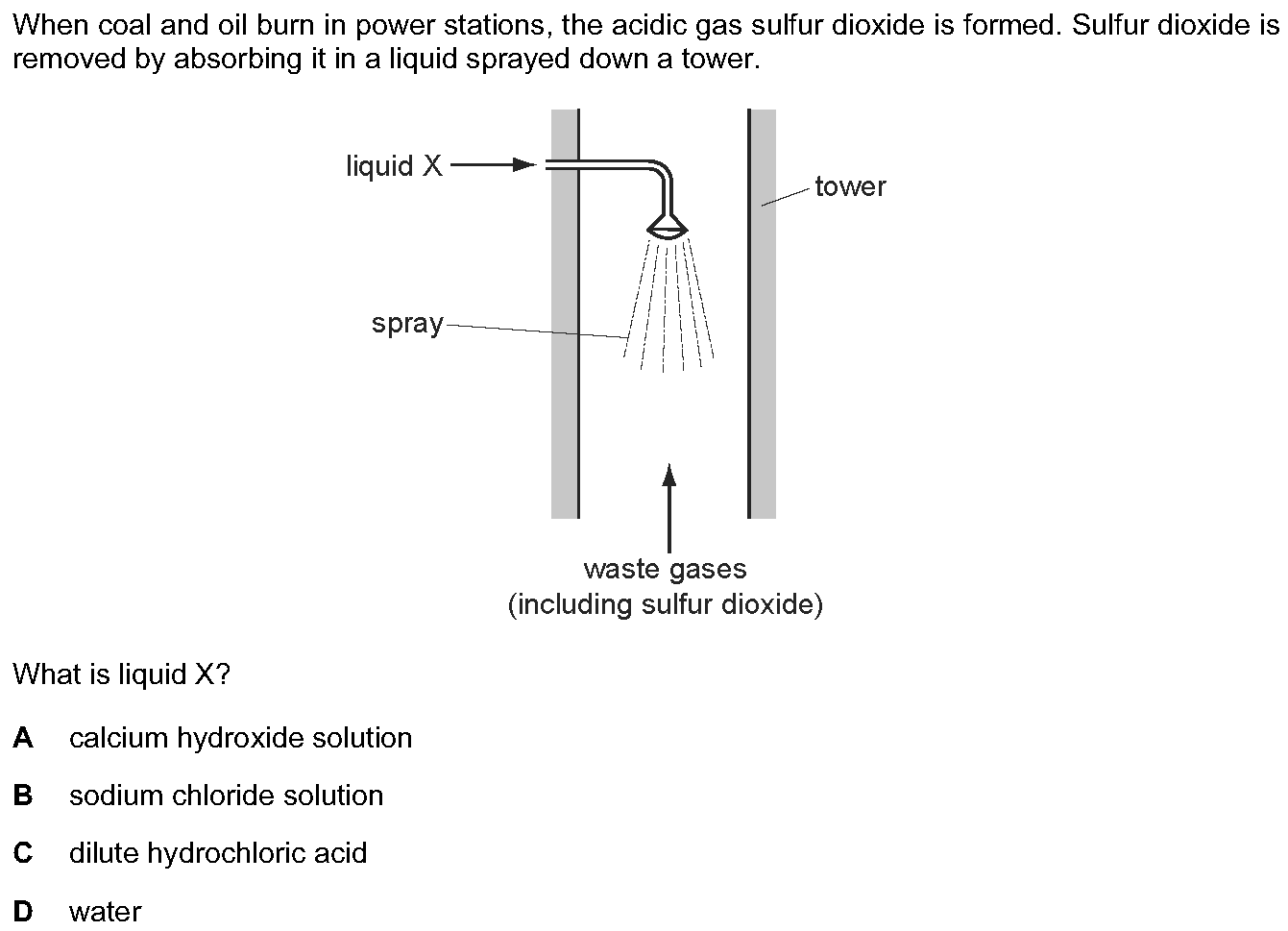
When coal and oil burn in power stations, the acidic gas sulfur dioxide is formed. Sulfur dioxide is
removed by absorbing it in a liquid sprayed down a tower.
liquid X ——-
_-—~ tower
waste gases
(including sulfur dioxide)
What is liquid X?
A calcium hydroxide solution
B sodium chloride solution
C dilute hydrochloric acid
D_ water
removed by absorbing it in a liquid sprayed down a tower.
liquid X ——-
_-—~ tower
waste gases
(including sulfur dioxide)
What is liquid X?
A calcium hydroxide solution
B sodium chloride solution
C dilute hydrochloric acid
D_ water
Options:
A
B
C
D
Correct Key: A
A
B
C
D
Correct Key: A
Question 21
Paper Ref: 0620/11_Winter_2022_Q31
Paper Ref: 0620/11_Winter_2022_Q31
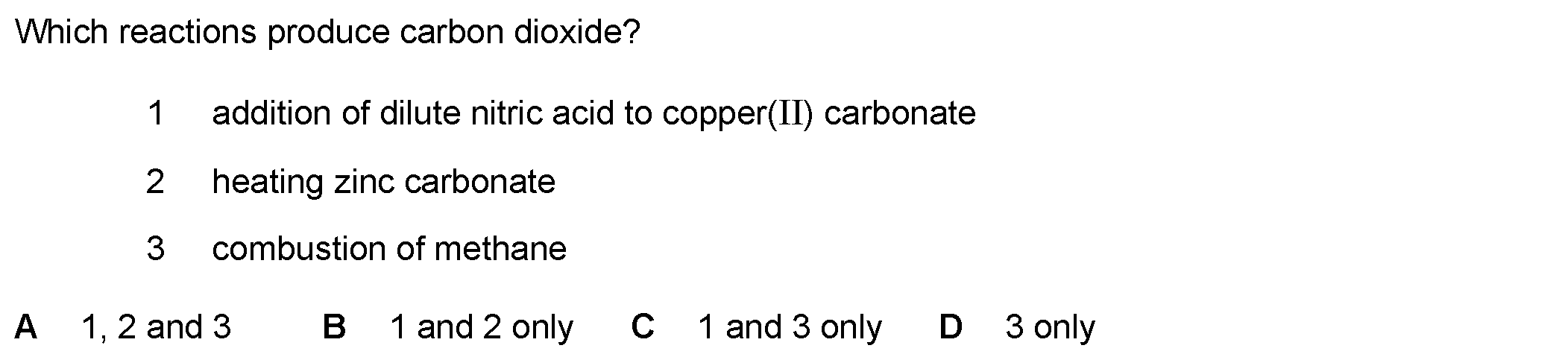
Which reactions produce carbon dioxide?
1. addition of dilute nitric acid to copper(II) carbonate
2 heating zinc carbonate
3 combustion of methane
A 1,2and3 B 1and2Z2only C 1and3only D_ 3only
1. addition of dilute nitric acid to copper(II) carbonate
2 heating zinc carbonate
3 combustion of methane
A 1,2and3 B 1and2Z2only C 1and3only D_ 3only
Options:
A
B
C
D
Correct Key: A
A
B
C
D
Correct Key: A
Question 22
Paper Ref: 0620/11_Winter_2020_Q34
Paper Ref: 0620/11_Winter_2020_Q34
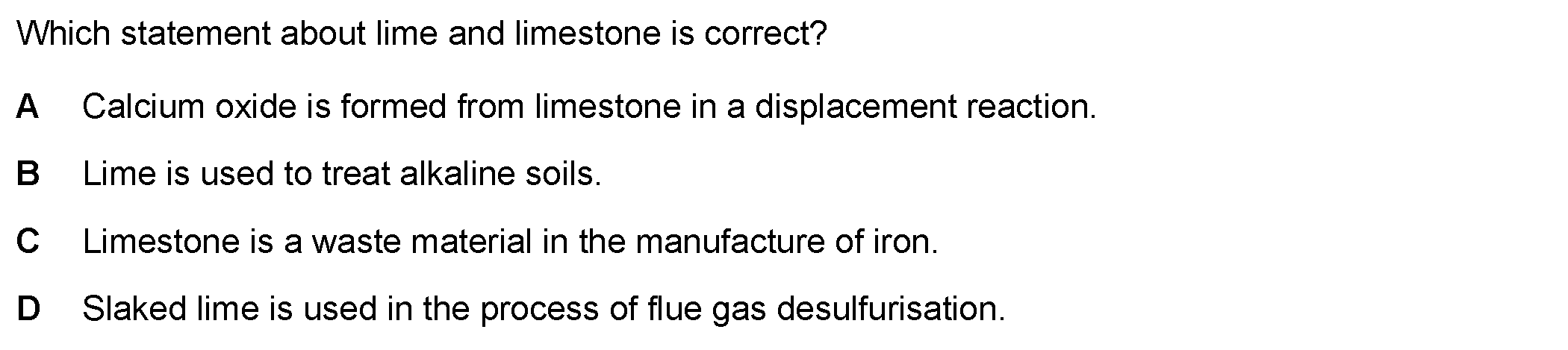
Which statement about lime and limestone is correct?
A Calcium oxide is formed from limestone in a displacement reaction.
Lime is used to treat alkaline soils.
Limestone is a waste material in the manufacture of iron.
0 O WW
Slaked lime is used in the process of flue gas desulfurisation.
A Calcium oxide is formed from limestone in a displacement reaction.
Lime is used to treat alkaline soils.
Limestone is a waste material in the manufacture of iron.
0 O WW
Slaked lime is used in the process of flue gas desulfurisation.
Options:
A
B
C
D
Correct Key: D
A
B
C
D
Correct Key: D
Structured Questions Mark Scheme & Answers
•1•.• • • •[•P•R•I• •2•0•1•0••• •P•1• • •·• • •Q•1•3• • •·• • •2•0•1•0• • •·• • •P•r•i•m•a•r•y• •0•8•4•6•]• • • • • • •(•n•o• •p•u•b•l•i•s•h•e•d• •m•a•r•k• •s•c•h•e•m•e• •f•o•r• •t•h•i•s• •p•a•p•e•r•)•
•2•.• • • •[•C•P• •M•a•y• •2•0•2•5• •P•1• • •·• • •Q•1•2• • •P•a•r•t• •(•a•)• • •·• • •2•0•2•5• • •·• • •L•o•w•e•r• •S•e•c• •0•8•9•3•]• • • • • • •h•y•d•r•o•c•h•l•o•r•i•c• •a•c•i•d• •1• •••c•c•e•p•t• •H•C•l•,• •b•u•t• •n•a•m•e• •t•a•k•e•s• •p•r•e•c•e•d•e•n•c•e• •I•g•n•o•r•e• •h•y•d•r•o•g•e•n• •c•h•l•o•r•i•d•e•
•3•.• • • •[•C•P• •M•a•y• •2•0•2•5• •P•1• • •·• • •Q•1•2• • •P•a•r•t• •(•b•)• • •·• • •2•0•2•5• • •·• • •L•o•w•e•r• •S•e•c• •0•8•9•3•]• • • • • • •2• •e•a•c•h• •c•o•r•r•e•c•t• •a•n•s•w•e•r• •=• •1• •m•a•r•k• •M•1• •f•i•l•t•r•a•t•i•o•n• •o•r• •f•i•l•t•e•r• •o•r• •d•e•s•c•r•i•p•t•i•o•n• •o•f• •f•i•l•t•r•a•t•i•o•n• •I•g•n•o•r•e• •d•e•c•a•n•t•i•n•g• •o•r• •s•i•e•v•i•n•g• •M•2• •c•o•l•l•e•c•t•s• •f•i•l•t•r•a•t•e• •••c•c•e•p•t• •(•i•d•e•a• •t•h•a•t•)• •z•i•n•c• •c•a•r•b•o•n•a•t•e• •i•s• •t•h•e• •r•e•s•i•d•u•e• •o•n• •t•h•e• •f•i•l•t•e•r• •p•a•p•e•r•
•4•.• • • •[•C•P• •M•a•y• •2•0•2•5• •P•1• • •·• • •Q•1•2• • •P•a•r•t• •(•c•)• • •·• • •2•0•2•5• • •·• • •L•o•w•e•r• •S•e•c• •0•8•9•3•]• • • • • • •l•e•a•v•e•s• •i•n• •a• •w•a•r•m• •p•l•a•c•e• •o•r• •l•e•a•v•e•s• •b•y• •a• •w•i•n•d•o•w• •o•r• •s•l•o•w•l•y• •1• •••c•c•e•p•t• •h•e•a•t•/•b•o•i•l• •t•o• •r•e•d•u•c•e• •v•o•l•u•m•e• •b•y• •h•a•l•f• •a•n•d• •e•v•a•p•o•r•a•t•e•s• •t•h•e•n• •l•e•a•v•e• •(•t•o• •e•v•a•p•o•r•a•t•e•)• •o•r• •h•e•a•t• •t•o• •g•e•t• •s•a•t•u•r•a•t•e•d• •s•o•l•u•t•i•o•n• •a•n•d• •t•h•e•n• •l•e•a•v•e• •(•t•o• •c•o•o•l•)• •o•r• •l•e•a•v•e• •f•o•r• •a• •f•e•w• •d•a•y•s• •(•t•o• •e•v•a•p•o•r•a•t•e• •o•r• •c•r•y•s•t•a•l•l•i•s•e•)• •o•r• •l•e•a•v•e• •s•o•l•u•t•i•o•n• •t•o• •e•v•a•p•o•r•a•t•e• •o•r• •h•e•a•t• •a•n•d• •l•e•a•v•e• •t•o• •c•o•o•l• •N•o•t•e• •c•r•y•s•t•a•l•l•i•s•a•t•i•o•n• •i•s• •n•o•t• •s•u•f•f•i•c•i•e•n•t• •I•g•n•o•r•e• •l•e•a•v•e• •s•o•l•u•t•i•o•n• •t•o• •d•r•y•/•s•o•l•i•d•i•f•y• •D•o• •n•o•t• •a•c•c•e•p•t• •(•i•d•e•a• •o•f•)• •h•e•a•t• •t•o• •d•r•y•n•e•s•s•
•5•.• • • •[•P•T• •S•9• •2•0•2•6• •P•2• • •·• • •Q•1•0• • •P•a•r•t• •(•c•)• • •·• • •2•0•2•6• • •·• • •L•o•w•e•r• •S•e•c• •0•8•9•3•]• • • • • • •a•n•y• •t•w•o• •f•r•o•m• •2• •e•a•c•h• •c•o•r•r•e•c•t• •a•n•s•w•e•r• •=• •1• •m•a•r•k• •N•o•t•e• •h•e•a•t• •s•o•l•u•t•i•o•n• •u•n•t•i•l• •a•l•l• •w•a•t•e•r• •e•v•a•p•o•r•a•t•e•s• •o•r• •b•o•i•l• •s•o•l•u•t•i•o•n• •u•n•t•i•l• •a•l•l• •w•a•t•e•r• •e•v•a•p•o•r•a•t•e•s• •=• •0• •m•a•r•k•s• •f•o•r• •t•h•e• •q•u•e•s•t•i•o•n• •M•1• •(•h•e•a•t•)• •t•o• •m•a•k•e• •a• •c•o•n•c•e•n•t•r•a•t•e•d• •s•o•l•u•t•i•o•n• •o•r• •t•o• •m•a•k•e• •a• •••c•c•e•p•t• •f•o•r• •M•1• •e•v•a•p•o•r•a•t•e•/•h•e•a•t• •t•o• •g•e•t• •h•a•l•f• •o•f• •t•h•e• •s•a•t•u•r•a•t•e•d• •s•o•l•u•t•i•o•n• •o•r• •u•n•t•i•l• •f•i•r•s•t• •a•p•p•e•a•r•a•n•c•e• •o•f• •c•r•y•s•t•a•l•s• •o•r• •v•o•l•u•m•e• •o•f• •s•o•l•u•t•i•o•n• •s•o•l•i•d• •••c•c•e•p•t• •f•o•r• •M•1• •h•e•a•t• •s•o•l•u•t•i•o•n• •u•n•t•i•l• •f•i•r•s•t• •a•p•p•e•a•r•a•n•c•e• •o•f• •c•r•y•s•t•a•l•s• •••c•c•e•p•t• •f•o•r• •M•1• •e•v•a•p•o•r•a•t•e• •w•a•t•e•r• •f•r•o•m• •s•o•l•u•t•i•o•n• •u•n•t•i•l• •a• •s•a•t•u•r•a•t•e•d• •s•o•l•u•t•i•o•n• •i•s• •m•a•d•e• •••c•c•e•p•t• •f•o•r• •M•1• •l•e•a•v•e• •t•o• •e•v•a•p•o•r•a•t•e• •i•n• •a• •w•a•r•m• •p•l•a•c•e• •M•2• •l•e•t• •(•h•o•t•)• •s•o•l•u•t•i•o•n• •c•o•o•l• •o•r• •l•e•a•v•e• •h•o•t• •s•o•l•u•t•i•o•n• •t•o• •e•v•a•p•o•r•a•t•e• •(•f•o•r• •a• •f•e•w• •d•a•y•s•)• •••c•c•e•p•t• •f•o•r• •M•3• •a•n•d• •M•4• •p•i•c•k• •o•u•t• •c•r•y•s•t•a•l•s• •a•n•d• •d•r•y• •M•3• •f•i•l•t•e•r• •o•f•f• •c•r•y•s•t•a•l•s• •b•e•t•w•e•e•n• •p•i•e•c•e•s• •o•f• •f•i•l•t•e•r• •p•a•p•e•r• •=• •2• •m•a•r•k•s• •M•4• •w•a•s•h• •c•r•y•s•t•a•l•s• •w•i•t•h• •a• •s•m•a•l•l• •a•m•o•u•n•t• •o•f• •c•o•l•d• •w•a•t•e•r• •a•n•d• •l•e•a•v•e• •t•o• •d•r•y• •o•r• •d•r•y• •c•r•y•s•t•a•l•s• •b•e•t•w•e•e•n• •f•i•l•t•e•r• •p•a•p•e•r• •©• •C•a•m•b•r•i•d•g•e• •U•n•i•v•e•r•s•i•t•y• •P•r•e•s•s• •&• •••s•s•e•s•s•m•e•n•t• •2•0•2•6• •P•a•g•e• •1•0• •o•f• •1•4• •S•9•/•0•2• •S•c•i•e•n•c•e• •S•t•a•g•e• •9• •P•a•p•e•r• •2• •M•a•r•k• •S•c•h•e•m•e• •2•0•2•6•
•6•.• • • •[•C•P• •O•c•t•o•b•e•r• •2•0•2•5• •P•1• • •·• • •Q•6• • •P•a•r•t• •(•b•)• • •·• • •2•0•2•5• • •·• • •L•o•w•e•r• •S•e•c• •0•8•9•3•]• • • • • • •f•i•l•t•r•a•t•i•o•n• •o•r• •b•y• •f•i•l•t•e•r•i•n•g• •i•t• •1• •••c•c•e•p•t• •u•s•e• •f•i•l•t•e•r• •p•a•p•e•r• •I•g•n•o•r•e• •d•e•c•a•n•t•i•n•g• •o•r• •s•i•e•v•i•n•g•
•7•.• • • •[•C•P• •O•c•t•o•b•e•r• •2•0•2•5• •P•1• • •·• • •Q•6• • •P•a•r•t• •(•c•)• • •·• • •2•0•2•5• • •·• • •L•o•w•e•r• •S•e•c• •0•8•9•3•]• • • • • • •2• •e•a•c•h• •c•o•r•r•e•c•t• •a•n•s•w•e•r• •=• •1• •m•a•r•k• •M•1• •e•v•a•p•o•r•a•t•e• •o•f•f• •s•o•m•e• •o•f• •t•h•e• •w•a•t•e•r• •••c•c•e•p•t• •h•e•a•t• •t•o• •m•a•k•e• •a• •s•a•t•u•r•a•t•e•d• •s•o•l•u•t•i•o•n• •o•r• •h•e•a•t• •t•o• •r•e•d•u•c•e• •t•h•e• •v•o•l•u•m•e• •b•y• •a• •h•a•l•f• •o•r• •h•e•a•t• •u•n•t•i•l• •f•i•r•s•t• •c•r•y•s•t•a•l•s• •a•p•p•e•a•r• •M•2• •l•e•a•v•e• •s•o•l•u•t•i•o•n• •t•o• •c•r•y•s•t•a•l•l•i•s•e• •s•l•o•w•l•y• •••c•c•e•p•t• •l•e•a•v•e• •s•o•l•u•t•i•o•n• •i•n• •a• •w•a•r•m• •p•l•a•c•e• •••c•c•e•p•t• •l•e•a•v•e• •w•a•r•m• •s•o•l•u•t•i•o•n• •t•o• •c•o•o•l• •d•o•w•n•
•8•.• • • •[•P•R•I• •2•0•2•0•B• •P•2• • •·• • •Q•1•5• • •P•a•r•t• •(•c•)• • •·• • •2•0•2•0• • •·• • •P•r•i•m•a•r•y• •0•8•4•6•]• • • • • • •d•i•s•s•o•l•v•e•s• •1• •c•o•l•o•u•r•l•e•s•s• •1• •••c•c•e•p•t• •c•l•e•a•r• •/• •t•r•a•n•s•p•a•r•e•n•t• •/• •w•h•i•t•e• •I•g•n•o•r•e• •t•h•e• •s•a•m•e• •c•o•l•o•u•r• •a•s• •w•a•t•e•r• •s•a•l•t• •i•s• •s•o•l•u•b•l•e• •i•n• •w•a•t•e•r• •/• •s•a•l•t• •i•s• •d•i•s•s•o•l•v•e•d• •i•n• •t•h•e• •w•a•t•e•r• •1• •••c•c•e•p•t• •i•d•e•a• •t•h•a•t• •t•h•e• •s•a•l•t• •p•a•s•s•e•s• •t•h•r•o•u•g•h• •t•h•e• •(•f•i•l•t•e•r• •p•a•p•e•r•)• •w•i•t•h• •t•h•e• •w•a•t•e•r• •••c•c•e•p•t• •b•e•c•a•u•s•e• •t•h•e• •s•a•l•t• •h•a•s• •d•i•s•s•o•l•v•e•d• •D•o• •n•o•t• •a•c•c•e•p•t• •b•e•c•a•u•s•e• •s•a•l•t• •i•s• •v•e•r•y• •s•m•a•l•l• •i•t• •w•i•l•l• •g•o• •t•h•r•o•u•g•h• •t•h•e• •f•i•l•t•e•r• •a•n•y• •t•w•o• •f•r•o•m• •2• •••c•c•e•p•t• •p•u•t• •t•h•e• •d•i•s•h• •i•n• •t•h•e• •s•u•n• •h•e•a•t• •t•h•e• •s•o•l•u•t•i•o•n• •e•v•a•p•o•r•a•t•e• •w•a•t•e•r• •••c•c•e•p•t• •b•o•i•l• •a• •(•w•h•i•t•e•)• •s•o•l•i•d• •i•s• •f•o•r•m•e•d• •••c•c•e•p•t• •s•a•l•t• •i•s• •l•e•f•t• •b•e•h•i•n•d• •/• •s•a•l•t• •i•s• •f•o•r•m•e•d• •••c•c•e•p•t• •h•e•a•t• •t•o• •g•e•t• •a• •(•w•h•i•t•e•)• •r•e•s•i•d•u•e• •=• •2• •m•a•r•k•s• •©• •U•C•L•E•S• •2•0•2•0• •P•a•g•e• •1•0• •o•f• •1•2• •••s•s•e•m•b•l•e•d• •b•y• •N•.•S•.• •2•2•/•3•8•4•
Last updated:
\n