1.4.5Motion, Forces and Energy
Hooke’s Law — Cambridge IGCSE Physics 0625 Revision Notes & Topical Questions
5 min read 11 parts Lesson 35 of 91 1 quiz
1.4.5 Hooke's Law — IGCSE PHYSICS notes: State Hooke's law, use F = kx and interpret a force-extension graph.Hooke's law = the extension of a spring is directly proportional to the force stretching it, provided the limit of proportionality is not exceeded.Equation — F = kx.What t…
- What the symbols mean
- Meaning of k
- A spring of original length 10 cm stretched to 14 cm has an extension of 4 cm
- Compression
- Beyond the limit
- Swapped axes
Part 1 of 9The law
- F = kx.What the symbols mean: F = force (N) · k = spring constant (N m−1) · x or e = extension (m)
- F is force in N, x is extension in m and k is the spring constant in N/m.
- Stiffness a stiff spring has a large k and a soft spring has a small k.
- Meaning of k a spring with k = 50 N/m extends 1 m for 50 N, or 2 cm for 1 N.
Part 2 of 9Extension, not length
- Compression the same law applies when a spring is squashed, with the force pushing in.
Part 3 of 9Spring apparatus: image and practical questions
Spring apparatus: image and practical questions
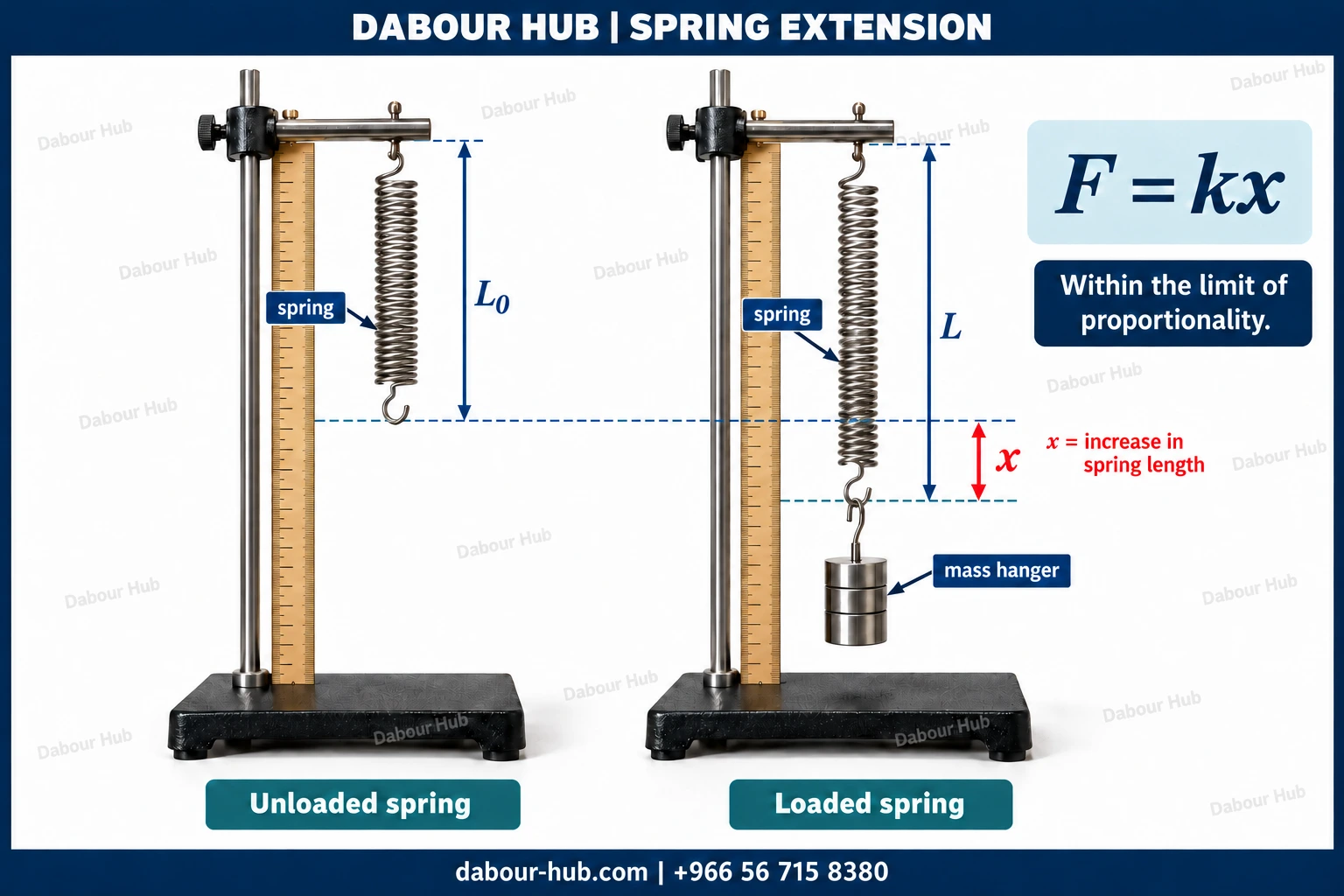
The two setups compare the same spring before and after loading. Measure both lengths between the fixed upper support and the same point on the lower hook. Use the numerical values supplied in the questions; the image is illustrative.
Question 1
Which two positions define the extension x shown in red?
Show answer and explanation
The lower spring-hook position before loading and the lower spring-hook position after loading, measured from the same fixed upper reference. The bottom of the mass hanger is not the spring endpoint.
Question 2
The unloaded spring length is 12.0 cm and the loaded length is 16.0 cm. Calculate x in metres.
Show answer and explanation
x = 16.0 − 12.0 = 4.0 cm = 0.040 m. These supplied values are independent of the illustrative ruler marks.
Question 3
A total hanging mass of 0.200 kg, including the hanger, produces this 0.040 m extension. Use g = 10 N/kg to calculate k.
Show answer and explanation
F = mg = 0.200 × 10 = 2.00 N. At rest the spring force balances this weight. k = F/x = 2.00/0.040 = 50 N/m, provided the spring is in its proportional region.
Question 4
The force increases from 1.0 N to 3.0 N while extension increases from 0.020 m to 0.060 m along a straight force-extension graph. Find its gradient and state its meaning.
Show answer and explanation
Gradient = (3.0 − 1.0)/(0.060 − 0.020) = 50 N/m. With force on the vertical axis and extension on the horizontal axis, this is the spring constant k.
Question 5
An additional 1.0 N first produces an extra 0.020 m, but the next additional 1.0 N produces an extra 0.035 m. Does a single constant k describe this whole range?
Show answer and explanation
No. Equal force increments produce unequal extension increments, so the force-extension relation is no longer proportional throughout. This alone does not prove permanent deformation; unload the spring and test whether its original length is recovered.
Question 6
State three practical steps that improve this investigation and one safety precaution.
Show answer and explanation
Clamp the ruler vertically close to the spring; read the same hook or pointer at eye level to reduce parallax; wait for oscillations to settle and repeat readings. Include the hanger mass when calculating force. Secure the stand and keep clear of falling masses; use small load increments and avoid overstretching the spring.
Part 4 of 9The force-extension graph
- Gradient the gradient of the straight section is F/x = k.
- Beyond the limit the line curves and the spring stretches more for the same extra force.
- Swapped axes if extension is plotted against force, the gradient is 1/k.
Part 5 of 9Elastic and plastic behaviour
- Elastic a material returns to its original shape when the force is removed.
- Plastic beyond the elastic limit the material is permanently stretched.
- Not all materials obey Hooke's law rubber bands and polymers give curves even for small forces, and a copper wire obeys it only for small loads.
Part 6 of 9Springs in use
- Newton meters the extension of a spring measures the force.
- Energy stored for a straight line graph, the area under it gives ½Fx = ½kx2.
Part 7 of 9Checking validity
Part 8 of 9More from the specification
- An object remains at rest or continues moving at a constant speed in a straight line unless acted upon by an unbalanced resultant force; balanced forces cause no change in motion.
- (constant velocity)
- A non-zero resultant force acting on an object causes an acceleration in the direction of the force, governed by the formula F = m·a;
- the rate of change of velocity is directly proportional to the net force.
- Friction is a contact force that acts in the direction opposing relative motion;
- when driving forces exceed friction, an object speeds up,
- and when friction exceeds driving force, the object decelerates.
- Motion along a circular path with a force towards the centre.
- Vector sum of two or more vectors.
- Rate of change of displacement.
- Rate of change of velocity.
- Force parallel to the surface opposing relative motion or its tendency.
- Having equal and opposite moments.
- Gravitational force on a mass.
- Another name for net force.
- Speed that does not change.
Part 9 of 9More from the specification
- Magnitude
- The size of a quantity.
Key terms
| Term | Meaning |
|---|---|
| Hooke's law | Extension is proportional to force up to the limit of proportionality. |
| Spring constant k | Force per unit extension, in N/m. |
| Limit of proportionality | Point beyond which F is no longer proportional to x. |
| Elastic limit | Maximum extension that is fully recovered. |
| Compression | Decrease in length under a squashing force. |
Avoid these mistakes
Marked practiceQuizzes for this lesson
Last updated:
\n