5.2Motion, Forces and Energy
Using the reactivity series — Question Bank (Cambridge) — Cambridge IGCSE Physics 0625 Revision Notes & Topical Questions
10 min read Lesson 46 of 91 Unit quiz
Cambridge Past Paper Bank
5.2 Using the reactivity series
17 Multiple-Choice Questions with Official Mark Schemes
Question 1
0620/22_Summer_2014_Q28
Question 2
0620/11_Winter_2016_Q25
Question 3
5129/11_Winter_2020_Q22
Question 4
0620/13_Winter_2024_Q30
Question 5
0620/12_Summer_2022_Q26
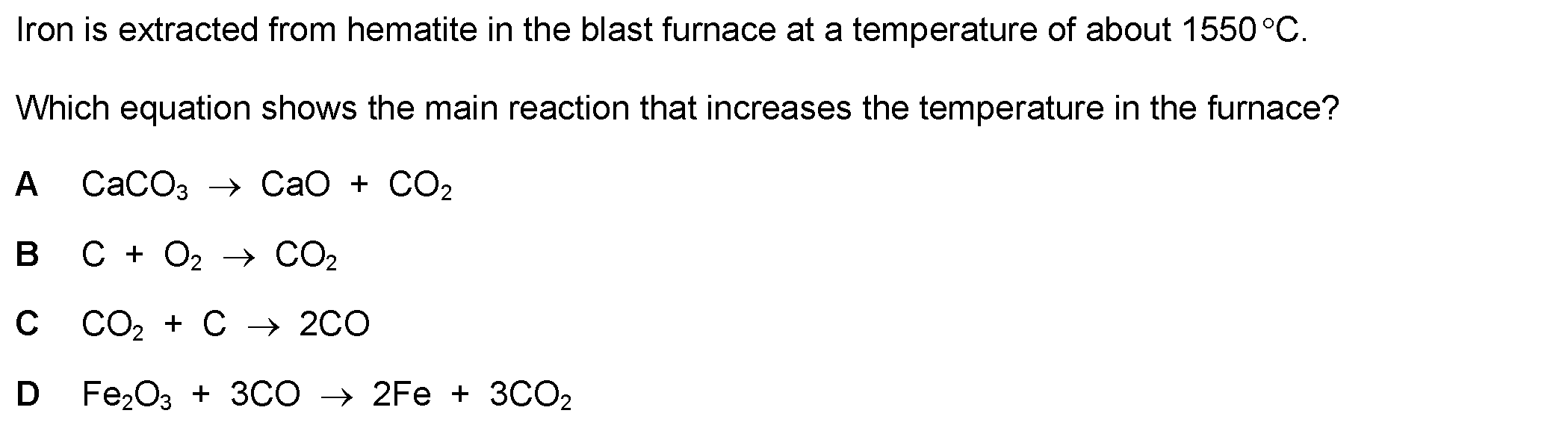
Question 6
0620/11_Summer_2022_Q29
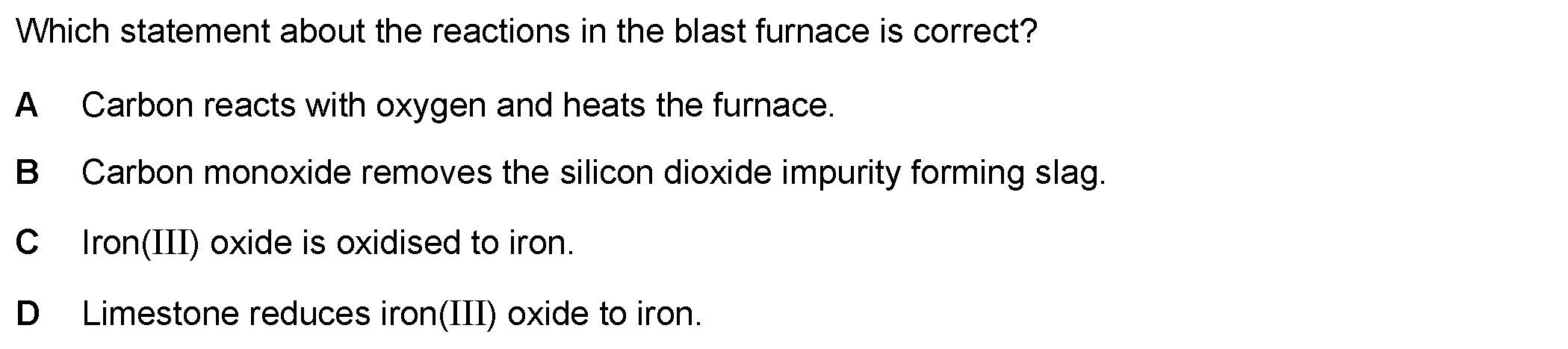
Question 7
0620/21_Summer_2019_Q24
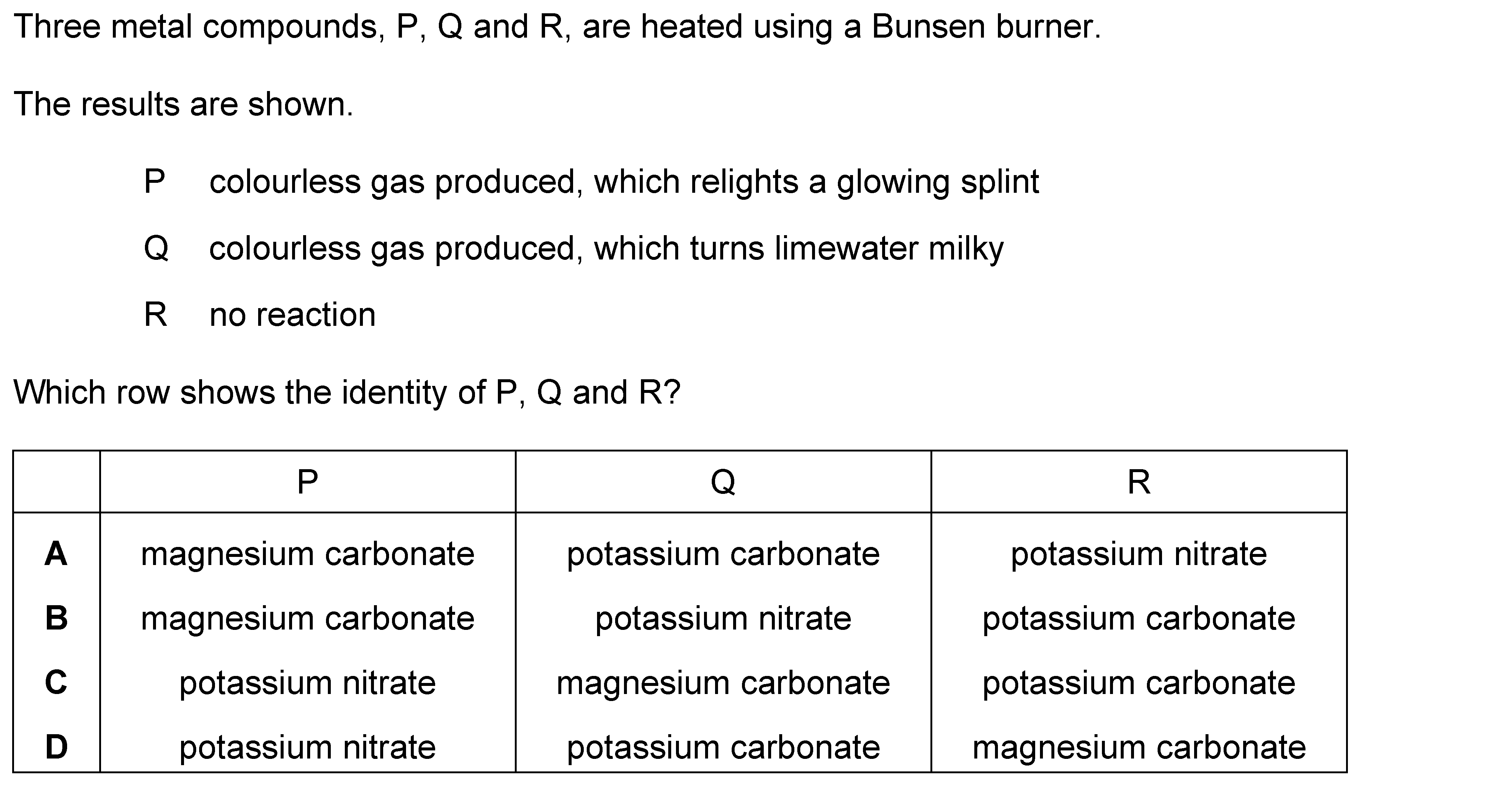
Question 8
5129/11_Winter_2022_Q22
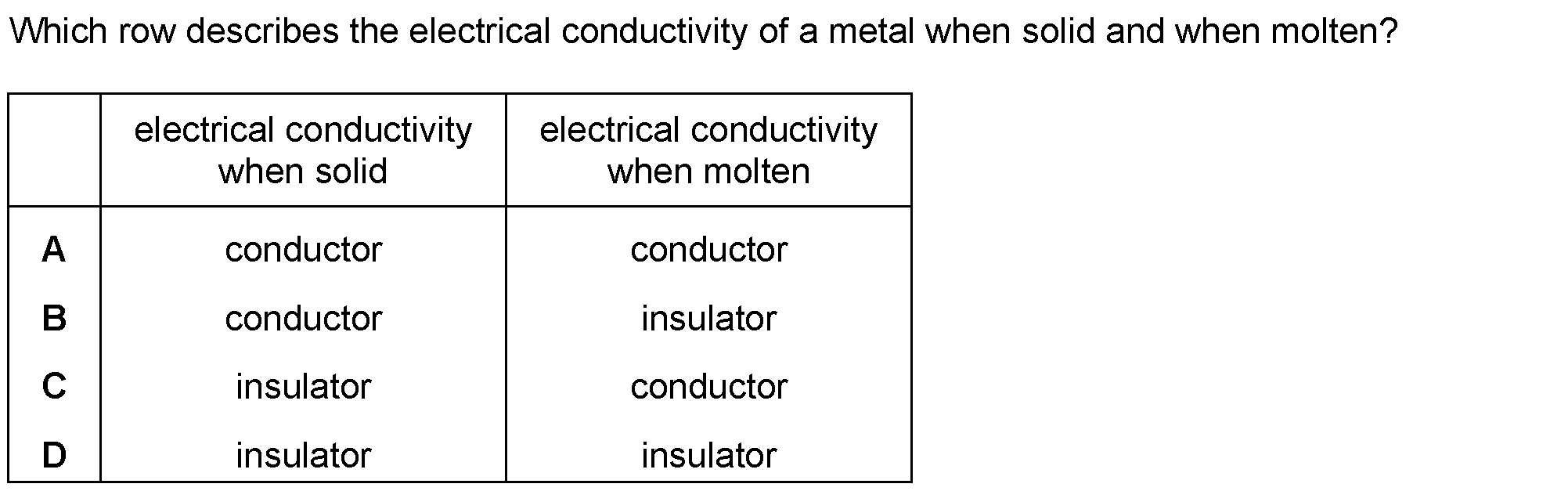
Question 9
0620/23_Summer_2019_Q26
Question 10
0620/12_Winter_2023_Q27
Question 11
0620/11_Winter_2022_Q24
Question 12
0620/21_Summer_2020_Q26
Question 13
0620/21_Winter_2024_Q8
Question 14
0620/23_Summer_2024_Q27
Question 15
0620/21_Winter_2021_Q28
Question 16
0620/22_Summer_2018_Q26
Question 17
0620/22_Summer_2013_Q26
Cambridge Lower Secondary Stage 9
5.2 Using the reactivity series – Complete Question Bank & Mark Scheme
Total Questions17 Questions with Verified Solutions & Past Paper Mark Schemes
Multiple Choice Questions (Exam Practice)
Question 1
Paper Ref: 0620/22_Summer_2014_Q28
Paper Ref: 0620/22_Summer_2014_Q28
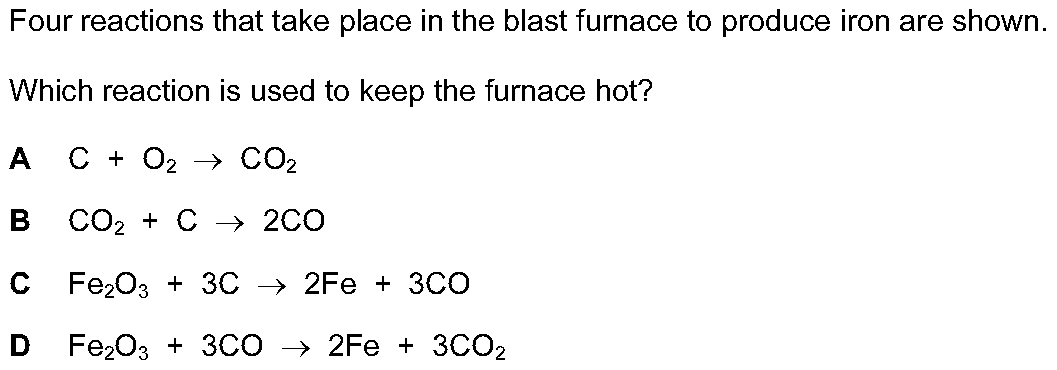
Four reactions that take place in the blast furnace to produce iron are shown.
Which reaction is used to keep the furnace hot?
A C+ Oz > CO;
B COz + C > 2CO
C Fe,03 + 3C > 2Fe + 3CO
D FeO; + 3CO – 2Fe + 3COz
Which reaction is used to keep the furnace hot?
A C+ Oz > CO;
B COz + C > 2CO
C Fe,03 + 3C > 2Fe + 3CO
D FeO; + 3CO – 2Fe + 3COz
Options:
A
B
C
D
Correct Key: A
A
B
C
D
Correct Key: A
Question 2
Paper Ref: 0620/11_Winter_2016_Q25
Paper Ref: 0620/11_Winter_2016_Q25
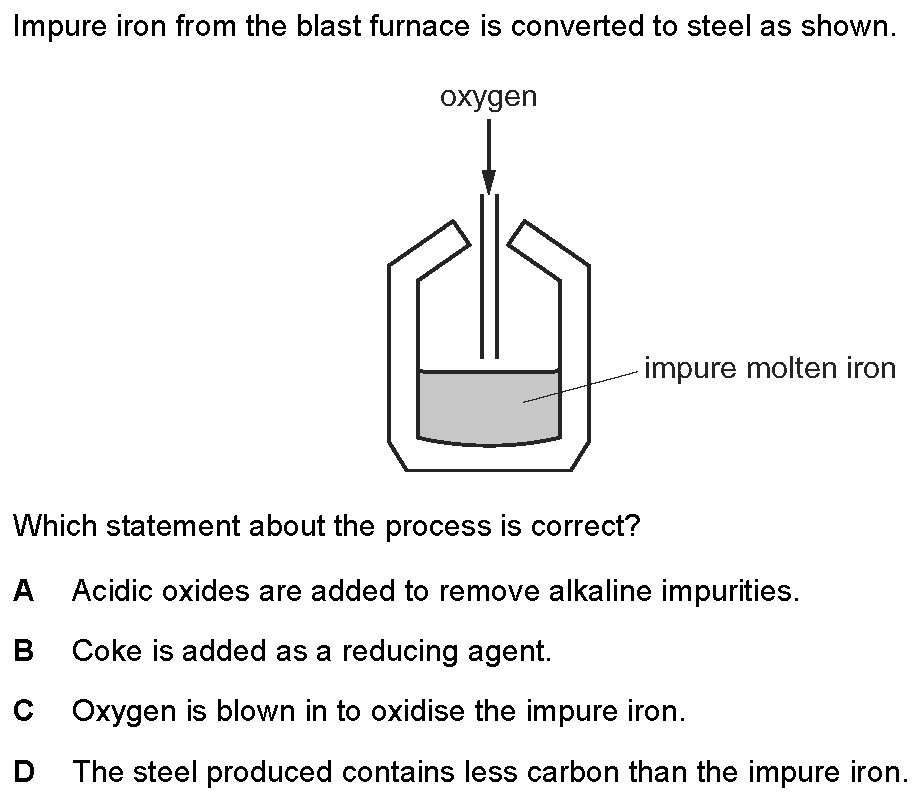
Impure iron from the blast furnace is converted to steel as shown.
oxygen
impure molten iron
Which statement about the process is correct?
A
B
c
D
Acidic oxides are added to remove alkaline impurities.
Coke is added as a reducing agent.
Oxygen is blown in to oxidise the impure iron.
The steel produced contains less carbon than the impure iron.
oxygen
impure molten iron
Which statement about the process is correct?
A
B
c
D
Acidic oxides are added to remove alkaline impurities.
Coke is added as a reducing agent.
Oxygen is blown in to oxidise the impure iron.
The steel produced contains less carbon than the impure iron.
Options:
A
B
C
D
Correct Key: D
A
B
C
D
Correct Key: D
Question 3
Paper Ref: 5129/11_Winter_2020_Q22
Paper Ref: 5129/11_Winter_2020_Q22
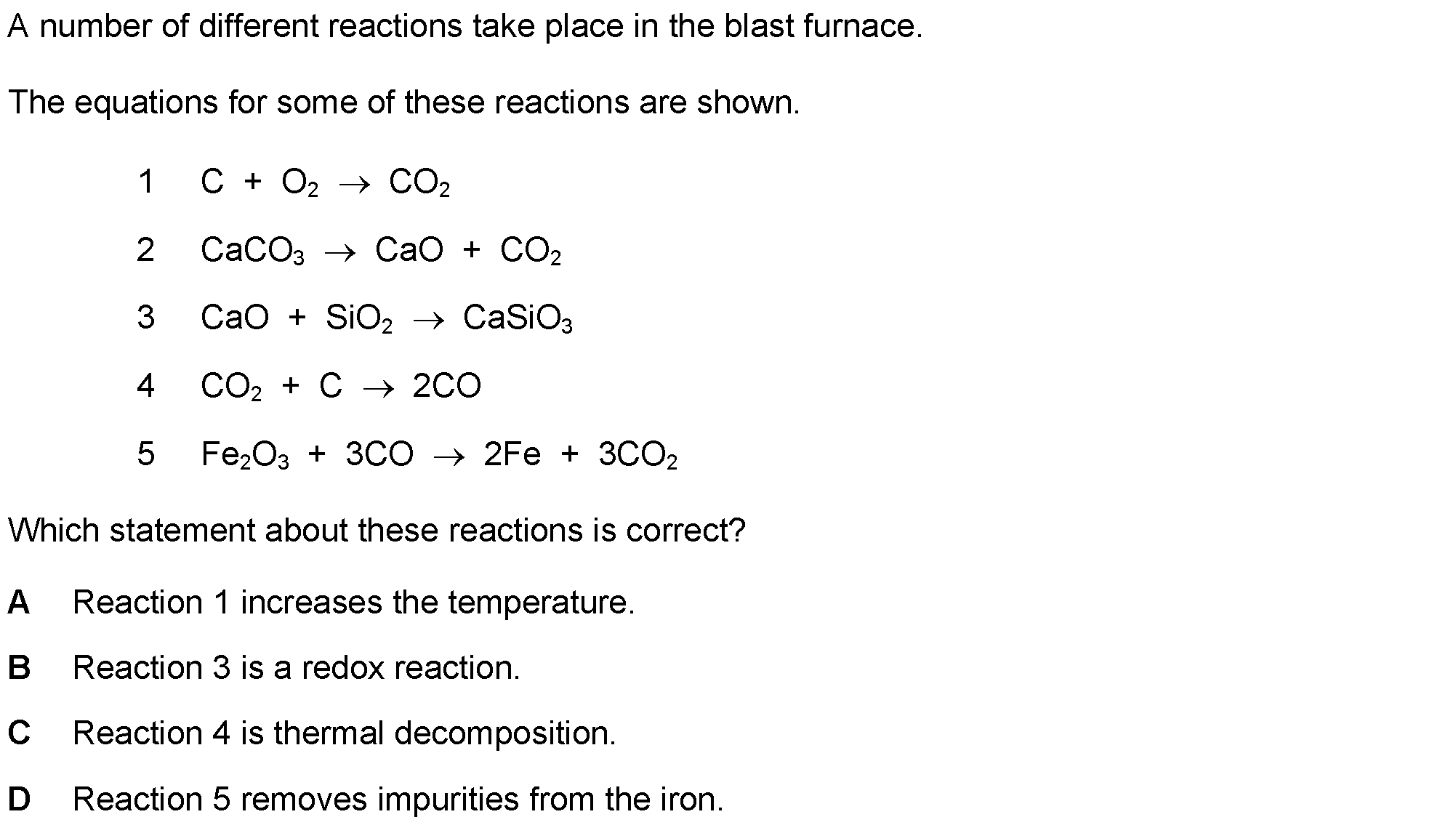
A number of different reactions take place in the blast furnace.
The equations for some of these reactions are shown.
1
2
3
4
5
C + QO. > CO,
CaCOQ3 > CaO + CO,
CaO + SiO. > CaSiO;
CO, + C > 2CO
Fe.O03 + 3CO > 2Fe + 3CQO2
Which statement about these reactions is correct?
A Reaction 1 increases the temperature.
0 OO WW
Reaction 3 is a redox reaction.
Reaction 4 is thermal decomposition.
Reaction 5 removes impurities from the iron.
Options:
A
B
C
D
Correct Key: A
A
B
C
D
Correct Key: A
Question 4
Paper Ref: 0620/13_Winter_2024_Q30
Paper Ref: 0620/13_Winter_2024_Q30
Iron is extracted from its ore in the blast furnace.
Which statement about one of the reactions in the blast furnace is correct?
A Carbon monoxide is reduced to carbon dioxide.
B_Iron(II) oxide is reduced by carbon dioxide.
C Slag is produced when calcium carbonate reacts with carbon dioxide.
D
The reaction that heats the blast furnace produces carbon dioxide.
Options:
A
B
C
D
Correct Key: D
A
B
C
D
Correct Key: D
Question 5
Paper Ref: 0620/12_Summer_2022_Q26
Paper Ref: 0620/12_Summer_2022_Q26
Iron is extracted from hematite in the blast furnace at a temperature of about 1550°C.
Which equation shows the main reaction that increases the temperature in the furnace?
A CaCO; > CaO + CO2
B C+ OQO,—> COQ,
C CQ, + C > 2CO
D Fe,03 + 3CO > 2Fe + 3CO,
Which equation shows the main reaction that increases the temperature in the furnace?
A CaCO; > CaO + CO2
B C+ OQO,—> COQ,
C CQ, + C > 2CO
D Fe,03 + 3CO > 2Fe + 3CO,
Options:
A
B
C
D
Correct Key: B
A
B
C
D
Correct Key: B
Question 6
Paper Ref: 0620/11_Summer_2022_Q29
Paper Ref: 0620/11_Summer_2022_Q29
Which statement about the reactions in the blast furnace is correct?
A_ Carbon reacts with oxygen and heats the furnace.
Carbon monoxide removes the silicon dioxide impurity forming slag.
lron(III) oxide is oxidised to iron.
0 OO WW
Limestone reduces iron(II) oxide to iron.
A_ Carbon reacts with oxygen and heats the furnace.
Carbon monoxide removes the silicon dioxide impurity forming slag.
lron(III) oxide is oxidised to iron.
0 OO WW
Limestone reduces iron(II) oxide to iron.
Options:
A
B
C
D
Correct Key: A
A
B
C
D
Correct Key: A
Question 7
Paper Ref: 0620/21_Summer_2019_Q24
Paper Ref: 0620/21_Summer_2019_Q24
Three metal compounds, P, Q and R, are heated using a Bunsen burner.
The results are shown.
P colourless gas produced, which relights a glowing splint
Q_ colourless gas produced, which turns limewater milky
R noreaction
Which row shows the identity of P, @ and R?
magnesium carbonate potassium carbonate potassium nitrate
magnesium carbonate potassium nitrate potassium carbonate
potassium nitrate magnesium carbonate potassium carbonate
potassium nitrate potassium carbonate magnesium carbonate
Options:
A
B
C
D
Correct Key: C
A
B
C
D
Correct Key: C
Question 8
Paper Ref: 5129/11_Winter_2022_Q22
Paper Ref: 5129/11_Winter_2022_Q22
Which row describes the electrical conductivity of a metal when solid and when molten?
electrical conductivity electrical conductivity
when solid when molten
conductor conductor
conductor insulator
insulator conductor
insulator insulator
electrical conductivity electrical conductivity
when solid when molten
conductor conductor
conductor insulator
insulator conductor
insulator insulator
Options:
A
B
C
D
Correct Key: A
A
B
C
D
Correct Key: A
Question 9
Paper Ref: 0620/23_Summer_2019_Q26
Paper Ref: 0620/23_Summer_2019_Q26
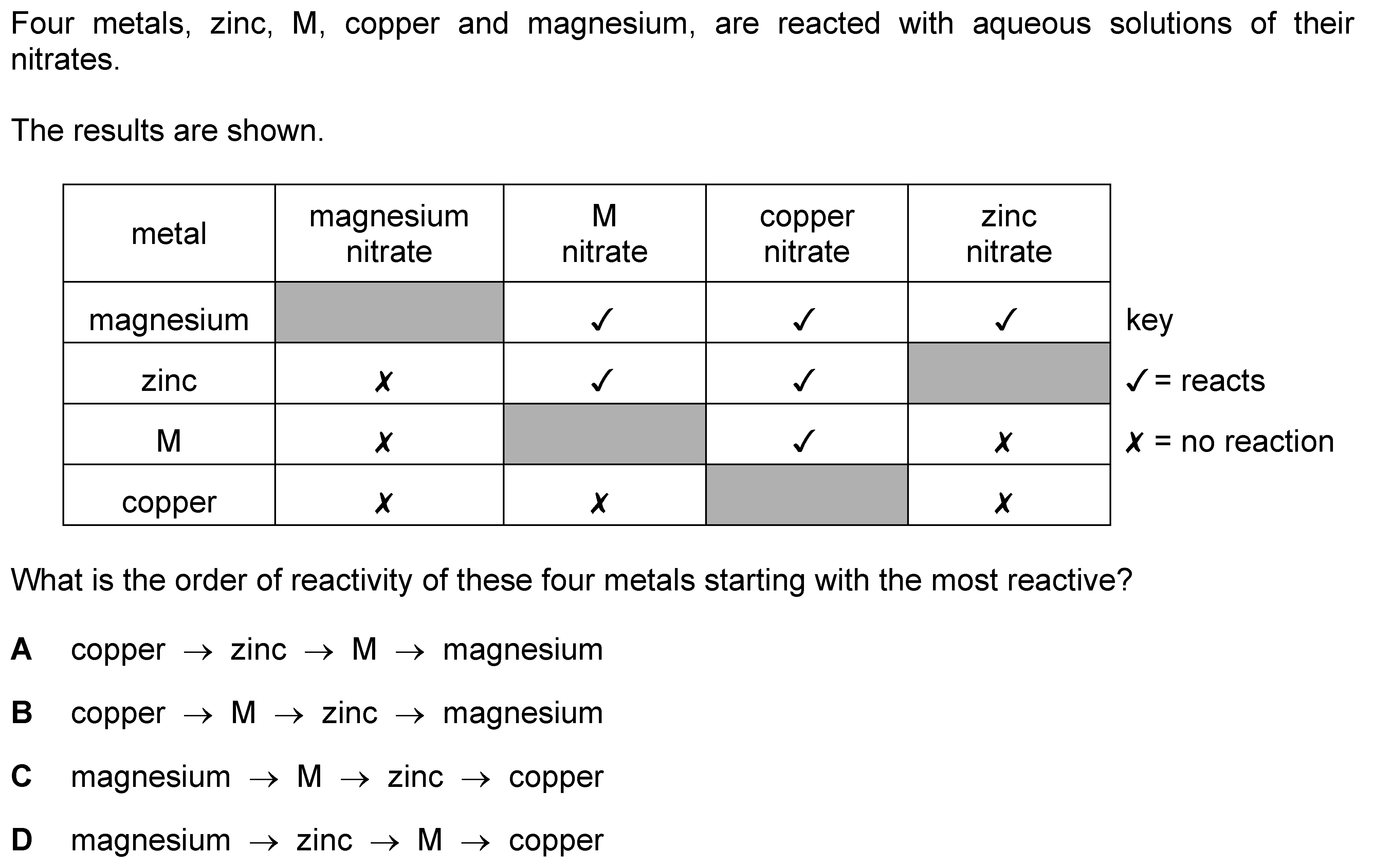
Four metals, zinc, M, copper and magnesium, are reacted with aqueous solutions of their
nitrates.
The results are shown.
magnesium M copper ZINC
metal
nitrate nitrate nitrate nitrate
-magnesium | | ov | Key
copper | x | x |
What is the order of reactivity of these four metals starting with the most reactive?
A copper —> zinc —~ M —+ magnesium
B copper — M — zinc + magnesium
C magnesium > M — zinc > copper
D
magnesium — zinc + M — copper
Options:
A
B
C
D
Correct Key: D
A
B
C
D
Correct Key: D
Question 10
Paper Ref: 0620/12_Winter_2023_Q27
Paper Ref: 0620/12_Winter_2023_Q27
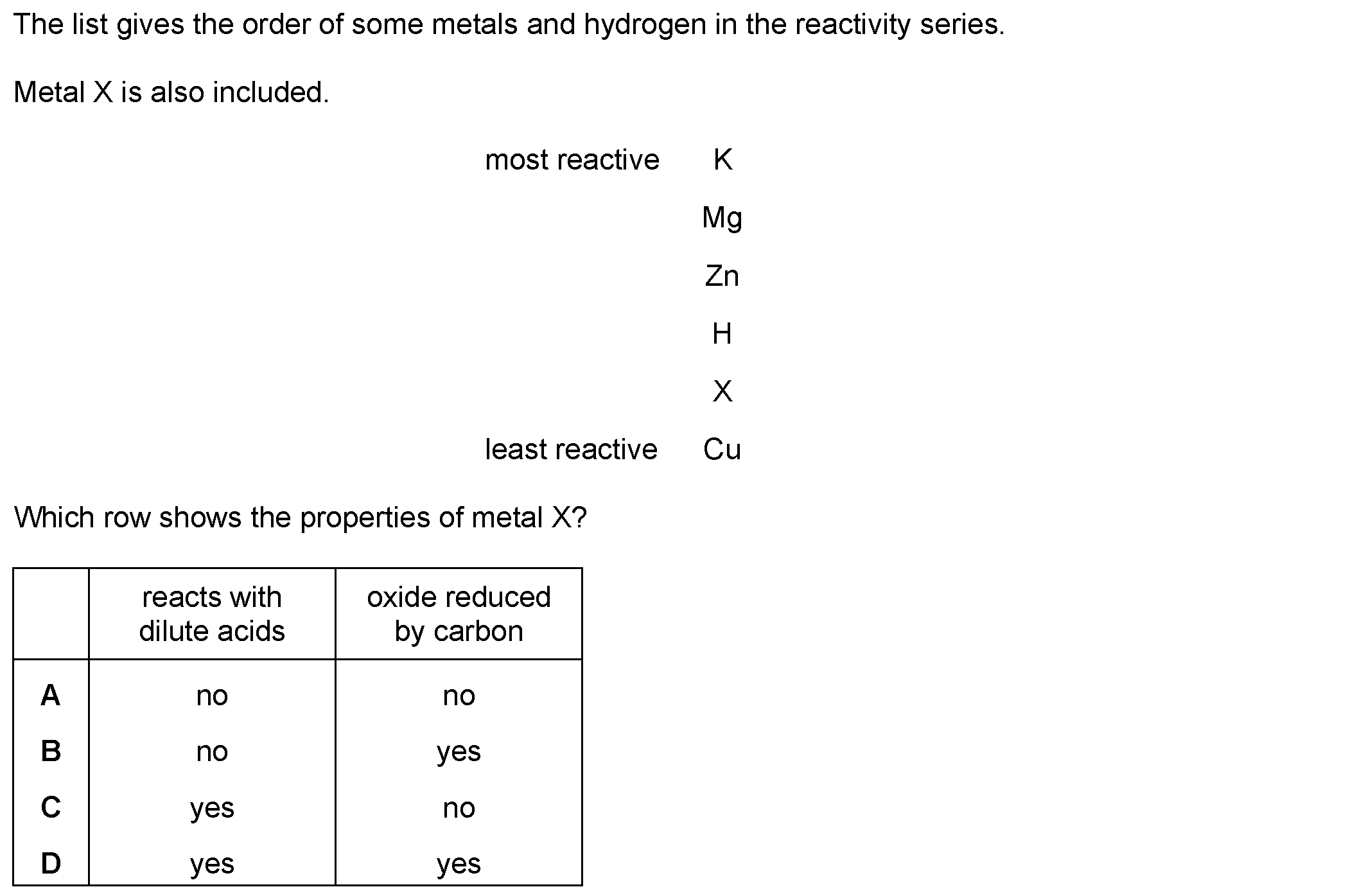
The list gives the order of some metals and hydrogen in the reactivity series.
Metal X is also included.
most reactive K
least reactive Cu
Which row shows the properties of metal X?
reacts with oxide reduced
dilute acids by carbon
Metal X is also included.
most reactive K
least reactive Cu
Which row shows the properties of metal X?
reacts with oxide reduced
dilute acids by carbon
Options:
A
B
C
D
Correct Key: B
A
B
C
D
Correct Key: B
Question 11
Paper Ref: 0620/11_Winter_2022_Q24
Paper Ref: 0620/11_Winter_2022_Q24
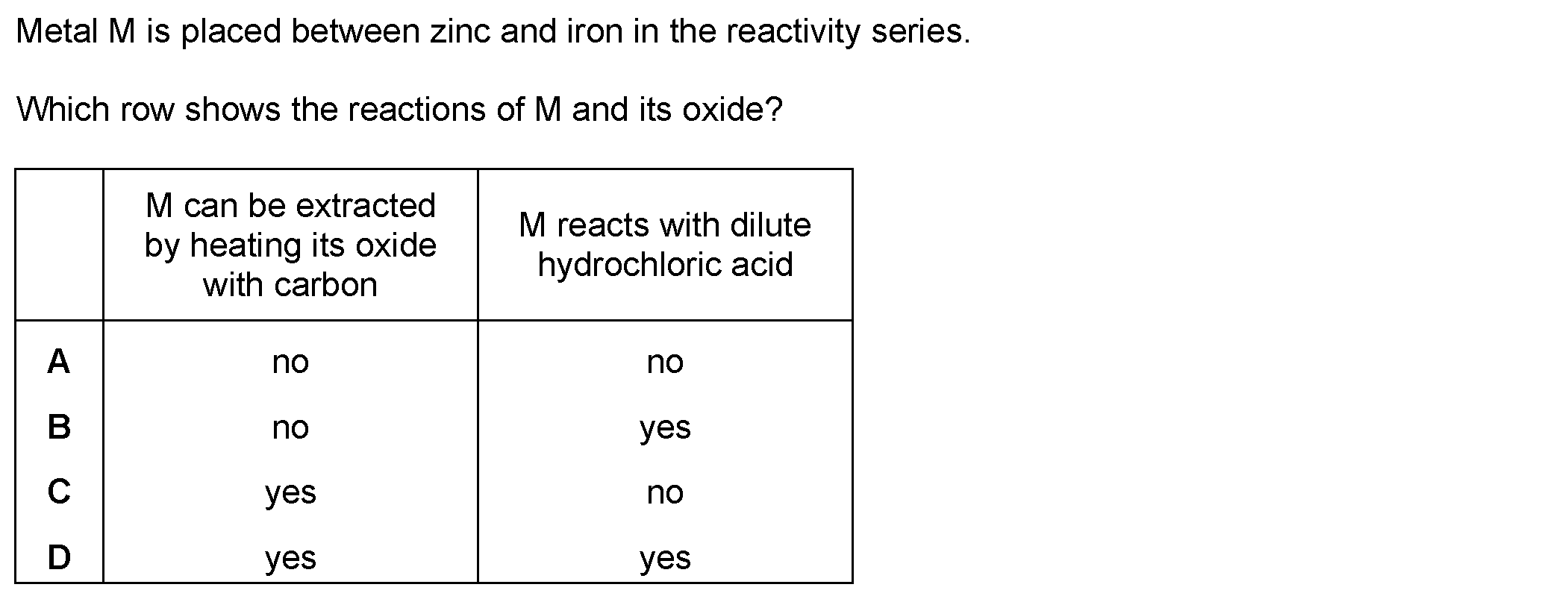
Metal M is placed between zinc and iron in the reactivity series.
Which row shows the reactions of M and its oxide?
M can be extracted
by heating its oxide
with carbon
M reacts with dilute
hydrochloric acid
Which row shows the reactions of M and its oxide?
M can be extracted
by heating its oxide
with carbon
M reacts with dilute
hydrochloric acid
Options:
A
B
C
D
Correct Key: D
A
B
C
D
Correct Key: D
Question 12
Paper Ref: 0620/21_Summer_2020_Q26
Paper Ref: 0620/21_Summer_2020_Q26
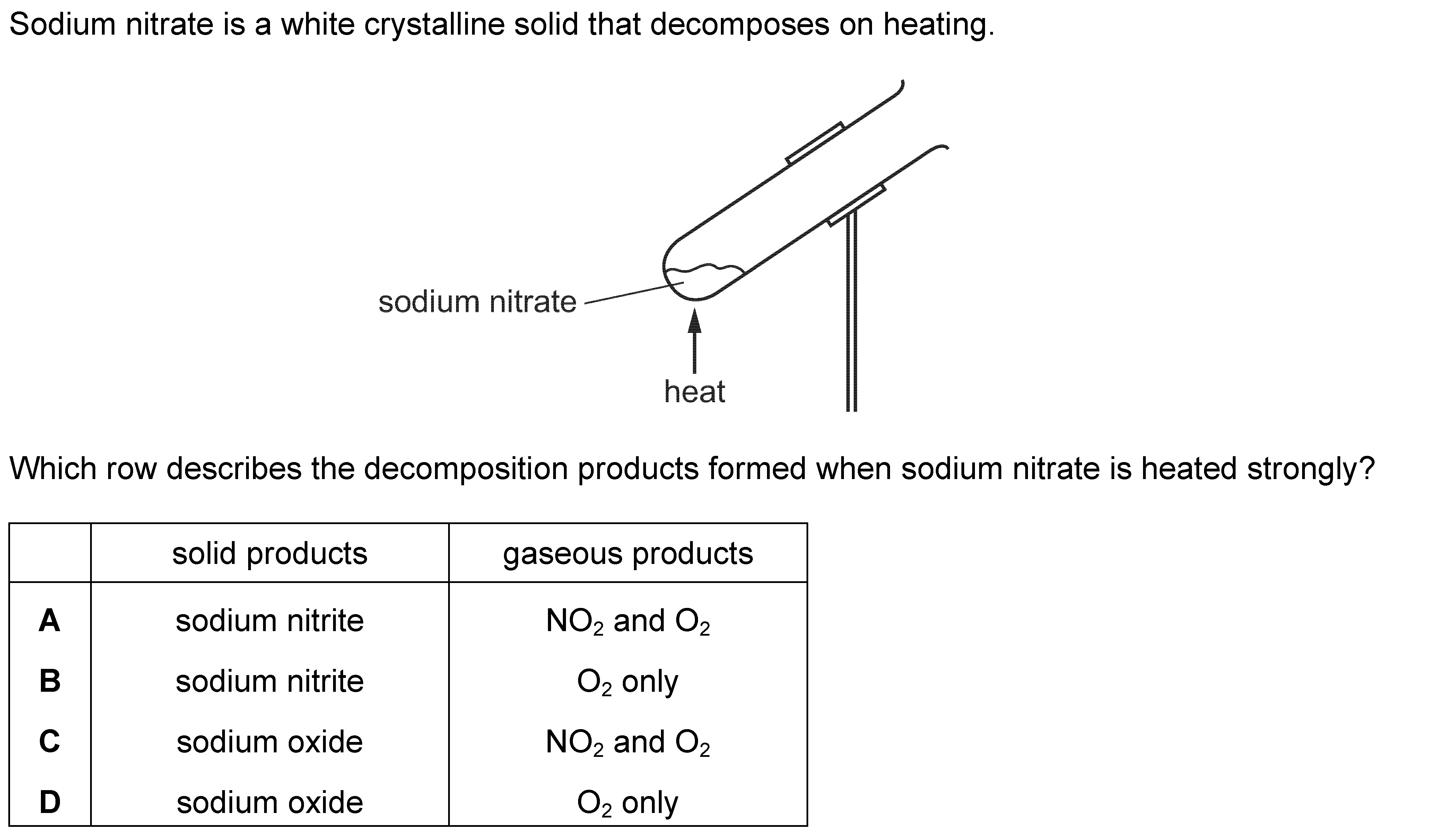
Sodium nitrate is a white crystalline solid that decomposes on heating.
sodium nitrate
heat
Which row describes the decomposition products formed when sodium nitrate is heated strongly?
— solid products gaseous products
sodium nitrite NO, and Oz
sodium nitrite Oz only
sodium oxide NO. and Oz
sodium oxide Oz only
sodium nitrate
heat
Which row describes the decomposition products formed when sodium nitrate is heated strongly?
— solid products gaseous products
sodium nitrite NO, and Oz
sodium nitrite Oz only
sodium oxide NO. and Oz
sodium oxide Oz only
Options:
A
B
C
D
Correct Key: B
A
B
C
D
Correct Key: B
Question 13
Paper Ref: 0620/21_Winter_2024_Q8
Paper Ref: 0620/21_Winter_2024_Q8
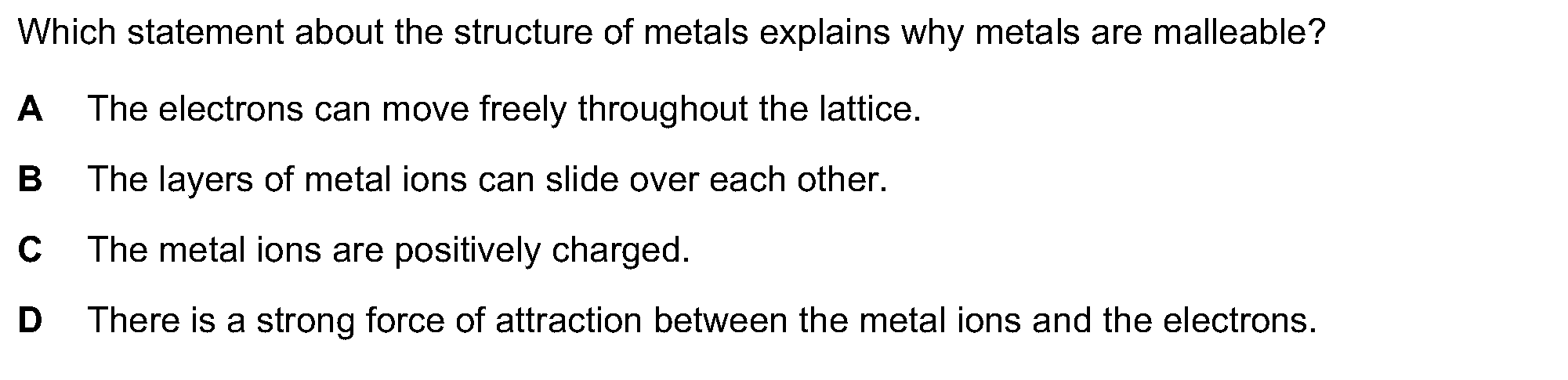
Which statement about the structure of metals explains why metals are malleable?
A
B
Cc
D
The electrons can move freely throughout the lattice.
The layers of metal ions can slide over each other.
The metal ions are positively charged.
There is a strong force of attraction between the metal ions and the electrons.
A
B
Cc
D
The electrons can move freely throughout the lattice.
The layers of metal ions can slide over each other.
The metal ions are positively charged.
There is a strong force of attraction between the metal ions and the electrons.
Options:
A
B
C
D
Correct Key: B
A
B
C
D
Correct Key: B
Question 14
Paper Ref: 0620/23_Summer_2024_Q27
Paper Ref: 0620/23_Summer_2024_Q27
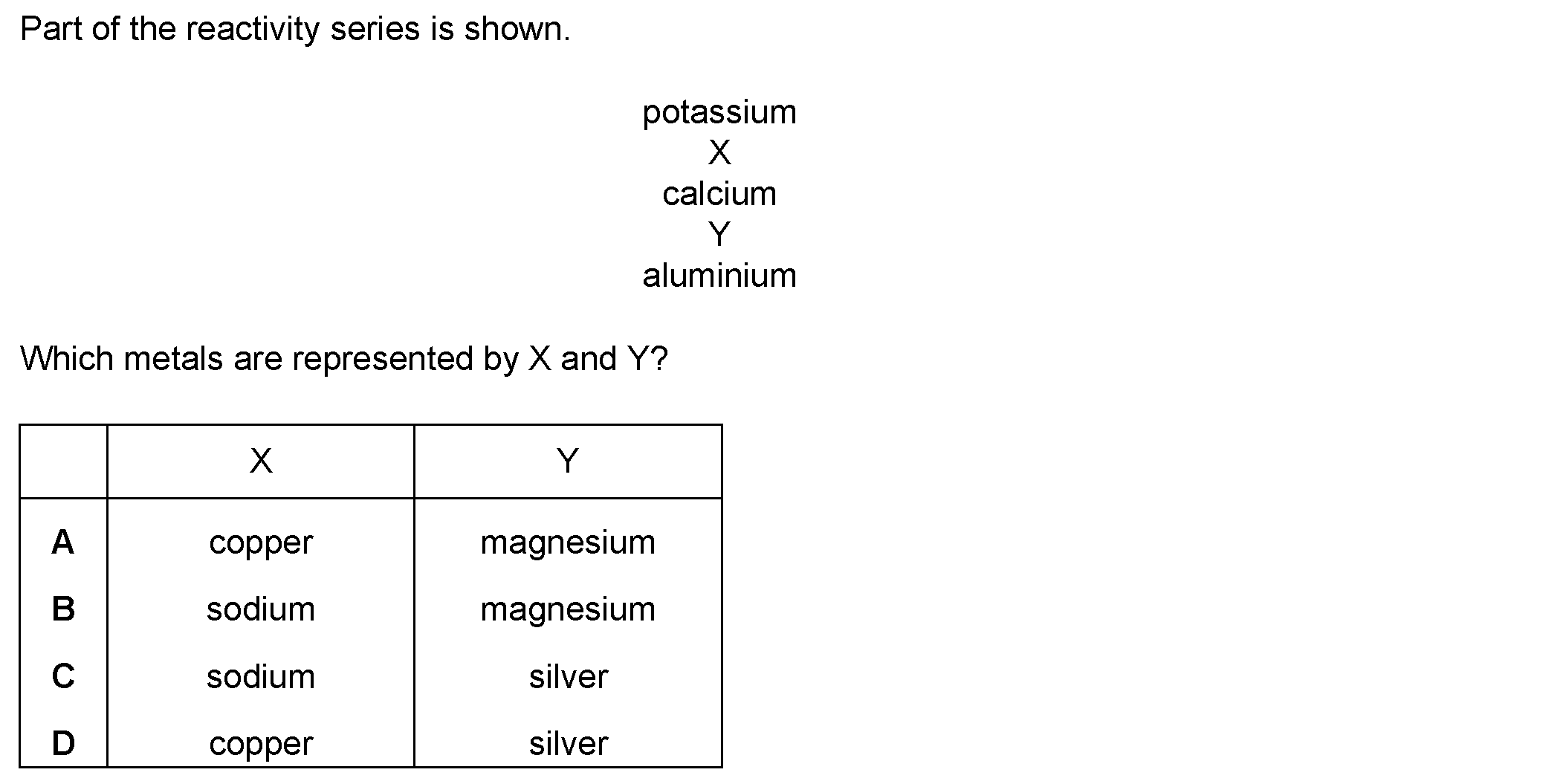
Part of the reactivity series is shown.
potassium
Xx
calcium
Y
aluminium
Which metals are represented by X and Y?
copper magnesium
sodium magnesium
sodium silver
copper silver
potassium
Xx
calcium
Y
aluminium
Which metals are represented by X and Y?
copper magnesium
sodium magnesium
sodium silver
copper silver
Options:
A
B
C
D
Correct Key: B
A
B
C
D
Correct Key: B
Question 15
Paper Ref: 0620/21_Winter_2021_Q28
Paper Ref: 0620/21_Winter_2021_Q28
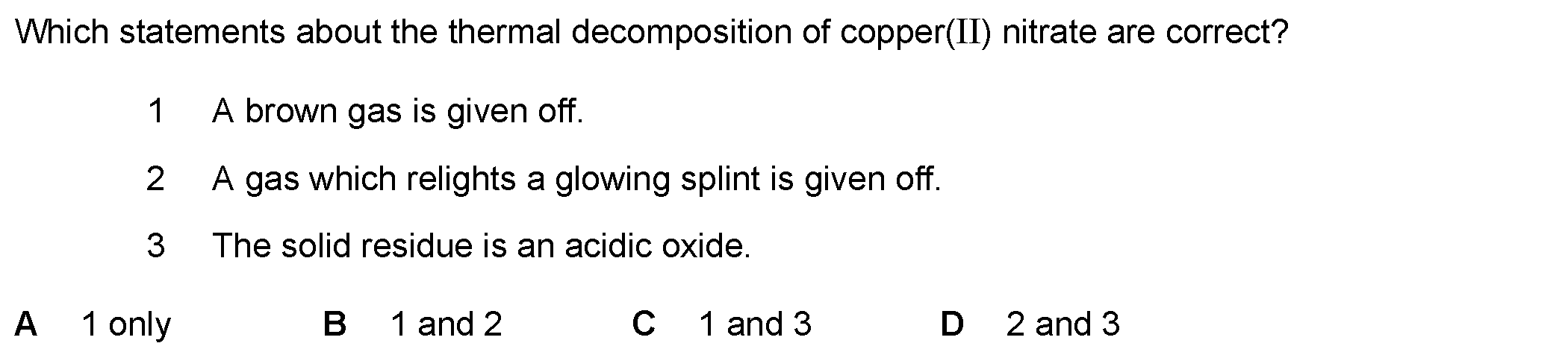
Which statements about the thermal decomposition of copper(II) nitrate are correct?
1 A brown gas is given off.
2 Agas which relights a glowing splint is given off.
3 The solid residue is an acidic oxide.
A 1only B iand2 C 1and3 D 2and3
1 A brown gas is given off.
2 Agas which relights a glowing splint is given off.
3 The solid residue is an acidic oxide.
A 1only B iand2 C 1and3 D 2and3
Options:
A
B
C
D
Correct Key: B
A
B
C
D
Correct Key: B
Question 16
Paper Ref: 0620/22_Summer_2018_Q26
Paper Ref: 0620/22_Summer_2018_Q26
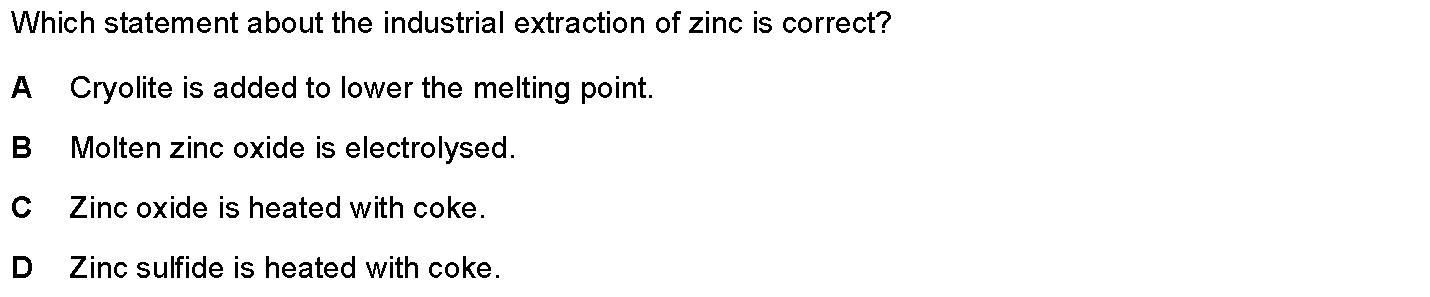
Which statement about the industrial extraction of zinc is correct?
A Cryolite is added to lower the melting point.
Molten zinc oxide is electrolysed.
Zinc oxide is heated with coke.
0 9 DW
Zinc sulfide is heated with coke.
A Cryolite is added to lower the melting point.
Molten zinc oxide is electrolysed.
Zinc oxide is heated with coke.
0 9 DW
Zinc sulfide is heated with coke.
Options:
A
B
C
D
Correct Key: C
A
B
C
D
Correct Key: C
Question 17
Paper Ref: 0620/22_Summer_2013_Q26
Paper Ref: 0620/22_Summer_2013_Q26
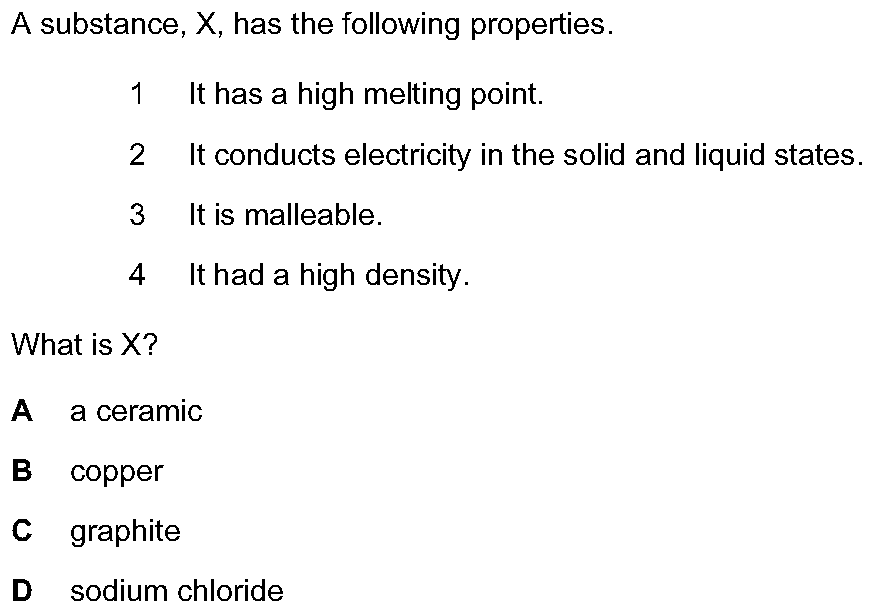
A substance, X, has the following properties.
1 It has a high melting point.
2 It conducts electricity in the solid and liquid states.
3 Itis malleable.
4 Ithad a high density.
What is X?
A aceramic
B copper
C graphite
D
sodium chloride
1 It has a high melting point.
2 It conducts electricity in the solid and liquid states.
3 Itis malleable.
4 Ithad a high density.
What is X?
A aceramic
B copper
C graphite
D
sodium chloride
Options:
A
B
C
D
Correct Key: B
A
B
C
D
Correct Key: B
Structured Questions Mark Scheme & Answers
•1•.• • • •[•▍• •C•P• •M•a•r•c•h• •2•0•2•6• •P•2• • •·• • •Q•2• • •P•a•r•t• •(•b•)• • •·• • •2•0•2•6• • •·• • •L•o•w•e•r• •S•e•c• •0•8•9•3•]• • • • • • •S•i•l•v•e•r• •n•i•t•r•a•t•e• •i•s• •m•o•r•e• •r•e•a•c•t•i•v•e• •t•h•a•n• •m•a•g•n•e•s•i•u•m• •n•i•t•r•a•t•e•.• •1• •m•o•r•e• •t•h•a•n• •o•n•e• •a•n•s•w•e•r• •t•i•c•k•e•d• •=• •0• •m•a•r•k•s• •••c•c•e•p•t• •a•n•y• •i•n•d•i•c•a•t•i•o•n• •o•f• •t•h•e• •c•o•r•r•e•c•t• •a•n•s•w•e•r•,• •S•i•l•v•e•r• •i•s• •m•o•r•e• •r•e•a•c•t•i•v•e• •t•h•a•n• •m•a•g•n•e•s•i•u•m•.• •e•.•g•.• •c•i•r•c•l•i•n•g• •o•r• •u•n•d•e•r•l•i•n•i•n•g•,• •b•u•t• •t•i•c•k•i•n•g• •t•a•k•e•s• •p•r•e•c•e•d•e•n•c•e• •M•a•g•n•e•s•i•u•m• •i•s• •m•o•r•e• •r•e•a•c•t•i•v•e• •t•h•a•n• •s•i•l•v•e•r•.• •• •M•a•g•n•e•s•i•u•m• •n•i•t•r•a•t•e• •i•s• •m•o•r•e• •r•e•a•c•t•i•v•e• •t•h•a•n• •s•i•l•v•e•r• •n•i•t•r•a•t•e•.•
•2•.• • • •[•▍• •P•T• •S•7• •2•0•2•0• •P•2• • •·• • •Q•3• • •P•a•r•t• •(•a•)• • •·• • •2•0•2•0• • •·• • •L•o•w•e•r• •S•e•c• •s•o•u•r•c•e• •a•d•d•i•t•i•o•n•]• • • • • • •N•o• •m•a•t•c•h•i•n•g• •m•a•r•k•-•s•c•h•e•m•e• •e•n•t•r•y• •w•a•s• •f•o•u•n•d• •i•n• •M•a•r•k•_•S•c•h•e•m•e•s•.•d•o•c•x•.•
Last updated:
\n