5.1Motion, Forces and Energy
The structure of the atom — Question Bank (Cambridge) — Cambridge IGCSE Physics 0625 Revision Notes & Topical Questions
15 min read Lesson 41 of 91 Unit quiz
Cambridge Past Paper Bank
5.1 The structure of the atom
16 Multiple-Choice Questions with Official Mark Schemes
Question 1
0620/23_Summer_2020_Q4
Question 2
0620/21_Summer_2015_Q3
Question 3
0620/11_Winter_2024_Q3

Question 4
0620/23_Winter_2025_Q3
Question 5
0620/12_Summer_2016_Q6
Question 6
0620/22_Winter_2010_Q9
Question 7
0620/13_Winter_2023_Q3
Question 8
5129/12_Winter_2021_Q15
Question 9
5129/11_Winter_2024_Q15
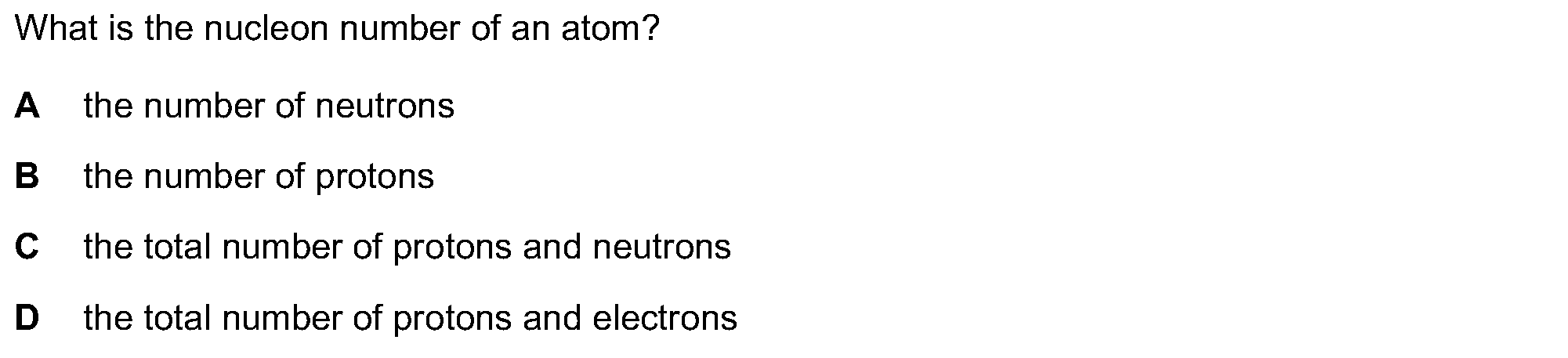
Question 10
0620/13_Winter_2024_Q4
Question 11
5129/11_Summer_2023_Q15
Question 12
0620/11_Summer_2022_Q7
Question 13
0620/22_Summer_2022_Q22
Question 14
0620/13_Summer_2018_Q4
Question 15
0620/21_Summer_2011_Q24
Question 16
5129/12_Winter_2022_Q16
Cambridge Lower Secondary Stage 8
5.1 The structure of the atom – Complete Question Bank & Mark Scheme
Total Questions16 Questions with Verified Solutions & Past Paper Mark Schemes
Multiple Choice Questions (Exam Practice)
Question 1
Paper Ref: 0620/23_Summer_2020_Q4
Paper Ref: 0620/23_Summer_2020_Q4
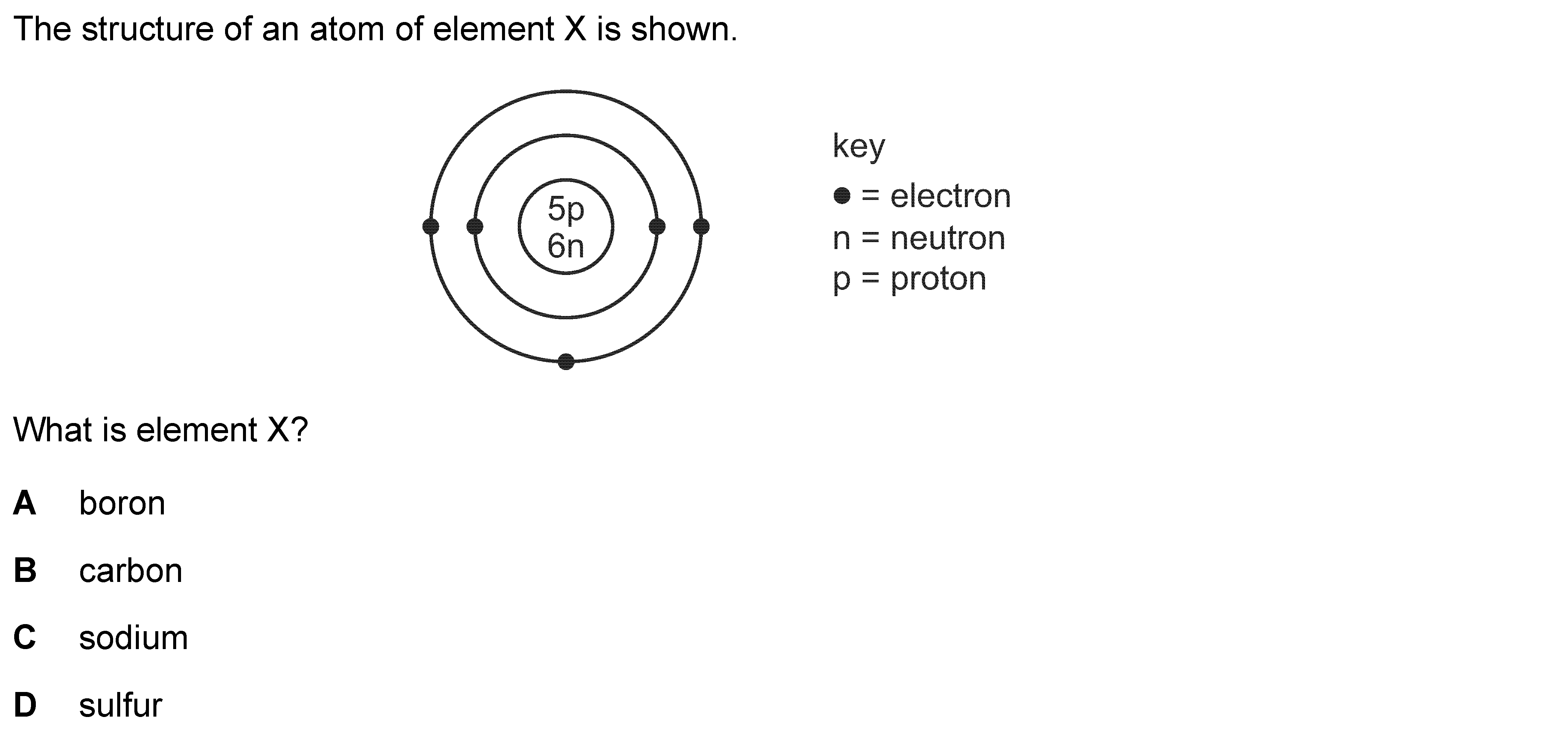
The structure of an atom of element X is shown.
key
@ = electron
n = neutron
p = proton
What is element X?
A boron
B carbon
C sodium
D sulfur
key
@ = electron
n = neutron
p = proton
What is element X?
A boron
B carbon
C sodium
D sulfur
Options:
A
B
C
D
Correct Key: A
A
B
C
D
Correct Key: A
Question 2
Paper Ref: 0620/21_Summer_2015_Q3
Paper Ref: 0620/21_Summer_2015_Q3
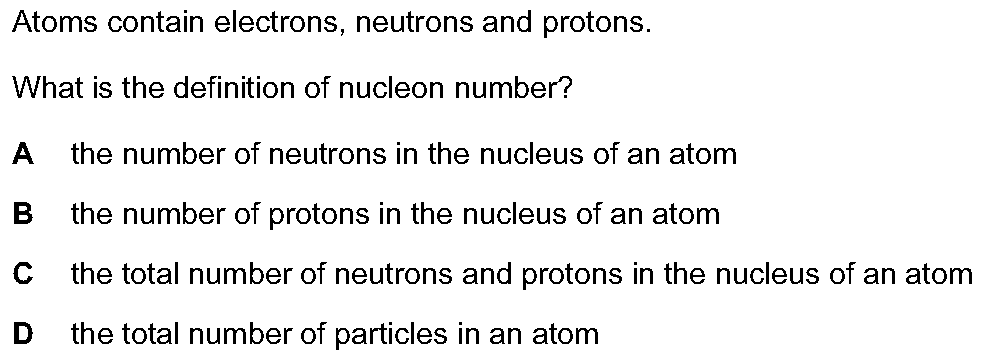
Atoms contain electrons, neutrons and protons.
What is the definition of nucleon number?
oo BD
the number of neutrons in the nucleus of an atom
the number of protons in the nucleus of an atom
the total number of neutrons and protons in the nucleus of an atom
the total number of particles in an atom
What is the definition of nucleon number?
oo BD
the number of neutrons in the nucleus of an atom
the number of protons in the nucleus of an atom
the total number of neutrons and protons in the nucleus of an atom
the total number of particles in an atom
Options:
A
B
C
D
Correct Key: C
A
B
C
D
Correct Key: C
Question 3
Paper Ref: 0620/11_Winter_2024_Q3
Paper Ref: 0620/11_Winter_2024_Q3
One atom of an element contains 12 electrons, 12 protons and 13 neutrons.
How many nucleons does this atom contain?
A 12 B 13 C 24 D 25
How many nucleons does this atom contain?
A 12 B 13 C 24 D 25
Options:
A
B
C
D
Correct Key: D
A
B
C
D
Correct Key: D
Question 4
Paper Ref: 0620/23_Winter_2025_Q3
Paper Ref: 0620/23_Winter_2025_Q3
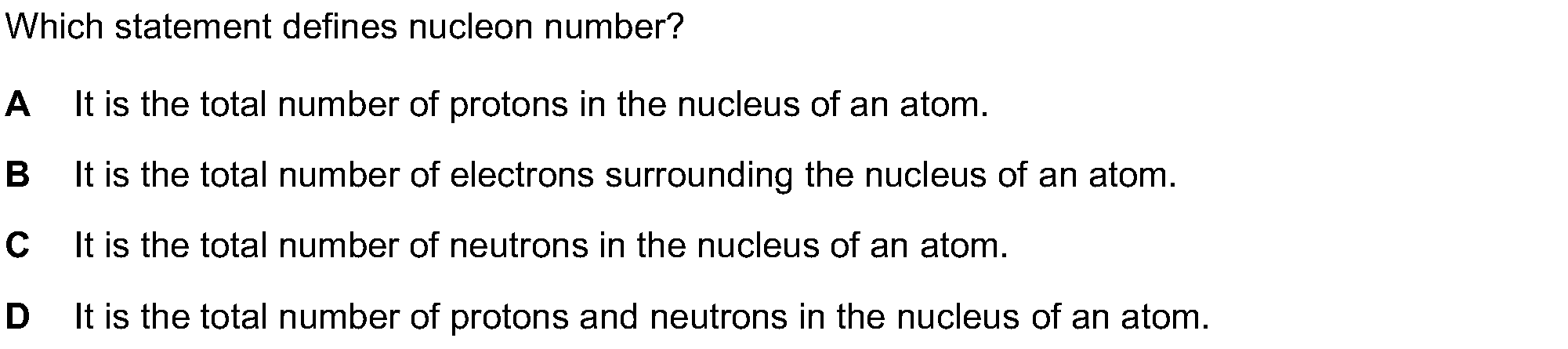
Which statement defines nucleon number?
A
B
Cc
D
It is the total number of protons in the nucleus of an atom.
It is the total number of electrons surrounding the nucleus of an atom.
It is the total number of neutrons in the nucleus of an atom.
It is the total number of protons and neutrons in the nucleus of an atom.
A
B
Cc
D
It is the total number of protons in the nucleus of an atom.
It is the total number of electrons surrounding the nucleus of an atom.
It is the total number of neutrons in the nucleus of an atom.
It is the total number of protons and neutrons in the nucleus of an atom.
Options:
A
B
C
D
Correct Key: D
A
B
C
D
Correct Key: D
Question 5
Paper Ref: 0620/12_Summer_2016_Q6
Paper Ref: 0620/12_Summer_2016_Q6
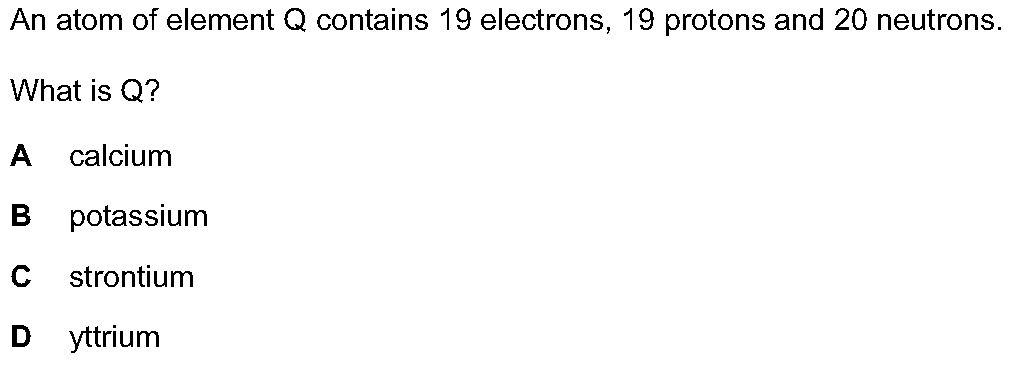
An atom of element Q contains 19 electrons, 19 protons and 20 neutrons.
What is Q?
A calcium
B potassium
C – strontium
D- yttrium
What is Q?
A calcium
B potassium
C – strontium
D- yttrium
Options:
A
B
C
D
Correct Key: B
A
B
C
D
Correct Key: B
Question 6
Paper Ref: 0620/22_Winter_2010_Q9
Paper Ref: 0620/22_Winter_2010_Q9
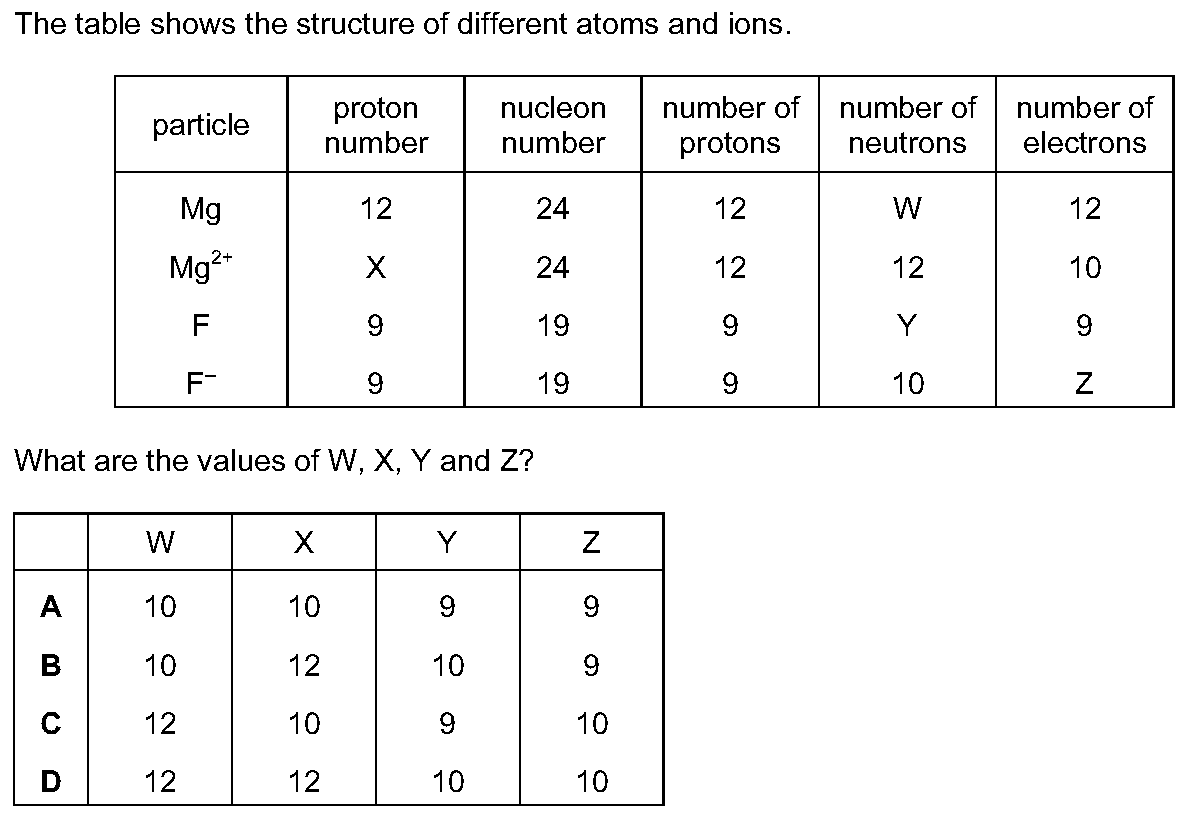
The table shows the structure of different atoms and ions.
. proton nucleon number of | number of | number of
particle
number number protons neutrons electrons
Mg 12 24 12 Ww 12
Mg?" Xx 24 12 12 10
F 9 19 9 Y 9
F− 9 19 9 10 Z
oo wD >
10
10
12
12
10
12
10
12
. proton nucleon number of | number of | number of
particle
number number protons neutrons electrons
Mg 12 24 12 Ww 12
Mg?" Xx 24 12 12 10
F 9 19 9 Y 9
F− 9 19 9 10 Z
oo wD >
10
10
12
12
10
12
10
12
Options:
A
B
C
D
Correct Key: D
A
B
C
D
Correct Key: D
Question 7
Paper Ref: 0620/13_Winter_2023_Q3
Paper Ref: 0620/13_Winter_2023_Q3
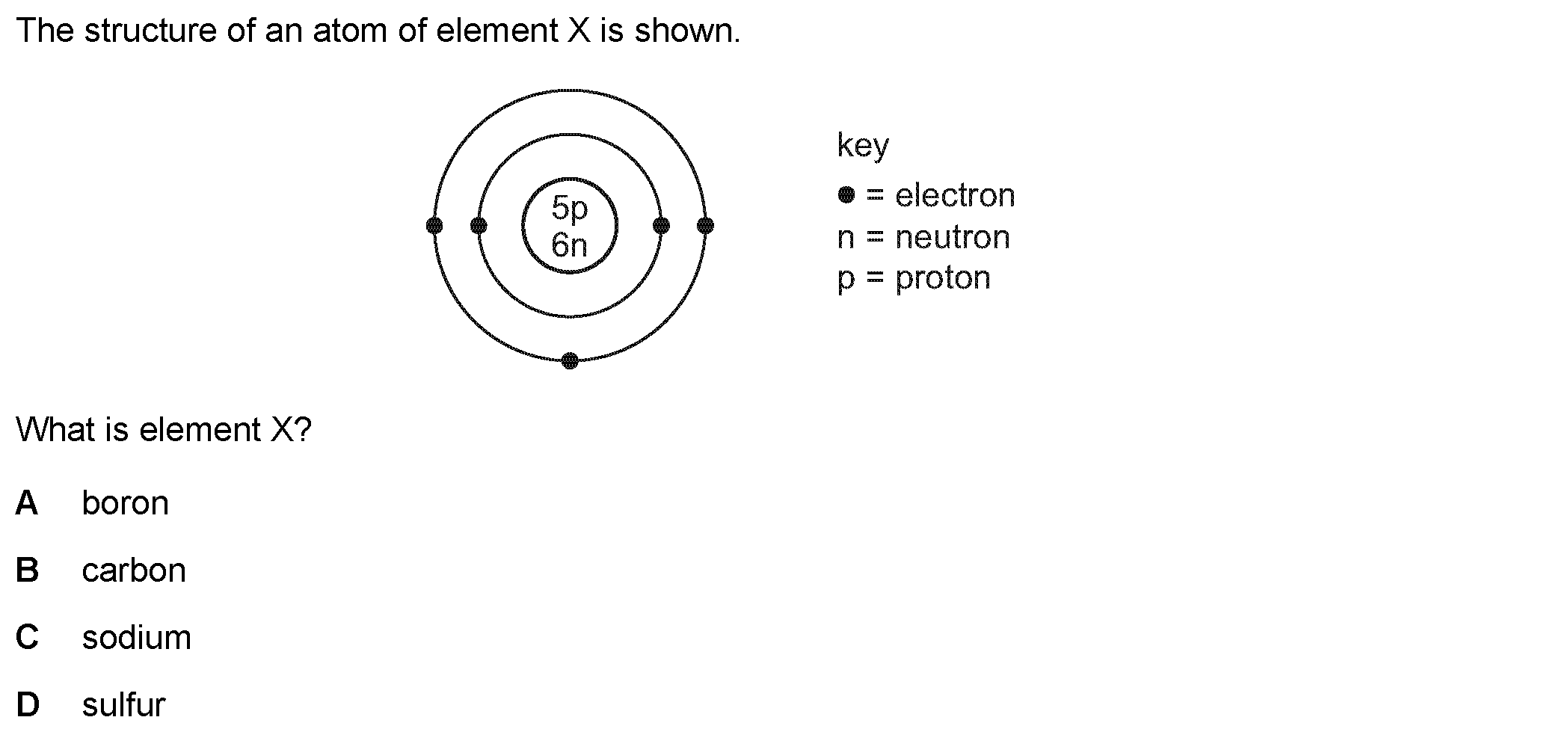
The structure of an atom of element X is shown.
key
@ = electron
n = neutron
p = proton
What is element X?
boron
B carbon
C sodium
D — sulfur
key
@ = electron
n = neutron
p = proton
What is element X?
boron
B carbon
C sodium
D — sulfur
Options:
A
B
C
D
Correct Key: A
A
B
C
D
Correct Key: A
Question 8
Paper Ref: 5129/12_Winter_2021_Q15
Paper Ref: 5129/12_Winter_2021_Q15
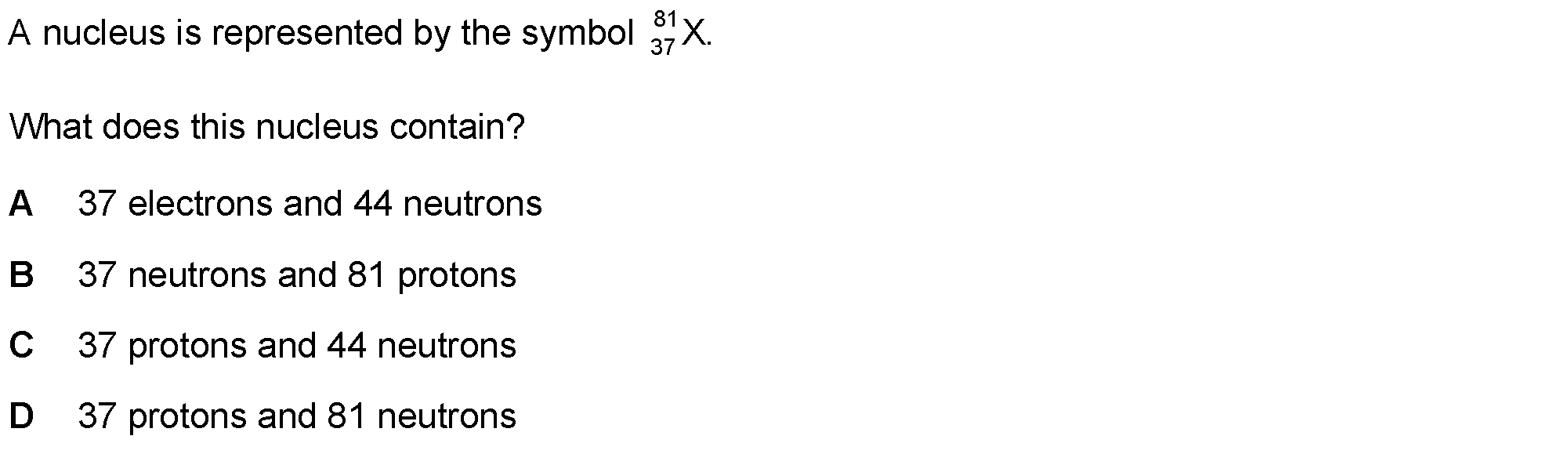
A nucleus is represented by the symbol 3) X.
What does this nucleus contain?
37 electrons and 44 neutrons
37 neutrons and 81 protons
37 protons and 44 neutrons
0 0O wD PY
37 protons and 81 neutrons
What does this nucleus contain?
37 electrons and 44 neutrons
37 neutrons and 81 protons
37 protons and 44 neutrons
0 0O wD PY
37 protons and 81 neutrons
Options:
A
B
C
D
Correct Key: C
A
B
C
D
Correct Key: C
Question 9
Paper Ref: 5129/11_Winter_2024_Q15
Paper Ref: 5129/11_Winter_2024_Q15
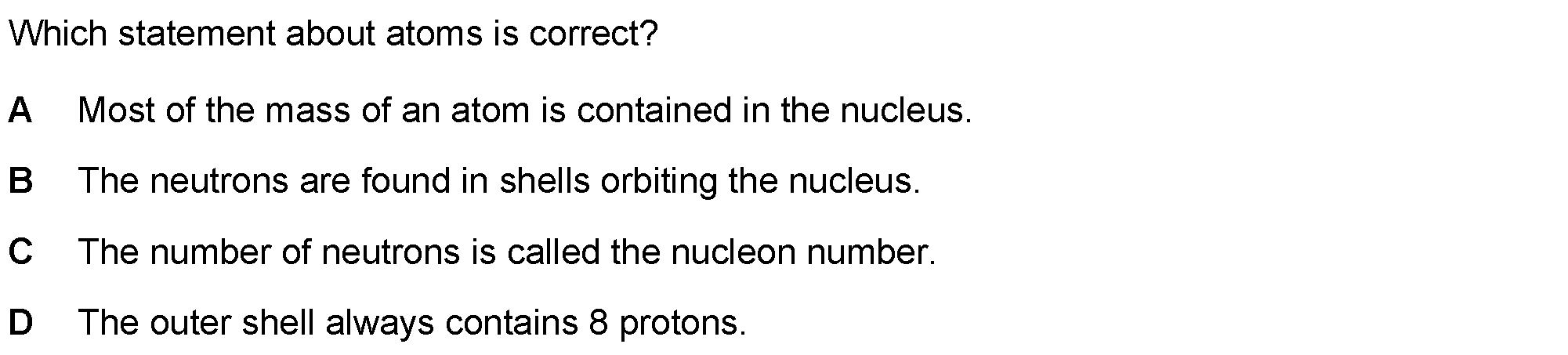
Which statement about atoms is correct?
A Most of the mass of an atom is contained in the nucleus.
The neutrons are found in shells orbiting the nucleus.
The number of neutrons is called the nucleon number.
0 O WW
The outer shell always contains 8 protons.
A Most of the mass of an atom is contained in the nucleus.
The neutrons are found in shells orbiting the nucleus.
The number of neutrons is called the nucleon number.
0 O WW
The outer shell always contains 8 protons.
Options:
A
B
C
D
Correct Key: A
A
B
C
D
Correct Key: A
Question 10
Paper Ref: 0620/13_Winter_2024_Q4
Paper Ref: 0620/13_Winter_2024_Q4
What is the nucleon number of an atom?
A the number of neutrons
B the number of protons
C the total number of protons and neutrons
D
the total number of protons and electrons
A the number of neutrons
B the number of protons
C the total number of protons and neutrons
D
the total number of protons and electrons
Options:
A
B
C
D
Correct Key: C
A
B
C
D
Correct Key: C
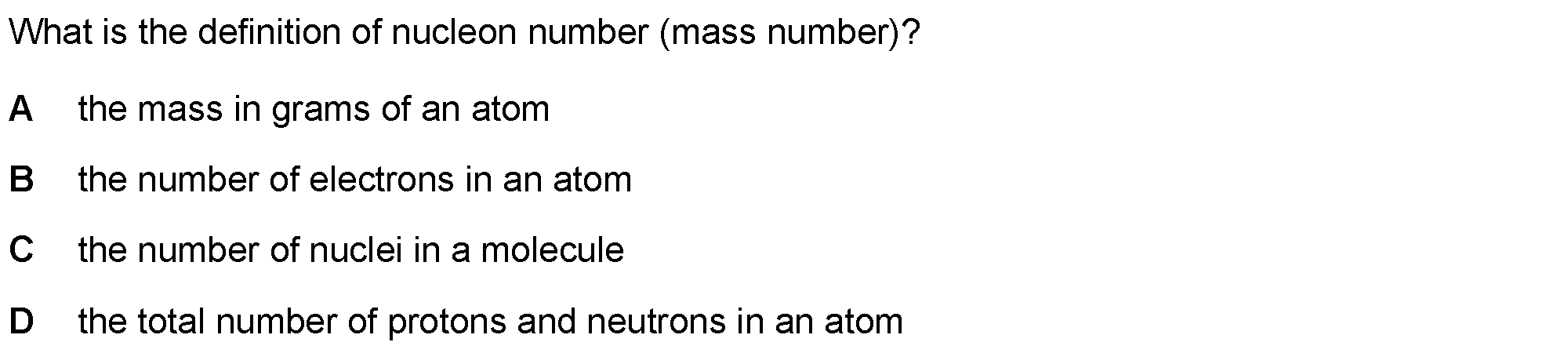
Question 11
Paper Ref: 5129/11_Summer_2023_Q15
Paper Ref: 5129/11_Summer_2023_Q15
What is the definition of nucleon number (mass number)?
A the mass in grams of an atom
B- the number of electrons in an atom
C the number of nuclei in a molecule
D
the total number of protons and neutrons in an atom
A the mass in grams of an atom
B- the number of electrons in an atom
C the number of nuclei in a molecule
D
the total number of protons and neutrons in an atom
Options:
A
B
C
D
Correct Key: D
A
B
C
D
Correct Key: D
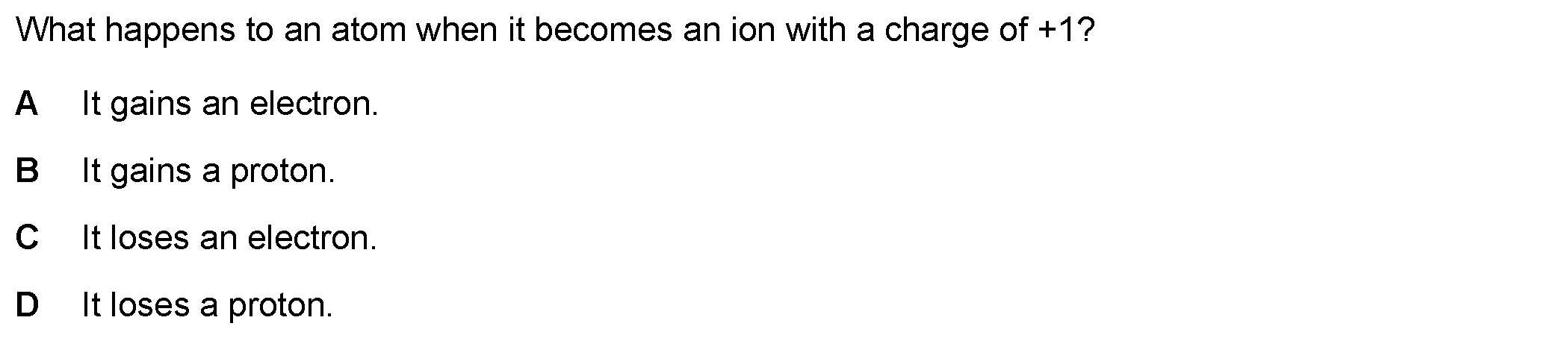
Question 12
Paper Ref: 0620/11_Summer_2022_Q7
Paper Ref: 0620/11_Summer_2022_Q7
What happens to an atom when it becomes an ion with a charge of +1?
It gains an electron.
B It gains a proton.
C_Itloses an electron.
D_ It loses a proton.
It gains an electron.
B It gains a proton.
C_Itloses an electron.
D_ It loses a proton.
Options:
A
B
C
D
Correct Key: C
A
B
C
D
Correct Key: C
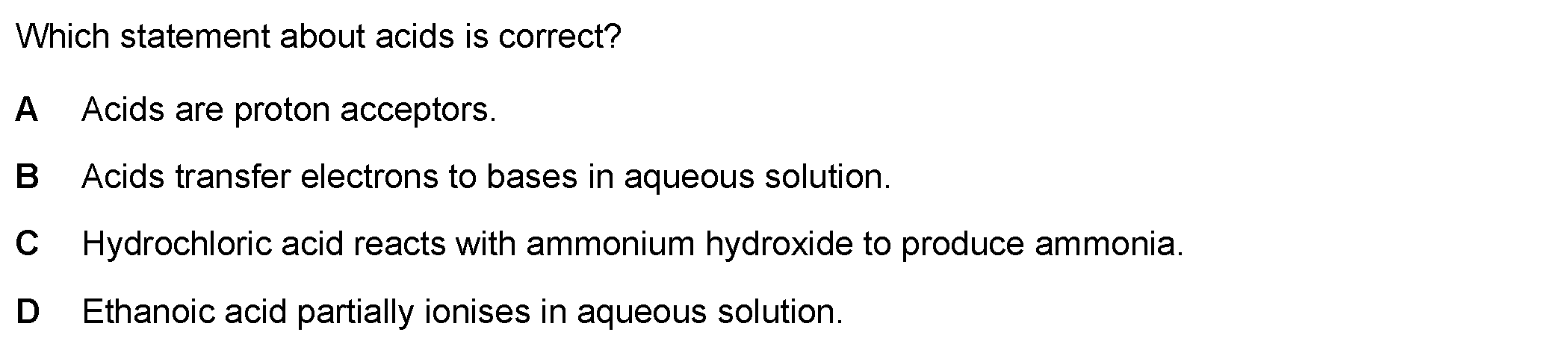
Question 13
Paper Ref: 0620/22_Summer_2022_Q22
Paper Ref: 0620/22_Summer_2022_Q22
Which statement about acids is correct?
A Acids are proton acceptors.
Acids transfer electrons to bases in aqueous solution.
Hydrochloric acid reacts with ammonium hydroxide to produce ammonia.
0 OO WW
Ethanoic acid partially ionises in aqueous solution.
A Acids are proton acceptors.
Acids transfer electrons to bases in aqueous solution.
Hydrochloric acid reacts with ammonium hydroxide to produce ammonia.
0 OO WW
Ethanoic acid partially ionises in aqueous solution.
Options:
A
B
C
D
Correct Key: D
A
B
C
D
Correct Key: D
Question 14
Paper Ref: 0620/13_Summer_2018_Q4
Paper Ref: 0620/13_Summer_2018_Q4
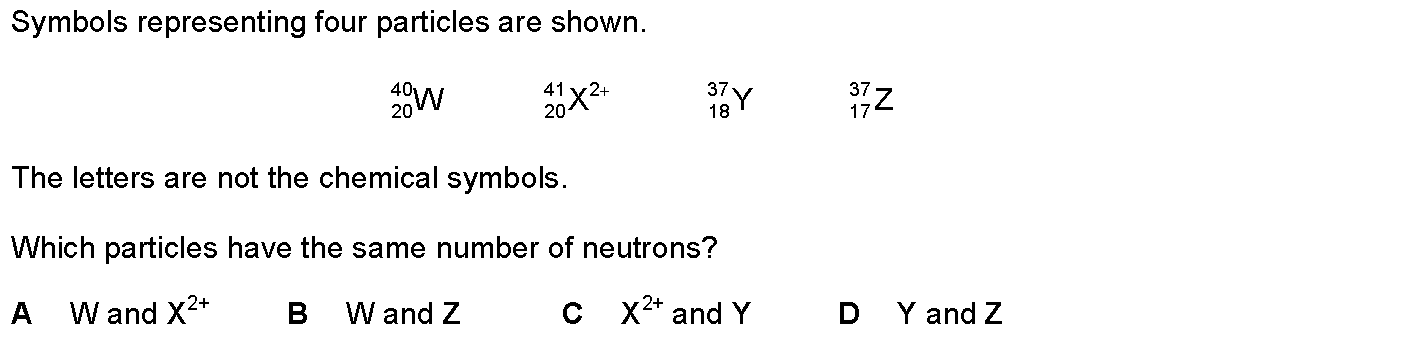
Symbols representing four particles are shown.
Mw gxe ly
The letters are not the chemical symbols.
Which particles have the same number of neutrons?
A Wand x** B Wandz Cc X* andy
37
72
D YandZ
Mw gxe ly
The letters are not the chemical symbols.
Which particles have the same number of neutrons?
A Wand x** B Wandz Cc X* andy
37
72
D YandZ
Options:
A
B
C
D
Correct Key: B
A
B
C
D
Correct Key: B
Question 15
Paper Ref: 0620/21_Summer_2011_Q24
Paper Ref: 0620/21_Summer_2011_Q24
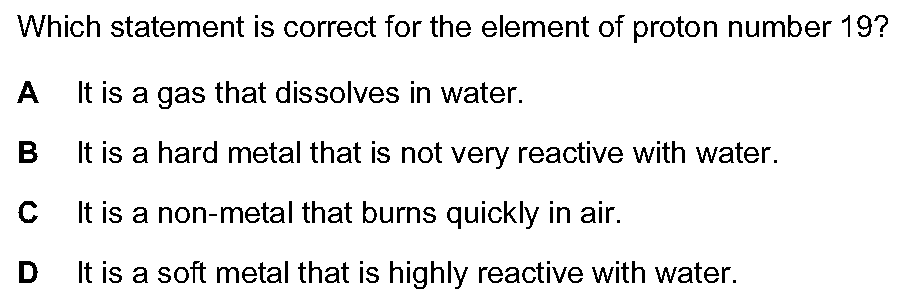
Which statement is correct for the element of proton number 19?
oo BD
It is a gas that dissolves in water.
It is a hard metal that is not very reactive with water.
It is a non-metal that burns quickly in air.
It is a soft metal that is highly reactive with water.
oo BD
It is a gas that dissolves in water.
It is a hard metal that is not very reactive with water.
It is a non-metal that burns quickly in air.
It is a soft metal that is highly reactive with water.
Options:
A
B
C
D
Correct Key: D
A
B
C
D
Correct Key: D
Question 16
Paper Ref: 5129/12_Winter_2022_Q16
Paper Ref: 5129/12_Winter_2022_Q16
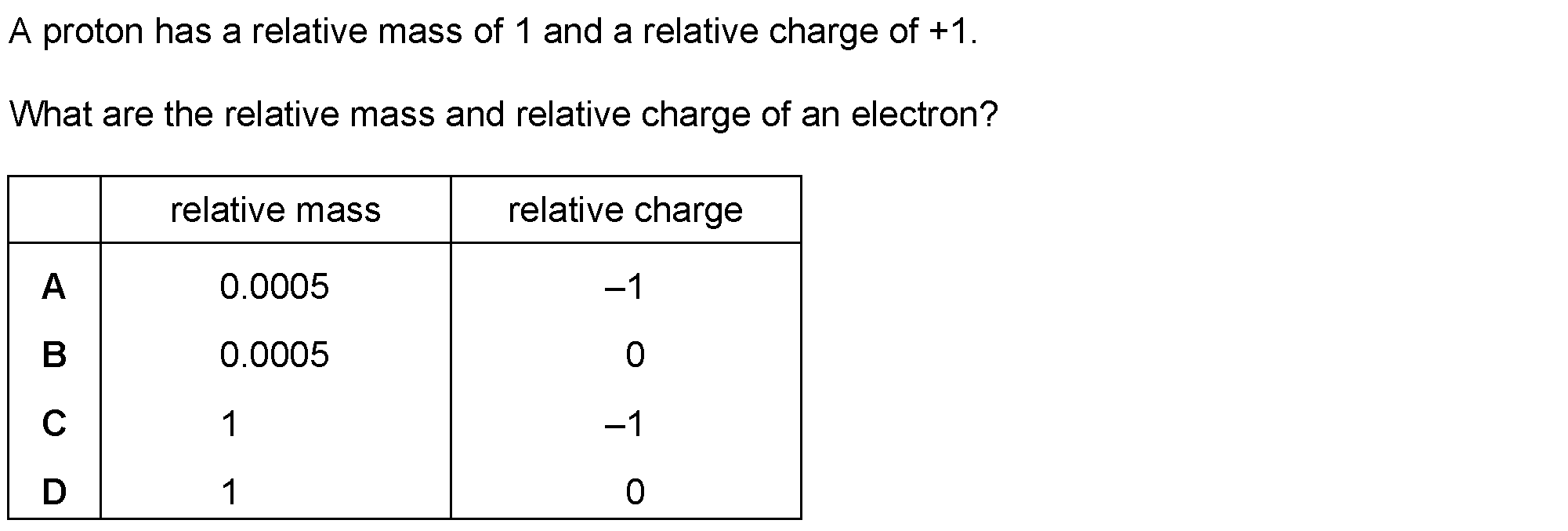
A proton has a relative mass of 1 and a relative charge of +1.
What are the relative mass and relative charge of an electron?
— relative mass relative charge
What are the relative mass and relative charge of an electron?
— relative mass relative charge
Options:
A
B
C
D
Correct Key: A
A
B
C
D
Correct Key: A
Structured Questions Mark Scheme & Answers
•1•.• • • •[•C•P• •O•c•t•o•b•e•r• •2•0•2•4• •P•2• • •·• • •Q•1•0• • •P•a•r•t• •(•a•)• • •·• • •2•0•2•4• • •·• • •L•o•w•e•r• •S•e•c• •0•8•9•3•]• • • • • • •(•i•d•e•a• •t•h•a•t•)• •n•e•w• •i•n•f•o•r•m•a•t•i•o•n• •m•a•y• •b•e• •d•i•s•c•o•v•e•r•e•d• •1• •••c•c•e•p•t• •(•i•d•e•a• •o•f•)• •b•e•t•t•e•r• •t•e•c•h•n•o•l•o•g•y• •••c•c•e•p•t• •a•t•o•m• •i•s• •3•D• •a•n•d• •n•o•t• •2•D• •••c•c•e•p•t• •(•i•d•e•a• •t•h•a•t•)• •t•h•e• •m•o•d•e•l• •h•a•s• •a• •f•l•a•w• •(•s•o• •n•e•e•d•s• •c•h•a•n•g•i•n•g• •o•r• •(•i•d•e•a• •t•h•a•t•)• •m•a•y• •f•i•n•d• •a• •b•e•t•t•e•r• •m•o•d•e•l• •I•g•n•o•r•e• •i•d•e•a• •t•h•a•t• •i•t• •c•h•a•n•g•e•d• •i•n• •t•h•e• •p•a•s•t• •s•o• •w•i•l•l• •c•h•a•n•g•e• •a•g•a•i•n•
•2•.• • • •[•C•P• •M•a•r•c•h• •2•0•2•6• •P•1• • •·• • •Q•2• • •·• • •2•0•2•6• • •·• • •L•o•w•e•r• •S•e•c• •0•8•9•3•]• • • • • • •3• •e•a•c•h• •c•o•r•r•e•c•t• •a•n•s•w•e•r• •=• •1• •m•a•r•k• •••c•c•e•p•t• •a•n•s•w•e•r•s• •i•n• •l•a•b•e•l•l•e•d• •d•i•a•g•r•a•m• •o•r• •w•o•r•d•s•,• •b•u•t• •d•i•a•g•r•a•m• •t•a•k•e•s• •p•r•e•c•e•d•e•n•c•e• •I•g•n•o•r•e• •o•l•d•e•r• •m•o•d•e•l•s• •o•f• •a•t•o•m•s• •t•h•a•t• •d•o• •n•o•t• •h•a•v•e• •a• •n•u•c•l•e•u•s• •a•n•d• •e•l•e•c•t•r•o•n•s• •n•u•c•l•e•u•s• •(•a•t• •t•h•e• •c•e•n•t•r•e• •o•f• •t•h•e• •a•t•o•m•)• •D•o• •n•o•t• •a•c•c•e•p•t• •n•u•c•l•e•u•s• •a•t• •c•e•n•t•r•e• •o•f• •c•e•l•l• •e•l•e•c•t•r•o•n•s• •m•o•v•e• •a•r•o•u•n•d• •t•h•e• •n•u•c•l•e•u•s• •(•i•n• •s•h•e•l•l•s• •o•r• •o•r•b•i•t•s•)• •••c•c•e•p•t• •e•l•e•c•t•r•o•n•s• •o•r•b•i•t• •t•h•e• •n•u•c•l•e•u•s• •o•r• •e•l•e•c•t•r•o•n•s• •i•n• •s•p•a•c•e• •o•u•t•s•i•d•e• •o•f• •n•u•c•l•e•u•s• •o•r• •r•e•f•e•r•e•n•c•e• •t•o• •e•l•e•c•t•r•o•n• •s•h•e•l•l•s• •(•o•u•t•s•i•d•e• •t•h•e• •n•u•c•l•e•u•s•)• •o•r• •e•l•e•c•t•r•o•n• •o•r•b•i•t•s• •(•o•u•t•s•i•d•e• •t•h•e• •n•u•c•l•e•u•s•)• •N•o•t•e• •a•t•o•m• •h•a•s• •e•l•e•c•t•r•o•n•s• •u•n•q•u•a•l•i•f•i•e•d• •i•s• •n•o•t• •s•u•f•f•i•c•i•e•n•t• •••c•c•e•p•t• •e•l•e•c•t•r•o•n•s• •s•h•o•w•n• •a•s• •X• •o•r• •c•i•r•c•l•e• •w•i•t•h• •n•e•g•a•t•i•v•e• •s•i•g•n• •o•u•t•s•i•d•e• •o•f• •n•u•c•l•e•u•s• •••c•c•e•p•t• •p• •f•o•r• •p•r•o•t•o•n•,• •e• •f•o•r• •e•l•e•c•t•r•o•n• •a•n•d• •n• •f•o•r• •n•e•u•t•r•o•n• •a•n•d• •a•n•y• •o•n•e• •f•r•o•m• •n•u•c•l•e•u•s• •c•o•n•t•a•i•n•s• •p•r•o•t•o•n•s• •a•n•d• •n•e•u•t•r•o•n•s• •••c•c•e•p•t• •c•e•n•t•r•e• •o•f• •a•t•o•m• •h•a•s• •p•r•o•t•o•n•s• •a•n•d• •n•e•u•t•r•o•n•s• •p•o•s•i•t•i•v•e• •n•u•c•l•e•u•s• •a•n•d• •n•e•g•a•t•i•v•e• •e•l•e•c•t•r•o•n•s• •p•r•o•t•o•n•s• •h•a•v•e• •a• •p•o•s•i•t•i•v•e• •c•h•a•r•g•e• •a•n•d• •n•e•u•t•r•o•n•s• •h•a•v•e• •n•o• •c•h•a•r•g•e• •n•u•m•b•e•r• •o•f• •p•r•o•t•o•n•s• •=• •n•u•m•b•e•r• •o•f• •e•l•e•c•t•r•o•n•s•
•3•.• • • •[•P•T• •S•9• •2•0•2•6• •P•1• • •·• • •Q•1•3• • •P•a•r•t• •(•a•)• • •·• • •2•0•2•6• • •·• • •L•o•w•e•r• •S•e•c• •0•8•9•3•]• • • • • • •a•n•y• •o•n•e• •f•r•o•m• •1• •b•o•t•h• •h•a•v•e• •e•l•e•c•t•r•o•n•s• •••c•c•e•p•t• •b•o•t•h• •h•a•v•e• •n•e•g•a•t•i•v•e• •c•h•a•r•g•e• •b•o•t•h• •h•a•v•e• •a• •p•o•s•i•t•i•v•e• •c•h•a•r•g•e•
•4•.• • • •[•P•T• •S•9• •2•0•2•6• •P•1• • •·• • •Q•1•3• • •P•a•r•t• •(•b•)• • •·• • •2•0•2•6• • •·• • •L•o•w•e•r• •S•e•c• •0•8•9•3•]• • • • • • •a•n•y• •o•n•e• •f•r•o•m• •1• •••c•c•e•p•t• •o•r•a• •f•o•r• •a•l•l• •m•a•r•k•i•n•g• •p•o•i•n•t•s• •c•u•r•r•e•n•t• •d•a•y• •m•o•d•e•l• •h•a•s• •e•l•e•c•t•r•o•n•s• •i•n• •s•h•e•l•l•s• •o•r• •o•r•b•i•t•s• •c•u•r•r•e•n•t• •d•a•y• •m•o•d•e•l• •h•a•s• •p•r•o•t•o•n•s• •c•u•r•r•e•n•t• •d•a•y• •m•o•d•e•l• •h•a•s• •a• •n•u•c•l•e•u•s• •c•u•r•r•e•n•t• •d•a•y• •m•o•d•e•l• •h•a•s• •n•e•u•t•r•o•n•s• •©• •C•a•m•b•r•i•d•g•e• •U•n•i•v•e•r•s•i•t•y• •P•r•e•s•s• •&• •••s•s•e•s•s•m•e•n•t• •2•0•2•6• •P•a•g•e• •9• •o•f• •1•2• •S•9•/•0•1• •S•c•i•e•n•c•e• •S•t•a•g•e• •9• •P•a•p•e•r• •1• •M•a•r•k• •S•c•h•e•m•e• •2•0•2•6•
•5•.• • • •[•P•T• •S•8• •2•0•2•6• •P•1• • •·• • •Q•2• • •P•a•r•t• •(•a•)• • •·• • •2•0•2•6• • •·• • •L•o•w•e•r• •S•e•c• •0•8•9•3•]• • • • • • •c•e•n•t•r•e• •1• •••c•c•e•p•t• •m•i•d•d•l•e•
•6•.• • • •[•P•T• •S•8• •2•0•2•5• •P•2• • •·• • •Q•2• • •P•a•r•t• •(•a•)• • •·• • •2•0•2•5• • •·• • •L•o•w•e•r• •S•e•c• •0•8•9•3•]• • • • • • •2• •e•a•c•h• •c•o•r•r•e•c•t• •a•n•s•w•e•r• •=• •1• •m•a•r•k• •(•••)• •n•u•c•l•e•u•s• •••c•c•e•p•t• •p•r•o•t•o•n•s• •a•n•d• •n•e•u•t•r•o•n•s• •(•B•)• •e•l•e•c•t•r•o•n•
•7•.• • • •[•P•T• •S•8• •2•0•2•5• •P•2• • •·• • •Q•2• • •P•a•r•t• •(•b•)• • •·• • •2•0•2•5• • •·• • •L•o•w•e•r• •S•e•c• •0•8•9•3•]• • • • • • •p•r•o•t•o•n•s• •a•n•d• •n•e•u•t•r•o•n•s• •1• •b•o•t•h• •a•n•s•w•e•r•s• •i•n• •e•i•t•h•e•r• •o•r•d•e•r• •f•o•r• •t•h•e• •m•a•r•k•
•8•.• • • •[•S•P• •S•8• •P•1• • •·• • •Q•2• • •P•a•r•t• •(•a•)• • •·• • •S•p•e•c•i•m•e•n• • •·• • •L•o•w•e•r• •S•e•c• •0•8•9•3•]• • • • • • •p•o•s•i•t•i•v•e• •c•h•a•r•g•e• •o•n• •p•r•o•t•o•n•s• •o•r• •n•u•c•l•e•u•s• •a•n•d• •n•e•g•a•t•i•v•e• •c•h•a•r•g•e• •2• •e•a•c•h• •c•o•r•r•e•c•t• •a•n•s•w•e•r• •=• •1• •m•a•r•k• •o•n• •e•l•e•c•t•r•o•n•s• •a•t•t•r•a•c•t• •e•a•c•h• •o•t•h•e•r•
Last updated:
\n