1.1Motion, Forces and Energy
The human respiratory system — Question Bank (Cambridge) — Cambridge IGCSE Physics 0625 Revision Notes & Topical Questions
20 min read Lesson 3 of 91 Unit quiz
Cambridge Past Paper Bank
1.1 The human respiratory system
11 Multiple-Choice Questions with Official Mark Schemes
Question 1
0610/21_Summer_2009_Q7
Question 2
0610/12_Winter_2023_Q22
Question 3
0610/12_Winter_2021_Q22
Question 4
0610/23_Winter_2021_Q5
Question 5
0610/23_Summer_2013_Q23
Question 6
0610/21_Summer_2013_Q22
Question 7
0610/13_Winter_2025_Q4

Question 8
0610/22_Winter_2013_Q22
Question 9
0610/12_Summer_2019_Q5
Question 10
0610/11_Winter_2024_Q5

Question 11
0610/23_Summer_2022_Q21

Cambridge Lower Secondary Stage 8
1.1 The human respiratory system – Complete Question Bank & Mark Scheme
Total Questions11 Questions with Verified Solutions & Past Paper Mark Schemes
Multiple Choice Questions (Exam Practice)
Question 1
Paper Ref: 0610/21_Summer_2009_Q7
Paper Ref: 0610/21_Summer_2009_Q7
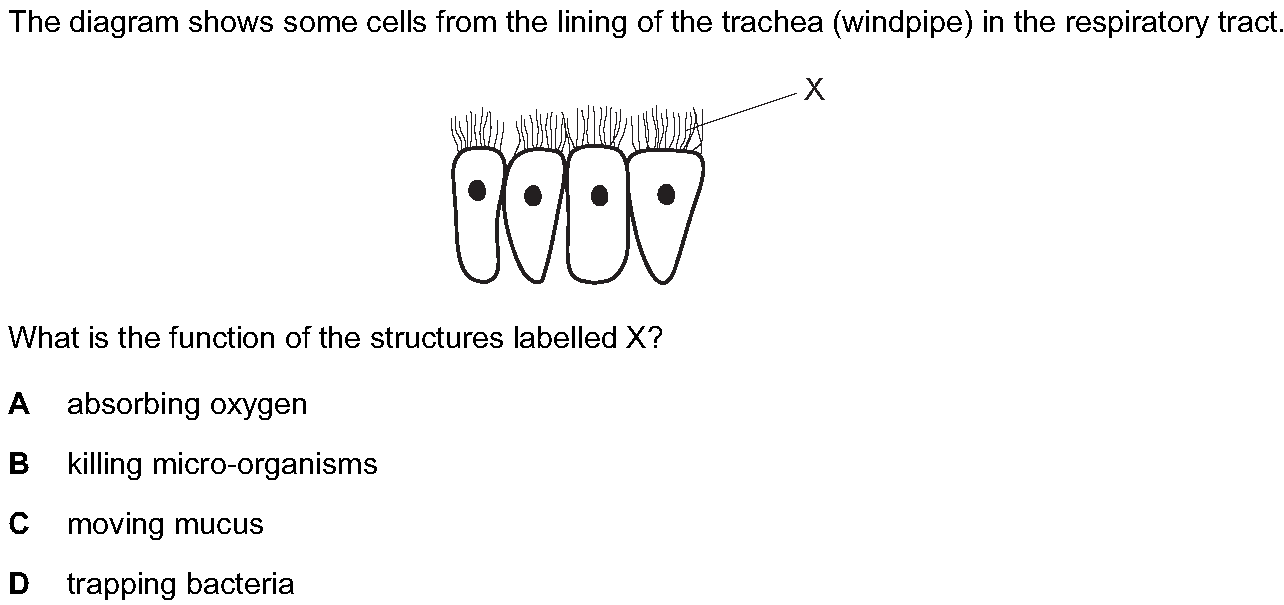
The diagram shows some cells from the lining of the trachea (windpipe) in the respiratory tract.
What is the function of the structures labelled X?
A absorbing oxygen
B killing micro-organisms
C moving mucus
D trapping bacteria
What is the function of the structures labelled X?
A absorbing oxygen
B killing micro-organisms
C moving mucus
D trapping bacteria
Options:
A
B
C
D
Correct Key: C
A
B
C
D
Correct Key: C
Question 2
Paper Ref: 0610/12_Winter_2023_Q22
Paper Ref: 0610/12_Winter_2023_Q22
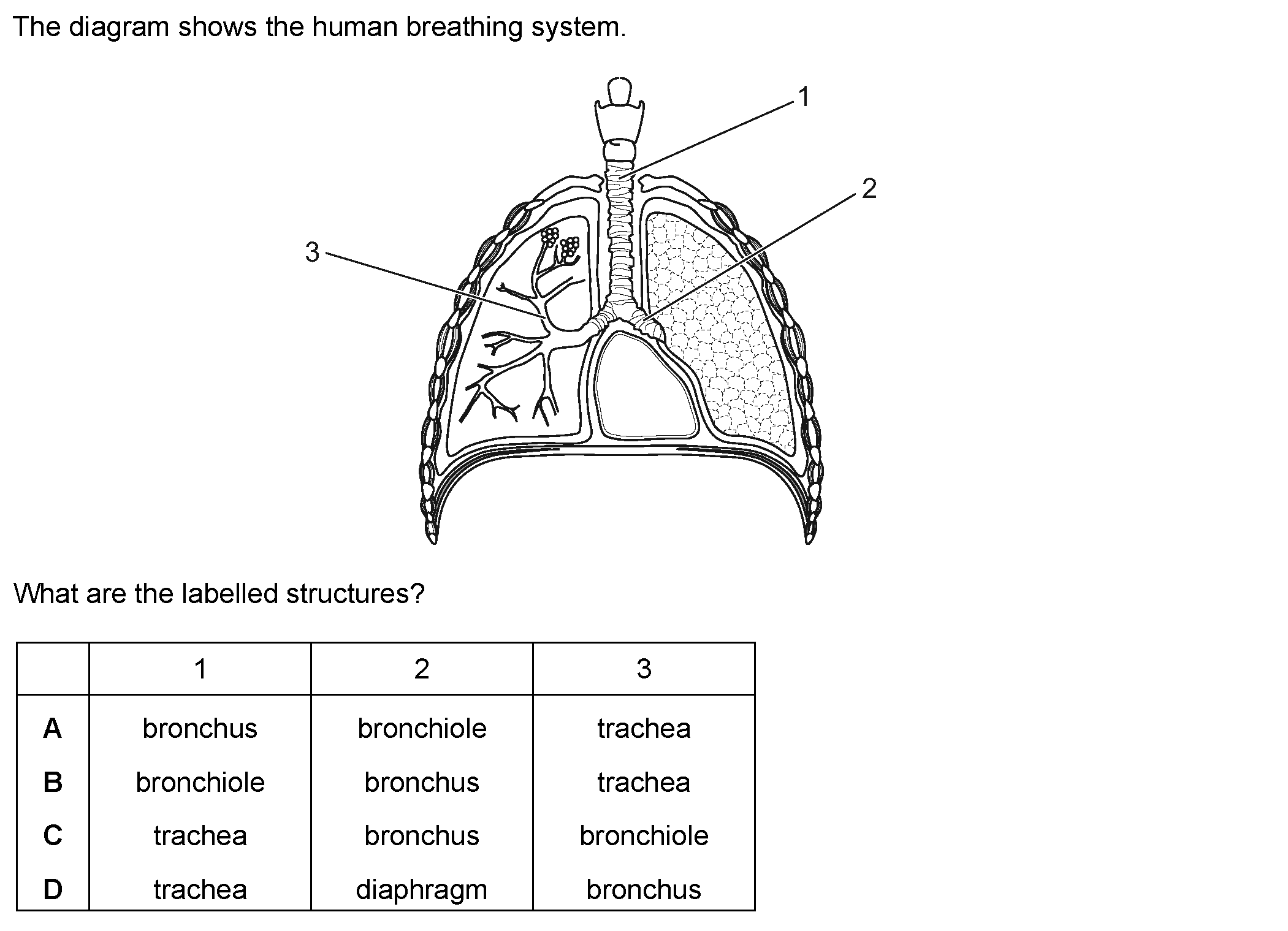
The diagram shows the human breathing system.
bronchus bronchiole trachea
bronchus trachea
bronchiole
trachea bronchus bronchiole
trachea diaphragm bronchus
bronchus bronchiole trachea
bronchus trachea
bronchiole
trachea bronchus bronchiole
trachea diaphragm bronchus
Options:
A
B
C
D
Correct Key: C
A
B
C
D
Correct Key: C
Question 3
Paper Ref: 0610/12_Winter_2021_Q22
Paper Ref: 0610/12_Winter_2021_Q22
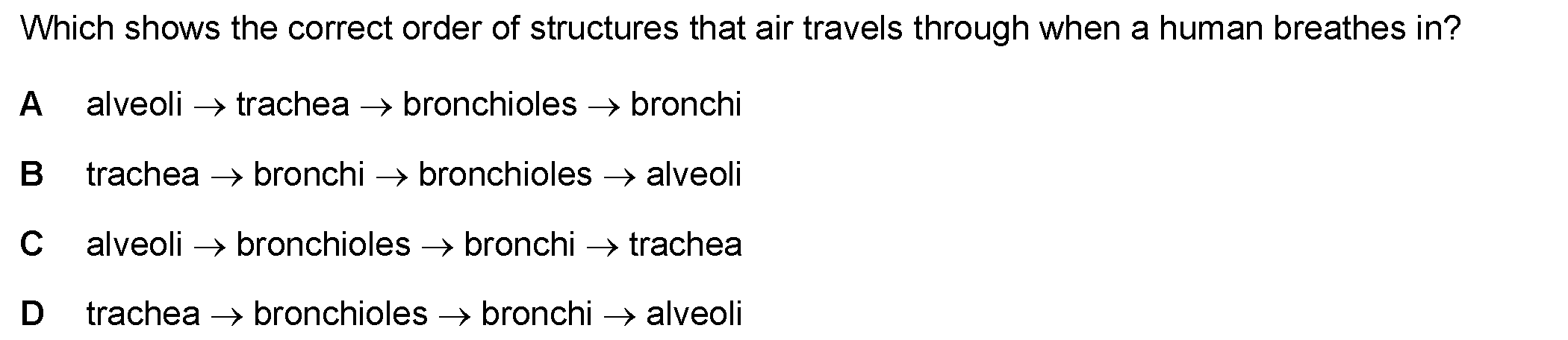
Which shows the correct order of structures that air travels through when a human breathes in?
A alveoli > trachea > bronchioles —> bronchi
B_ trachea — bronchi —> bronchioles —> alveoli
C alveoli — bronchioles + bronchi —> trachea
D
trachea — bronchioles — bronchi —> alveoli
A alveoli > trachea > bronchioles —> bronchi
B_ trachea — bronchi —> bronchioles —> alveoli
C alveoli — bronchioles + bronchi —> trachea
D
trachea — bronchioles — bronchi —> alveoli
Options:
A
B
C
D
Correct Key: B
A
B
C
D
Correct Key: B
Question 4
Paper Ref: 0610/23_Winter_2021_Q5
Paper Ref: 0610/23_Winter_2021_Q5
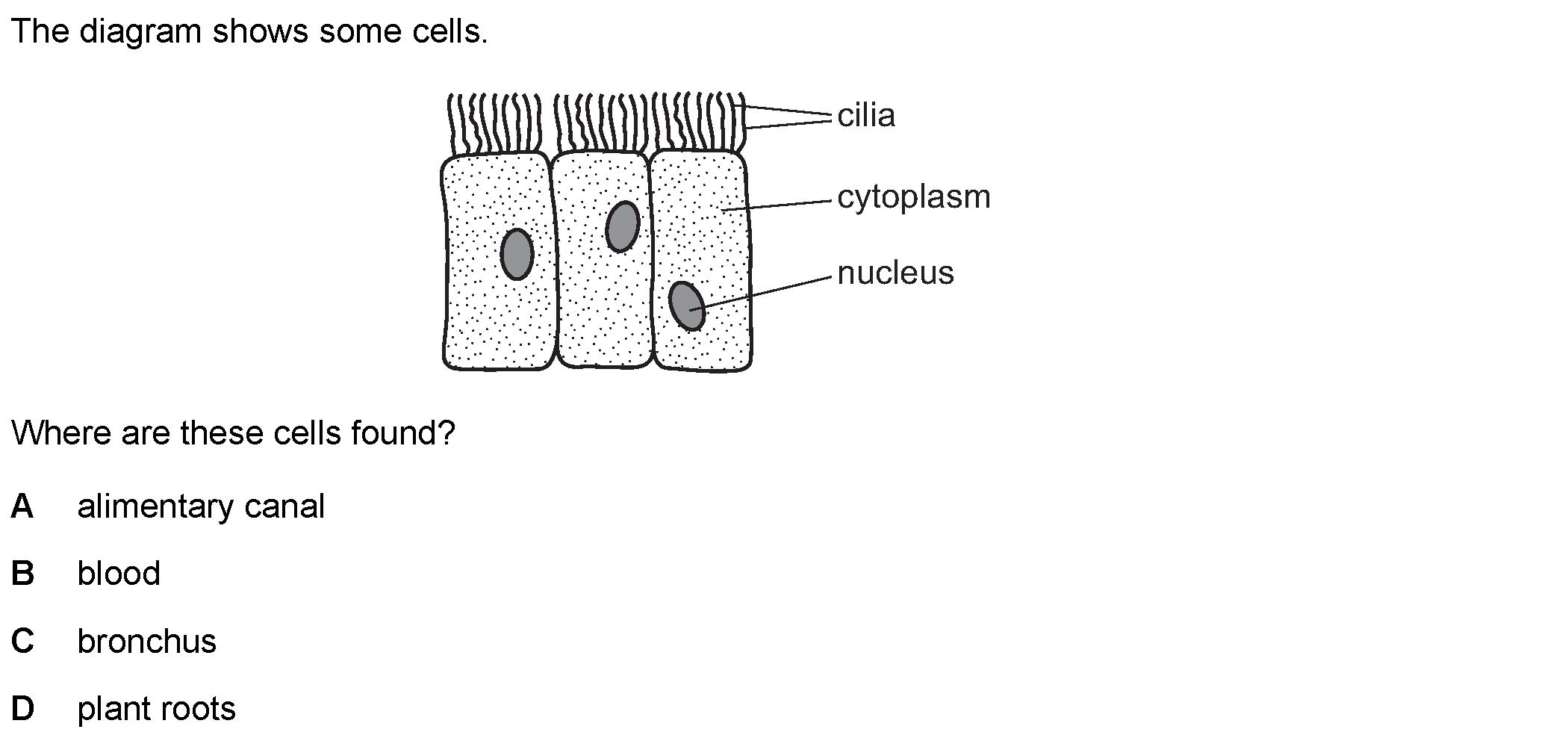
The diagram shows some cells.
cilia
cytoplasm
nucleus
Where are these cells found?
A alimentary canal
blood
bronchus
0 O WW
plant roots
cilia
cytoplasm
nucleus
Where are these cells found?
A alimentary canal
blood
bronchus
0 O WW
plant roots
Options:
A
B
C
D
Correct Key: C
A
B
C
D
Correct Key: C
Question 5
Paper Ref: 0610/23_Summer_2013_Q23
Paper Ref: 0610/23_Summer_2013_Q23
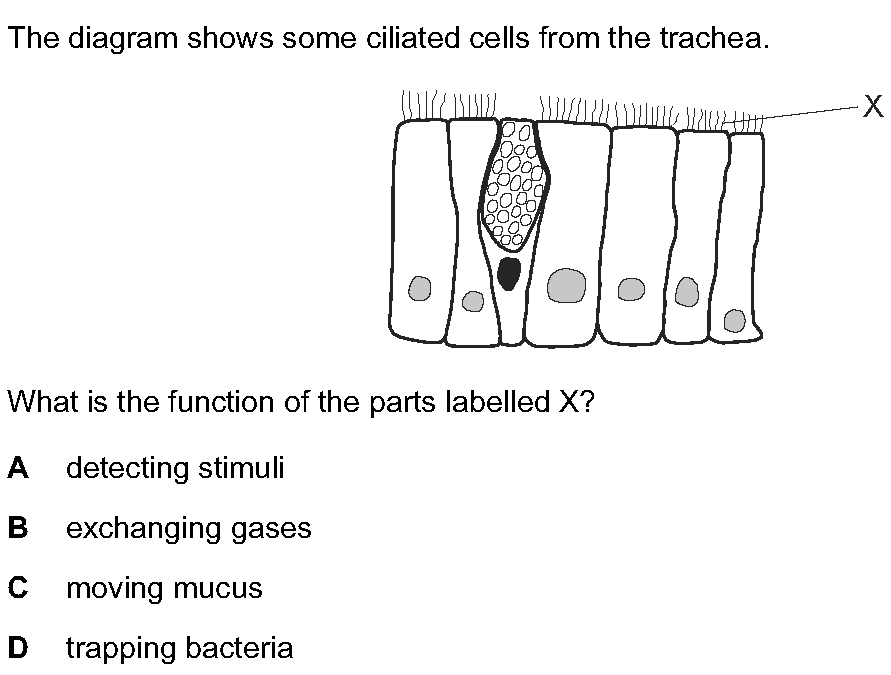
The diagram shows some ciliated cells from the trachea.
What is the function of the parts labelled X?
detecting stimuli
B_ exchanging gases
C moving mucus
D trapping bacteria
What is the function of the parts labelled X?
detecting stimuli
B_ exchanging gases
C moving mucus
D trapping bacteria
Options:
A
B
C
D
Correct Key: C
A
B
C
D
Correct Key: C
Question 6
Paper Ref: 0610/21_Summer_2013_Q22
Paper Ref: 0610/21_Summer_2013_Q22
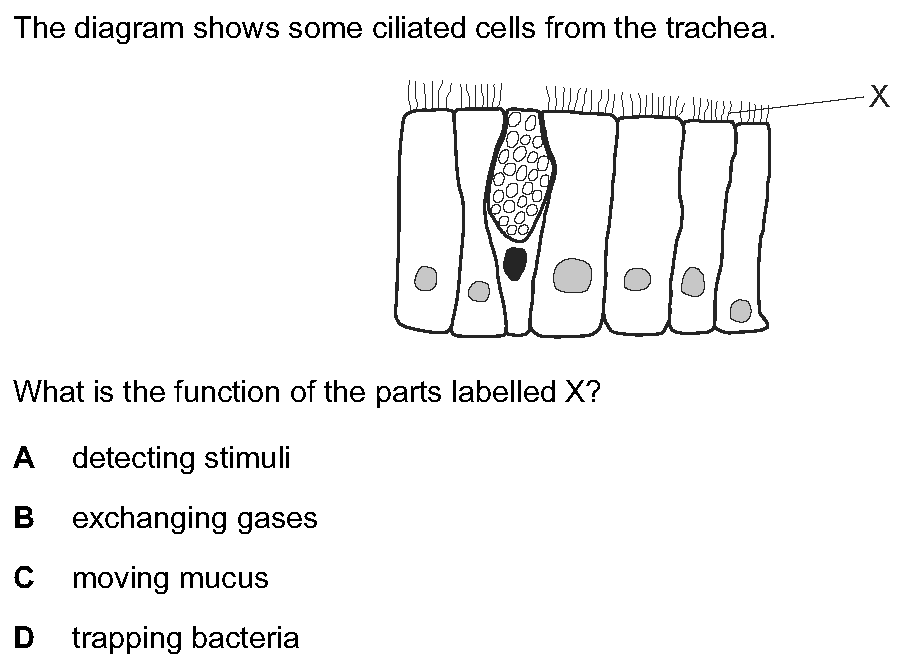
The diagram shows some ciliated cells from the trachea.
What is the function of the parts labelled X?
detecting stimuli
is]
exchanging gases
Qa
moving mucus
D trapping bacteria
What is the function of the parts labelled X?
detecting stimuli
is]
exchanging gases
Qa
moving mucus
D trapping bacteria
Options:
A
B
C
D
Correct Key: C
A
B
C
D
Correct Key: C
Question 7
Paper Ref: 0610/13_Winter_2025_Q4
Paper Ref: 0610/13_Winter_2025_Q4
Which statement describes a plasmid?
A
B
Cc
D
It is a circular piece of DNA.
It is the liquid part of human blood.
It is the site of aerobic respiration.
It is the site of protein synthesis.
A
B
Cc
D
It is a circular piece of DNA.
It is the liquid part of human blood.
It is the site of aerobic respiration.
It is the site of protein synthesis.
Options:
A
B
C
D
Correct Key: A
A
B
C
D
Correct Key: A
Question 8
Paper Ref: 0610/22_Winter_2013_Q22
Paper Ref: 0610/22_Winter_2013_Q22
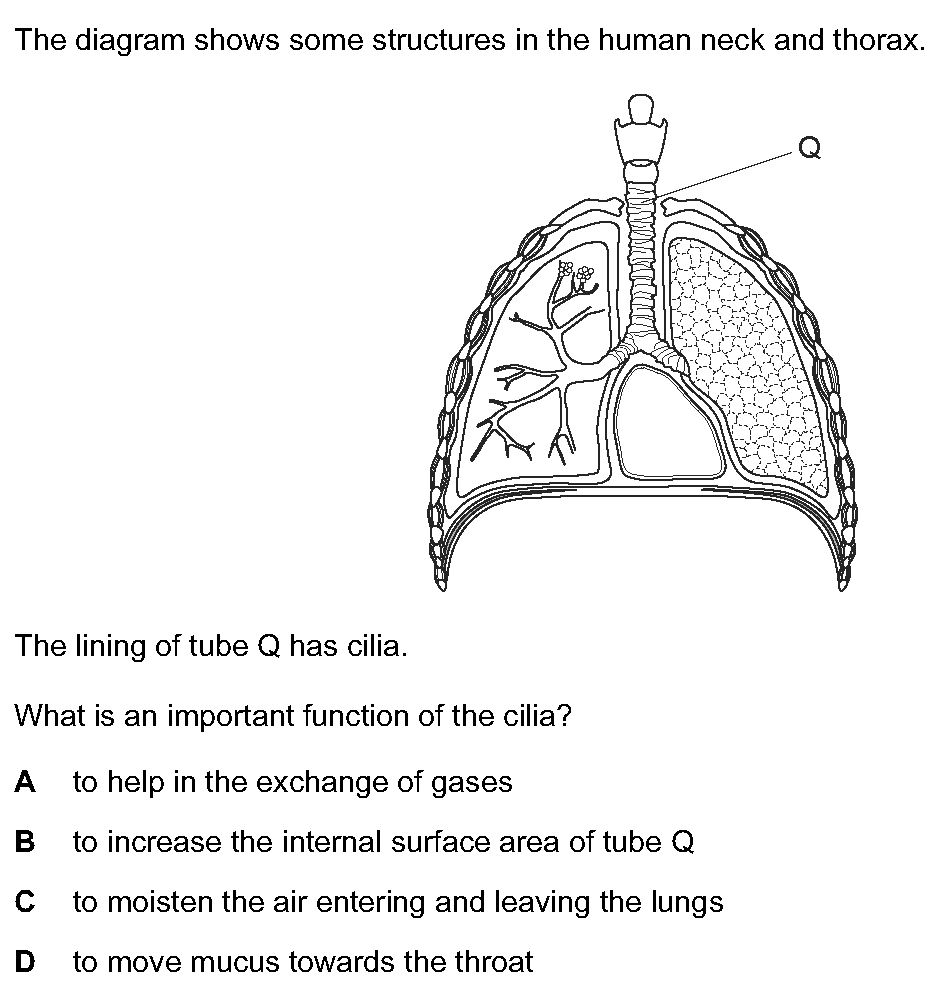
The diagram shows some structures in the human neck and thorax.
The lining of tube Q has cilia.
What is an important function of the cilia?
oo BD
to help in the exchange of gases
to increase the internal surface area of tube Q
to moisten the air entering and leaving the lungs
to move mucus towards the throat
The lining of tube Q has cilia.
What is an important function of the cilia?
oo BD
to help in the exchange of gases
to increase the internal surface area of tube Q
to moisten the air entering and leaving the lungs
to move mucus towards the throat
Options:
A
B
C
D
Correct Key: D
A
B
C
D
Correct Key: D
Question 9
Paper Ref: 0610/12_Summer_2019_Q5
Paper Ref: 0610/12_Summer_2019_Q5
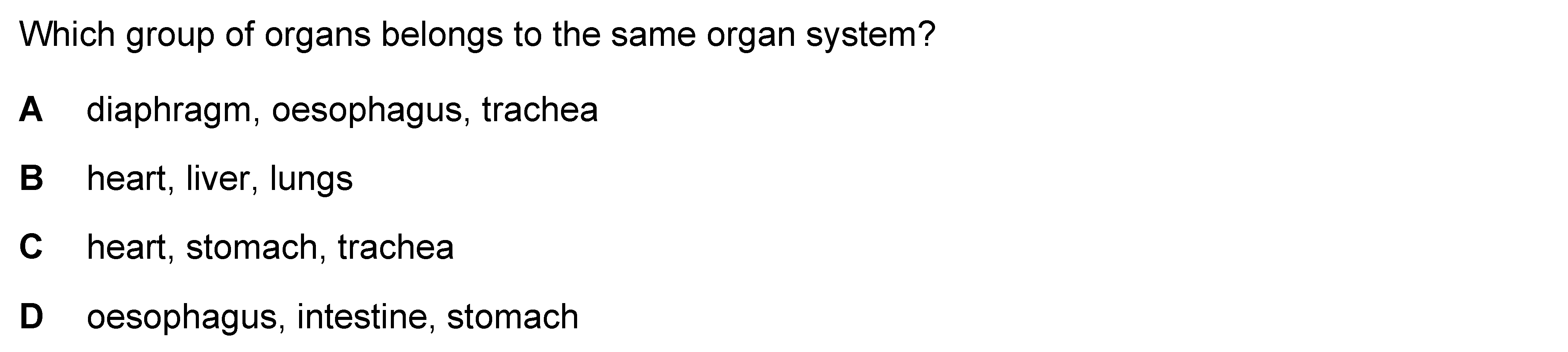
Which group of organs belongs to the same organ system?
A
B
C
D
diaphragm, oesophagus, trachea
heart, liver, lungs
heart, stomach, trachea
oesophagus, intestine, stomach
A
B
C
D
diaphragm, oesophagus, trachea
heart, liver, lungs
heart, stomach, trachea
oesophagus, intestine, stomach
Options:
A
B
C
D
Correct Key: D
A
B
C
D
Correct Key: D
Question 10
Paper Ref: 0610/11_Winter_2024_Q5
Paper Ref: 0610/11_Winter_2024_Q5
What is the function of ciliated cells in the bronchi?
A to absorb oxygen
to digest pathogens
to move mucus
0 OO WW
to produce antibodies
A to absorb oxygen
to digest pathogens
to move mucus
0 OO WW
to produce antibodies
Options:
A
B
C
D
Correct Key: C
A
B
C
D
Correct Key: C
Question 11
Paper Ref: 0610/23_Summer_2022_Q21
Paper Ref: 0610/23_Summer_2022_Q21
Carbon dioxide is produced by aerobic respiration.
How many molecules of carbon dioxide are produced from the aerobic respiration of three
molecules of glucose?
A 3 B 6 C 12 D 18
How many molecules of carbon dioxide are produced from the aerobic respiration of three
molecules of glucose?
A 3 B 6 C 12 D 18
Options:
A
B
C
D
Correct Key: D
A
B
C
D
Correct Key: D
Structured Questions Mark Scheme & Answers
•1•.• • • •[•S•P• •S•8• •P•1• • •·• • •Q•1• • •P•a•r•t• •(•a•)• • •·• • •S•p•e•c•i•m•e•n• • •·• • •L•o•w•e•r• •S•e•c• •0•8•9•3•]• • • • • • •X• •=• •r•i•b•(•s•)• •(•c•a•g•e•)• •2• •e•a•c•h• •c•o•r•r•e•c•t• •a•n•s•w•e•r• •=• •1• •m•a•r•k• •Y• •=• •d•i•a•p•h•r•a•g•m• •I•g•n•o•r•e• •i•n•t•e•r•c•o•s•t•a•l• •m•u•s•c•l•e•s• •r•i•b•(•s•)• •(•c•a•g•e•)• •m•o•v•e•s• •u•p• •/• •m•o•v•e•s• •o•u•t• •2• •e•a•c•h• •c•o•r•r•e•c•t• •a•n•s•w•e•r• •=• •1• •m•a•r•k• •d•i•a•p•h•r•a•g•m• •c•o•n•t•r•a•c•t•s• •/• •m•o•v•e•s• •d•o•w•n• •/• •f•l•a•t•t•e•n•s•
•2•.• • • •[•S•P• •S•8• •P•1• • •·• • •Q•1• • •P•a•r•t• •(•b•)• • •·• • •S•p•e•c•i•m•e•n• • •·• • •L•o•w•e•r• •S•e•c• •0•8•9•3•]• • • • • • •s•t•o•p•-•w•a•t•c•h• •/• •t•i•m•e•r• •1• •••c•c•e•p•t• •d•a•t•a• •l•o•g•g•e•r• •I•g•n•o•r•e• •c•h•e•s•t• •b•a•n•d• •/• •s•p•i•r•o•m•e•t•e•r• •(•r•u•n•n•i•n•g•)• •s•p•e•e•d• •1• •(•s•a•m•e•)• •d•u•r•a•t•i•o•n• •/• •(•s•a•m•e•)• •p•e•r•s•o•n• •d•o•i•n•g• •t•h•e• •r•u•n•n•i•n•g• •/• •(•s•a•m•e•)• •1• •b•r•e•a•t•h•i•n•g• •r•a•t•e• •a•t• •s•t•a•r•t• •i•n• •a• •t•a•b•l•e• •/• •g•r•a•p•h• •/• •b•a•r• •c•h•a•r•t• •1• •D•o• •n•o•t• •a•c•c•e•p•t• •p•i•e• •c•h•a•r•t• •©• •U•C•L•E•S• •2•0•2•0• •P•a•g•e• •3• •o•f• •1•2• •S•8•/•0•1• •S•c•i•e•n•c•e• •S•t•a•g•e• •8• •P•a•p•e•r• •1• •M•a•r•k• •S•c•h•e•m•e• •F•r•o•m• •2•0•2•0•
•3•.• • • •[•P•R•I• •2•0•1•5••• •P•1• • •·• • •Q•1•0• • •P•a•r•t• •(•a•)• • •·• • •2•0•1•5• • •·• • •P•r•i•m•a•r•y• •0•8•4•6•]• • • • • • •(•n•o• •p•u•b•l•i•s•h•e•d• •m•a•r•k• •s•c•h•e•m•e• •f•o•r• •t•h•i•s• •p•a•p•e•r•)•
•4•.• • • •[•P•R•I• •2•0•1•5••• •P•1• • •·• • •Q•1•0• • •P•a•r•t• •(•b•)• • •·• • •2•0•1•5• • •·• • •P•r•i•m•a•r•y• •0•8•4•6•]• • • • • • •(•n•o• •p•u•b•l•i•s•h•e•d• •m•a•r•k• •s•c•h•e•m•e• •f•o•r• •t•h•i•s• •p•a•p•e•r•)•
•5•.• • • •[•P•R•I• •2•0•1•7••• •P•1• • •·• • •Q•9• • •·• • •2•0•1•7• • •·• • •P•r•i•m•a•r•y• •0•8•4•6•]• • • • • • •2• •e•a•c•h• •c•o•r•r•e•c•t• •a•n•s•w•e•r• •=• •1• •m•a•r•k• •••n•s•w•e•r• •m•u•s•t• •i•n•c•l•u•d•e• •d•e•s•c•r•i•p•t•i•o•n• •a•n•d• •a•n•y• •t•w•o• •f•r•o•m• •e•x•p•l•a•n•a•t•i•o•n• •o•f• •a•d•a•p•t•a•t•i•o•n• •f•o•r• •m•a•r•k• •(•i•d•e•a• •o•f•)• •f•a•t• •l•a•y•e•r• •f•o•r• •i•n•s•u•l•a•t•i•o•n• •/• •f•a•t• •t•o• •k•e•e•p• •t•h•e•m• •w•a•r•m• •/• •f•a•t• •t•o• •••c•c•e•p•t• •b•l•u•b•b•e•r• •f•o•r• •f•a•t• •w•i•t•h•s•t•a•n•d• •t•h•e• •c•o•l•d• •t•h•i•c•k• •f•e•a•t•h•e•r•s• •f•o•r• •i•n•s•u•l•a•t•i•o•n• •/• •l•o•t•s• •o•f• •f•e•a•t•h•e•r•s• •f•o•r• •i•n•s•u•l•a•t•i•o•n• •/• •t•h•i•c•k• •••c•c•e•p•t• •t•o• •k•e•e•p• •t•h•e•m• •w•a•r•m• •f•e•a•t•h•e•r• •l•a•y•e•r• •f•o•r• •i•n•s•u•l•a•t•i•o•n• •D•o• •n•o•t• •a•c•c•e•p•t• •f•u•r• •c•l•a•w•s• •o•r• •n•a•i•l•s• •t•o• •g•r•i•p• •(•t•h•e• •i•c•e•)• •/• •c•l•a•w•s• •o•r• •n•a•i•l•s• •t•o• •h•e•l•p• •t•h•e•m• •w•a•l•k• •o•n• •i•c•e• •o•i•l•y• •f•e•a•t•h•e•r•s• •t•o• •m•a•k•e• •t•h•e•m• •w•a•t•e•r•p•r•o•o•f• •f•l•a•t•t•e•n•e•d• •w•i•n•g•s• •(•f•l•i•p•p•e•r•s•)• •t•o• •s•w•i•m• •i•n• •t•h•e• •w•a•t•e•r• •/• •s•h•o•r•t• •w•i•n•g•s• •(•f•l•i•p•p•e•r•s•)• •t•o• •s•w•i•m• •i•n• •t•h•e• •w•a•t•e•r• •b•l•a•c•k• •(•b•a•c•k•)• •f•o•r• •c•a•m•o•u•f•l•a•g•e• •/• •w•h•i•t•e• •(•f•r•o•n•t•)• •f•o•r• •c•a•m•o•u•f•l•a•g•e• •(•w•h•e•n• •s•w•i•m•m•i•n•g•)• •s•t•r•e•a•m•l•i•n•e• •s•h•a•p•e• •f•o•r• •s•w•i•m•m•i•n•g• •/• •a•e•r•o•d•y•n•a•m•i•c• •s•h•a•p•e• •f•o•r• •s•w•i•m•m•i•n•g• •s•h•a•r•p• •b•e•a•k• •f•o•r• •f•e•e•d•i•n•g• •o•r• •c•a•t•c•h•i•n•g• •f•i•s•h• •/• •l•o•n•g• •b•e•a•k• •f•o•r• •f•e•e•d•i•n•g• •o•r• •c•a•t•c•h•i•n•g• •f•i•s•h• •w•e•b•b•e•d• •f•e•e•t• •f•o•r• •(•p•o•w•e•r•f•u•l•)• •s•w•i•m•m•i•n•g• •I•f• •t•w•o• •s•t•r•u•c•t•u•r•a•l• •a•d•a•p•t•a•t•i•o•n•s• •o•n•l•y• •g•i•v•e•n• •a•n•d• •n•o• •r•e•a•s•o•n•s• •e•.•g•.• •s•h•a•r•p• •b•e•a•k• •a•n•d• •s•h•o•r•t• •l•e•g•s• •t•o• •w•a•l•k•/•w•a•d•d•l•e• •o•n• •s•n•o•w•/•i•c•e• •t•h•i•c•k• •f•e•a•t•h•e•r•s• •t•h•e•n• •=• •1• •m•a•r•k• •©• •U•C•L•E•S• •2•0•1•7• •P•a•g•e• •8• •o•f• •1•6• •••s•s•e•m•b•l•e•d• •b•y• •N•.•S•.• •1•3•6•/•3•8•4•
•6•.• • • •[•P•R•I• •2•0•1•7••• •P•1• • •·• • •Q•1•1• • •·• • •2•0•1•7• • •·• • •P•r•i•m•a•r•y• •0•8•4•6•]• • • • • • •2• •t•h•r•e•e• •c•o•r•r•e•c•t• •=• •2• •m•a•r•k•s• •o•n•e• •o•r• •t•w•o• •c•o•r•r•e•c•t• •=• •1• •m•a•r•k• •Y•o•u•s•s•e•f• •p•u•t•s• •t•h•e• •i•n•h•a•l•e•r• •i•n• •h•i•s• •m•o•u•t•h•.• •••c•c•e•p•t• •b•r•e•a•t•h•e•s• •i•n• •a•n•d• •o•u•t• •/• •b•r•e•a•t•h• •(•i•n•)• •H•e• •p•r•e•s•s•e•s• •t•h•e• •i•n•h•a•l•e•r• •a•n•d• •b•r•e•a•t•h•e•s• •(•i•n•)• •/• •i•n•h•a•l•e•s•.• •••c•c•e•p•t• •a•i•r• •o•r• •o•x•y•g•e•n• •e•n•t•e•r•s• •T•h•e• •m•e•d•i•c•i•n•e• •t•r•a•v•e•l•s• •d•o•w•n• •h•i•s• •w•i•n•d•p•i•p•e• •t•o• •h•i•s• •l•u•n•g•s•.•
•7•.• • • •[•P•R•I• •2•0•1•9•C• •P•1• • •·• • •Q•1•1• • •P•a•r•t• •(•a•)• • •·• • •2•0•1•9• • •·• • •P•r•i•m•a•r•y• •0•8•4•6•]• • • • • • •p•l•a•n•t•s• •i•n• •t•h•e• •l•i•g•h•t• •p•l•a•n•t•s• •i•n• •t•h•e• •d•a•r•k• •2• •••n•s•w•e•r•s• •m•u•s•t• •b•e• •c•o•m•p•a•r•a•t•i•v•e• •e•.•g•.• •t•h•e• •p•l•a•n•t•s• •i•n• •t•h•e• •d•a•r•k• •g•r•e•w• •t•a•l•l•e•r• •/• •p•l•a•n•t•s• •i•n• •••s•s•e•m•b•l•e•d• •b•y• •N•.•S•.• •s•t•r•a•i•g•h•t•(•e•r•)• •/• •n•o•t• •b•e•n•t• •/• •g•r•o•w•n• •g•r•o•w•i•n•g• •i•n• •d•i•f•f•e•r•e•n•t• •d•i•r•e•c•t•i•o•n•s• •/• •l•i•g•h•t• •a•r•e• •s•h•o•r•t• •a•n•d• •p•l•a•n•t•s• •i•n• •d•a•r•k• •a•r•e• •l•o•n•g• •u•p•w•a•r•d•s• •/• •u•p•r•i•g•h•t• •b•e•n•t• •/• •l•o•p•s•i•d•e•d• •/• •d•r•o•o•p•i•n•g• •/• •n•o•t• •u•p•r•i•g•h•t• •D•o• •n•o•t• •a•c•c•e•p•t• •i•n•c•o•r•r•e•c•t• •c•o•m•p•a•r•i•s•o•n•s• •s•t•r•o•n•g•(•e•r•)• •w•e•a•k•(•e•r•)• •e•.•g•.• •p•l•a•n•t•s• •i•n• •d•a•r•k• •a•r•e• •s•h•o•r•t•e•r• •l•a•r•g•e•(•r•)• •l•e•a•v•e•s• •s•m•a•l•l•(•e•r•)• •l•e•a•v•e•s• •d•a•r•k•(•e•r•)• •c•o•l•o•u•r• •/• •g•r•e•e•n•(•e•r•)• •l•i•g•h•t•(•e•r•)• •c•o•l•o•u•r• •/• •p•a•l•e•(•r•)• •/• •y•e•l•l•o•w•(•e•r•)• •/• •w•h•i•t•e•(•r•)• •/• •n•o•t• •g•r•e•e•n• •s•h•o•r•t•(•e•r•)• •/• •s•m•a•l•l•(•e•r•)• •l•o•n•g•(•e•r•)• •/• •t•a•l•l•(•e•r•)• •/• •b•i•g•(•g•e•r•)• •t•h•i•n•(•n•e•r•)• •s•t•e•m•s• •t•h•i•c•k•(•e•r•)• •s•t•e•m•s• •f•e•w•(•e•r•)• •p•l•a•n•t•s• •/• •f•e•w•(•e•r•)• •s•e•e•d•s• •m•o•r•e• •p•l•a•n•t•s• •/• •m•o•r•e• •s•e•e•d•s• •g•e•r•m•i•n•a•t•e•d• •g•e•r•m•i•n•a•t•e•d• •(•i•d•e•a• •t•h•a•t• •i•t• •i•s•)• •t•o• •c•o•l•l•e•c•t• •e•n•o•u•g•h• •r•e•s•u•l•t•s• •/• •t•o• •m•a•k•e• •i•t• •r•e•l•i•a•b•l•e• •1• •••c•c•e•p•t• •t•o• •g•e•t• •s•u•f•f•i•c•i•e•n•t• •e•v•i•d•e•n•c•e• •/• •t•o• •g•e•t• •a•n• •a•v•e•r•a•g•e• •/• •t•o• •c•h•e•c•k• •t•h•e• •r•e•s•u•l•t• •(•i•s• •c•o•r•r•e•c•t•)• •/• •i•n• •c•a•s•e• •s•o•m•e• •d•o• •n•o•t• •g•r•o•w• •D•o• •n•o•t• •a•c•c•e•p•t• •f•a•i•r• •t•e•s•t• •/• •t•o• •m•a•k•e• •i•t• •(•m•o•r•e•)• •a•c•c•u•r•a•t•e• •f•o•r• •e•n•e•r•g•y• •/• •t•o• •g•r•o•w• •/• •t•o• •m•a•k•e• •f•o•o•d• •1• •5•7•/•3•8•4•
•8•.• • • •[•P•R•I• •2•0•1•9•C• •P•1• • •·• • •Q•1•1• • •P•a•r•t• •(•b•)• • •·• • •2•0•1•9• • •·• • •P•r•i•m•a•r•y• •0•8•4•6•]• • • • • • •p•l•a•n•t•s• •i•n• •t•h•e• •l•i•g•h•t• •p•l•a•n•t•s• •i•n• •t•h•e• •d•a•r•k• •2• •••n•s•w•e•r•s• •m•u•s•t• •b•e• •c•o•m•p•a•r•a•t•i•v•e• •e•.•g•.• •t•h•e• •p•l•a•n•t•s• •i•n• •t•h•e• •d•a•r•k• •g•r•e•w• •t•a•l•l•e•r• •/• •p•l•a•n•t•s• •i•n• •••s•s•e•m•b•l•e•d• •b•y• •N•.•S•.• •s•t•r•a•i•g•h•t•(•e•r•)• •/• •n•o•t• •b•e•n•t• •/• •g•r•o•w•n• •g•r•o•w•i•n•g• •i•n• •d•i•f•f•e•r•e•n•t• •d•i•r•e•c•t•i•o•n•s• •/• •l•i•g•h•t• •a•r•e• •s•h•o•r•t• •a•n•d• •p•l•a•n•t•s• •i•n• •d•a•r•k• •a•r•e• •l•o•n•g• •u•p•w•a•r•d•s• •/• •u•p•r•i•g•h•t• •b•e•n•t• •/• •l•o•p•s•i•d•e•d• •/• •d•r•o•o•p•i•n•g• •/• •n•o•t• •u•p•r•i•g•h•t• •D•o• •n•o•t• •a•c•c•e•p•t• •i•n•c•o•r•r•e•c•t• •c•o•m•p•a•r•i•s•o•n•s• •s•t•r•o•n•g•(•e•r•)• •w•e•a•k•(•e•r•)• •e•.•g•.• •p•l•a•n•t•s• •i•n• •d•a•r•k• •a•r•e• •s•h•o•r•t•e•r• •l•a•r•g•e•(•r•)• •l•e•a•v•e•s• •s•m•a•l•l•(•e•r•)• •l•e•a•v•e•s• •d•a•r•k•(•e•r•)• •c•o•l•o•u•r• •/• •g•r•e•e•n•(•e•r•)• •l•i•g•h•t•(•e•r•)• •c•o•l•o•u•r• •/• •p•a•l•e•(•r•)• •/• •y•e•l•l•o•w•(•e•r•)• •/• •w•h•i•t•e•(•r•)• •/• •n•o•t• •g•r•e•e•n• •s•h•o•r•t•(•e•r•)• •/• •s•m•a•l•l•(•e•r•)• •l•o•n•g•(•e•r•)• •/• •t•a•l•l•(•e•r•)• •/• •b•i•g•(•g•e•r•)• •t•h•i•n•(•n•e•r•)• •s•t•e•m•s• •t•h•i•c•k•(•e•r•)• •s•t•e•m•s• •f•e•w•(•e•r•)• •p•l•a•n•t•s• •/• •f•e•w•(•e•r•)• •s•e•e•d•s• •m•o•r•e• •p•l•a•n•t•s• •/• •m•o•r•e• •s•e•e•d•s• •g•e•r•m•i•n•a•t•e•d• •g•e•r•m•i•n•a•t•e•d• •(•i•d•e•a• •t•h•a•t• •i•t• •i•s•)• •t•o• •c•o•l•l•e•c•t• •e•n•o•u•g•h• •r•e•s•u•l•t•s• •/• •t•o• •m•a•k•e• •i•t• •r•e•l•i•a•b•l•e• •1• •••c•c•e•p•t• •t•o• •g•e•t• •s•u•f•f•i•c•i•e•n•t• •e•v•i•d•e•n•c•e• •/• •t•o• •g•e•t• •a•n• •a•v•e•r•a•g•e• •/• •t•o• •c•h•e•c•k• •t•h•e• •r•e•s•u•l•t• •(•i•s• •c•o•r•r•e•c•t•)• •/• •i•n• •c•a•s•e• •s•o•m•e• •d•o• •n•o•t• •g•r•o•w• •D•o• •n•o•t• •a•c•c•e•p•t• •f•a•i•r• •t•e•s•t• •/• •t•o• •m•a•k•e• •i•t• •(•m•o•r•e•)• •a•c•c•u•r•a•t•e• •f•o•r• •e•n•e•r•g•y• •/• •t•o• •g•r•o•w• •/• •t•o• •m•a•k•e• •f•o•o•d• •1• •5•7•/•3•8•4•
Last updated:
\n