7.2Motion, Forces and Energy
Food chains and webs — Question Bank (Cambridge) — Cambridge IGCSE Physics 0625 Revision Notes & Topical Questions
10 min read Lesson 69 of 91 Unit quiz
Cambridge Past Paper Bank
7.2 Food chains and webs
13 Multiple-Choice Questions with Official Mark Schemes
Question 1
0610/11_Winter_2019_Q35
Question 2
0610/23_Winter_2014_Q32
Question 3
0610/23_Winter_2016_Q34
Question 4
0610/23_Winter_2010_Q35
Question 5
0610/21_Summer_2015_Q35
Question 6
0610/22_Summer_2025_Q35
Question 7
0610/23_Winter_2015_Q33
Question 8
0610/11_Winter_2023_Q40
Question 9
5129/12_Summer_2023_Q12
Question 10
0610/12_Winter_2021_Q36
Question 11
0610/12_Summer_2017_Q35
Question 12
0610/12_Spring_2026_Q35
Question 13
0610/12_Winter_2020_Q35
Cambridge Lower Secondary Stage 7
7.2 Food chains and webs – Complete Question Bank & Mark Scheme
Total Questions13 Questions with Verified Solutions & Past Paper Mark Schemes
Multiple Choice Questions (Exam Practice)
Question 1
Paper Ref: 0610/11_Winter_2019_Q35
Paper Ref: 0610/11_Winter_2019_Q35
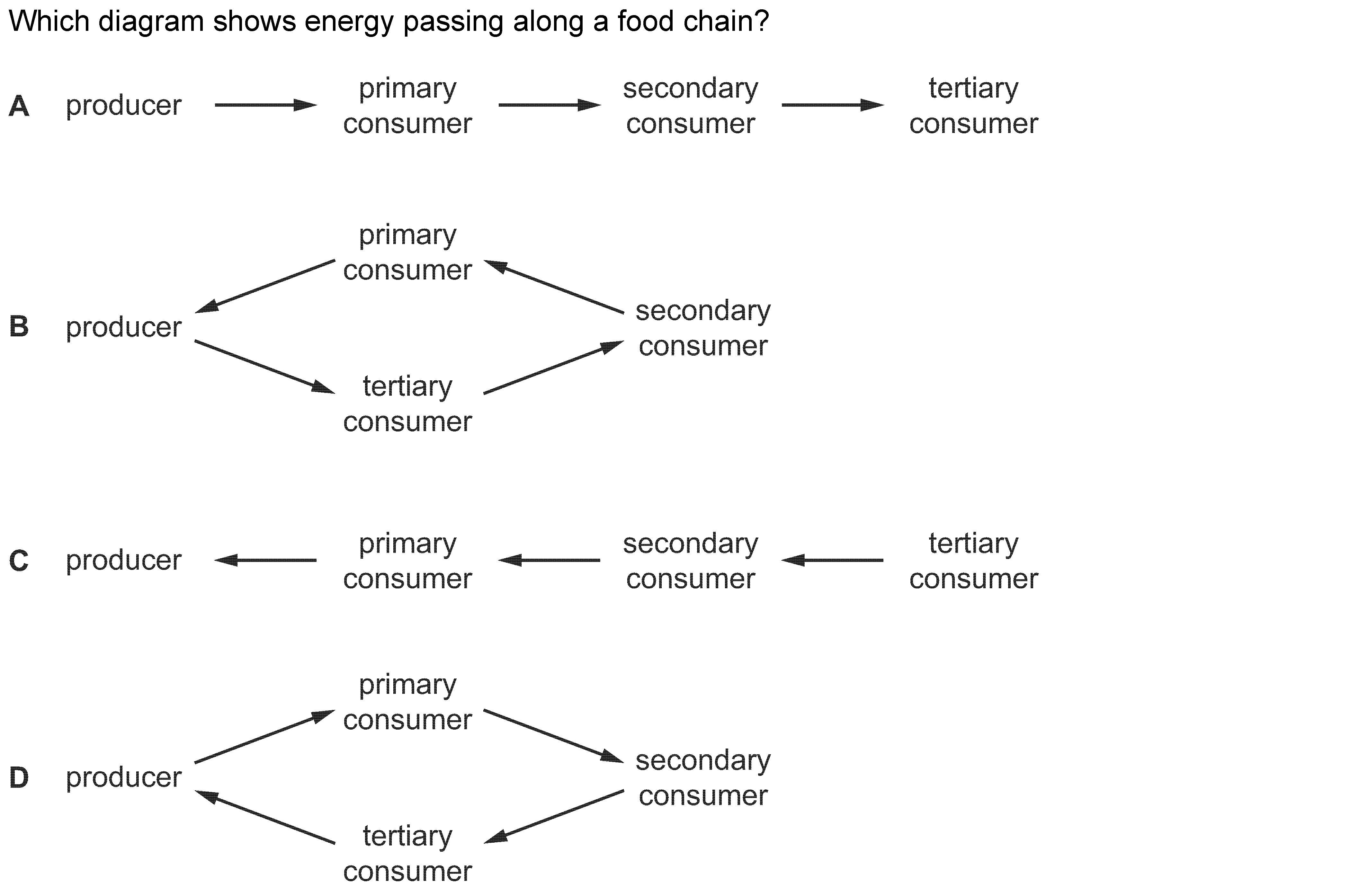
Which diagram shows energy passing along a food chain?
primary secondary tertiary
A producer –—
consumer consumer consumer
primary
7 —- consumer —“—
secondary
consumer
tertiary —
consumer
B producer
primary secondary tertiary
C producer ~<——
consumer consumer consumer
primary
a consumer oO
secondary
consumer
tertiary a
consumer
D producer
primary secondary tertiary
A producer –—
consumer consumer consumer
primary
7 —- consumer —“—
secondary
consumer
tertiary —
consumer
B producer
primary secondary tertiary
C producer ~<——
consumer consumer consumer
primary
a consumer oO
secondary
consumer
tertiary a
consumer
D producer
Options:
A
B
C
D
Correct Key: A
A
B
C
D
Correct Key: A
Question 2
Paper Ref: 0610/23_Winter_2014_Q32
Paper Ref: 0610/23_Winter_2014_Q32
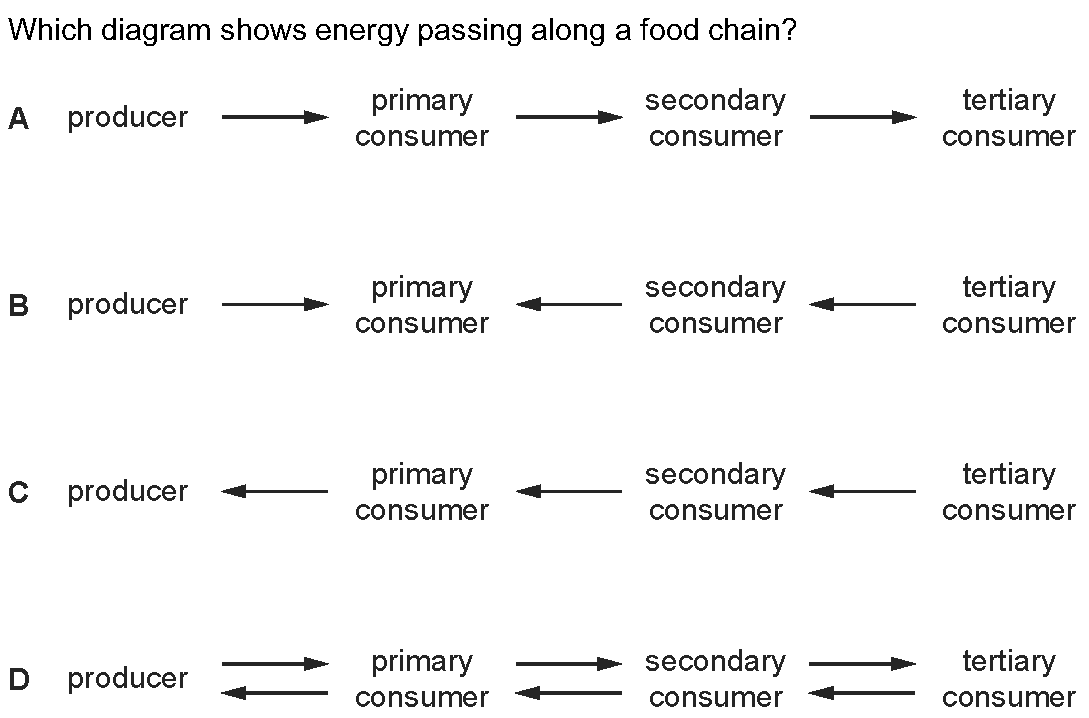
Which diagram shows energy passing along a food chain?
primary secondary tertiary
A producer ——>
consumer consumer consumer
primary secondary tertiary
B producer ———+
consumer consumer consumer
primary secondary tertiary
C producer «——
consumer consumer consumer
—, primary ——» secondary ——+ tertiary
D roducer
P ~+——_ consumer “*—— consumer ~*—— consumer
primary secondary tertiary
A producer ——>
consumer consumer consumer
primary secondary tertiary
B producer ———+
consumer consumer consumer
primary secondary tertiary
C producer «——
consumer consumer consumer
—, primary ——» secondary ——+ tertiary
D roducer
P ~+——_ consumer “*—— consumer ~*—— consumer
Options:
A
B
C
D
Correct Key: A
A
B
C
D
Correct Key: A
Question 3
Paper Ref: 0610/23_Winter_2016_Q34
Paper Ref: 0610/23_Winter_2016_Q34
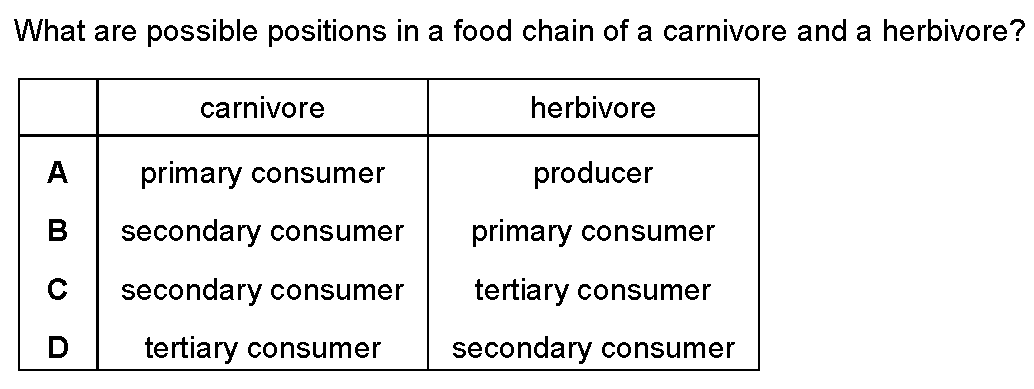
What are possible positions in a food chain of a carnivore and a herbivore?
carnivore herbivore
A primary consumer producer
B | secondary consumer primary consumer
C | secondary consumer tertiary consumer
D tertiary consumer secondary consumer
carnivore herbivore
A primary consumer producer
B | secondary consumer primary consumer
C | secondary consumer tertiary consumer
D tertiary consumer secondary consumer
Options:
A
B
C
D
Correct Key: B
A
B
C
D
Correct Key: B
Question 4
Paper Ref: 0610/23_Winter_2010_Q35
Paper Ref: 0610/23_Winter_2010_Q35
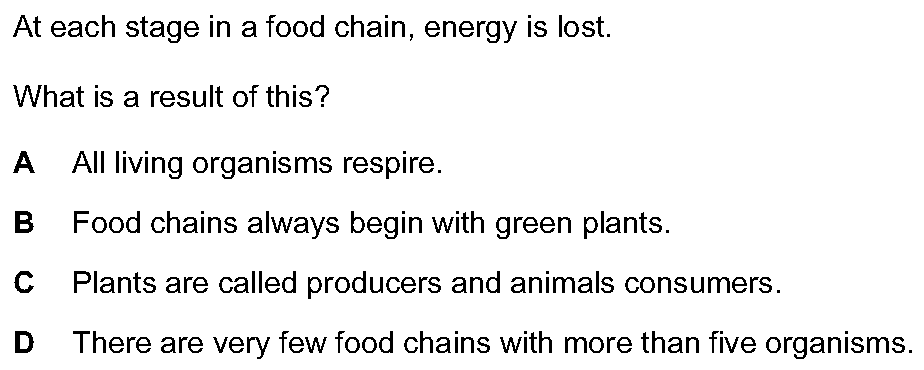
At each stage in a food chain, energy is lost.
What is a result of this?
oo BD
All living organisms respire.
Food chains always begin with green plants.
Plants are called producers and animals consumers.
There are very few food chains with more than five organisms.
What is a result of this?
oo BD
All living organisms respire.
Food chains always begin with green plants.
Plants are called producers and animals consumers.
There are very few food chains with more than five organisms.
Options:
A
B
C
D
Correct Key: D
A
B
C
D
Correct Key: D
Question 5
Paper Ref: 0610/21_Summer_2015_Q35
Paper Ref: 0610/21_Summer_2015_Q35
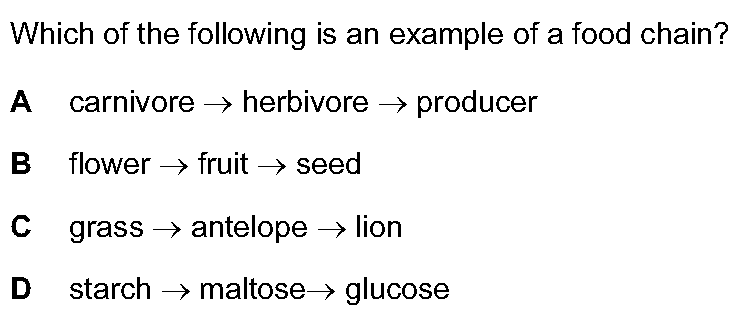
Which of the following is an example of a food chain?
A
B
c
D
carnivore — herbivore — producer
flower — fruit > seed
grass —> antelope —> lion
starch > maltose glucose
A
B
c
D
carnivore — herbivore — producer
flower — fruit > seed
grass —> antelope —> lion
starch > maltose glucose
Options:
A
B
C
D
Correct Key: C
A
B
C
D
Correct Key: C
Question 6
Paper Ref: 0610/22_Summer_2025_Q35
Paper Ref: 0610/22_Summer_2025_Q35
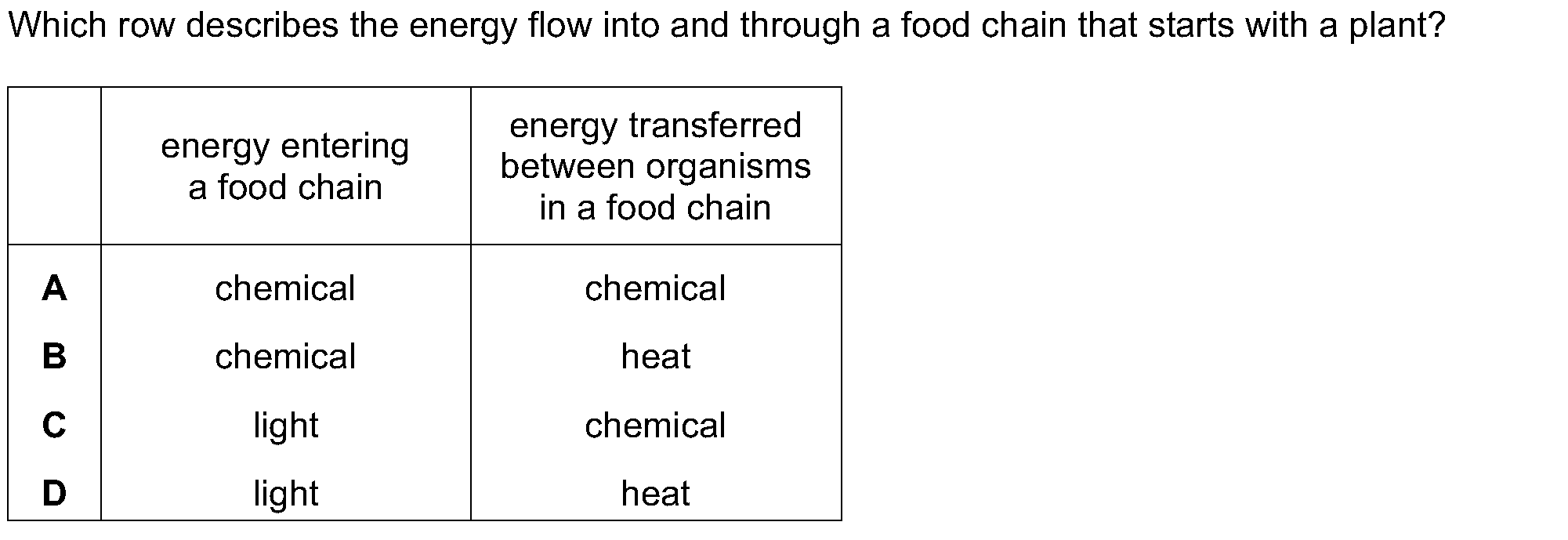
Which row describes the energy flow into and through a food chain that starts with a plant?
energy entering
energy transferred
between organisms
a food chain in a food chain
A chemical chemical
B chemical heat
Cc light chemical
D light heat
energy entering
energy transferred
between organisms
a food chain in a food chain
A chemical chemical
B chemical heat
Cc light chemical
D light heat
Options:
A
B
C
D
Correct Key: C
A
B
C
D
Correct Key: C
Question 7
Paper Ref: 0610/23_Winter_2015_Q33
Paper Ref: 0610/23_Winter_2015_Q33
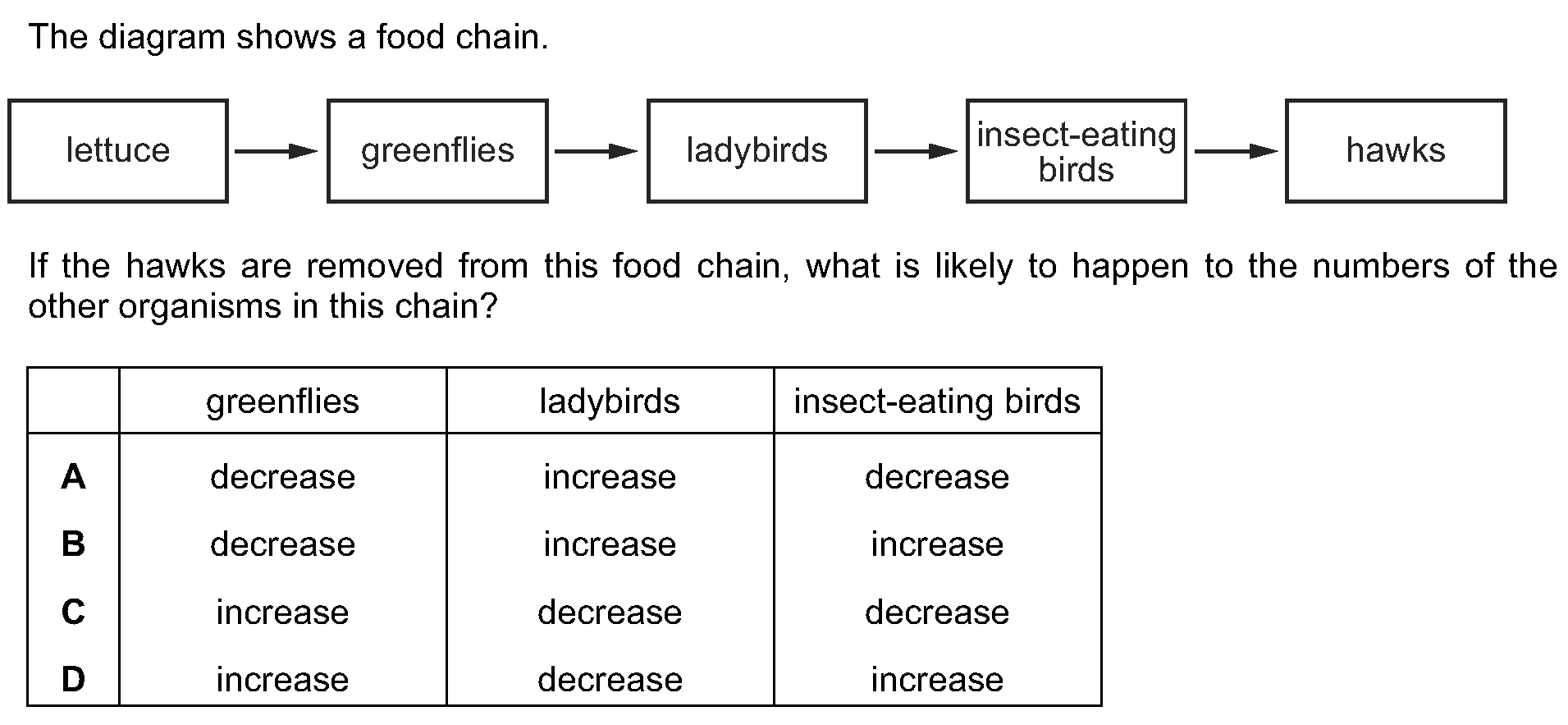
The diagram shows a food chain.
If the hawks are removed from this food chain, what is likely to happen to the numbers of the
other organisms in this chain?
| —eeentes _ ladybirds insect-eating birds
decrease increase decrease
decrease increase increase
increase decrease decrease
increase decrease increase
If the hawks are removed from this food chain, what is likely to happen to the numbers of the
other organisms in this chain?
| —eeentes _ ladybirds insect-eating birds
decrease increase decrease
decrease increase increase
increase decrease decrease
increase decrease increase
Options:
A
B
C
D
Correct Key: D
A
B
C
D
Correct Key: D
Question 8
Paper Ref: 0610/11_Winter_2023_Q40
Paper Ref: 0610/11_Winter_2023_Q40
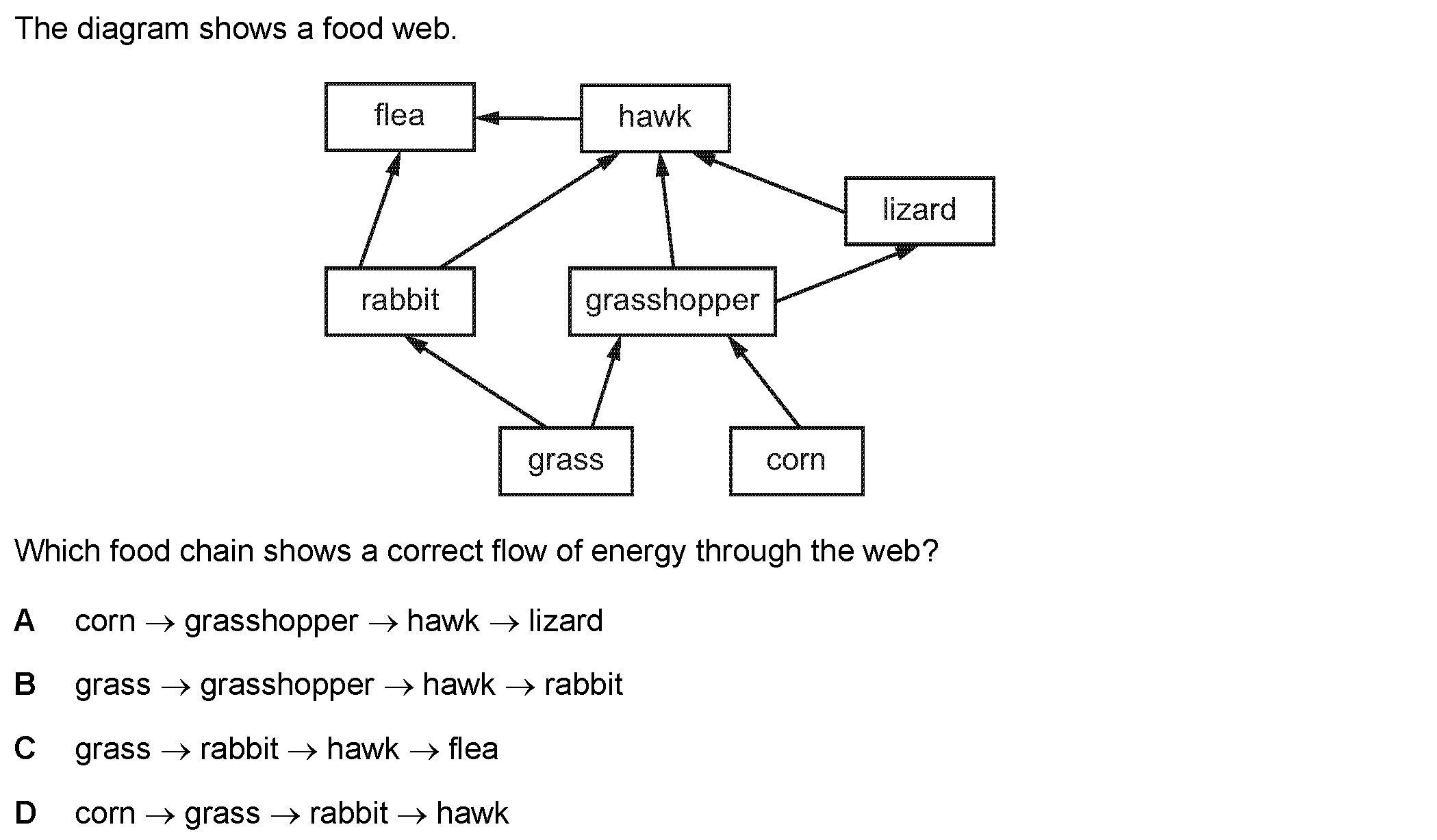
The diagram shows a food web.
lizard
aa
grasshopper
Which food chain shows a correct flow of energy through the web?
A
B
Cc
D
corn — grasshopper —> hawk – lizard
grass — grasshopper — hawk —> rabbit
grass > rabbit > hawk — flea
corn > grass > rabbit > hawk
lizard
aa
grasshopper
Which food chain shows a correct flow of energy through the web?
A
B
Cc
D
corn — grasshopper —> hawk – lizard
grass — grasshopper — hawk —> rabbit
grass > rabbit > hawk — flea
corn > grass > rabbit > hawk
Options:
A
B
C
D
Correct Key: C
A
B
C
D
Correct Key: C
Question 9
Paper Ref: 5129/12_Summer_2023_Q12
Paper Ref: 5129/12_Summer_2023_Q12
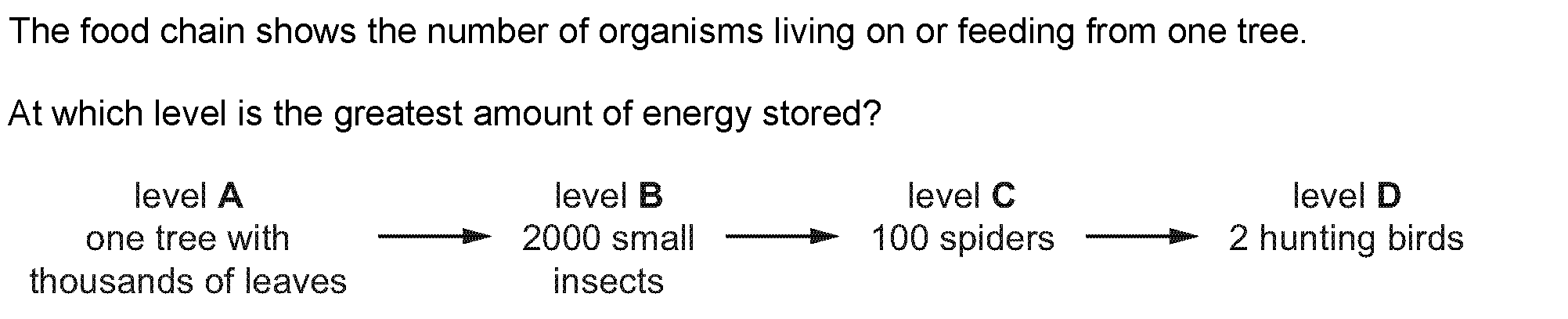
The food chain shows the number of organisms living on or feeding from one tree.
At which level is the greatest amount of energy stored?
level A level B level C level D
one tree with mente §— 2000 small ————® 100 spiders ———® 2 hunting birds
thousands of leaves insects
At which level is the greatest amount of energy stored?
level A level B level C level D
one tree with mente §— 2000 small ————® 100 spiders ———® 2 hunting birds
thousands of leaves insects
Options:
A
B
C
D
Correct Key: A
A
B
C
D
Correct Key: A
Question 10
Paper Ref: 0610/12_Winter_2021_Q36
Paper Ref: 0610/12_Winter_2021_Q36
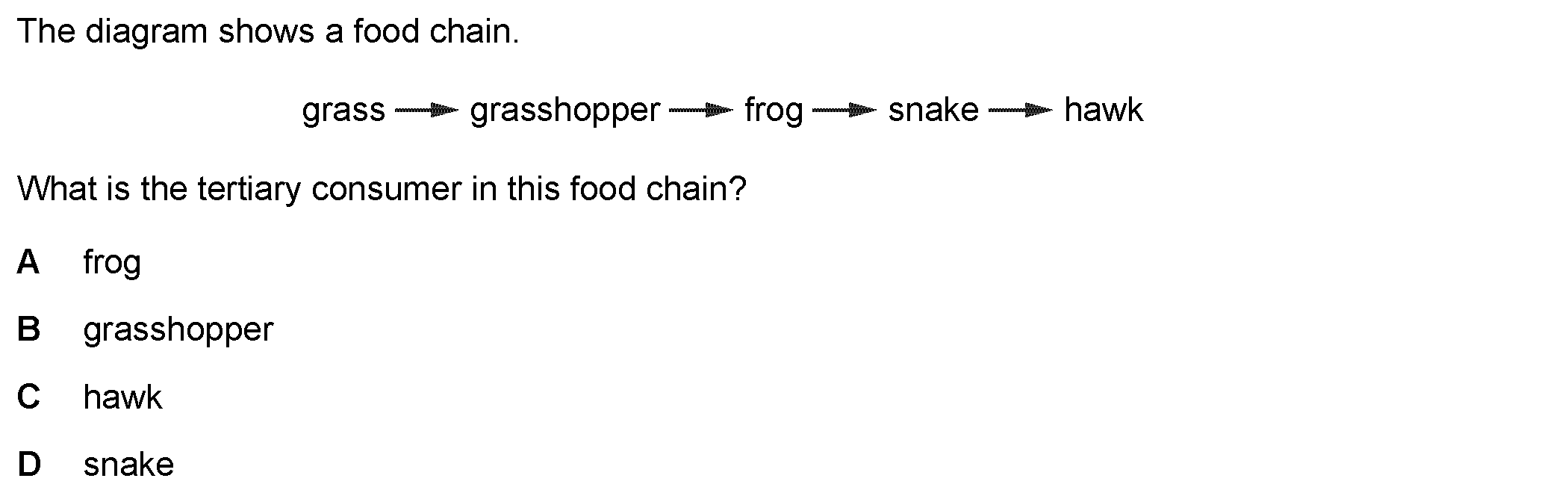
The diagram shows a food chain.
grass —~* grasshopper -—*- frog —~# snake —-# hawk
What is the tertiary consumer in this food chain?
A frog
B grasshopper
C hawk
D_ snake
grass —~* grasshopper -—*- frog —~# snake —-# hawk
What is the tertiary consumer in this food chain?
A frog
B grasshopper
C hawk
D_ snake
Options:
A
B
C
D
Correct Key: D
A
B
C
D
Correct Key: D
Question 11
Paper Ref: 0610/12_Summer_2017_Q35
Paper Ref: 0610/12_Summer_2017_Q35
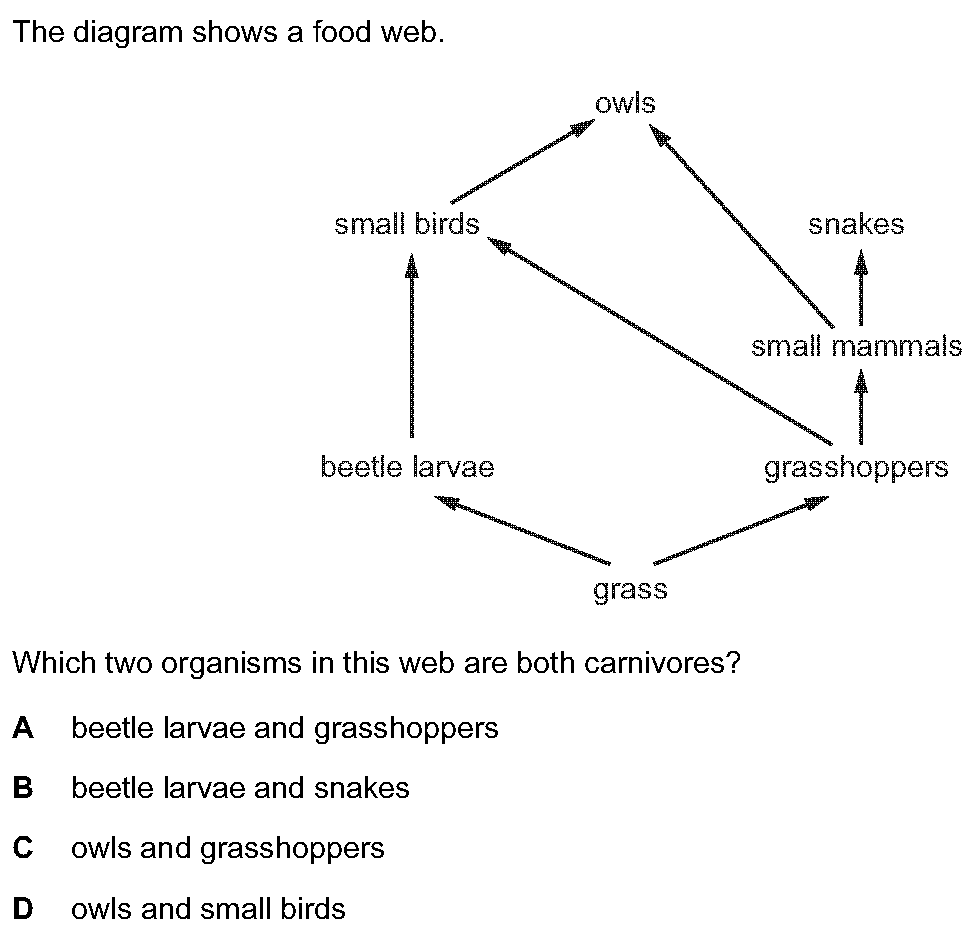
The diagram shows a food web.
owls
small birds snakes
small mammals
beetle larvae grasshoppers
NL a
grass
Which two organisms in this web are both carnivores?
beetle larvae and grasshoppers
is]
beetle larvae and snakes
Qa
owls and grasshoppers
i=]
owls and small birds
owls
small birds snakes
small mammals
beetle larvae grasshoppers
NL a
grass
Which two organisms in this web are both carnivores?
beetle larvae and grasshoppers
is]
beetle larvae and snakes
Qa
owls and grasshoppers
i=]
owls and small birds
Options:
A
B
C
D
Correct Key: D
A
B
C
D
Correct Key: D
Question 12
Paper Ref: 0610/12_Spring_2026_Q35
Paper Ref: 0610/12_Spring_2026_Q35
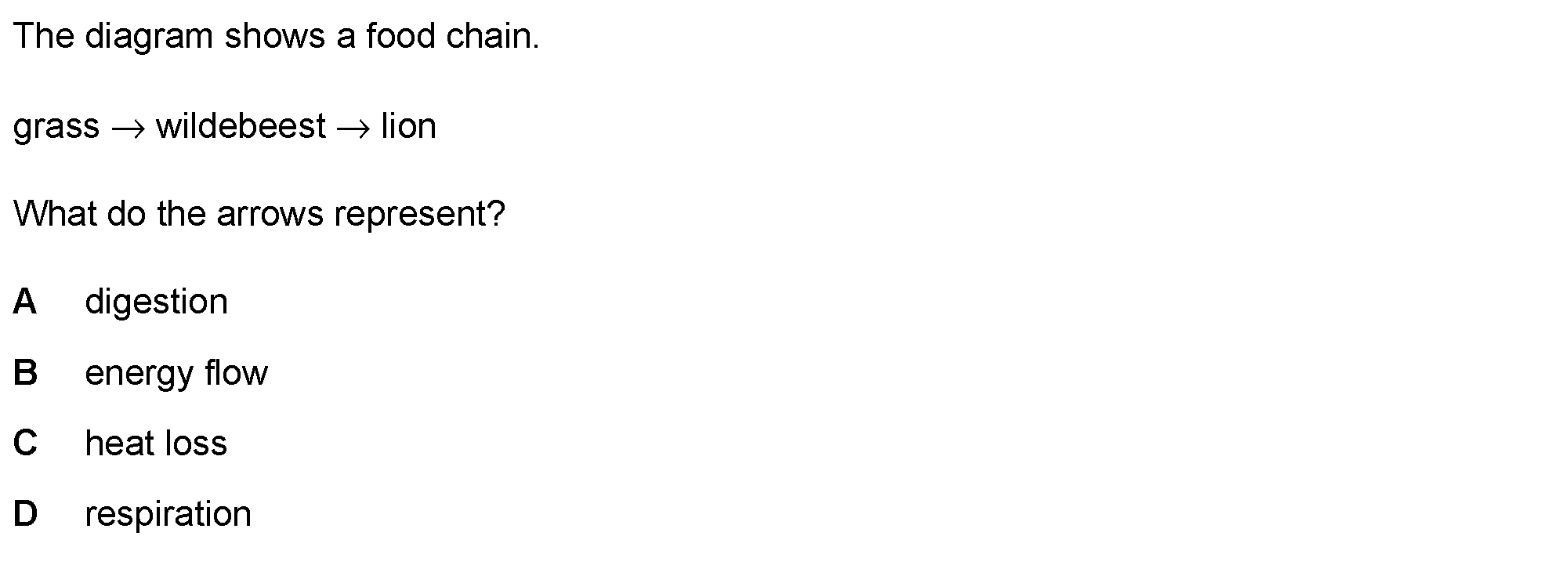
The diagram shows a food chain.
grass — wildebeest = lion
What do the arrows represent?
digestion
B- energy flow
C heat loss
D respiration
grass — wildebeest = lion
What do the arrows represent?
digestion
B- energy flow
C heat loss
D respiration
Options:
A
B
C
D
Correct Key: B
A
B
C
D
Correct Key: B
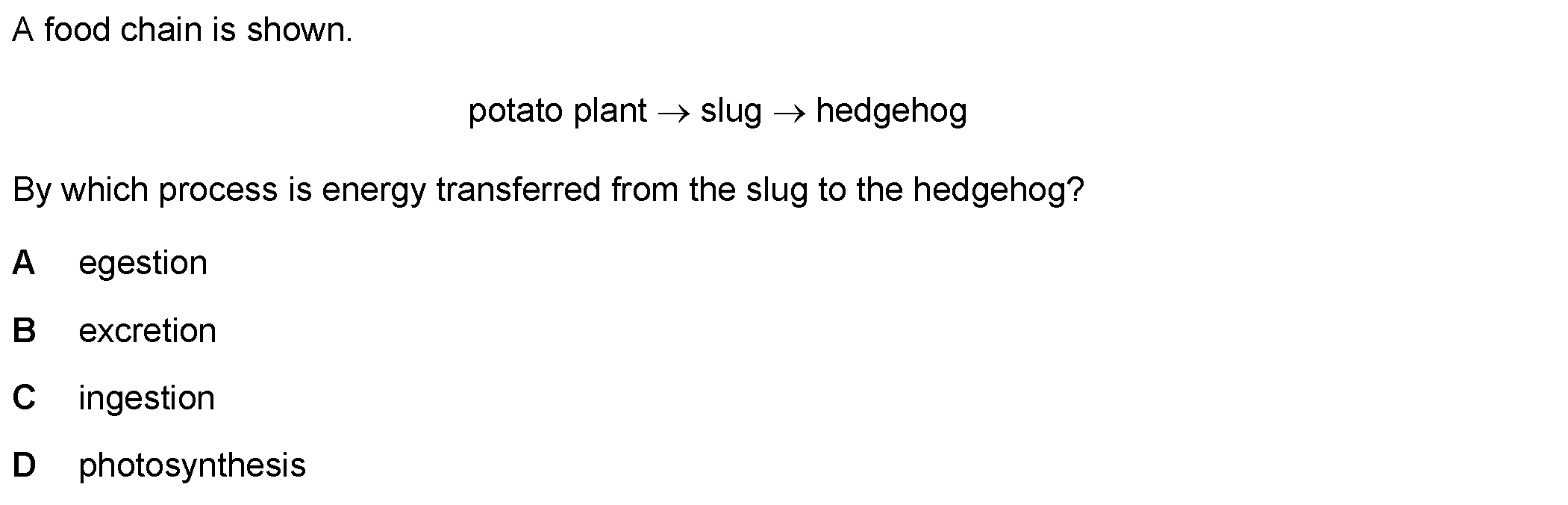
Question 13
Paper Ref: 0610/12_Winter_2020_Q35
Paper Ref: 0610/12_Winter_2020_Q35
A food chain is shown.
potato plant > slug — hedgehog
By which process is energy transferred from the slug to the hedgehog?
A egestion
B_ excretion
C ingestion
D
photosynthesis
potato plant > slug — hedgehog
By which process is energy transferred from the slug to the hedgehog?
A egestion
B_ excretion
C ingestion
D
photosynthesis
Options:
A
B
C
D
Correct Key: C
A
B
C
D
Correct Key: C
Structured Questions Mark Scheme & Answers
•1•.• • • •[•S•P• •S•7• •P•2• • •·• • •Q•4• • •P•a•r•t• •(•a•)• • •·• • •S•p•e•c•i•m•e•n• • •·• • •L•o•w•e•r• •S•e•c• •0•8•9•3•]• • • • • • •2• •a•l•l• •f•o•u•r• •o•r•g•a•n•i•s•m•s• •c•o•r•r•e•c•t• •=• •2• •m•a•r•k•s• •e•a•g•l•e• •(•j•a•g•u•a•r•)• •b•o•a• •c•o•n•s•t•r•i•c•t•o•r• •t•w•o• •o•r• •t•h•r•e•e• •o•r•g•a•n•i•s•m•s• •c•o•r•r•e•c•t• •=• •1• •m•a•r•k• •o•n•e• •o•r•g•a•n•i•s•m• •c•o•r•r•e•c•t• •=• •0• •m•a•r•k•s• •(•m•o•n•k•e•y•)• •t•a•p•i•r• •(•m•a•c•a•w•)• •s•l•o•t•h• •(•a•g•o•u•t•i•)• •(•f•r•u•i•t• •a•n•d• •n•u•t•s• •o•n• •t•h•e• •t•r•e•e•s•)•
•2•.• • • •[•S•P• •S•7• •P•2• • •·• • •Q•4• • •P•a•r•t• •(•b•)• • •·• • •S•p•e•c•i•m•e•n• • •·• • •L•o•w•e•r• •S•e•c• •0•8•9•3•]• • • • • • •e•n•e•r•g•y• •f•l•o•w• •(•t•h•r•o•u•g•h• •t•h•e• •f•o•o•d• •w•e•b•)• •1• •I•g•n•o•r•e• •r•e•f•e•r•e•n•c•e• •t•o• •w•h•a•t• •e•a•t•s• •w•h•a•t•
•3•.• • • •[•S•P• •S•7• •P•2• • •·• • •Q•4• • •P•a•r•t• •(•c•)• • •·• • •S•p•e•c•i•m•e•n• • •·• • •L•o•w•e•r• •S•e•c• •0•8•9•3•]• • • • • • •5• •1•
•4•.• • • •[•S•P• •S•7• •P•2• • •·• • •Q•4• • •P•a•r•t• •(•d•)• • •·• • •S•p•e•c•i•m•e•n• • •·• • •L•o•w•e•r• •S•e•c• •0•8•9•3•]• • • • • • •m•i•c•r•o•o•r•g•a•n•i•s•m•s• •/• •b•a•c•t•e•r•i•a• •/• •f•u•n•g•i• •1• •••c•c•e•p•t• •n•a•m•e•d• •e•x•a•m•p•l•e•s• •••c•c•e•p•t• •e•a•r•t•h•w•o•r•m•s• •/• •m•a•g•g•o•t•s• •/• •w•o•o•d•l•i•c•e• •o•r• •o•t•h•e•r• •d•e•t•r•i•t•i•v•o•r•e•s• •d•e•a•d• •m•a•t•e•r•i•a•l• •/• •d•e•c•a•y•i•n•g• •m•a•t•e•r•i•a•l• •/• •w•a•s•t•e• •m•a•t•e•r•i•a•l• •/• •d•e•a•d• •1• •l•e•a•v•e•s• •/• •d•e•a•d• •a•n•i•m•a•l•s• •/• •f•a•e•c•e•s• •©• •U•C•L•E•S• •2•0•2•0• •P•a•g•e• •5• •o•f• •1•2• •S•7•/•0•2• •S•c•i•e•n•c•e• •S•t•a•g•e• •7• •P•a•p•e•r• •2• •M•a•r•k• •S•c•h•e•m•e• •F•r•o•m• •2•0•2•0•
•5•.• • • •[•P•R•I• •2•0•0•7••• •P•1• • •·• • •Q•2• • •P•a•r•t• •(•a•)• • •·• • •2•0•0•7• • •·• • •P•r•i•m•a•r•y• •0•8•4•6•]• • • • • • •(•n•o• •p•u•b•l•i•s•h•e•d• •m•a•r•k• •s•c•h•e•m•e• •f•o•r• •t•h•i•s• •p•a•p•e•r•)•
•6•.• • • •[•P•R•I• •2•0•0•7••• •P•1• • •·• • •Q•2• • •P•a•r•t• •(•b•)• • •·• • •2•0•0•7• • •·• • •P•r•i•m•a•r•y• •0•8•4•6•]• • • • • • •(•n•o• •p•u•b•l•i•s•h•e•d• •m•a•r•k• •s•c•h•e•m•e• •f•o•r• •t•h•i•s• •p•a•p•e•r•)•
•7•.• • • •[•P•R•I• •2•0•0•7••• •P•1• • •·• • •Q•2• • •P•a•r•t• •(•c•)• • •·• • •2•0•0•7• • •·• • •P•r•i•m•a•r•y• •0•8•4•6•]• • • • • • •(•n•o• •p•u•b•l•i•s•h•e•d• •m•a•r•k• •s•c•h•e•m•e• •f•o•r• •t•h•i•s• •p•a•p•e•r•)•
•8•.• • • •[•P•R•I• •2•0•0•8•B• •P•2• • •·• • •Q•5• • •P•a•r•t• •(•a•)• • •·• • •2•0•0•8• • •·• • •P•r•i•m•a•r•y• •0•8•4•6•]• • • • • • •(•n•o• •p•u•b•l•i•s•h•e•d• •m•a•r•k• •s•c•h•e•m•e• •f•o•r• •t•h•i•s• •p•a•p•e•r•)•
Last updated:
\n