1.2Motion, Forces and Energy
Gas exchange — Question Bank (Cambridge) — Cambridge IGCSE Physics 0625 Revision Notes & Topical Questions
15 min read Lesson 10 of 91 Unit quiz
Cambridge Past Paper Bank
1.2 Gas exchange
15 Multiple-Choice Questions with Official Mark Schemes
Question 1
0610/22_Winter_2013_Q18
Question 2
0610/21_Winter_2013_Q20
Question 3
0610/12_Summer_2023_Q23
Question 4
5129/12_Summer_2023_Q5
Question 5
0610/22_Winter_2019_Q19
Question 6
5129/12_Winter_2022_Q8
Question 7
0610/22_Winter_2023_Q21
Question 8
0610/22_Spring_2020_Q22
Question 9
0610/22_Winter_2009_Q7
Question 10
5129/12_Summer_2025_Q7
Question 11
5129/12_Winter_2025_Q7
Question 12
0610/11_Winter_2017_Q22
Question 13
0610/13_Winter_2025_Q9
Question 14
5129/12_Summer_2024_Q5
Question 15
0610/22_Spring_2022_Q20
Cambridge Lower Secondary Stage 8
1.2 Gas exchange – Complete Question Bank & Mark Scheme
Total Questions15 Questions with Verified Solutions & Past Paper Mark Schemes
Multiple Choice Questions (Exam Practice)
Question 1
Paper Ref: 0610/22_Winter_2013_Q18
Paper Ref: 0610/22_Winter_2013_Q18
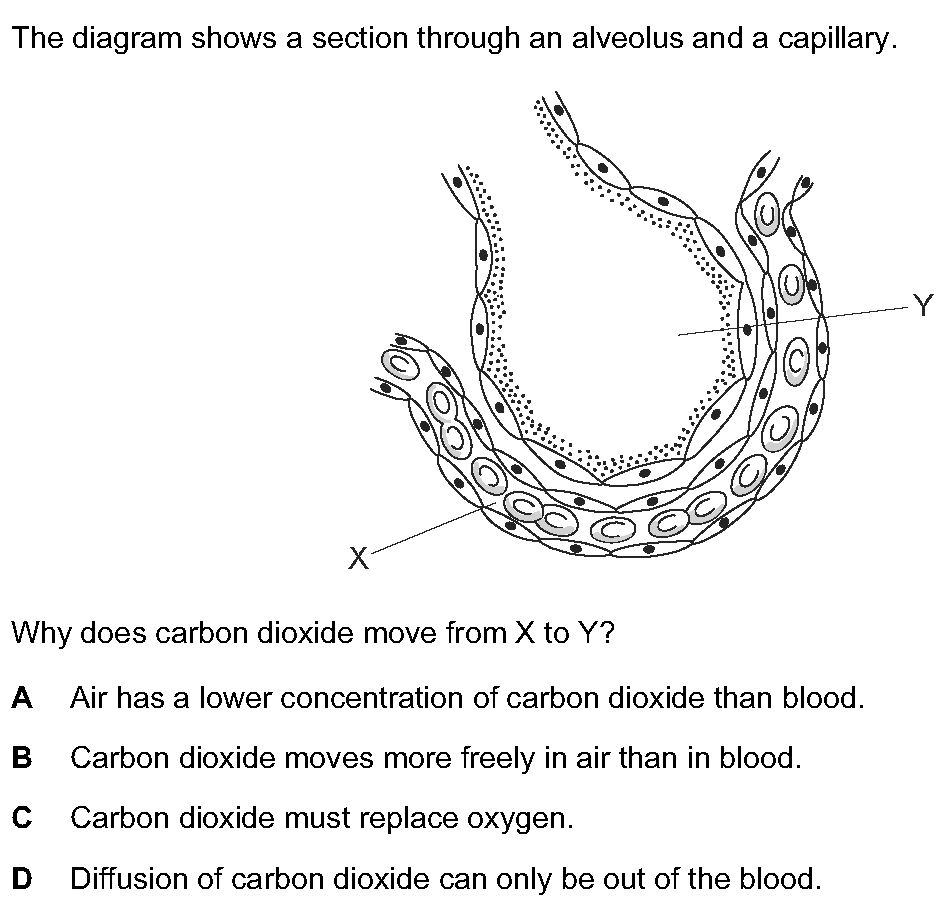
The diagram shows a section through an alveolus and a capillary.
Why does carbon dioxide move from X to Y?
Air has a lower concentration of carbon dioxide than blood.
is]
Carbon dioxide moves more freely in air than in blood.
Qa
Carbon dioxide must replace oxygen.
D Diffusion of carbon dioxide can only be out of the blood.
Why does carbon dioxide move from X to Y?
Air has a lower concentration of carbon dioxide than blood.
is]
Carbon dioxide moves more freely in air than in blood.
Qa
Carbon dioxide must replace oxygen.
D Diffusion of carbon dioxide can only be out of the blood.
Options:
A
B
C
D
Correct Key: A
A
B
C
D
Correct Key: A
Question 2
Paper Ref: 0610/21_Winter_2013_Q20
Paper Ref: 0610/21_Winter_2013_Q20
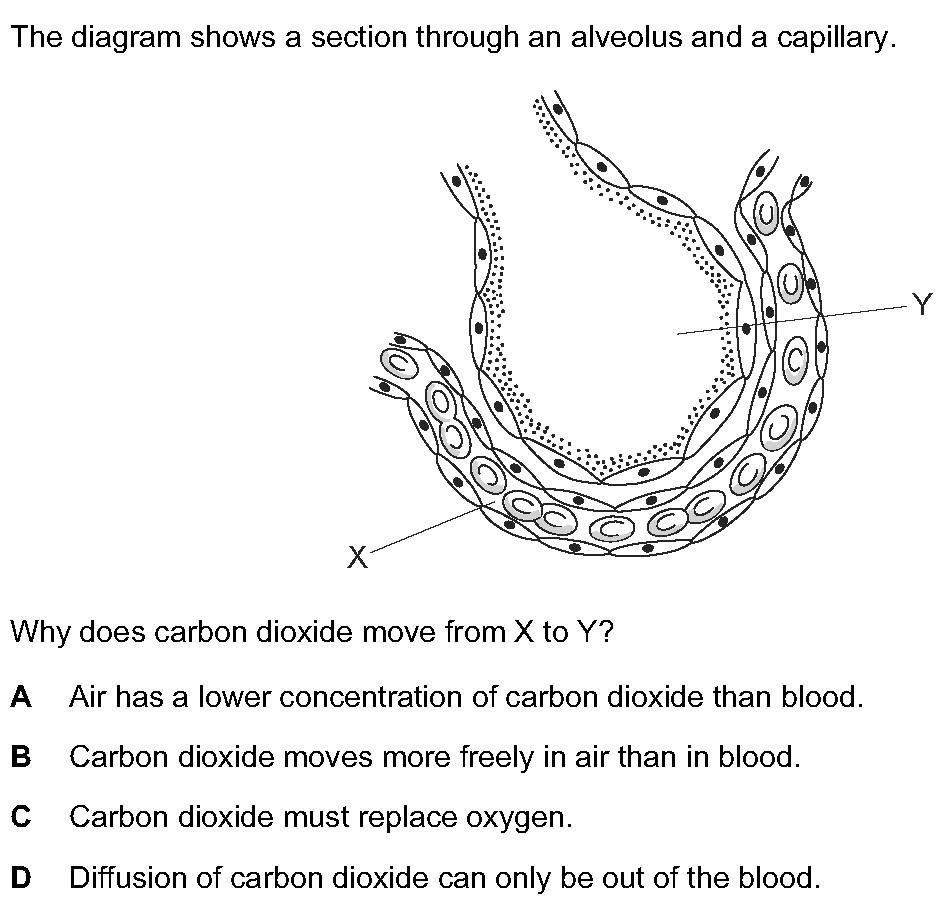
The diagram shows a section through an alveolus and a capillary.
Why does carbon dioxide move from X to Y?
A Air has a lower concentration of carbon dioxide than blood.
B Carbon dioxide moves more freely in air than in blood.
C Carbon dioxide must replace oxygen.
D
Diffusion of carbon dioxide can only be out of the blood.
Why does carbon dioxide move from X to Y?
A Air has a lower concentration of carbon dioxide than blood.
B Carbon dioxide moves more freely in air than in blood.
C Carbon dioxide must replace oxygen.
D
Diffusion of carbon dioxide can only be out of the blood.
Options:
A
B
C
D
Correct Key: A
A
B
C
D
Correct Key: A
Question 3
Paper Ref: 0610/12_Summer_2023_Q23
Paper Ref: 0610/12_Summer_2023_Q23
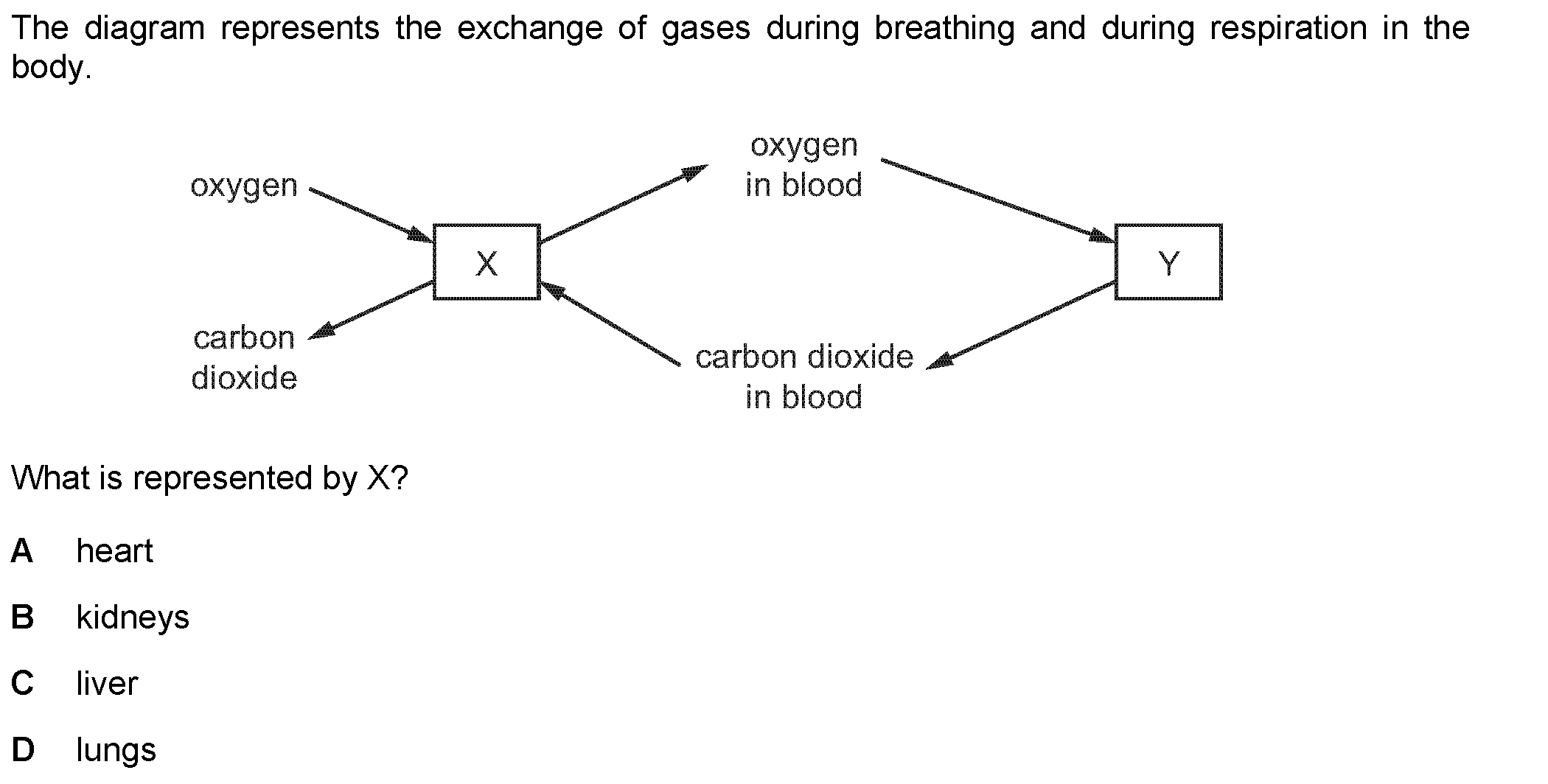
The diagram represents the exchange of gases during breathing and during respiration in the
body.
oxygen
oxygen in blood
carbon dioxide
in blood
carbon
dioxide
What is represented by X?
A heart
B_ kidneys
C siiver
D lungs
body.
oxygen
oxygen in blood
carbon dioxide
in blood
carbon
dioxide
What is represented by X?
A heart
B_ kidneys
C siiver
D lungs
Options:
A
B
C
D
Correct Key: D
A
B
C
D
Correct Key: D
Question 4
Paper Ref: 5129/12_Summer_2023_Q5
Paper Ref: 5129/12_Summer_2023_Q5
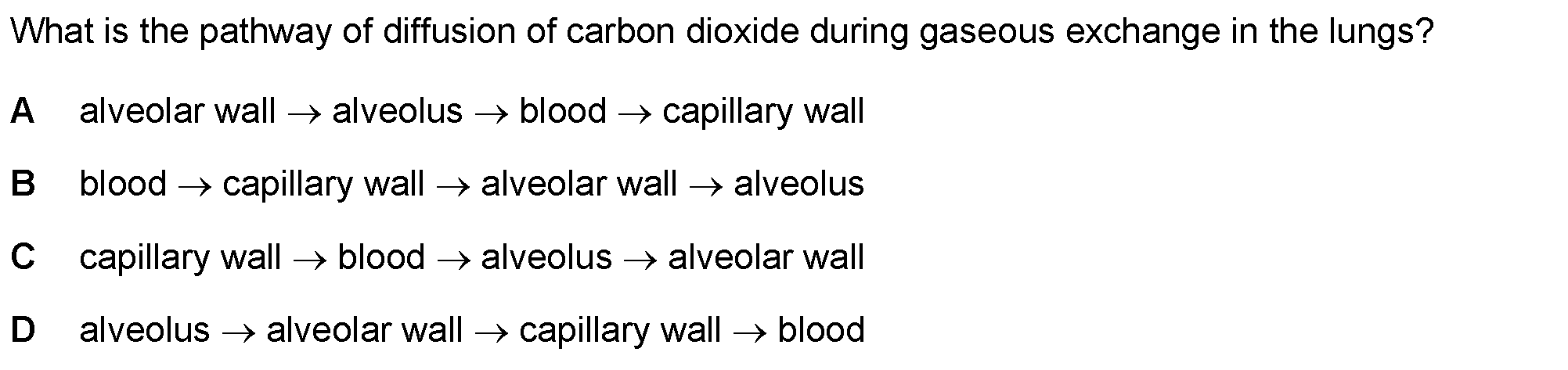
What is the pathway of diffusion of carbon dioxide during gaseous exchange in the lungs?
A alveolar wall > alveolus — blood > capillary wall
B_ blood > capillary wall > alveolar wall > alveolus
C_ capillary wall > blood —> alveolus — alveolar wall
D
alveolus — alveolar wall > capillary wall > blood
A alveolar wall > alveolus — blood > capillary wall
B_ blood > capillary wall > alveolar wall > alveolus
C_ capillary wall > blood —> alveolus — alveolar wall
D
alveolus — alveolar wall > capillary wall > blood
Options:
A
B
C
D
Correct Key: B
A
B
C
D
Correct Key: B
Question 5
Paper Ref: 0610/22_Winter_2019_Q19
Paper Ref: 0610/22_Winter_2019_Q19
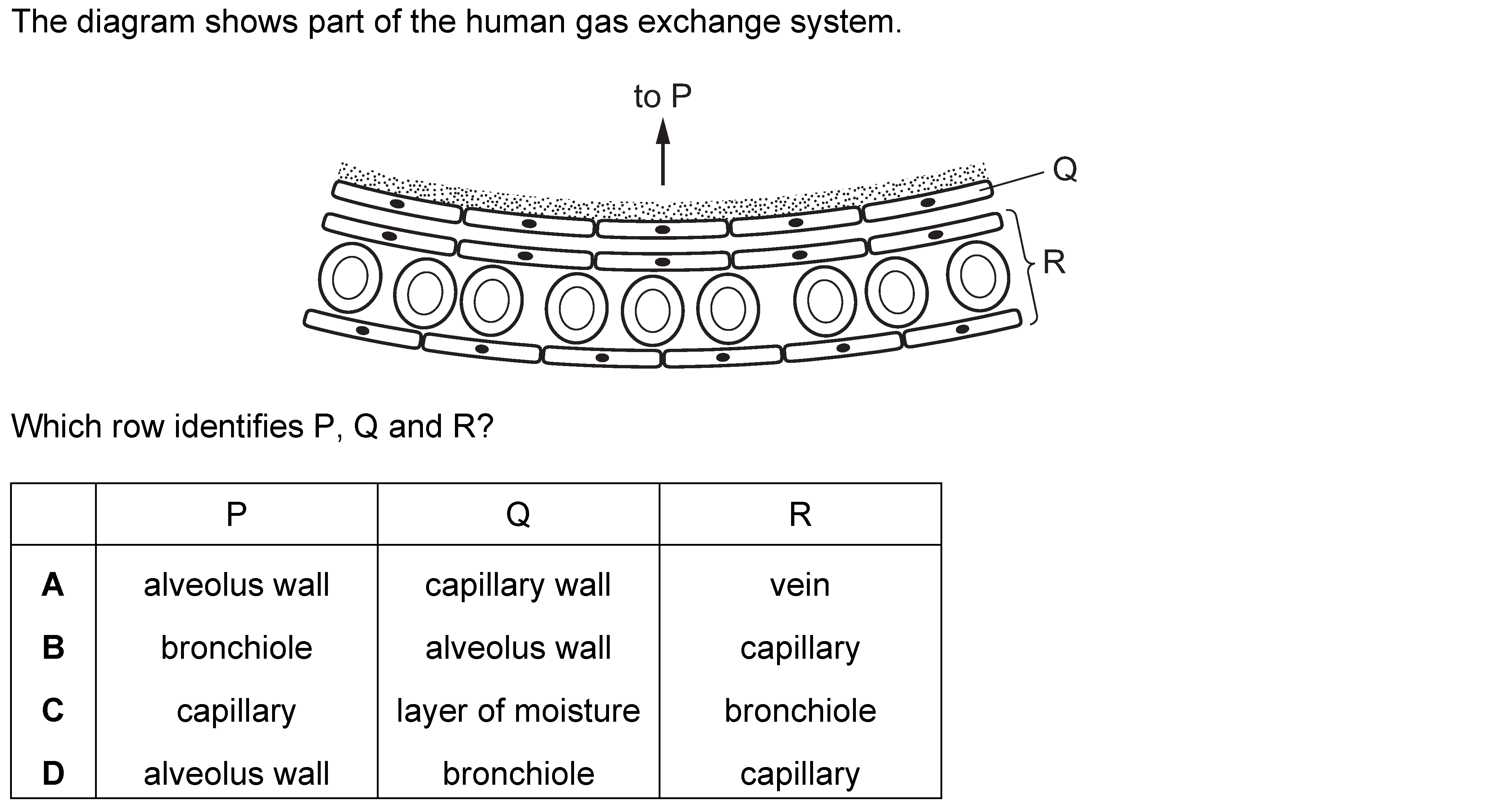
The diagram shows part of the human gas exchange system.
alveolus wall capillary wall vein
bronchiole alveolus wall capillary
capillary layer of moisture bronchiole
alveolus wall bronchiole capillary
alveolus wall capillary wall vein
bronchiole alveolus wall capillary
capillary layer of moisture bronchiole
alveolus wall bronchiole capillary
Options:
A
B
C
D
Correct Key: B
A
B
C
D
Correct Key: B
Question 6
Paper Ref: 5129/12_Winter_2022_Q8
Paper Ref: 5129/12_Winter_2022_Q8
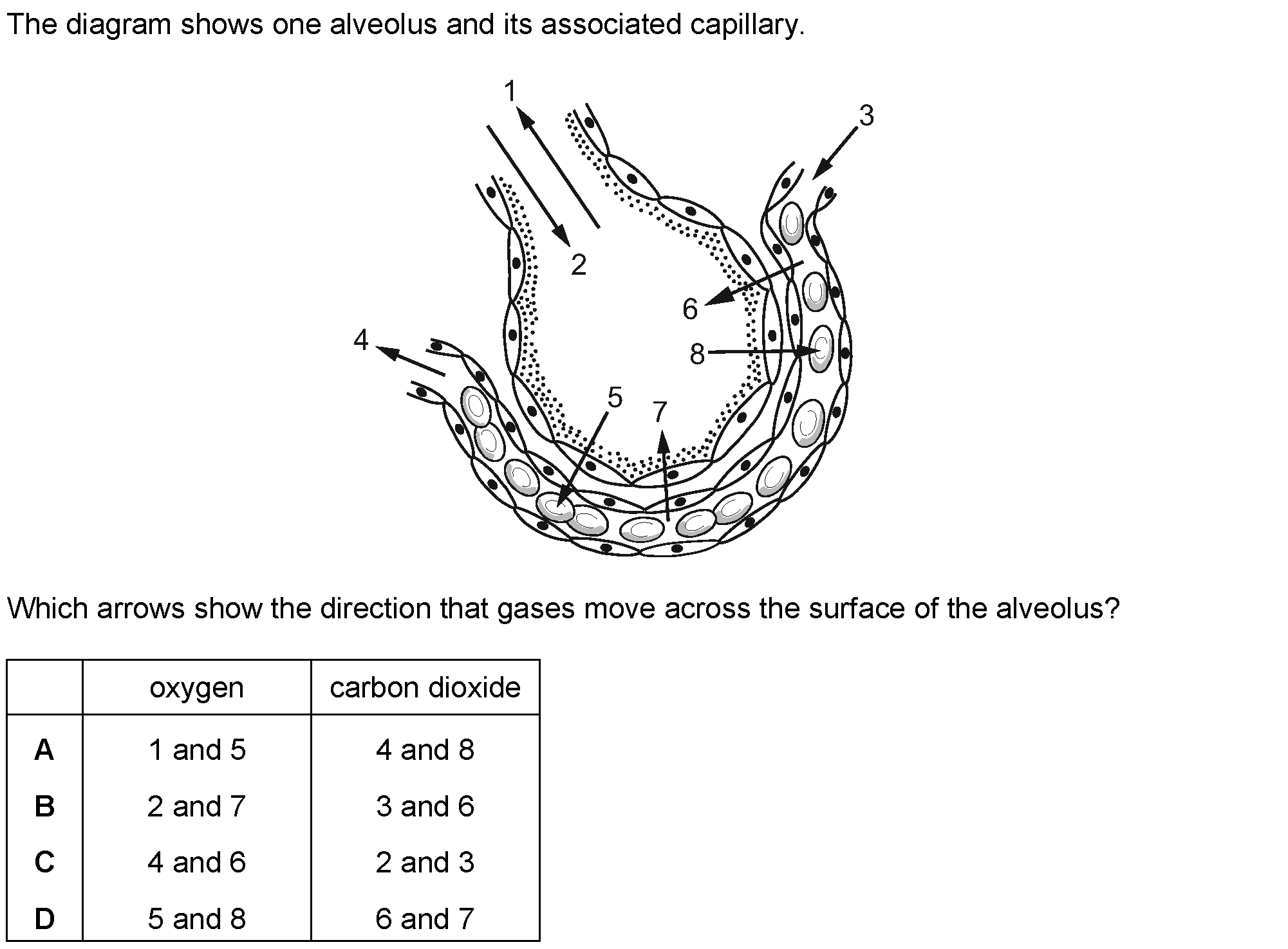
The diagram shows one alveolus and its associated capillary.
Which arrows show the direction that gases move across the surface of the alveolus?
[agen [eaten doxae
A
Which arrows show the direction that gases move across the surface of the alveolus?
[agen [eaten doxae
A
Options:
A
B
C
D
Correct Key: D
A
B
C
D
Correct Key: D
Question 7
Paper Ref: 0610/22_Winter_2023_Q21
Paper Ref: 0610/22_Winter_2023_Q21
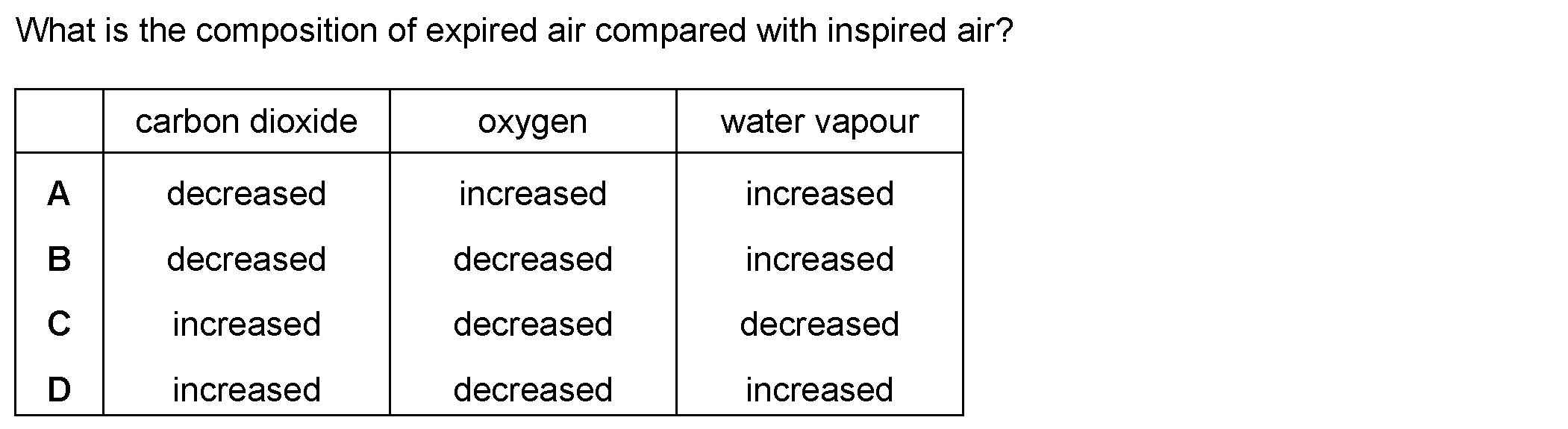
What is the composition of expired air compared with inspired air?
— carbon dioxide oxygen water vapour
decreased increased increased
decreased decreased increased
increased decreased decreased
increased decreased increased
— carbon dioxide oxygen water vapour
decreased increased increased
decreased decreased increased
increased decreased decreased
increased decreased increased
Options:
A
B
C
D
Correct Key: D
A
B
C
D
Correct Key: D
Question 8
Paper Ref: 0610/22_Spring_2020_Q22
Paper Ref: 0610/22_Spring_2020_Q22
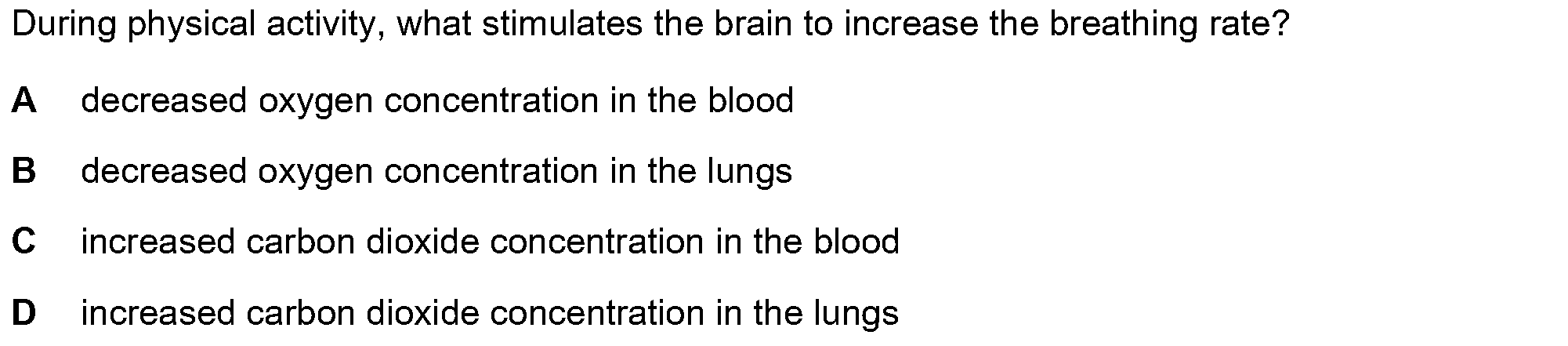
During physical activity, what stimulates the brain to increase the breathing rate?
A
B
Cc
D
decreased oxygen concentration in the blood
decreased oxygen concentration in the lungs
increased carbon dioxide concentration in the blood
increased carbon dioxide concentration in the lungs
A
B
Cc
D
decreased oxygen concentration in the blood
decreased oxygen concentration in the lungs
increased carbon dioxide concentration in the blood
increased carbon dioxide concentration in the lungs
Options:
A
B
C
D
Correct Key: C
A
B
C
D
Correct Key: C
Question 9
Paper Ref: 0610/22_Winter_2009_Q7
Paper Ref: 0610/22_Winter_2009_Q7
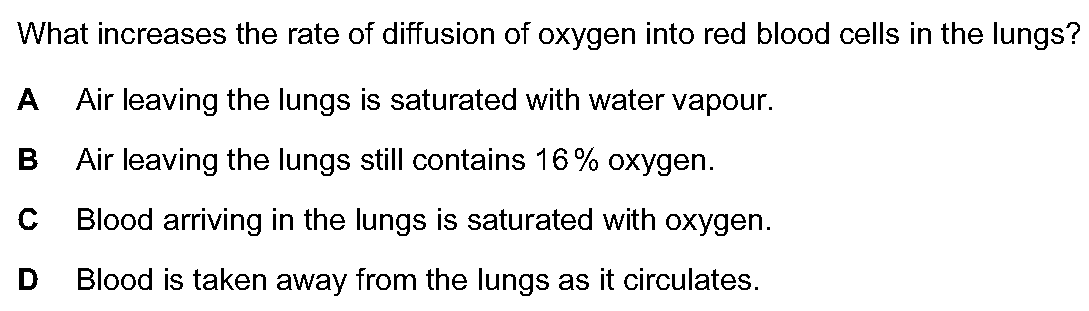
What increases the rate of diffusion of oxygen into red blood cells in the lungs?
oo BD
Air leaving the lungs is saturated with water vapour.
Air leaving the lungs still contains 16% oxygen.
Blood arriving in the lungs is saturated with oxygen.
Blood is taken away from the lungs as it circulates.
oo BD
Air leaving the lungs is saturated with water vapour.
Air leaving the lungs still contains 16% oxygen.
Blood arriving in the lungs is saturated with oxygen.
Blood is taken away from the lungs as it circulates.
Options:
A
B
C
D
Correct Key: D
A
B
C
D
Correct Key: D
Question 10
Paper Ref: 5129/12_Summer_2025_Q7
Paper Ref: 5129/12_Summer_2025_Q7
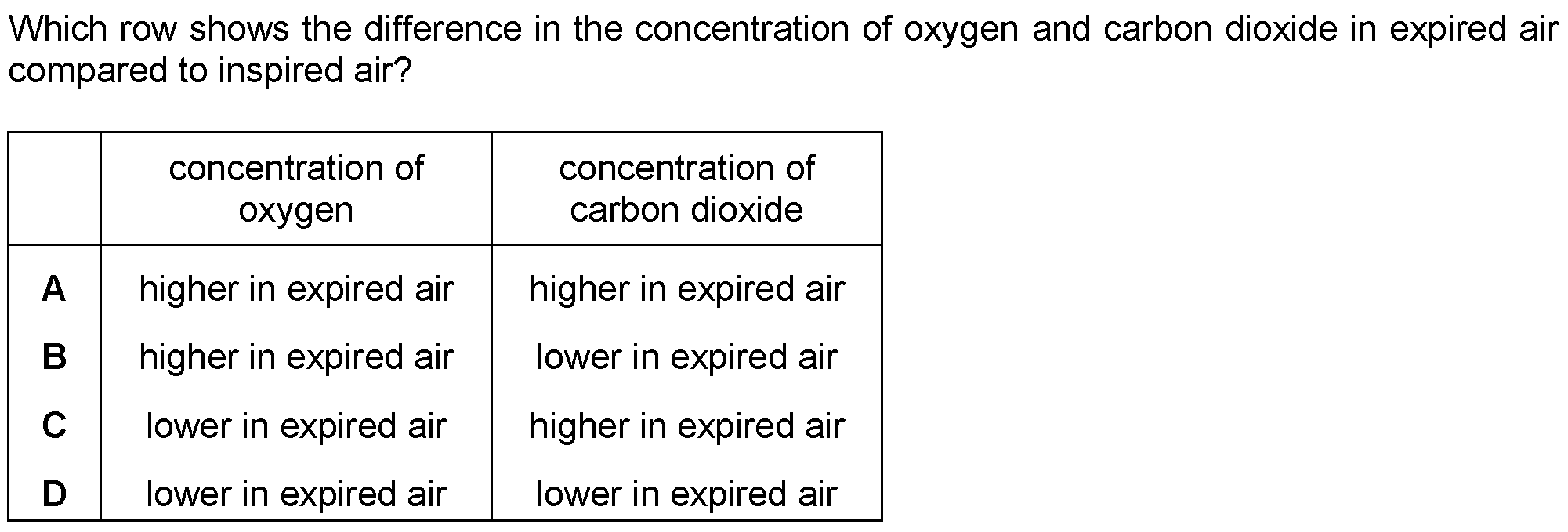
Which row shows the difference in the concentration of oxygen and carbon dioxide in expired air
compared to inspired air?
concentration of concentration of
oxygen carbon dioxide
higher in expired air higher in expired air
higher in expired air lower in expired air
lower in expired air higher in expired air
lower in expired air lower in expired air
compared to inspired air?
concentration of concentration of
oxygen carbon dioxide
higher in expired air higher in expired air
higher in expired air lower in expired air
lower in expired air higher in expired air
lower in expired air lower in expired air
Options:
A
B
C
D
Correct Key: C
A
B
C
D
Correct Key: C
Question 11
Paper Ref: 5129/12_Winter_2025_Q7
Paper Ref: 5129/12_Winter_2025_Q7
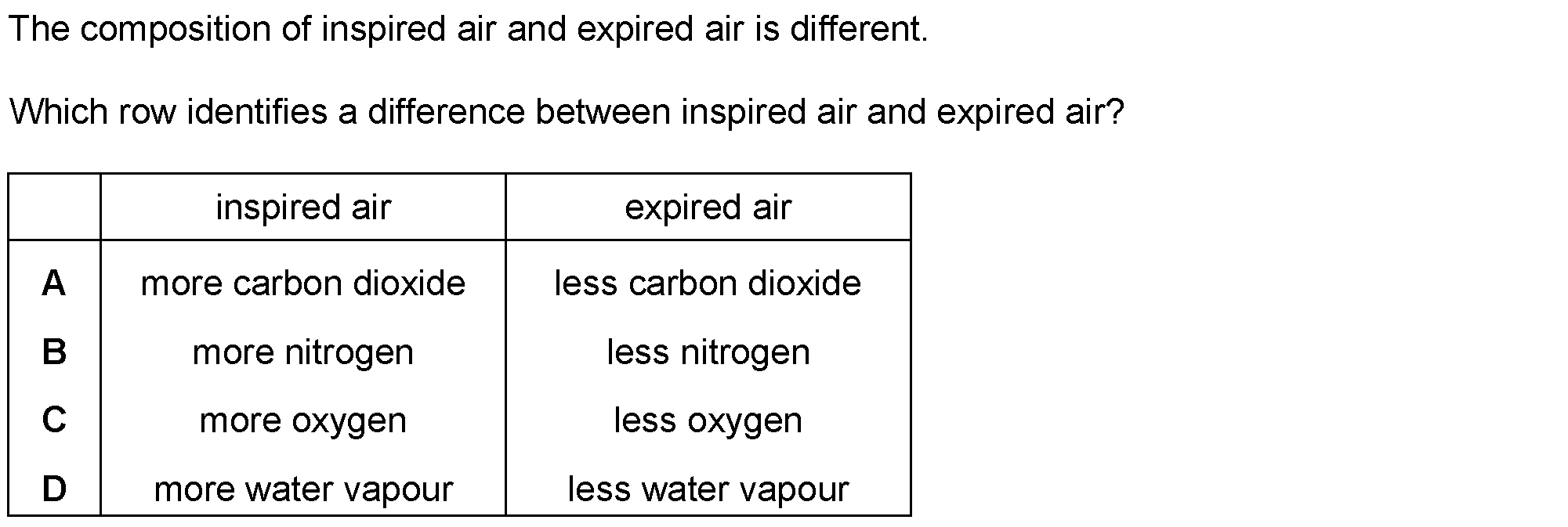
The composition of inspired air and expired air is different.
Which row identifies a difference between inspired air and expired air?
— inspired air expired air
more carbon dioxide less carbon dioxide
more nitrogen less nitrogen
more oxygen less oxygen
more water vapour less water vapour
Which row identifies a difference between inspired air and expired air?
— inspired air expired air
more carbon dioxide less carbon dioxide
more nitrogen less nitrogen
more oxygen less oxygen
more water vapour less water vapour
Options:
A
B
C
D
Correct Key: C
A
B
C
D
Correct Key: C
Question 12
Paper Ref: 0610/11_Winter_2017_Q22
Paper Ref: 0610/11_Winter_2017_Q22
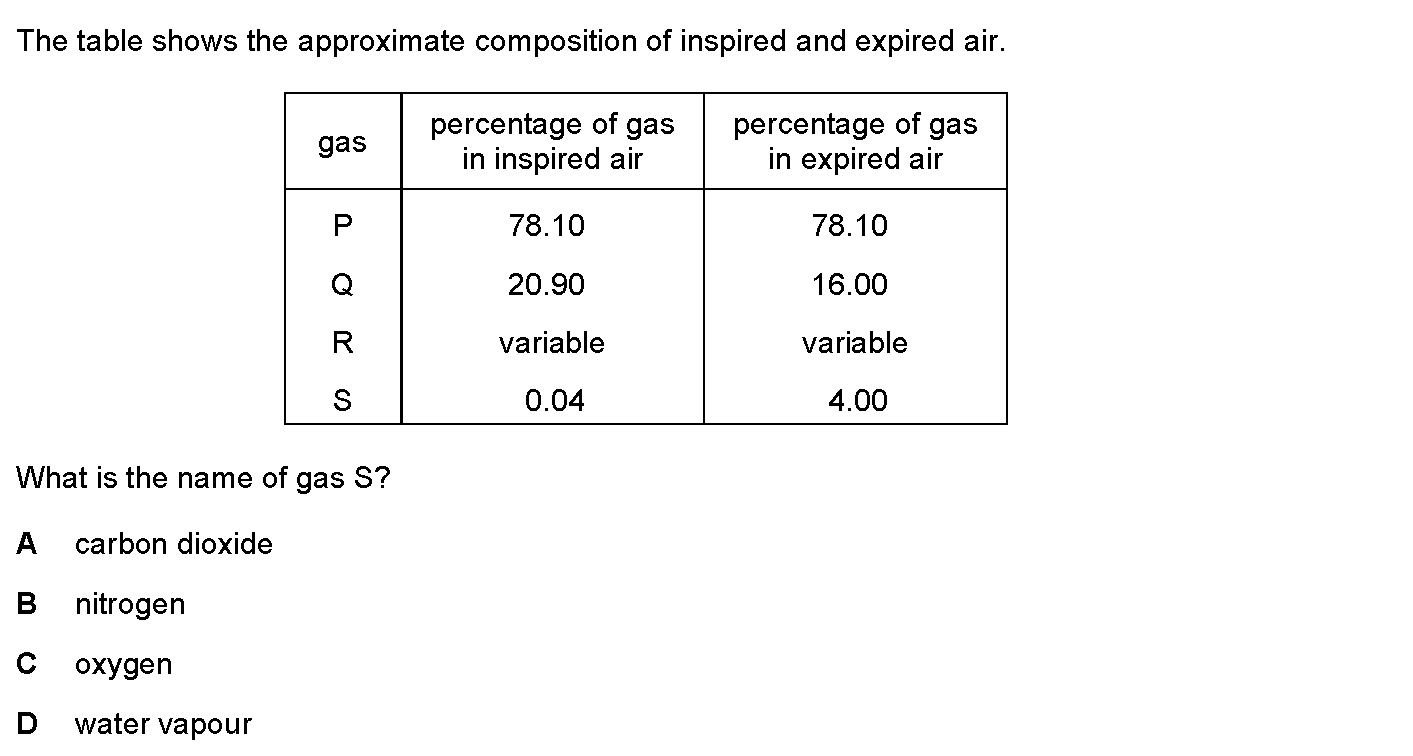
The table shows the approximate composition of inspired and expired air.
percentage of gas percentage of gas
gas cs : : : :
in inspired air in expired air
P 78.10 78.10
Q 20.90 16.00
R variable variable
Ss 0.04 4.00
What is the name of gas S?
A carbon dioxide
B nitrogen
C oxygen
D
water vapour
percentage of gas percentage of gas
gas cs : : : :
in inspired air in expired air
P 78.10 78.10
Q 20.90 16.00
R variable variable
Ss 0.04 4.00
What is the name of gas S?
A carbon dioxide
B nitrogen
C oxygen
D
water vapour
Options:
A
B
C
D
Correct Key: A
A
B
C
D
Correct Key: A
Question 13
Paper Ref: 0610/13_Winter_2025_Q9
Paper Ref: 0610/13_Winter_2025_Q9
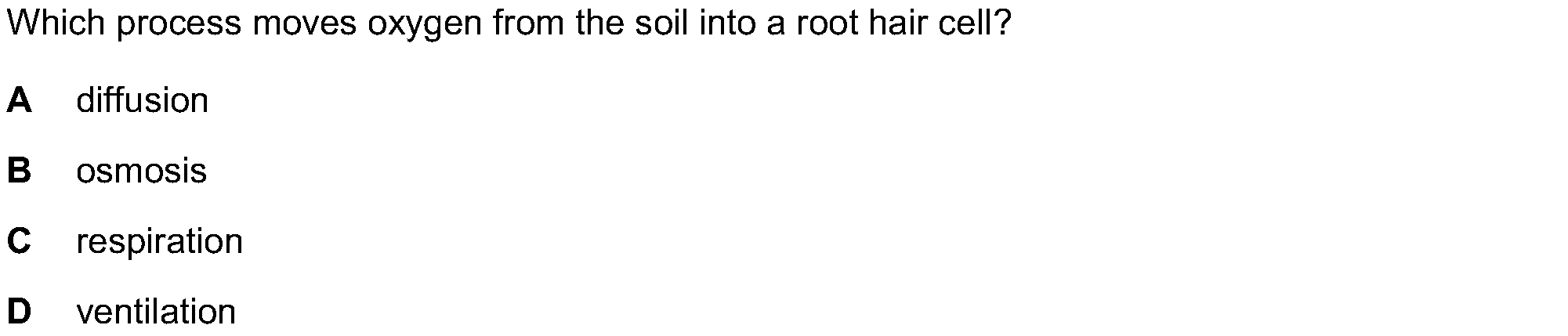
Which process moves oxygen from the soil into a root hair cell?
A diffusion
B osmosis
C_ respiration
D ventilation
A diffusion
B osmosis
C_ respiration
D ventilation
Options:
A
B
C
D
Correct Key: A
A
B
C
D
Correct Key: A
Question 14
Paper Ref: 5129/12_Summer_2024_Q5
Paper Ref: 5129/12_Summer_2024_Q5
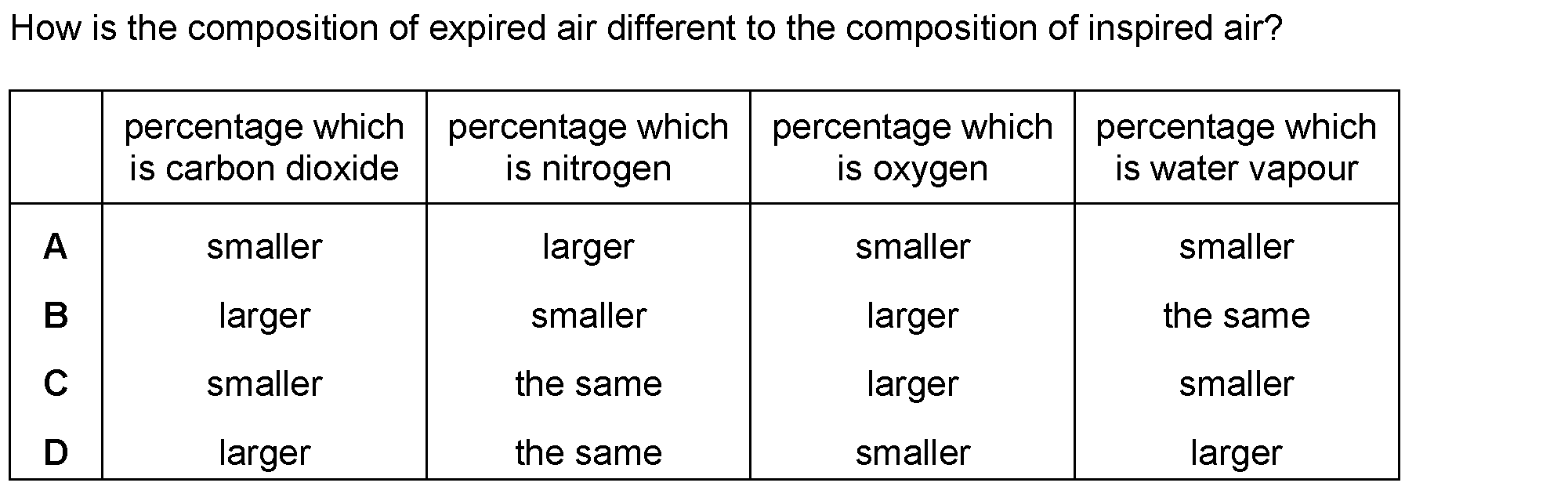
How is the composition of expired air different to the composition of inspired air?
percentage which | percentage which | percentage which | percentage which
is carbon dioxide is nitrogen is oxygen is water vapour
smaller larger smaller smaller
larger smaller larger the same
smaller the same larger smaller
larger the same smaller larger
percentage which | percentage which | percentage which | percentage which
is carbon dioxide is nitrogen is oxygen is water vapour
smaller larger smaller smaller
larger smaller larger the same
smaller the same larger smaller
larger the same smaller larger
Options:
A
B
C
D
Correct Key: D
A
B
C
D
Correct Key: D
Question 15
Paper Ref: 0610/22_Spring_2022_Q20
Paper Ref: 0610/22_Spring_2022_Q20
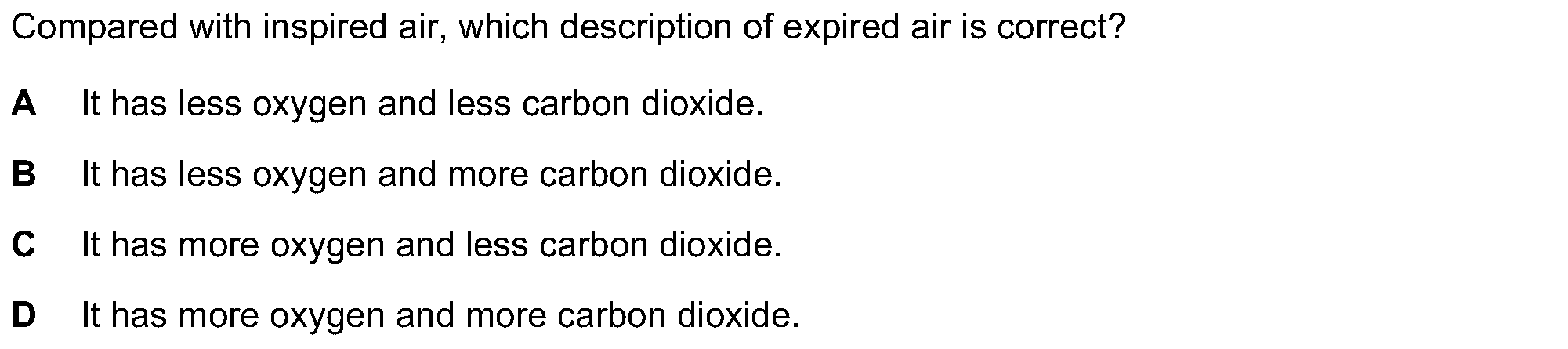
Compared with inspired air, which description of expired air is correct?
A
B
Cc
D
It has less oxygen and less carbon dioxide.
It has less oxygen and more carbon dioxide.
It has more oxygen and less carbon dioxide.
It has more oxygen and more carbon dioxide.
A
B
Cc
D
It has less oxygen and less carbon dioxide.
It has less oxygen and more carbon dioxide.
It has more oxygen and less carbon dioxide.
It has more oxygen and more carbon dioxide.
Options:
A
B
C
D
Correct Key: B
A
B
C
D
Correct Key: B
Structured Questions Mark Scheme & Answers
•1•.• • • •[•P•R•I• •2•0•1•9•C• •P•1• • •·• • •Q•1•1• • •P•a•r•t• •(•c•)• • •·• • •2•0•1•9• • •·• • •P•r•i•m•a•r•y• •0•8•4•6•]• • • • • • •p•l•a•n•t•s• •i•n• •t•h•e• •l•i•g•h•t• •p•l•a•n•t•s• •i•n• •t•h•e• •d•a•r•k• •2• •••n•s•w•e•r•s• •m•u•s•t• •b•e• •c•o•m•p•a•r•a•t•i•v•e• •e•.•g•.• •t•h•e• •p•l•a•n•t•s• •i•n• •t•h•e• •d•a•r•k• •g•r•e•w• •t•a•l•l•e•r• •/• •p•l•a•n•t•s• •i•n• •••s•s•e•m•b•l•e•d• •b•y• •N•.•S•.• •s•t•r•a•i•g•h•t•(•e•r•)• •/• •n•o•t• •b•e•n•t• •/• •g•r•o•w•n• •g•r•o•w•i•n•g• •i•n• •d•i•f•f•e•r•e•n•t• •d•i•r•e•c•t•i•o•n•s• •/• •l•i•g•h•t• •a•r•e• •s•h•o•r•t• •a•n•d• •p•l•a•n•t•s• •i•n• •d•a•r•k• •a•r•e• •l•o•n•g• •u•p•w•a•r•d•s• •/• •u•p•r•i•g•h•t• •b•e•n•t• •/• •l•o•p•s•i•d•e•d• •/• •d•r•o•o•p•i•n•g• •/• •n•o•t• •u•p•r•i•g•h•t• •D•o• •n•o•t• •a•c•c•e•p•t• •i•n•c•o•r•r•e•c•t• •c•o•m•p•a•r•i•s•o•n•s• •s•t•r•o•n•g•(•e•r•)• •w•e•a•k•(•e•r•)• •e•.•g•.• •p•l•a•n•t•s• •i•n• •d•a•r•k• •a•r•e• •s•h•o•r•t•e•r• •l•a•r•g•e•(•r•)• •l•e•a•v•e•s• •s•m•a•l•l•(•e•r•)• •l•e•a•v•e•s• •d•a•r•k•(•e•r•)• •c•o•l•o•u•r• •/• •g•r•e•e•n•(•e•r•)• •l•i•g•h•t•(•e•r•)• •c•o•l•o•u•r• •/• •p•a•l•e•(•r•)• •/• •y•e•l•l•o•w•(•e•r•)• •/• •w•h•i•t•e•(•r•)• •/• •n•o•t• •g•r•e•e•n• •s•h•o•r•t•(•e•r•)• •/• •s•m•a•l•l•(•e•r•)• •l•o•n•g•(•e•r•)• •/• •t•a•l•l•(•e•r•)• •/• •b•i•g•(•g•e•r•)• •t•h•i•n•(•n•e•r•)• •s•t•e•m•s• •t•h•i•c•k•(•e•r•)• •s•t•e•m•s• •f•e•w•(•e•r•)• •p•l•a•n•t•s• •/• •f•e•w•(•e•r•)• •s•e•e•d•s• •m•o•r•e• •p•l•a•n•t•s• •/• •m•o•r•e• •s•e•e•d•s• •g•e•r•m•i•n•a•t•e•d• •g•e•r•m•i•n•a•t•e•d• •(•i•d•e•a• •t•h•a•t• •i•t• •i•s•)• •t•o• •c•o•l•l•e•c•t• •e•n•o•u•g•h• •r•e•s•u•l•t•s• •/• •t•o• •m•a•k•e• •i•t• •r•e•l•i•a•b•l•e• •1• •••c•c•e•p•t• •t•o• •g•e•t• •s•u•f•f•i•c•i•e•n•t• •e•v•i•d•e•n•c•e• •/• •t•o• •g•e•t• •a•n• •a•v•e•r•a•g•e• •/• •t•o• •c•h•e•c•k• •t•h•e• •r•e•s•u•l•t• •(•i•s• •c•o•r•r•e•c•t•)• •/• •i•n• •c•a•s•e• •s•o•m•e• •d•o• •n•o•t• •g•r•o•w• •D•o• •n•o•t• •a•c•c•e•p•t• •f•a•i•r• •t•e•s•t• •/• •t•o• •m•a•k•e• •i•t• •(•m•o•r•e•)• •a•c•c•u•r•a•t•e• •f•o•r• •e•n•e•r•g•y• •/• •t•o• •g•r•o•w• •/• •t•o• •m•a•k•e• •f•o•o•d• •1• •5•7•/•3•8•4•
•2•.• • • •[•C•P• •M•a•y• •2•0•2•4• •P•1• • •·• • •Q•6• • •·• • •2•0•2•4• • •·• • •L•o•w•e•r• •S•e•c• •0•8•9•3•]• • • • • • •(•n•o• •p•u•b•l•i•s•h•e•d• •m•a•r•k• •s•c•h•e•m•e• •f•o•r• •t•h•i•s• •p•a•p•e•r•)•
•3•.• • • •[•P•T• •S•7• •2•0•2•3• •P•2• • •·• • •Q•6• • •·• • •2•0•2•3• • •·• • •L•o•w•e•r• •S•e•c• •s•o•u•r•c•e• •a•d•d•i•t•i•o•n•]• • • • • • •N•o• •m•a•t•c•h•i•n•g• •m•a•r•k•-•s•c•h•e•m•e• •e•n•t•r•y• •w•a•s• •f•o•u•n•d• •i•n• •M•a•r•k•_•S•c•h•e•m•e•s•.•d•o•c•x•.•
•4•.• • • •[•P•T• •S•8• •2•0•2•5• •P•2• • •·• • •Q•1• • •P•a•r•t• •(•c•)• • •·• • •2•0•2•5• • •·• • •L•o•w•e•r• •S•e•c• •0•8•9•3•]• • • • • • •a•n•y• •t•w•o• •f•r•o•m• •2• •e•a•c•h• •c•o•r•r•e•c•t• •a•n•s•w•e•r• •=• •1• •m•a•r•k• •r•e•s•p•i•r•a•t•i•o•n• •i•s• •a• •c•h•e•m•i•c•a•l• •r•e•a•c•t•i•o•n• •a•n•d• •b•r•e•a•t•h•i•n•g• •i•s• •a• •••c•c•e•p•t• •b•r•e•a•t•h•i•n•g• •i•s• •p•h•y•s•i•c•a•l• •p•r•o•c•e•s•s• •m•e•c•h•a•n•i•c•a•l• •p•r•o•c•e•s•s• •i•n• •r•e•s•p•i•r•a•t•i•o•n• •g•a•s•e•s• •a•r•e• •r•e•a•c•t•a•n•t•s• •o•r• •p•r•o•d•u•c•t•s• •a•n•d• •b•r•e•a•t•h•i•n•g• •i•n•v•o•l•v•e•s• •e•x•c•h•a•n•g•e• •o•f• •g•a•s•e•s• •r•e•s•p•i•r•a•t•i•o•n• •o•n•l•y• •o•c•c•u•r•s• •i•n•s•i•d•e• •c•e•l•l•s• •a•n•d• •(•i•d•e•a• •t•h•a•t•)• •b•r•e•a•t•h•i•n•g• •i•n•v•o•l•v•e•s• •o•r•g•a•n•s• •r•e•s•p•i•r•a•t•i•o•n• •r•e•l•e•a•s•e•s• •e•n•e•r•g•y• •a•n•d• •b•r•e•a•t•h•i•n•g• •r•e•q•u•i•r•e•s• •e•n•e•r•g•y• •N•o•t•e• •i•f• •n•o• •m•a•r•k•s• •h•a•v•e• •b•e•e•n• •a•w•a•r•d•e•d•,• •a•c•c•e•p•t• •t•w•o• •c•o•r•r•e•c•t• •s•t•a•t•e•m•e•n•t•s• •a•b•o•u•t• •r•e•s•p•i•r•a•t•i•o•n• •=• •1• •m•a•r•k• •N•o•t•e• •i•f• •n•o• •m•a•r•k•s• •h•a•v•e• •b•e•e•n• •a•w•a•r•d•e•d•,• •a•c•c•e•p•t• •t•w•o• •c•o•r•r•e•c•t• •s•t•a•t•e•m•e•n•t•s• •a•b•o•u•t• •b•r•e•a•t•h•i•n•g• •=• •1• •m•a•r•k• •©• •U•C•L•E•S• •2•0•2•5• •P•a•g•e• •3• •o•f• •1•2• •S•8•/•0•2• •S•c•i•e•n•c•e• •S•t•a•g•e• •8• •P•a•p•e•r• •2• •M•a•r•k• •S•c•h•e•m•e• •2•0•2•5•
•5•.• • • •[•P•T• •S•8• •2•0•2•6• •P•2• • •·• • •Q•1•4• • •P•a•r•t• •(•a•)• • •·• • •2•0•2•6• • •·• • •L•o•w•e•r• •S•e•c• •0•8•9•3•]• • • • • • •s•t•o•p•-•c•l•o•c•k• •o•r• •s•t•o•p•-•w•a•t•c•h• •1• •••c•c•e•p•t• •c•l•o•c•k• •o•r• •t•i•m•e•r•
•6•.• • • •[•P•T• •S•8• •2•0•2•6• •P•2• • •·• • •Q•1•4• • •P•a•r•t• •(•b•)• • •·• • •2•0•2•6• • •·• • •L•o•w•e•r• •S•e•c• •0•8•9•3•]• • • • • • •e•x•e•r•c•i•s•e• •i•n•c•r•e•a•s•e•s• •n•u•m•b•e•r• •o•f• •b•r•e•a•t•h•s• •i•n• •o•n•e• •m•i•n•u•t•e• •1• •••c•c•e•p•t• •b•r•e•a•t•h•i•n•g• •r•a•t•e• •i•n•c•r•e•a•s•e•s• •a•f•t•e•r• •e•x•e•r•c•i•s•e• •©• •C•a•m•b•r•i•d•g•e• •U•n•i•v•e•r•s•i•t•y• •P•r•e•s•s• •&• •••s•s•e•s•s•m•e•n•t• •2•0•2•6• •P•a•g•e• •1•1• •o•f• •1•2• •3•1•4•5•/•0•2• •S•c•i•e•n•c•e• •S•t•a•g•e• •8• •P•a•p•e•r• •2• •M•a•r•k• •S•c•h•e•m•e• •2•0•2•6•
•7•.• • • •[•P•R•I• •2•0•0•8••• •P•1• • •·• • •Q•4• • •P•a•r•t• •(•a•)• • •·• • •2•0•0•8• • •·• • •P•r•i•m•a•r•y• •0•8•4•6•]• • • • • • •(•n•o• •p•u•b•l•i•s•h•e•d• •m•a•r•k• •s•c•h•e•m•e• •f•o•r• •t•h•i•s• •p•a•p•e•r•)•
•8•.• • • •[•P•R•I• •2•0•0•8••• •P•1• • •·• • •Q•4• • •P•a•r•t• •(•b•)• • •·• • •2•0•0•8• • •·• • •P•r•i•m•a•r•y• •0•8•4•6•]• • • • • • •(•n•o• •p•u•b•l•i•s•h•e•d• •m•a•r•k• •s•c•h•e•m•e• •f•o•r• •t•h•i•s• •p•a•p•e•r•)•
Last updated:
\n