5.2Motion, Forces and Energy
Purity — Question Bank (Cambridge) — Cambridge IGCSE Physics 0625 Revision Notes & Topical Questions
5 min read Lesson 47 of 91 Unit quiz
Cambridge Past Paper Bank
5.2 Purity
7 Multiple-Choice Questions with Official Mark Schemes
Question 1
0620/13_Summer_2026_Q39
Question 2
0620/23_Winter_2020_Q3
Question 3
0620/12_Winter_2024_Q40
Question 4
0620/21_Winter_2009_Q2
Question 5
0620/23_Summer_2024_Q21
Question 6
0620/11_Winter_2025_Q38
Question 7
0620/21_Summer_2013_Q3
Cambridge Lower Secondary Stage 8
5.2 Purity – Complete Question Bank & Mark Scheme
Total Questions7 Questions with Verified Solutions & Past Paper Mark Schemes
Multiple Choice Questions (Exam Practice)
Question 1
Paper Ref: 0620/13_Summer_2026_Q39
Paper Ref: 0620/13_Summer_2026_Q39
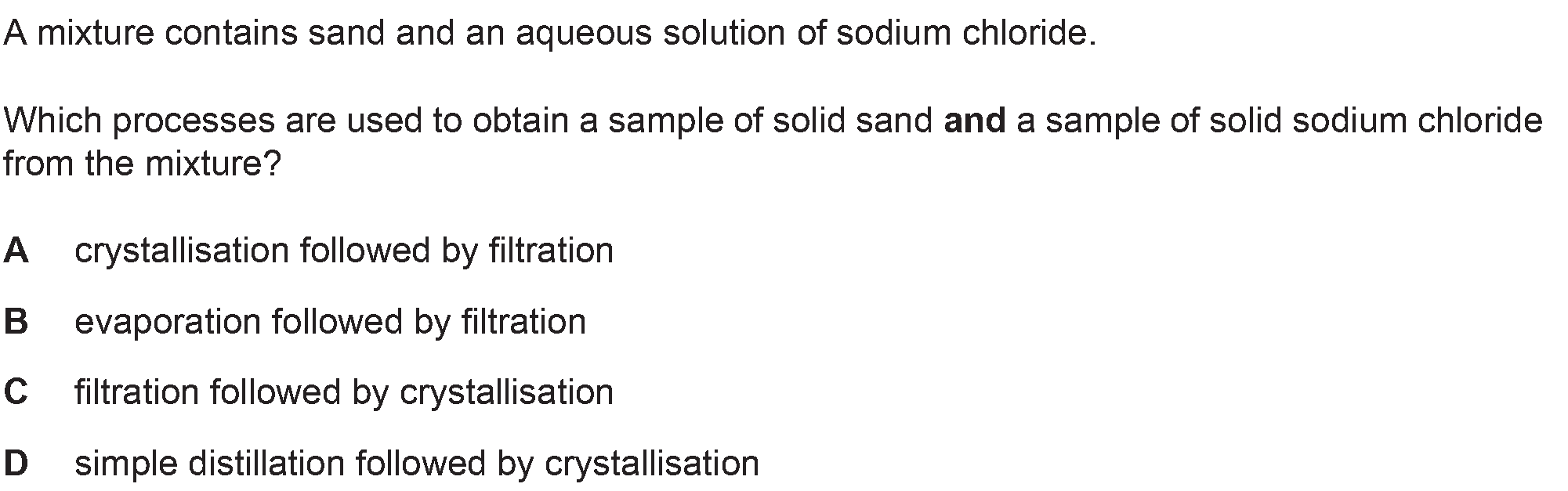
A mixture contains sand and an aqueous solution of sodium chloride.
Which processes are used to obtain a sample of solid sand and a sample of solid sodium chloride
from the mixture?
A crystallisation followed by filtration
B_ evaporation followed by filtration
C filtration followed by crystallisation
D
simple distillation followed by crystallisation
Which processes are used to obtain a sample of solid sand and a sample of solid sodium chloride
from the mixture?
A crystallisation followed by filtration
B_ evaporation followed by filtration
C filtration followed by crystallisation
D
simple distillation followed by crystallisation
Options:
A
B
C
D
Correct Key: C
A
B
C
D
Correct Key: C
Question 2
Paper Ref: 0620/23_Winter_2020_Q3
Paper Ref: 0620/23_Winter_2020_Q3
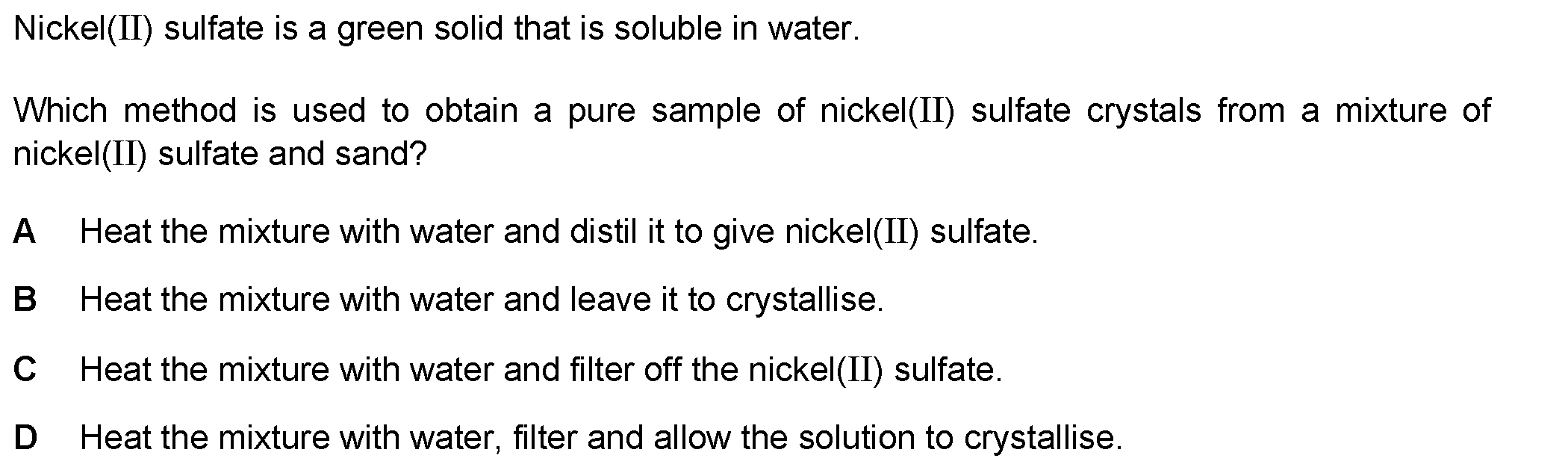
Nickel(II) sulfate is a green solid that is soluble in water.
Which method is used to obtain a pure sample of nickel(II) sulfate crystals from a mixture of
nickel(II) sulfate and sand?
A Heat the mixture with water and distil it to give nickel(IT) sulfate.
B- Heat the mixture with water and leave it to crystallise.
C Heat the mixture with water and filter off the nickel(II) sulfate.
D
Heat the mixture with water, filter and allow the solution to crystallise.
Options:
A
B
C
D
Correct Key: D
A
B
C
D
Correct Key: D
Question 3
Paper Ref: 0620/12_Winter_2024_Q40
Paper Ref: 0620/12_Winter_2024_Q40
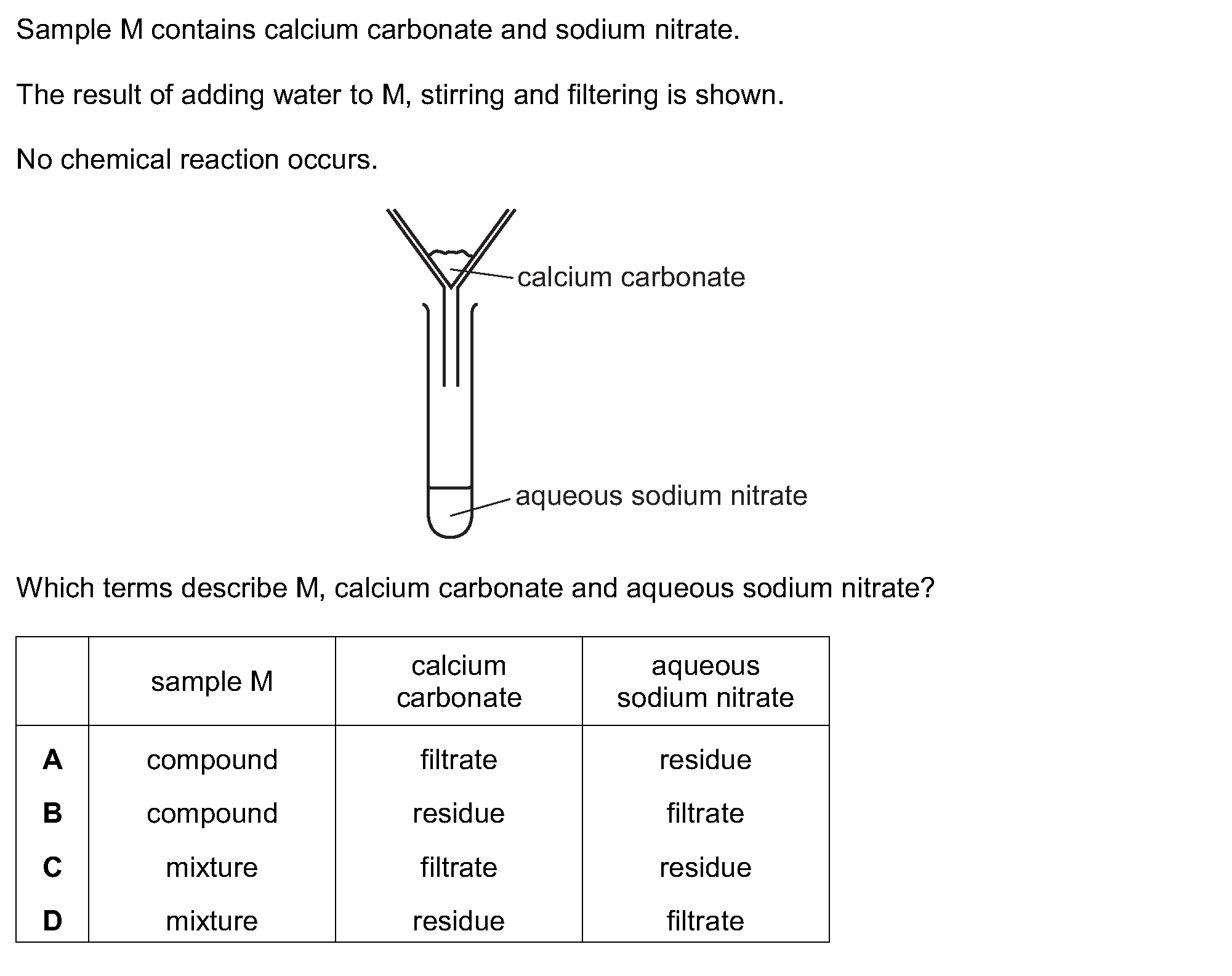
Sample M contains calcium carbonate and sodium nitrate.
The result of adding water to M, stirring and filtering is shown.
No chemical reaction occurs.
calcium carbonate
aqueous sodium nitrate
Which terms describe M, calcium carbonate and aqueous sodium nitrate?
sample M calcium aqueous
carbonate sodium nitrate
A compound filtrate residue
B compound residue filtrate
Cc mixture filtrate residue
D mixture residue filtrate
Options:
A
B
C
D
Correct Key: D
A
B
C
D
Correct Key: D
Question 4
Paper Ref: 0620/21_Winter_2009_Q2
Paper Ref: 0620/21_Winter_2009_Q2
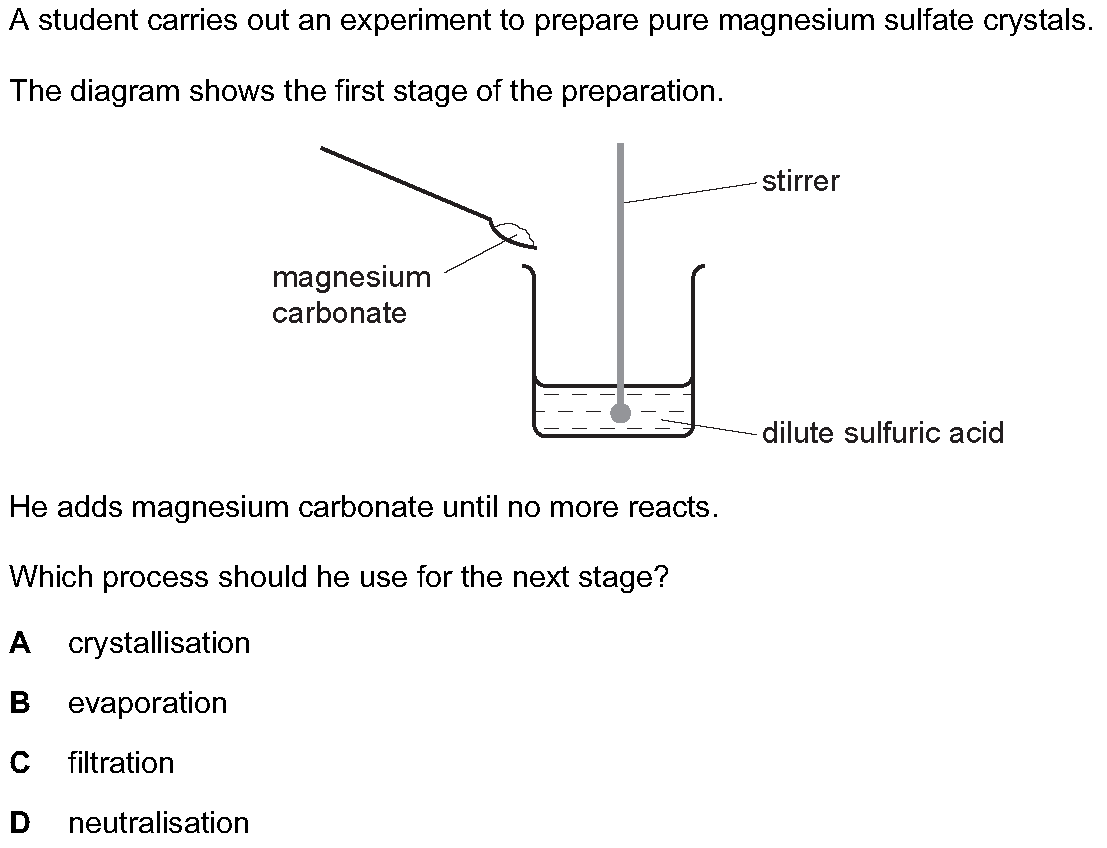
A student carries out an experiment to prepare pure magnesium sulfate crystals.
The diagram shows the first stage of the preparation.
stirrer
magnesium
carbonate
dilute sulfuric acid
He adds magnesium carbonate until no more reacts.
Which process should he use for the next stage?
crystallisation
B_evaporation
C filtration
D neutralisation
The diagram shows the first stage of the preparation.
stirrer
magnesium
carbonate
dilute sulfuric acid
He adds magnesium carbonate until no more reacts.
Which process should he use for the next stage?
crystallisation
B_evaporation
C filtration
D neutralisation
Options:
A
B
C
D
Correct Key: C
A
B
C
D
Correct Key: C
Question 5
Paper Ref: 0620/23_Summer_2024_Q21
Paper Ref: 0620/23_Summer_2024_Q21
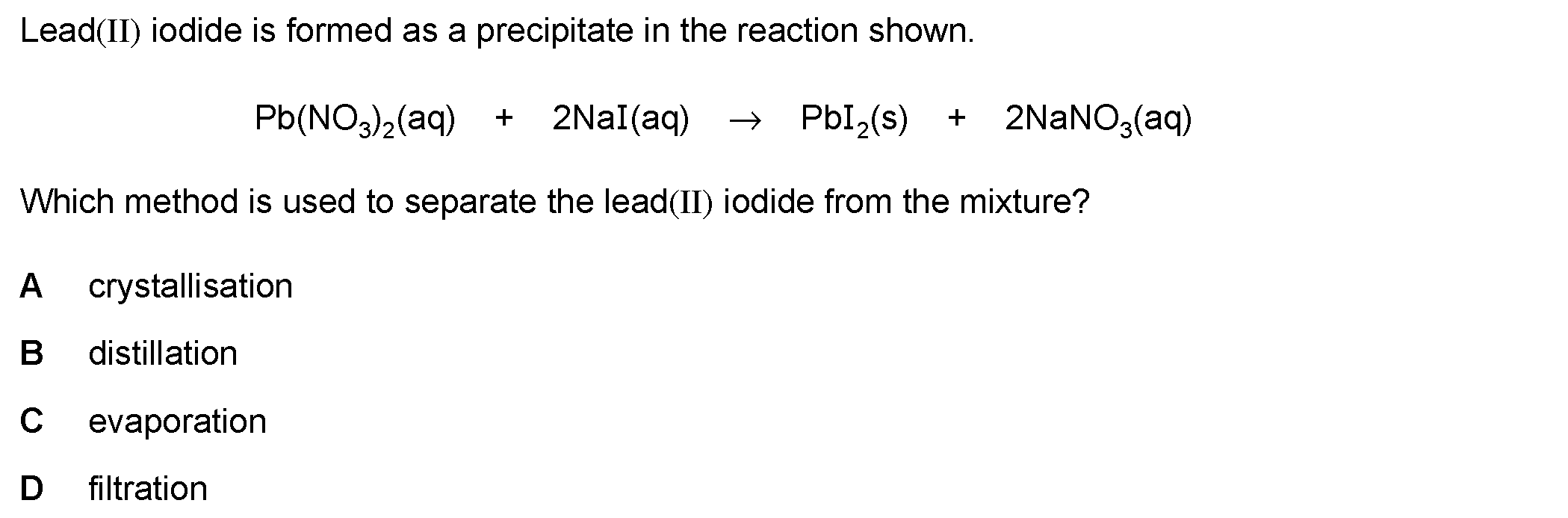
Lead(II) iodide is formed as a precipitate in the reaction shown.
Pb(NO3).(aq) + 2Nal(aq) — PbI,(s) + 2NaNO,(aq)
Which method is used to separate the lead(ID iodide from the mixture?
crystallisation
distillation
evaporation
0 0O wD FY
filtration
Pb(NO3).(aq) + 2Nal(aq) — PbI,(s) + 2NaNO,(aq)
Which method is used to separate the lead(ID iodide from the mixture?
crystallisation
distillation
evaporation
0 0O wD FY
filtration
Options:
A
B
C
D
Correct Key: D
A
B
C
D
Correct Key: D
Question 6
Paper Ref: 0620/11_Winter_2025_Q38
Paper Ref: 0620/11_Winter_2025_Q38
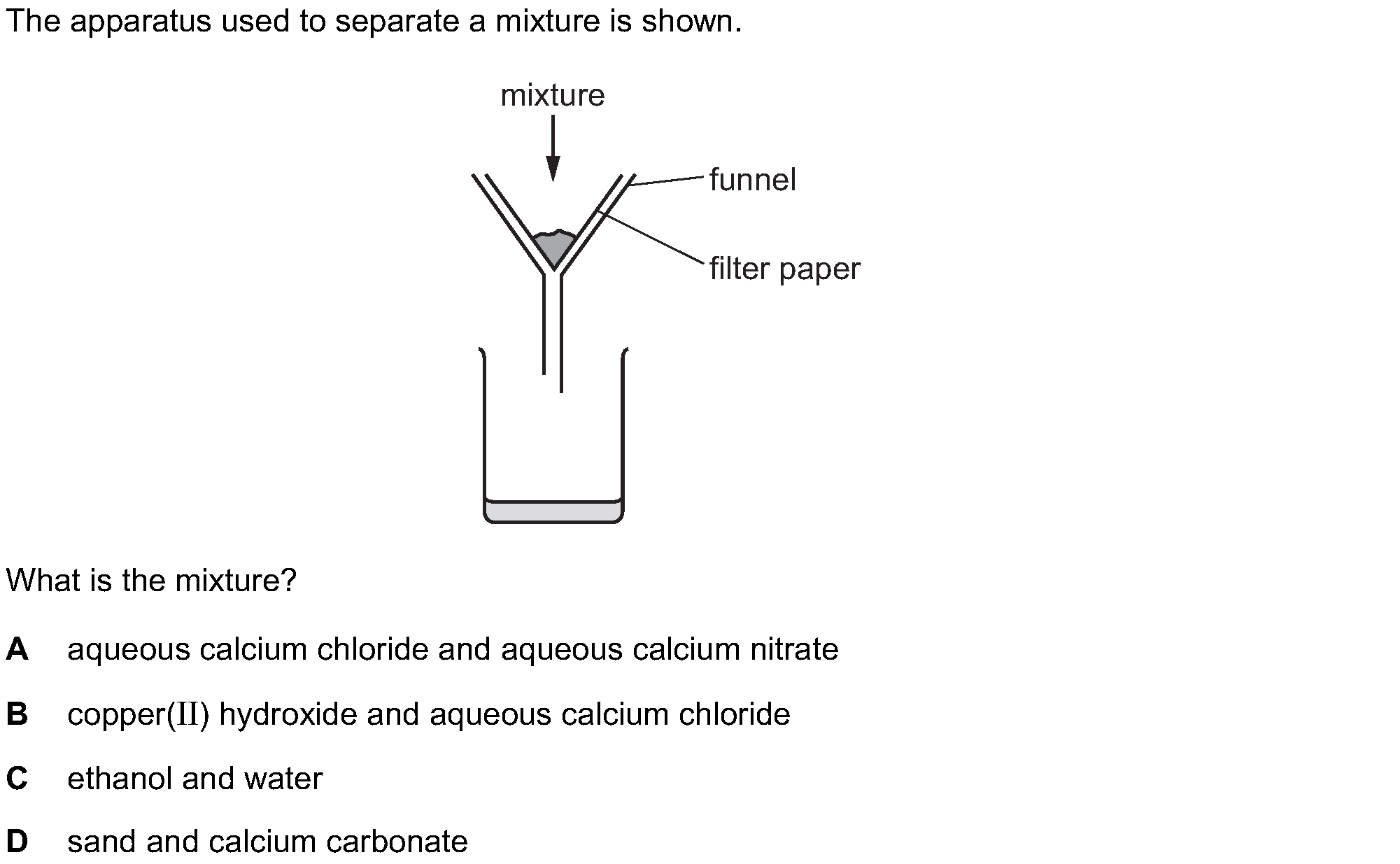
The apparatus used to separate a mixture is shown.
mixture
| funnel
filter paper
What is the mixture?
A aqueous calcium chloride and aqueous calcium nitrate
B- copper(II) hydroxide and aqueous calcium chloride
C_ ethanol and water
D
sand and calcium carbonate
mixture
| funnel
filter paper
What is the mixture?
A aqueous calcium chloride and aqueous calcium nitrate
B- copper(II) hydroxide and aqueous calcium chloride
C_ ethanol and water
D
sand and calcium carbonate
Options:
A
B
C
D
Correct Key: B
A
B
C
D
Correct Key: B
Question 7
Paper Ref: 0620/21_Summer_2013_Q3
Paper Ref: 0620/21_Summer_2013_Q3
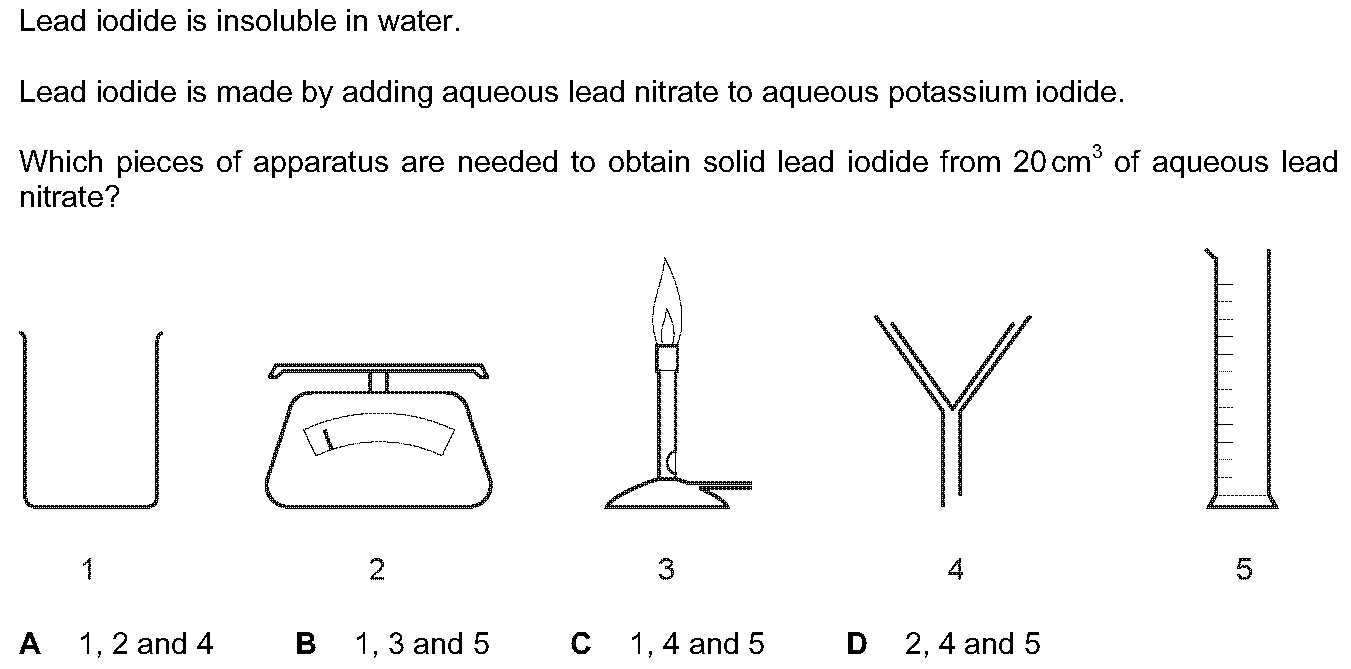
Lead iodide is insoluble in water.
Lead iodide is made by adding aqueous lead nitrate to aqueous potassium iodide.
Which pieces of apparatus are needed to obtain solid lead iodide from 20cm?* of aqueous lead
nitrate?
1 2 3 4 5
A 1,2and4 B 1,3and5 C 1,4and5 D 2,4and5
Lead iodide is made by adding aqueous lead nitrate to aqueous potassium iodide.
Which pieces of apparatus are needed to obtain solid lead iodide from 20cm?* of aqueous lead
nitrate?
1 2 3 4 5
A 1,2and4 B 1,3and5 C 1,4and5 D 2,4and5
Options:
A
B
C
D
Correct Key: C
A
B
C
D
Correct Key: C
Structured Questions Mark Scheme & Answers
•1•.• • • •[•P•R•I• •2•0•0•7•B• •P•2• • •·• • •Q•1•5• • •P•a•r•t• •(•a•)• • •·• • •2•0•0•7• • •·• • •P•r•i•m•a•r•y• •0•8•4•6•]• • • • • • •(•n•o• •p•u•b•l•i•s•h•e•d• •m•a•r•k• •s•c•h•e•m•e• •f•o•r• •t•h•i•s• •p•a•p•e•r•)•
•2•.• • • •[•P•R•I• •2•0•0•7•B• •P•2• • •·• • •Q•1•5• • •P•a•r•t• •(•c•)• • •·• • •2•0•0•7• • •·• • •P•r•i•m•a•r•y• •0•8•4•6•]• • • • • • •(•n•o• •p•u•b•l•i•s•h•e•d• •m•a•r•k• •s•c•h•e•m•e• •f•o•r• •t•h•i•s• •p•a•p•e•r•)•
•3•.• • • •[•P•R•I• •2•0•0•7•B• •P•2• • •·• • •Q•1•5• • •P•a•r•t• •(•d•)• • •·• • •2•0•0•7• • •·• • •P•r•i•m•a•r•y• •0•8•4•6•]• • • • • • •(•n•o• •p•u•b•l•i•s•h•e•d• •m•a•r•k• •s•c•h•e•m•e• •f•o•r• •t•h•i•s• •p•a•p•e•r•)•
•4•.• • • •[•P•R•I• •2•0•1•4•B• •P•2• • •·• • •Q•1•5• • •P•a•r•t• •(•a•)• • •·• • •2•0•1•4• • •·• • •P•r•i•m•a•r•y• •0•8•4•6•]• • • • • • •(•n•o• •p•u•b•l•i•s•h•e•d• •m•a•r•k• •s•c•h•e•m•e• •f•o•r• •t•h•i•s• •p•a•p•e•r•)•
•5•.• • • •[•P•R•I• •2•0•1•4•B• •P•2• • •·• • •Q•1•5• • •P•a•r•t• •(•b•)• • •·• • •2•0•1•4• • •·• • •P•r•i•m•a•r•y• •0•8•4•6•]• • • • • • •(•n•o• •p•u•b•l•i•s•h•e•d• •m•a•r•k• •s•c•h•e•m•e• •f•o•r• •t•h•i•s• •p•a•p•e•r•)•
•6•.• • • •[•P•R•I• •2•0•1•4•B• •P•2• • •·• • •Q•1•5• • •P•a•r•t• •(•c•)• • •·• • •2•0•1•4• • •·• • •P•r•i•m•a•r•y• •0•8•4•6•]• • • • • • •(•n•o• •p•u•b•l•i•s•h•e•d• •m•a•r•k• •s•c•h•e•m•e• •f•o•r• •t•h•i•s• •p•a•p•e•r•)•
•7•.• • • •[•P•R•I• •2•0•1•5•B• •P•2• • •·• • •Q•1•6• • •·• • •2•0•1•5• • •·• • •P•r•i•m•a•r•y• •0•8•4•6•]• • • • • • •(•n•o• •p•u•b•l•i•s•h•e•d• •m•a•r•k• •s•c•h•e•m•e• •f•o•r• •t•h•i•s• •p•a•p•e•r•)•
•8•.• • • •[•P•R•I• •2•0•1•6•C• •P•1• • •·• • •Q•1•8• • •P•a•r•t• •(•a•)• • •·• • •2•0•1•6• • •·• • •P•r•i•m•a•r•y• •0•8•4•6•]• • • • • • •(•n•o• •p•u•b•l•i•s•h•e•d• •m•a•r•k• •s•c•h•e•m•e• •f•o•r• •t•h•i•s• •p•a•p•e•r•)•
Last updated:
\n