1.2Motion, Forces and Energy
More about photosynthesis — Question Bank (Cambridge) — Cambridge IGCSE Physics 0625 Revision Notes & Topical Questions
10 min read Lesson 9 of 91 Unit quiz
Curriculum Equation Key Balanced Photosynthesis EquationFast Exam Solution
6CO₂ + 6H₂O ➔ C₆H₁₂O₆ + 6O₂
Word Equation & Conditions: Carbon Dioxide + Water (+ Light & Chlorophyll) -> Glucose + Oxygen
Cambridge Past Paper Bank
1.2 More about photosynthesis
10 Multiple-Choice Questions with Official Mark Schemes
Question 1
0610/21_Winter_2018_Q12
Question 2
0610/12_Spring_2024_Q14
Question 3
0610/22_Winter_2013_Q8
Question 4
0610/21_Winter_2013_Q5
Question 5
0610/22_Winter_2009_Q9
Question 6
0610/13_Summer_2022_Q13
Question 7
0610/21_Summer_2026_Q10
Question 8
5129/12_Winter_2023_Q3
Question 9
0610/23_Winter_2021_Q3
Question 10
0610/23_Summer_2011_Q16
Cambridge Lower Secondary Stage 9
1.2 More about photosynthesis – Complete Question Bank & Mark Scheme
Total Questions10 Questions with Verified Solutions & Past Paper Mark Schemes
Multiple Choice Questions (Exam Practice)
Question 1
Paper Ref: 0610/21_Winter_2018_Q12
Paper Ref: 0610/21_Winter_2018_Q12
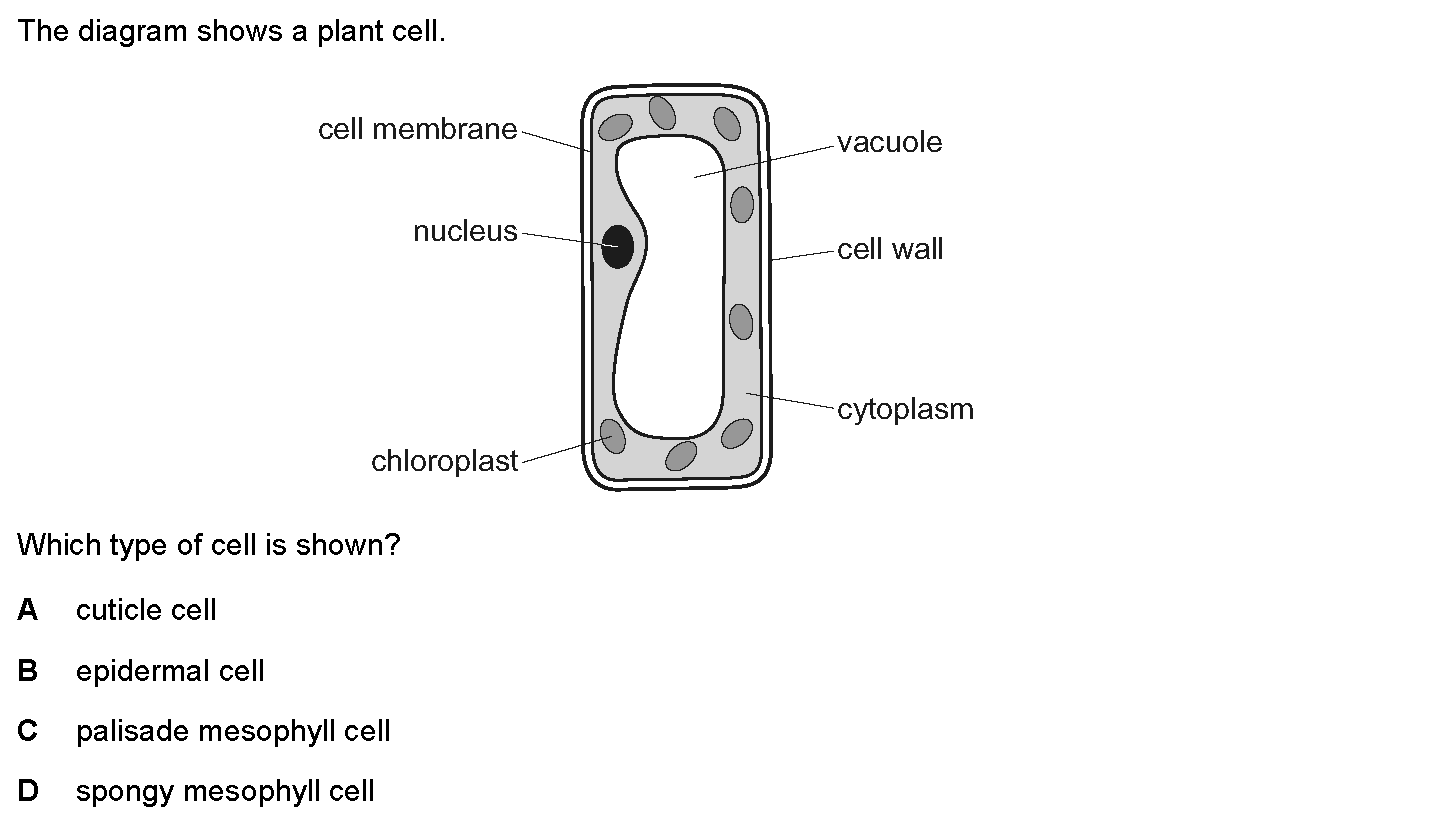
The diagram shows a plant cell.
cell membrane
nucleus
chloroplast
Which type of cell is shown?
A cuticle cell
B_ epidermal cell
Cpalisade mesophyll cell
D spongy mesophyll cell
cell membrane
nucleus
chloroplast
Which type of cell is shown?
A cuticle cell
B_ epidermal cell
Cpalisade mesophyll cell
D spongy mesophyll cell
Options:
A
B
C
D
Correct Key: C
A
B
C
D
Correct Key: C
Question 2
Paper Ref: 0610/12_Spring_2024_Q14
Paper Ref: 0610/12_Spring_2024_Q14
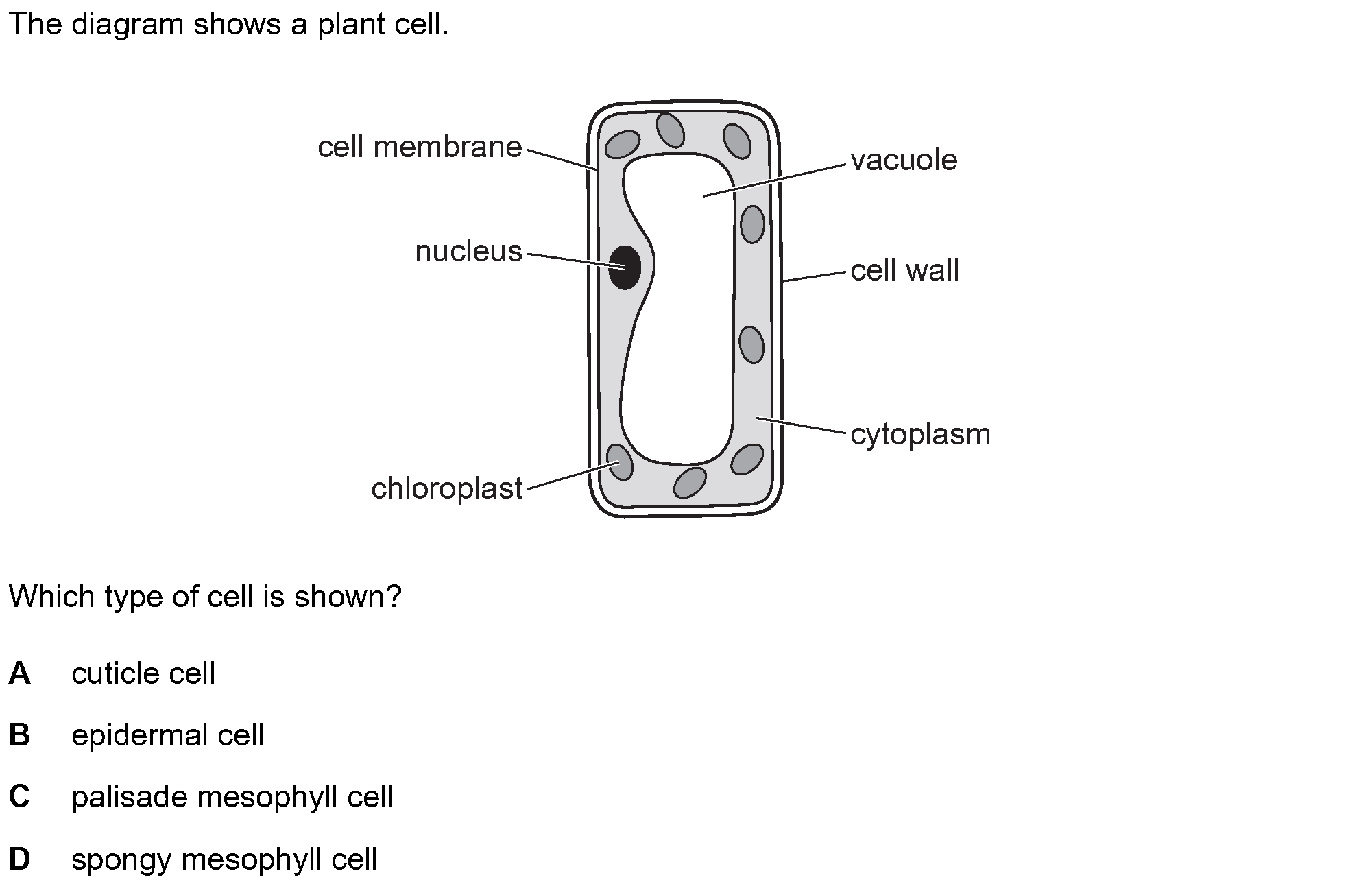
The diagram shows a plant cell.
cell membrane O Q vacuole
nucleus | 0
—re cell wall
‘|| ~~ cytoplasm
chloroplast O @
Which type of cell is shown?
A cuticle cell
epidermal cell
palisade mesophyll cell
oO Oo WW
spongy mesophyll cell
cell membrane O Q vacuole
nucleus | 0
—re cell wall
‘|| ~~ cytoplasm
chloroplast O @
Which type of cell is shown?
A cuticle cell
epidermal cell
palisade mesophyll cell
oO Oo WW
spongy mesophyll cell
Options:
A
B
C
D
Correct Key: C
A
B
C
D
Correct Key: C
Question 3
Paper Ref: 0610/22_Winter_2013_Q8
Paper Ref: 0610/22_Winter_2013_Q8
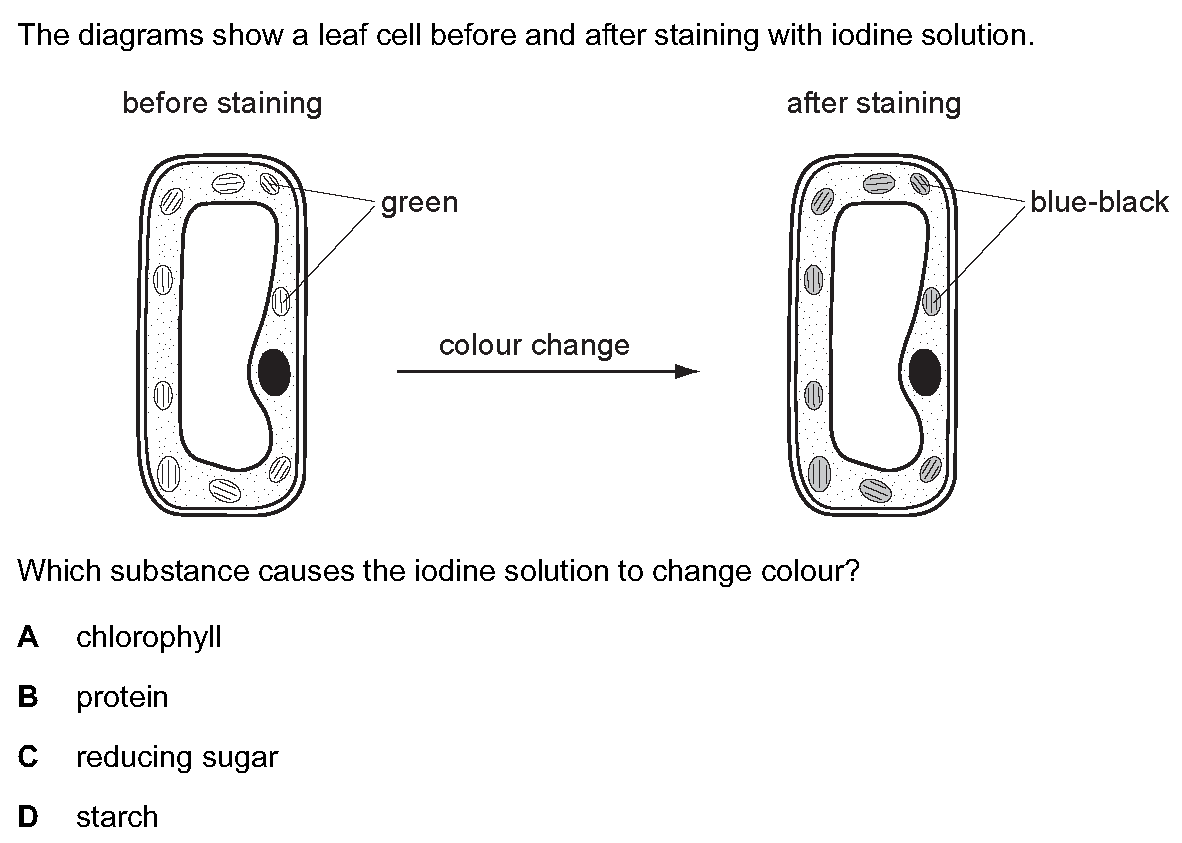
The diagrams show a leaf cell before and after staining with iodine solution.
before staining after staining
green blue-black
colour change
Which substance causes the iodine solution to change colour?
>
chlorophyll
B protein
C_ reducing sugar
D
starch
before staining after staining
green blue-black
colour change
Which substance causes the iodine solution to change colour?
>
chlorophyll
B protein
C_ reducing sugar
D
starch
Options:
A
B
C
D
Correct Key: D
A
B
C
D
Correct Key: D
Question 4
Paper Ref: 0610/21_Winter_2013_Q5
Paper Ref: 0610/21_Winter_2013_Q5
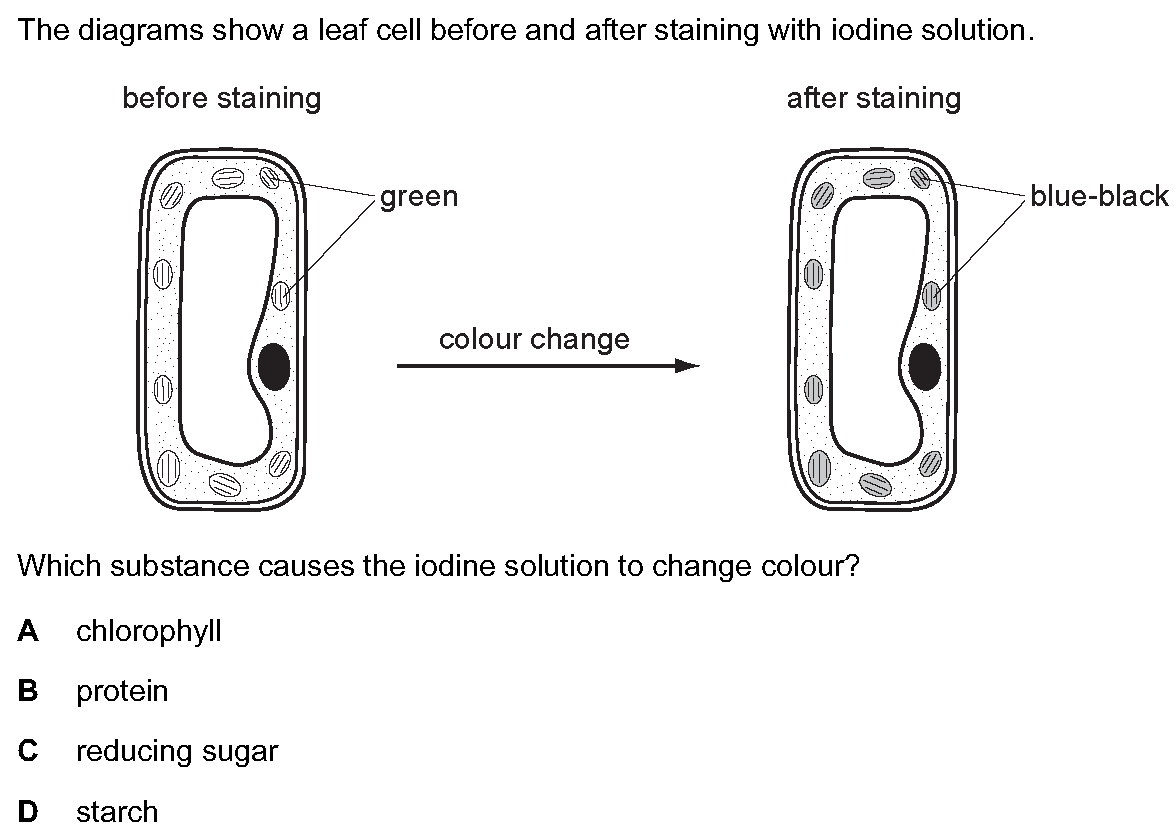
The diagrams show a leaf cell before and after staining with iodine solution.
before staining
green
colour change
after staining
Which substance causes the iodine solution to change colour?
A
B
c
chlorophyll
protein
reducing sugar
starch
blue-black
before staining
green
colour change
after staining
Which substance causes the iodine solution to change colour?
A
B
c
chlorophyll
protein
reducing sugar
starch
blue-black
Options:
A
B
C
D
Correct Key: D
A
B
C
D
Correct Key: D
Question 5
Paper Ref: 0610/22_Winter_2009_Q9
Paper Ref: 0610/22_Winter_2009_Q9
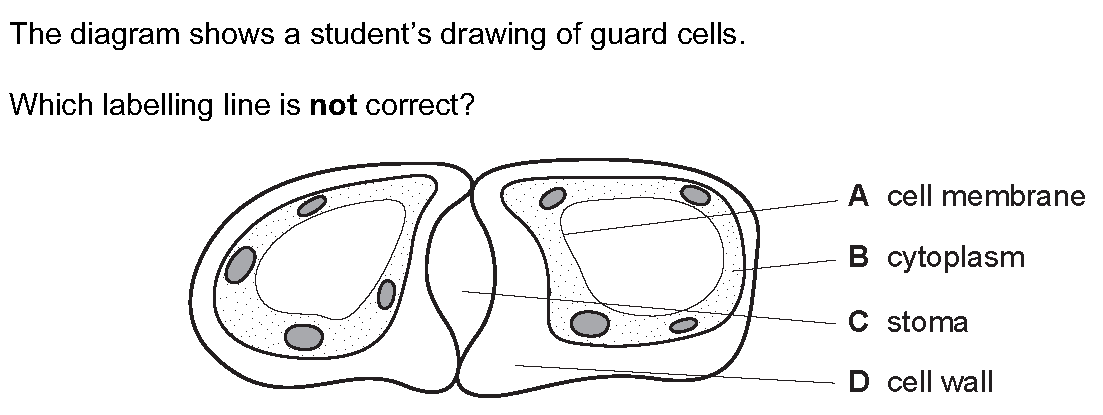
The diagram shows a student’s drawing of guard cells.
Which labelling line is not correct?
A cell membrane
B cytoplasm
Cc stoma
D cell wall
Which labelling line is not correct?
A cell membrane
B cytoplasm
Cc stoma
D cell wall
Options:
A
B
C
D
Correct Key: A
A
B
C
D
Correct Key: A
Question 6
Paper Ref: 0610/13_Summer_2022_Q13
Paper Ref: 0610/13_Summer_2022_Q13
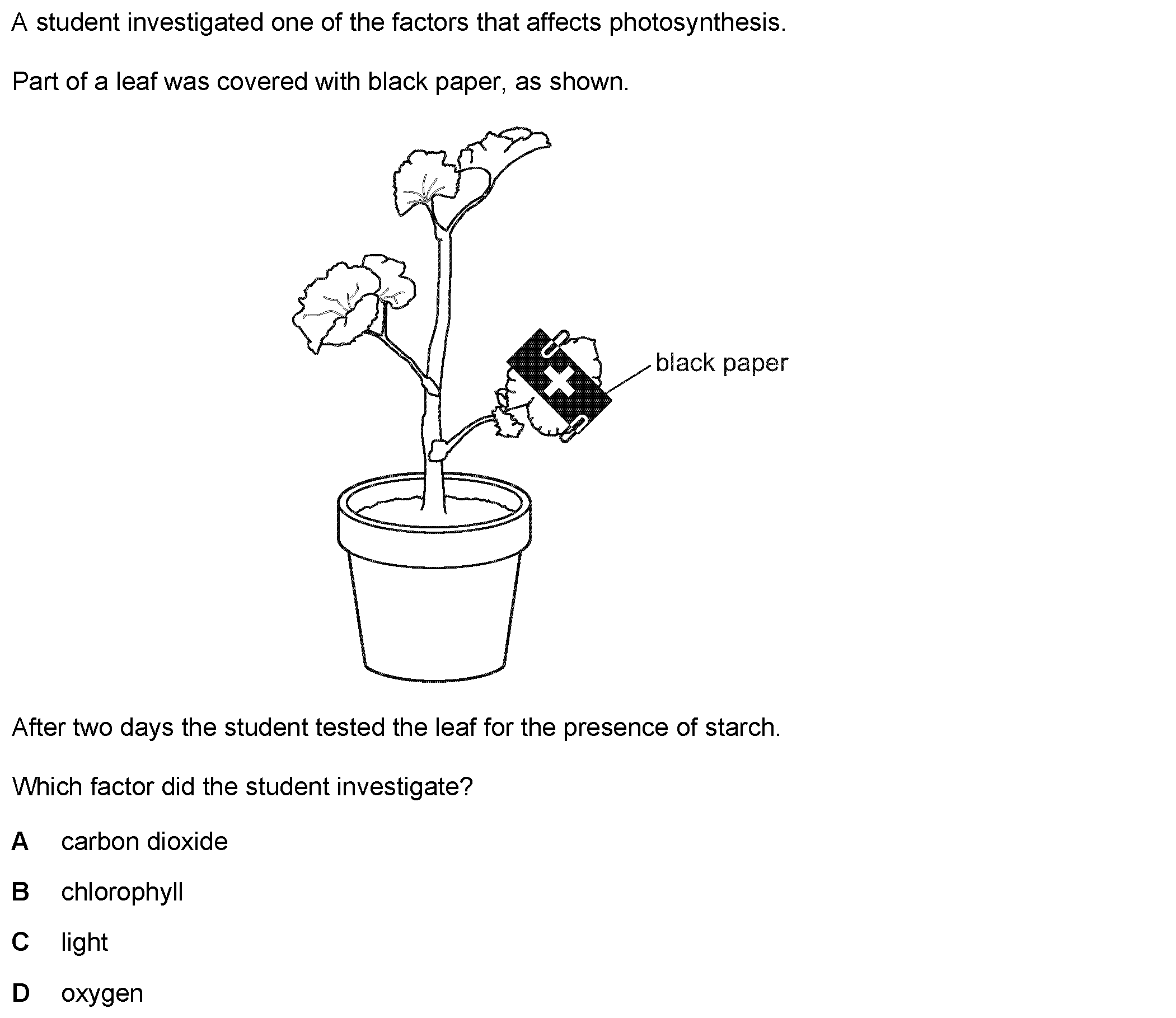
A student investigated one of the factors that affects photosynthesis.
Part of a leaf was covered with black paper, as shown.
black paper
After two days the student tested the leaf for the presence of starch.
Which factor did the student investigate?
carbon dioxide
chlorophyll
light
0 0O wD FY
oxygen
Part of a leaf was covered with black paper, as shown.
black paper
After two days the student tested the leaf for the presence of starch.
Which factor did the student investigate?
carbon dioxide
chlorophyll
light
0 0O wD FY
oxygen
Options:
A
B
C
D
Correct Key: C
A
B
C
D
Correct Key: C
Question 7
Paper Ref: 0610/21_Summer_2026_Q10
Paper Ref: 0610/21_Summer_2026_Q10
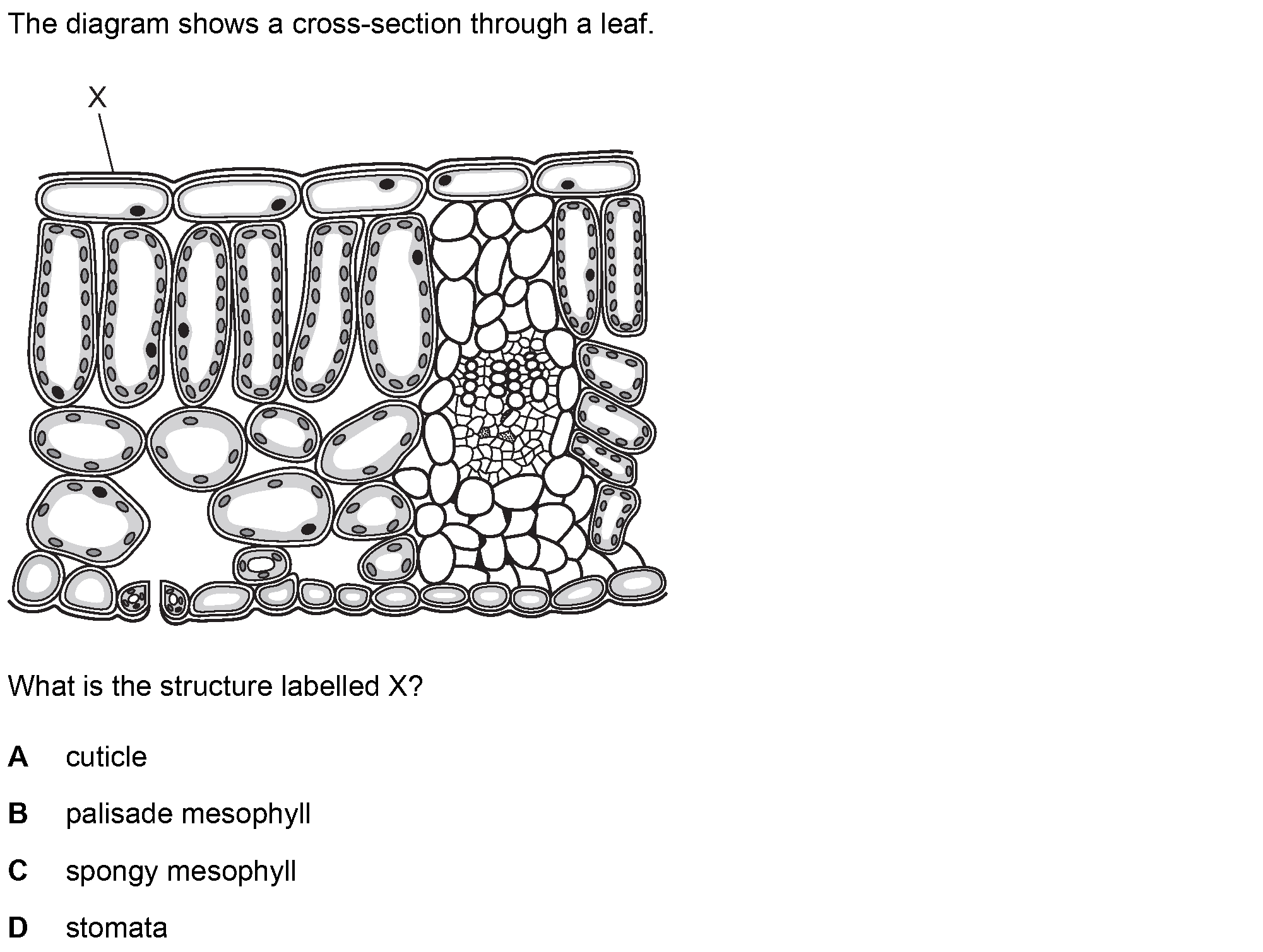
The diagram shows a cross-section through a leaf.
What is the structure labelled X?
cuticle
A
Bpalisade mesophyll
Cc
D
spongy mesophyll
stomata
What is the structure labelled X?
cuticle
A
Bpalisade mesophyll
Cc
D
spongy mesophyll
stomata
Options:
A
B
C
D
Correct Key: A
A
B
C
D
Correct Key: A
Question 8
Paper Ref: 5129/12_Winter_2023_Q3
Paper Ref: 5129/12_Winter_2023_Q3
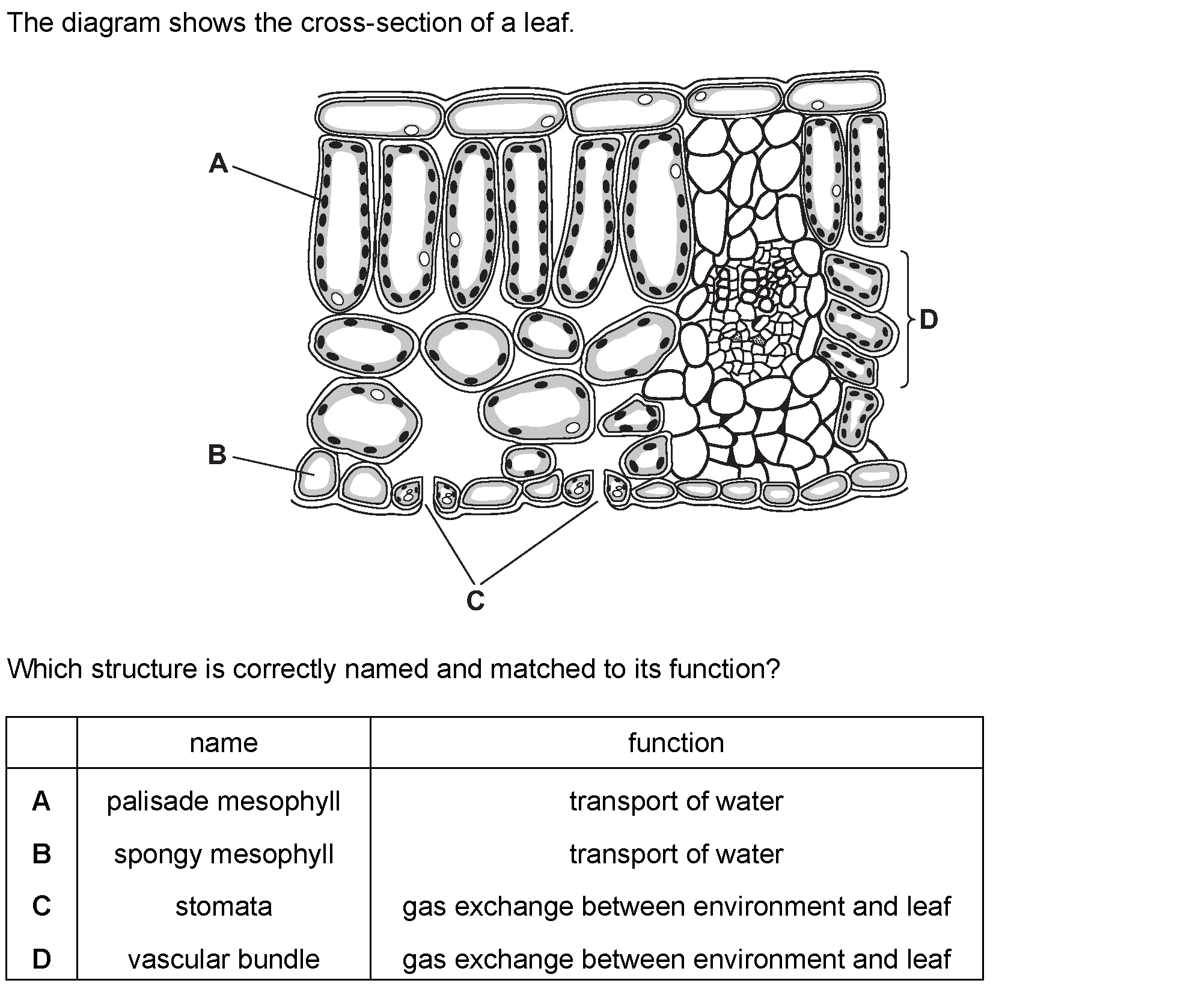
The diagram shows the cross-section of a leaf.
\
i
~
– 8;
\
Caan!
-as68
i)
= |
(Come)
PEN PEON
SU
KO :. ah ‘d
iw]
i) SS
ve
bors:
Once:
AY
Cat,
Al
ot
aS
‘2
OP
‘
g
\)
Which structure is correctly named and matched to its function?
function
palisade mesophyll transport of water
spongy mesophyll transport of water
stomata gas exchange between environment and leaf
vascular bundle gas exchange between environment and leaf
\
i
~
– 8;
\
Caan!
-as68
i)
= |
(Come)
PEN PEON
SU
KO :. ah ‘d
iw]
i) SS
ve
bors:
Once:
AY
Cat,
Al
ot
aS
‘2
OP
‘
g
\)
Which structure is correctly named and matched to its function?
function
palisade mesophyll transport of water
spongy mesophyll transport of water
stomata gas exchange between environment and leaf
vascular bundle gas exchange between environment and leaf
Options:
A
B
C
D
Correct Key: C
A
B
C
D
Correct Key: C
Question 9
Paper Ref: 0610/23_Winter_2021_Q3
Paper Ref: 0610/23_Winter_2021_Q3
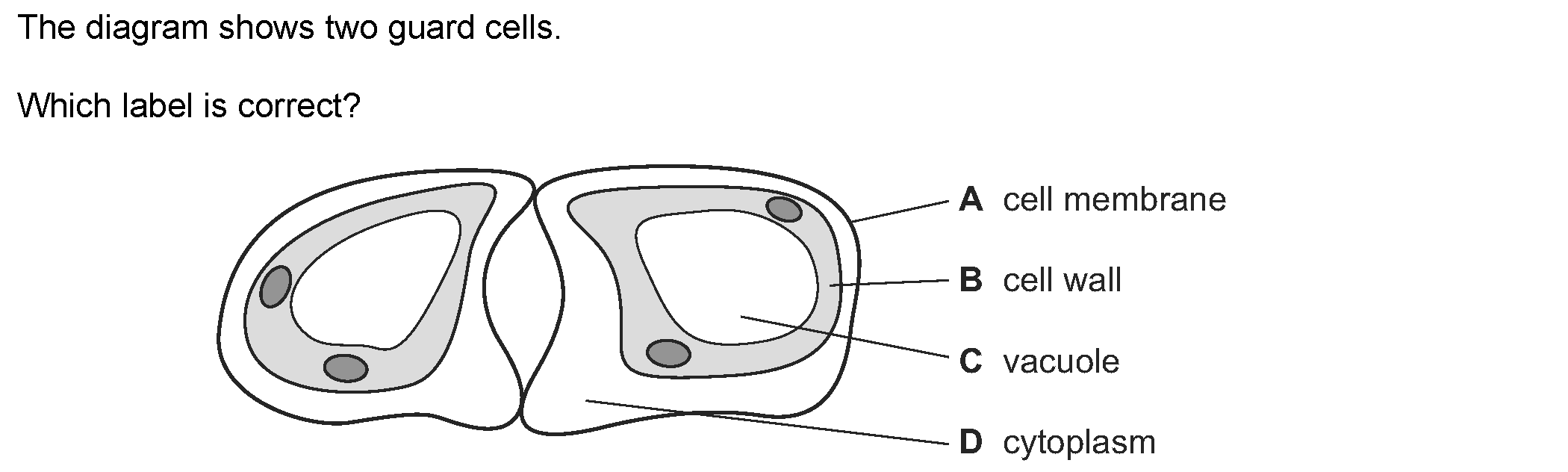
The diagram shows two guard cells.
Which label is correct?
A cell membrane
B cell wall
LI
C vacuole
D cytoplasm
Which label is correct?
A cell membrane
B cell wall
LI
C vacuole
D cytoplasm
Options:
A
B
C
D
Correct Key: C
A
B
C
D
Correct Key: C
Question 10
Paper Ref: 0610/23_Summer_2011_Q16
Paper Ref: 0610/23_Summer_2011_Q16
What is formed first in a leaf as a result of photosynthesis?
A cellulose
B protein
C – starch
D
sugar
A cellulose
B protein
C – starch
D
sugar
Options:
A
B
C
D
Correct Key: D
A
B
C
D
Correct Key: D
Structured Questions Mark Scheme & Answers
•1•.• • • •[•S•P• •S•9• •P•1• • •·• • •Q•4• • •P•a•r•t• •(•a•)• • •·• • •S•p•e•c•i•m•e•n• • •·• • •L•o•w•e•r• •S•e•c• •0•8•9•3•]• • • • • • •c•h•l•o•r•o•p•h•y•l•l• •1• •p•r•o•t•e•i•n• •/• •a•m•i•n•o• •a•c•i•d•s• •/• •p•e•p•t•i•d•e•s• •/• •p•o•l•y•p•e•p•t•i•d•e•s• •1•
•2•.• • • •[•S•P• •S•9• •P•1• • •·• • •Q•4• • •P•a•r•t• •(•b•)• • •·• • •S•p•e•c•i•m•e•n• • •·• • •L•o•w•e•r• •S•e•c• •0•8•9•3•]• • • • • • •2• •N•o•t•e• •a•s•s•u•m•e• •a•n•s•w•e•r• •r•e•f•e•r•s• •t•o• •p•l•a•n•t• ••• •••c•c•e•p•t• •c•o•n•v•e•r•s•e• •a•r•g•u•m•e•n•t• •i•f• •p•l•a•n•t• •B• •s•p•e•c•i•f•i•e•d• •p•l•a•n•t• ••• •h•a•s• •m•o•r•e• •c•h•l•o•r•o•p•h•y•l•l• •••c•c•e•p•t• •p•l•a•n•t• ••• •h•a•s• •m•o•r•e• •g•r•e•e•n• •l•e•a•v•e•s• •b•u•t• •n•a•m•e• •t•a•k•e•s• •p•r•e•c•e•d•e•n•c•e• •p•l•a•n•t• ••• •c•a•n• •m•a•k•e• •m•o•r•e• •f•o•o•d• •/• •m•o•r•e• •p•h•o•t•o•s•y•n•t•h•e•s•i•s• •o•x•y•g•e•n• •1• •••c•c•e•p•t• •O•2• •o•r• •O•
•3•.• • • •[•S•P• •S•9• •P•1• • •·• • •Q•4• • •P•a•r•t• •(•c•)• • •·• • •S•p•e•c•i•m•e•n• • •·• • •L•o•w•e•r• •S•e•c• •0•8•9•3•]• • • • • • •t•o• •r•e•d•u•c•e• •c•o•m•p•e•t•i•t•i•o•n• •(•f•o•r• •l•i•g•h•t•,• •w•a•t•e•r• •o•r• •m•i•n•e•r•a•l•s•)• •1• •••c•c•e•p•t• •t•o• •r•e•d•u•c•e• •o•v•e•r•c•r•o•w•d•i•n•g• •••c•c•e•p•t• •p•r•e•v•e•n•t•s• •s•p•r•e•a•d• •o•f• •d•i•s•e•a•s•e• •o•r• •p•e•s•t•s• •/• •m•a•k•e• •h•a•r•v•e•s•t•i•n•g• •e•a•s•i•e•r• •••c•c•e•p•t• •t•o• •h•a•v•e• •m•o•r•e• •s•p•a•c•e• •t•o• •g•r•o•w•
•4•.• • • •[•P•R•I• •2•0•0•7•C• •P•1• • •·• • •Q•1• • •P•a•r•t• •(•b•)• • •·• • •2•0•0•7• • •·• • •P•r•i•m•a•r•y• •0•8•4•6•]• • • • • • •(•n•o• •p•u•b•l•i•s•h•e•d• •m•a•r•k• •s•c•h•e•m•e• •f•o•r• •t•h•i•s• •p•a•p•e•r•)•
•5•.• • • •[•P•R•I• •2•0•0•7•C• •P•1• • •·• • •Q•1• • •P•a•r•t• •(•c•)• • •·• • •2•0•0•7• • •·• • •P•r•i•m•a•r•y• •0•8•4•6•]• • • • • • •(•n•o• •p•u•b•l•i•s•h•e•d• •m•a•r•k• •s•c•h•e•m•e• •f•o•r• •t•h•i•s• •p•a•p•e•r•)•
•6•.• • • •[•C•P• •O•c•t•o•b•e•r• •2•0•2•4• •P•2• • •·• • •Q•9• • •·• • •2•0•2•4• • •·• • •L•o•w•e•r• •S•e•c• •0•8•9•3•]• • • • • • •M•1• •t•a•b•l•e• •d•r•a•w•n• •w•i•t•h• •s•u•i•t•a•b•l•e• •h•e•a•d•i•n•g•s•,• •e•.•g•.• •s•o•i•l• •a•n•d• •m•a•s•s• •3• •N•o•t•e• •M•1• •d•o•e•s• •n•o•t• •n•e•e•d• •u•n•i•t•s• •o•f• •m•a•g•n•e•s•i•u•m• •(•s•a•l•t•s• •i•n• •1• •k•g•)• •••c•c•e•p•t• •M•g• •f•o•r• •m•a•g•n•e•s•i•u•m• •t•a•b•l•e• •w•i•t•h• •h•e•a•d•i•n•g•s• •=• •1• •m•a•r•k• •M•2• •u•n•i•t•s• •i•n• •g• •o•r• •g•r•a•m•s• •i•n•c•l•u•d•e•d• •i•n• •h•e•a•d•i•n•g•s• •(•b•u•t• •n•o•t• •i•n• •t•h•e• •u•n•i•t• •o•n•l•y• •i•n•c•l•u•d•e•d• •i•n• •t•h•e• •h•e•a•d•i•n•g• •=• •1• •m•a•r•k• •b•o•d•y• •o•f• •t•h•e• •t•a•b•l•e•)• •c•o•r•r•e•c•t•l•y• •e•n•t•e•r•e•d• •d•a•t•a• •=• •1• •m•a•r•k• •m•a•s•s• •o•f• •m•a•g•n•e•s•i•u•m• •t•y•p•e• •o•f• •s•o•i•l• •i•n• •g• •M•3• •a•l•l• •d•a•t•a• •e•n•t•e•r•e•d• •c•o•r•r•e•c•t•l•y• ••• •5•.•0• •o•r• •5• •B• •0•.•4• •C• •3•5•.•0• •o•r• •3•5• •D• •6•.•4• •I•g•n•o•r•e• •t•h•e• •o•r•d•e•r• •o•f• •t•h•e• •s•o•i•l• •t•y•p•e•s•
•7•.• • • •[•C•P• •M•a•r•c•h• •2•0•2•6• •P•2• • •·• • •Q•9• • •·• • •2•0•2•6• • •·• • •L•o•w•e•r• •S•e•c• •0•8•9•3•]• • • • • • •2• •e•a•c•h• •c•o•r•r•e•c•t• •a•n•s•w•e•r• •=• •1• •m•a•r•k• •m•a•g•n•e•s•i•u•m• •••c•c•e•p•t• •n•a•m•e•d• •m•a•g•n•e•s•i•u•m• •c•o•m•p•o•u•n•d• •n•e•e•d•e•d• •t•o• •m•a•k•e• •c•h•l•o•r•o•p•h•y•l•l• •••c•c•e•p•t• •i•t• •p•r•o•v•i•d•e•s• •c•h•l•o•r•o•p•h•y•l•l• •••c•c•e•p•t• •n•o•t• •s•u•f•f•i•c•i•e•n•t• •c•h•l•o•r•o•p•h•y•l•l• •m•a•d•e• •••c•c•e•p•t• •c•h•l•o•r•o•p•h•y•l•l• •c•o•n•t•a•i•n•s• •m•a•g•n•e•s•i•u•m• •••c•c•e•p•t• •t•h•e•r•e• •i•s• •n•o•t• •e•n•o•u•g•h• •m•a•g•n•e•s•i•u•m• •f•o•r• •c•h•l•o•r•o•p•h•y•l•l• •I•g•n•o•r•e• •r•e•f•e•r•e•n•c•e• •t•o• •c•h•l•o•r•o•p•l•a•s•t• •D•o• •n•o•t• •a•c•c•e•p•t• •m•a•g•n•e•s•i•u•m• •c•o•n•t•a•i•n•s• •c•h•l•o•r•o•p•h•y•l•l• •f•o•r• •M•2•
•8•.• • • •[•P•T• •S•9• •2•0•2•6• •P•2• • •·• • •Q•1• • •P•a•r•t• •(•a•)• • •·• • •2•0•2•6• • •·• • •L•o•w•e•r• •S•e•c• •0•8•9•3•]• • • • • • •a•n•y• •t•w•o• •f•r•o•m• •2• •e•a•c•h• •c•o•r•r•e•c•t• •a•n•s•w•e•r• •=• •1• •m•a•r•k• •(•s•a•m•e•)• •t•e•m•p•e•r•a•t•u•r•e• •(•s•a•m•e•)• •a•g•e• •o•f• •p•l•a•n•t• •(•s•a•m•e•)• •l•i•g•h•t• •i•n•t•e•n•s•i•t•y• •/• •n•u•m•b•e•r• •o•f• •h•o•u•r•s• •o•f• •l•i•g•h•t• •••c•c•e•p•t• •(•s•a•m•e•)• •a•m•o•u•n•t• •o•f• •l•i•g•h•t• •(•s•a•m•e•)• •c•o•n•c•e•n•t•r•a•t•i•o•n• •o•f• •c•a•r•b•o•n• •d•i•o•x•i•d•e• •(•s•a•m•e•)• •p•H• •o•f• •l•i•q•u•i•d• •I•g•n•o•r•e• •(•s•a•m•e•)• •v•o•l•u•m•e• •o•f• •l•i•q•u•i•d• •o•r• •(•s•a•m•e•)• •t•y•p•e• •o•f• •p•l•a•n•t• •o•r• •(•s•a•m•e•)• •s•p•e•c•i•e•s• •o•f• •p•l•a•n•t• •o•r• •(•s•a•m•e•)• •i•n•i•t•i•a•l• •h•e•i•g•h•t• •o•f• •p•l•a•n•t• •t•y•p•e• •o•f• •n•u•t•r•i•e•n•t•s• •(•i•n• •t•h•e• •l•i•q•u•i•d•)• •1• •••c•c•e•p•t• •t•h•e• •l•i•q•u•i•d•
Last updated:
Biology 0610 & 9700 Exam Model
Limiting Factors Master
Photosynthesis: Limiting Factors & Graph Plateau
6CO2 + 6H2O → C6H12O6 + 6O2 (Light & Chlorophyll required)
- Limiting Factor Definition: Something present in the environment in such short supply that it restricts life processes.
- Graph Plateau: When rate levels off as light intensity increases, light is no longer the limiting factor; CO2 concentration or temperature has become limiting.
- High Temperature Drop: Beyond optimum temp (~40°C), enzymes (e.g. RuBisCO) denature, permanently decreasing rate.