1.3Motion, Forces and Energy
The carbon cycle — Question Bank (Cambridge) — Cambridge IGCSE Physics 0625 Revision Notes & Topical Questions
10 min read Lesson 19 of 91 Unit quiz
Cambridge Past Paper Bank
1.3 The carbon cycle
16 Multiple-Choice Questions with Official Mark Schemes
Question 1
0610/12_Summer_2024_Q37
Question 2
0610/21_Summer_2015_Q37
Question 3
5129/12_Summer_2021_Q12
Question 4
0610/12_Summer_2022_Q37
Question 5
0610/12_Summer_2016_Q38
Question 6
0610/12_Spring_2023_Q38
Question 7
0620/22_Summer_2020_Q30
Question 8
0620/23_Winter_2020_Q33
Question 9
0620/21_Summer_2017_Q31
Question 10
0620/22_Summer_2021_Q32
Question 11
5129/12_Winter_2022_Q24
Question 12
5129/12_Summer_2024_Q12
Question 13
5129/12_Summer_2026_Q26
Question 14
0610/22_Spring_2020_Q38
Question 15
0610/12_Winter_2017_Q38
Question 16
5129/12_Winter_2024_Q12
Cambridge Lower Secondary Stage 9
1.3 The carbon cycle – Complete Question Bank & Mark Scheme
Total Questions16 Questions with Verified Solutions & Past Paper Mark Schemes
Multiple Choice Questions (Exam Practice)
Question 1
Paper Ref: 0610/12_Summer_2024_Q37
Paper Ref: 0610/12_Summer_2024_Q37
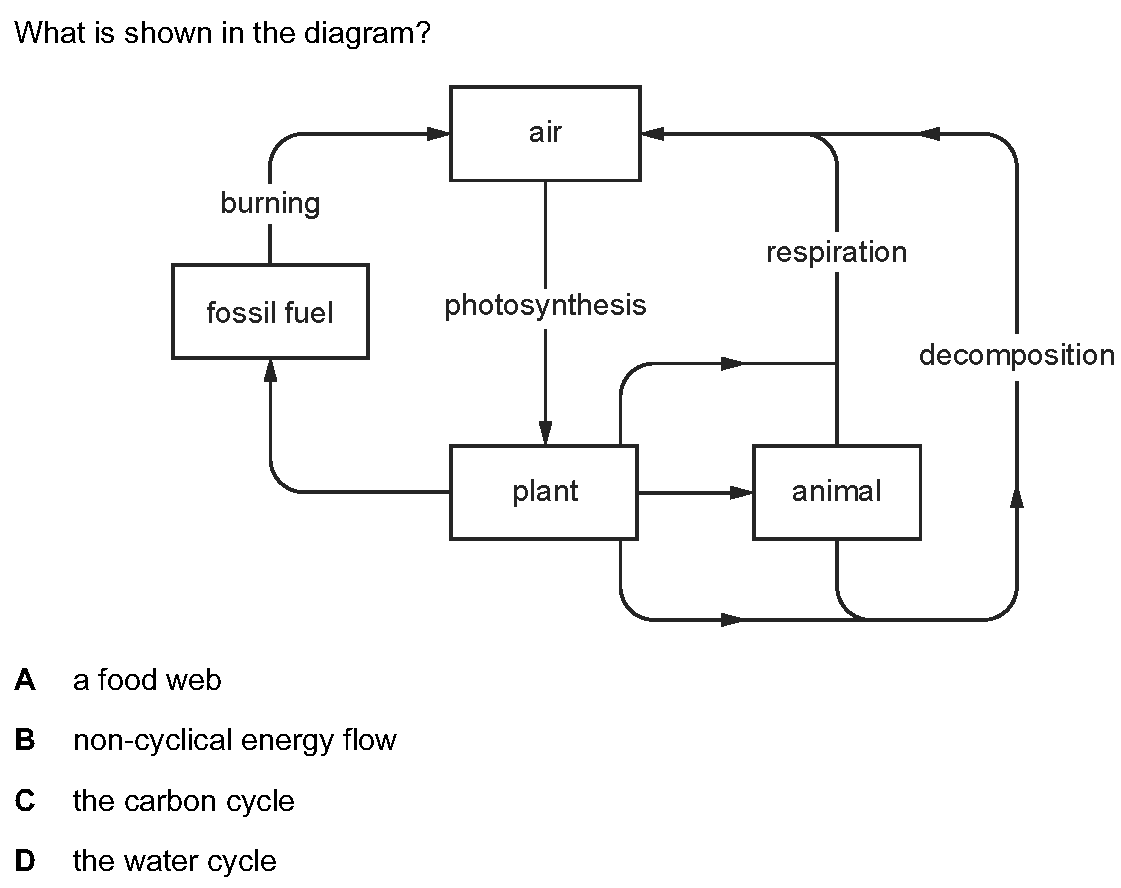
What is shown in the diagram?
0 oO DD >
burning
respiration
fossil fuel photosynthesis
decomposition
a food web
non-cyclical energy flow
the carbon cycle
the water cycle
0 oO DD >
burning
respiration
fossil fuel photosynthesis
decomposition
a food web
non-cyclical energy flow
the carbon cycle
the water cycle
Options:
A
B
C
D
Correct Key: C
A
B
C
D
Correct Key: C
Question 2
Paper Ref: 0610/21_Summer_2015_Q37
Paper Ref: 0610/21_Summer_2015_Q37
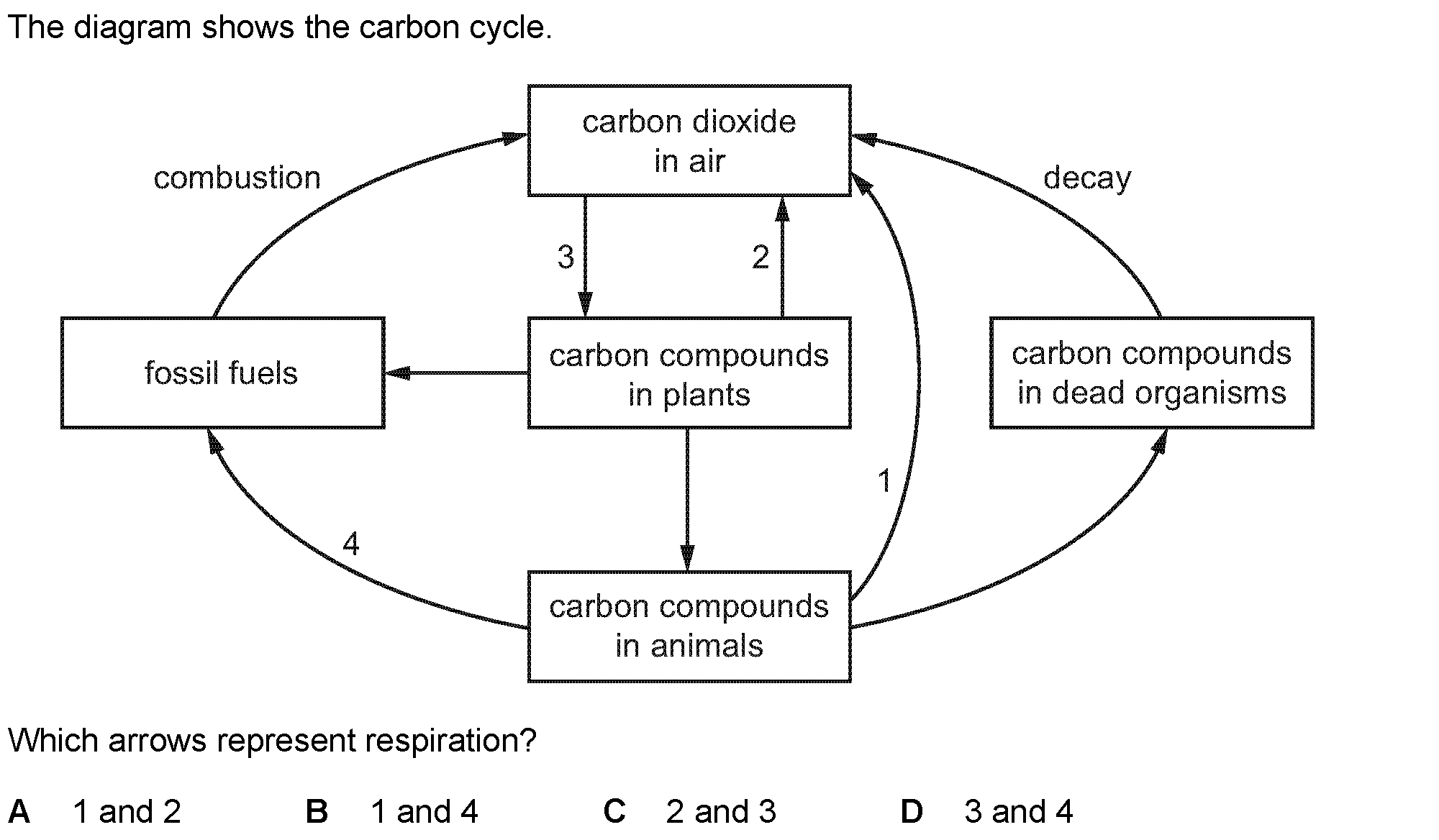
The diagram shows the carbon cycle.
carbon dioxide
in air
carbon compounds
in plants
carbon compounds
in animals
combustion
fossil fuels
carbon compounds
in dead organisms
Which arrows represent respiration?
A 1and2 B 1and4 C 2and3 D 3and4
carbon dioxide
in air
carbon compounds
in plants
carbon compounds
in animals
combustion
fossil fuels
carbon compounds
in dead organisms
Which arrows represent respiration?
A 1and2 B 1and4 C 2and3 D 3and4
Options:
A
B
C
D
Correct Key: C
A
B
C
D
Correct Key: C
Question 3
Paper Ref: 5129/12_Summer_2021_Q12
Paper Ref: 5129/12_Summer_2021_Q12
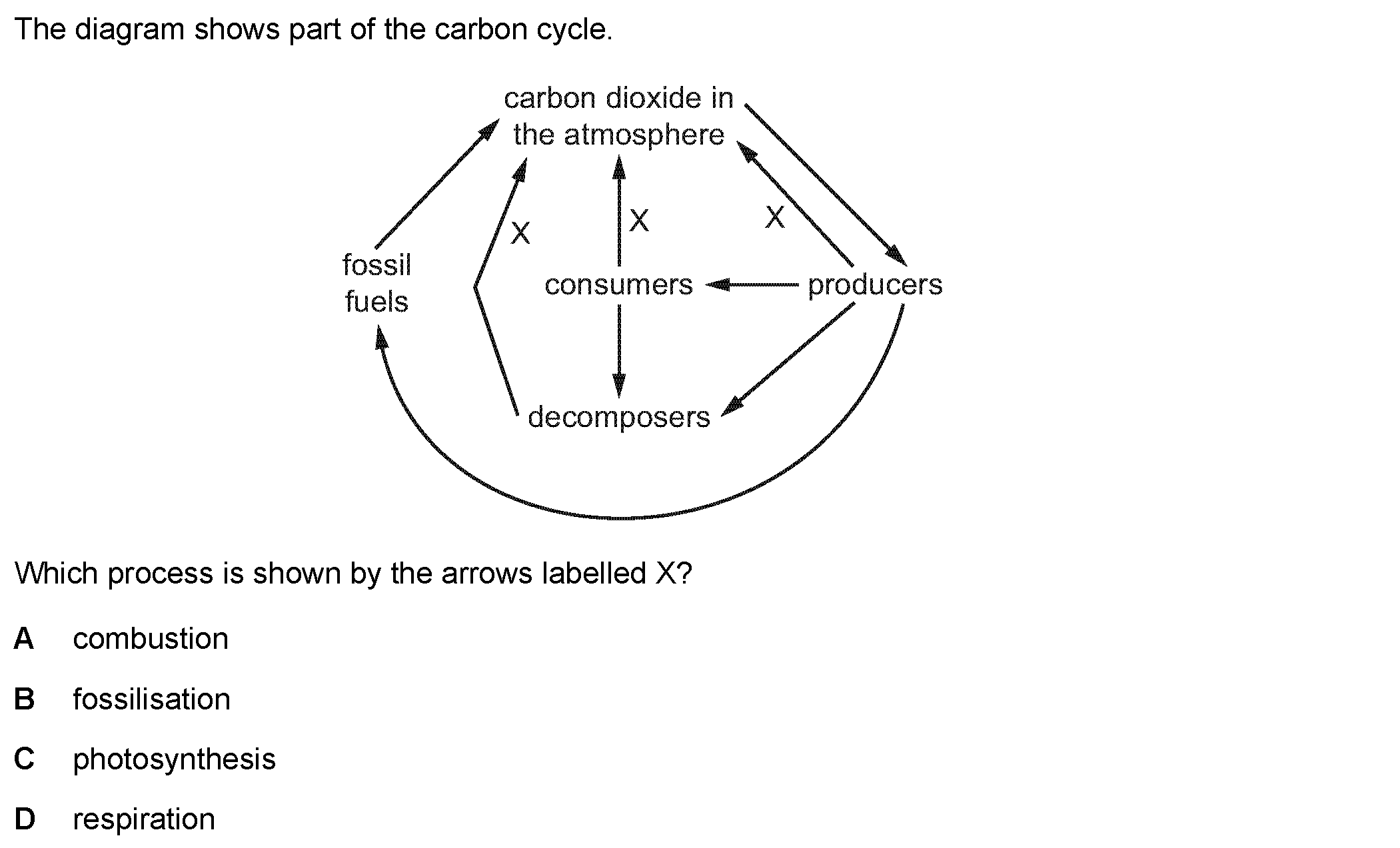
The diagram shows part of the carbon cycle.
carbon dioxide in
the atmosphere
x _—N
fossil
“ mm OT OCLUCEFS
fuels
_t.
Which process is shown by the arrows labelled X?
combustion
fossilisation
photosynthesis
0 0O wD PY
respiration
carbon dioxide in
the atmosphere
x _—N
fossil
“ mm OT OCLUCEFS
fuels
_t.
Which process is shown by the arrows labelled X?
combustion
fossilisation
photosynthesis
0 0O wD PY
respiration
Options:
A
B
C
D
Correct Key: A
A
B
C
D
Correct Key: A
Question 4
Paper Ref: 0610/12_Summer_2022_Q37
Paper Ref: 0610/12_Summer_2022_Q37
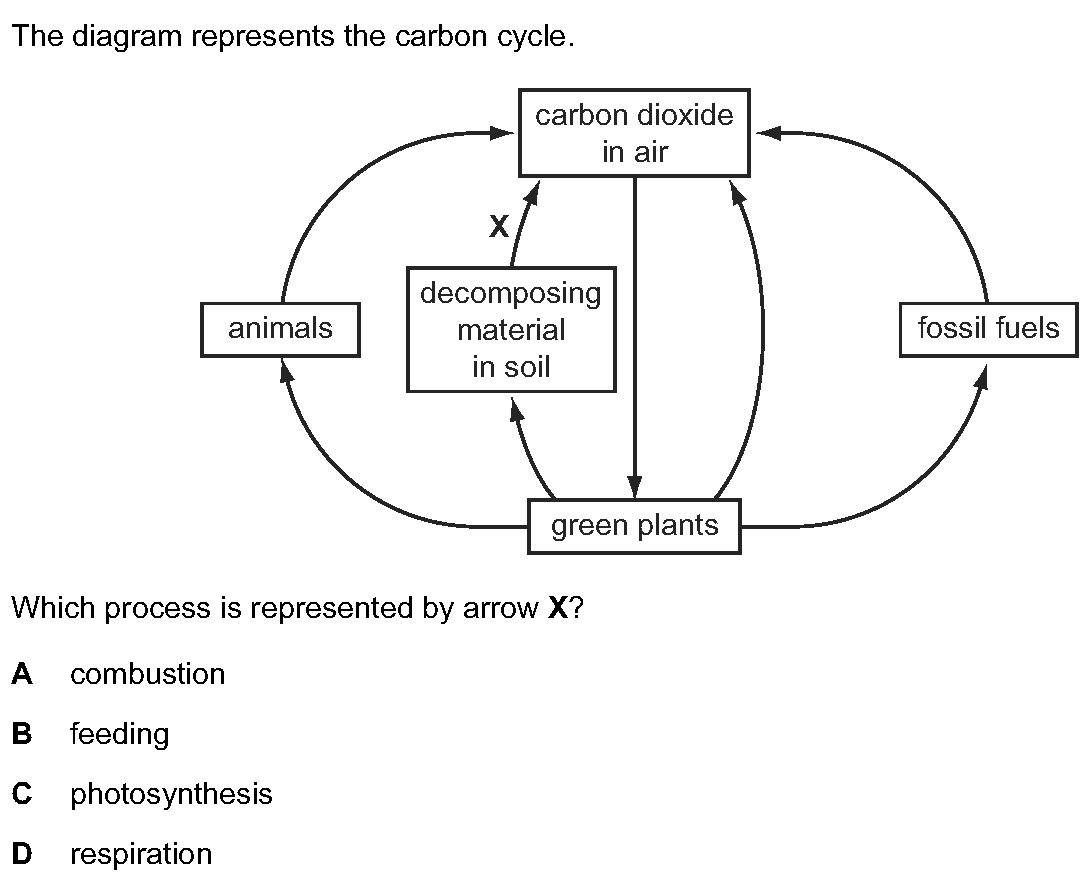
The diagram represents the carbon cycle.
carbon dioxide
in air
decomposing
animals material fossil fuels
in soil
green plants
Which process is represented by arrow X?
combustion
B_ feeding
C photosynthesis
D respiration
carbon dioxide
in air
decomposing
animals material fossil fuels
in soil
green plants
Which process is represented by arrow X?
combustion
B_ feeding
C photosynthesis
D respiration
Options:
A
B
C
D
Correct Key: D
A
B
C
D
Correct Key: D
Question 5
Paper Ref: 0610/12_Summer_2016_Q38
Paper Ref: 0610/12_Summer_2016_Q38
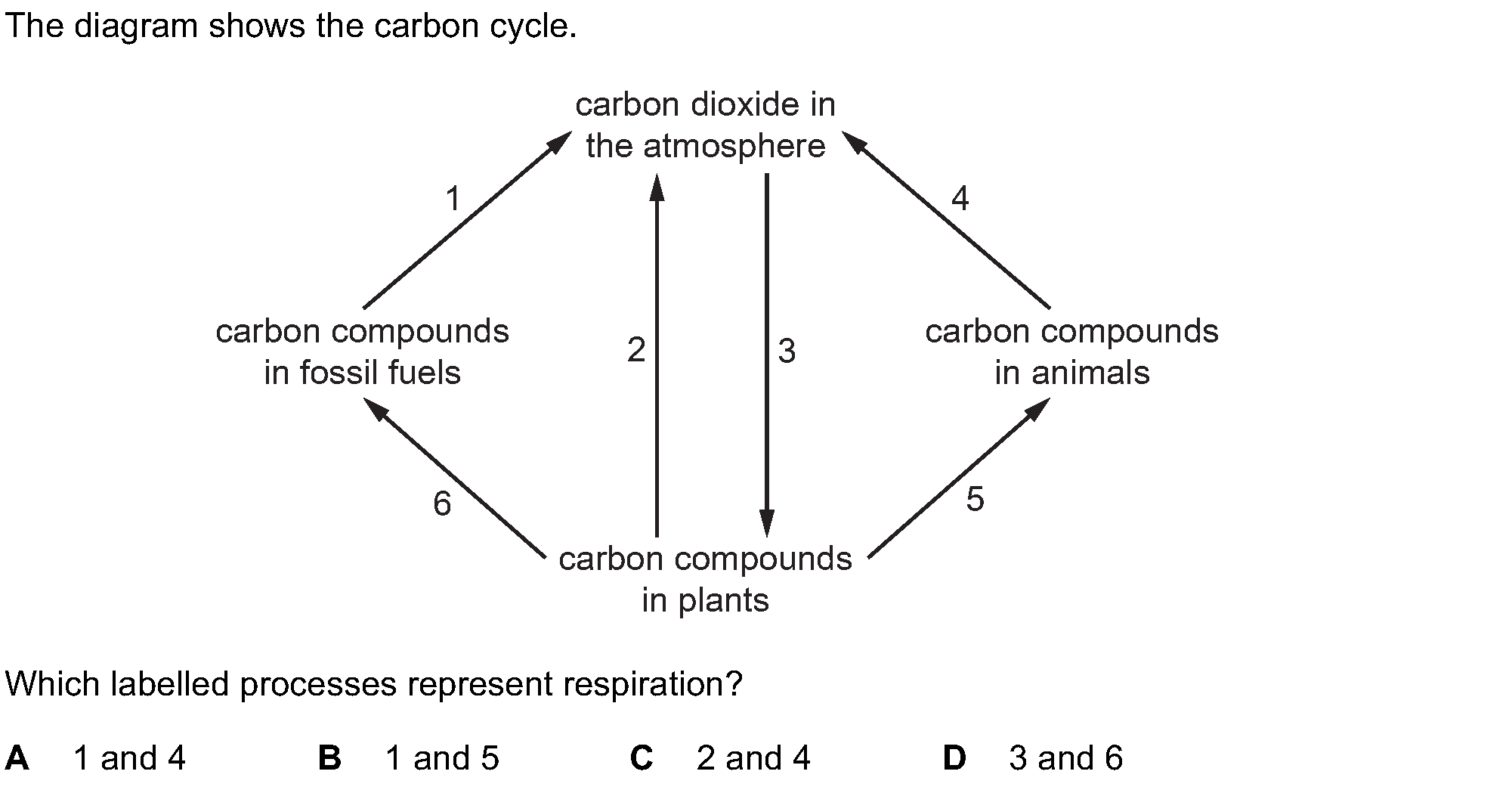
The diagram shows the carbon cycle.
carbon dioxide in
the atmosphere
1 4
carbon compounds 2 3 carbon compounds
in fossil fuels in animals
6 5
carbon compounds
in plants
Which labelled processes represent respiration?
A iand4 B tdand5 C 2and4 D 3and6
carbon dioxide in
the atmosphere
1 4
carbon compounds 2 3 carbon compounds
in fossil fuels in animals
6 5
carbon compounds
in plants
Which labelled processes represent respiration?
A iand4 B tdand5 C 2and4 D 3and6
Options:
A
B
C
D
Correct Key: D
A
B
C
D
Correct Key: D
Question 6
Paper Ref: 0610/12_Spring_2023_Q38
Paper Ref: 0610/12_Spring_2023_Q38
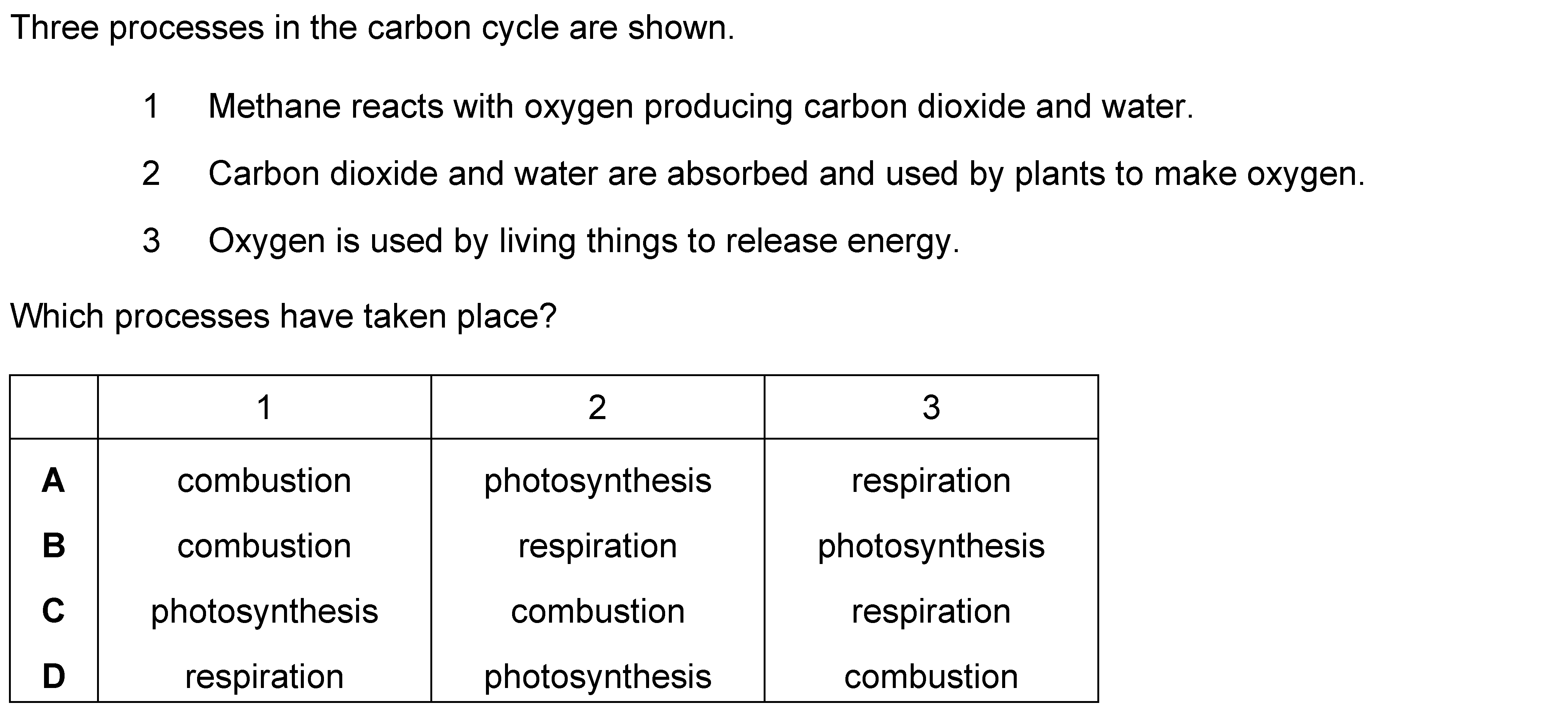
Three processes in the carbon cycle are shown.
1 Methane reacts with oxygen producing carbon dioxide and water.
2 Carbon dioxide and water are absorbed and used by plants to make oxygen.
3 Oxygen is used by living things to release energy.
Which processes have taken place?
combustion photosynthesis respiration
combustion respiration photosynthesis
photosynthesis combustion respiration
respiration photosynthesis combustion
Options:
A
B
C
D
Correct Key: C
A
B
C
D
Correct Key: C
Question 7
Paper Ref: 0620/22_Summer_2020_Q30
Paper Ref: 0620/22_Summer_2020_Q30
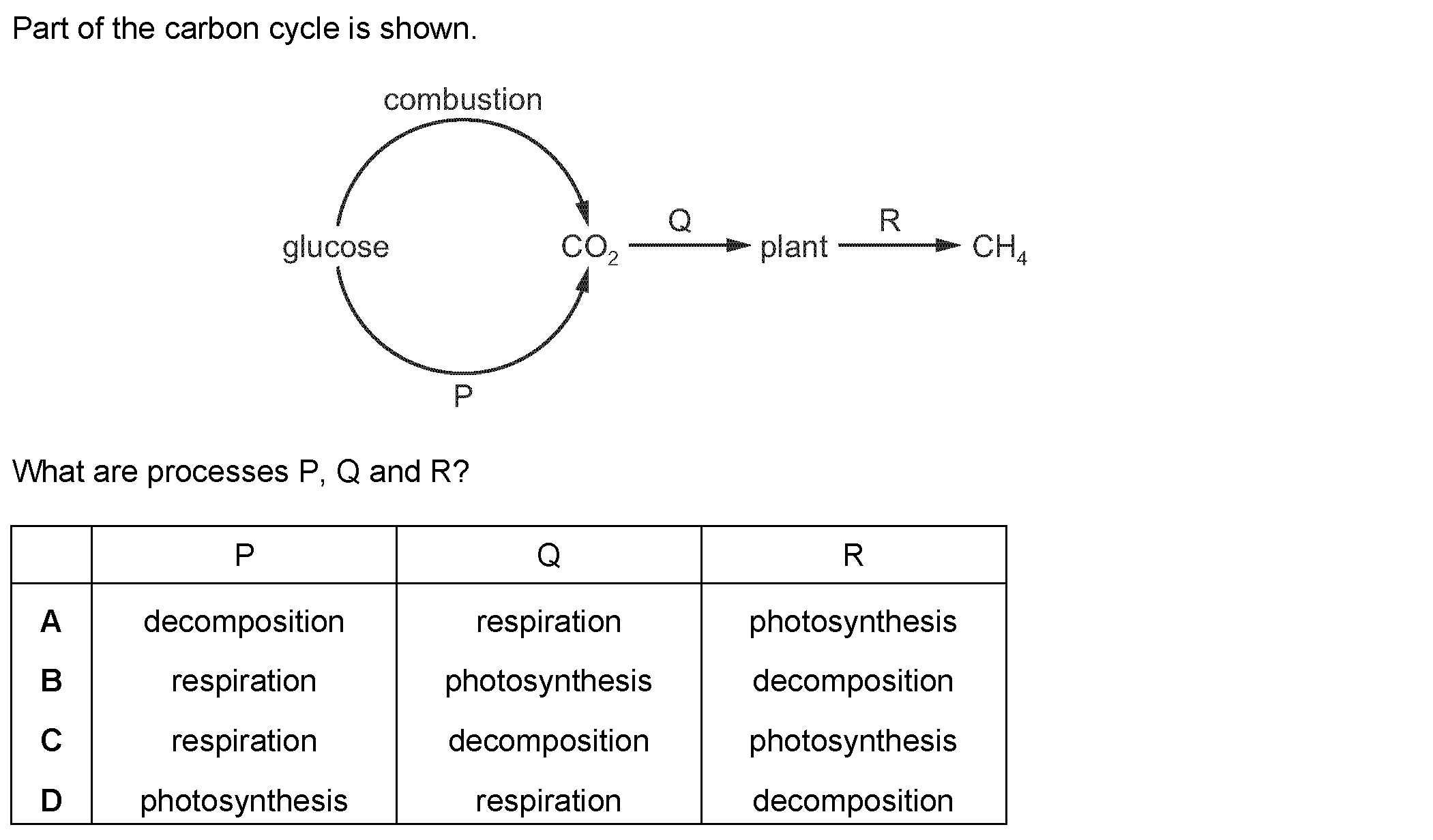
Part of the carbon cycle is shown.
combustion
Q R
glucose CO, — plant mm CH,
P
What are processes P, Q and R?
decomposition respiration photosynthesis
respiration photosynthesis decomposition
respiration decomposition photosynthesis
photosynthesis respiration decomposition
combustion
Q R
glucose CO, — plant mm CH,
P
What are processes P, Q and R?
decomposition respiration photosynthesis
respiration photosynthesis decomposition
respiration decomposition photosynthesis
photosynthesis respiration decomposition
Options:
A
B
C
D
Correct Key: A
A
B
C
D
Correct Key: A
Question 8
Paper Ref: 0620/23_Winter_2020_Q33
Paper Ref: 0620/23_Winter_2020_Q33
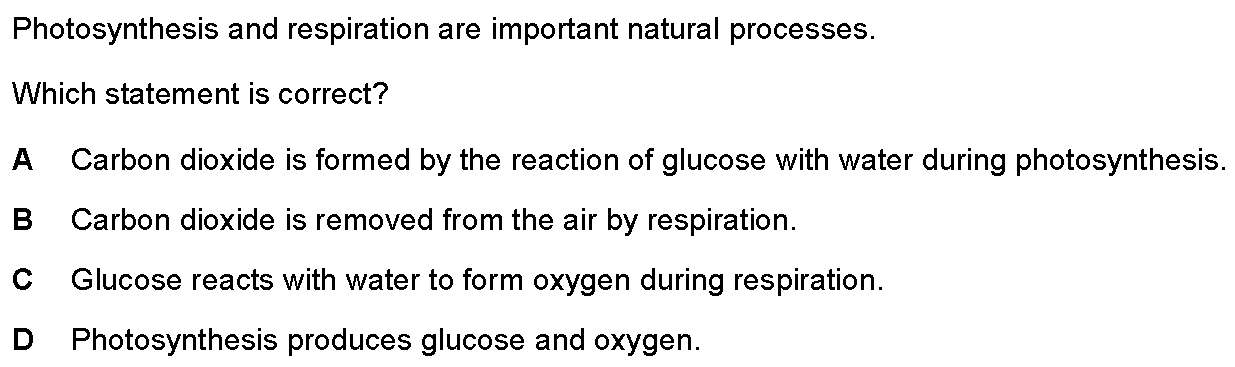
Photosynthesis and respiration are important natural processes.
Which statement is correct?
A
B
c
D
Carbon dioxide is formed by the reaction of glucose with water during photosynthesis.
Carbon dioxide is removed from the air by respiration.
Glucose reacts with water to form oxygen during respiration.
Photosynthesis produces glucose and oxygen.
Which statement is correct?
A
B
c
D
Carbon dioxide is formed by the reaction of glucose with water during photosynthesis.
Carbon dioxide is removed from the air by respiration.
Glucose reacts with water to form oxygen during respiration.
Photosynthesis produces glucose and oxygen.
Options:
A
B
C
D
Correct Key: B
A
B
C
D
Correct Key: B
Question 9
Paper Ref: 0620/21_Summer_2017_Q31
Paper Ref: 0620/21_Summer_2017_Q31
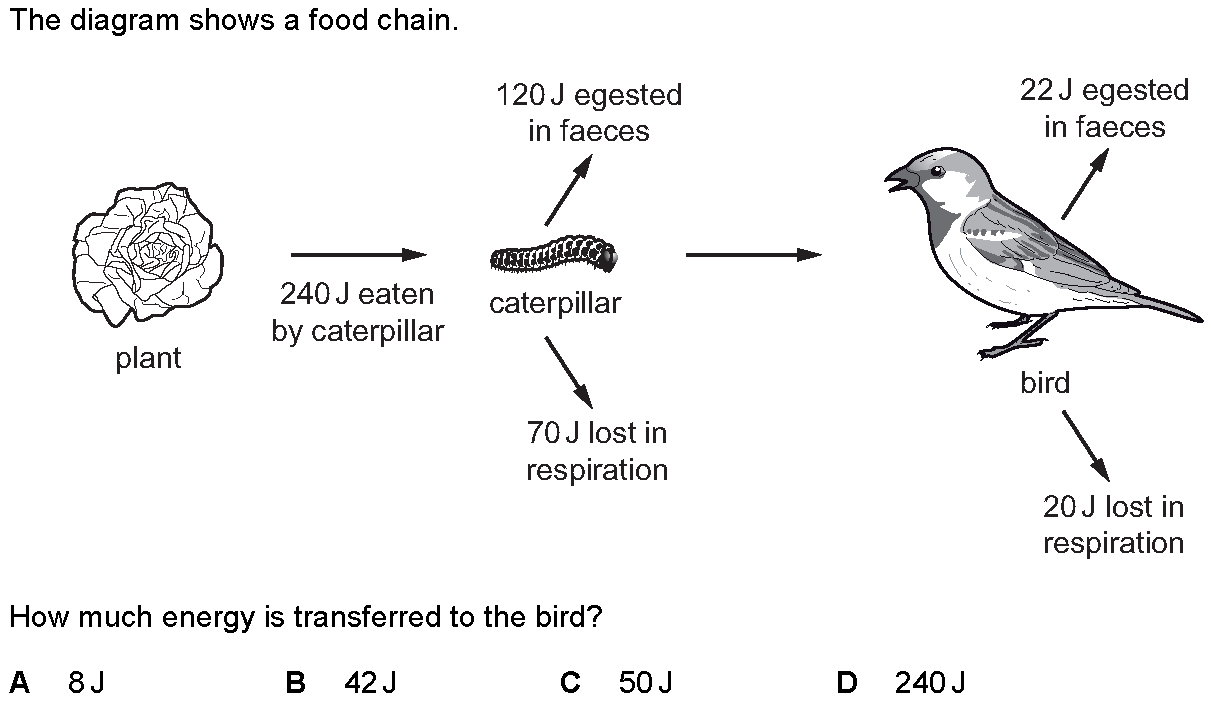
The diagram shows a food chain.
120J egested 22 J egested
in faeces in faeces
/
<a —
Ee 240J eaten caterpillar
lant by caterpillar
plan \
70J lostin
respiration
20 J lost in
respiration
How much energy is transferred to the bird?
A 8J B 42J Cc 50J D 240J
120J egested 22 J egested
in faeces in faeces
/
<a —
Ee 240J eaten caterpillar
lant by caterpillar
plan \
70J lostin
respiration
20 J lost in
respiration
How much energy is transferred to the bird?
A 8J B 42J Cc 50J D 240J
Options:
A
B
C
D
Correct Key: D
A
B
C
D
Correct Key: D
Question 10
Paper Ref: 0620/22_Summer_2021_Q32
Paper Ref: 0620/22_Summer_2021_Q32
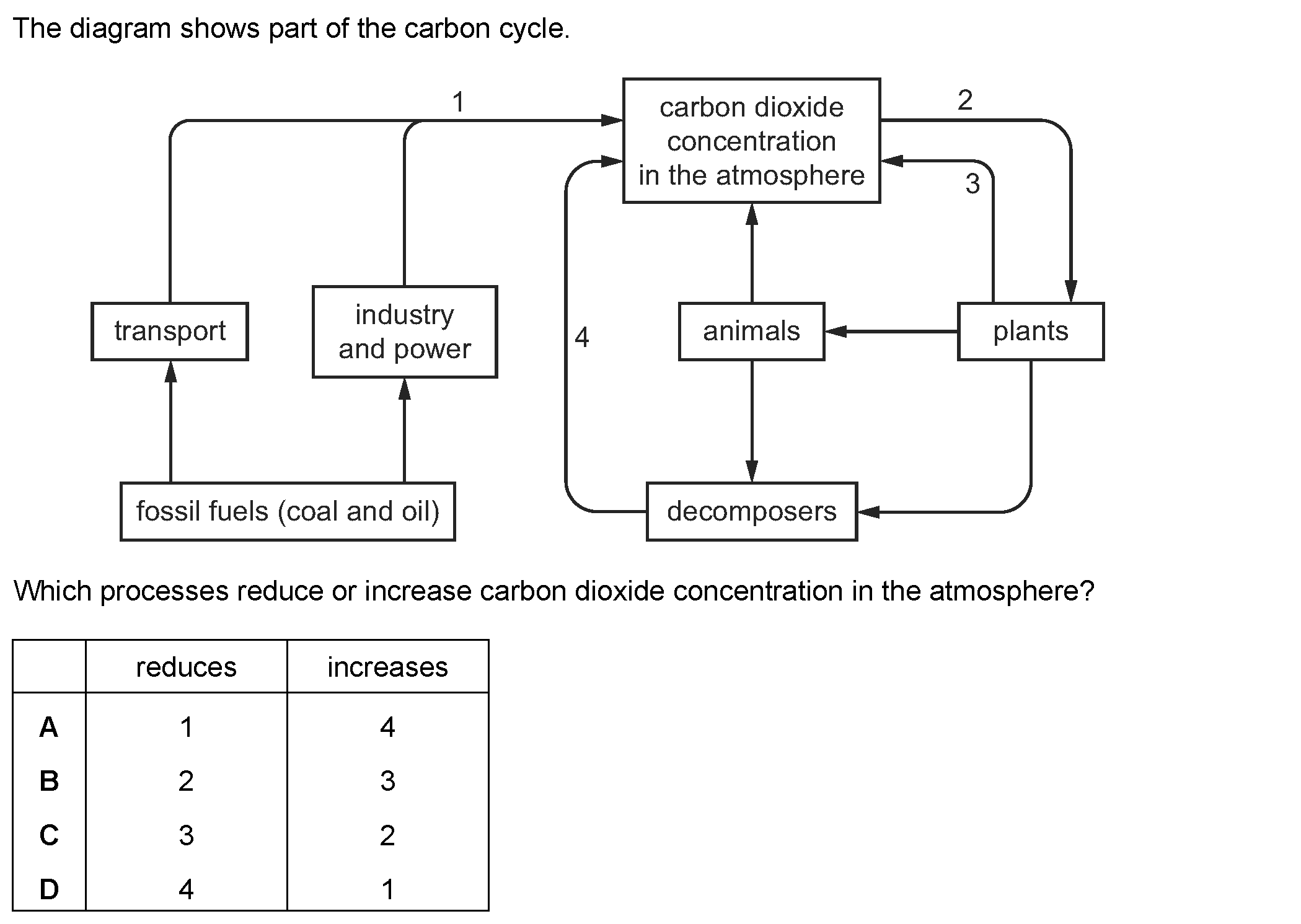
The diagram shows part of the carbon cycle.
1 carbon dioxide 2
concentration
in the atmosphere
and power
fossil fuels (coal and oil) decomposers
Which processes reduce or increase carbon dioxide concentration in the atmosphere?
reduces increases
1 4
2 3
3 2
4 1
1 carbon dioxide 2
concentration
in the atmosphere
and power
fossil fuels (coal and oil) decomposers
Which processes reduce or increase carbon dioxide concentration in the atmosphere?
reduces increases
1 4
2 3
3 2
4 1
Options:
A
B
C
D
Correct Key: C
A
B
C
D
Correct Key: C
Question 11
Paper Ref: 5129/12_Winter_2022_Q24
Paper Ref: 5129/12_Winter_2022_Q24
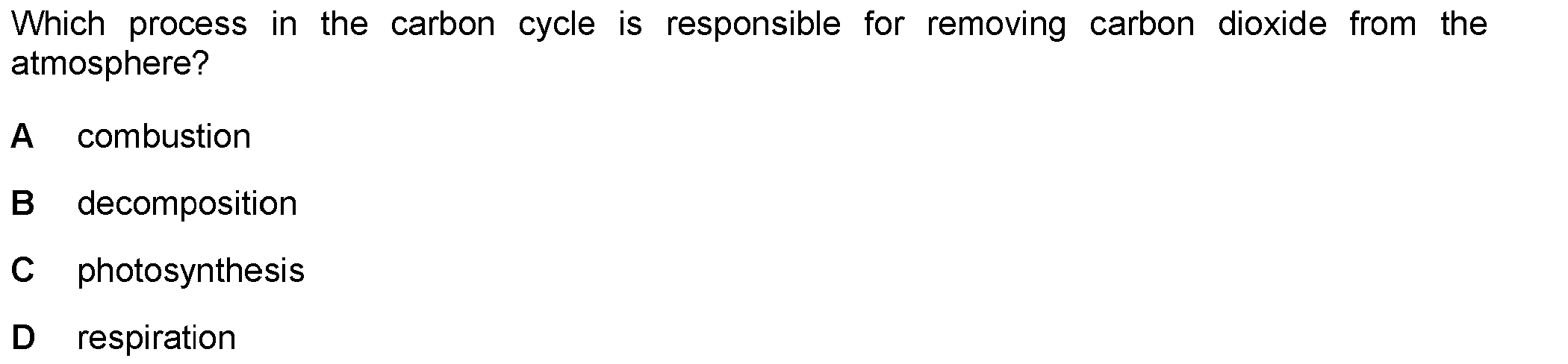
Which process in the carbon cycle is responsible for removing carbon dioxide from the
atmosphere?
A combustion
B decomposition
C photosynthesis
D
respiration
atmosphere?
A combustion
B decomposition
C photosynthesis
D
respiration
Options:
A
B
C
D
Correct Key: D
A
B
C
D
Correct Key: D
Question 12
Paper Ref: 5129/12_Summer_2024_Q12
Paper Ref: 5129/12_Summer_2024_Q12
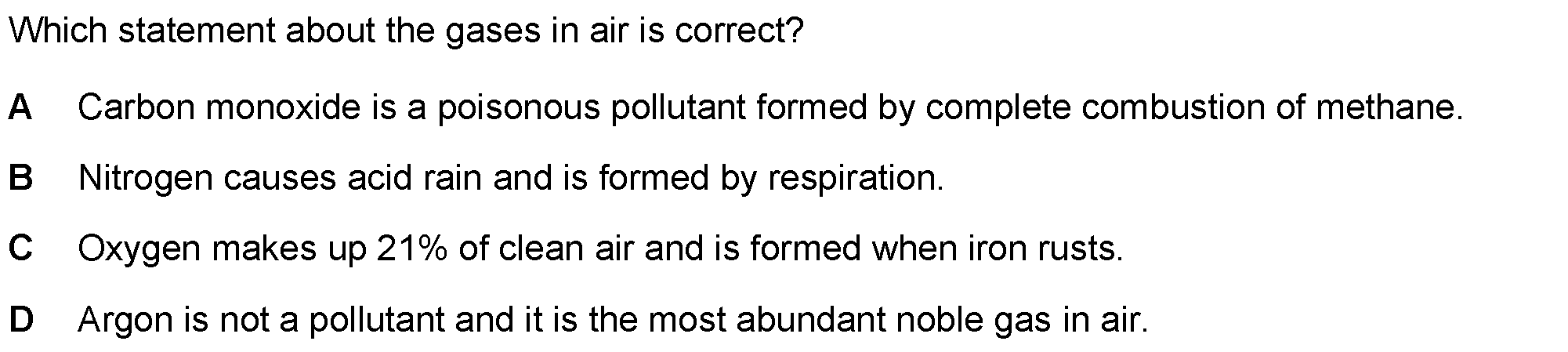
Which statement about the gases in air is correct?
A
B
Cc
D
Carbon monoxide is a poisonous pollutant formed by complete combustion of methane.
Nitrogen causes acid rain and is formed by respiration.
Oxygen makes up 21% of clean air and is formed when iron rusts.
Argon is not a pollutant and it is the most abundant noble gas in air.
A
B
Cc
D
Carbon monoxide is a poisonous pollutant formed by complete combustion of methane.
Nitrogen causes acid rain and is formed by respiration.
Oxygen makes up 21% of clean air and is formed when iron rusts.
Argon is not a pollutant and it is the most abundant noble gas in air.
Options:
A
B
C
D
Correct Key: B
A
B
C
D
Correct Key: B
Question 13
Paper Ref: 5129/12_Summer_2026_Q26
Paper Ref: 5129/12_Summer_2026_Q26
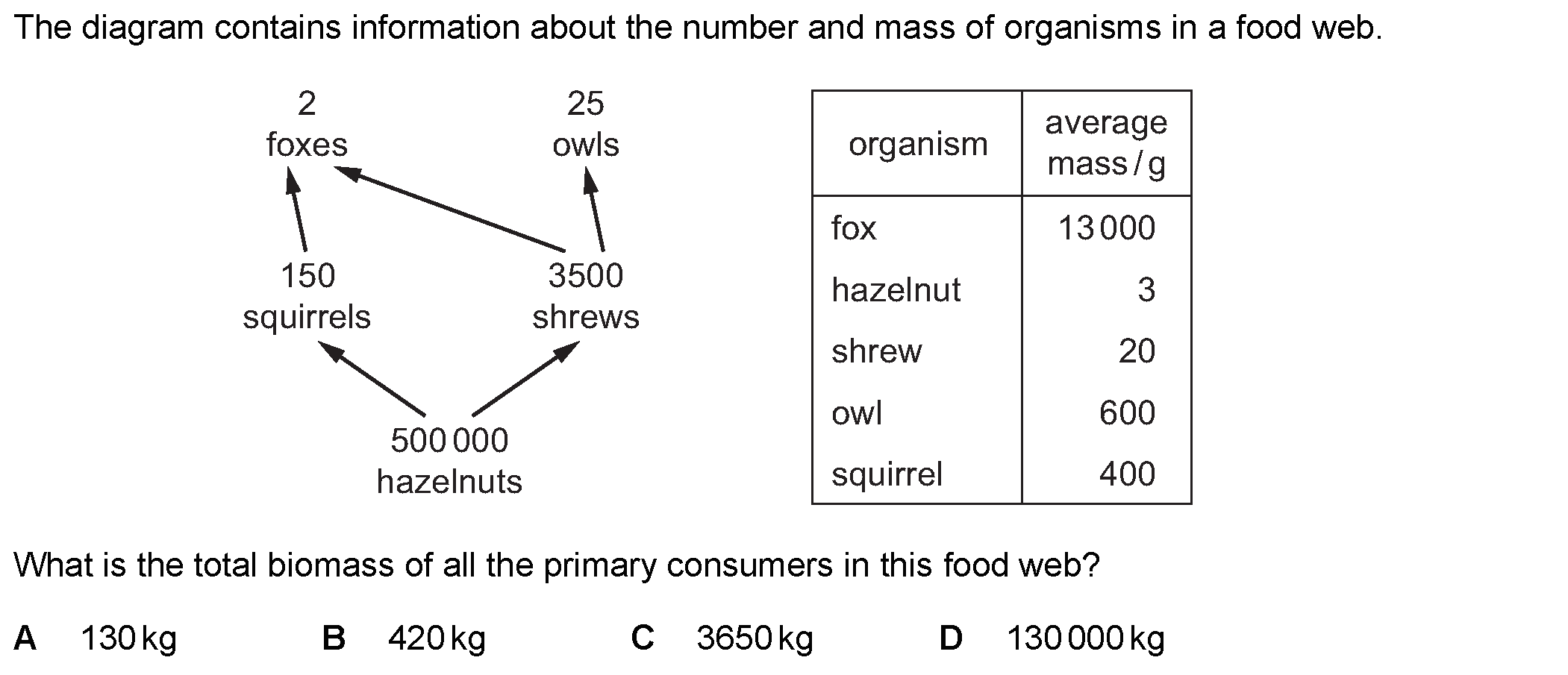
The diagram contains information about the number and mass of organisms in a food web.
2 25
foxes owls organism average
\ ae \ mass/g
fox
150 3500 hazelnut
squirrels shrews
NN wa shrew
owl
500 000
hazelnuts squirrel
What is the total biomass of all the primary consumers in this food web?
A 130kg B 420kg C 3650kg D 130000kg
2 25
foxes owls organism average
\ ae \ mass/g
fox
150 3500 hazelnut
squirrels shrews
NN wa shrew
owl
500 000
hazelnuts squirrel
What is the total biomass of all the primary consumers in this food web?
A 130kg B 420kg C 3650kg D 130000kg
Options:
A
B
C
D
Correct Key: C
A
B
C
D
Correct Key: C
Question 14
Paper Ref: 0610/22_Spring_2020_Q38
Paper Ref: 0610/22_Spring_2020_Q38
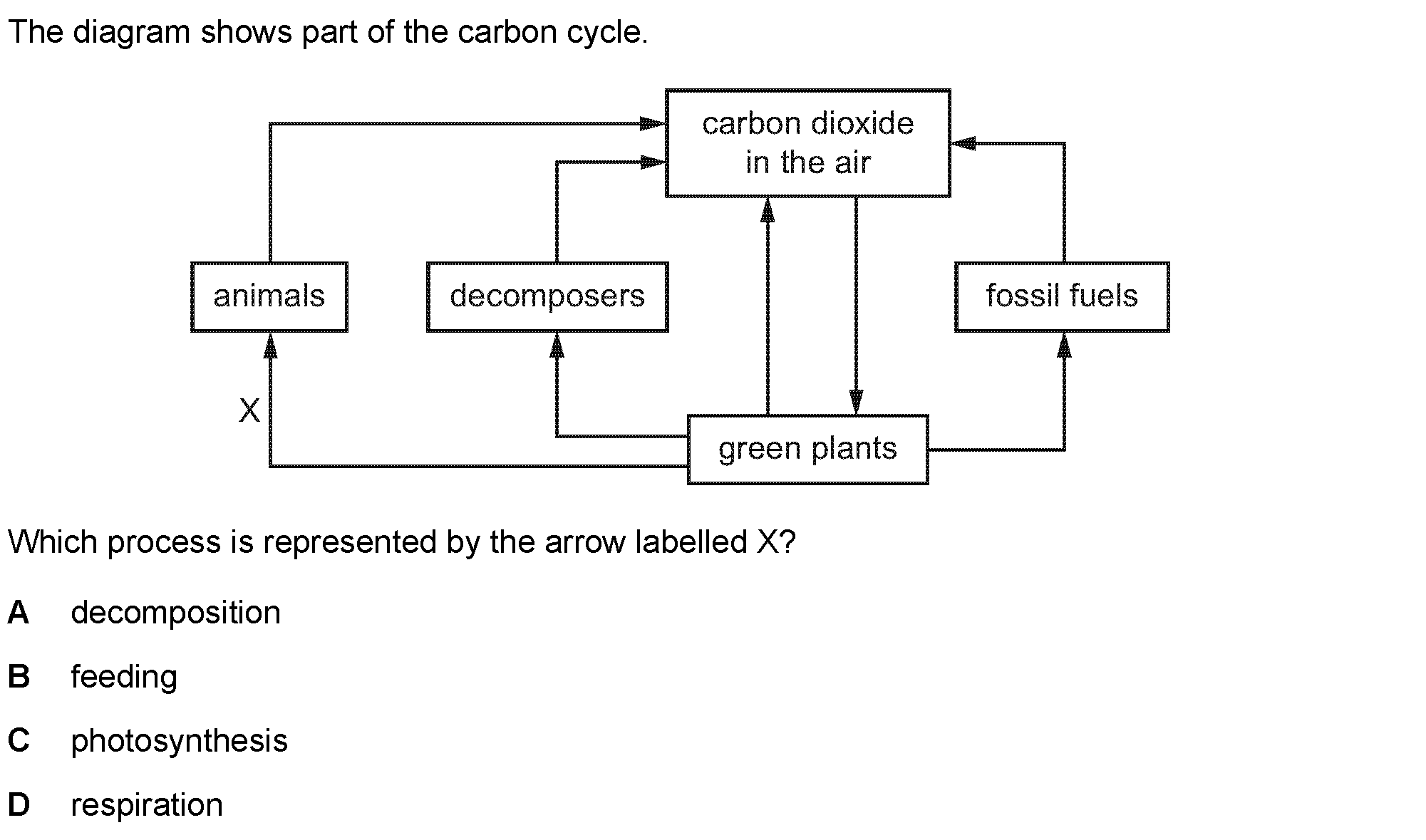
The diagram shows part of the carbon cycle.
carbon dioxide
in the air
decomposers; fossil fuels
green plants
Which process is represented by the arrow labelled X?
animals
A decomposition
B_ feeding
C photosynthesis
D
respiration
carbon dioxide
in the air
decomposers; fossil fuels
green plants
Which process is represented by the arrow labelled X?
animals
A decomposition
B_ feeding
C photosynthesis
D
respiration
Options:
A
B
C
D
Correct Key: B
A
B
C
D
Correct Key: B
Question 15
Paper Ref: 0610/12_Winter_2017_Q38
Paper Ref: 0610/12_Winter_2017_Q38
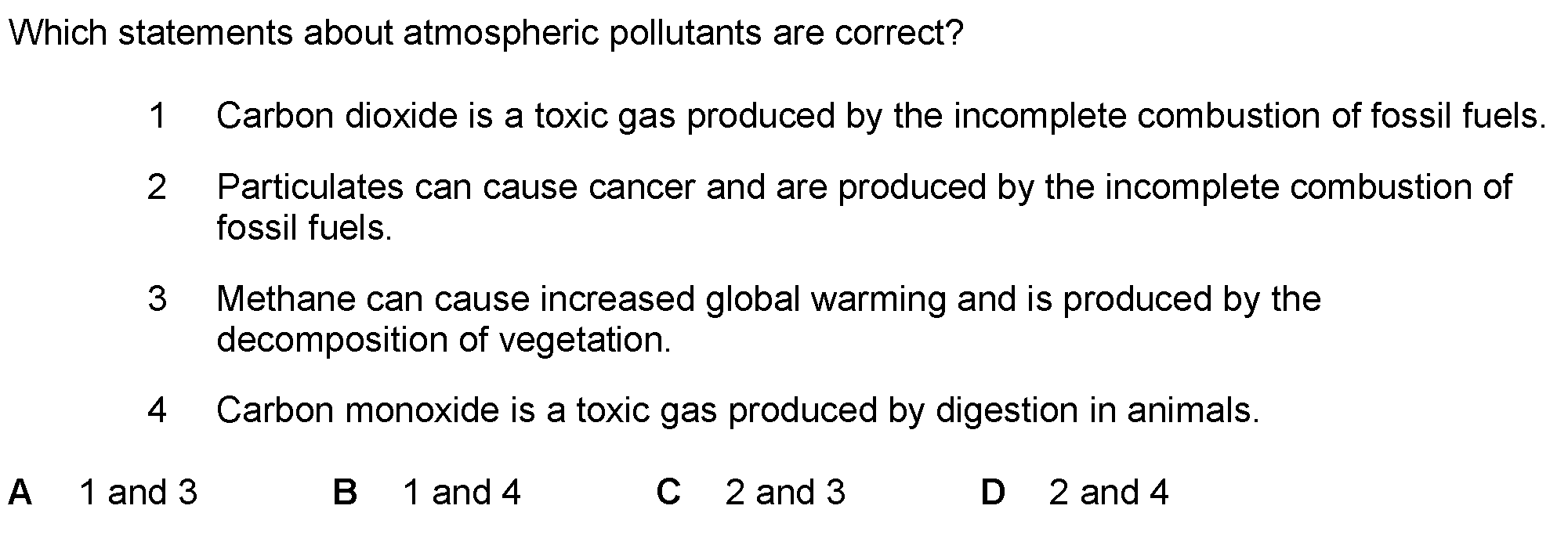
Which statements about atmospheric pollutants are correct?
A
1 and 3
Carbon dioxide is a toxic gas produced by the incomplete combustion of fossil fuels.
Particulates can cause cancer and are produced by the incomplete combustion of
fossil fuels.
Methane can cause increased global warming and is produced by the
decomposition of vegetation.
Carbon monoxide is a toxic gas produced by digestion in animals.
B 1and4 C 2and3 D 2and4
Options:
A
B
C
D
Correct Key: C
A
B
C
D
Correct Key: C
Question 16
Paper Ref: 5129/12_Winter_2024_Q12
Paper Ref: 5129/12_Winter_2024_Q12
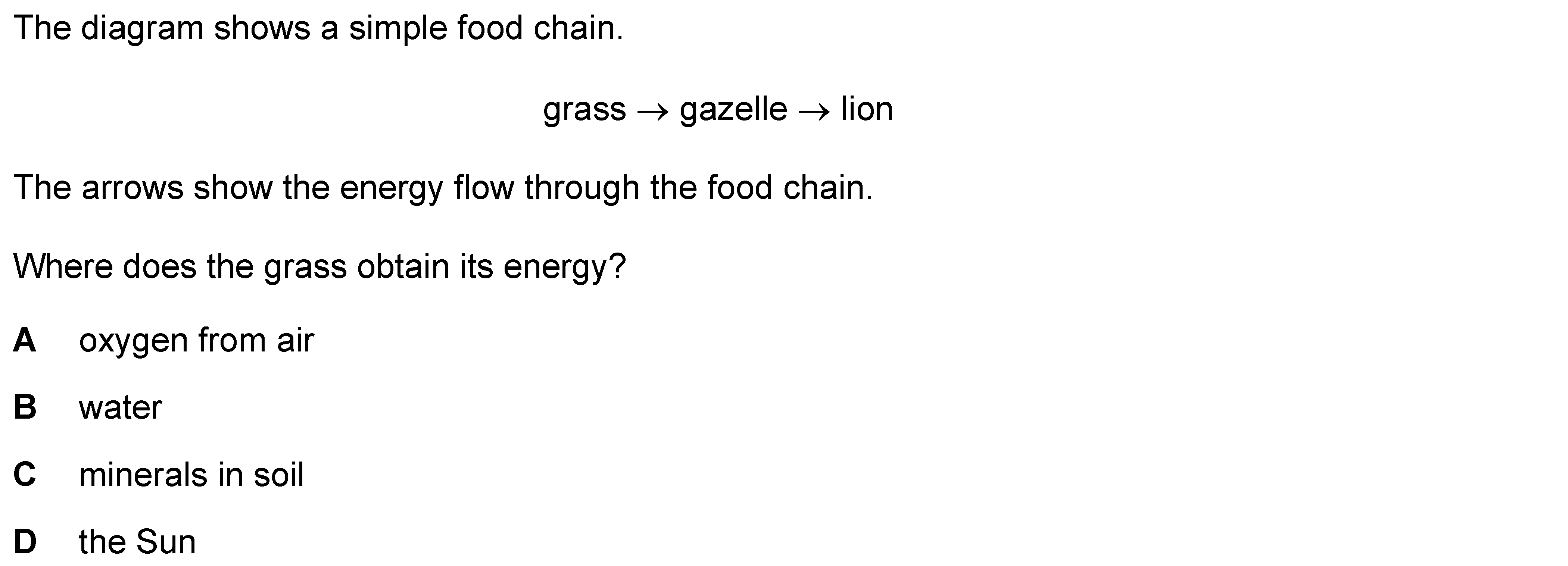
The diagram shows a simple food chain.
grass —> gazelle — lion
The arrows show the energy flow through the food chain.
Where does the grass obtain its energy?
A
B
C
D
oxygen from air
water
minerals in soll
the Sun
grass —> gazelle — lion
The arrows show the energy flow through the food chain.
Where does the grass obtain its energy?
A
B
C
D
oxygen from air
water
minerals in soll
the Sun
Options:
A
B
C
D
Correct Key: A
A
B
C
D
Correct Key: A
Structured Questions Mark Scheme & Answers
•1•.• • • •[•▍• •C•P• •O•c•t•o•b•e•r• •2•0•2•4• •P•2• • •·• • •Q•1•2• • •P•a•r•t• •(•b•)• • •·• • •2•0•2•4• • •·• • •L•o•w•e•r• •S•e•c• •0•8•9•3•]• • • • • • •3• •o•r• •t•h•r•e•e• •1• •••c•c•e•p•t• •r•e•s•p•i•r•a•t•i•o•n•,• •d•e•c•o•m•p•o•s•i•t•i•o•n• •a•n•d• •c•o•m•b•u•s•t•i•o•n•
•2•.• • • •[•▍• •C•P• •O•c•t•o•b•e•r• •2•0•2•4• •P•2• • •·• • •Q•1•2• • •P•a•r•t• •(•c•)• • •·• • •2•0•2•4• • •·• • •L•o•w•e•r• •S•e•c• •0•8•9•3•]• • • • • • •1• •b•o•t•h• •c•o•r•r•e•c•t• •f•o•r• •t•h•e• •m•a•r•k• •(•p•r•o•c•e•s•s•)• •c•o•m•b•u•s•t•i•o•n• •••c•c•e•p•t• •b•u•r•n•i•n•g• •f•o•r• •c•o•m•b•u•s•t•i•o•n• •a•n•d• •••c•c•e•p•t• •c•o•m•b•u•s•t•i•o•n• •a•n•d• •(•m•o•r•e•)• •t•r•a•n•s•p•o•r•t• •o•r• •c•o•m•b•u•s•t•i•o•n• •a•n•d• •(•m•o•r•e•)• •s•l•a•s•h• •a•n•d• •b•u•r•n• •o•r• •c•o•m•b•u•s•t•i•o•n• •a•n•d• •(•m•o•r•e•)• •b•u•r•n•i•n•g• •t•r•a•s•h• •o•r• •w•a•s•t•e• •(•e•x•p•l•a•n•a•t•i•o•n•)• •(•i•d•e•a• •o•f•)• •(•i•n•c•r•e•a•s•e•d•)• •u•s•e• •o•f• •f•o•s•s•i•l• •f•u•e•l•s• •o•r• •i•n•c•r•e•a•s•e• •i•n• •p•o•p•u•l•a•t•i•o•n• •o•r• •t•o• •p•r•o•v•i•d•e• •e•n•e•r•g•y• •••c•c•e•p•t• •r•e•s•p•i•r•a•t•i•o•n• •a•n•d• •i•n•c•r•e•a•s•e• •i•n• •p•o•p•u•l•a•t•i•o•n•
•3•.• • • •[•▍• •C•P• •O•c•t•o•b•e•r• •2•0•2•4• •P•2• • •·• • •Q•1•2• • •P•a•r•t• •(•d•)• • •·• • •2•0•2•4• • •·• • •L•o•w•e•r• •S•e•c• •0•8•9•3•]• • • • • • •p•h•o•t•o•s•y•n•t•h•e•s•i•s• •1• •••c•c•e•p•t• •c•o•r•r•e•c•t• •c•a•r•b•o•n• •s•t•o•r•a•g•e• •e•x•a•m•p•l•e•,• •e•.•g•.• •r•o•c•k• •f•o•r•m•a•t•i•o•n• •o•r• •s•e•d•i•m•e•n•t•a•t•i•o•n• •o•r• •f•o•r•m•a•t•i•o•n• •o•f• •f•o•s•s•i•l• •f•u•e•l•s•
•4•.• • • •[•▍• •C•P• •M•a•y• •2•0•2•5• •P•2• • •·• • •Q•4• • •P•a•r•t• •(•a•)• • •·• • •2•0•2•5• • •·• • •L•o•w•e•r• •S•e•c• •0•8•9•3•]• • • • • • •a•n•y• •t•w•o• •f•r•o•m• •2• •(•i•d•e•a• •o•f•)• •s•e•a• •l•e•v•e•l• •r•i•s•i•n•g• •••c•c•e•p•t• •p•o•l•a•r• •i•c•e•c•a•p•s• •m•e•l•t•i•n•g• •o•r• •g•l•a•c•i•e•r•s• •m•e•l•t•i•n•g• •o•r• •o•c•e•a•n• •t•e•m•p•e•r•a•t•u•r•e• •r•i•s•i•n•g• •N•o•t•e• •i•c•e• •m•e•l•t•i•n•g• •i•s• •n•o•t• •s•u•f•f•i•c•i•e•n•t• •f•l•o•o•d•i•n•g• •d•r•o•u•g•h•t•s• •••c•c•e•p•t• •d•e•s•e•r•t•i•f•i•c•a•t•i•o•n• •e•x•t•r•e•m•e• •w•e•a•t•h•e•r• •c•o•n•d•i•t•i•o•n•s• •••c•c•e•p•t• •n•a•m•e•d• •e•x•t•r•e•m•e• •c•o•n•d•i•t•i•o•n•s•,• •e•.•g•.• •(•m•o•r•e•)• •t•o•r•n•a•d•o•e•s• •o•r• •(•m•o•r•e•)• •h•u•r•r•i•c•a•n•e•s• •o•r• •u•n•p•r•e•d•i•c•t•a•b•l•e•/•l•e•s•s• •r•a•i•n•f•a•l•l• •o•r• •u•n•p•r•e•d•i•c•t•a•b•l•e• •w•e•a•t•h•e•r• •o•r• •r•i•s•e• •i•n• •(•g•l•o•b•a•l•)• •t•e•m•p•e•r•a•t•u•r•e•s• •o•r• •g•l•o•b•a•l• •w•a•r•m•i•n•g• •o•r• •h•o•t•t•e•r• •w•e•a•t•h•e•r• •I•g•n•o•r•e• •p•o•l•l•u•t•i•o•n• •o•r• •h•e•a•t• •s•t•r•e•s•s• •N•o•t•e• •w•i•l•d•f•i•r•e•s• •i•s• •n•o•t• •s•u•f•f•i•c•i•e•n•t• •b•u•t• •a•c•c•e•p•t• •m•o•r•e• •w•i•l•d•f•i•r•e•s• •••c•c•e•p•t• •h•a•b•i•t•a•t• •d•e•s•t•r•u•c•t•i•o•n• •o•r• •d•e•f•o•r•e•s•t•a•t•i•o•n• •o•r• •c•h•a•n•g•e• •i•n• •h•a•b•i•t•a•t• •••c•c•e•p•t• •(•i•d•e•a• •o•f•)• •e•x•t•i•n•c•t•i•o•n• •o•f• •s•p•e•c•i•e•s• •••c•c•e•p•t• •l•a•c•k• •o•f• •f•o•o•d• •o•r• •l•a•c•k• •o•f• •(•c•l•e•a•n•)• •w•a•t•e•r• •N•o•t•e• •m•o•r•e• •n•a•t•u•r•a•l• •d•i•s•a•s•t•e•r•s• •i•s• •n•o•t• •s•u•f•f•i•c•i•e•n•t•
•5•.• • • •[•▍• •C•P• •M•a•y• •2•0•2•5• •P•2• • •·• • •Q•4• • •P•a•r•t• •(•b•)• • •·• • •2•0•2•5• • •·• • •L•o•w•e•r• •S•e•c• •0•8•9•3•]• • • • • • •r•e•s•p•i•r•a•t•i•o•n• •o•r• •c•o•m•b•u•s•t•i•o•n• •o•r• •d•e•c•o•m•p•o•s•i•t•i•o•n• •1• •••c•c•e•p•t• •b•u•r•n•i•n•g• •o•r• •d•e•c•a•y• •I•g•n•o•r•e• •b•r•e•a•t•h•i•n•g• •••0•8•9•3•/•0•2• •C•h•e•c•k•p•o•i•n•t• •S•e•c•o•n•d•a•r•y• •–• •M•a•r•k• •S•c•h•e•m•e• •••p•r•i•l• •2•0•2•5•
•6•.• • • •[•▍• •C•P• •O•c•t•o•b•e•r• •2•0•2•5• •P•1• • •·• • •Q•8• • •P•a•r•t• •(•a•)• • •·• • •2•0•2•5• • •·• • •L•o•w•e•r• •S•e•c• •0•8•9•3•]• • • • • • •3• •e•a•c•h• •c•o•r•r•e•c•t• •a•n•s•w•e•r• •=• •1• •m•a•r•k• •(•p•r•o•c•e•s•s• •••)• •p•h•o•t•o•s•y•n•t•h•e•s•i•s• •D•o• •n•o•t• •a•c•c•e•p•t• •b•r•e•a•t•h•i•n•g• •(•p•r•o•c•e•s•s• •B•)• •r•e•s•p•i•r•a•t•i•o•n• •o•r• •d•e•c•o•m•p•o•s•i•t•i•o•n• •(•p•r•o•c•e•s•s• •C•)• •c•o•m•b•u•s•t•i•o•n• •••c•c•e•p•t• •b•u•r•n•i•n•g•
Last updated:
\n