5.1Motion, Forces and Energy
Reactivity and displacement — Question Bank (Cambridge) — Cambridge IGCSE Physics 0625 Revision Notes & Topical Questions
10 min read Lesson 40 of 91 Unit quiz
Cambridge Past Paper Bank
5.1 Reactivity and displacement
7 Multiple-Choice Questions with Official Mark Schemes
Question 1
5129/11_Summer_2025_Q24
Question 2
0620/21_Summer_2024_Q32
Question 3
0620/23_Summer_2020_Q28
Question 4
5129/12_Summer_2025_Q25
Question 5
5129/12_Winter_2024_Q24
Question 6
0620/22_Winter_2022_Q26
Question 7
0620/23_Summer_2015_Q26
Cambridge Lower Secondary Stage 9
5.1 Reactivity and displacement – Complete Question Bank & Mark Scheme
Total Questions7 Questions with Verified Solutions & Past Paper Mark Schemes
Multiple Choice Questions (Exam Practice)
Question 1
Paper Ref: 5129/11_Summer_2025_Q24
Paper Ref: 5129/11_Summer_2025_Q24
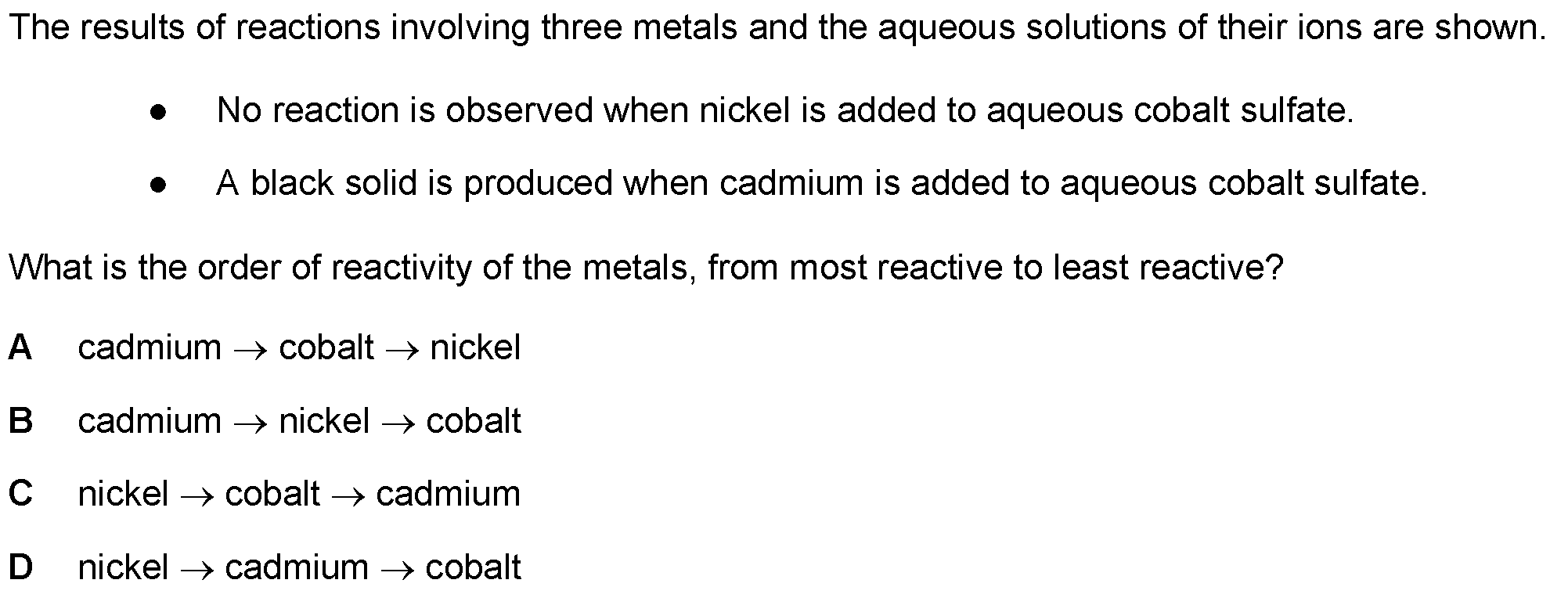
The results of reactions involving three metals and the aqueous solutions of their ions are shown.
e No reaction is observed when nickel is added to aqueous cobalt sulfate.
e A black solid is produced when cadmium is added to aqueous cobalt sulfate.
What is the order of reactivity of the metals, from most reactive to least reactive?
A cadmium -—> cobalt — nickel
B cadmium — nickel —> cobalt
C nickel + cobalt > cadmium
D
nickel + cadmium —> cobalt
Options:
A
B
C
D
Correct Key: A
A
B
C
D
Correct Key: A
Question 2
Paper Ref: 0620/21_Summer_2024_Q32
Paper Ref: 0620/21_Summer_2024_Q32
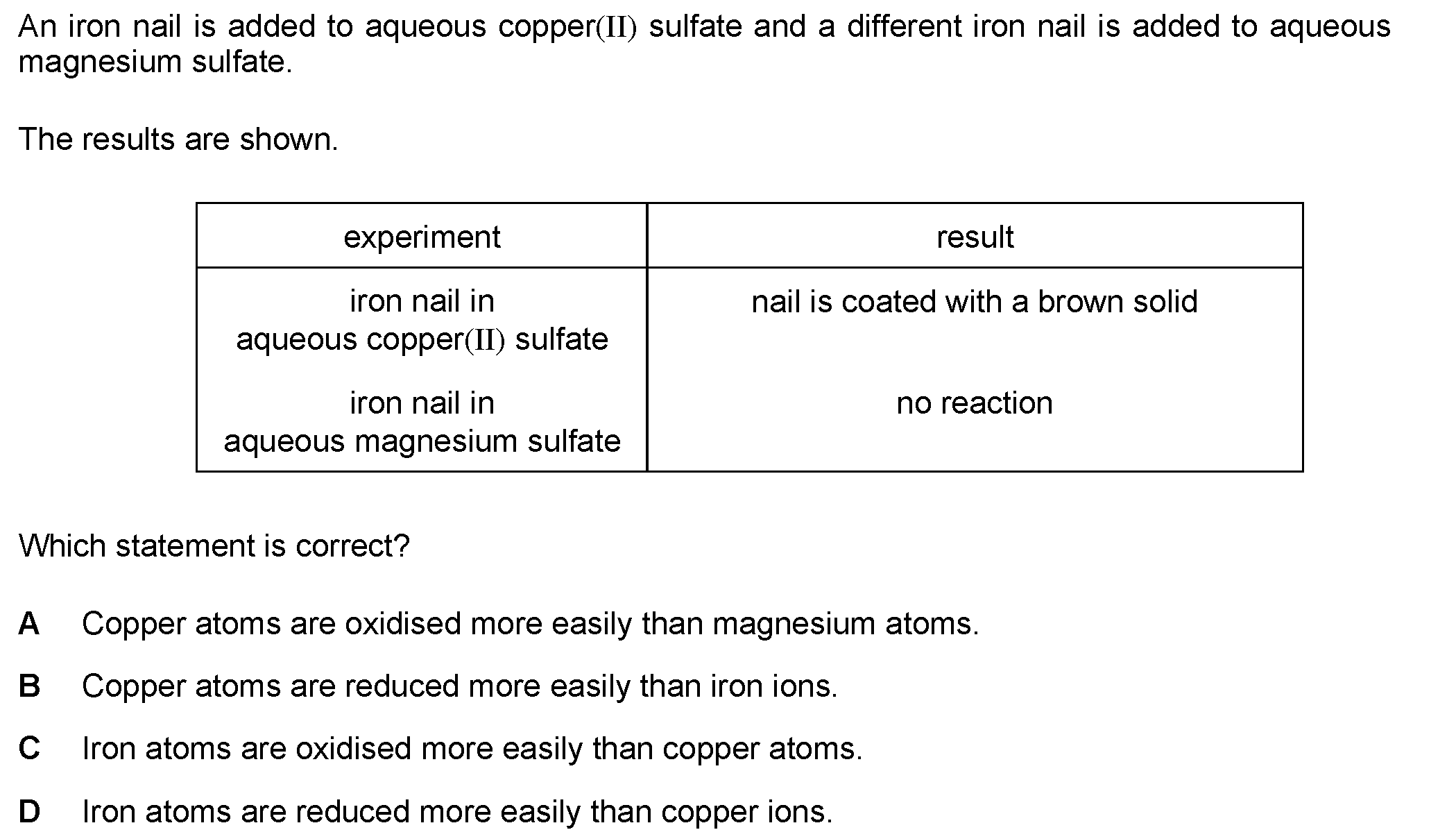
An iron nail is added to aqueous copper(II) sulfate and a different iron nail is added to aqueous
magnesium sulfate.
The results are shown.
experiment result
iron nail in nail is coated with a brown solid
aqueous copper(II) sulfate
iron nail in no reaction
aqueous magnesium sulfate
Which statement is correct?
A Copper atoms are oxidised more easily than magnesium atoms.
Copper atoms are reduced more easily than iron ions.
Iron atoms are oxidised more easily than copper atoms.
0 OO WW
Iron atoms are reduced more easily than copper ions.
Options:
A
B
C
D
Correct Key: C
A
B
C
D
Correct Key: C
Question 3
Paper Ref: 0620/23_Summer_2020_Q28
Paper Ref: 0620/23_Summer_2020_Q28
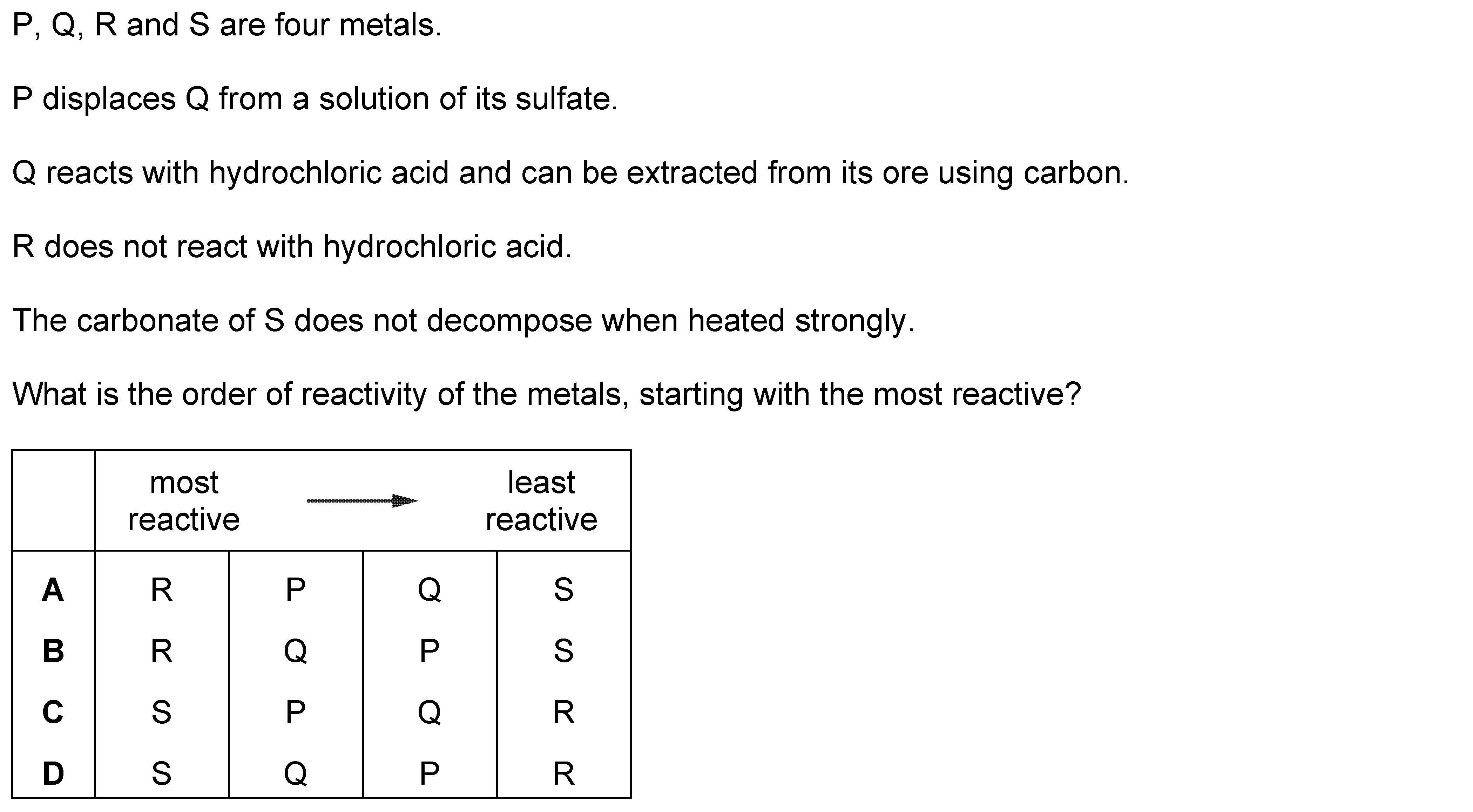
P, Q, Rand S are four metals.
P displaces Q from a solution of its sulfate.
Q reacts with hydrochloric acid and can be extracted from its ore using carbon.
R does not react with hydrochloric acid.
The carbonate of S does not decompose when heated strongly.
What is the order of reactivity of the metals, starting with the most reactive?
most least
. semmomanoncnosoel IB.
reactive reactive
A
R S
Options:
A
B
C
D
Correct Key: C
A
B
C
D
Correct Key: C
Question 4
Paper Ref: 5129/12_Summer_2025_Q25
Paper Ref: 5129/12_Summer_2025_Q25
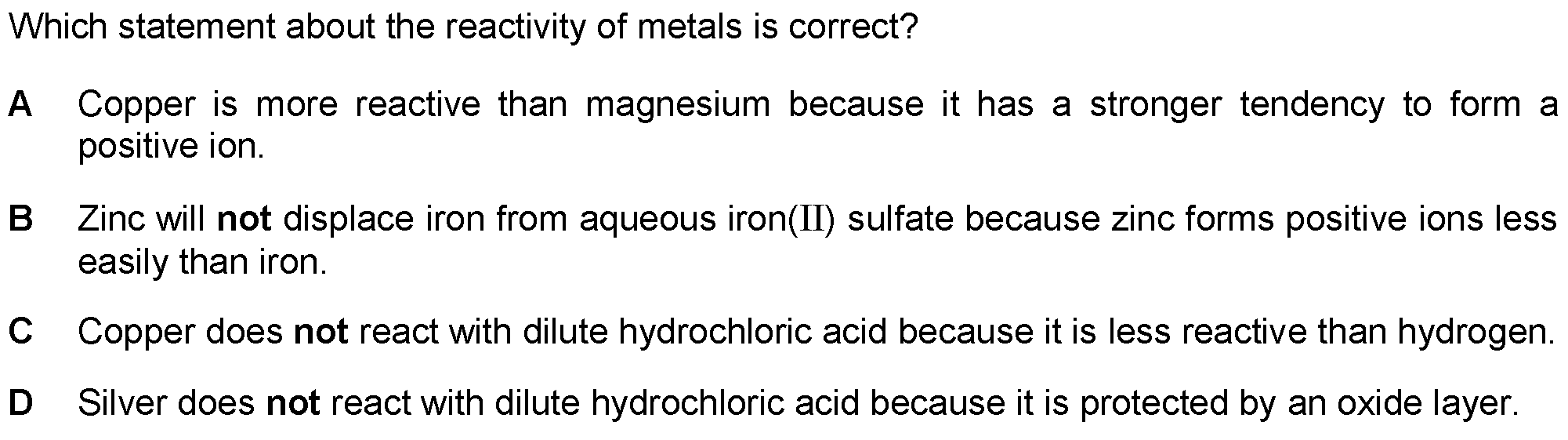
Which statement about the reactivity of metals is correct?
A Copper is more reactive than magnesium because it has a stronger tendency to form a
positive ion.
B Zinc will not displace iron from aqueous iron(II) sulfate because zinc forms positive ions less
easily than iron.
Copper does not react with dilute hydrochloric acid because it is less reactive than hydrogen.
Silver does not react with dilute hydrochloric acid because it is protected by an oxide layer.
Options:
A
B
C
D
Correct Key: C
A
B
C
D
Correct Key: C
Question 5
Paper Ref: 5129/12_Winter_2024_Q24
Paper Ref: 5129/12_Winter_2024_Q24
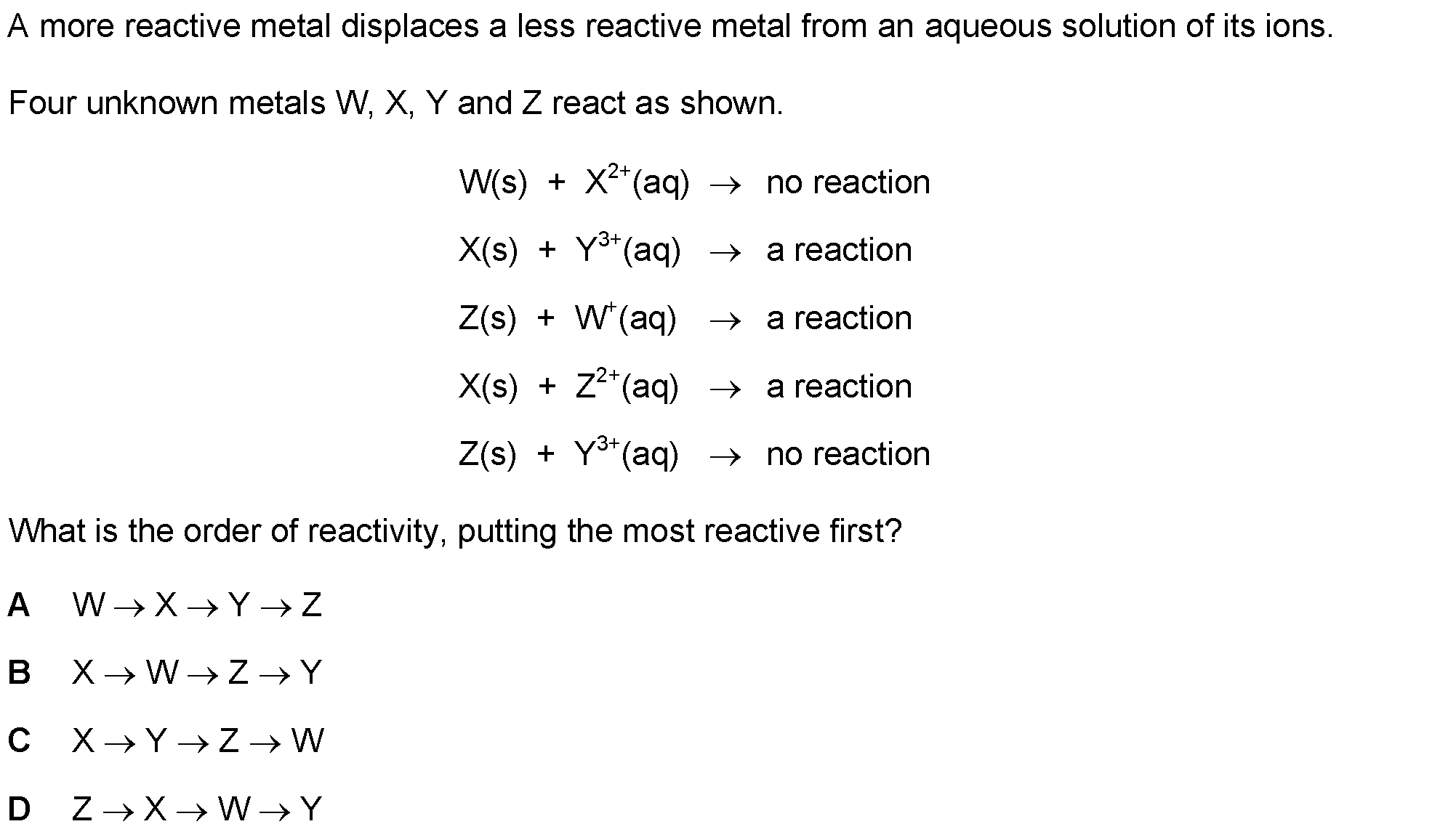
A more reactive metal displaces a less reactive metal from an aqueous solution of its ions.
Four unknown metals W, X, Y and Z react as shown.
W(s) + X?*(aq) no reaction
X(s) + Y**(aq) a reaction
X(s) + Z°*(aq)
+>
+>
Z(s) + W'(aq) — areaction
— areaction
+>
Z(s) + Y**(aq) no reaction
What is the order of reactivity, putting the most reactive first?
WoK3Y>Zz
Xe>W>2Z>5Y
X>YOZ5W
0 0O WwW F
Zo KOWRO>Y
Options:
A
B
C
D
Correct Key: C
A
B
C
D
Correct Key: C
Question 6
Paper Ref: 0620/22_Winter_2022_Q26
Paper Ref: 0620/22_Winter_2022_Q26
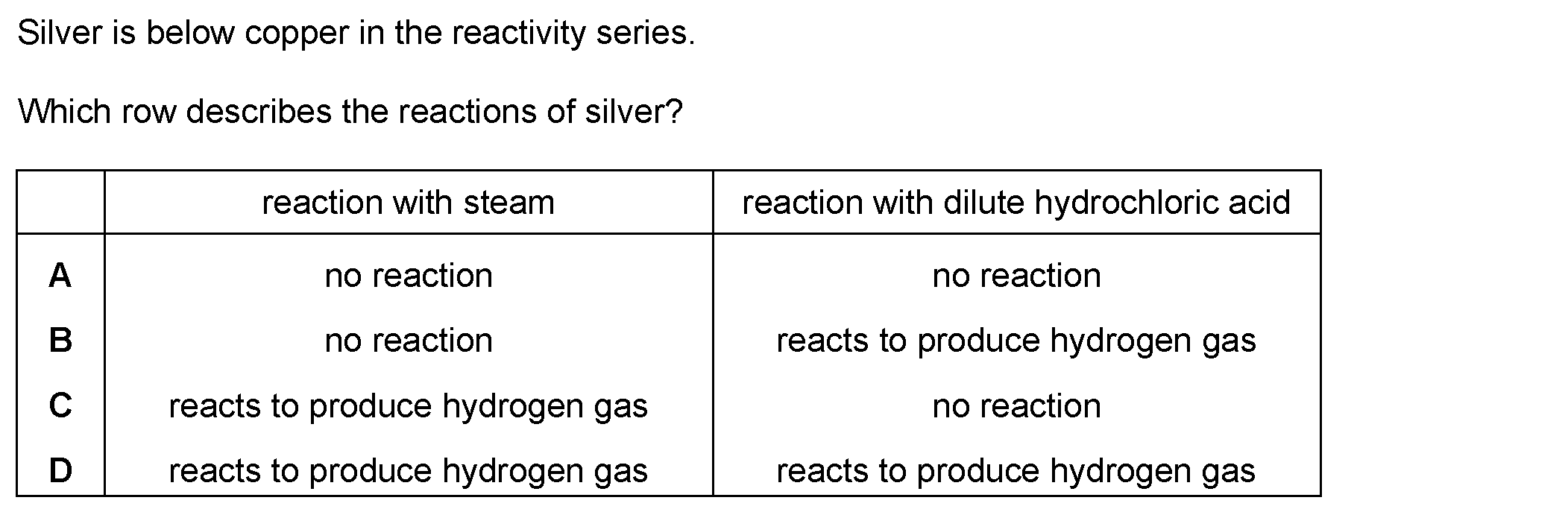
Silver is below copper in the reactivity series.
Which row describes the reactions of silver?
— reaction with steam reaction with dilute hydrochloric acid
no reaction no reaction
no reaction reacts to produce hydrogen gas
reacts to produce hydrogen gas no reaction
reacts to produce hydrogen gas reacts to produce hydrogen gas
Which row describes the reactions of silver?
— reaction with steam reaction with dilute hydrochloric acid
no reaction no reaction
no reaction reacts to produce hydrogen gas
reacts to produce hydrogen gas no reaction
reacts to produce hydrogen gas reacts to produce hydrogen gas
Options:
A
B
C
D
Correct Key: A
A
B
C
D
Correct Key: A
Question 7
Paper Ref: 0620/23_Summer_2015_Q26
Paper Ref: 0620/23_Summer_2015_Q26
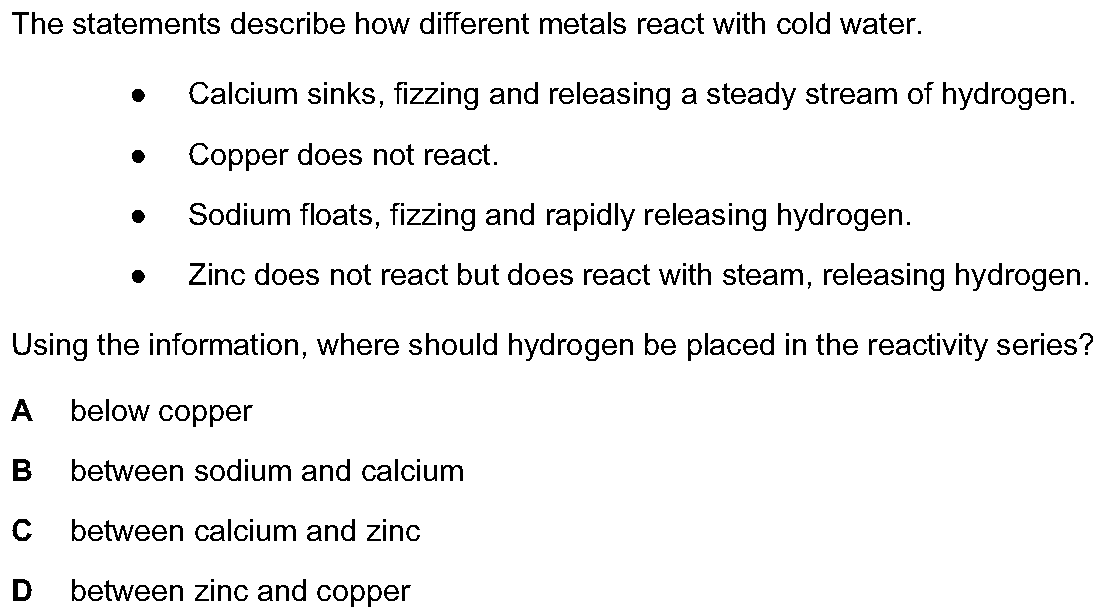
The statements describe how different metals react with cold water.
e Calcium sinks, fizzing and releasing a steady stream of hydrogen.
e Copper does not react.
e Sodium floats, fizzing and rapidly releasing hydrogen.
e Zinc does not react but does react with steam, releasing hydrogen.
Using the information, where should hydrogen be placed in the reactivity series?
oo BD
below copper
between sodium and calcium
between calcium and zinc
between zinc and copper
Options:
A
B
C
D
Correct Key: D
A
B
C
D
Correct Key: D
Structured Questions Mark Scheme & Answers
•1•.• • • •[•▍• •P•R•I• •2•0•2•0•B• •P•2• • •·• • •Q•1•5• • •P•a•r•t• •(•a•)• • •·• • •2•0•2•0• • •·• • •P•r•i•m•a•r•y• •0•8•4•6•]• • • • • • •d•i•s•s•o•l•v•e•s• •1• •c•o•l•o•u•r•l•e•s•s• •1• •••c•c•e•p•t• •c•l•e•a•r• •/• •t•r•a•n•s•p•a•r•e•n•t• •/• •w•h•i•t•e• •I•g•n•o•r•e• •t•h•e• •s•a•m•e• •c•o•l•o•u•r• •a•s• •w•a•t•e•r• •s•a•l•t• •i•s• •s•o•l•u•b•l•e• •i•n• •w•a•t•e•r• •/• •s•a•l•t• •i•s• •d•i•s•s•o•l•v•e•d• •i•n• •t•h•e• •w•a•t•e•r• •1• •••c•c•e•p•t• •i•d•e•a• •t•h•a•t• •t•h•e• •s•a•l•t• •p•a•s•s•e•s• •t•h•r•o•u•g•h• •t•h•e• •(•f•i•l•t•e•r• •p•a•p•e•r•)• •w•i•t•h• •t•h•e• •w•a•t•e•r• •••c•c•e•p•t• •b•e•c•a•u•s•e• •t•h•e• •s•a•l•t• •h•a•s• •d•i•s•s•o•l•v•e•d• •D•o• •n•o•t• •a•c•c•e•p•t• •b•e•c•a•u•s•e• •s•a•l•t• •i•s• •v•e•r•y• •s•m•a•l•l• •i•t• •w•i•l•l• •g•o• •t•h•r•o•u•g•h• •t•h•e• •f•i•l•t•e•r• •a•n•y• •t•w•o• •f•r•o•m• •2• •••c•c•e•p•t• •p•u•t• •t•h•e• •d•i•s•h• •i•n• •t•h•e• •s•u•n• •h•e•a•t• •t•h•e• •s•o•l•u•t•i•o•n• •e•v•a•p•o•r•a•t•e• •w•a•t•e•r• •••c•c•e•p•t• •b•o•i•l• •a• •(•w•h•i•t•e•)• •s•o•l•i•d• •i•s• •f•o•r•m•e•d• •••c•c•e•p•t• •s•a•l•t• •i•s• •l•e•f•t• •b•e•h•i•n•d• •/• •s•a•l•t• •i•s• •f•o•r•m•e•d• •••c•c•e•p•t• •h•e•a•t• •t•o• •g•e•t• •a• •(•w•h•i•t•e•)• •r•e•s•i•d•u•e• •=• •2• •m•a•r•k•s• •©• •U•C•L•E•S• •2•0•2•0• •P•a•g•e• •1•0• •o•f• •1•2• •••s•s•e•m•b•l•e•d• •b•y• •N•.•S•.• •2•2•/•3•8•4•
•2•.• • • •[•▍• •P•R•I• •2•0•2•0•B• •P•2• • •·• • •Q•1•5• • •P•a•r•t• •(•b•)• • •·• • •2•0•2•0• • •·• • •P•r•i•m•a•r•y• •0•8•4•6•]• • • • • • •d•i•s•s•o•l•v•e•s• •1• •c•o•l•o•u•r•l•e•s•s• •1• •••c•c•e•p•t• •c•l•e•a•r• •/• •t•r•a•n•s•p•a•r•e•n•t• •/• •w•h•i•t•e• •I•g•n•o•r•e• •t•h•e• •s•a•m•e• •c•o•l•o•u•r• •a•s• •w•a•t•e•r• •s•a•l•t• •i•s• •s•o•l•u•b•l•e• •i•n• •w•a•t•e•r• •/• •s•a•l•t• •i•s• •d•i•s•s•o•l•v•e•d• •i•n• •t•h•e• •w•a•t•e•r• •1• •••c•c•e•p•t• •i•d•e•a• •t•h•a•t• •t•h•e• •s•a•l•t• •p•a•s•s•e•s• •t•h•r•o•u•g•h• •t•h•e• •(•f•i•l•t•e•r• •p•a•p•e•r•)• •w•i•t•h• •t•h•e• •w•a•t•e•r• •••c•c•e•p•t• •b•e•c•a•u•s•e• •t•h•e• •s•a•l•t• •h•a•s• •d•i•s•s•o•l•v•e•d• •D•o• •n•o•t• •a•c•c•e•p•t• •b•e•c•a•u•s•e• •s•a•l•t• •i•s• •v•e•r•y• •s•m•a•l•l• •i•t• •w•i•l•l• •g•o• •t•h•r•o•u•g•h• •t•h•e• •f•i•l•t•e•r• •a•n•y• •t•w•o• •f•r•o•m• •2• •••c•c•e•p•t• •p•u•t• •t•h•e• •d•i•s•h• •i•n• •t•h•e• •s•u•n• •h•e•a•t• •t•h•e• •s•o•l•u•t•i•o•n• •e•v•a•p•o•r•a•t•e• •w•a•t•e•r• •••c•c•e•p•t• •b•o•i•l• •a• •(•w•h•i•t•e•)• •s•o•l•i•d• •i•s• •f•o•r•m•e•d• •••c•c•e•p•t• •s•a•l•t• •i•s• •l•e•f•t• •b•e•h•i•n•d• •/• •s•a•l•t• •i•s• •f•o•r•m•e•d• •••c•c•e•p•t• •h•e•a•t• •t•o• •g•e•t• •a• •(•w•h•i•t•e•)• •r•e•s•i•d•u•e• •=• •2• •m•a•r•k•s• •©• •U•C•L•E•S• •2•0•2•0• •P•a•g•e• •1•0• •o•f• •1•2• •••s•s•e•m•b•l•e•d• •b•y• •N•.•S•.• •2•2•/•3•8•4•
•3•.• • • •[•▍• •S•P• •S•7• •P•2• • •·• • •Q•3• • •P•a•r•t• •(•a•)• • •·• • •S•p•e•c•i•m•e•n• • •·• • •L•o•w•e•r• •S•e•c• •0•8•9•3•]• • • • • • •m•a•g•n•e•s•i•u•m• •o•x•i•d•e• •1• •••c•c•e•p•t• •M•g•O• •b•u•t• •n•a•m•e• •t•a•k•e•s• •p•r•e•c•e•d•e•n•c•e•
•4•.• • • •[•▍• •C•P• •O•c•t•o•b•e•r• •2•0•2•4• •P•2• • •·• • •Q•7• • •P•a•r•t• •(•b•)• • •·• • •2•0•2•4• • •·• • •L•o•w•e•r• •S•e•c• •0•8•9•3•]• • • • • • •1• •m•o•r•e• •t•h•a•n• •o•n•e• •b•o•x• •t•i•c•k•e•d• •=• •0• •m•a•r•k•s• •z•i•n•c• •i•s• •m•o•r•e• •r•e•a•c•t•i•v•e• •t•h•a•n• •c•o•p•p•e•r• •••c•c•e•p•t• •a•n•y• •i•n•d•i•c•a•t•i•o•n• •o•f• •t•h•e• •c•o•r•r•e•c•t• •a•n•s•w•e•r•,• •e•.•g•.• •u•n•d•e•r•l•i•n•i•n•g• •o•r• •c•i•r•c•l•i•n•g•,• •b•u•t• •t•i•c•k•i•n•g• •t•a•k•e•s• •p•r•e•c•e•d•e•n•c•e•
Last updated:
\n