7.1Motion, Forces and Energy
Chromosomes genes and DNA — Question Bank (Cambridge) — Cambridge IGCSE Physics 0625 Revision Notes & Topical Questions
10 min read Lesson 59 of 91 Unit quiz
Cambridge Past Paper Bank
7.1 Chromosomes genes and DNA
16 Multiple-Choice Questions with Official Mark Schemes
Question 1
0610/22_Winter_2018_Q31
Question 2
0610/23_Summer_2017_Q33
Question 3
0610/22_Summer_2020_Q30
Question 4
0610/23_Winter_2021_Q31
Question 5
0610/23_Summer_2018_Q33
Question 6
0610/11_Summer_2022_Q33
Question 7
0610/21_Winter_2018_Q30
Question 8
0610/22_Spring_2023_Q30
Question 9
0610/22_Summer_2021_Q32
Question 10
0610/22_Winter_2023_Q32
Question 11
0610/23_Winter_2014_Q30
Question 12
5129/12_Summer_2024_Q10
Question 13
0610/12_Spring_2024_Q36
Question 14
0610/21_Summer_2021_Q33
Question 15
0610/23_Summer_2026_Q40
Question 16
0610/21_Winter_2015_Q29
Cambridge Lower Secondary Stage 9
7.1 Chromosomes genes and DNA – Complete Question Bank & Mark Scheme
Total Questions16 Questions with Verified Solutions & Past Paper Mark Schemes
Multiple Choice Questions (Exam Practice)
Question 1
Paper Ref: 0610/22_Winter_2018_Q31
Paper Ref: 0610/22_Winter_2018_Q31
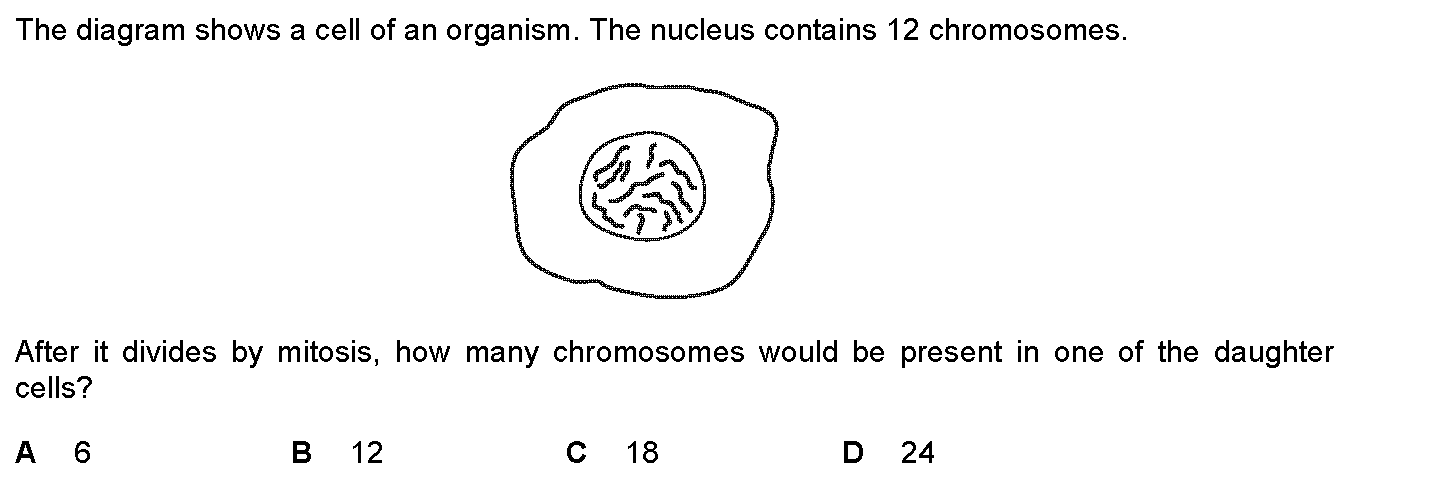
The diagram shows a cell of an organism. The nucleus contains 12 chromosomes.
After it divides by mitosis, how many chromosomes would be present in one of the daughter
cells?
A 6 B 12 Cc 18 D 24
After it divides by mitosis, how many chromosomes would be present in one of the daughter
cells?
A 6 B 12 Cc 18 D 24
Options:
A
B
C
D
Correct Key: B
A
B
C
D
Correct Key: B
Question 2
Paper Ref: 0610/23_Summer_2017_Q33
Paper Ref: 0610/23_Summer_2017_Q33
Which statement about the sex chromosomes is correct?
oo BD
Men and women can inherit characteristics from genes carried on the X chromosome.
Men and women can inherit characteristics from genes carried on the Y chromosome.
Only men can inherit characteristics from genes carried on the X chromosome.
Only women can inherit characteristics from genes carried on the Y chromosome.
Options:
A
B
C
D
Correct Key: A
A
B
C
D
Correct Key: A
Question 3
Paper Ref: 0610/22_Summer_2020_Q30
Paper Ref: 0610/22_Summer_2020_Q30
What is a diploid nucleus?
A
B
C
D
a nucleus containing one set of chromosomes
a nucleus containing two sets of chromosomes
a nucleus with one double helix of DNA
a nucleus with two genes
A
B
C
D
a nucleus containing one set of chromosomes
a nucleus containing two sets of chromosomes
a nucleus with one double helix of DNA
a nucleus with two genes
Options:
A
B
C
D
Correct Key: B
A
B
C
D
Correct Key: B
Question 4
Paper Ref: 0610/23_Winter_2021_Q31
Paper Ref: 0610/23_Winter_2021_Q31
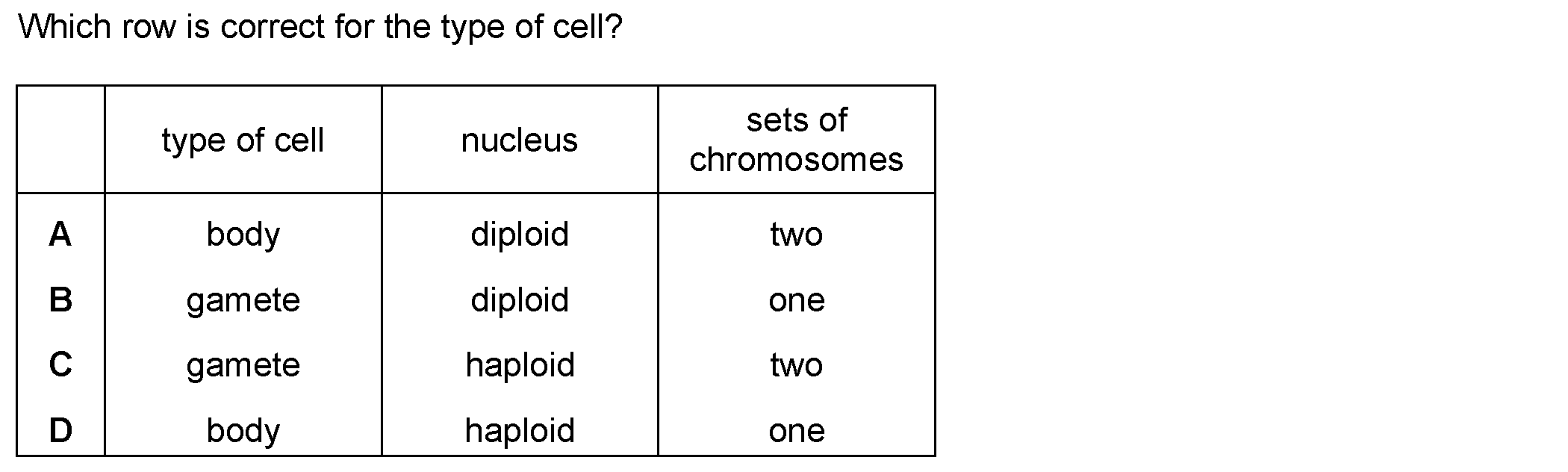
Which row is correct for the type of cell?
sets of
type of cell nucleus
chromosomes
body diploid
gamete diploid
gamete haploid
body haploid
sets of
type of cell nucleus
chromosomes
body diploid
gamete diploid
gamete haploid
body haploid
Options:
A
B
C
D
Correct Key: A
A
B
C
D
Correct Key: A
Question 5
Paper Ref: 0610/23_Summer_2018_Q33
Paper Ref: 0610/23_Summer_2018_Q33
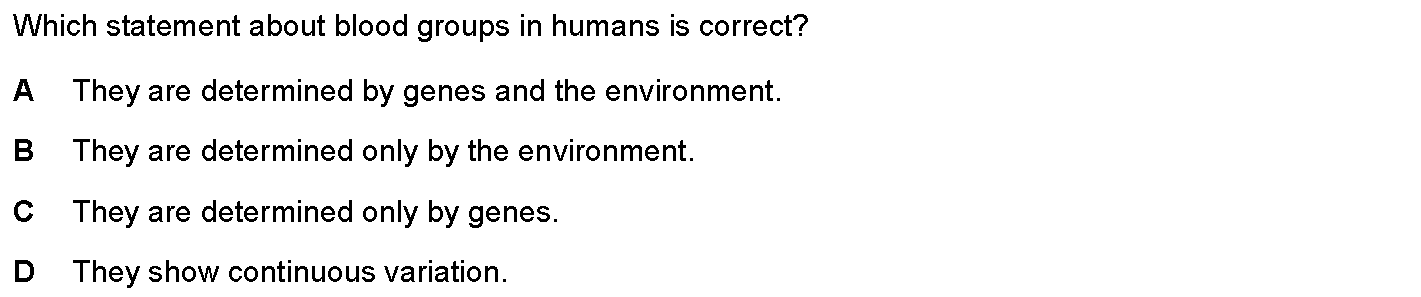
Which statement about blood groups in humans is correct?
A
B
c
D
They are determined by genes and the environment.
They are determined only by the environment.
They are determined only by genes.
They show continuous variation.
A
B
c
D
They are determined by genes and the environment.
They are determined only by the environment.
They are determined only by genes.
They show continuous variation.
Options:
A
B
C
D
Correct Key: C
A
B
C
D
Correct Key: C
Question 6
Paper Ref: 0610/11_Summer_2022_Q33
Paper Ref: 0610/11_Summer_2022_Q33
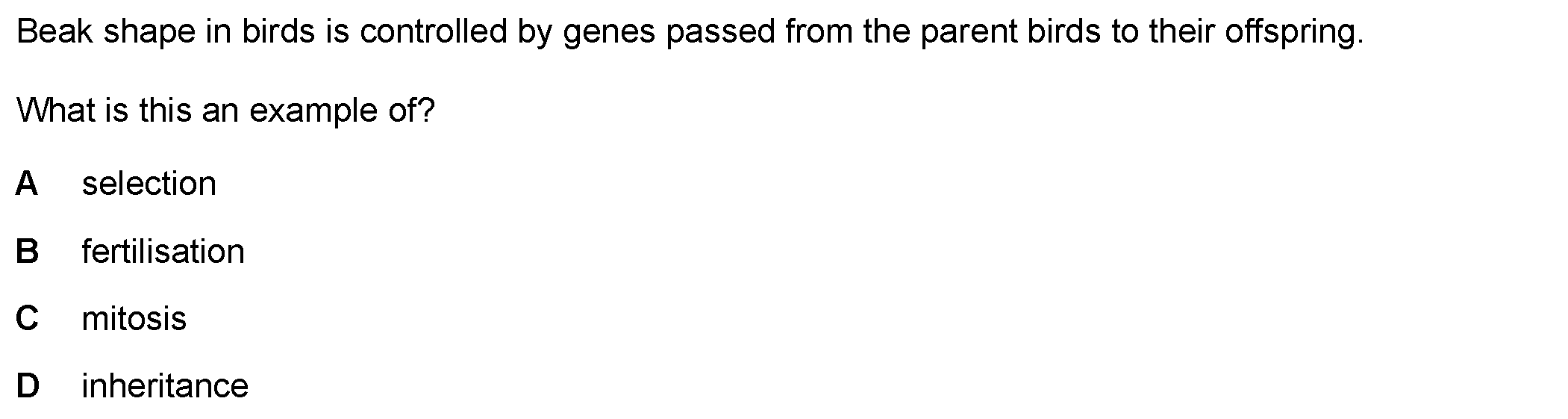
Beak shape in birds is controlled by genes passed from the parent birds to their offspring.
What is this an example of?
selection
fertilisation
mitosis
0 0O wD PY
inheritance
What is this an example of?
selection
fertilisation
mitosis
0 0O wD PY
inheritance
Options:
A
B
C
D
Correct Key: D
A
B
C
D
Correct Key: D
Question 7
Paper Ref: 0610/21_Winter_2018_Q30
Paper Ref: 0610/21_Winter_2018_Q30
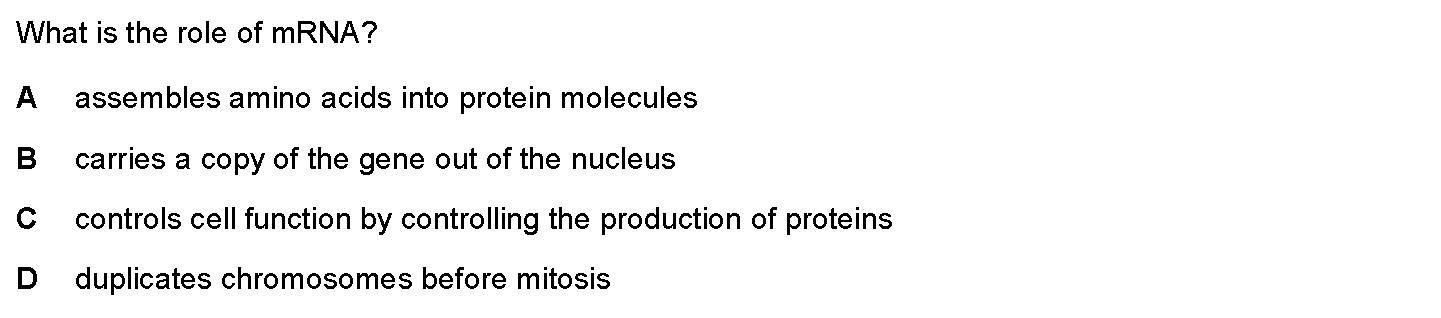
What is the role of MRNA?
A assembles amino acids into protein molecules
carries a copy of the gene out of the nucleus
controls cell function by controlling the production of proteins
0 9 DW
duplicates chromosomes before mitosis
A assembles amino acids into protein molecules
carries a copy of the gene out of the nucleus
controls cell function by controlling the production of proteins
0 9 DW
duplicates chromosomes before mitosis
Options:
A
B
C
D
Correct Key: B
A
B
C
D
Correct Key: B
Question 8
Paper Ref: 0610/22_Spring_2023_Q30
Paper Ref: 0610/22_Spring_2023_Q30
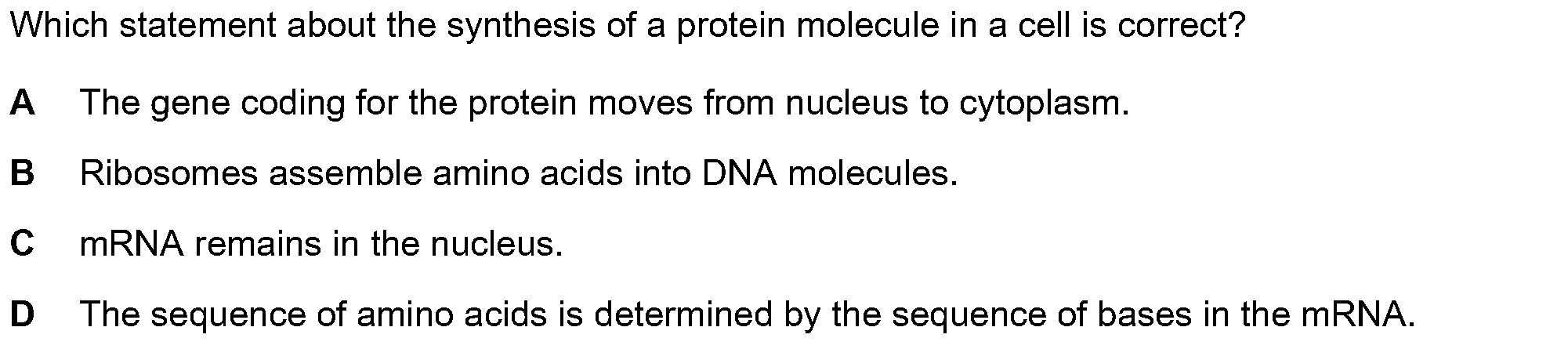
Which statement about the synthesis of a protein molecule in a cell is correct?
A
B
Cc
D
The gene coding for the protein moves from nucleus to cytoplasm.
Ribosomes assemble amino acids into DNA molecules.
mRNA remains in the nucleus.
The sequence of amino acids is determined by the sequence of bases in the MRNA.
A
B
Cc
D
The gene coding for the protein moves from nucleus to cytoplasm.
Ribosomes assemble amino acids into DNA molecules.
mRNA remains in the nucleus.
The sequence of amino acids is determined by the sequence of bases in the MRNA.
Options:
A
B
C
D
Correct Key: D
A
B
C
D
Correct Key: D
Question 9
Paper Ref: 0610/22_Summer_2021_Q32
Paper Ref: 0610/22_Summer_2021_Q32
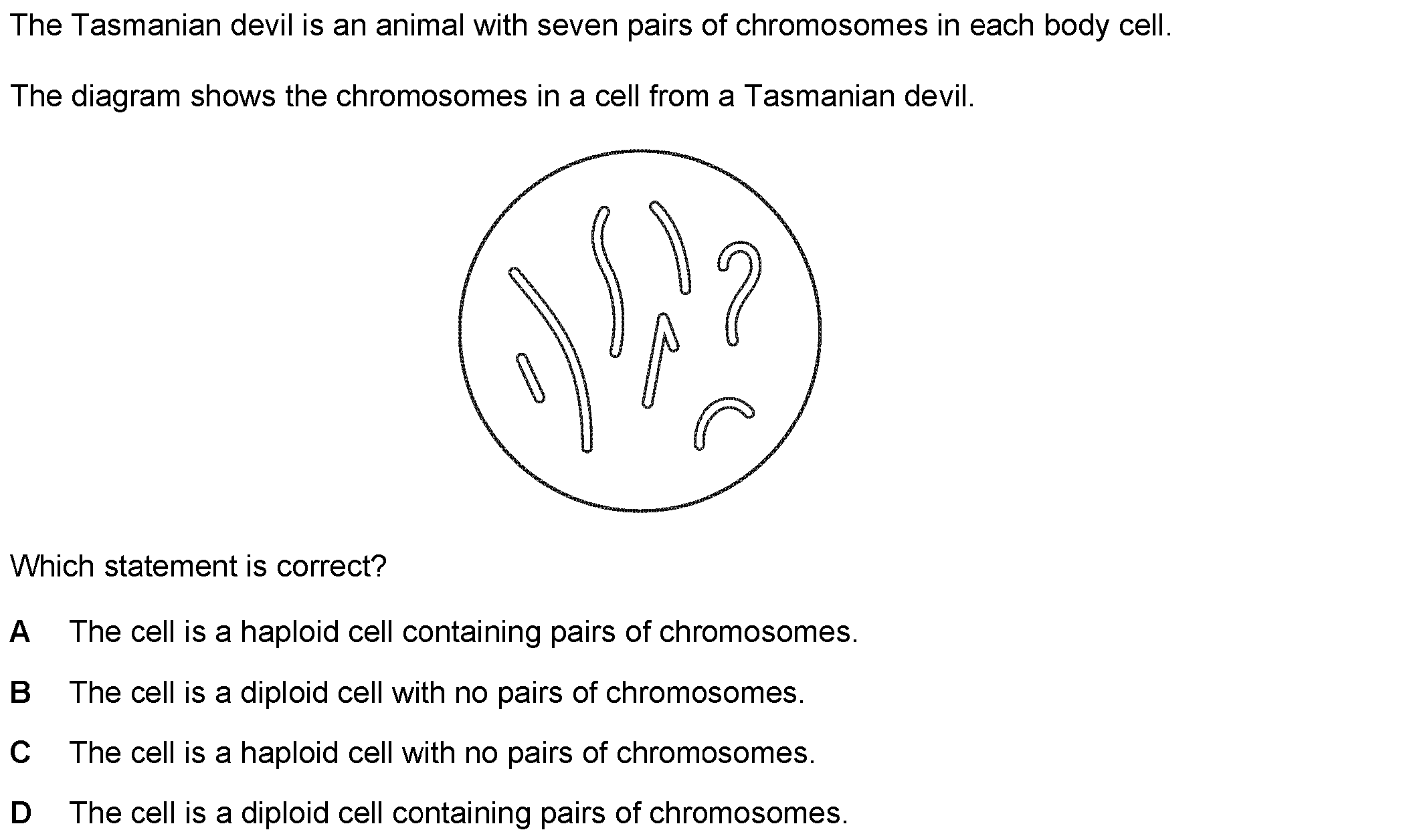
The Tasmanian devil is an animal with seven pairs of chromosomes in each body cell.
The diagram shows the chromosomes in a cell from a Tasmanian devil.
Which statement is correct?
A The cell is a haploid cell containing pairs of chromosomes.
The cell is a diploid cell with no pairs of chromosomes.
The cell is a haploid cell with no pairs of chromosomes.
0 OO DW
The cell is a diploid cell containing pairs of chromosomes.
Options:
A
B
C
D
Correct Key: C
A
B
C
D
Correct Key: C
Question 10
Paper Ref: 0610/22_Winter_2023_Q32
Paper Ref: 0610/22_Winter_2023_Q32
Why are cells in the pancreas the only body cells that produce insulin?
A
B
Cc
D
All of the genes in the nucleus of a cell in the pancreas are expressed.
Other body cells do not have the gene for insulin.
The cells in the pancreas have twice as many genes as the other body cells.
The gene for insulin is only expressed by cells in the pancreas.
A
B
Cc
D
All of the genes in the nucleus of a cell in the pancreas are expressed.
Other body cells do not have the gene for insulin.
The cells in the pancreas have twice as many genes as the other body cells.
The gene for insulin is only expressed by cells in the pancreas.
Options:
A
B
C
D
Correct Key: D
A
B
C
D
Correct Key: D
Question 11
Paper Ref: 0610/23_Winter_2014_Q30
Paper Ref: 0610/23_Winter_2014_Q30
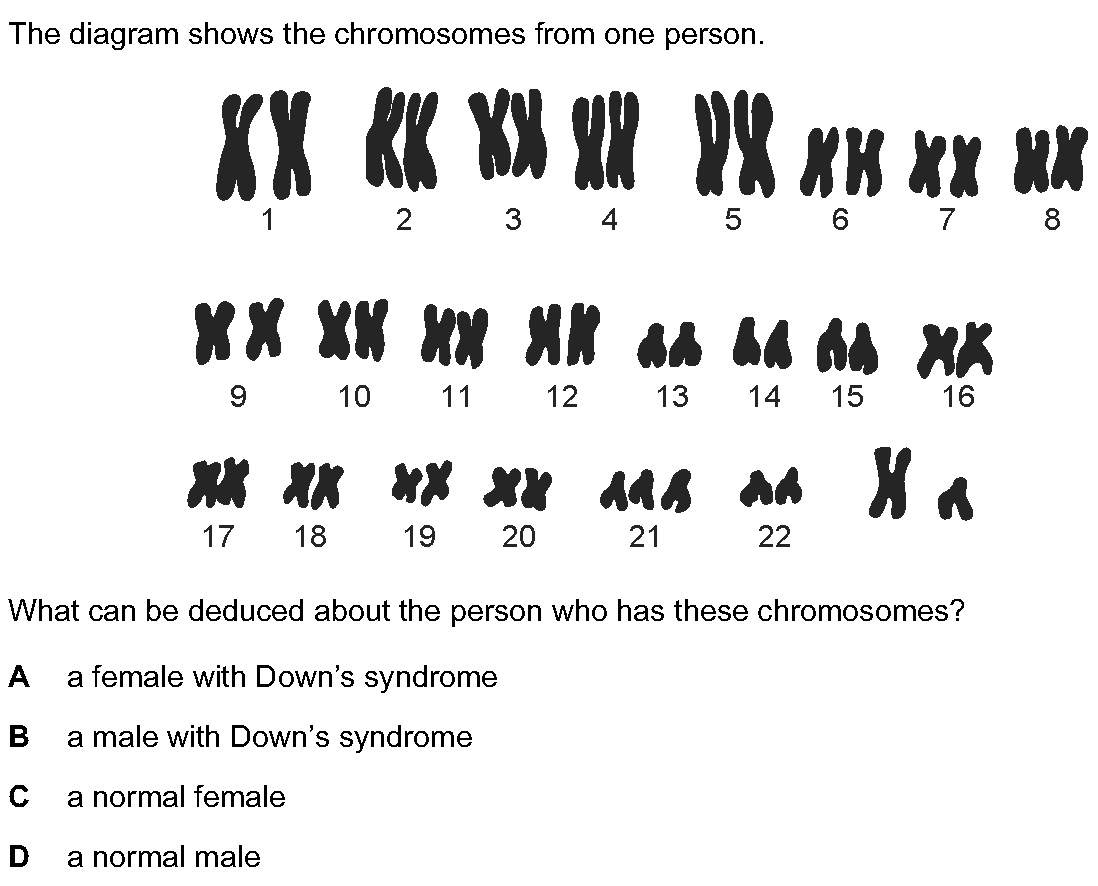
The diagram shows the chromosomes from one person.
1 2 3 4 5 6 7 8
MX XN WW NK 4a 64 ha HK
9 10 11 12 13 14 15 16
Ht XK WX ate Ads ad Ka
18 19
What can be deduced about the person who has these chromosomes?
A afemale with Down’s syndrome
B amale with Down’s syndrome
C anormal female
D
a normal male
1 2 3 4 5 6 7 8
MX XN WW NK 4a 64 ha HK
9 10 11 12 13 14 15 16
Ht XK WX ate Ads ad Ka
18 19
What can be deduced about the person who has these chromosomes?
A afemale with Down’s syndrome
B amale with Down’s syndrome
C anormal female
D
a normal male
Options:
A
B
C
D
Correct Key: B
A
B
C
D
Correct Key: B
Question 12
Paper Ref: 5129/12_Summer_2024_Q10
Paper Ref: 5129/12_Summer_2024_Q10
A cell with a nucleus containing 8 chromosomes undergoes meiosis.
What describes the cells produced by this process?
A
B
Cc
D
2 cells each containing 4 chromosomes
2 cells each containing 8 chromosomes
4 cells each containing 4 chromosomes
4 cells each containing 8 chromosomes
What describes the cells produced by this process?
A
B
Cc
D
2 cells each containing 4 chromosomes
2 cells each containing 8 chromosomes
4 cells each containing 4 chromosomes
4 cells each containing 8 chromosomes
Options:
A
B
C
D
Correct Key: C
A
B
C
D
Correct Key: C
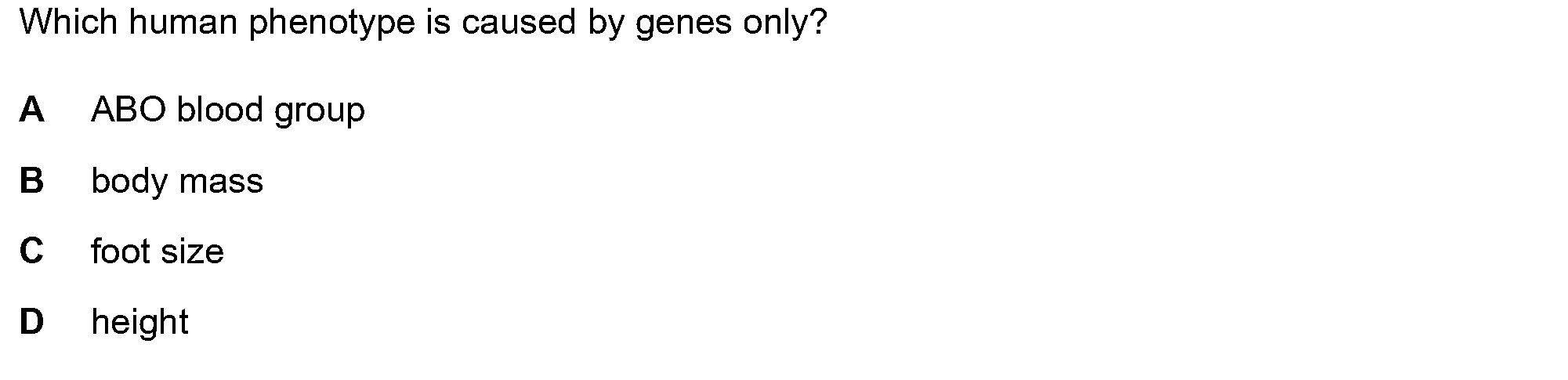
Question 13
Paper Ref: 0610/12_Spring_2024_Q36
Paper Ref: 0610/12_Spring_2024_Q36
Which human phenotype is caused by genes only?
A ABO blood group
body mass
foot size
Oo ©} W
height
A ABO blood group
body mass
foot size
Oo ©} W
height
Options:
A
B
C
D
Correct Key: A
A
B
C
D
Correct Key: A
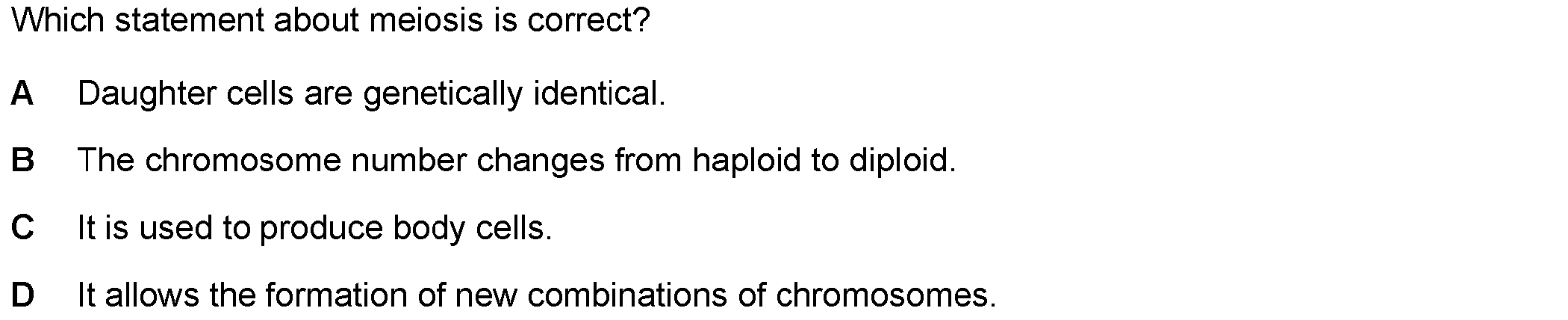
Question 14
Paper Ref: 0610/21_Summer_2021_Q33
Paper Ref: 0610/21_Summer_2021_Q33
Which statement about meiosis is correct?
A Daughter cells are genetically identical.
B The chromosome number changes from haploid to diploid.
C_ itis used to produce body cells.
D It allows the formation of new combinations of chromosomes.
A Daughter cells are genetically identical.
B The chromosome number changes from haploid to diploid.
C_ itis used to produce body cells.
D It allows the formation of new combinations of chromosomes.
Options:
A
B
C
D
Correct Key: D
A
B
C
D
Correct Key: D
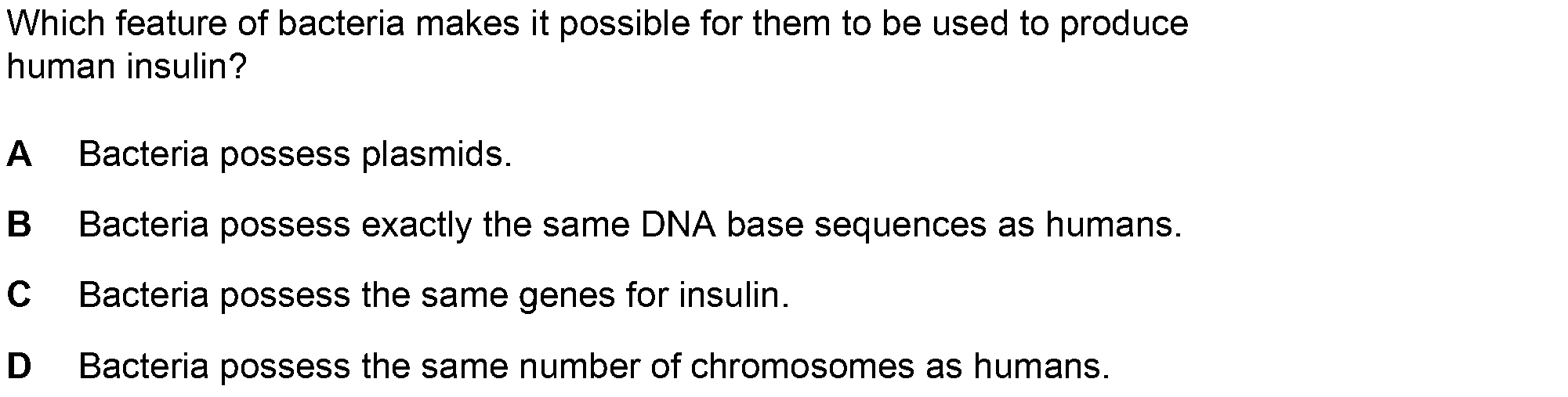
Question 15
Paper Ref: 0610/23_Summer_2026_Q40
Paper Ref: 0610/23_Summer_2026_Q40
Which feature of bacteria makes it possible for them to be used to produce
human insulin?
A
B
Cc
D
Bacteria possess plasmids.
Bacteria possess exactly the same DNA base sequences as humans.
Bacteria possess the same genes for insulin.
Bacteria possess the same number of chromosomes as humans.
human insulin?
A
B
Cc
D
Bacteria possess plasmids.
Bacteria possess exactly the same DNA base sequences as humans.
Bacteria possess the same genes for insulin.
Bacteria possess the same number of chromosomes as humans.
Options:
A
B
C
D
Correct Key: A
A
B
C
D
Correct Key: A
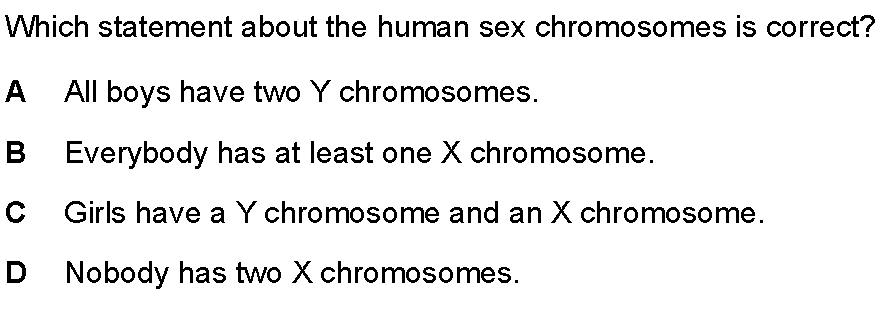
Question 16
Paper Ref: 0610/21_Winter_2015_Q29
Paper Ref: 0610/21_Winter_2015_Q29
Which statement about the human sex chromosomes is correct?
0 9 DW
All boys have two Y chromosomes.
Everybody has at least one X chromosome.
Girls have a Y chromosome and an X chromosome.
Nobody has two X chromosomes.
0 9 DW
All boys have two Y chromosomes.
Everybody has at least one X chromosome.
Girls have a Y chromosome and an X chromosome.
Nobody has two X chromosomes.
Options:
A
B
C
D
Correct Key: B
A
B
C
D
Correct Key: B
Structured Questions Mark Scheme & Answers
•1•.• • • •[•C•P• •O•c•t•o•b•e•r• •2•0•2•4• •P•2• • •·• • •Q•1• • •P•a•r•t• •(•a•)• • •·• • •2•0•2•4• • •·• • •L•o•w•e•r• •S•e•c• •0•8•9•3•]• • • • • • •v•a•r•i•a•t•i•o•n• •1• •I•g•n•o•r•e• •t•r•a•i•t•s• •/• •i•n•h•e•r•i•t•a•n•c•e• •D•o• •n•o•t• •a•c•c•e•p•t• •g•e•n•e•s• •/• •D•N••• •/• •n•a•t•u•r•a•l• •s•e•l•e•c•t•i•o•n•
•2•.• • • •[•C•P• •O•c•t•o•b•e•r• •2•0•2•4• •P•2• • •·• • •Q•1• • •P•a•r•t• •(•b•)• • •·• • •2•0•2•4• • •·• • •L•o•w•e•r• •S•e•c• •0•8•9•3•]• • • • • • •a•n•y• •t•h•r•e•e• •f•r•o•m• •3• •e•a•c•h• •c•o•r•r•e•c•t• •a•n•s•w•e•r• •=• •1• •m•a•r•k• •a•t•t•a•c•h•e•d• •e•a•r•l•o•b•e•s• •I•g•n•o•r•e• •s•h•a•p•e• •o•f• •e•a•r•s• •b•l•o•o•d• •g•r•o•u•p• •e•y•e• •c•o•l•o•u•r• •c•o•l•o•u•r• •b•l•i•n•d•n•e•s•s• •s•e•x• •/• •g•e•n•d•e•r• •t•o•n•g•u•e• •r•o•l•l•i•n•g• •d•i•m•p•l•e•s• •a•n•d• •f•r•e•c•k•l•e•s• •I•g•n•o•r•e• •f•a•c•i•a•l• •f•e•a•t•u•r•e•s• •••c•c•e•p•t• •a•n•y• •o•t•h•e•r• •s•u•i•t•a•b•l•e• •c•h•a•r•a•c•t•e•r•i•s•t•i•c• •e•.•g•.• •c•u•r•l•y• •h•a•i•r• •e•t•c•.• •••c•c•e•p•t• •n•a•m•e•d• •g•e•n•e•t•i•c• •d•i•s•o•r•d•e•r•s• •s•u•c•h• •a•s• •p•o•l•y•d•a•c•t•y•l•y• •o•r• •c•y•s•t•i•c• •f•i•b•r•o•s•i•s•
•3•.• • • •[•C•P• •M•a•y• •2•0•2•5• •P•2• • •·• • •Q•9• • •P•a•r•t• •(•a•)• • •·• • •2•0•2•5• • •·• • •L•o•w•e•r• •S•e•c• •0•8•9•3•]• • • • • • •c•o•l•o•u•r• •o•f• •f•e•a•t•h•e•r•s• •o•r• •m•a•r•k•i•n•g•s• •o•f• •f•e•a•t•h•e•r•s• •o•r• •b•e•a•k• •s•h•a•p•e• •1• •••c•c•e•p•t• •e•y•e• •c•o•l•o•u•r• •o•r• •f•u•r• •c•o•l•o•u•r• •o•r• •s•e•x• •o•f• •p•u•f•f•i•n• •o•r• •b•e•a•k• •m•a•r•k•i•n•g•s• •o•r• •b•e•a•k• •c•o•l•o•u•r• •o•r• •c•o•l•o•u•r• •o•f• •f•e•e•t• •I•g•n•o•r•e• •s•k•i•n• •c•o•l•o•u•r• •o•r• •e•y•e• •s•h•a•p•e• •D•o• •n•o•t• •a•c•c•e•p•t• •s•i•z•e• •o•f• •b•e•a•k• •o•r• •s•i•z•e• •o•f• •b•i•r•d• •N•o•t•e• •u•n•q•u•a•l•i•f•i•e•d• •c•o•l•o•u•r• •o•r• •b•e•a•k• •i•s• •n•o•t• •s•u•f•f•i•c•i•e•n•t• •N•o•t•e• •t•y•p•e• •o•f• •f•e•e•t• •i•s• •n•o•t• •s•u•f•f•i•c•i•e•n•t•
•4•.• • • •[•C•P• •O•c•t•o•b•e•r• •2•0•2•5• •P•1• • •·• • •Q•1• • •P•a•r•t• •(•a•)• • •·• • •2•0•2•5• • •·• • •L•o•w•e•r• •S•e•c• •0•8•9•3•]• • • • • • •c•h•r•o•m•o•s•o•m•e•s• •1• •••c•c•e•p•t• •s•e•x• •c•h•r•o•m•o•s•o•m•e•
•5•.• • • •[•C•P• •O•c•t•o•b•e•r• •2•0•2•5• •P•1• • •·• • •Q•1• • •P•a•r•t• •(•b•)• • •·• • •2•0•2•5• • •·• • •L•o•w•e•r• •S•e•c• •0•8•9•3•]• • • • • • •g•e•n•e•(•s•)• •1• •••c•c•e•p•t• •a•l•l•e•l•e• •I•g•n•o•r•e• •r•e•c•e•s•s•i•v•e• •o•r• •g•e•n•e•t•i•c•
•6•.• • • •[•C•P• •O•c•t•o•b•e•r• •2•0•2•5• •P•1• • •·• • •Q•1• • •P•a•r•t• •(•c•)• • •·• • •2•0•2•5• • •·• • •L•o•w•e•r• •S•e•c• •0•8•9•3•]• • • • • • •y•e•s• •t•i•c•k•e•d• •(•n•o• •m•a•r•k•)• •1• •i•f• •n•o• •t•i•c•k•e•d• •=• •0• •m•a•r•k•s• •t•h•e•r•e• •i•s• •a• •Y• •c•h•r•o•m•o•s•o•m•e• •••c•c•e•p•t• •(•s•e•x• •c•h•r•o•m•o•s•o•m•e•s• •a•r•e•)• •X•Y• •••c•c•e•p•t• •(•i•d•e•a• •t•h•a•t•)• •i•f• •i•t• •w•a•s• •a• •w•o•m•a•n• •s•e•x• •c•h•r•o•m•o•s•o•m•e•s• •w•o•u•l•d• •b•e• •X•X•
•7•.• • • •[•S•P• •S•9• •P•2• • •·• • •Q•7• • •P•a•r•t• •(•a•)•(•i•)• • •·• • •S•p•e•c•i•m•e•n• • •·• • •L•o•w•e•r• •S•e•c• •0•8•9•3•]• • • • • • •D•N•••;• •a•c•c•e•p•t• •g•e•n•e•s•.•
Last updated:
—
- RNA: 5′ → 3′ 3′ → 5′.
- : AUG UAC .
- : UAA, UAG, UGA tRNA (Release Factor) .