7.4Motion, Forces and Energy
Natural selection — Question Bank (Cambridge) — Cambridge IGCSE Physics 0625 Revision Notes & Topical Questions
15 min read Lesson 77 of 91 Unit quiz
Cambridge Past Paper Bank
7.4 Natural selection
11 Multiple-Choice Questions with Official Mark Schemes
Question 1
0610/11_Summer_2025_Q34
Question 2
0610/13_Summer_2025_Q30

Question 3
0610/12_Summer_2018_Q35
Question 4
0610/12_Spring_2023_Q35
Question 5
0610/23_Winter_2021_Q35
Question 6
0610/23_Winter_2025_Q34
Question 7
0610/11_Winter_2024_Q37
Question 8
0610/13_Winter_2023_Q35
Question 9
0610/12_Spring_2023_Q34
Question 10
0610/22_Winter_2018_Q40
Question 11
0610/22_Summer_2017_Q35
Cambridge Lower Secondary Stage 9
7.4 Natural selection – Complete Question Bank & Mark Scheme
Total Questions11 Questions with Verified Solutions & Past Paper Mark Schemes
Multiple Choice Questions (Exam Practice)
Question 1
Paper Ref: 0610/11_Summer_2025_Q34
Paper Ref: 0610/11_Summer_2025_Q34
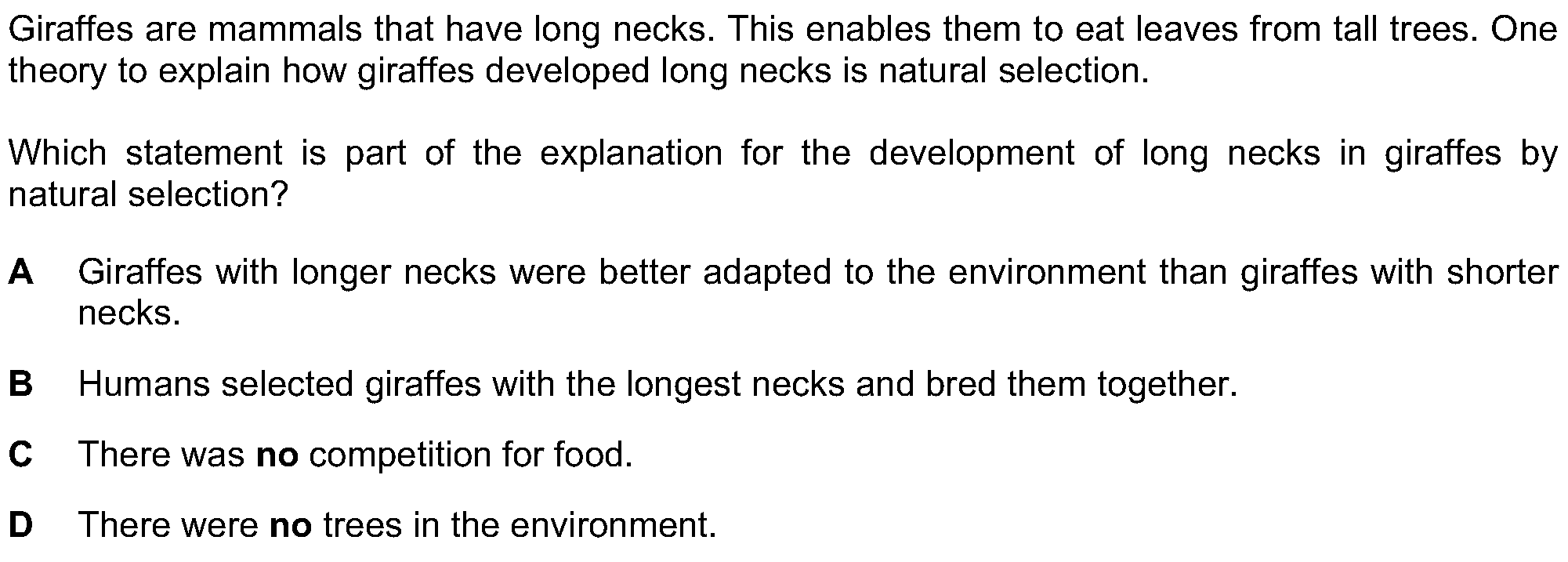
Giraffes are mammals that have long necks. This enables them to eat leaves from tall trees. One
theory to explain how giraffes developed long necks is natural selection.
Which statement is part of the explanation for the development of long necks in giraffes by
natural selection?
A_ Giraffes with longer necks were better adapted to the environment than giraffes with shorter
necks.
Humans selected giraffes with the longest necks and bred them together.
There was no competition for food.
There were no trees in the environment.
Options:
A
B
C
D
Correct Key: A
A
B
C
D
Correct Key: A
Question 2
Paper Ref: 0610/13_Summer_2025_Q30
Paper Ref: 0610/13_Summer_2025_Q30
What is a feature of natural selection?
A
B
Cc
D
genetic variation within populations
plenty of resources
production of genetically identical offspring
selection by humans
A
B
Cc
D
genetic variation within populations
plenty of resources
production of genetically identical offspring
selection by humans
Options:
A
B
C
D
Correct Key: A
A
B
C
D
Correct Key: A
Question 3
Paper Ref: 0610/12_Summer_2018_Q35
Paper Ref: 0610/12_Summer_2018_Q35
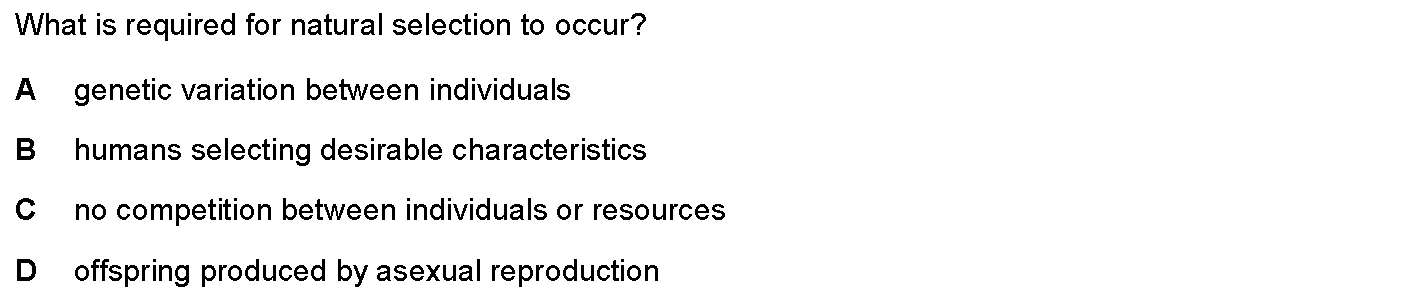
What is required for natural selection to occur?
A genetic variation between individuals
B humans selecting desirable characteristics
C no competition between individuals or resources
D
offspring produced by asexual reproduction
A genetic variation between individuals
B humans selecting desirable characteristics
C no competition between individuals or resources
D
offspring produced by asexual reproduction
Options:
A
B
C
D
Correct Key: A
A
B
C
D
Correct Key: A
Question 4
Paper Ref: 0610/12_Spring_2023_Q35
Paper Ref: 0610/12_Spring_2023_Q35
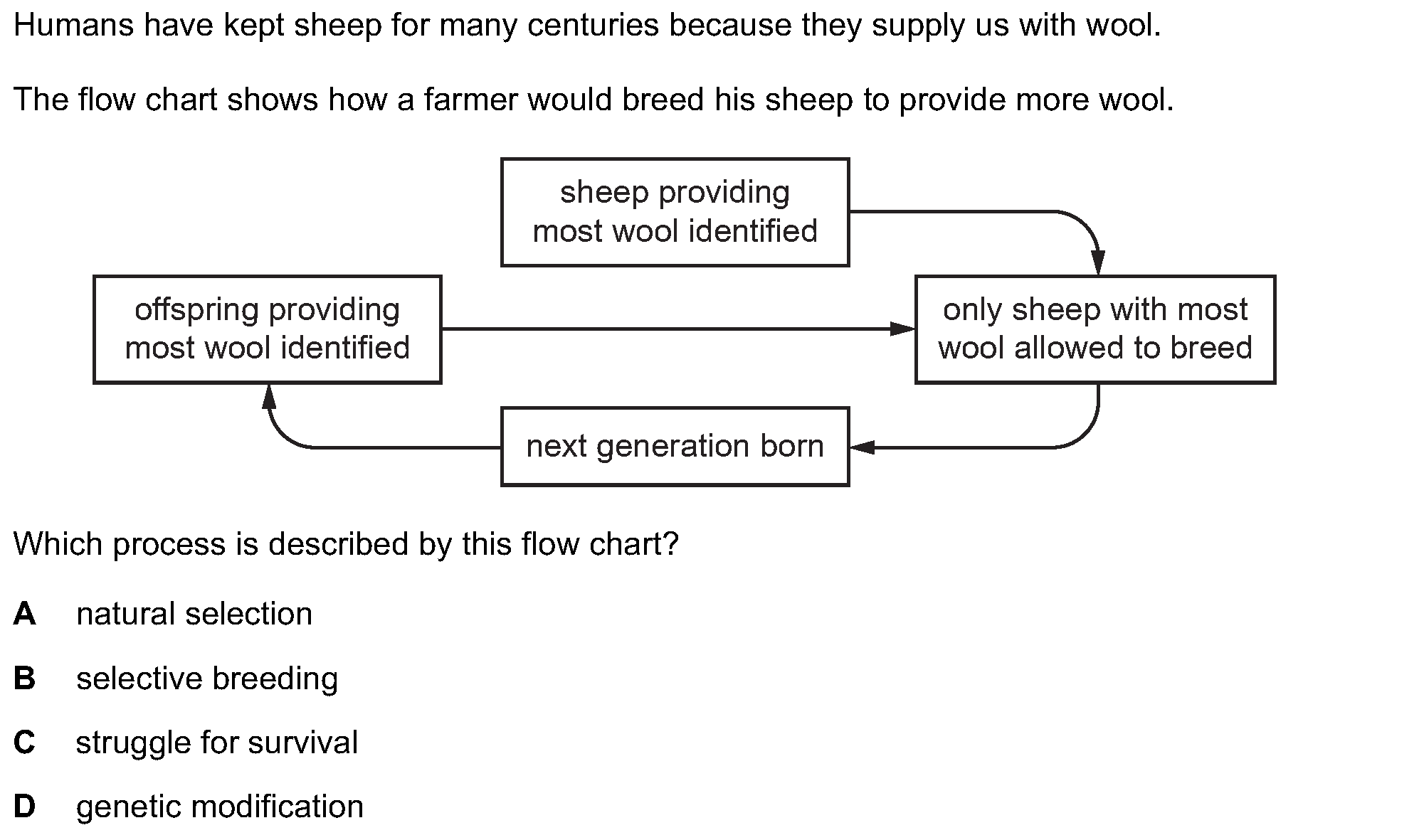
Humans have kept sheep for many centuries because they supply us with wool.
The flow chart shows how a farmer would breed his sheep to provide more wool.
sheep providing
most wool identified
offspring providing only sheep with most
most wool identified wool allowed to breed
next generation born
Which process is described by this flow chart?
A natural selection
B_ selective breeding
C _ struggle for survival
D
genetic modification
Options:
A
B
C
D
Correct Key: B
A
B
C
D
Correct Key: B
Question 5
Paper Ref: 0610/23_Winter_2021_Q35
Paper Ref: 0610/23_Winter_2021_Q35
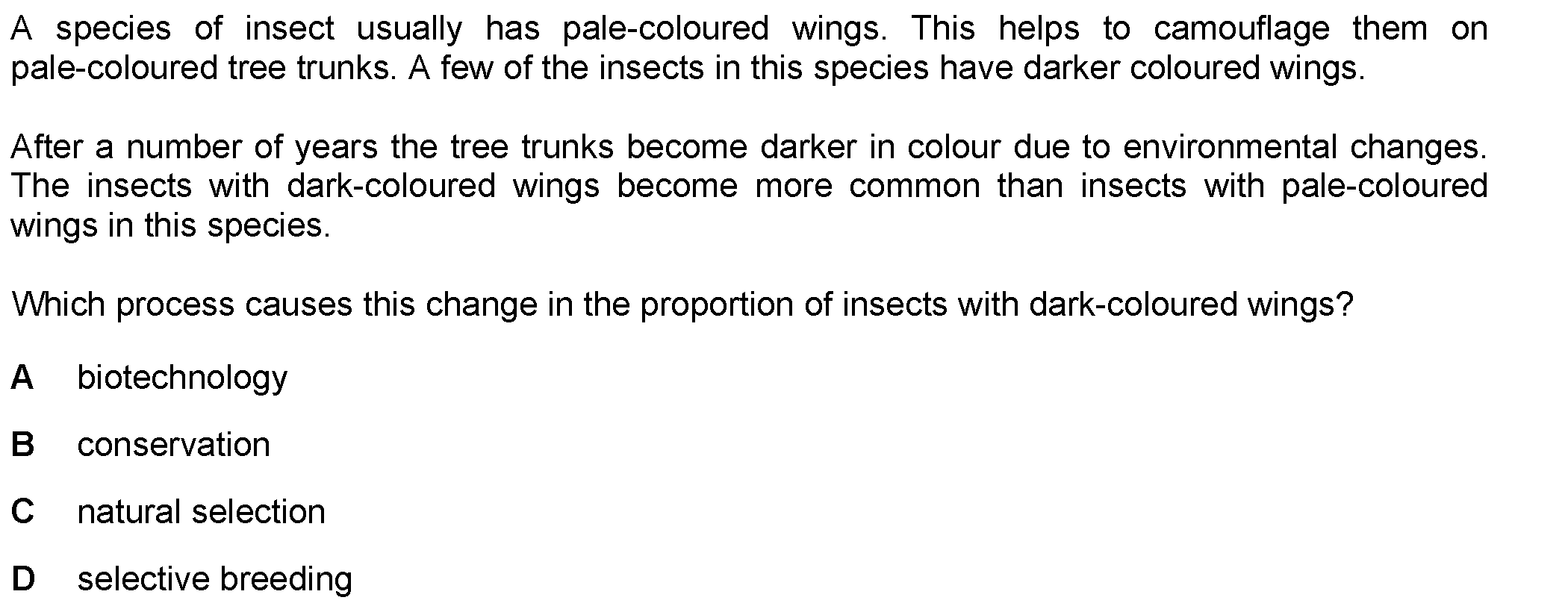
A species of insect usually has pale-coloured wings. This helps to camouflage them on
pale-coloured tree trunks. A few of the insects in this species have darker coloured wings.
After a number of years the tree trunks become darker in colour due to environmental changes.
The insects with dark-coloured wings become more common than insects with pale-coloured
wings in this species.
Which process causes this change in the proportion of insects with dark-coloured wings?
biotechnology
conservation
natural selection
0 0O wD F
selective breeding
Options:
A
B
C
D
Correct Key: C
A
B
C
D
Correct Key: C
Question 6
Paper Ref: 0610/23_Winter_2025_Q34
Paper Ref: 0610/23_Winter_2025_Q34
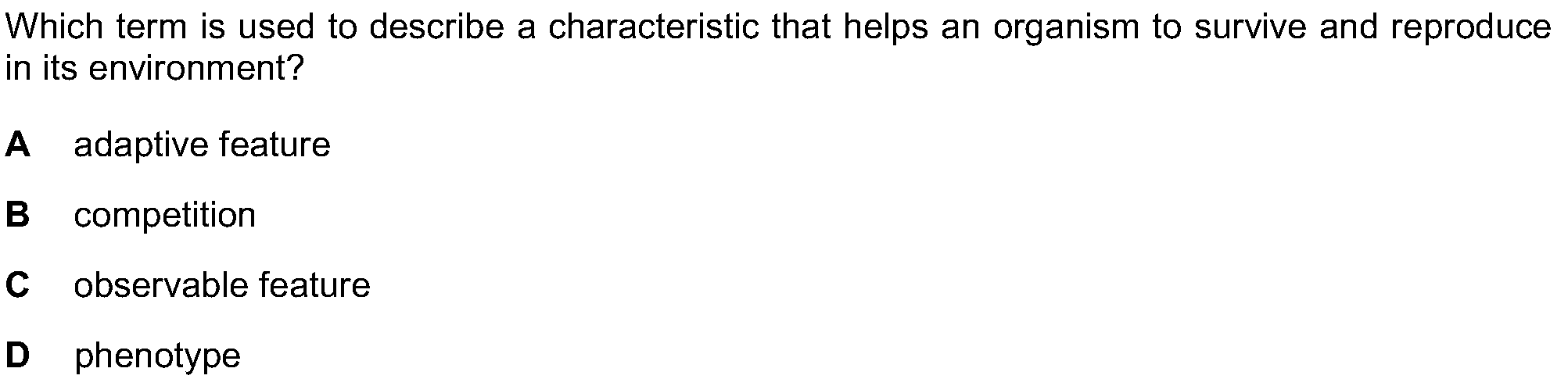
Which term is used to describe a characteristic that helps an organism to survive and reproduce
in its environment?
A adaptive feature
B competition
C observable feature
7]
phenotype
in its environment?
A adaptive feature
B competition
C observable feature
7]
phenotype
Options:
A
B
C
D
Correct Key: A
A
B
C
D
Correct Key: A
Question 7
Paper Ref: 0610/11_Winter_2024_Q37
Paper Ref: 0610/11_Winter_2024_Q37
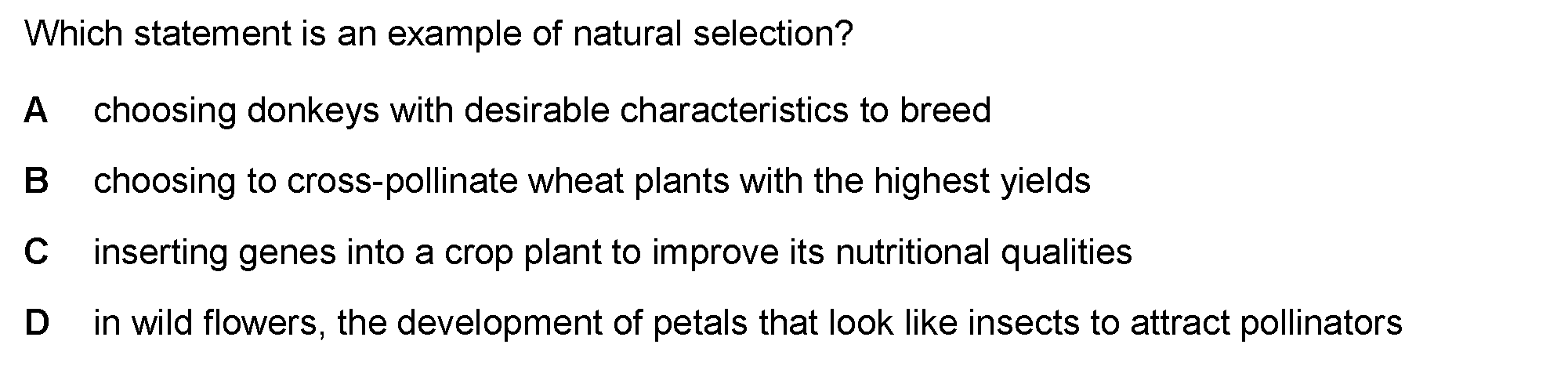
Which statement is an example of natural selection?
A choosing donkeys with desirable characteristics to breed
B- choosing to cross-pollinate wheat plants with the highest yields
C inserting genes into a crop plant to improve its nutritional qualities
D
in wild flowers, the development of petals that look like insects to attract pollinators
A choosing donkeys with desirable characteristics to breed
B- choosing to cross-pollinate wheat plants with the highest yields
C inserting genes into a crop plant to improve its nutritional qualities
D
in wild flowers, the development of petals that look like insects to attract pollinators
Options:
A
B
C
D
Correct Key: D
A
B
C
D
Correct Key: D
Question 8
Paper Ref: 0610/13_Winter_2023_Q35
Paper Ref: 0610/13_Winter_2023_Q35
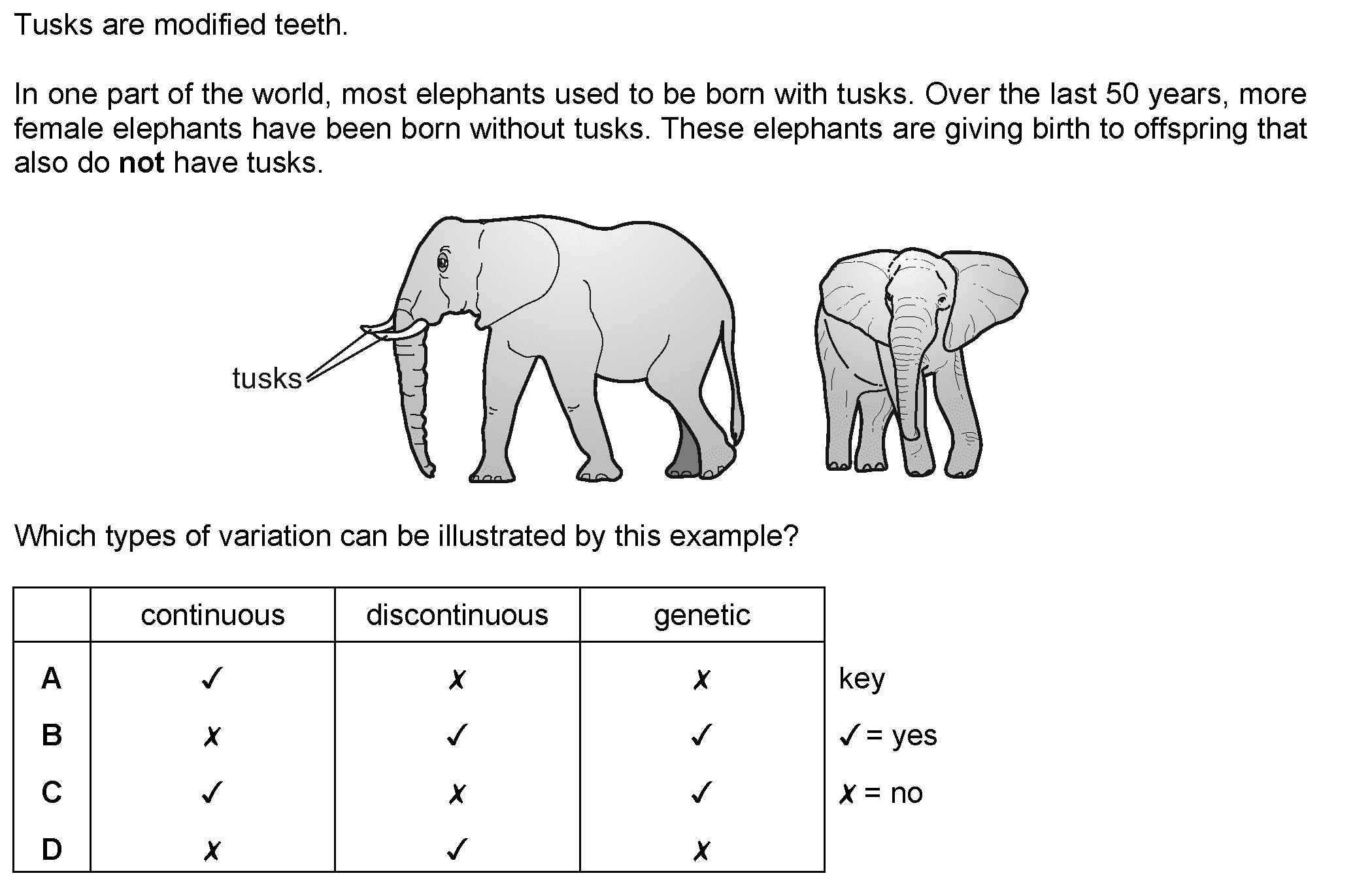
Tusks are modified teeth.
In one part of the world, most elephants used to be born with tusks. Over the last 50 years, more
female elephants have been born without tusks. These elephants are giving birth to offspring that
also do not have tusks.
Which types of variation can be illustrated by this example?
continuous discontinuous genetic
Jv x x key
x Jv Jv /=yes
v x v x=no
x v x
Options:
A
B
C
D
Correct Key: B
A
B
C
D
Correct Key: B
Question 9
Paper Ref: 0610/12_Spring_2023_Q34
Paper Ref: 0610/12_Spring_2023_Q34
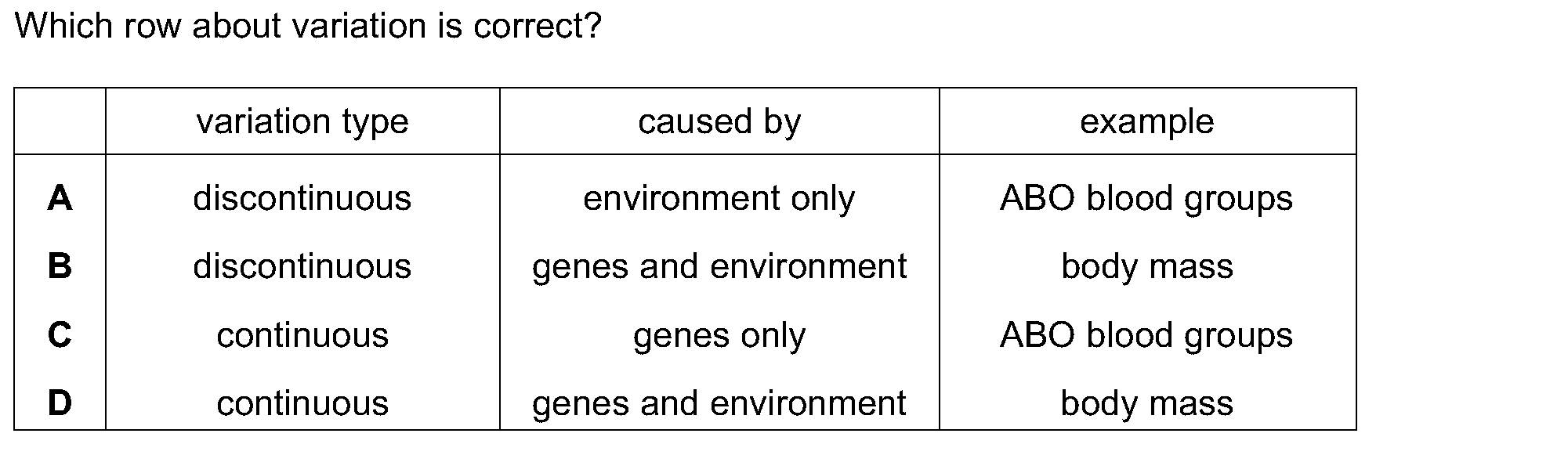
Which row about variation is correct?
variation type
caused by
example
0 0O WD >
discontinuous
discontinuous
continuous
continuous
environment only
genes and environment
genes only
genes and environment
ABO blood groups
body mass
ABO blood groups
body mass
variation type
caused by
example
0 0O WD >
discontinuous
discontinuous
continuous
continuous
environment only
genes and environment
genes only
genes and environment
ABO blood groups
body mass
ABO blood groups
body mass
Options:
A
B
C
D
Correct Key: D
A
B
C
D
Correct Key: D
Question 10
Paper Ref: 0610/22_Winter_2018_Q40
Paper Ref: 0610/22_Winter_2018_Q40
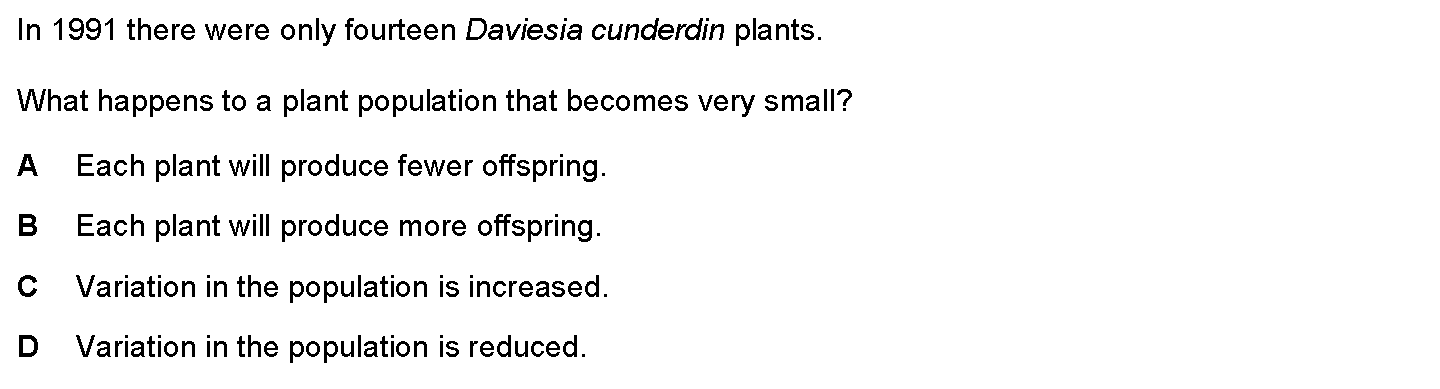
In 1991 there were only fourteen Daviesia cunderdin plants.
What happens to a plant population that becomes very small?
A
B
c
D
Each plant will produce fewer offspring.
Each plant will produce more offspring.
Variation in the population is increased.
Variation in the population is reduced.
What happens to a plant population that becomes very small?
A
B
c
D
Each plant will produce fewer offspring.
Each plant will produce more offspring.
Variation in the population is increased.
Variation in the population is reduced.
Options:
A
B
C
D
Correct Key: D
A
B
C
D
Correct Key: D
Question 11
Paper Ref: 0610/22_Summer_2017_Q35
Paper Ref: 0610/22_Summer_2017_Q35
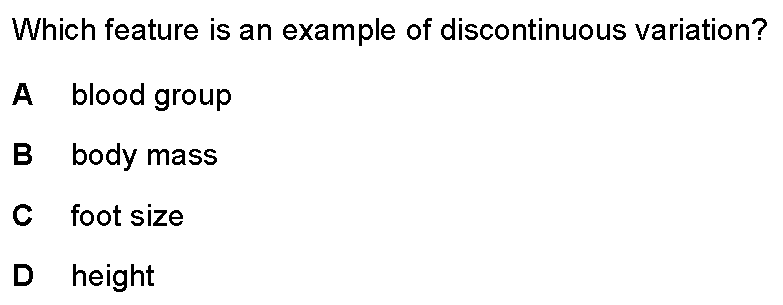
Which feature is an example of discontinuous variation?
0 9 DW
blood group
body mass
foot size
height
0 9 DW
blood group
body mass
foot size
height
Options:
A
B
C
D
Correct Key: A
A
B
C
D
Correct Key: A
Structured Questions Mark Scheme & Answers
•1•.• • • •[•C•P• •M•a•y• •2•0•2•4• •P•1• • •·• • •Q•1•3• • •P•a•r•t• •(•a•)• • •·• • •2•0•2•4• • •·• • •L•o•w•e•r• •S•e•c• •0•8•9•3•]• • • • • • •s•p•e•c•i•e•s• •2• •e•a•c•h• •c•o•r•r•e•c•t• •a•n•s•w•e•r• •=• •1• •m•a•r•k• •g•e•n•e•s•
•2•.• • • •[•P•T• •S•9• •2•0•2•5• •P•1• • •·• • •Q•9• • •·• • •2•0•2•5• • •·• • •L•o•w•e•r• •S•e•c• •0•8•9•3•]• • • • • • •4• •e•a•c•h• •c•o•r•r•e•c•t• •a•n•s•w•e•r• •=• •1• •m•a•r•k• •(•d•a•r•k• •m•i•c•e•)• •d•e•c•r•e•a•s•e•s• •••c•c•e•p•t• •d•a•r•k• •m•i•c•e• •g•o•e•s• •f•r•o•m• •4• •t•o• •1• •a•n•d• •l•i•g•h•t• •m•i•c•e• •a•n•d• •g•o•e•s• •f•r•o•m• •4• •t•o• •(•3• •t•o•)• •7• •(•l•i•g•h•t• •m•i•c•e• •d•e•c•r•e•a•s•e•s• •a•n•d• •t•h•e•n•)• •i•n•c•r•e•a•s•e•s• •(•e•x•p•l•a•n•a•t•i•o•n•)• •(•i•d•e•a• •t•h•a•t•)• •d•a•r•k• •m•i•c•e• •a•r•e• •m•o•r•e• •v•i•s•i•b•l•e• •s•o• •a•r•e• •m•o•r•e• •l•i•k•e•l•y• •t•o• •b•e• •e•a•t•e•n• •o•r• •l•i•g•h•t• •m•i•c•e• •a•r•e• •l•e•s•s• •v•i•s•i•b•l•e• •s•o• •l•e•s•s• •l•i•k•e•l•y• •t•o• •b•e• •e•a•t•e•n• •(•i•d•e•a• •t•h•a•t•)• •l•i•g•h•t• •m•i•c•e• •a•r•e• •m•o•r•e• •l•i•k•e•l•y• •t•o• •r•e•p•r•o•d•u•c•e• •o•r• •d•a•r•k• •m•i•c•e• •a•r•e• •l•e•s•s• •l•i•k•e•l•y• •t•o• •r•e•p•r•o•d•u•c•e• •(•i•d•e•a• •t•h•a•t•)• •t•h•e• •c•h•a•r•a•c•t•e•r•i•s•t•i•c•s• •f•o•r• •l•i•g•h•t• •m•i•c•e• •m•o•r•e• •l•i•k•e•l•y• •t•o• •b•e• •p•a•s•s•e•d• •o•n• •t•o• •o•f•f•s•p•r•i•n•g• •o•r• •c•h•a•r•a•c•t•e•r•i•s•t•i•c•s• •f•o•r• •d•a•r•k• •m•i•c•e• •l•e•s•s• •l•i•k•e•l•y• •t•o• •b•e• •p•a•s•s•e•d• •o•n• •t•o• •o•f•f•s•p•r•i•n•g• •©• •U•C•L•E•S• •2•0•2•5• •P•a•g•e• •8• •o•f• •1•4• •S•9•/•0•1• •S•c•i•e•n•c•e• •S•t•a•g•e• •9• •P•a•p•e•r• •1• •M•a•r•k• •S•c•h•e•m•e• •2•0•2•5•
•3•.• • • •[•C•P• •M•a•r•c•h• •2•0•2•6• •P•2• • •·• • •Q•1• • •P•a•r•t• •(•a•)• • •·• • •2•0•2•6• • •·• • •L•o•w•e•r• •S•e•c• •0•8•9•3•]• • • • • • •v•a•r•i•a•t•i•o•n• •1• •••c•c•e•p•t• •(•g•e•n•e•t•i•c•)• •v•a•r•i•a•b•i•l•i•t•y• •I•g•n•o•r•e• •g•e•n•e•t•i•c• •I•g•n•o•r•e• •b•r•e•e•d• •o•r• •v•a•r•i•e•t•y•
•4•.• • • •[•C•P• •M•a•r•c•h• •2•0•2•6• •P•2• • •·• • •Q•1• • •P•a•r•t• •(•b•)• • •·• • •2•0•2•6• • •·• • •L•o•w•e•r• •S•e•c• •0•8•9•3•]• • • • • • •(•i•d•e•a• •o•f•)• •g•e•n•e•t•i•c• •(•d•i•f•f•e•r•e•n•c•e•s•)• •1• •••c•c•e•p•t• •(•d•i•f•f•e•r•e•n•c•e•s• •i•n•)• •D•N••• •o•r• •g•e•n•e•s• •••c•c•e•p•t• •m•u•t•a•t•i•o•n•s• •o•r• •e•r•r•o•r•s• •i•n• •c•o•p•y•i•n•g• •D•N••• •I•g•n•o•r•e• •n•a•t•u•r•a•l• •s•e•l•e•c•t•i•o•n• •o•r• •a•d•a•p•t•a•t•i•o•n• •o•r• •e•n•v•i•r•o•n•m•e•n•t•a•l• •o•r• •h•a•b•i•t•a•t•
•5•.• • • •[•C•P• •M•a•r•c•h• •2•0•2•6• •P•2• • •·• • •Q•1• • •P•a•r•t• •(•c•)• • •·• • •2•0•2•6• • •·• • •L•o•w•e•r• •S•e•c• •0•8•9•3•]• • • • • • •m•o•r•e• •1• •••c•c•e•p•t• •a•n•y• •i•n•d•i•c•a•t•i•o•n• •o•f• •t•h•e• •c•o•r•r•e•c•t• •a•n•s•w•e•r•,• •e•.•g•.• •t•i•c•k•i•n•g• •o•r• •u•n•d•e•r•l•i•n•i•n•g• •o•r• •c•i•r•c•l•i•n•g•,• •b•u•t• •a•n•s•w•e•r• •l•i•n•e• •t•a•k•e•s• •p•r•e•c•e•d•e•n•c•e• •2• •e•a•c•h• •c•o•r•r•e•c•t• •a•n•s•w•e•r• •=• •1• •m•a•r•k• •(•i•d•e•a• •t•h•a•t• •a•f•t•e•r• •1•9•5•0•)• •t•h•e• •d•a•r•k• •p•e•p•p•e•r•e•d• •m•o•t•h• •w•a•s• •m•o•r•e• •N•o•t•e• •m•u•s•t• •b•e• •a• •c•o•m•p•a•r•a•t•i•v•e• •s•t•a•t•e•m•e•n•t• •c•a•m•o•u•f•l•a•g•e•d• •(•f•r•o•m• •p•r•e•d•a•t•o•r•s•)• •o•r• •d•a•r•k• •m•o•t•h•s• •l•e•s•s• •l•i•k•e•l•y• •t•o• •b•e• •e•a•t•e•n• •b•y• •p•r•e•d•a•t•o•r•s• •o•r• •d•a•r•k• •m•o•t•h•s• •b•e•t•t•e•r• •a•d•a•p•t•e•d• •t•o• •t•h•e•i•r• •••c•c•e•p•t• •i•t• •w•a•s• •m•o•r•e• •c•a•m•o•u•f•l•a•g•e•d• •e•n•v•i•r•o•n•m•e•n•t• •••c•c•e•p•t• •o•r•a• •i•f• •q•u•a•l•i•f•i•e•d• •w•i•t•h• •l•i•g•h•t• •c•o•l•o•u•r•e•d• •m•o•t•h•s• •(•i•d•e•a• •t•h•a•t•)• •s•o• •t•h•e• •d•a•r•k• •p•e•p•p•e•r•e•d• •m•o•t•h• •s•u•r•v•i•v•e•d• •a•n•d• •p•a•s•s•e•d• •o•n• •••c•c•e•p•t• •o•r•a• •i•t•s• •g•e•n•e•s• •N•o•t•e• •M•2• •m•u•s•t• •r•e•f•e•r• •t•o• •g•e•n•e•s• •i•n• •a•n•s•w•e•r•
•6•.• • • •[•P•T• •S•9• •2•0•2•6• •P•2• • •·• • •Q•1•5• • •·• • •2•0•2•6• • •·• • •L•o•w•e•r• •S•e•c• •0•8•9•3•]• • • • • • •a•n•y• •t•h•r•e•e• •f•r•o•m• •3• •e•a•c•h• •c•o•r•r•e•c•t• •a•n•s•w•e•r• •=• •1• •m•a•r•k• •(•i•d•e•a• •t•h•a•t•)• •t•h•e• •c•h•a•n•g•e•s• •t•o• •t•h•e• •h•o•r•s•e• •a•r•e• •d•u•e• •t•o• •g•e•n•e•t•i•c• •c•h•a•n•g•e•s• •o•v•e•r• •t•i•m•e• •(•i•d•e•a• •t•h•a•t•)• •p•r•e•s•e•n•t• •d•a•y• •h•o•r•s•e•s• •d•o• •n•o•t• •n•e•e•d• •t•o• •e•s•c•a•p•e• •f•r•o•m• •o•t•h•e•r• •a•n•i•m•a•l•s• •(•s•o• •d•o• •n•o•t• •n•e•e•d• •4• •t•o•e•s•)• •(•i•d•e•a• •t•h•a•t•)• •p•r•e•s•e•n•t• •d•a•y• •h•o•r•s•e•s• •d•o• •n•o•t• •a•l•l• •l•i•v•e• •i•n• •a•r•e•a•s• •w•i•t•h• •s•o•f•t•,• •w•e•t• •g•r•o•u•n•d• •(•s•o• •d•o• •n•o•t• •n•e•e•d• •4• •t•o•e•s•)• •(•i•d•e•a• •t•h•a•t•)• •p•r•e•s•e•n•t• •d•a•y• •h•o•r•s•e•s• •c•a•n• •n•o•w• •e•a•t• •h•a•r•d•e•r• •f•o•o•d• •(•s•o• •h•a•v•e• •d•e•v•e•l•o•p•e•d• •h•a•r•d• •t•e•e•t•h•)• •(•i•d•e•a• •t•h•a•t•)• •p•r•e•s•e•n•t• •d•a•y• •h•o•r•s•e•s• •d•o• •n•o•t• •n•e•e•d• •t•o• •b•e• •s•m•a•l•l• •t•o• •h•i•d•e• •(•a•s• •a•r•e• •n•o•t• •e•s•c•a•p•i•n•g• •o•t•h•e•r• •a•n•i•m•a•l•s•)• •©• •C•a•m•b•r•i•d•g•e• •U•n•i•v•e•r•s•i•t•y• •P•r•e•s•s• •&• •••s•s•e•s•s•m•e•n•t• •2•0•2•6• •P•a•g•e• •1•4• •o•f• •1•4•
•7•.• • • •[•P•T• •S•7• •2•0•1•2• •P•1• • •·• • •Q•7• • •·• • •2•0•1•2• • •·• • •L•o•w•e•r• •S•e•c• •s•o•u•r•c•e• •a•d•d•i•t•i•o•n•]• • • • • • •N•o• •m•a•t•c•h•i•n•g• •m•a•r•k•-•s•c•h•e•m•e• •e•n•t•r•y• •w•a•s• •f•o•u•n•d• •i•n• •M•a•r•k•_•S•c•h•e•m•e•s•.•d•o•c•x•.•
•8•.• • • •[•P•T• •S•7• •2•0•1•8• •P•2• • •·• • •Q•1• • •·• • •2•0•1•8• • •·• • •L•o•w•e•r• •S•e•c• •s•o•u•r•c•e• •a•d•d•i•t•i•o•n•]• • • • • • •N•o• •m•a•t•c•h•i•n•g• •m•a•r•k•-•s•c•h•e•m•e• •e•n•t•r•y• •w•a•s• •f•o•u•n•d• •i•n• •M•a•r•k•_•S•c•h•e•m•e•s•.•d•o•c•x•.•
Last updated:
\n