Curriculum
AP Physics C: Mechanics
1. Kinematics
0/11
2. Force and Translational Dynamics
0/21
3. Work, Energy, and Power
0/11
4. Linear Momentum
0/9
5. Torque and Rotational Dynamics
0/13
6. Energy and Momentum of Rotating Systems
0/13
-
6. Energy and Momentum of Rotating Systems
 Preview
-
6.1 Rotational Kinetic Energy
Preview
-
6.1 Rotational Kinetic Energy - Check yourself
 Preview
-
6.2 Torque and Work
Preview
-
6.2 Torque and Work - Check yourself
Preview
-
6.3 Angular Momentum and Angular Impulse
Preview
-
6.3 Angular Momentum and Angular Impulse - Check yourself
Preview
-
6.4 Conservation of Angular Momentum
Preview
-
6.4 Conservation of Angular Momentum - Check yourself
Preview
-
6.5 Rolling
Preview
-
6.5 Rolling - Check yourself
Preview
-
6.6 Motion of Orbiting Satellites
Preview
-
6.6 Motion of Orbiting Satellites - Check yourself
Preview
7. Oscillations
0/11
Text lesson
6.3 Angular Momentum and Angular Impulse
6.3 Angular Momentum and Angular Impulse — AP PHYSICS C: MECHANICS notes: You will be able to describe the angular momentum of a particle and of a rigid system about a chosen axis, calculate the angular impulse from a torque by integration, and use the rotational impulse–momentum theorem to relate the angular impulse to the change in angular momentum.
1
Its magnitude is L = rmv sin θ, where θ is the angle between r and v, so L = mvr⊥, with r⊥ = r sin θ the perpendicular distance from the reference point to the line of motion.
2
Angular momentum is measured in kilogram metres squared per second (kg·m2/s).
3
Its direction is perpendicular to both r and p, given by the right-hand rule.
4
The value depends on the choice of reference point.
5
The same particle moving in a straight line has a different angular momentum about two different points, because its perpendicular distance from each point is different.
6
For that reason the axis or point must always be stated.
7
A particle moving directly toward or away from the reference point has θ = 0 or π and therefore zero angular momentum about that point.
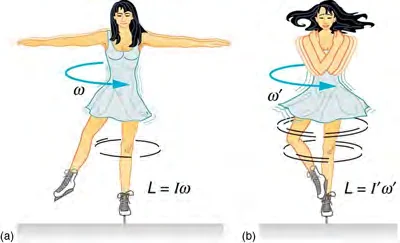
This follows from summing the angular momenta of the particles: each particle has Li = miri2ω, so L = (Σmiri2)ω = Iω.
The direction of L is along the axis of rotation, and it is positive when the rotation is in the chosen positive sense.
Angular momentum is the rotational analogue of linear momentum: I plays the role of mass and ω plays the role of velocity.
Like linear momentum, it is a vector, and its sign tells the direction of rotation.
1
Angular impulse is the product of the torque exerted on a system and the time interval during which it acts.
2
When the torque varies with time, the angular impulse is Jang = ∫titf τ dt, measured in N·m·s, which is the same unit as kg·m2/s.
3
A constant torque gives Jang = τΔt.
4
The angular impulse has the same direction as the torque that delivers it.
5
On a graph of torque against time, the angular impulse is the area between the curve and the time axis.
6
As with work, areas below the axis count as negative, so a torque that reverses sign reduces the angular impulse.
1
Differentiating shows that the net torque is the rate of change of angular momentum, τnet = dL/dt, so the slope of an angular momentum–time graph is the net torque.
2
For a rigid body with constant rotational inertia, dL/dt = I dω/dt = Iα, which recovers τnet = Iα, the rotational form of Newton’s second law.
3
The magnitude of the change in angular momentum is found by comparing the final and initial values of L that point in the same sense.
4
If the angular momentum is reversed in direction, ΔL = Lf − Li must be taken with signs.
5
For a rigid body with fixed I, ΔL = IΔω, so the angular impulse is IΔω.
1
Because the velocity is perpendicular to the radius, sin θ = 1 and L = mvr⊥ = (0.20 kg)(5.0 m/s)(0.40 m) = 0.40 kg·m2/s.
Answer
The angular momentum about the pivot is 0.40 kg·m2/s, directed according to the right-hand rule for the sense of the motion.
1
Jang = ∫03.0(6.0 − 2.0t) dt = [6.0t − t2]03.0 = 18 − 9.0 = 9.0 N·m·s.
2
Worked examples
3
The change in angular momentum is ΔL = 9.0 kg·m2/s.
4
The initial angular momentum is zero, so Lf = Iωf gives ωf = 9.0/0.30 = 30 rad/s.
Answer
The angular impulse is 9.0 N·m·s and the final angular speed is 30 rad/s.
1
The initial angular momentum is Li = Iωi = (0.50)(4.0) = 2.0 kg·m2/s, taken as positive.
2
The angular impulse is −(0.50 N·m)(2.0 s) = −1.0 N·m·s, so ΔL = −1.0 kg·m2/s.
3
The final angular momentum is Lf = 2.0 − 1.0 = 1.0 kg·m2/s.
4
Then ωf = 1.0/0.50 = 2.0 rad/s.
Answer
The final angular momentum is 1.0 kg·m2/s and the disk still rotates in the original sense, now at 2.0 rad/s.
Using the full speed in L = mvr for a particle
Only the perpendicular distance and the perpendicular part of the velocity contribute, so use L = mvr sin θ.
Calculating angular momentum without naming the reference point or axis
The value changes with the choice of point, and the question must fix that choice.
Confusing angular impulse, ∫τ dt, with work, ∫τ dθ
Angular impulse changes angular momentum; work changes kinetic energy.
Ignoring signs when a torque opposes the rotation
A negative angular impulse reduces the angular momentum, and it can reduce it to zero or reverse its sense.
Reading the slope of a torque–time graph as the angular impulse
The slope of an angular momentum–time graph is the net torque, and the area under a torque–time graph is the angular impulse.
Avoid
Using Iω for the angular momentum of a body that is not rotating about a fixed axis, or forgetting the orbital angular momentum of a body that moves past the axis