Curriculum
AP Physics C: Mechanics
1. Kinematics
0/11
2. Force and Translational Dynamics
0/21
-
2. Force and Translational Dynamics
 Preview
-
2.1 Systems and Center of Mass
Preview
-
2.1 Systems and Center of Mass - Check yourself
 Preview
-
2.2 Forces and Free-Body Diagrams
Preview
-
2.2 Forces and Free-Body Diagrams - Check yourself
Preview
-
2.3 Newton’s Third Law
Preview
-
2.3 Newton’s Third Law - Check yourself
Preview
-
2.4 Newton’s First Law
Preview
-
2.4 Newton’s First Law - Check yourself
Preview
-
2.5 Newton’s Second Law
Preview
-
2.5 Newton’s Second Law - Check yourself
Preview
-
2.6 Gravitational Force
Preview
-
2.6 Gravitational Force - Check yourself
Preview
-
2.7 Kinetic and Static Friction
Preview
-
2.7 Kinetic and Static Friction - Check yourself
Preview
-
2.8 Spring Forces
Preview
-
2.8 Spring Forces - Check yourself
Preview
-
2.9 Resistive Forces
Preview
-
2.9 Resistive Forces - Check yourself
Preview
-
2.10 Circular Motion
Preview
-
2.10 Circular Motion - Check yourself
Preview
3. Work, Energy, and Power
0/11
4. Linear Momentum
0/9
5. Torque and Rotational Dynamics
0/13
6. Energy and Momentum of Rotating Systems
0/13
7. Oscillations
0/11
Text lesson
2.6 Gravitational Force
2.6 Gravitational Force — AP PHYSICS C: MECHANICS (CALCULUS-BASED) notes: You will be able to calculate the gravitational force and field between masses, distinguish weight from apparent weight, explain inertial and gravitational mass, and find the gravitational force inside and outside a uniform sphere of mass by integration.
1
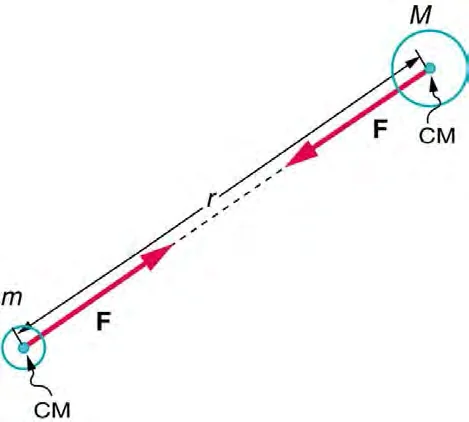
The force is directly proportional to each of their masses and inversely proportional to the square of the distance between their centres of mass:
Here Fg is the magnitude of the gravitational force in newtons (N), m1 and m2 are the masses in kilograms (kg), r is the distance between the centres of mass in metres (m), and G = 6.67 × 10⁻¹¹ N·m2/kg2 is the gravitational constant.
The gravitational force is always attractive, and it acts along the line joining the two centres of mass.
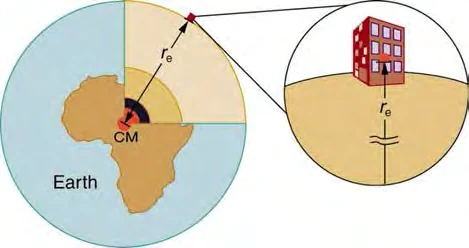
For a system, the force can be considered to act at its centre of mass, so a large body can be replaced by a point at its centre when it is outside the body.
The force on one object is equal and opposite to the force on the other, as Newton’s third law requires.
Its size depends on the masses and the separation but not on the medium between them, and the gravitational force between everyday objects is extremely small because G is so small.
A field model describes the effect of a noncontact force exerted on an object at various positions in space.
The gravitational field strength at a point due to a mass M is the ratio of the gravitational force exerted by the mass on a small test object to the mass of the test object.
Its magnitude is
g = Fg/m = GM/r2
1
The field strength is measured in newtons per kilogram (N/kg).
2
If gravity is the only force on an object, its acceleration equals the magnitude of the gravitational field at its location, so the acceleration is measured in m/s2 and is numerically equal to the field in N/kg.
3
The gravitational force exerted by an astronomical body on a relatively small nearby object is called weight.
4
It is given by Fg = mg, where m is the mass of the object in kilograms and g is the field strength in N/kg.
5
Near the surface of the Earth, g = 9.8 N/kg, and it is directed toward the centre of the Earth.
6
If the distance from the centre of the Earth changes by only a small fraction, the gravitational force can be treated as constant, and the value of g near the surface is the same at all nearby points.
1
The magnitude of the apparent weight of a system is the magnitude of the normal force exerted on it by its support.
2
A person standing on a scale reads the apparent weight, which is the normal force from the scale.
3
When the person is at rest, the apparent weight equals the gravitational force mg.
4
When the person accelerates, the normal force changes, and the apparent weight is no longer equal to mg.
5
If the system accelerates upward with acceleration a, Newton’s second law gives N − mg = ma, so the apparent weight is N = m(g + a), which is larger than the weight.
6
If it accelerates downward with acceleration a, the apparent weight is N = m(g − a), which is smaller.
7
A system is weightless when no forces are exerted on it, or when gravity is the only force exerted on it, as in free fall.
8
An astronaut in orbit is not weightless because gravity is absent; the astronaut is in free fall, and the normal force from the spacecraft is zero.
9
The equivalence principle states that an observer in a noninertial reference frame cannot distinguish between an object’s apparent weight and the gravitational force exerted on the object by a gravitational field.
10
In a lift that accelerates upward, a passenger feels a larger apparent weight, exactly as if the gravitational field were stronger.
1
It appears in Newton’s second law.
2
Gravitational mass is the property that determines the force of attraction between two systems with mass, as in the equation above.
3
The two are experimentally found to be equal.
4
This equality is why all objects fall with the same acceleration near the Earth’s surface, regardless of their masses.
A uniform sphere of total mass M and radius R can be divided into thin spherical shells, each of radius r, thickness dr and mass dM = 4πr2ρ dr, where ρ is the constant density in kg/m3.
The net gravitational force exerted on an object by the sphere is the sum of the forces from all these differential masses.
For a point outside the sphere, the force is the same as if all the mass were concentrated at the centre.
This is the outside part of Newton’s shell theorem.
Newton’s shell theorem also states that the net gravitational force exerted on an object inside a thin spherical shell is zero, and that an object outside a thin shell is attracted as if the shell’s mass were a point at its centre.
For an object inside a uniform solid sphere, only the mass inside its radius contributes.
The partial mass at radius r is
M(r) = ∫0r 4πr′2ρ dr′ = (4/3)πr3ρ = M(r/R)3
1
So that the gravitational force on a mass m at distance r from the centre, with r less than R, is F = GM(r)m/r2 = −(GMm/R3) r, where the negative sign shows that the force is directed toward the centre.
2
This force is proportional to the distance from the centre, and the gravitational field inside the sphere is therefore g(r) = GMr/R3.
3
The field falls linearly to zero at the centre.
4
AP Physics C Mechanics does not expect students to derive the shell theorem, but it does expect them to apply it.
Example 1
Gravitational force between two masses
1
Fg = Gm1m2/r2 = (6.67 × 10⁻¹¹)(2.0 × 10³)(5.0 × 10³)/(4.0)2 = (6.67 × 10⁻¹¹)(1.0 × 10⁷)/16 = 4.2 × 10⁻⁵ N.
Answer
The gravitational force has magnitude 4.2 × 10⁻⁵ N and is attractive, directed along the line joining the two centres of mass.
Example 2
Apparent weight in an accelerating lift
1
The scale reads the normal force N.
2
Newton’s second law with upward positive gives N − mg = ma, so N = m(g + a) = (70 kg)(9.8 + 2.0) m/s2 = (70 kg)(11.8 m/s2) = 826 N.
3
The weight is mg = 686 N
Answer
The scale reads 826 N, about 140 N more than the weight of 686 N. If the lift accelerated downward at 2.0 m/s2 instead, the reading would be 546 N, which is smaller than the weight
Example 3
Gravitational field inside a uniform Earth
1
At the surface, gs = GM/R2 = (6.67 × 10⁻¹¹)(6.0 × 1024)/(6.4 × 106)2 = 9.8 N/kg.
2
Inside the sphere, g(r) = GMr/R3 = gs(r/R).
3
At r = R/2, g = (9.8 N/kg)(0.50) = 4.9 N/kg.
4
The force is F = mg = (70 kg)(4.9 N/kg) = 343 N, directed toward the centre.
Answer
The field at the surface is 9.8 N/kg, and at the midpoint it is 4.9 N/kg. The force on the 70 kg person at that point is 340 N (343 N), directed toward the centre of the Earth. Only the mass inside radius R/2 contributes to this force.
Setting the apparent weight equal to mg in an accelerating lift
The apparent weight is m(g ± a).
Saying that an astronaut in orbit is weightless because there is no gravity
Gravity still acts; the astronaut is in free fall.
Assuming that the gravitational field inside the Earth is the same as at the surface
Inside a uniform sphere, the field decreases linearly toward the centre.
Including the mass outside a radius r when finding the force inside a uniform sphere
Only the partial mass within radius r contributes.
Claiming that an object inside a thin spherical shell is pulled toward the shell
The net force inside a thin shell is zero.
Avoid
Using the distance from the surface of an object instead of the distance between the centres of mass in F = Gm1m2/r2