Curriculum
AP Physics C: Mechanics
1. Kinematics
0/11
2. Force and Translational Dynamics
0/21
3. Work, Energy, and Power
0/11
-
3. Work, Energy, and Power
 Preview
-
3.1 Translational Kinetic Energy
Preview
-
3.1 Translational Kinetic Energy - Check yourself
 Preview
-
3.2 Work
Preview
-
3.2 Work - Check yourself
Preview
-
3.3 Potential Energy
Preview
-
3.3 Potential Energy - Check yourself
Preview
-
3.4 Conservation of Energy
Preview
-
3.4 Conservation of Energy - Check yourself
Preview
-
3.5 Power
Preview
-
3.5 Power - Check yourself
Preview
4. Linear Momentum
0/9
5. Torque and Rotational Dynamics
0/13
6. Energy and Momentum of Rotating Systems
0/13
7. Oscillations
0/11
Text lesson
3.1 Translational Kinetic Energy
3.1 Translational Kinetic Energy — AP PHYSICS C: MECHANICS notes: You will be able to describe the translational kinetic energy of an object in terms of its mass and velocity, and explain why this scalar quantity depends on the observer’s frame of reference.
1Translational motion and kinetic energy2Translational motion and kinetic energy3Translational motion and kinetic energy4Translational motion and kinetic energy5Translational motion and kinetic energy
Translational motion and kinetic energy
Translational motion and kinetic energy
Translational kinetic energy is the energy an object has because its centre of mass moves through space.
1 / 5Next ▶
Translational motion and kinetic energy
1
It is the kinetic energy that the object would have if all of its mass were concentrated at its centre of mass and it moved as a single particle.
2
A spinning top or a rolling wheel also has rotational kinetic energy
but in this topic only the translational part is considered.
3
For an object of mass m moving with speed v, the translational kinetic energy is K = ½mv2.
4
Here
5
K
6
is the kinetic energy in joules (J),
◀ Previous2 / 5Next ▶
Translational motion and kinetic energy
Translational motion and kinetic energy
m
is the mass in kilograms (kg), and
v
is the speed of the centre of mass in metres per second (m/s).
Because the speed is squared, doubling the speed of an object quadruples its kinetic energy
while doubling its mass only doubles it.
Kinetic energy is written with the speed, not the velocity vector.
◀ Previous3 / 5Next ▶
Translational motion and kinetic energy
Translational motion and kinetic energy
The direction of motion does not change the value of
,
so a car travelling north at 20 m/s and a car travelling west at 20 m/s have the same kinetic energy.
Translational kinetic energy is therefore a scalar quantity: it has magnitude and units but no direction,
and kinetic energies are added by ordinary arithmetic.
◀ Previous4 / 5Next ▶
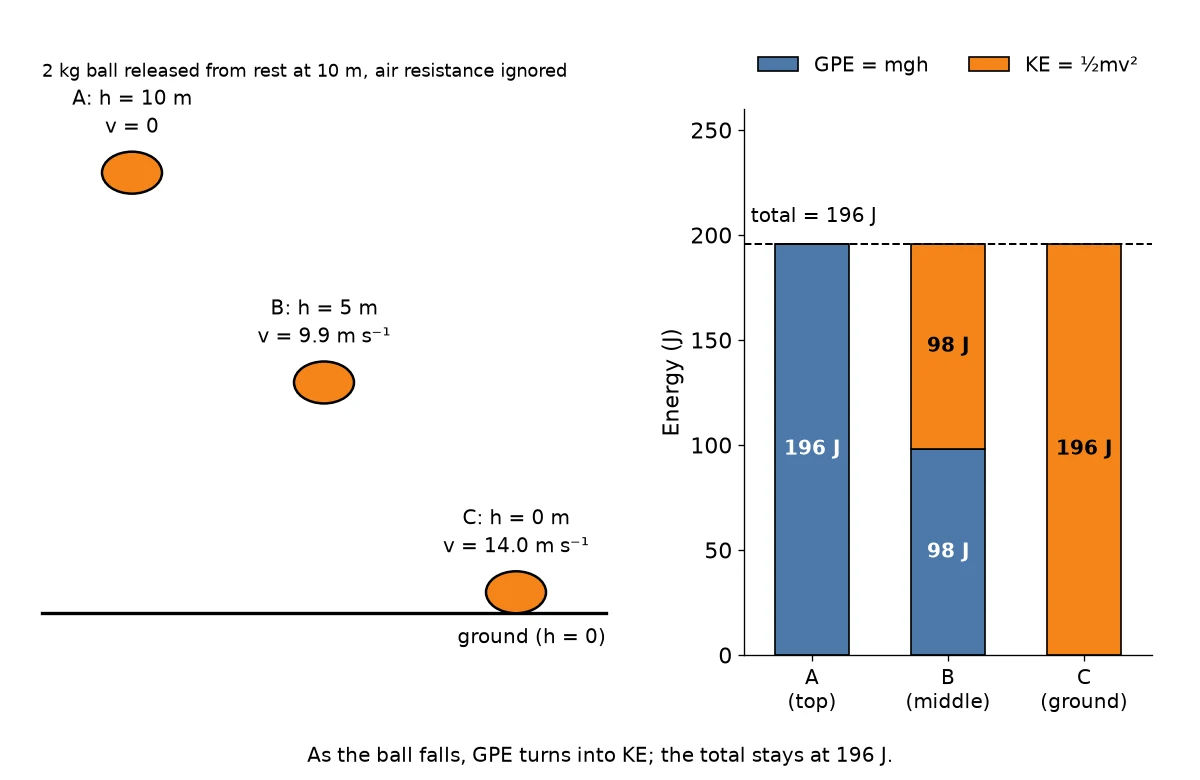
A 2 kg ball at the top, middle and ground of its fall, with stacked bars for GPE and KE at each point
Translational motion and kinetic energy
◀ Previous5 / 5
1Kinetic energy and the momentum of an object2Kinetic energy and the momentum of an object3Kinetic energy and the momentum of an object
Kinetic energy and the momentum of an object
Kinetic energy and the momentum of an object
The momentum of an object is p = mv, and substituting this into the kinetic energy gives K = p2/(2m).
1 / 3Next ▶
Kinetic energy and the momentum of an object
Kinetic energy and the momentum of an object
Here
p
is the momentum in kilogram metres per second (kg·m/s).
This form shows that two objects with the same momentum but different masses do not have the same kinetic energy: the lighter object has the larger kinetic energy.
For an object whose speed changes with time, the kinetic energy at any instant is found from the instantaneous speed, K(t) = ½m[v(t)]2. The rate at which the kinetic energy changes is dK/dt = mv(dv/dt) = Fv
which is the link to power in topic 3.5. This relation is used with calculus when the speed is given as a function of time.
◀ Previous2 / 3Next ▶
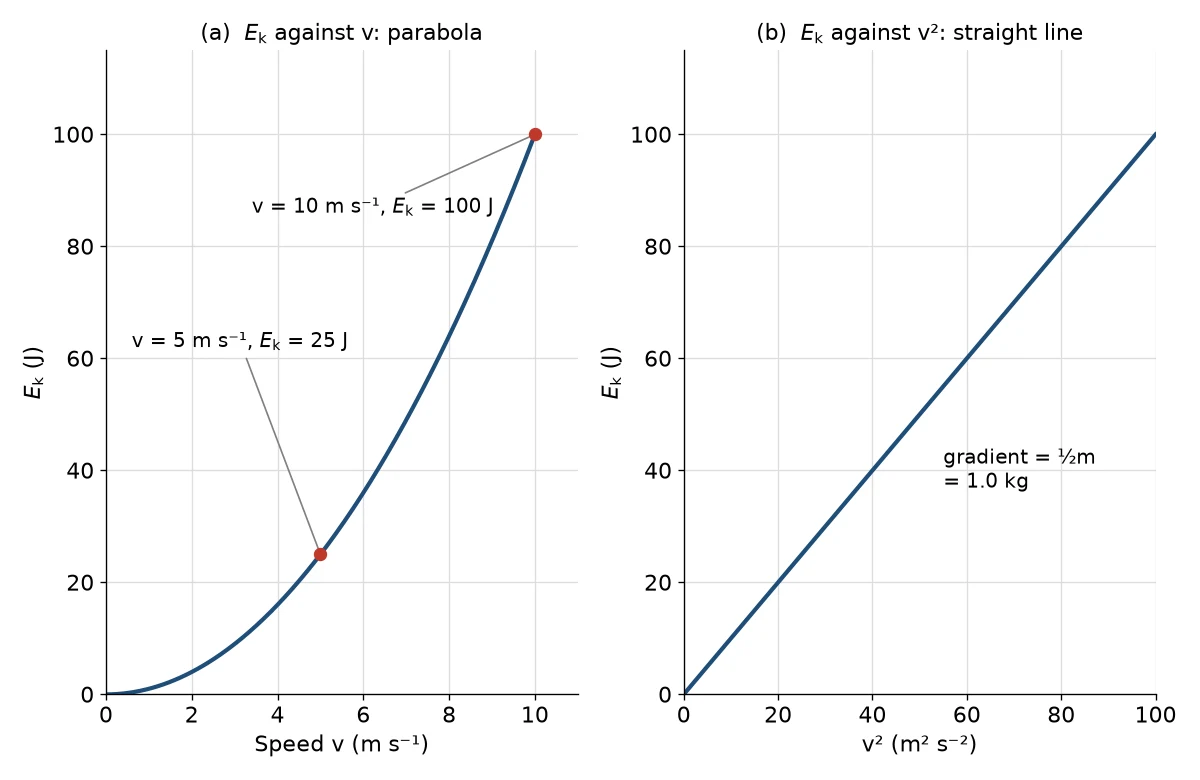
Two graphs of kinetic energy: against speed a parabola, against speed squared a straight line through the origin
Kinetic energy and the momentum of an object
◀ Previous3 / 3
1Kinetic energy depends on the frame of reference2Kinetic energy depends on the frame of reference3Kinetic energy depends on the frame of reference
1Example 1: Kinetic energy of a car · Example 2: Kinetic ener2Worked examples3Worked examples4Worked examples5Worked examples6Worked examples · Example 3: Same motion, two frames of refe
Key terms
| Term | Meaning |
|---|---|
| Translational kinetic energy (K) | The energy an object has because its centre of mass moves, given by K = ½mv2 and measured in joules. |
| Centre of mass | The average position of the mass of an object or system, which moves as if all the mass were concentrated there. |
| Scalar quantity | A quantity that has magnitude and units but no direction, such as kinetic energy. |
| Momentum (p) | The product of mass and velocity, p = mv, measured in kg·m/s. |
| Frame of reference | The viewpoint of an observer from which position, velocity and energy are measured. |
| Joule (J) | The SI unit of energy, equal to one kilogram metre squared per second squared (kg·m2/s2). |
| Rotational kinetic energy | The energy of an object due to its rotation about an axis. It is not included in translational kinetic energy. |
1Avoid these mistakes2Avoid these mistakes3Avoid these mistakes