Curriculum
AP Physics C: Mechanics
1. Kinematics
0/11
2. Force and Translational Dynamics
0/21
-
2. Force and Translational Dynamics
 Preview
-
2.1 Systems and Center of Mass
Preview
-
2.1 Systems and Center of Mass - Check yourself
 Preview
-
2.2 Forces and Free-Body Diagrams
Preview
-
2.2 Forces and Free-Body Diagrams - Check yourself
Preview
-
2.3 Newton’s Third Law
Preview
-
2.3 Newton’s Third Law - Check yourself
Preview
-
2.4 Newton’s First Law
Preview
-
2.4 Newton’s First Law - Check yourself
Preview
-
2.5 Newton’s Second Law
Preview
-
2.5 Newton’s Second Law - Check yourself
Preview
-
2.6 Gravitational Force
Preview
-
2.6 Gravitational Force - Check yourself
Preview
-
2.7 Kinetic and Static Friction
Preview
-
2.7 Kinetic and Static Friction - Check yourself
Preview
-
2.8 Spring Forces
Preview
-
2.8 Spring Forces - Check yourself
Preview
-
2.9 Resistive Forces
Preview
-
2.9 Resistive Forces - Check yourself
Preview
-
2.10 Circular Motion
Preview
-
2.10 Circular Motion - Check yourself
Preview
3. Work, Energy, and Power
0/11
4. Linear Momentum
0/9
5. Torque and Rotational Dynamics
0/13
6. Energy and Momentum of Rotating Systems
0/13
7. Oscillations
0/11
Text lesson
2.7 Kinetic and Static Friction
2.7 Kinetic and Static Friction — AP PHYSICS C: MECHANICS (CALCULUS-BASED) notes: You will be able to describe kinetic friction and static friction between two surfaces, calculate the kinetic friction force and the maximum static friction force from the normal force and the coefficients of friction, and decide whether an object slides or stays at rest.
1
The kinetic friction force exerted on an object is directed opposite to the motion of that surface relative to the other surface.
2
If a block slides to the right across a table, the friction from the table on the block points to the left.
3
Friction is a contact force, and it acts parallel to the surfaces in contact.
4
The force of kinetic friction does not depend on the size of the area of contact.
5
Two blocks with the same mass sliding on a surface experience the same friction, whether they rest on a small face or a large face.
6
The magnitude of the kinetic friction force is the product of the normal force that the surface exerts on the object and the coefficient of kinetic friction:
Here fk is the kinetic friction force in newtons (N), μk is the dimensionless coefficient of kinetic friction, and FN is the magnitude of the normal force in newtons.
The normal force is the component of the force from the surface that is perpendicular to the surface and directed away from it.
The coefficient depends on the materials of the two surfaces in contact.
It is not a property of the object alone.
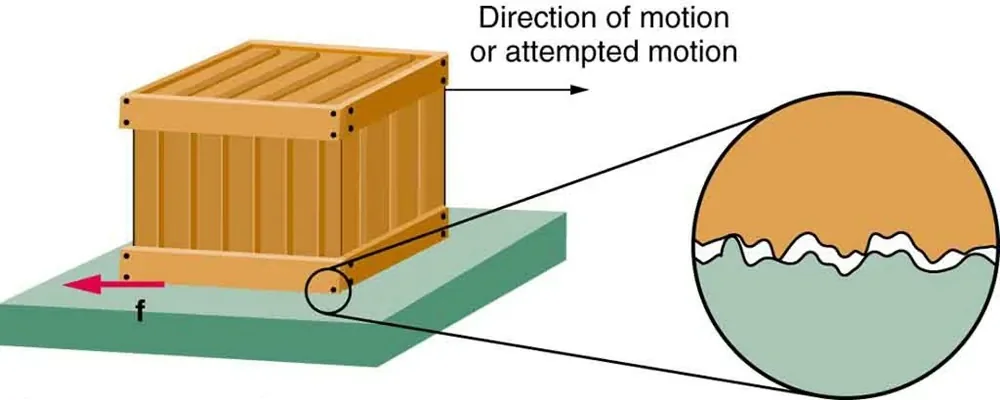
Static friction may occur between the contacting surfaces of two objects that are not moving relative to each other.
It is not given by a fixed formula.
Static friction adopts whatever value and direction is required to prevent an object from slipping or sliding on the surface.
A crate pushed gently across a floor is held in place by static friction that exactly balances the push, so the friction force equals the push in magnitude.
Slipping and sliding both describe situations in which two surfaces move relative to each other.
The static friction force has a maximum value, beyond which it cannot prevent slipping.
This maximum is
fs,max = μsFN
1
Where μs is the coefficient of static friction.
2
The static friction force can take any value from zero up to this maximum, so 0 ≤ fs ≤ μsFN.
3
If the applied force exceeds the maximum, the object begins to slide, and the friction then drops to the kinetic value.
4
For a given pair of surfaces, the coefficient of static friction is typically greater than the coefficient of kinetic friction, so the force needed to start a sliding object moving is usually larger than the force needed to keep it moving.
1
To decide what friction does, first find the force that would act on the object if there were no friction.
2
If this force is less than the maximum static friction, the object does not slide and the static friction equals the force that would otherwise act, in the opposite direction.
3
If the force exceeds the maximum static friction, the object slides and the kinetic friction force, equal to μkFN, acts opposite to the motion.
1
A block stays at rest on a slope if mg sin θ ≤ μsmg cos θ, which is the same as tan θ ≤ μs.
2
If the block slides, the net force along the slope is mg sin θ − μkmg cos θ, and the acceleration down the slope is the net force divided by the mass.
Example 1
Crate pushed across a floor
1
The normal force is FN = mg = 98 N.
2
The maximum static friction is μsFN = (0.50)(98 N) = 49 N.
3
For the 30 N push, which is less than 49 N, the crate does not slide, and static friction is 30 N, opposite to the push.
4
Its acceleration is zero.
5
For the 50 N push, which exceeds 49 N, the crate slides.
6
The kinetic friction is μkFN = (0.40)(98 N) = 39.2 N, opposite to the motion.
7
The net force is 50 N − 39.2 N = 10.8 N, and the acceleration is 10.8 N/10 kg = 1.08 m/s2.
Answer
With a 30 N push, the static friction is 30 N and the crate stays at rest. With a 50 N push, the kinetic friction is 39 N (39.2 N) and the crate accelerates at 1.1 m/s2 (1.08 m/s2).
Example 2
Block on a slope that stays at rest
1
The weight is mg = 49 N.
2
The component along the slope is mg sin 20° = (49 N)(0.342) = 16.8 N, pointing down the slope.
3
The normal force is mg cos 20° = (49 N)(0.940) = 46.0 N.
4
The maximum static friction is μsFN = (0.50)(46.0 N) = 23.0 N.
5
Since 16.8 N is less than 23.0 N, the block does not slide.
Answer
The static friction is 17 N (16.8 N), directed up the slope, and the block stays at rest. Check: tan 20° = 0.364 is less than 0.50, which gives the same conclusion.
Example 3
Block sliding down a slope
1
Take the direction down the slope as positive.
2
The gravitational component along the slope is mg sin 30° = (49 N)(0.500) = 24.5 N, and the normal force is mg cos 30° = (49 N)(0.866) = 42.4 N.
3
The kinetic friction is μkFN = (0.30)(42.4 N) = 12.7 N, acting up the slope.
4
The net force down the slope is 24.5 N − 12.7 N = 11.8 N, so the acceleration is 11.8 N/5.0 kg = 2.4 m/s2.
Answer
The block accelerates down the slope at 2.4 m/s2. This agrees with the general result a = g(sin θ − μk cos θ) = 9.8(0.500 − 0.260) = 2.35 m/s2.
Stating that static friction always equals μsFN
This is only the maximum; the static friction can be any value up to it.
Using the total weight as the normal force on a slope
The normal force is mg cos θ.
Saying that friction opposes the motion of an object
It opposes the relative motion of the two surfaces in contact, and it can even speed up an object, such as a driven wheel.
Making the kinetic friction depend on the area of contact
It depends only on μk and the normal force.
Using μk to decide whether an object starts to move
The decision uses μs, and μk applies only once the surfaces are sliding.
Drawing friction parallel to the applied force when the object is at rest
Static friction points in the direction that prevents the slip, which is opposite to the tendency to slide.