Curriculum
AP Physics C: Mechanics
1. Kinematics
0/11
2. Force and Translational Dynamics
0/21
3. Work, Energy, and Power
0/11
4. Linear Momentum
0/9
5. Torque and Rotational Dynamics
0/13
-
5. Torque and Rotational Dynamics
 Preview
-
5.1 Rotational Kinematics
Preview
-
5.1 Rotational Kinematics - Check yourself
 Preview
-
5.2 Connecting Linear and Rotational Motion
Preview
-
5.2 Connecting Linear and Rotational Motion - Check yourself
Preview
-
5.3 Torque
Preview
-
5.3 Torque - Check yourself
Preview
-
5.4 Rotational Inertia
Preview
-
5.4 Rotational Inertia - Check yourself
Preview
-
5.5 Rotational Equilibrium and Newton’s First Law in Rotational Form
Preview
-
5.5 Rotational Equilibrium and Newton’s First Law in Rotational Form - Check yourself
Preview
-
5.6 Newton’s Second Law in Rotational Form
Preview
-
5.6 Newton’s Second Law in Rotational Form - Check yourself
Preview
6. Energy and Momentum of Rotating Systems
0/13
7. Oscillations
0/11
Text lesson
5.3 Torque
5.3 Torque — AP PHYSICS C: MECHANICS notes: You will be able to identify the torques exerted on a rigid system, calculate the torque of a force about a chosen pivot from its lever arm or from the cross product, and describe a torque with a force diagram.
1
It depends on how large the force is, where it acts and in which direction it pushes.
2
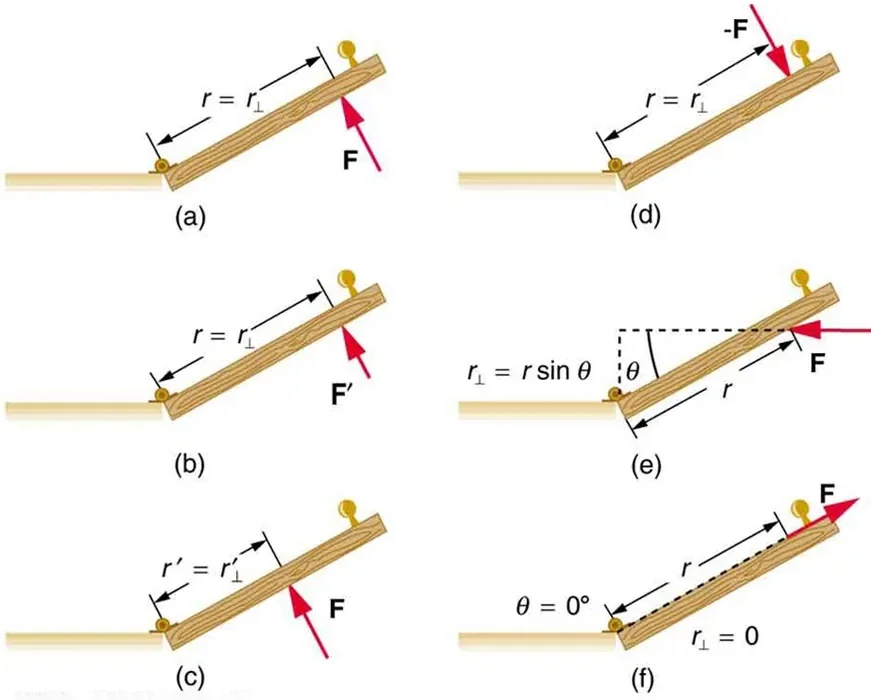
The torque exerted on a rigid system by a force is measured about a chosen pivot point, and it is given by τ = rF sin θ, where r is the distance from the pivot to the point where the force is applied, F is the magnitude of the force, and θ is the angle between the position vector r and the force.
3
The SI unit of torque is the newton metre (N·m).
4
Torque is not energy, so it is not expressed in joules.
5
Only the component of the force perpendicular to the position vector produces torque.
6
The perpendicular distance from the axis of rotation to the line of action of the force is the lever arm, r⊥ = r sin θ.
7
With this definition, τ = r⊥F, which is the same as τ = rF⊥, where F⊥ = F sin θ is the perpendicular component of the force.
8
A force that points along the line joining the pivot and the point of application has a lever arm of zero and exerts no torque about that pivot.
9
Pushing a door at its hinge does nothing, however hard the push.
10
Counterclockwise torques are positive in these notes and clockwise torques are negative.
For two vectors A and B separated by an angle θ, the cross product has magnitude |A × B| = AB sin θ, so the magnitude of the torque is τ = rF sin θ, the same as before.
The direction of the cross-product vector is perpendicular to both A and B, so it is normal to the plane that they define.
The direction is found with the right-hand rule point the fingers of the right hand along the first vector (for a torque, the position vector r), curl them towards the second vector (the force F), and the thumb gives the direction of the result.
For a force that tends to turn a system counterclockwise when viewed from the front, the thumb points out of the page, which corresponds to a positive torque.
If r points along +x and F points along +y, then r × F points along +z, which is out of the page for the usual axes.
The magnitude is rF sin 90° = rF.
1
A force diagram is similar to a free-body diagram.
2
It shows the forces acting on a rigid system, their relative magnitudes and directions, and the points at which they act relative to the axis of rotation.
3
A force diagram for torques therefore includes the location of each force, which a free-body diagram does not need.
4
Drawing it helps to find the lever arm of each force before any calculation is started.
5
The net torque on a rigid system about a chosen pivot is the sum of the torques of all the forces about that pivot: Στ = Σr⊥F.
6
Each term carries a sign from the counterclockwise-positive convention.
7
The same force can produce different torques when it acts at different points, because each point has a different lever arm.
1
Moving the pivot changes the position vectors and therefore the lever arms, so a force may produce a large torque about one pivot and a smaller torque, or none, about another.
2
The torque about a pivot through which a force acts is zero, because the lever arm is zero.
3
Choosing a pivot at the point where an unknown force acts removes that unknown force from the torque equation, which is a common technique in problems on rigid systems.
4
A pivot is the point about which the torques are calculated; it need not be a physical support.
5
Any point can be chosen, but the net torque is zero about all points only when the system is in rotational equilibrium with zero net force, as studied in topic 5.5.
1
(a) The angle between r and F is 90°, so τ = (0.80 m)(20 N)(sin 90°) = 16 N·m
2
(b) The lever arm is r sin 30° = (0.80 m)(0.50) = 0.40 m, so τ = (0.40 m)(20 N) = 8.0 N·m.
Answer
(a) 16 N·m; (b) 8.0 N·m, which is half the perpendicular torque because only the perpendicular component of the force turns the door.
1
τ = rF sin θ = (0.25 m)(40 N) sin 60° = (10 N·m)(0.866) = 8.7 N·m.
Answer
The torque about the bolt is 8.7 N·m, counterclockwise if the force pushes the handle that way.
1
Use counterclockwise as positive.
2
A downward force on the left of the pivot turns the beam counterclockwise, so its torque is +(1.5 m)(98 N) = +147 N·m.
3
A downward force on the right of the pivot turns the beam clockwise, so its torque is −(3.0 m)F.
4
For zero net torque 147 − 3.0F = 0, so F = 49 N.
Answer
The second force must be 49 N, acting downward at 3.0 m to the right of the pivot.
Using the full force instead of its perpendicular component
A force at an angle to the position vector produces less torque than the same force applied perpendicularly.
Using the distance from the pivot to the line of action of the force as r in τ = rF sin θ
The distance from the pivot to the point of application is r, and the angle is measured between r and F.
Writing torque in joules
Torque is measured in newton metres, and it is not a form of energy.
Thinking that a force pointing directly away from the pivot produces a torque
Its lever arm is zero, so its torque is zero.
Mixing sign conventions within one problem
Choose counterclockwise as positive at the start and apply it to every torque.