Curriculum
AP Physics C: Mechanics
1. Kinematics
0/11
2. Force and Translational Dynamics
0/21
3. Work, Energy, and Power
0/11
4. Linear Momentum
0/9
5. Torque and Rotational Dynamics
0/13
6. Energy and Momentum of Rotating Systems
0/13
7. Oscillations
0/11
-
7. Oscillations
 Preview
-
7.1 Defining Simple Harmonic Motion (SHM)
Preview
-
7.1 Defining Simple Harmonic Motion (SHM) - Check yourself
 Preview
-
7.2 Frequency and Period of SHM
Preview
-
7.2 Frequency and Period of SHM - Check yourself
Preview
-
7.3 Representing and Analyzing SHM
Preview
-
7.3 Representing and Analyzing SHM - Check yourself
Preview
-
7.4 Energy of Simple Harmonic Oscillators
Preview
-
7.4 Energy of Simple Harmonic Oscillators - Check yourself
Preview
-
7.5 Simple and Physical Pendulums
Preview
-
7.5 Simple and Physical Pendulums - Check yourself
Preview
Text lesson
7.1 Defining Simple Harmonic Motion (SHM)
7.1 Defining Simple Harmonic Motion (SHM) — AP PHYSICS C: MECHANICS notes: You will be able to state the condition that makes motion simple harmonic, identify whether a given system is in SHM from its restoring force, and locate the equilibrium position of an oscillating object.
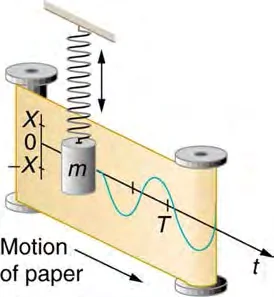
1
A swinging pendulum, a bobbing buoy and a mass moving up and down on a spring all return to the same state after a fixed time.
2
Simple harmonic motion (SHM) is a special case of periodic motion, one in which the repeated motion has a particularly simple mathematical form.
3
Every SHM is periodic, but a periodic motion is not necessarily SHM.
4
A bouncing ball repeats its motion, yet its restoring force is not of the type described below, so its motion is not SHM.
5
The word harmonic refers to the fact that the motion can be described by a sine or cosine function of time.
6
The rest of Unit 7 builds on this description, so it is important to know what physical condition produces it.
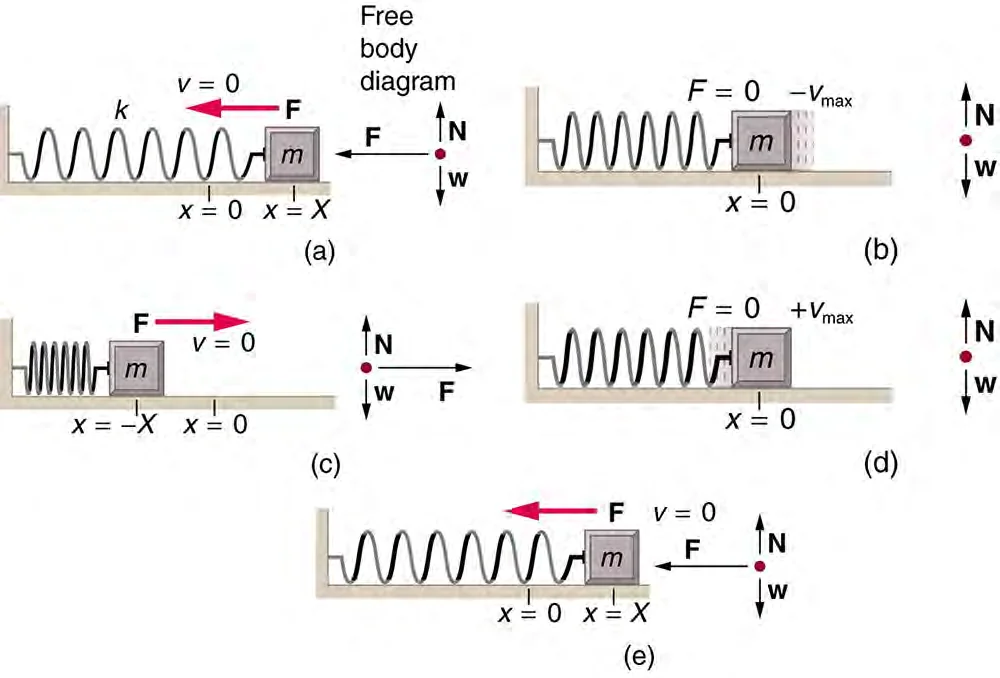
If an object is placed there at rest, it stays at rest.
For a mass hanging from a spring, the equilibrium position is the point where the upward spring force balances the downward weight.
Displacement in SHM is always measured from this position.
A restoring force is a force that is exerted in a direction opposite to the object’s displacement from the equilibrium position.
It acts to bring the object back towards equilibrium.
When the object is displaced to the right of equilibrium, the restoring force points to the left, and when it is displaced to the left, the restoring force points to the right.
The restoring force is what makes the object oscillate rather than move away.
1
SHM results when the magnitude of the restoring force exerted on an object is proportional to the object’s displacement from its equilibrium position.
2
In the one-dimensional case, with the origin at equilibrium and displacement x measured in metres (m), the restoring force can be written as Fx = −kx.
3
Here k is a positive constant called the force constant, measured in newtons per metre (N/m), and the minus sign shows that the force opposes the displacement.
4
This is the form of Hooke’s law for an ideal spring.
5
Newton’s second law applied to a mass m, measured in kilograms (kg), gives max = −kx, so the acceleration is ax = −(k/m)x.
6
The acceleration is proportional to the displacement and always points towards equilibrium.
7
This is the defining feature of SHM.
8
In topic 7.3 this relation becomes a second-order differential equation, and its solution gives the position as a function of time.
9
The test is the proportionality, not the particular form of the force.
10
If the restoring force is proportional to displacement, the motion is SHM, however the force is produced.
11
If the proportionality fails, the motion is not SHM, even though it may be periodic and approximately similar.
1
1When a pendulum bob of mass m is displaced through an angle θ from the vertical, the tangential component of gravity acts as a restoring force of magnitude mg sin θ, where g is the gravitational field strength at Earth’s surface, taken as 9.8 m/s2.
2
For a displacement measured along the arc, s = Lθ, the restoring force is F = −(mg/L)s when θ is small, because sin θ is approximately θ in radians.
3
Over a small arc the restoring force is therefore proportional to the displacement, and the pendulum is in SHM to a very good approximation.
4
At large angles the proportionality fails and the motion is no longer SHM.
5
Some motions are not SHM.
6
1An object sliding on a rough surface experiences a friction force of constant magnitude, which does not depend on displacement, so its motion is not SHM.
7
An object falling under gravity alone has a constant acceleration, which is not proportional to any displacement.
8
A ball bouncing between a floor and a ceiling is not SHM either.
9
4Between collisions its acceleration is constant and equal to g, which is not proportional to displacement, and its velocity reverses abruptly at each collision.
10
To test a set of force and displacement data, compute the ratio of force to displacement for each measurement.
11
For a spring, the ratio of the restoring force to the displacement is the constant −k, so the ratio is the same for every displacement.
12
If the ratio changes with displacement, the restoring force is not proportional to displacement and the motion is not SHM.
1
The restoring force magnitude is F = kx = (80 N/m)(0.10 m) = 8.0 N
2
It points back towards equilibrium
3
Taking the displacement as positive, Fx = −8.0 N
4
The acceleration is ax = Fx/m = −8.0 N/0.40 kg = −20 m/s2.
Answer
The restoring force has magnitude 8.0 N and points towards equilibrium. The acceleration is 20 m/s2 towards equilibrium.
1
The ratio F/x is −0.60 N/0.10 m = −6.0 N/m at each displacement, so the restoring force is proportional to displacement and opposite to it.
2
The motion is SHM with force constant k = 6.0 N/m.
3
The acceleration is a = −(k/m)x = −(6.0/1.5)x = −4.0x (m/s2).
4
Comparing with the form −ω2x gives ω2 = 4.0 s−2, so ω = 2.0 rad/s.
Answer
The motion is SHM, with force constant 6.0 N/m and angular frequency 2.0 rad/s.
1
For a small angle the restoring force is F = −(mg/L)s, so the effective force constant is k = mg/L = (0.20 kg)(9.8 m/s2)/(1.5 m) = 1.31 N/m
2
The restoring force magnitude is F = (1.31 N/m)(0.075 m) = 0.098 N.
Answer
The restoring force has magnitude 0.098 N and points towards equilibrium. The effective force constant is about 1.3 N/m, and the pendulum behaves like a spring with this constant for small displacements.
Calling every periodic motion simple harmonic motion
SHM requires the restoring force to be proportional to displacement, so a repeating motion with a different force law is not SHM.
Assuming the equilibrium position is where the object is at rest
At equilibrium the net force is zero, but the object may be moving at its greatest speed.
Giving the restoring force the same direction as the displacement
The restoring force always points towards equilibrium, opposite to the displacement.
Using the small-angle approximation sin θ ≈ θ with θ in degrees
The approximation requires θ in radians, and it is accurate only for small angles.
Concluding that a restoring force of any shape gives SHM
Only a force proportional to displacement does; a constant friction force, for example, does not.
Avoid
Forgetting that the displacement is measured from equilibrium, not from the starting point of a motion that is not at equilibrium